
LinkedIn Ads or outbound: where a small B2B budget goes first
LinkedIn Ads for B2B can work, but for most small companies outbound should come first. Outbound means reaching out to buyers you picked yourself, by email or LinkedIn message. It costs mostly time, reaches exactly the people you choose, and often shows within weeks whether your offer gets replies.
LinkedIn Ads fit later, when your buyer list is big enough, one won deal is worth many paid clicks, and the offer already works. Outbound first, ads later is the rule we suggest.
What LinkedIn Ads for B2B really cost
You can start at $10 a day, but a test that tells you something costs far more.
LinkedIn's budget page sets that floor and asks for at least $100 in total per new campaign (as of November 2026). The same page says the floor collects data slowly.
LinkedIn can charge for clicks, views or messages sent, depending on the campaign (LinkedIn). Cost per click, the easiest to picture, is what you pay each time someone clicks your ad.
Kiin, a LinkedIn Ads agency, tracks more than 1,000 advertiser accounts. It reports a typical (median) cost of $13.63 per click to your website on single image ads, the simple one-picture kind.
Even as rough agency data, that means $10 a day buys less than one site visit a day.
One LinkedIn Ads specialist, AJ Wilcox, aims much higher. In 2018, Wilcox called $3,000 to $5,000 a month "the minimum I'd advise budgeting for LinkedIn campaigns" on LinkedIn's blog.
A common outbound tool like Sales Navigator costs US$119.99 a month for its Core plan (as of November 2026, may exclude VAT).
| What you compare | Outbound | LinkedIn Ads |
|---|---|---|
| Main cost | Your time, plus a few tools | Money for clicks, views or messages |
| What you learn first | Whether buyers reply | Who clicks, slowly on small budgets |
| What usually breaks it | A weak offer or sloppy list | Too little budget or audience |
Why outbound usually comes first
Outbound is the cheaper way to find out whether buyers want your offer. You pay with your own time and a list, not with an ad budget.
Don't expect many replies. Belkins, an outbound agency, measured an average cold email reply rate of 0.45% across the 2025 campaigns it ran for clients.
So judge outbound by conversations and booked calls (sales meetings on the calendar).
Outbound also teaches you the market. The startup Merge sent hundreds of cold emails over six months and talked to 100 companies, First Round Review reports.
In our view, a small team reads outbound results faster, and you control the volume. Then pick which outbound channel to start with.
If outbound sounds like more hard work, this video offers another angle. Sabir explains why working harder no longer drives growth and lays out a system-based framework instead.
Outbound has rules, and they differ by country. Germany's unfair competition law requires a clear OK before you send advertising email, even to businesses, with one narrow exception for existing customers.
In the UK, the regulator ICO says you don't need consent to email most companies. Sole traders count as individuals, and the guidance is under review. Check with a lawyer for your markets, for email and LinkedIn messages.
When LinkedIn Ads are worth testing
LinkedIn Ads are worth testing when four things are true. Your list is big enough, one deal is worth many clicks, your offer already gets replies, and someone follows up fast.
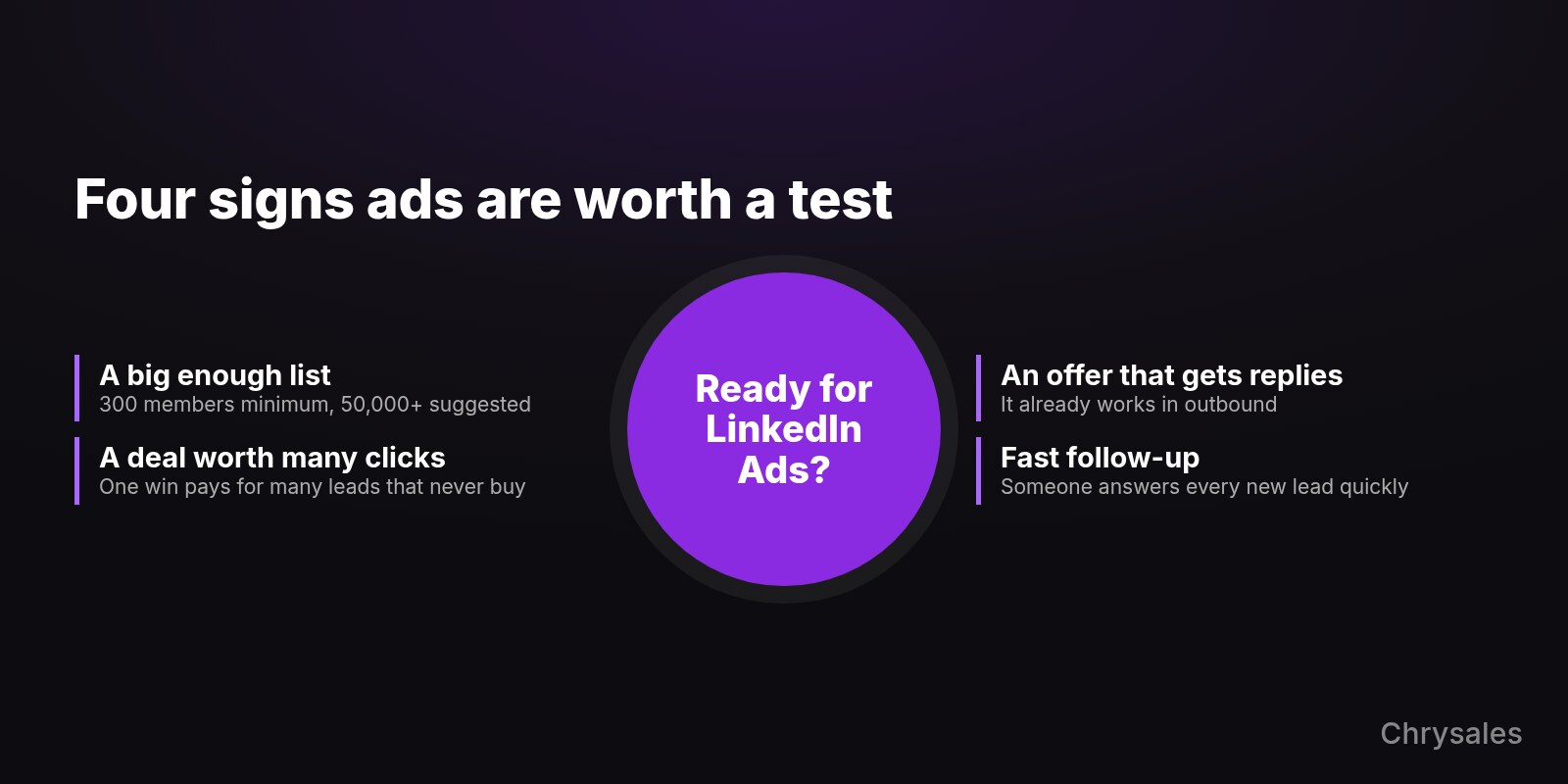
An audience is the group of LinkedIn users who can see your ad. LinkedIn needs at least 300 of them before an ad runs, and suggests 50,000 or more for results.
You can also aim ads at an uploaded company list, a file of the companies you want to reach. It needs at least 300 rows, so a list of 200 can't even be uploaded, and LinkedIn recommends 1,000 or more companies.
Then there is cost. Kiin's agency data puts a typical demo-request lead at $350, so one won deal has to pay for many leads that never buy.
Your offer should also get replies in outbound first, and someone has to answer new leads fast. A Lead Gen Form, a form inside LinkedIn that fills in from the person's profile, makes signing up easy at no extra cost.
"A form cannot rescue imprecise targeting," writes Paige Stuhrenberg of the B2B marketing agency Directive. See also the wider list of lead channels.
How to use both on one list
Once outbound works, ads can warm up the companies you are already contacting. Buyers may then see your name in their feed while your messages arrive.
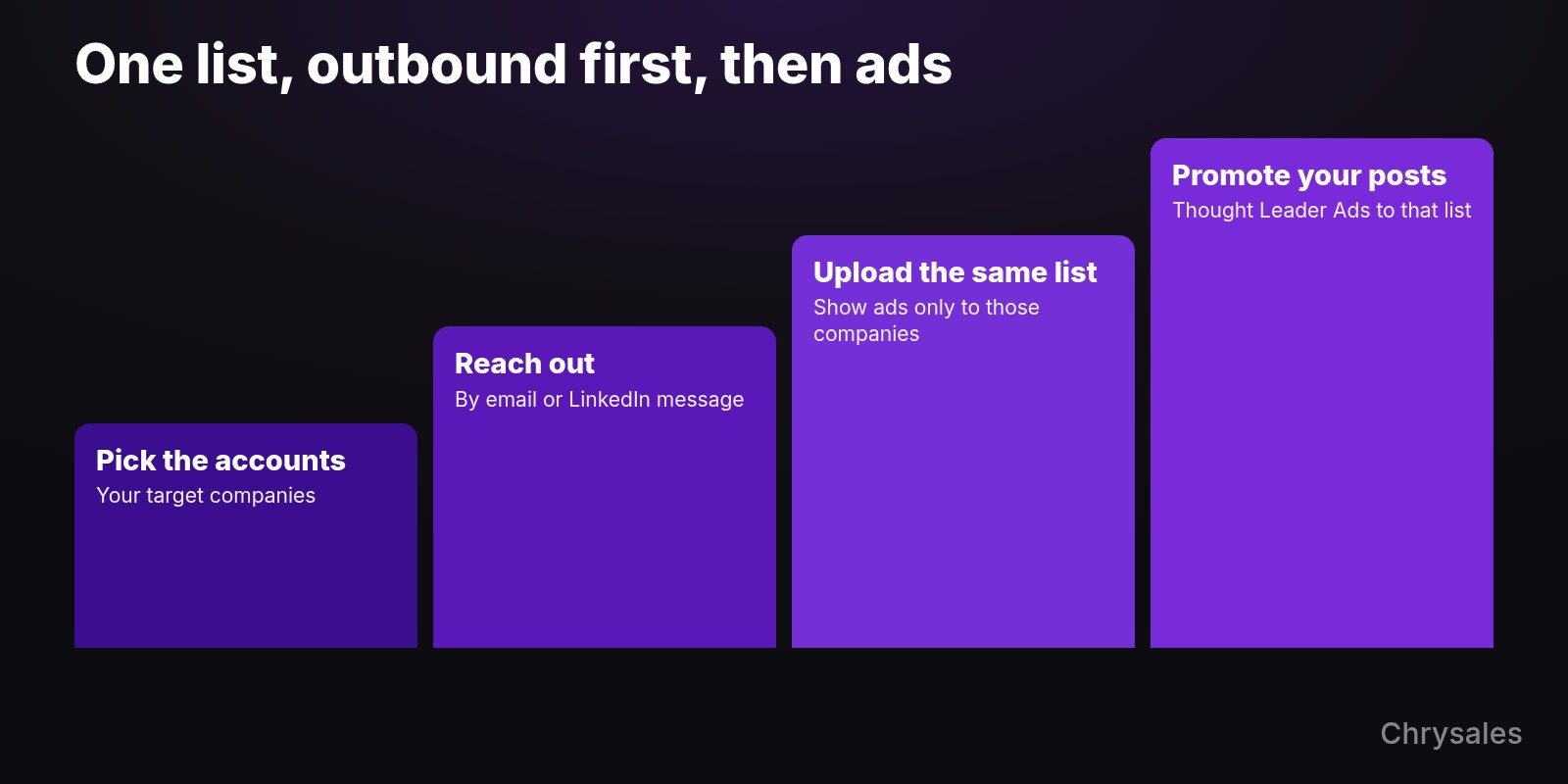
This works because your outreach has already tested a short list of target companies, so ad money goes to companies you know fit.
The Thought Leader Ad fits well here. It is a post written by one of your people, for example you, that your company pays to promote. That person has to approve it.
In LinkedIn's own customer story, Smokeball cut customer testimonial videos into short clips that customers posted on their own profiles. It then promoted them as Thought Leader Ads, aimed with LinkedIn's Matched Audiences.
LinkedIn reports these ads earned 186% more per ad dollar than a regular video ad with the same videos.
A small test with a stop line
We suggest testing one channel for a fixed time, counting booked calls, and deciding in advance when to stop.
- Pick 50 to 100 target buyers and one clear offer.
- Run outbound to them for four weeks.
- Count replies and booked calls every week, not opens or likes.
- If four weeks of outbound bring no booked calls, fix the offer before you spend on ads.
- Test ads only after that, with a cost per booked call set in advance, and stop if you go above it.
Going by Wilcox's advice, if you can't spend about $3,000 a month on ads, a test may give you too little data to judge.
Count calls, not clicks. "Clicks don't pay the bills, pipeline quality does," Jae Oh, head of ads measurement at LinkedIn, told Digiday.
Conclusion: Start with outbound, then add ads
This month, pick your list and one offer, start outbound to 50 to 100 buyers, and write down your stop line.
Add LinkedIn Ads once outbound books calls and you can afford a real test. In our view, ads can make sense sooner if your list is large and one deal is worth many clicks.
Outbound isn't free either. It costs time and needs care with the rules where you sell. Either channel is one part of your client acquisition system, next to your offer, list, follow-up and closing.
Not sure which channel to fund first? On a free strategy call, Chrysales can help you choose the first channel and plan your outbound test. Plan your first channel test on a free call
LinkedIn Ads for B2B can work, but for most small companies outbound should come first. Outbound means reaching out to buyers you picked yourself, by email or LinkedIn message. It costs mostly time, reaches exactly the people you choose, and often shows within weeks whether your offer gets replies.
LinkedIn Ads fit later, when your buyer list is big enough, one won deal is worth many paid clicks, and the offer already works. Outbound first, ads later is the rule we suggest.
What LinkedIn Ads for B2B really cost
You can start at $10 a day, but a test that tells you something costs far more.
LinkedIn's budget page sets that floor and asks for at least $100 in total per new campaign (as of November 2026). The same page says the floor collects data slowly.
LinkedIn can charge for clicks, views or messages sent, depending on the campaign (LinkedIn). Cost per click, the easiest to picture, is what you pay each time someone clicks your ad.
Kiin, a LinkedIn Ads agency, tracks more than 1,000 advertiser accounts. It reports a typical (median) cost of $13.63 per click to your website on single image ads, the simple one-picture kind.
Even as rough agency data, that means $10 a day buys less than one site visit a day.
One LinkedIn Ads specialist, AJ Wilcox, aims much higher. In 2018, Wilcox called $3,000 to $5,000 a month "the minimum I'd advise budgeting for LinkedIn campaigns" on LinkedIn's blog.
A common outbound tool like Sales Navigator costs US$119.99 a month for its Core plan (as of November 2026, may exclude VAT).
| What you compare | Outbound | LinkedIn Ads |
|---|---|---|
| Main cost | Your time, plus a few tools | Money for clicks, views or messages |
| What you learn first | Whether buyers reply | Who clicks, slowly on small budgets |
| What usually breaks it | A weak offer or sloppy list | Too little budget or audience |
Why outbound usually comes first
Outbound is the cheaper way to find out whether buyers want your offer. You pay with your own time and a list, not with an ad budget.
Don't expect many replies. Belkins, an outbound agency, measured an average cold email reply rate of 0.45% across the 2025 campaigns it ran for clients.
So judge outbound by conversations and booked calls (sales meetings on the calendar).
Outbound also teaches you the market. The startup Merge sent hundreds of cold emails over six months and talked to 100 companies, First Round Review reports.
In our view, a small team reads outbound results faster, and you control the volume. Then pick which outbound channel to start with.
If outbound sounds like more hard work, this video offers another angle. Sabir explains why working harder no longer drives growth and lays out a system-based framework instead.
Outbound has rules, and they differ by country. Germany's unfair competition law requires a clear OK before you send advertising email, even to businesses, with one narrow exception for existing customers.
In the UK, the regulator ICO says you don't need consent to email most companies. Sole traders count as individuals, and the guidance is under review. Check with a lawyer for your markets, for email and LinkedIn messages.
When LinkedIn Ads are worth testing
LinkedIn Ads are worth testing when four things are true. Your list is big enough, one deal is worth many clicks, your offer already gets replies, and someone follows up fast.
An audience is the group of LinkedIn users who can see your ad. LinkedIn needs at least 300 of them before an ad runs, and suggests 50,000 or more for results.
You can also aim ads at an uploaded company list, a file of the companies you want to reach. It needs at least 300 rows, so a list of 200 can't even be uploaded, and LinkedIn recommends 1,000 or more companies.
Then there is cost. Kiin's agency data puts a typical demo-request lead at $350, so one won deal has to pay for many leads that never buy.
Your offer should also get replies in outbound first, and someone has to answer new leads fast. A Lead Gen Form, a form inside LinkedIn that fills in from the person's profile, makes signing up easy at no extra cost.
"A form cannot rescue imprecise targeting," writes Paige Stuhrenberg of the B2B marketing agency Directive. See also the wider list of lead channels.
How to use both on one list
Once outbound works, ads can warm up the companies you are already contacting. Buyers may then see your name in their feed while your messages arrive.
This works because your outreach has already tested a short list of target companies, so ad money goes to companies you know fit.
The Thought Leader Ad fits well here. It is a post written by one of your people, for example you, that your company pays to promote. That person has to approve it.
In LinkedIn's own customer story, Smokeball cut customer testimonial videos into short clips that customers posted on their own profiles. It then promoted them as Thought Leader Ads, aimed with LinkedIn's Matched Audiences.
LinkedIn reports these ads earned 186% more per ad dollar than a regular video ad with the same videos.
A small test with a stop line
We suggest testing one channel for a fixed time, counting booked calls, and deciding in advance when to stop.
- Pick 50 to 100 target buyers and one clear offer.
- Run outbound to them for four weeks.
- Count replies and booked calls every week, not opens or likes.
- If four weeks of outbound bring no booked calls, fix the offer before you spend on ads.
- Test ads only after that, with a cost per booked call set in advance, and stop if you go above it.
Going by Wilcox's advice, if you can't spend about $3,000 a month on ads, a test may give you too little data to judge.
Count calls, not clicks. "Clicks don't pay the bills, pipeline quality does," Jae Oh, head of ads measurement at LinkedIn, told Digiday.
Conclusion: Start with outbound, then add ads
This month, pick your list and one offer, start outbound to 50 to 100 buyers, and write down your stop line.
Add LinkedIn Ads once outbound books calls and you can afford a real test. In our view, ads can make sense sooner if your list is large and one deal is worth many clicks.
Outbound isn't free either. It costs time and needs care with the rules where you sell. Either channel is one part of your client acquisition system, next to your offer, list, follow-up and closing.
Not sure which channel to fund first? On a free strategy call, Chrysales can help you choose the first channel and plan your outbound test. Plan your first channel test on a free call
Scaling Is Not Hard If You Have The Right Systems
If you’re serious about leveling up your scaling game, you need the right system, the right training, and the right team behind you. We're here to give you the exact tools and strategies top entrepreneurs use to dominate.

Discover the latest tips
View All
Chrysales was formed from the words "chrysalis" the stage where a caterpillar transforms into a butterfly and "sales".
It stands for one thing: sales transformation.Because scaling doesn’t happen by doing more of the same. Scaling only happens when you go through real transformation in your systems, your offer, team and the way you sell.


