.avif)
What Lead Generation Companies for Small Businesses Won't Tell You
Lead generation companies for small businesses help you find leads, but the real value comes from turning those leads into clients with a working system.
Quick question: How many times have you heard "you need more leads" without anyone explaining how to get them in a way that actually works?
Most small businesses burn through budgets on lead generation companies that promise the moon and deliver a spreadsheet full of cold emails that never reply.
Here's the thing nobody tells you upfront: most lead generation companies for small businesses sell you a list or a tool, but they don't build you a system that turns those leads into clients. That's the gap.
Let's break down what actually matters when you're looking for help with lead generation, what to watch out for, and how to think about building something that works long-term.
What Lead Generation Companies for Small Businesses Actually Do
Most people think lead generation companies hand you a magic list of people ready to buy. The reality is way less exciting.
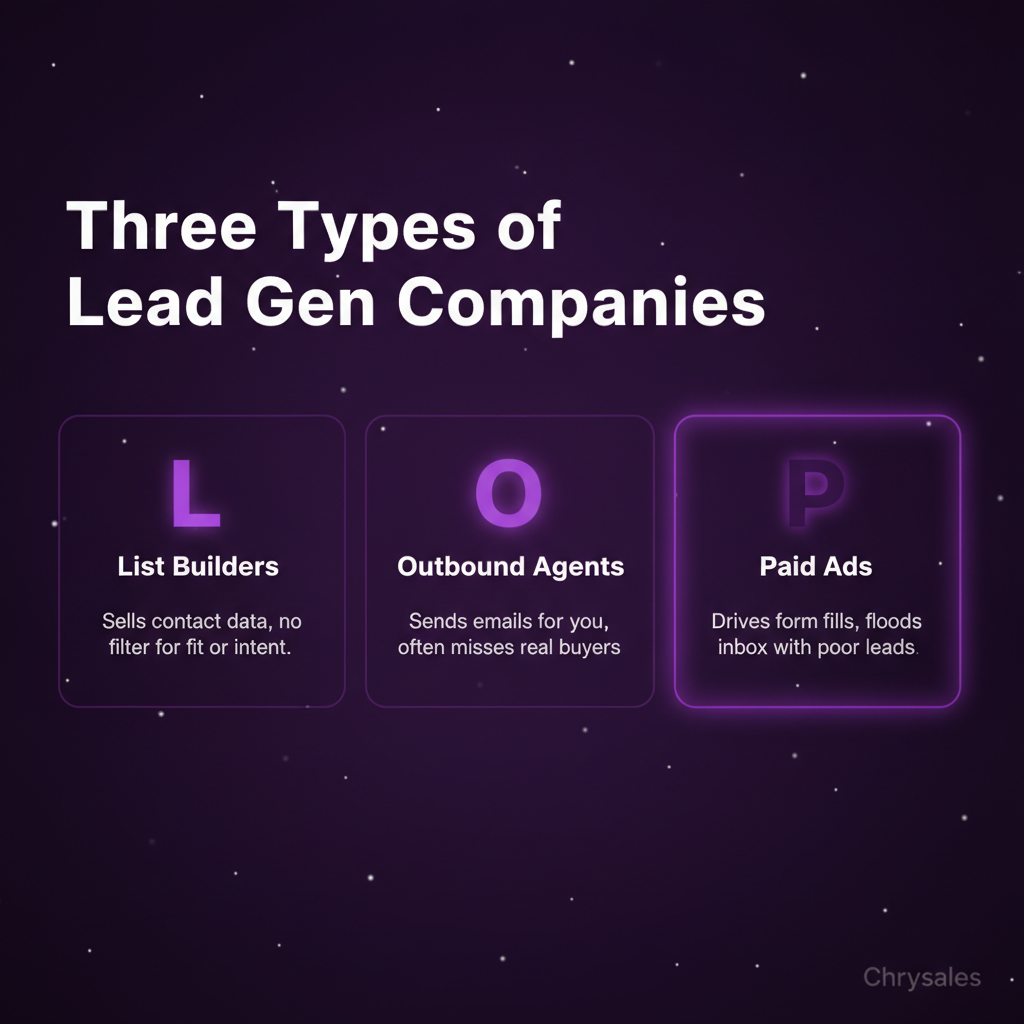
These companies fall into a few buckets, and understanding the difference will save you months of wasted spend.
List Builders and Data Providers
These companies scrape LinkedIn, use public databases, and sell you contact lists. You get names, emails, job titles, sometimes phone numbers.
The problem? A 200-person company that just did layoffs is not a "hot lead." It's a bad fit, full stop. You're paying for volume, not relevance.
Think of it like buying a phone contact list where half the numbers don't work and the other half are people who don't want to talk to you.
Outbound Agencies
These companies take your offer and run cold email or LinkedIn outreach campaigns on your behalf. They build the list, write the messages, send thousands of emails, and book meetings for you.
Sounds great, except when the messages sound like they were written by a robot, the targeting is off, and you end up on sales calls with people who have no budget or authority.
A 30-person consulting firm tried this last quarter. They booked 12 calls in 3 weeks, but only one was a real fit. The rest were tire-kickers.
Paid Lead Generation Services
Some companies run ads for you on Google, LinkedIn, or Facebook and send you the leads that fill out a form. This works if your offer is clear and your ad targeting is tight.
But most small business sales systems can't handle a flood of unqualified form fills. You end up with a inbox full of "just browsing" leads and no time to follow up on the good ones.
Pro Tip: Before you hire any lead generation company, ask them how they define a qualified lead for your business. If they can't answer that clearly, walk away.
Why Most Lead Generation Fails (and It's Not the Company's Fault)
Here's where it gets interesting. Most lead generation companies for small businesses do exactly what they promise. They generate leads.
The problem is that generating leads and converting leads into clients are two totally different things.
Picture this: you spend two weeks building a perfect email campaign, but your list is full of people who aren't even buyers. That's the trap.
The List Does Most of the Heavy Lifting
One marketing agency had a 0.5% reply rate on cold outreach. After fixing their list to target companies with actual buying signals, it jumped to 4%. Same emails. Same sender. Different list.
Most cold emails flop because the list is bad, not the words. If you're working with a lead generation firm, ask them how they filter for intent, timing, and fit.
If the answer is "we send to everyone in your industry," that's a red flag. Understanding cold email response rates benchmarks can help you gauge whether your targeting is actually working.
No Sales System on the Back End
Let's say the leads show up. Now what? Do you have a script? A discovery call structure? A way to handle objections? Most teams don't.
We see this all the time with new clients. They pay for leads, book a few calls, fumble the pitch, and blame the lead quality.
The truth is, even a great lead will bounce if your sales process is a mess. A good sales system is like a recipe. Follow the steps, get the same dish every time.
Watch out: If you're signing up for a lead generation service and you don't have a repeatable way to close deals, you're setting yourself up for expensive disappointment. Learn how to build a sales system that actually scales before ramping up your lead flow.
What to Look For in a Lead Generation Company (the Real Checklist)
If you're shopping around for lead generation companies for small businesses, here's what actually matters. Most comparison blogs focus on pricing and reviews. Those are fine, but they miss the bigger picture.
Targeting Precision Over Volume
A thousand leads mean nothing if none of them are buyers. Ask how the company builds their lists. Do they use firmographics like company size, revenue, tech stack, recent funding, hiring trends? Or do they just scrape LinkedIn for job titles?
The best lead gen companies layer multiple signals to find companies that are actually in the market. For more on this approach, watch these 4 ways to find clients who need your services right now.
One tech company we worked with switched from a broad outreach agency to a precision-targeted partner and cut their list size by 70%, but doubled their meeting-booked rate.
Flexibility and Customization
Most lead generation businesses sell packages. You get what you get. But B2B sales for a consulting firm looks totally different than B2B lead generation for a software company.
If the company can't tailor their approach to your offer, your ideal customer profile, and your sales process, you're going to waste time and money. Understanding proven B2B sales tips can help you evaluate whether an agency's approach matches what actually works.
Ask if they build custom filters, write personalized outreach, or just plug your name into a template.
Reporting and Lead Scoring
How do you know if a lead is worth calling? The top lead generation companies give you some kind of scoring system.
Simple signals like recent job changes, company growth, website visits, or engagement with your outreach tell you who to prioritize. Using buying signals to follow up and close deals is critical for maximizing conversion rates.
Set a simple rule: anything scoring above 70 goes to the top of your call list. Anything under 40 gets a follow-up sequence, not a call.
Common mistake: Most teams treat every lead the same. That's like calling every number in your phone and hoping someone answers. Prioritize based on fit and intent, not just order of arrival.
The Hidden Costs of Outsourced Lead Generation
Let's talk money. Most lead generation companies for small businesses charge anywhere from $1,500 to $10,000 per month depending on volume, channels, and customization.
Sounds reasonable until you add up the hidden costs.
Your Time
Even if the company books the meetings, you still have to show up and close. If you're spending 10 hours a week on calls with bad-fit leads, that's 40 hours a month you could have spent actually running your business.
We worked with a tech company who hired three salespeople in a month. Two quit within 60 days. The fix wasn't more hiring, it was the system around the hires.
Brand Risk
If your lead generation firm sends spammy cold emails from your domain, you risk landing in spam folders, getting your domain blacklisted, or just looking desperate.
LinkedIn lead generation B2B is huge right now, but if the outreach feels robotic or pushy, it damages your brand.
Once you're known as "that company that sends weird messages," it's hard to recover.
Opportunity Cost
Every dollar you spend on a lead generation service that doesn't convert is a dollar you didn't spend on something that might.
Some small businesses blow through $30k in six months on outsourced lead generation services without a single closed deal. Not because the company was bad, but because the sales system wasn't ready.
Pro Tip: Start with a small test budget. Run one or two months with a lead generation company and measure real outcomes: meetings booked, qualified opportunities, and revenue closed. If it's not working by month two, pivot fast.
When to Build In-House vs. Hire a Lead Generation Company
Here's the part most blogs skip. Sometimes the answer isn't hiring a lead generation firm. Sometimes it's building your own small business sales system.
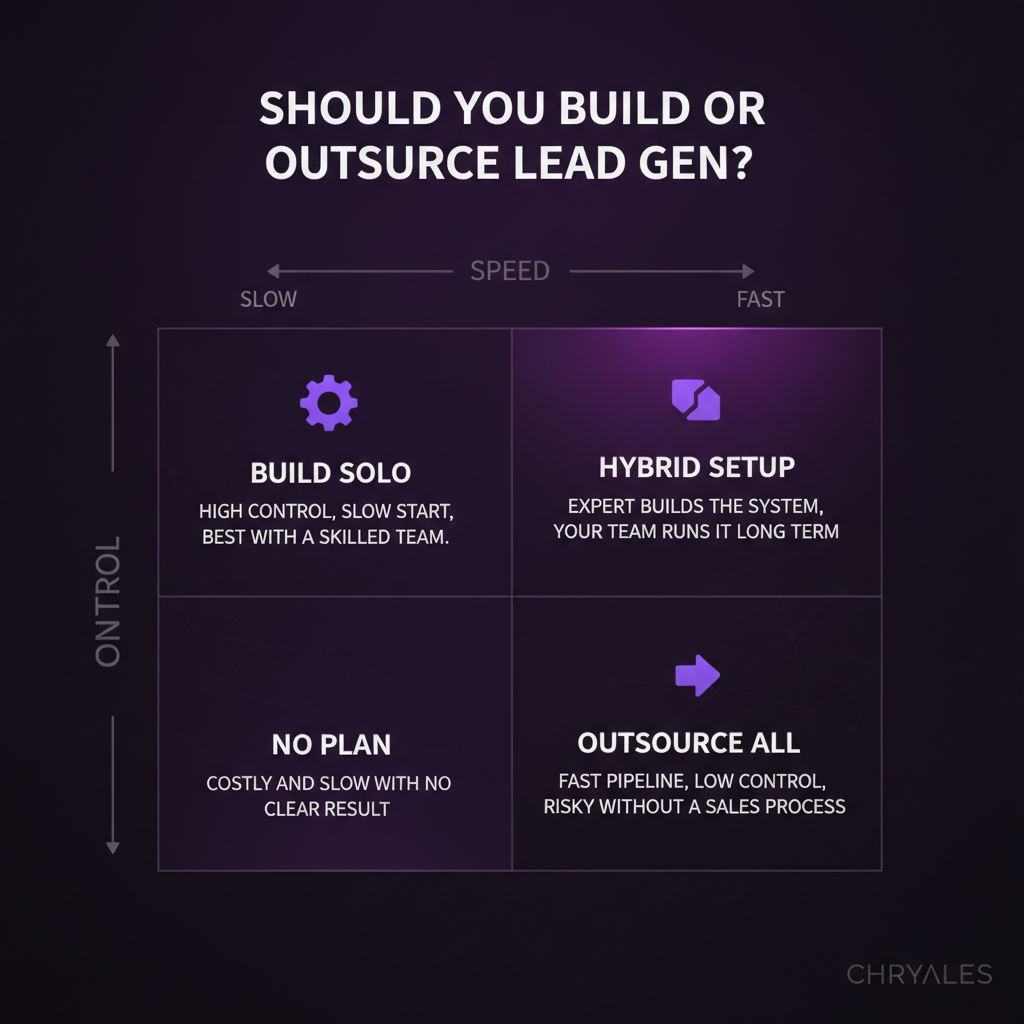
Build In-House If You Have the Time and Talent
If you've got someone on your team who understands B2B sales, can build lists, write emails, and track results, you might not need to outsource.
Tools like LinkedIn Sales Navigator, Apollo, and Clay make it possible to run your own predictable client acquisition engine. You'll move slower at first, but you'll own the system.
Most teams build a 40-step workflow when 12 steps would do the job. Keep it simple.
Outsource If You Need Speed or Expertise
If you're a 15-person consulting firm and nobody on your team has done outbound before, hiring a lead generation company makes sense. Same if you're scaling fast and don't have time to learn.
Just make sure whoever you hire is teaching you as they go. Exploring different outbound sales strategy platforms and agencies can help you understand what approach fits your business best.
If they won't share the list, the scripts, or the process, you're renting results, not building a system.
Hybrid Approach: Hire for Setup, Run It Yourself
This is what we see working best. You bring in a sales training expert or a lead generation specialist to build the system, train your team, and hand it off.
You keep control, but you skip the trial-and-error phase. Learn how to build a sales system so powerful clients come to you and you'll understand why this approach works so well.
Think of it like hiring a personal trainer for three months to teach you how to lift, then hitting the gym on your own after that.
Watch out: Some lead generation companies lock you into long contracts with no exit. If you're testing a new channel, insist on month-to-month or a three-month pilot with a clear success metric.
How to Vet Lead Generation Companies Before You Sign
Okay, you've decided to hire help. Now how do you pick the right one?
Most small business owners Google "best lead gen companies" and click the first five results. That's not a strategy. Here's a better way.
Ask for Case Studies in Your Industry
If they say they work with everyone, they probably don't work well with anyone. A company that specializes in LinkedIn lead generation B2B for consulting firms will understand your buyer better than a generalist.
Ask for examples: What industries? What was the reply rate? How many meetings turned into deals? If they won't share numbers, that's a red flag.
Test Their Targeting Logic
Ask them to build a sample list of 50 leads for your business. If the list is generic or full of bad fits, you know what you're getting.
One marketing agency we worked with did this test with three different companies. Two came back with junk. One nailed it. Guess who got the contract.
Check How They Handle Objections and Replies
What happens when a lead replies "not interested" or "call me in six months"? Do they have a follow-up sequence? Do they tag the lead for future outreach? Or does it just disappear into a spreadsheet?
The best lead generation companies treat every reply as data, not just a yes or no. Looking at current B2B sales statistics can help you set realistic expectations for reply and conversion rates.
Look at Their Team and Tools
Are they using AI to score leads, automate follow-ups, and personalize outreach? Or are they still manually copy-pasting emails?
Cold outreach for small businesses is getting more competitive every year. If the company you're hiring isn't using modern tools, you're already behind.
Common mistake: Hiring based on price alone. The cheapest lead generation company is usually cheap for a reason. You want quality, not just quantity.
What Happens After the Leads Come In (the Part Nobody Talks About)
Let's say you hired a great lead generation company. The leads are flowing. Meetings are booked. Now what?
This is where most small businesses drop the ball.
You Need a Sales Call Structure
Every discovery call should follow the same basic flow: intro, pain discovery, solution fit, objection handling, next steps. If your team is winging it, half your leads will walk away confused.
We see this all the time. A company spends $5k on leads, then loses deals because the sales call was all over the place.
You Need an Offer That Makes Sense
If your pitch sounds like "we do consulting and also marketing and maybe some tech stuff," the lead won't buy.
Your offer is the menu. Your sales call is the waiter. If the menu is confusing, the waiter has no chance.
Get your positioning tight before you scale lead generation.
You Need Follow-Up Sequences
Most deals don't close on the first call. If you don't have an automated follow-up system, you're leaving money on the table.
Email, LinkedIn, maybe a quick SMS if it fits your industry. The key is consistency. Set it up once, let it run.
Pro Tip: Track everything. How many leads turned into meetings? How many meetings turned into proposals? How many proposals closed? If you don't know your conversion rates, you can't improve them.
Frequently Asked Questions
Q: What's the average cost of lead generation companies for small businesses?
Most lead generation companies charge between $1,500 and $10,000 per month depending on the service. Basic list-building services start around $500 to $1,500. Full-service outbound agencies with custom targeting, writing, and follow-up can run $5,000 to $15,000 monthly. Some charge per lead or per meeting booked instead of a flat fee. Always ask what's included and whether you own the data and process after the contract ends.
Q: How long does it take to see results from a lead generation company?
Expect 30 to 60 days before you see real momentum. The first two weeks are usually setup: building lists, writing emails, testing messages. Weeks three and four start generating replies and bookings. By month two, you should have enough data to know if it's working. If you're not seeing qualified meetings by day 60, something's wrong with the targeting, the message, or your offer.
Q: Should I use LinkedIn or email for B2B lead generation?
Both work, but they serve different goals. LinkedIn is great for warm outreach, relationship building, and targeting specific decision makers. Email scales better and lets you reach more people faster. The best approach is a mix: start on LinkedIn to get attention, then move to email for the pitch and follow-up. One without the other leaves opportunities on the table.
Q: What's the difference between a lead generation company and a sales training service?
A lead generation company finds and books leads for you. A sales training service teaches your team how to close those leads. Most small businesses need both, but in the right order. If you don't have a repeatable sales process, leads won't convert no matter how good they are. Think of lead generation as filling the pipeline and sales training as making sure nothing leaks out the bottom.
Q: Can I build my own lead generation system instead of hiring a company?
Absolutely. If you have the time, tools, and someone who understands B2B sales, you can build a working system in-house. Use LinkedIn Sales Navigator or Apollo for lists, write simple cold emails, track replies in a CRM, and iterate. The upside is you own the process and learn as you go. The downside is it takes longer and you'll make mistakes. Hiring a company or coach to set it up, then running it yourself, is often the smartest middle path.
Lead generation companies for small businesses help you find leads, but the real value comes from turning those leads into clients with a working system.
Quick question: How many times have you heard "you need more leads" without anyone explaining how to get them in a way that actually works?
Most small businesses burn through budgets on lead generation companies that promise the moon and deliver a spreadsheet full of cold emails that never reply.
Here's the thing nobody tells you upfront: most lead generation companies for small businesses sell you a list or a tool, but they don't build you a system that turns those leads into clients. That's the gap.
Let's break down what actually matters when you're looking for help with lead generation, what to watch out for, and how to think about building something that works long-term.
What Lead Generation Companies for Small Businesses Actually Do
Most people think lead generation companies hand you a magic list of people ready to buy. The reality is way less exciting.
These companies fall into a few buckets, and understanding the difference will save you months of wasted spend.
List Builders and Data Providers
These companies scrape LinkedIn, use public databases, and sell you contact lists. You get names, emails, job titles, sometimes phone numbers.
The problem? A 200-person company that just did layoffs is not a "hot lead." It's a bad fit, full stop. You're paying for volume, not relevance.
Think of it like buying a phone contact list where half the numbers don't work and the other half are people who don't want to talk to you.
Outbound Agencies
These companies take your offer and run cold email or LinkedIn outreach campaigns on your behalf. They build the list, write the messages, send thousands of emails, and book meetings for you.
Sounds great, except when the messages sound like they were written by a robot, the targeting is off, and you end up on sales calls with people who have no budget or authority.
A 30-person consulting firm tried this last quarter. They booked 12 calls in 3 weeks, but only one was a real fit. The rest were tire-kickers.
Paid Lead Generation Services
Some companies run ads for you on Google, LinkedIn, or Facebook and send you the leads that fill out a form. This works if your offer is clear and your ad targeting is tight.
But most small business sales systems can't handle a flood of unqualified form fills. You end up with a inbox full of "just browsing" leads and no time to follow up on the good ones.
Pro Tip: Before you hire any lead generation company, ask them how they define a qualified lead for your business. If they can't answer that clearly, walk away.
Why Most Lead Generation Fails (and It's Not the Company's Fault)
Here's where it gets interesting. Most lead generation companies for small businesses do exactly what they promise. They generate leads.
The problem is that generating leads and converting leads into clients are two totally different things.
Picture this: you spend two weeks building a perfect email campaign, but your list is full of people who aren't even buyers. That's the trap.
The List Does Most of the Heavy Lifting
One marketing agency had a 0.5% reply rate on cold outreach. After fixing their list to target companies with actual buying signals, it jumped to 4%. Same emails. Same sender. Different list.
Most cold emails flop because the list is bad, not the words. If you're working with a lead generation firm, ask them how they filter for intent, timing, and fit.
If the answer is "we send to everyone in your industry," that's a red flag. Understanding cold email response rates benchmarks can help you gauge whether your targeting is actually working.
No Sales System on the Back End
Let's say the leads show up. Now what? Do you have a script? A discovery call structure? A way to handle objections? Most teams don't.
We see this all the time with new clients. They pay for leads, book a few calls, fumble the pitch, and blame the lead quality.
The truth is, even a great lead will bounce if your sales process is a mess. A good sales system is like a recipe. Follow the steps, get the same dish every time.
Watch out: If you're signing up for a lead generation service and you don't have a repeatable way to close deals, you're setting yourself up for expensive disappointment. Learn how to build a sales system that actually scales before ramping up your lead flow.
What to Look For in a Lead Generation Company (the Real Checklist)
If you're shopping around for lead generation companies for small businesses, here's what actually matters. Most comparison blogs focus on pricing and reviews. Those are fine, but they miss the bigger picture.
Targeting Precision Over Volume
A thousand leads mean nothing if none of them are buyers. Ask how the company builds their lists. Do they use firmographics like company size, revenue, tech stack, recent funding, hiring trends? Or do they just scrape LinkedIn for job titles?
The best lead gen companies layer multiple signals to find companies that are actually in the market. For more on this approach, watch these 4 ways to find clients who need your services right now.
One tech company we worked with switched from a broad outreach agency to a precision-targeted partner and cut their list size by 70%, but doubled their meeting-booked rate.
Flexibility and Customization
Most lead generation businesses sell packages. You get what you get. But B2B sales for a consulting firm looks totally different than B2B lead generation for a software company.
If the company can't tailor their approach to your offer, your ideal customer profile, and your sales process, you're going to waste time and money. Understanding proven B2B sales tips can help you evaluate whether an agency's approach matches what actually works.
Ask if they build custom filters, write personalized outreach, or just plug your name into a template.
Reporting and Lead Scoring
How do you know if a lead is worth calling? The top lead generation companies give you some kind of scoring system.
Simple signals like recent job changes, company growth, website visits, or engagement with your outreach tell you who to prioritize. Using buying signals to follow up and close deals is critical for maximizing conversion rates.
Set a simple rule: anything scoring above 70 goes to the top of your call list. Anything under 40 gets a follow-up sequence, not a call.
Common mistake: Most teams treat every lead the same. That's like calling every number in your phone and hoping someone answers. Prioritize based on fit and intent, not just order of arrival.
The Hidden Costs of Outsourced Lead Generation
Let's talk money. Most lead generation companies for small businesses charge anywhere from $1,500 to $10,000 per month depending on volume, channels, and customization.
Sounds reasonable until you add up the hidden costs.
Your Time
Even if the company books the meetings, you still have to show up and close. If you're spending 10 hours a week on calls with bad-fit leads, that's 40 hours a month you could have spent actually running your business.
We worked with a tech company who hired three salespeople in a month. Two quit within 60 days. The fix wasn't more hiring, it was the system around the hires.
Brand Risk
If your lead generation firm sends spammy cold emails from your domain, you risk landing in spam folders, getting your domain blacklisted, or just looking desperate.
LinkedIn lead generation B2B is huge right now, but if the outreach feels robotic or pushy, it damages your brand.
Once you're known as "that company that sends weird messages," it's hard to recover.
Opportunity Cost
Every dollar you spend on a lead generation service that doesn't convert is a dollar you didn't spend on something that might.
Some small businesses blow through $30k in six months on outsourced lead generation services without a single closed deal. Not because the company was bad, but because the sales system wasn't ready.
Pro Tip: Start with a small test budget. Run one or two months with a lead generation company and measure real outcomes: meetings booked, qualified opportunities, and revenue closed. If it's not working by month two, pivot fast.
When to Build In-House vs. Hire a Lead Generation Company
Here's the part most blogs skip. Sometimes the answer isn't hiring a lead generation firm. Sometimes it's building your own small business sales system.
Build In-House If You Have the Time and Talent
If you've got someone on your team who understands B2B sales, can build lists, write emails, and track results, you might not need to outsource.
Tools like LinkedIn Sales Navigator, Apollo, and Clay make it possible to run your own predictable client acquisition engine. You'll move slower at first, but you'll own the system.
Most teams build a 40-step workflow when 12 steps would do the job. Keep it simple.
Outsource If You Need Speed or Expertise
If you're a 15-person consulting firm and nobody on your team has done outbound before, hiring a lead generation company makes sense. Same if you're scaling fast and don't have time to learn.
Just make sure whoever you hire is teaching you as they go. Exploring different outbound sales strategy platforms and agencies can help you understand what approach fits your business best.
If they won't share the list, the scripts, or the process, you're renting results, not building a system.
Hybrid Approach: Hire for Setup, Run It Yourself
This is what we see working best. You bring in a sales training expert or a lead generation specialist to build the system, train your team, and hand it off.
You keep control, but you skip the trial-and-error phase. Learn how to build a sales system so powerful clients come to you and you'll understand why this approach works so well.
Think of it like hiring a personal trainer for three months to teach you how to lift, then hitting the gym on your own after that.
Watch out: Some lead generation companies lock you into long contracts with no exit. If you're testing a new channel, insist on month-to-month or a three-month pilot with a clear success metric.
How to Vet Lead Generation Companies Before You Sign
Okay, you've decided to hire help. Now how do you pick the right one?
Most small business owners Google "best lead gen companies" and click the first five results. That's not a strategy. Here's a better way.
Ask for Case Studies in Your Industry
If they say they work with everyone, they probably don't work well with anyone. A company that specializes in LinkedIn lead generation B2B for consulting firms will understand your buyer better than a generalist.
Ask for examples: What industries? What was the reply rate? How many meetings turned into deals? If they won't share numbers, that's a red flag.
Test Their Targeting Logic
Ask them to build a sample list of 50 leads for your business. If the list is generic or full of bad fits, you know what you're getting.
One marketing agency we worked with did this test with three different companies. Two came back with junk. One nailed it. Guess who got the contract.
Check How They Handle Objections and Replies
What happens when a lead replies "not interested" or "call me in six months"? Do they have a follow-up sequence? Do they tag the lead for future outreach? Or does it just disappear into a spreadsheet?
The best lead generation companies treat every reply as data, not just a yes or no. Looking at current B2B sales statistics can help you set realistic expectations for reply and conversion rates.
Look at Their Team and Tools
Are they using AI to score leads, automate follow-ups, and personalize outreach? Or are they still manually copy-pasting emails?
Cold outreach for small businesses is getting more competitive every year. If the company you're hiring isn't using modern tools, you're already behind.
Common mistake: Hiring based on price alone. The cheapest lead generation company is usually cheap for a reason. You want quality, not just quantity.
What Happens After the Leads Come In (the Part Nobody Talks About)
Let's say you hired a great lead generation company. The leads are flowing. Meetings are booked. Now what?
This is where most small businesses drop the ball.
You Need a Sales Call Structure
Every discovery call should follow the same basic flow: intro, pain discovery, solution fit, objection handling, next steps. If your team is winging it, half your leads will walk away confused.
We see this all the time. A company spends $5k on leads, then loses deals because the sales call was all over the place.
You Need an Offer That Makes Sense
If your pitch sounds like "we do consulting and also marketing and maybe some tech stuff," the lead won't buy.
Your offer is the menu. Your sales call is the waiter. If the menu is confusing, the waiter has no chance.
Get your positioning tight before you scale lead generation.
You Need Follow-Up Sequences
Most deals don't close on the first call. If you don't have an automated follow-up system, you're leaving money on the table.
Email, LinkedIn, maybe a quick SMS if it fits your industry. The key is consistency. Set it up once, let it run.
Pro Tip: Track everything. How many leads turned into meetings? How many meetings turned into proposals? How many proposals closed? If you don't know your conversion rates, you can't improve them.
Frequently Asked Questions
Q: What's the average cost of lead generation companies for small businesses?
Most lead generation companies charge between $1,500 and $10,000 per month depending on the service. Basic list-building services start around $500 to $1,500. Full-service outbound agencies with custom targeting, writing, and follow-up can run $5,000 to $15,000 monthly. Some charge per lead or per meeting booked instead of a flat fee. Always ask what's included and whether you own the data and process after the contract ends.
Q: How long does it take to see results from a lead generation company?
Expect 30 to 60 days before you see real momentum. The first two weeks are usually setup: building lists, writing emails, testing messages. Weeks three and four start generating replies and bookings. By month two, you should have enough data to know if it's working. If you're not seeing qualified meetings by day 60, something's wrong with the targeting, the message, or your offer.
Q: Should I use LinkedIn or email for B2B lead generation?
Both work, but they serve different goals. LinkedIn is great for warm outreach, relationship building, and targeting specific decision makers. Email scales better and lets you reach more people faster. The best approach is a mix: start on LinkedIn to get attention, then move to email for the pitch and follow-up. One without the other leaves opportunities on the table.
Q: What's the difference between a lead generation company and a sales training service?
A lead generation company finds and books leads for you. A sales training service teaches your team how to close those leads. Most small businesses need both, but in the right order. If you don't have a repeatable sales process, leads won't convert no matter how good they are. Think of lead generation as filling the pipeline and sales training as making sure nothing leaks out the bottom.
Q: Can I build my own lead generation system instead of hiring a company?
Absolutely. If you have the time, tools, and someone who understands B2B sales, you can build a working system in-house. Use LinkedIn Sales Navigator or Apollo for lists, write simple cold emails, track replies in a CRM, and iterate. The upside is you own the process and learn as you go. The downside is it takes longer and you'll make mistakes. Hiring a company or coach to set it up, then running it yourself, is often the smartest middle path.
Scaling Is Not Hard If You Have The Right Systems
If you’re serious about leveling up your scaling game, you need the right system, the right training, and the right team behind you. We're here to give you the exact tools and strategies top entrepreneurs use to dominate.

Discover the latest tips
View All.avif)
Chrysales was formed from the words "chrysalis" the stage where a caterpillar transforms into a butterfly and "sales".
It stands for one thing: sales transformation.Because scaling doesn’t happen by doing more of the same. Scaling only happens when you go through real transformation in your systems, your offer, team and the way you sell.
.avif)


