.avif)
How to Build an Instagram Outreach Sequence That Converts
An Instagram outreach sequence is a set of DMs sent over time to start conversations, build trust, and turn followers into clients through lead generation and client acquisition. Most cold outreach fails before the first message even lands. Instagram DM outreach is no different. You send a message, get ignored, and wonder if the whole thing was a waste of time. Here's the thing: the problem isn't usually the message. It's the lack of a sequence. Most people send one DM and stop. The conversion happens in the follow-up. A proper Instagram outreach sequence turns cold followers into warm conversations, and warm conversations into booked calls. This isn't about spamming. It's about building a system that works the same way every time.
Why Instagram outreach sequences work for B2B lead generation
Instagram isn't just for influencers and lifestyle brands. It's become one of the fastest ways to reach B2B buyers, especially in consulting, tech, and agency spaces. The reason is simple: people check Instagram more than their email. Your message shows up next to photos from friends, not buried under 47 sales emails. A sequence beats a one-off message every time. Think of it like this: if someone knocked on your door once and left, you might not answer. If they knocked, left a note, and came back the next day with something useful, you'd probably open the door. That's what a sequence does. It gives you multiple chances to start a conversation without being annoying.
Pro Tip: Most replies come between message 2 and message 4. If you stop after one message, you're leaving 70% of your results on the table.
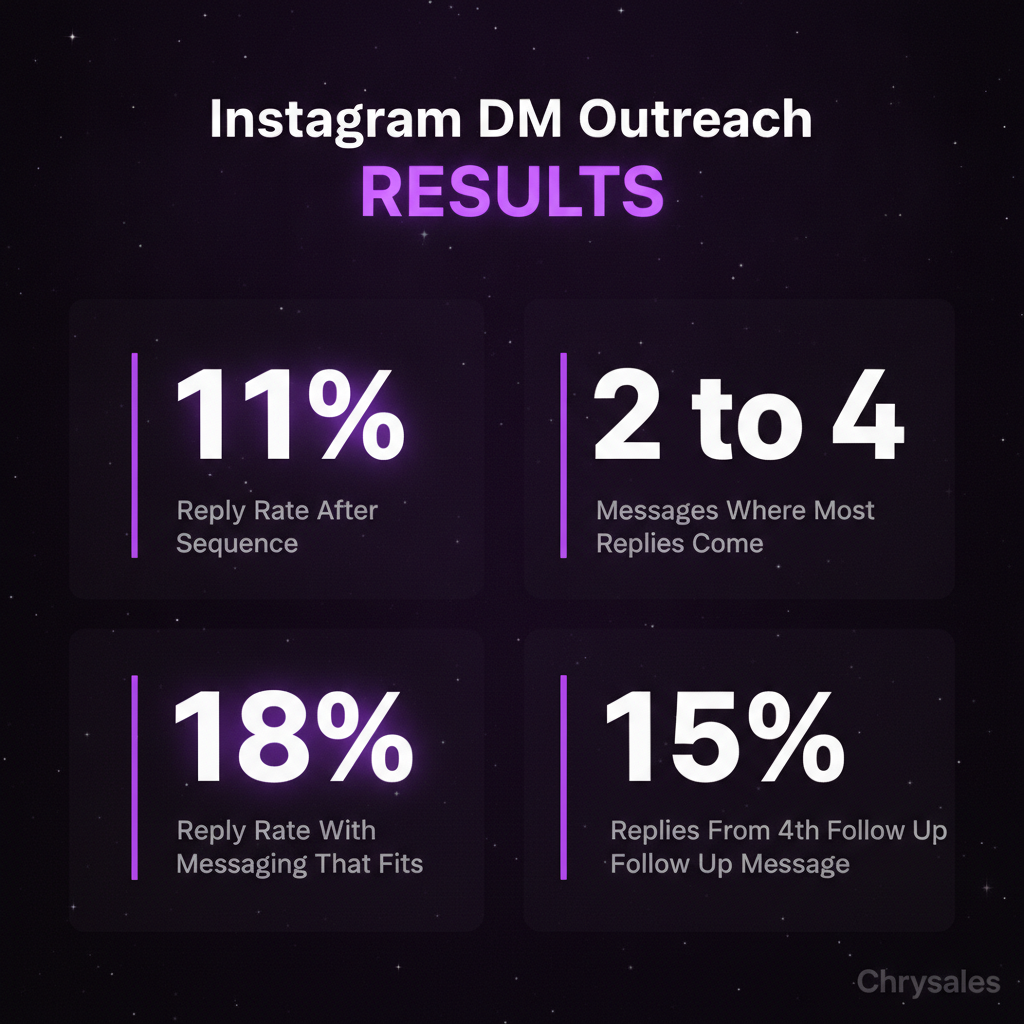
Here's what a good Instagram DM outreach system looks like in practice. A 20-person consulting firm started using a three-message sequence targeting companies in their niche. First message: short intro with a genuine compliment about their work. Second message: a quick case result with no ask. Third message: soft question about a problem they likely face. They went from 2% reply rate to 11% in three weeks. Same target audience. Same offer. The only change was adding a sequence instead of sending one cold pitch.
The psychology behind multi-touch outreach
People need to see your name more than once before they trust you. One message feels random. Three messages feel like you actually care. The key is spacing them out and adding value each time. The first message warms them up. The second builds curiosity. The third opens the conversation. Research on sales follow-up statistics and conversion patterns shows that multi-touch sequences consistently outperform single-touch outreach across all B2B channels.
Instagram vs other B2B channels
Instagram sits between email and LinkedIn. Cold email is great for scale, but open rates are dropping. LinkedIn is solid for B2B, but DMs often feel stiff and formal. Instagram is faster, more personal, and people actually check their messages. The downside is volume. You can't blast 500 Instagram DMs a day like you can with email. But for client acquisition in smaller niches, quality beats quantity. To see why multi-touch outreach beats single messages, learn how layering multiple touchpoints increases reply and conversion rates exponentially.
Building your target list before the first message
Your Instagram outreach sequence is only as good as the list you're messaging. This is where most people mess up. They find 100 random accounts, send the same template, and wonder why nobody replies. A bad list is like inviting 1,000 random people to a birthday party. Most won't show up. The few who do don't even like cake. Start with your ideal customer profile. Not "everyone who might need my service." Specific. What industry? What size? What problem are they dealing with right now? A 15-person marketing agency targeting e-commerce brands is a better fit than "small businesses."
Use these methods to build your list:
- Competitor followers: Find 3-5 accounts that serve your ideal clients. Look through their followers. These people already follow content in your space.
- Hashtag searches: Search niche hashtags like #SaaSmarketing or #B2Bconsulting. Find active accounts posting in those topics.
- Location tags: If you serve local or regional clients, use location tags to find businesses in your area.
- Engagement filters: Look for accounts that post regularly and reply to comments. Ghost accounts won't reply to your DMs either.
Common mistake: Messaging accounts with 50K+ followers or verified badges. They get hundreds of DMs a week. You'll get buried. Focus on 500 to 10K follower accounts. They're real businesses, not influencers, and they actually read their messages.
Once you have a list of 50 to 100 accounts, qualify them. Check their bio. Look at their last 3 posts. Do they match your service? If a consulting firm just posted about hiring, they might need sales training for the new team. If a marketing agency posted a case study, they're actively looking for new clients. That's a warm signal. For more advanced tactics on finding clients who need your services right now, use these methods to build a highly qualified prospect list for your outreach sequence.
The 3-message Instagram outreach sequence structure
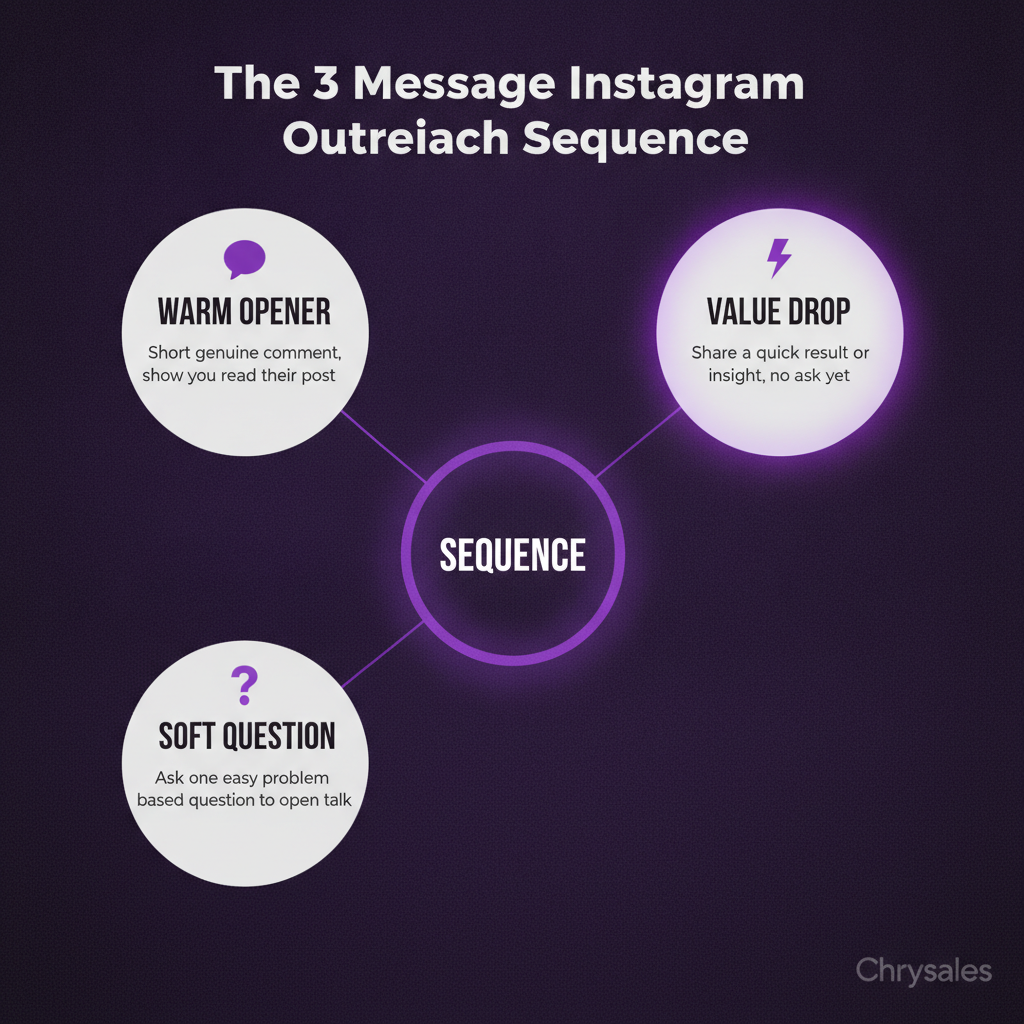
Most Instagram outreach sequences follow a simple pattern: warm them up, add value, open a conversation. Three messages spaced over 5 to 7 days. Each message has one job. Don't try to close a deal in message one. You're starting a conversation, not pitching a product.
Message 1: The warm opener
The first message is not a pitch. It's a short, genuine comment that shows you actually looked at their profile. No templates. No "Hey, I help businesses like yours." Just a real observation.
Examples:
- "Saw your post about scaling outbound. The point about list quality was spot on."
- "Your case study on the SaaS rebrand was really clean. The before/after was a nice touch."
- "Been following your content on cold email. The subject line breakdown last week was useful."
Keep it under 25 words. End with a period, not a question. You're not asking for anything yet. You're just showing up as a real person who noticed their work.
Watch out: Don't compliment something vague like "great content" or "love your page." They can tell you didn't actually look. Be specific. Mention a post, a project, or a topic they talked about recently.
Timing matters. Send message 1 in the morning, ideally between 9 AM and 11 AM in their timezone. That's when people check Instagram before diving into work. Avoid weekends unless your audience is active then.
Message 2: The value drop
Wait 2 to 3 days after message 1. If they replied, great. Have a conversation. If they didn't, send message 2. This one adds value without asking for anything. Share a quick insight, a result, or a resource that connects to what they do.
Examples:
- "Quick thought: we tested a similar outreach method with a tech company last month. Changing the follow-up timing from 5 days to 2 days doubled their reply rate. Might be worth testing if you're running cold outreach."
- "Saw you're hiring a sales team. One thing that helped a consulting firm we worked with: they recorded their best sales calls and turned them into a training doc before hiring. Cut onboarding time in half."
- "If you're doing Instagram outreach, this sequence structure worked well for an agency client: short intro, case drop, soft question. Got them from 2% to 12% replies in three weeks."
Still no ask. Just value. This builds curiosity. If they found message 1 interesting, message 2 makes them think "who is this person and why are they helping me?"
Message 3: The soft question
Wait another 2 to 3 days. Message 3 is where you open the conversation. Ask a simple question related to a problem they likely face. Not "do you want to buy my service?" More like "are you dealing with this thing I can help with?"
Examples:
- "Quick question: are you handling all the sales calls yourself, or do you have a team doing outreach?"
- "Curious, how are you generating leads right now? Outbound, referrals, or something else?"
- "Are you using any automation for Instagram DMs, or is it all manual?"
The question should be easy to answer in one sentence. If it takes effort, they won't reply. The goal is to start a back-and-forth. Once they reply, you have a conversation. That's when you can talk about what you do.
Pro Tip: If they don't reply after message 3, wait a week and send a fourth message. Something like "No worries if this isn't a fit. Let me know if you ever want to chat about [topic]." About 15% of replies come from this last follow-up.
Personalization tricks that make cold DMs feel warm
Personalization isn't just using someone's first name. It's showing you actually know something about them. A proper Instagram outreach strategy for B2B lead generation uses details from their profile, posts, and activity to make each message feel like it was written just for them.
Here's what to look for before you send message 1:
- Recent posts: Did they share a win, a challenge, or a question? Reference it.
- Bio details: Do they mention a niche, a location, or a specific service? Use it.
- Mutual connections: If you follow the same people or engage with the same content, mention it.
- Comments they've left: Look at what they say on other posts. It tells you what they care about.
Picture this: you're messaging a marketing agency. You see they posted a case study last week about running Facebook ads for e-commerce brands. Your first message could be: "That Facebook ad case study you posted was solid. The breakdown of cost per acquisition by audience segment was really helpful." Now you're not just another cold DM. You're someone who actually read their work.
One tech company we worked with used this approach. They built a list of 80 consulting firms on Instagram. Instead of sending the same message to everyone, they spent 2 minutes per account finding one specific detail. A post, a comment, a bio line. Their reply rate jumped from 4% to 18%. Same sequence structure. Same offer. The only difference was those 2 minutes of research.
Using voice notes and video messages
Text is fine, but voice notes and video DMs stand out. Instagram lets you send short voice messages inside DMs. Most people never get these, so it feels more personal. Use them in message 2 or 3 if the person seems active on the platform. Keep it under 30 seconds. Say their name, share the insight or question, and end it. Don't ramble. A 15-second voice note saying "Hey [name], quick thought on your outbound strategy" gets more replies than a text wall.
Timing and frequency for B2B Instagram outreach
Sending the right message at the wrong time kills Instagram outreach sequences. B2B buyers check Instagram at specific times. Hit them when they're scrolling, not when they're in back-to-back meetings. Research on optimal Instagram posting and engagement times shows consistent patterns across industries for when B2B decision-makers are most active on the platform.
Best times to send Instagram DMs for B2B lead generation:
- 9 AM to 11 AM: People check Instagram before work or during their first break
- 12 PM to 1 PM: Lunch break scrolling
- 6 PM to 8 PM: After work, unwinding time
Avoid sending DMs between 2 PM and 5 PM. That's deep work time for most people. Your message will get buried under notifications.
Common mistake: Sending all three messages in the same week. Space them out. Message 1 on Monday. Message 2 on Wednesday or Thursday. Message 3 the following Monday or Tuesday. This gives them time to see each message without feeling bombarded.
How many accounts to message per day
Instagram has limits. Send too many DMs too fast, and your account gets flagged. Start with 20 to 30 new messages per day if your account is established. If it's newer, start with 10 and ramp up over two weeks. Use a warm-up period. Before launching your Instagram outreach sequence at scale, spend a week engaging with your target list. Like their posts. Leave thoughtful comments. Follow them. This warms up your account and makes your DMs less likely to land in the "message requests" folder where most people never look.
Common Instagram outreach mistakes that kill reply rates
Even with a solid Instagram outreach sequence, small mistakes tank your results. These are the ones we see most often with new clients.
Mistake 1: Sending a pitch in message 1. Nobody wants to read a sales pitch from a stranger. Message 1 is for warming them up, not closing a deal. Save the pitch for message 3 or 4, and even then, ask a question first.
Mistake 2: Using the same template for everyone. Templates are fine as a starting structure, but you have to customize them. If your message could be sent to 100 different people without changing a word, it's too generic. Add one specific detail per message.
Mistake 3: Sending messages to accounts that never post. If someone hasn't posted in six months, they're not checking their DMs either. Filter your list. Only message active accounts that post at least once a month.
Mistake 4: Asking for a call too soon. You can't go from cold DM to "book a call with me" in one message. Build the conversation first. Ask about their situation. Share value. Then, if it makes sense, suggest a call. To learn more about converting Instagram conversations into booked sales calls, use proven conversation frameworks that bridge the gap between DMs and scheduled meetings.
Mistake 5: Ignoring message requests. If your DM lands in someone's message requests folder instead of their main inbox, they might never see it. That's why engagement before the DM matters. If you like and comment on their posts first, Instagram is more likely to put your message in their main inbox.
One marketing agency tried Instagram outreach for three months with zero results. We looked at their sequence. Every message started with "Hey [name], I help agencies like yours get more clients." Nobody replied because it sounded like every other spam DM. We rewrote it. First message became a genuine comment about their latest post. Second message shared a quick case result with no ask. Third message asked a simple question. Reply rate went from 0% to 9% in two weeks. Same list. Same offer. Better sequence.
How to track and improve your Instagram DM outreach
You can't improve what you don't measure. Tracking your Instagram outreach sequence tells you what's working and where you're losing people. Most teams skip this step and wonder why results stay flat.
Track these numbers:
- Messages sent: How many DMs did you send in total?
- Messages delivered: Did they land in the main inbox or message requests?
- Replies: How many people responded to any message in your sequence?
- Conversations: How many replies turned into back-and-forth conversations?
- Calls booked: How many conversations led to a booked call or next step?
Calculate your reply rate: (replies ÷ messages sent) × 100. A good reply rate for cold Instagram DM outreach is 8% to 15%. If you're below 5%, something's off. Check your list, your first message, or your timing.
Pro Tip: Track reply rates by message. Most replies come from message 2 or 3, not message 1. If nobody replies to message 1, that's fine. If nobody replies to message 3, your sequence might be too long or your offer isn't clear.
Using automation tools (carefully)
Some tools automate Instagram DM sequences. They send messages, track replies, and manage follow-ups. This can save time, but Instagram cracks down on automation. Use tools that mimic human behavior: random delays between messages, varied send times, and real engagement before DMing. For a comprehensive guide on Instagram DM automation and outreach best practices, learn how to balance efficiency with platform compliance and authentic engagement.
Popular automation platforms for Instagram outreach include tools built for social media prospecting and cold DM strategy. But here's the catch: if the tool is too aggressive, your account gets banned. Start manual. Once your sequence is working, test light automation for repetitive tasks like tracking or scheduling follow-ups.
Improving your sequence based on data
After 50 messages, look at the data. Which message gets the most replies? If message 2 outperforms message 1, test sending message 2 first. If message 3 gets ignored, rewrite it. Maybe the question is too complex or the timing is off.
A 30-person consulting firm tested two versions of message 1. Version A was a compliment about their recent post. Version B shared a quick stat related to their industry. Version B got 22% more replies. Small test, big difference. They rolled out version B to their full list and booked six new calls in a month. If you want to see how to turn Instagram outreach into booked B2B clients, use the data-driven sequence optimization methods that convert conversations into revenue.
Frequently Asked Questions
Q: How long should I wait between messages in an Instagram outreach sequence?
Wait 2 to 3 days between each message. This gives the person time to see your DM without feeling spammed. If you send all three messages in one day, it looks desperate. If you wait a week between each message, they'll forget who you are. Two to three days is the sweet spot for B2B Instagram outreach.
Q: What if my messages land in the message requests folder instead of the main inbox?
This happens when Instagram doesn't recognize you as a connection. To avoid it, engage with the person's content before sending a DM. Like their last 2 to 3 posts. Leave a thoughtful comment. Follow them. This signals to Instagram that you're not a random spammer, and your DM is more likely to land in their main inbox.
Q: How many Instagram DMs should I send per day without getting flagged?
Start with 20 to 30 per day if your account is established. If your account is newer or you haven't done outreach before, start with 10 and increase by 5 per day over two weeks. Sending 100 DMs on day one will get your account flagged. Ramp up slowly and mix in real engagement with your target list.
Q: Can I use the same Instagram outreach sequence for every industry?
The structure stays the same, but the content changes. A sequence targeting tech companies will mention different pain points than one targeting marketing agencies. Customize the examples, questions, and value you share based on the industry. The three-message flow works across industries, but the words inside each message need to match your audience.
Q: What should I do if someone replies but doesn't want to book a call?
Not every reply turns into a call, and that's fine. If they reply but aren't interested, ask if you can follow up in a few months or offer to send them something useful. Sometimes people aren't ready now but will be in three months. Keep the conversation friendly. A "no" today can turn into a "yes" later if you don't push too hard.
An Instagram outreach sequence is a set of DMs sent over time to start conversations, build trust, and turn followers into clients through lead generation and client acquisition. Most cold outreach fails before the first message even lands. Instagram DM outreach is no different. You send a message, get ignored, and wonder if the whole thing was a waste of time. Here's the thing: the problem isn't usually the message. It's the lack of a sequence. Most people send one DM and stop. The conversion happens in the follow-up. A proper Instagram outreach sequence turns cold followers into warm conversations, and warm conversations into booked calls. This isn't about spamming. It's about building a system that works the same way every time.
Why Instagram outreach sequences work for B2B lead generation
Instagram isn't just for influencers and lifestyle brands. It's become one of the fastest ways to reach B2B buyers, especially in consulting, tech, and agency spaces. The reason is simple: people check Instagram more than their email. Your message shows up next to photos from friends, not buried under 47 sales emails. A sequence beats a one-off message every time. Think of it like this: if someone knocked on your door once and left, you might not answer. If they knocked, left a note, and came back the next day with something useful, you'd probably open the door. That's what a sequence does. It gives you multiple chances to start a conversation without being annoying.
Pro Tip: Most replies come between message 2 and message 4. If you stop after one message, you're leaving 70% of your results on the table.
Here's what a good Instagram DM outreach system looks like in practice. A 20-person consulting firm started using a three-message sequence targeting companies in their niche. First message: short intro with a genuine compliment about their work. Second message: a quick case result with no ask. Third message: soft question about a problem they likely face. They went from 2% reply rate to 11% in three weeks. Same target audience. Same offer. The only change was adding a sequence instead of sending one cold pitch.
The psychology behind multi-touch outreach
People need to see your name more than once before they trust you. One message feels random. Three messages feel like you actually care. The key is spacing them out and adding value each time. The first message warms them up. The second builds curiosity. The third opens the conversation. Research on sales follow-up statistics and conversion patterns shows that multi-touch sequences consistently outperform single-touch outreach across all B2B channels.
Instagram vs other B2B channels
Instagram sits between email and LinkedIn. Cold email is great for scale, but open rates are dropping. LinkedIn is solid for B2B, but DMs often feel stiff and formal. Instagram is faster, more personal, and people actually check their messages. The downside is volume. You can't blast 500 Instagram DMs a day like you can with email. But for client acquisition in smaller niches, quality beats quantity. To see why multi-touch outreach beats single messages, learn how layering multiple touchpoints increases reply and conversion rates exponentially.
Building your target list before the first message
Your Instagram outreach sequence is only as good as the list you're messaging. This is where most people mess up. They find 100 random accounts, send the same template, and wonder why nobody replies. A bad list is like inviting 1,000 random people to a birthday party. Most won't show up. The few who do don't even like cake. Start with your ideal customer profile. Not "everyone who might need my service." Specific. What industry? What size? What problem are they dealing with right now? A 15-person marketing agency targeting e-commerce brands is a better fit than "small businesses."
Use these methods to build your list:
- Competitor followers: Find 3-5 accounts that serve your ideal clients. Look through their followers. These people already follow content in your space.
- Hashtag searches: Search niche hashtags like #SaaSmarketing or #B2Bconsulting. Find active accounts posting in those topics.
- Location tags: If you serve local or regional clients, use location tags to find businesses in your area.
- Engagement filters: Look for accounts that post regularly and reply to comments. Ghost accounts won't reply to your DMs either.
Common mistake: Messaging accounts with 50K+ followers or verified badges. They get hundreds of DMs a week. You'll get buried. Focus on 500 to 10K follower accounts. They're real businesses, not influencers, and they actually read their messages.
Once you have a list of 50 to 100 accounts, qualify them. Check their bio. Look at their last 3 posts. Do they match your service? If a consulting firm just posted about hiring, they might need sales training for the new team. If a marketing agency posted a case study, they're actively looking for new clients. That's a warm signal. For more advanced tactics on finding clients who need your services right now, use these methods to build a highly qualified prospect list for your outreach sequence.
The 3-message Instagram outreach sequence structure
Most Instagram outreach sequences follow a simple pattern: warm them up, add value, open a conversation. Three messages spaced over 5 to 7 days. Each message has one job. Don't try to close a deal in message one. You're starting a conversation, not pitching a product.
Message 1: The warm opener
The first message is not a pitch. It's a short, genuine comment that shows you actually looked at their profile. No templates. No "Hey, I help businesses like yours." Just a real observation.
Examples:
- "Saw your post about scaling outbound. The point about list quality was spot on."
- "Your case study on the SaaS rebrand was really clean. The before/after was a nice touch."
- "Been following your content on cold email. The subject line breakdown last week was useful."
Keep it under 25 words. End with a period, not a question. You're not asking for anything yet. You're just showing up as a real person who noticed their work.
Watch out: Don't compliment something vague like "great content" or "love your page." They can tell you didn't actually look. Be specific. Mention a post, a project, or a topic they talked about recently.
Timing matters. Send message 1 in the morning, ideally between 9 AM and 11 AM in their timezone. That's when people check Instagram before diving into work. Avoid weekends unless your audience is active then.
Message 2: The value drop
Wait 2 to 3 days after message 1. If they replied, great. Have a conversation. If they didn't, send message 2. This one adds value without asking for anything. Share a quick insight, a result, or a resource that connects to what they do.
Examples:
- "Quick thought: we tested a similar outreach method with a tech company last month. Changing the follow-up timing from 5 days to 2 days doubled their reply rate. Might be worth testing if you're running cold outreach."
- "Saw you're hiring a sales team. One thing that helped a consulting firm we worked with: they recorded their best sales calls and turned them into a training doc before hiring. Cut onboarding time in half."
- "If you're doing Instagram outreach, this sequence structure worked well for an agency client: short intro, case drop, soft question. Got them from 2% to 12% replies in three weeks."
Still no ask. Just value. This builds curiosity. If they found message 1 interesting, message 2 makes them think "who is this person and why are they helping me?"
Message 3: The soft question
Wait another 2 to 3 days. Message 3 is where you open the conversation. Ask a simple question related to a problem they likely face. Not "do you want to buy my service?" More like "are you dealing with this thing I can help with?"
Examples:
- "Quick question: are you handling all the sales calls yourself, or do you have a team doing outreach?"
- "Curious, how are you generating leads right now? Outbound, referrals, or something else?"
- "Are you using any automation for Instagram DMs, or is it all manual?"
The question should be easy to answer in one sentence. If it takes effort, they won't reply. The goal is to start a back-and-forth. Once they reply, you have a conversation. That's when you can talk about what you do.
Pro Tip: If they don't reply after message 3, wait a week and send a fourth message. Something like "No worries if this isn't a fit. Let me know if you ever want to chat about [topic]." About 15% of replies come from this last follow-up.
Personalization tricks that make cold DMs feel warm
Personalization isn't just using someone's first name. It's showing you actually know something about them. A proper Instagram outreach strategy for B2B lead generation uses details from their profile, posts, and activity to make each message feel like it was written just for them.
Here's what to look for before you send message 1:
- Recent posts: Did they share a win, a challenge, or a question? Reference it.
- Bio details: Do they mention a niche, a location, or a specific service? Use it.
- Mutual connections: If you follow the same people or engage with the same content, mention it.
- Comments they've left: Look at what they say on other posts. It tells you what they care about.
Picture this: you're messaging a marketing agency. You see they posted a case study last week about running Facebook ads for e-commerce brands. Your first message could be: "That Facebook ad case study you posted was solid. The breakdown of cost per acquisition by audience segment was really helpful." Now you're not just another cold DM. You're someone who actually read their work.
One tech company we worked with used this approach. They built a list of 80 consulting firms on Instagram. Instead of sending the same message to everyone, they spent 2 minutes per account finding one specific detail. A post, a comment, a bio line. Their reply rate jumped from 4% to 18%. Same sequence structure. Same offer. The only difference was those 2 minutes of research.
Using voice notes and video messages
Text is fine, but voice notes and video DMs stand out. Instagram lets you send short voice messages inside DMs. Most people never get these, so it feels more personal. Use them in message 2 or 3 if the person seems active on the platform. Keep it under 30 seconds. Say their name, share the insight or question, and end it. Don't ramble. A 15-second voice note saying "Hey [name], quick thought on your outbound strategy" gets more replies than a text wall.
Timing and frequency for B2B Instagram outreach
Sending the right message at the wrong time kills Instagram outreach sequences. B2B buyers check Instagram at specific times. Hit them when they're scrolling, not when they're in back-to-back meetings. Research on optimal Instagram posting and engagement times shows consistent patterns across industries for when B2B decision-makers are most active on the platform.
Best times to send Instagram DMs for B2B lead generation:
- 9 AM to 11 AM: People check Instagram before work or during their first break
- 12 PM to 1 PM: Lunch break scrolling
- 6 PM to 8 PM: After work, unwinding time
Avoid sending DMs between 2 PM and 5 PM. That's deep work time for most people. Your message will get buried under notifications.
Common mistake: Sending all three messages in the same week. Space them out. Message 1 on Monday. Message 2 on Wednesday or Thursday. Message 3 the following Monday or Tuesday. This gives them time to see each message without feeling bombarded.
How many accounts to message per day
Instagram has limits. Send too many DMs too fast, and your account gets flagged. Start with 20 to 30 new messages per day if your account is established. If it's newer, start with 10 and ramp up over two weeks. Use a warm-up period. Before launching your Instagram outreach sequence at scale, spend a week engaging with your target list. Like their posts. Leave thoughtful comments. Follow them. This warms up your account and makes your DMs less likely to land in the "message requests" folder where most people never look.
Common Instagram outreach mistakes that kill reply rates
Even with a solid Instagram outreach sequence, small mistakes tank your results. These are the ones we see most often with new clients.
Mistake 1: Sending a pitch in message 1. Nobody wants to read a sales pitch from a stranger. Message 1 is for warming them up, not closing a deal. Save the pitch for message 3 or 4, and even then, ask a question first.
Mistake 2: Using the same template for everyone. Templates are fine as a starting structure, but you have to customize them. If your message could be sent to 100 different people without changing a word, it's too generic. Add one specific detail per message.
Mistake 3: Sending messages to accounts that never post. If someone hasn't posted in six months, they're not checking their DMs either. Filter your list. Only message active accounts that post at least once a month.
Mistake 4: Asking for a call too soon. You can't go from cold DM to "book a call with me" in one message. Build the conversation first. Ask about their situation. Share value. Then, if it makes sense, suggest a call. To learn more about converting Instagram conversations into booked sales calls, use proven conversation frameworks that bridge the gap between DMs and scheduled meetings.
Mistake 5: Ignoring message requests. If your DM lands in someone's message requests folder instead of their main inbox, they might never see it. That's why engagement before the DM matters. If you like and comment on their posts first, Instagram is more likely to put your message in their main inbox.
One marketing agency tried Instagram outreach for three months with zero results. We looked at their sequence. Every message started with "Hey [name], I help agencies like yours get more clients." Nobody replied because it sounded like every other spam DM. We rewrote it. First message became a genuine comment about their latest post. Second message shared a quick case result with no ask. Third message asked a simple question. Reply rate went from 0% to 9% in two weeks. Same list. Same offer. Better sequence.
How to track and improve your Instagram DM outreach
You can't improve what you don't measure. Tracking your Instagram outreach sequence tells you what's working and where you're losing people. Most teams skip this step and wonder why results stay flat.
Track these numbers:
- Messages sent: How many DMs did you send in total?
- Messages delivered: Did they land in the main inbox or message requests?
- Replies: How many people responded to any message in your sequence?
- Conversations: How many replies turned into back-and-forth conversations?
- Calls booked: How many conversations led to a booked call or next step?
Calculate your reply rate: (replies ÷ messages sent) × 100. A good reply rate for cold Instagram DM outreach is 8% to 15%. If you're below 5%, something's off. Check your list, your first message, or your timing.
Pro Tip: Track reply rates by message. Most replies come from message 2 or 3, not message 1. If nobody replies to message 1, that's fine. If nobody replies to message 3, your sequence might be too long or your offer isn't clear.
Using automation tools (carefully)
Some tools automate Instagram DM sequences. They send messages, track replies, and manage follow-ups. This can save time, but Instagram cracks down on automation. Use tools that mimic human behavior: random delays between messages, varied send times, and real engagement before DMing. For a comprehensive guide on Instagram DM automation and outreach best practices, learn how to balance efficiency with platform compliance and authentic engagement.
Popular automation platforms for Instagram outreach include tools built for social media prospecting and cold DM strategy. But here's the catch: if the tool is too aggressive, your account gets banned. Start manual. Once your sequence is working, test light automation for repetitive tasks like tracking or scheduling follow-ups.
Improving your sequence based on data
After 50 messages, look at the data. Which message gets the most replies? If message 2 outperforms message 1, test sending message 2 first. If message 3 gets ignored, rewrite it. Maybe the question is too complex or the timing is off.
A 30-person consulting firm tested two versions of message 1. Version A was a compliment about their recent post. Version B shared a quick stat related to their industry. Version B got 22% more replies. Small test, big difference. They rolled out version B to their full list and booked six new calls in a month. If you want to see how to turn Instagram outreach into booked B2B clients, use the data-driven sequence optimization methods that convert conversations into revenue.
Frequently Asked Questions
Q: How long should I wait between messages in an Instagram outreach sequence?
Wait 2 to 3 days between each message. This gives the person time to see your DM without feeling spammed. If you send all three messages in one day, it looks desperate. If you wait a week between each message, they'll forget who you are. Two to three days is the sweet spot for B2B Instagram outreach.
Q: What if my messages land in the message requests folder instead of the main inbox?
This happens when Instagram doesn't recognize you as a connection. To avoid it, engage with the person's content before sending a DM. Like their last 2 to 3 posts. Leave a thoughtful comment. Follow them. This signals to Instagram that you're not a random spammer, and your DM is more likely to land in their main inbox.
Q: How many Instagram DMs should I send per day without getting flagged?
Start with 20 to 30 per day if your account is established. If your account is newer or you haven't done outreach before, start with 10 and increase by 5 per day over two weeks. Sending 100 DMs on day one will get your account flagged. Ramp up slowly and mix in real engagement with your target list.
Q: Can I use the same Instagram outreach sequence for every industry?
The structure stays the same, but the content changes. A sequence targeting tech companies will mention different pain points than one targeting marketing agencies. Customize the examples, questions, and value you share based on the industry. The three-message flow works across industries, but the words inside each message need to match your audience.
Q: What should I do if someone replies but doesn't want to book a call?
Not every reply turns into a call, and that's fine. If they reply but aren't interested, ask if you can follow up in a few months or offer to send them something useful. Sometimes people aren't ready now but will be in three months. Keep the conversation friendly. A "no" today can turn into a "yes" later if you don't push too hard.
Scaling Is Not Hard If You Have The Right Systems
If you’re serious about leveling up your scaling game, you need the right system, the right training, and the right team behind you. We're here to give you the exact tools and strategies top entrepreneurs use to dominate.

Discover the latest tips
View All.avif)
Chrysales was formed from the words "chrysalis" the stage where a caterpillar transforms into a butterfly and "sales".
It stands for one thing: sales transformation.Because scaling doesn’t happen by doing more of the same. Scaling only happens when you go through real transformation in your systems, your offer, team and the way you sell.
.avif)


