.avif)
How to Create Instagram Content That Converts to Dms
Instagram content that converts is content designed to get the right people to message you, start a conversation, and move toward a sale. It uses clear hooks, proof, and calls to action to support lead generation and client acquisition. Picture this: you post three times a week on Instagram, get decent likes, a few comments, but zero people sliding into your DMs asking how they can work with you. The effort is there. The content looks good. But the pipeline stays empty.
Here's the thing most people miss: Instagram content that converts isn't about going viral or racking up followers. It's about getting the right people to reach out. The formula is different. This is how you build it.
Why Most Instagram Content Gets Likes But Zero Sales Calls
Most B2B companies treat Instagram like a branding exercise. Pretty graphics. Motivational quotes. Behind-the-scenes shots of the office. It looks nice, but it doesn't move the needle.
The problem isn't the quality. It's the intent behind each post. Content that drives DMs from buyers has a clear job: start a conversation with someone who has a problem you can solve. Every post should either educate them on that problem, show proof you can fix it, or give them a reason to message you right now.
The Three Content Types That Actually Convert
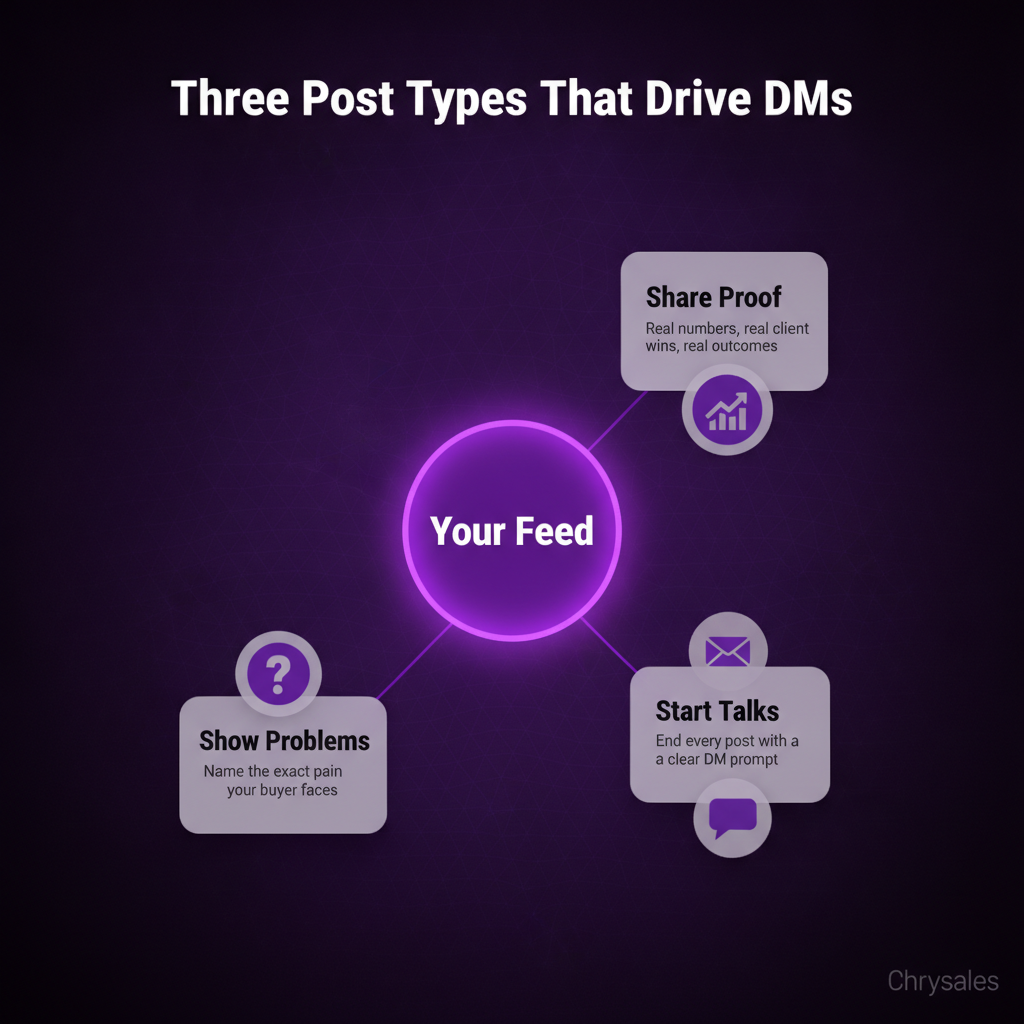
There are three buckets that work for B2B lead generation:
Problem-focused content that names the exact issue your target deals with. A 15-person consulting firm struggling to book meetings doesn't need generic advice. They need someone to say "your outreach is failing because your list is bad, not your messaging."
Proof content that shows results. A quick carousel with before-and-after metrics. A short Reel walking through one client win. Numbers build trust faster than any mission statement, and B2B content strategies built around case studies consistently drive higher conversions.
Conversation starters that end with a direct question or a DM prompt. "Which of these three mistakes is killing your close rate? DM me the number." Simple. Direct. Gets people typing.
Common mistake: Posting only one type. A feed full of proof feels like bragging. A feed full of problems feels negative. Mix all three.
The Content Structure That Pulls People Into Your DMs
Every piece of Instagram content that converts follows the same backbone: hook, value, proof, call-to-action. It sounds basic because it is. But most posts skip at least two of these.
Hook: The First 3 Seconds Decide Everything
If the first line doesn't stop the scroll, nothing else matters. Start with a number, a bold claim, or a question that hits a pain point. Good hooks sound like this:
- "We helped a tech company book 18 qualified calls in 14 days without spending a dollar on ads."
- "Your sales team isn't bad. Your offer is."
- "Most cold emails get ignored for one reason. Here it is."
Bad hooks sound like this:
- "Building a sales system can be challenging."
- "Let's talk about lead generation today."
The difference is specificity and punch. A good hook makes someone think "wait, how?" and keeps reading.
Value: Teach Something Useful in 60 Seconds or Less
The middle of your post should deliver one clear takeaway. Not three tips. Not a list of ten things. One idea explained simply.
A carousel that walks through the exact structure of a discovery call script. A Reel showing the difference between a weak offer and a no-brainer offer. A caption breaking down why most sales pipelines leak at the qualification stage.
Pro Tip: If you can't explain the idea to a friend in under a minute, simplify it before posting.
Proof: Show It Works Without Sounding Like a Sales Pitch
Proof doesn't mean testimonials in every post. It means showing the result in context.
"A marketing agency we worked with had a 2% close rate. After fixing their discovery questions and repositioning their offer, it jumped to 22% in six weeks."
That's proof. It's specific. It's credible. It doesn't ask the reader to trust you blindly.
Call-to-Action: Tell Them Exactly What to Do Next
Most posts end with nothing. No next step. No reason to engage. A strong CTA for B2B sales content is almost always a DM prompt:
- "DM me 'pipeline' and I'll send you the full framework."
- "Which one of these is your biggest challenge? Comment the number or send me a message."
- "If you want the script we use for discovery calls, shoot me a DM."
The CTA should feel low-pressure but clear. You're not asking them to book a call in the first interaction. You're starting a conversation.
How to Pick Content Topics That Attract Buyers, Not Browsers
Not all topics are equal. Some pull in curious onlookers. Others pull in people ready to buy. The difference is intent.
Buyers are looking for solutions to active problems. Browsers are looking for entertainment or vague inspiration.
Map Your Content to Real Sales Conversations
Look at the last ten sales calls you took. What questions did people ask? What objections came up? What made them say yes? Turn those into posts.
If prospects always ask "how long does this take to see results?", make a Reel answering it. If the biggest objection is "we tried this before and it didn't work", write a carousel explaining why most attempts fail and what's different.
Your content should feel like the first half of a sales conversation. By the time someone DMs you, they're already halfway sold.
Watch out: Don't post about topics just because they're trending. A viral Reel about productivity hacks might get views, but it won't book calls if you sell sales systems.
Use the 70/20/10 Split
70% of your content should educate on the problem and the solution. Teaching builds authority. It positions you as the expert without you having to say it.
20% should be proof and case studies. Real numbers. Real companies. Real outcomes. This is where you show that what you teach actually works.
10% can be personal, behind-the-scenes, or brand content. This makes you human. But don't lean too heavy here. People follow you for the value, not your morning coffee routine.
The DM Automation Setup That Turns Engagement Into Conversations

Getting people to DM you is step one. What happens next is where most people drop the ball.
If someone messages you "pipeline" because you told them to, and you don't reply for six hours, the momentum dies. They move on. You lose the lead.
Automate the First Response
Set up an Instagram DM automation tool so anyone who messages a keyword gets an instant reply. The message should feel personal, not robotic.
Bad auto-reply: "Thanks for your message! Click here to book a call."
Good auto-reply: "Hey, just sent you the pipeline framework. Take a look and let me know if you have questions. I usually reply within an hour."
The goal is to keep the conversation moving without making it feel like a bot took over.
Pro Tip: Use simple automation for the first touchpoint, then jump in manually for the second message. That balance keeps it smooth without losing the human touch.
Move Them From DM to Discovery Call
A DM conversation shouldn't drag on for days. After two or three exchanges, offer a next step.
"Sounds like you're dealing with X. Want to jump on a quick 20-minute call this week? I can walk you through exactly how we'd fix this for your team."
The offer should feel helpful, not salesy. You're not pitching. You're offering to dig deeper into their problem. If you want to operationalize your Instagram DM strategy for sales calls, having a proven message flow from first response to booked discovery calls is essential.
One tech company we worked with went from random Instagram engagement to booking 12 qualified discovery calls in three weeks just by tightening up their DM process. The content stayed the same. The follow-up changed everything.
How to Repurpose One Piece of Content Into a Week of Lead Generation
You don't need to create new content every single day. One strong piece can feed your Instagram content strategy for a week if you repurpose it right.
Start With One Core Idea
Pick a single topic tied to B2B lead generation, client acquisition, or sales training. Write a short breakdown or record a 60-second video explaining it. That's your anchor content.
Break It Into Multiple Formats
Turn that one idea into:
- A carousel post with 5-7 slides walking through the concept
- A Reel with a strong hook and the main takeaway
- A story sequence with a swipe-up or DM CTA
- A caption-heavy post for people who prefer reading
Each format hits a different part of your audience. Some people watch Reels. Some scroll carousels. Some read long captions. Covering all three multiplies your reach without multiplying your workload, and creating a content calendar for B2B lead generation helps you maintain this momentum week after week.
Common mistake: Posting the same thing in the same format everywhere. Different platforms and formats need slight tweaks. A LinkedIn post can be longer and more detailed. An Instagram Reel needs a faster hook and tighter edit.
Add a Call-to-Action to Every Version
Whether it's a carousel, a Reel, or a story, every piece should end with a reason to DM you. Change the CTA slightly so it doesn't feel repetitive, but keep the intent the same.
"DM me 'script' for the full breakdown." "Want the template? Send me a message." "Comment 'yes' or DM me and I'll send it over."
Why Consistency Beats Virality Every Single Time
Going viral sounds great until you realize 10,000 new followers who don't need your service won't move your business forward. A small, engaged audience of 500 people who actually have the problem you solve is worth more than 50,000 random followers.
Post on a Schedule, Not When You Feel Like It
Consistency builds trust. If you post once, disappear for two weeks, post three times in one day, then vanish again, people forget you exist.
Pick a realistic schedule. Three posts a week is plenty if they're high-quality and conversion-focused. Stick to it for 90 days before you change anything.
Track What Actually Drives Sales Calls, Not Just Engagement
Likes and comments feel good, but they don't pay bills. Track how many DMs you get per post. Track how many of those DMs turn into discovery calls. Track how many calls turn into clients.
A post with 50 likes and 8 DMs from qualified buyers beats a post with 500 likes and zero DMs every time. Most teams waste time trying to boost vanity metrics instead of doubling down on what actually books calls, but when you track content impact on your sales funnel, you get clarity on what truly moves the needle.
If carousel posts about objection handling get you 5 DMs per post and Reels about morning routines get you zero, the choice is obvious.
Pro Tip: Keep a simple spreadsheet. Post topic, format, number of DMs, number of calls booked. After 20 posts, you'll see patterns. Do more of what works.
How to Turn Instagram Content Into a Real Sales Pipeline
Instagram content that converts doesn't exist in a vacuum. It's part of a bigger system. The content gets attention. The DMs start conversations. The discovery calls qualify leads. The offer closes deals.
Connect Content to Your Full Sales System
Every DM that comes in should flow into a process:
- First response (automated or manual within an hour)
- Qualify the lead with 2-3 questions
- Offer a discovery call if they're a fit
- Use a proven call structure to close or disqualify
If your content is strong but your sales process is weak, you'll book calls that go nowhere. If your sales process is strong but your content is weak, you won't book enough calls to matter. You can watch how to build a sales system that turns inbound interest into predictable clients to see how these pieces fit together in practice.
Chrysales clients often come in with one side dialed in and the other side broken. A consulting firm might have great content but no idea how to run a discovery call. A tech company might close well but can't get anyone to reply to their outreach. Fixing both sides is how you build predictable client acquisition.
Use Instagram as One Channel in a Multi-Touch Strategy
Instagram works best when it's not your only channel. Combine it with cold email, LinkedIn outreach, or referral systems. To understand how to use multichannel and multi-touch outreach for better B2B results, consider how showing up in multiple places with the same message creates compound effects.
Someone might see your Instagram post, ignore it, then get a cold email from you two weeks later and reply because they recognize your name. That's the compound effect of showing up in multiple places with the same message.
One 30-person consulting firm we worked with used Instagram content to build authority, LinkedIn for direct outreach, and cold email for follow-up. The combination brought in 22 new qualified leads in a month. None of those channels alone would've hit that number.
Frequently Asked Questions
Q: How often should I post on Instagram to generate leads?
Three to four times per week is the sweet spot for most B2B companies. Posting daily sounds good in theory, but if quality drops, engagement and DMs drop too. Consistency matters more than frequency. Pick a schedule you can actually maintain for three months straight. A smaller team might do three posts a week and win. Bigger teams with more resources can go daily if every post is strong. Track your DM-to-post ratio after 30 days and adjust from there.
Q: What's the best content format for B2B sales on Instagram?
Carousels and Reels both work, but for different reasons. Carousels let you break down complex ideas into digestible steps. They get saved and shared more, which extends reach. Reels grab attention faster with a strong hook in the first three seconds. The best approach is mixing both. Use Reels to pull in cold traffic with bold claims and quick value. Use carousels to go deeper and build authority. Stories work great for quick CTAs and keeping your brand top-of-mind between posts. Test both formats for 20 posts and see which one drives more DMs for your specific audience.
Q: How do I get people to actually DM me instead of just liking my posts?
Make the CTA crystal clear and give them a reason to message you right now. "DM me for the template" works better than "link in bio." Offering something specific in exchange for a DM creates urgency. A framework, a script, a checklist, or a quick answer to a question they have. The key is making it feel like a conversation starter, not a hard pitch. If your content solves half the problem and the DM unlocks the rest, people will message you. Also, reply fast. If someone DMs you and waits six hours for a response, they lose interest.
Q: Can Instagram really generate qualified B2B leads, or is it just for B2C?
Instagram absolutely works for B2B if you treat it like a top-of-funnel tool, not a closing tool. Decision-makers scroll Instagram just like everyone else. The difference is how you position your content. Focus on solving real business problems, not entertaining. A marketing agency looking for more clients will engage with content about fixing sales pipelines or improving close rates, which is why understanding B2B sales fundamentals and pipeline management helps you craft stronger content. Make your content speak directly to those pain points. Use DMs to start conversations, then move people to discovery calls where the real qualification happens. We've seen tech companies, consulting firms, and agencies all book qualified calls from Instagram when the content and follow-up process are dialed in.
Q: How long does it take to see results from Instagram content?
Most teams see their first batch of inbound DMs within 30 to 45 days if they're posting consistently and using strong CTAs. The first two weeks are usually quiet while the algorithm figures out your content and your audience starts noticing you. By week four, if your content is solving real problems and your CTAs are clear, DMs start coming in. Turning those DMs into booked calls and closed deals adds another few weeks. Realistically, expect 60 to 90 days from your first post to your first client if you're starting from scratch. If you already have some followers and engagement, it can happen faster. The key is sticking with it and tracking what works so you can double down on the right content types.
Instagram content that converts is content designed to get the right people to message you, start a conversation, and move toward a sale. It uses clear hooks, proof, and calls to action to support lead generation and client acquisition. Picture this: you post three times a week on Instagram, get decent likes, a few comments, but zero people sliding into your DMs asking how they can work with you. The effort is there. The content looks good. But the pipeline stays empty.
Here's the thing most people miss: Instagram content that converts isn't about going viral or racking up followers. It's about getting the right people to reach out. The formula is different. This is how you build it.
Why Most Instagram Content Gets Likes But Zero Sales Calls
Most B2B companies treat Instagram like a branding exercise. Pretty graphics. Motivational quotes. Behind-the-scenes shots of the office. It looks nice, but it doesn't move the needle.
The problem isn't the quality. It's the intent behind each post. Content that drives DMs from buyers has a clear job: start a conversation with someone who has a problem you can solve. Every post should either educate them on that problem, show proof you can fix it, or give them a reason to message you right now.
The Three Content Types That Actually Convert
There are three buckets that work for B2B lead generation:
Problem-focused content that names the exact issue your target deals with. A 15-person consulting firm struggling to book meetings doesn't need generic advice. They need someone to say "your outreach is failing because your list is bad, not your messaging."
Proof content that shows results. A quick carousel with before-and-after metrics. A short Reel walking through one client win. Numbers build trust faster than any mission statement, and B2B content strategies built around case studies consistently drive higher conversions.
Conversation starters that end with a direct question or a DM prompt. "Which of these three mistakes is killing your close rate? DM me the number." Simple. Direct. Gets people typing.
Common mistake: Posting only one type. A feed full of proof feels like bragging. A feed full of problems feels negative. Mix all three.
The Content Structure That Pulls People Into Your DMs
Every piece of Instagram content that converts follows the same backbone: hook, value, proof, call-to-action. It sounds basic because it is. But most posts skip at least two of these.
Hook: The First 3 Seconds Decide Everything
If the first line doesn't stop the scroll, nothing else matters. Start with a number, a bold claim, or a question that hits a pain point. Good hooks sound like this:
- "We helped a tech company book 18 qualified calls in 14 days without spending a dollar on ads."
- "Your sales team isn't bad. Your offer is."
- "Most cold emails get ignored for one reason. Here it is."
Bad hooks sound like this:
- "Building a sales system can be challenging."
- "Let's talk about lead generation today."
The difference is specificity and punch. A good hook makes someone think "wait, how?" and keeps reading.
Value: Teach Something Useful in 60 Seconds or Less
The middle of your post should deliver one clear takeaway. Not three tips. Not a list of ten things. One idea explained simply.
A carousel that walks through the exact structure of a discovery call script. A Reel showing the difference between a weak offer and a no-brainer offer. A caption breaking down why most sales pipelines leak at the qualification stage.
Pro Tip: If you can't explain the idea to a friend in under a minute, simplify it before posting.
Proof: Show It Works Without Sounding Like a Sales Pitch
Proof doesn't mean testimonials in every post. It means showing the result in context.
"A marketing agency we worked with had a 2% close rate. After fixing their discovery questions and repositioning their offer, it jumped to 22% in six weeks."
That's proof. It's specific. It's credible. It doesn't ask the reader to trust you blindly.
Call-to-Action: Tell Them Exactly What to Do Next
Most posts end with nothing. No next step. No reason to engage. A strong CTA for B2B sales content is almost always a DM prompt:
- "DM me 'pipeline' and I'll send you the full framework."
- "Which one of these is your biggest challenge? Comment the number or send me a message."
- "If you want the script we use for discovery calls, shoot me a DM."
The CTA should feel low-pressure but clear. You're not asking them to book a call in the first interaction. You're starting a conversation.
How to Pick Content Topics That Attract Buyers, Not Browsers
Not all topics are equal. Some pull in curious onlookers. Others pull in people ready to buy. The difference is intent.
Buyers are looking for solutions to active problems. Browsers are looking for entertainment or vague inspiration.
Map Your Content to Real Sales Conversations
Look at the last ten sales calls you took. What questions did people ask? What objections came up? What made them say yes? Turn those into posts.
If prospects always ask "how long does this take to see results?", make a Reel answering it. If the biggest objection is "we tried this before and it didn't work", write a carousel explaining why most attempts fail and what's different.
Your content should feel like the first half of a sales conversation. By the time someone DMs you, they're already halfway sold.
Watch out: Don't post about topics just because they're trending. A viral Reel about productivity hacks might get views, but it won't book calls if you sell sales systems.
Use the 70/20/10 Split
70% of your content should educate on the problem and the solution. Teaching builds authority. It positions you as the expert without you having to say it.
20% should be proof and case studies. Real numbers. Real companies. Real outcomes. This is where you show that what you teach actually works.
10% can be personal, behind-the-scenes, or brand content. This makes you human. But don't lean too heavy here. People follow you for the value, not your morning coffee routine.
The DM Automation Setup That Turns Engagement Into Conversations
Getting people to DM you is step one. What happens next is where most people drop the ball.
If someone messages you "pipeline" because you told them to, and you don't reply for six hours, the momentum dies. They move on. You lose the lead.
Automate the First Response
Set up an Instagram DM automation tool so anyone who messages a keyword gets an instant reply. The message should feel personal, not robotic.
Bad auto-reply: "Thanks for your message! Click here to book a call."
Good auto-reply: "Hey, just sent you the pipeline framework. Take a look and let me know if you have questions. I usually reply within an hour."
The goal is to keep the conversation moving without making it feel like a bot took over.
Pro Tip: Use simple automation for the first touchpoint, then jump in manually for the second message. That balance keeps it smooth without losing the human touch.
Move Them From DM to Discovery Call
A DM conversation shouldn't drag on for days. After two or three exchanges, offer a next step.
"Sounds like you're dealing with X. Want to jump on a quick 20-minute call this week? I can walk you through exactly how we'd fix this for your team."
The offer should feel helpful, not salesy. You're not pitching. You're offering to dig deeper into their problem. If you want to operationalize your Instagram DM strategy for sales calls, having a proven message flow from first response to booked discovery calls is essential.
One tech company we worked with went from random Instagram engagement to booking 12 qualified discovery calls in three weeks just by tightening up their DM process. The content stayed the same. The follow-up changed everything.
How to Repurpose One Piece of Content Into a Week of Lead Generation
You don't need to create new content every single day. One strong piece can feed your Instagram content strategy for a week if you repurpose it right.
Start With One Core Idea
Pick a single topic tied to B2B lead generation, client acquisition, or sales training. Write a short breakdown or record a 60-second video explaining it. That's your anchor content.
Break It Into Multiple Formats
Turn that one idea into:
- A carousel post with 5-7 slides walking through the concept
- A Reel with a strong hook and the main takeaway
- A story sequence with a swipe-up or DM CTA
- A caption-heavy post for people who prefer reading
Each format hits a different part of your audience. Some people watch Reels. Some scroll carousels. Some read long captions. Covering all three multiplies your reach without multiplying your workload, and creating a content calendar for B2B lead generation helps you maintain this momentum week after week.
Common mistake: Posting the same thing in the same format everywhere. Different platforms and formats need slight tweaks. A LinkedIn post can be longer and more detailed. An Instagram Reel needs a faster hook and tighter edit.
Add a Call-to-Action to Every Version
Whether it's a carousel, a Reel, or a story, every piece should end with a reason to DM you. Change the CTA slightly so it doesn't feel repetitive, but keep the intent the same.
"DM me 'script' for the full breakdown." "Want the template? Send me a message." "Comment 'yes' or DM me and I'll send it over."
Why Consistency Beats Virality Every Single Time
Going viral sounds great until you realize 10,000 new followers who don't need your service won't move your business forward. A small, engaged audience of 500 people who actually have the problem you solve is worth more than 50,000 random followers.
Post on a Schedule, Not When You Feel Like It
Consistency builds trust. If you post once, disappear for two weeks, post three times in one day, then vanish again, people forget you exist.
Pick a realistic schedule. Three posts a week is plenty if they're high-quality and conversion-focused. Stick to it for 90 days before you change anything.
Track What Actually Drives Sales Calls, Not Just Engagement
Likes and comments feel good, but they don't pay bills. Track how many DMs you get per post. Track how many of those DMs turn into discovery calls. Track how many calls turn into clients.
A post with 50 likes and 8 DMs from qualified buyers beats a post with 500 likes and zero DMs every time. Most teams waste time trying to boost vanity metrics instead of doubling down on what actually books calls, but when you track content impact on your sales funnel, you get clarity on what truly moves the needle.
If carousel posts about objection handling get you 5 DMs per post and Reels about morning routines get you zero, the choice is obvious.
Pro Tip: Keep a simple spreadsheet. Post topic, format, number of DMs, number of calls booked. After 20 posts, you'll see patterns. Do more of what works.
How to Turn Instagram Content Into a Real Sales Pipeline
Instagram content that converts doesn't exist in a vacuum. It's part of a bigger system. The content gets attention. The DMs start conversations. The discovery calls qualify leads. The offer closes deals.
Connect Content to Your Full Sales System
Every DM that comes in should flow into a process:
- First response (automated or manual within an hour)
- Qualify the lead with 2-3 questions
- Offer a discovery call if they're a fit
- Use a proven call structure to close or disqualify
If your content is strong but your sales process is weak, you'll book calls that go nowhere. If your sales process is strong but your content is weak, you won't book enough calls to matter. You can watch how to build a sales system that turns inbound interest into predictable clients to see how these pieces fit together in practice.
Chrysales clients often come in with one side dialed in and the other side broken. A consulting firm might have great content but no idea how to run a discovery call. A tech company might close well but can't get anyone to reply to their outreach. Fixing both sides is how you build predictable client acquisition.
Use Instagram as One Channel in a Multi-Touch Strategy
Instagram works best when it's not your only channel. Combine it with cold email, LinkedIn outreach, or referral systems. To understand how to use multichannel and multi-touch outreach for better B2B results, consider how showing up in multiple places with the same message creates compound effects.
Someone might see your Instagram post, ignore it, then get a cold email from you two weeks later and reply because they recognize your name. That's the compound effect of showing up in multiple places with the same message.
One 30-person consulting firm we worked with used Instagram content to build authority, LinkedIn for direct outreach, and cold email for follow-up. The combination brought in 22 new qualified leads in a month. None of those channels alone would've hit that number.
Frequently Asked Questions
Q: How often should I post on Instagram to generate leads?
Three to four times per week is the sweet spot for most B2B companies. Posting daily sounds good in theory, but if quality drops, engagement and DMs drop too. Consistency matters more than frequency. Pick a schedule you can actually maintain for three months straight. A smaller team might do three posts a week and win. Bigger teams with more resources can go daily if every post is strong. Track your DM-to-post ratio after 30 days and adjust from there.
Q: What's the best content format for B2B sales on Instagram?
Carousels and Reels both work, but for different reasons. Carousels let you break down complex ideas into digestible steps. They get saved and shared more, which extends reach. Reels grab attention faster with a strong hook in the first three seconds. The best approach is mixing both. Use Reels to pull in cold traffic with bold claims and quick value. Use carousels to go deeper and build authority. Stories work great for quick CTAs and keeping your brand top-of-mind between posts. Test both formats for 20 posts and see which one drives more DMs for your specific audience.
Q: How do I get people to actually DM me instead of just liking my posts?
Make the CTA crystal clear and give them a reason to message you right now. "DM me for the template" works better than "link in bio." Offering something specific in exchange for a DM creates urgency. A framework, a script, a checklist, or a quick answer to a question they have. The key is making it feel like a conversation starter, not a hard pitch. If your content solves half the problem and the DM unlocks the rest, people will message you. Also, reply fast. If someone DMs you and waits six hours for a response, they lose interest.
Q: Can Instagram really generate qualified B2B leads, or is it just for B2C?
Instagram absolutely works for B2B if you treat it like a top-of-funnel tool, not a closing tool. Decision-makers scroll Instagram just like everyone else. The difference is how you position your content. Focus on solving real business problems, not entertaining. A marketing agency looking for more clients will engage with content about fixing sales pipelines or improving close rates, which is why understanding B2B sales fundamentals and pipeline management helps you craft stronger content. Make your content speak directly to those pain points. Use DMs to start conversations, then move people to discovery calls where the real qualification happens. We've seen tech companies, consulting firms, and agencies all book qualified calls from Instagram when the content and follow-up process are dialed in.
Q: How long does it take to see results from Instagram content?
Most teams see their first batch of inbound DMs within 30 to 45 days if they're posting consistently and using strong CTAs. The first two weeks are usually quiet while the algorithm figures out your content and your audience starts noticing you. By week four, if your content is solving real problems and your CTAs are clear, DMs start coming in. Turning those DMs into booked calls and closed deals adds another few weeks. Realistically, expect 60 to 90 days from your first post to your first client if you're starting from scratch. If you already have some followers and engagement, it can happen faster. The key is sticking with it and tracking what works so you can double down on the right content types.
Scaling Is Not Hard If You Have The Right Systems
If you’re serious about leveling up your scaling game, you need the right system, the right training, and the right team behind you. We're here to give you the exact tools and strategies top entrepreneurs use to dominate.

Discover the latest tips
View All.avif)
Chrysales was formed from the words "chrysalis" the stage where a caterpillar transforms into a butterfly and "sales".
It stands for one thing: sales transformation.Because scaling doesn’t happen by doing more of the same. Scaling only happens when you go through real transformation in your systems, your offer, team and the way you sell.
.avif)


