.avif)
How to Run an Influencer Outreach Campaign That Converts
An influencer outreach campaign is a structured way to contact creators, build partnerships, and turn those partnerships into lead generation and client acquisition. Most influencer outreach campaigns fail before the first message even gets sent. Teams spend weeks researching profiles, writing pitches, and chasing partnerships, only to get ghosted or end up with collaborations that generate zero client acquisition. The problem isn't the effort. It's that most teams treat influencer outreach like a marketing experiment instead of a structured sales process. When you approach an influencer outreach campaign the same way you'd build a sales pipeline, everything changes. You get real responses, real partnerships, and results you can measure and repeat.
Why Most Influencer Outreach Campaigns Miss the Mark
Picture this: you spend three weeks building a list of 200 influencers, send personalized messages to 50 of them, and get back two replies. One is a "not interested." The other is someone asking for five times your budget. You chalk it up to bad luck and move on. But here's the thing: the issue wasn't luck. It was the system, or lack of one. Most influencer marketing outreach treats partnerships like a creative project. You brainstorm ideas, craft beautiful messages, and hope someone bites. That might work once or twice. But if you want predictable client acquisition from influencer partnerships, you need a repeatable process.
Think of it like cold outreach for B2B sales. You don't send random emails to random people and hope for the best. You qualify leads, personalize at scale, follow up with a sequence, and track what converts. The same rules apply here. Your influencer outreach strategy should look less like a PR campaign and more like a sales pipeline. You need clear criteria for who you reach out to, a structured message that solves a real problem for them, and a follow-up system that doesn't quit after one message.
The Hidden Cost of Bad Targeting
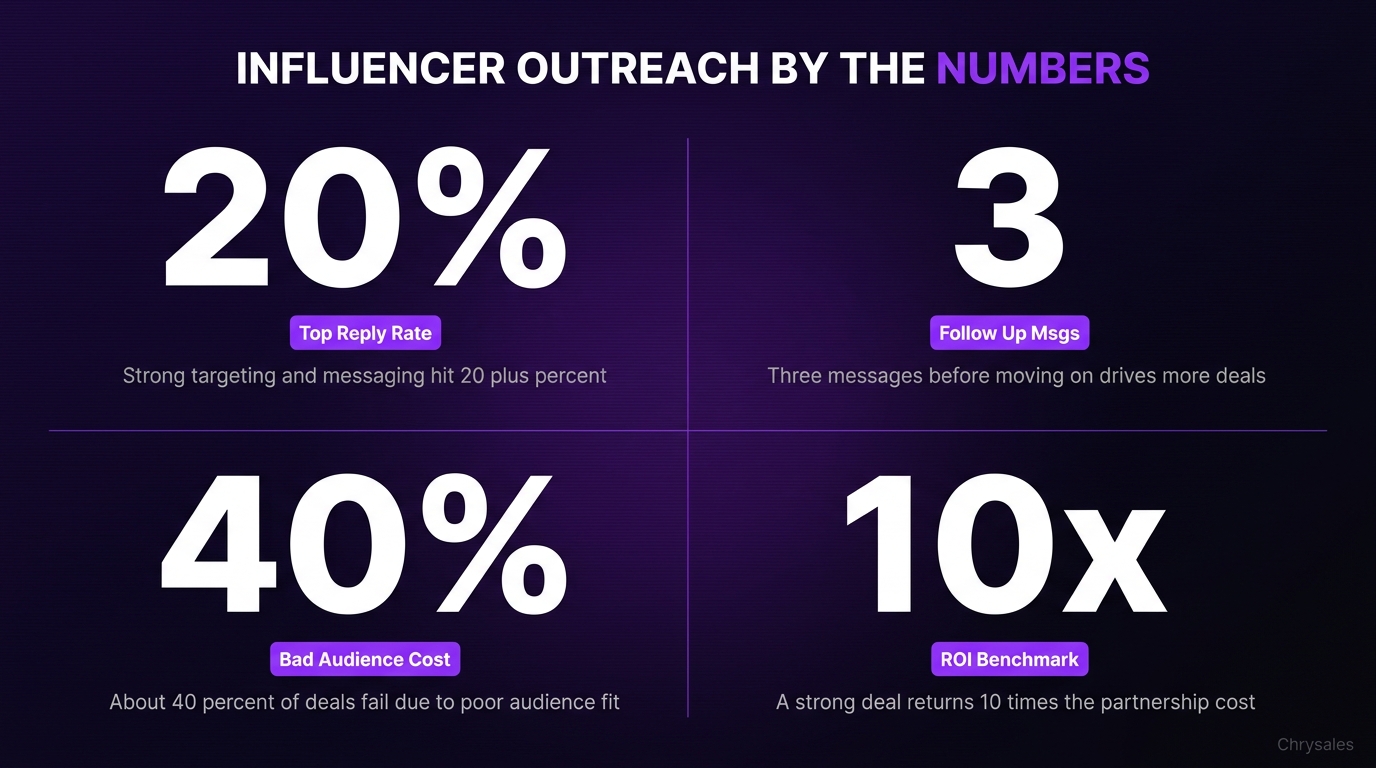
Here's a stat most teams ignore: about 40% of influencer partnerships fail because the audience doesn't match the offer. You could partner with someone who has 100,000 followers, but if those followers aren't your ideal buyers, you just paid for exposure that won't convert. A 15-person consulting firm that sells to enterprise tech companies doesn't need a lifestyle influencer with a Gen Z audience. They need someone whose followers are in IT leadership roles, already thinking about the problems that firm solves.
Watch out: Follower count is the easiest vanity metric to chase. A smaller influencer with 5,000 engaged followers in your niche will outperform a big name with 50,000 followers who don't care about what you do.
Where Most Outreach Messages Fall Apart
Most influencer outreach templates sound like this: "Hey, I love your content! We'd love to collaborate. Let me know if you're interested." That's not a pitch. That's a vague ask with no clear value for them. When you write an outreach campaign for B2B lead generation, you lead with what the prospect gets, not what you want. Same rule here. Your message should answer three questions in the first two sentences: Who are you? Why does this matter to them? What's the next step?
How to Build an Influencer Outreach Strategy That Works Like a Sales System
A strong influencer outreach campaign starts with the same discipline you'd use to build a sales system that actually scales. You define the goal, map the steps, and track what moves the needle. Most teams skip this and jump straight to sending messages. That's why they burn out after 20 outreaches and give up. Start by asking: What does success look like? If your goal is lead generation, you need influencers whose audience overlaps with your ideal client profile. If your goal is brand awareness in a new vertical, you need influencers who already talk about that space. Be specific. A goal of "get more visibility" doesn't help you pick who to reach out to or how to measure if it worked.
Step One: Build Your Influencer List Like a Sales Prospecting List
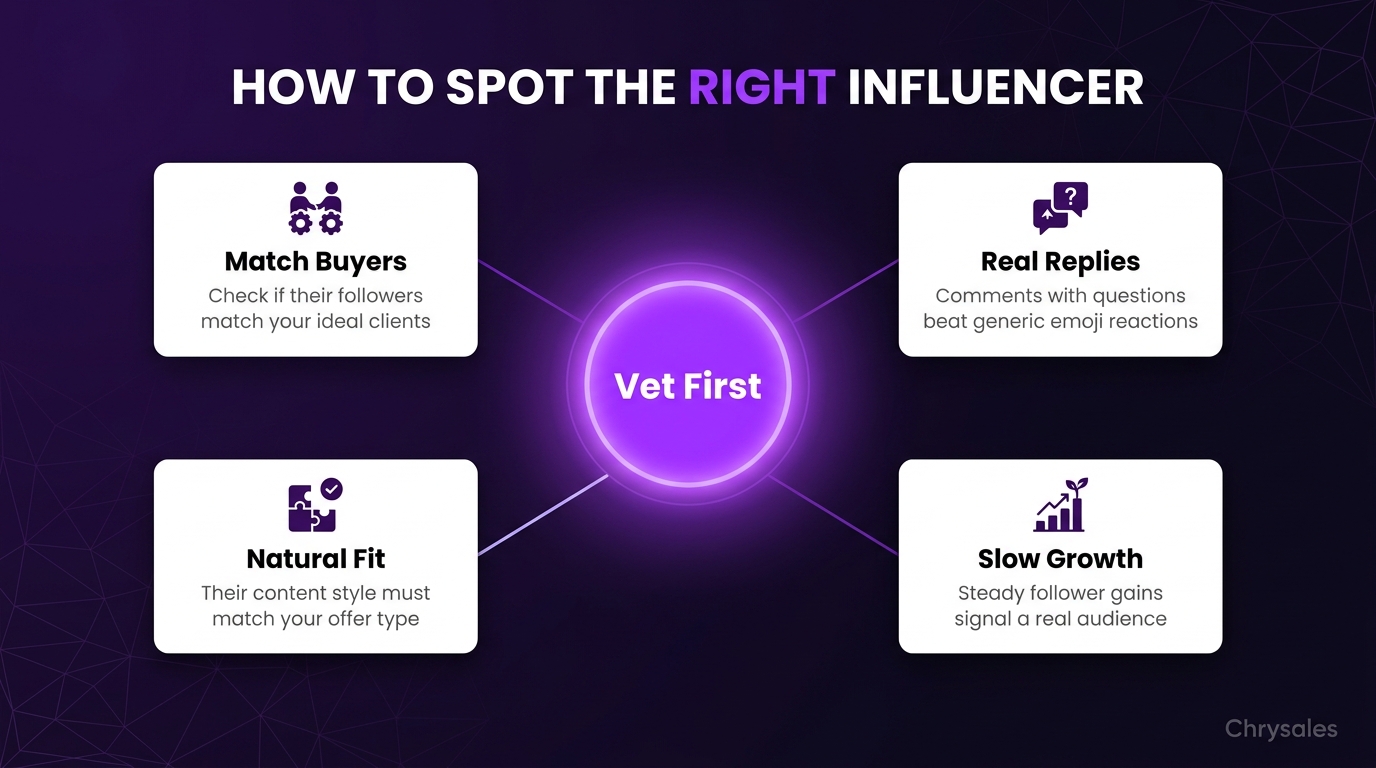
Think of your influencer list the same way you'd build a cold email list for outbound. You don't just grab names from a tool and hit send. You score them, segment them, and prioritize based on fit. For influencer partnership outreach, fit means three things: audience overlap, engagement quality, and content style. Audience overlap is the big one. You want influencers whose followers look like your buyers. If you sell sales training to mid-market B2B companies, you want influencers whose audience includes sales leaders, GTM teams, and people already searching for ways to improve client acquisition.
Tools like SparkToro or manual LinkedIn research can help you figure this out. Look at who comments on their posts, who shares their content, and what those people care about. Engagement quality matters more than size. A post with 500 likes and 40 real comments beats a post with 5,000 likes and three generic emojis. Real engagement means the audience trusts the influencer. That trust transfers when they recommend you. Content style tells you if your partnership will feel natural. If an influencer only posts memes and you want them to share a long form case study, it's a bad match. If they already post tactical how to content and your offer is a deep dive resource, that's a fit.
Pro Tip: Score each influencer on a simple 1-10 scale for audience fit, engagement, and content alignment. Anyone scoring 8 or above goes to the top of your outreach list.
Step Two: Write Personalized Influencer Outreach Messages That Sound Like Real Conversations
Most influencer outreach templates fail because they sound like templates. The influencer can tell you copied and pasted the same message to 50 people. Personalization doesn't mean adding their name. It means showing you actually know what they talk about and why this partnership makes sense for them. Here's what works: Open with a specific reference to something they posted recently. Not "I love your content." That's generic. Say "I saw your post last week about X, and the point you made about Y is exactly what we help teams solve." Now they know you're not mass mailing.
Next, explain what's in it for them. Most pitches focus on what you want. Flip it. What do they get? Access to your audience? A resource their followers will love? A chance to be part of a case study that makes them look smart? Lead with that. Then make the ask tiny. Don't ask for a 30 minute call to "discuss opportunities." Ask if they'd be open to a quick question via DM or email. Lower friction gets more yeses. Here's a simple structure that works:
- Specific reference to their content (1 sentence)
- What's in it for them (2 sentences)
- Tiny next step (1 sentence)
Keep it under 80 words. If you need three paragraphs to explain your idea, it's too complicated.
Common mistake: Sending a long pitch in the first message. Influencers get dozens of these a week. Short and clear wins.
Step Three: Build a Follow Up Sequence, Not a One Off Message
A one time outreach message gets about a 10 to 15% response rate on average. That means 85 to 90% of your list ignores you. Most teams stop there. But in B2B sales, follow ups are where the real conversions happen. Same here. Plan a three message sequence. Message one is your intro. If they don't reply in 4 to 5 days, send a short follow up. Keep it light: "Hey, just wanted to bump this up in case it got buried. Still interested in connecting?"
If they don't reply after that, wait another week and send a final message with a different angle or a small piece of value, like a resource their audience would love. This isn't pushy. It's professional persistence. People are busy. A follow up reminds them you exist. We see this all the time with new clients who think one cold email should be enough. It's not. Follow ups are where deals happen, and you can learn more about this in our guide on cold email follow up templates.
Pro Tip: Track your follow up response rates. If message two gets more replies than message one, your timing or angle in the second message is stronger. Use that data to improve the first message next time.
How to Find Influencers Who Actually Match Your B2B Offer
Finding the right influencers for a B2B influencer marketing campaign is harder than it sounds. Most influencer outreach tools are built for consumer brands selling skincare or athleisure. If you're in sales training, consulting, or tech services, the process looks different. Start with your existing network. Look at who your best clients follow on LinkedIn or Twitter. Check who they repost, comment on, or mention. Those influencers already have the attention of people like your buyers. That's your warmest list.
Next, search by topic, not by follower count. Use LinkedIn search or Twitter advanced search to find people posting about the problems you solve. Type in keywords like "sales hiring," "B2B lead generation," or "client acquisition." Filter by engagement. You want people whose posts get shared and discussed, not just liked. Podcasts and newsletters are often overlooked. A B2B podcast host with 2,000 listeners in your exact niche is more valuable than a generalist influencer with 50,000 followers who don't care about your space. Guest spots, newsletter sponsorships, or simple content collaborations with these hosts can drive serious lead generation.
Using Influencer Outreach Tools Without Wasting Time
There are tools built for influencer outreach campaigns, but most are overkill for B2B. If you're selling to marketing agencies or consulting firms, you don't need a tool that tracks TikTok engagement rates. You need something that helps you organize your list, track who you've contacted, and manage follow ups. A simple CRM or even a well organized spreadsheet works. Track columns for: influencer name, platform, audience size, engagement quality, outreach date, follow up dates, and response status. This is your influencer outreach program tracker. Treat it like a sales pipeline. Move people through stages: Researched, Contacted, Replied, Partnered.
If you want to automate parts of the process, use tools that integrate with your email or LinkedIn workflow. But don't automate the personalization. That's where most influencer outreach services fall apart. They scale the wrong thing. They send 500 generic messages instead of 50 great ones, ignoring outbound email marketing best practices that emphasize quality over quantity.
How to Vet Influencers for Real Engagement, Not Fake Numbers
Fake followers and fake engagement are everywhere. A recent study found that around 15 to 20% of influencer followers on some platforms are bots or inactive accounts. That means you could partner with someone who looks big but delivers zero results. Here's how to spot it: Check the comments on their posts. Real engagement means real conversations. If every comment is a generic emoji or "great post," that's a red flag. Look for comments that ask questions, add opinions, or tag other people.
Check follower to engagement ratio. A rough benchmark: an influencer with 10,000 followers should get at least 200 to 400 likes and 10 to 20 comments per post if their audience is real and engaged. If they have 50,000 followers and get 100 likes, something's off. Look at follower growth patterns. If someone went from 2,000 to 20,000 followers in one month, they probably bought followers. Slow, steady growth is a better sign.
Watch out: Influencers with huge followings but no website, no email list, and no other platforms are risky. Real influence spreads across multiple channels.
Turning Influencer Partnerships Into Repeatable Client Acquisition
Once you land a partnership, most teams treat it like a one off win. They post the collaboration, get a small spike in traffic, and move on. That's leaving money on the table. A good influencer partnership should plug into your broader B2B lead generation system, not sit outside it. Set up tracking from day one. If the influencer is sharing your content, use UTM links so you can see exactly how much traffic and how many conversions come from them. If they're hosting a webinar with you, capture emails and move those leads into your sales pipeline. Treat every partnership like a lead source you'd track in your CRM.
Ask for permission to repurpose the content. If you did a podcast interview, turn it into three LinkedIn posts, a blog, and a lead magnet. If they wrote about you in their newsletter, screenshot it and use it as social proof in your sales outreach. One partnership should generate content and credibility you can use for months. Build relationships, not transactions. If a partnership works, keep the conversation going. Check in every few months. Share their content. Offer to collaborate again. Long term influencer partnerships compound. The second campaign with the same person performs better because their audience already knows you.
How to Measure ROI on Your Influencer Outreach Campaign
Most influencer campaign ROI tracking focuses on vanity metrics: impressions, likes, shares. Those don't pay the bills. What matters is: Did this bring in leads? Did those leads turn into clients? How much revenue came from this partnership? Track three things: top of funnel traffic, mid funnel engagement, and bottom funnel conversions. Top of funnel is clicks and visits. Mid funnel is email signups, content downloads, or demo requests. Bottom funnel is closed deals.
If an influencer partnership brought in 500 clicks but zero signups, the audience wasn't the right fit. If it brought in 50 signups and 3 closed deals, that's a win. Compare the cost of the partnership (money, time, or value you gave them) to the revenue those deals generated. If you spent $2,000 on the partnership and closed $20,000 in new business, your ROI is clear. This approach aligns with proven strategies in B2B blog strategy that emphasize measurable business outcomes over vanity metrics.
Pro Tip: For smaller tests, track lead quality instead of raw volume. Five high intent leads from one influencer beat 50 tire kickers from another.
Avoiding the Biggest Mistakes in Influencer Outreach Strategies
We see the same mistakes over and over. First, teams reach out to influencers who are too big or too expensive and give up when they get ignored. Start smaller. A micro influencer in your niche will reply and deliver better results than a celebrity influencer who charges $10,000 per post. Second, teams pitch influencers without a clear offer. "Let's collaborate" isn't an offer. "I'll create a free resource for your audience and you share it in your newsletter" is an offer. Be specific about what you're asking for and what they get.
Third, no follow up system. One message isn't enough. Plan your sequence before you send the first message. Fourth, no tracking. If you can't measure what happened, you can't repeat what worked or fix what didn't. Set up tracking links, capture leads properly, and review the data after every campaign.
How Chrysales Builds Sales Systems Around Influencer and Partnership Outreach
At Chrysales, we don't treat influencer outreach like a marketing side project. We build it into your B2B sales system as a structured, repeatable channel for client acquisition. That means defining your ideal partnership profile the same way we define your ideal client profile. It means creating outreach sequences that convert, not just templates that sound nice. And it means tracking every stage so you know what's working and where to double down.
We've worked with over 500 sales teams and helped generate more than €10 million in client revenue by treating every lead source, including partnerships, as part of a bigger system. Influencer outreach campaigns work when they're integrated into your pipeline, tracked like any other sales channel, and optimized based on real data. If your current partnerships aren't bringing in measurable leads or closed deals, the issue isn't influencer marketing. It's the system around it. You can watch how to build a sales system so powerful clients come to you for a deeper understanding of this approach.
Our approach: identify the influencers or partners whose audience matches your buyers, write outreach that actually gets replies, build follow up sequences that don't quit, and plug the results into your CRM so every lead is tracked and nurtured. That's how you turn a one off collaboration into a repeatable growth channel.
Scaling Influencer Outreach Without Burning Out Your Team
Outreach campaigns for B2B influencer partnerships take time. If your team is already managing cold email, sales calls, and hiring, adding influencer outreach on top can feel impossible. The fix isn't working harder. It's building a system that scales without adding more manual work. Start by batching your research. Set aside two hours once a week to find and score 10 to 15 new influencers. Don't try to do this daily. Batching makes it faster and keeps you from getting distracted.
Use templates for structure, not for copy. A good template gives you a framework: hook, value, ask. But you still personalize every message. The goal is to speed up the process without losing quality. Automate follow ups where it makes sense. If you're using email for outreach, set up a simple sequence in your email tool. Message one goes out manually. Messages two and three can be automated if they don't get a reply. Just make sure the automation stops if they respond. Nobody wants to get a follow up after they already said yes.
Delegate the research, not the relationship building. A junior team member or VA can help with list building and initial research. But the actual outreach and relationship management should stay with someone who knows your offer and can adjust the message on the fly. Research shows that B2B SEO statistics highlight the importance of quality content and strategic partnerships in driving sustainable business growth.
Common mistake: Trying to reach out to 100 influencers at once. You'll burn out and the quality will tank. Start with 20 to 30. Get responses. Learn what works. Then scale.
Frequently Asked Questions
Q: How many influencers should I contact in my first influencer outreach campaign?
Start with 20 to 30. That's enough to test your messaging and see what gets replies, but not so many that you lose track or can't personalize well. If you're getting solid response rates, scale up to 50 to 75 in your next batch. Quality beats volume every time in B2B influencer marketing.
Q: What's a realistic response rate for B2B influencer outreach?
For cold outreach to influencers, expect 10 to 20% reply rate if your targeting and message are solid. That means out of 30 messages, you'll get 3 to 6 replies. Not all will turn into partnerships, but that's your starting pool. If you're under 10%, your list or message needs work. Over 20% means you nailed it.
Q: Should I pay influencers or offer free product and services?
It depends on the influencer and the value you're asking for. Micro influencers in B2B often accept free access, tools, or content they can share with their audience. Larger influencers or those with established media kits will expect payment. Start by offering value before offering cash. A custom resource, guest content swap, or affiliate setup works for many early partnerships.
Q: How long should I wait before following up on an influencer outreach message?
Wait 4 to 5 business days after your first message. People are busy, and your message might get buried. A short, friendly follow up after that window is fine. If they don't reply to the second message, wait another week and send a third with a different angle or a piece of value. After three messages, move on.
Q: What's the difference between influencer outreach and affiliate outreach?
Influencer outreach focuses on building a partnership where the influencer shares your content, co creates something, or promotes your offer to their audience, usually for exposure, value, or a flat fee. Affiliate outreach is a performance based relationship where the influencer earns a commission for every lead or sale they generate. You can combine both: start with an influencer partnership, then offer an affiliate deal if it performs well.
Q: How do I know if an influencer's audience is a good fit for my B2B offer?
Check three things: who comments on their posts, what topics they discuss, and where their audience works. If they post about sales training and the comments come from sales leaders and GTM teams, that's a fit. If they post about sales training but the comments are from students or people outside your target market, it's not. Tools like SparkToro or manual LinkedIn research help with this. You can also discover four ways to find clients who need your services right now to refine your audience targeting approach.
Q: Can influencer outreach really drive leads for B2B companies, or is it just for consumer brands?
It works for B2B, but the approach is different. You're not chasing viral posts or huge follower counts. You're targeting influencers whose audience overlaps with your ideal clients. A LinkedIn thought leader with 5,000 engaged followers in your niche can drive more qualified leads than a generalist with 100,000. We've seen consulting firms, sales training companies, and tech services all generate real client acquisition from the right influencer partnerships. The key is treating it like a sales channel, not a brand play.
An influencer outreach campaign is a structured way to contact creators, build partnerships, and turn those partnerships into lead generation and client acquisition. Most influencer outreach campaigns fail before the first message even gets sent. Teams spend weeks researching profiles, writing pitches, and chasing partnerships, only to get ghosted or end up with collaborations that generate zero client acquisition. The problem isn't the effort. It's that most teams treat influencer outreach like a marketing experiment instead of a structured sales process. When you approach an influencer outreach campaign the same way you'd build a sales pipeline, everything changes. You get real responses, real partnerships, and results you can measure and repeat.
Why Most Influencer Outreach Campaigns Miss the Mark
Picture this: you spend three weeks building a list of 200 influencers, send personalized messages to 50 of them, and get back two replies. One is a "not interested." The other is someone asking for five times your budget. You chalk it up to bad luck and move on. But here's the thing: the issue wasn't luck. It was the system, or lack of one. Most influencer marketing outreach treats partnerships like a creative project. You brainstorm ideas, craft beautiful messages, and hope someone bites. That might work once or twice. But if you want predictable client acquisition from influencer partnerships, you need a repeatable process.
Think of it like cold outreach for B2B sales. You don't send random emails to random people and hope for the best. You qualify leads, personalize at scale, follow up with a sequence, and track what converts. The same rules apply here. Your influencer outreach strategy should look less like a PR campaign and more like a sales pipeline. You need clear criteria for who you reach out to, a structured message that solves a real problem for them, and a follow-up system that doesn't quit after one message.
The Hidden Cost of Bad Targeting
Here's a stat most teams ignore: about 40% of influencer partnerships fail because the audience doesn't match the offer. You could partner with someone who has 100,000 followers, but if those followers aren't your ideal buyers, you just paid for exposure that won't convert. A 15-person consulting firm that sells to enterprise tech companies doesn't need a lifestyle influencer with a Gen Z audience. They need someone whose followers are in IT leadership roles, already thinking about the problems that firm solves.
Watch out: Follower count is the easiest vanity metric to chase. A smaller influencer with 5,000 engaged followers in your niche will outperform a big name with 50,000 followers who don't care about what you do.
Where Most Outreach Messages Fall Apart
Most influencer outreach templates sound like this: "Hey, I love your content! We'd love to collaborate. Let me know if you're interested." That's not a pitch. That's a vague ask with no clear value for them. When you write an outreach campaign for B2B lead generation, you lead with what the prospect gets, not what you want. Same rule here. Your message should answer three questions in the first two sentences: Who are you? Why does this matter to them? What's the next step?
How to Build an Influencer Outreach Strategy That Works Like a Sales System
A strong influencer outreach campaign starts with the same discipline you'd use to build a sales system that actually scales. You define the goal, map the steps, and track what moves the needle. Most teams skip this and jump straight to sending messages. That's why they burn out after 20 outreaches and give up. Start by asking: What does success look like? If your goal is lead generation, you need influencers whose audience overlaps with your ideal client profile. If your goal is brand awareness in a new vertical, you need influencers who already talk about that space. Be specific. A goal of "get more visibility" doesn't help you pick who to reach out to or how to measure if it worked.
Step One: Build Your Influencer List Like a Sales Prospecting List
Think of your influencer list the same way you'd build a cold email list for outbound. You don't just grab names from a tool and hit send. You score them, segment them, and prioritize based on fit. For influencer partnership outreach, fit means three things: audience overlap, engagement quality, and content style. Audience overlap is the big one. You want influencers whose followers look like your buyers. If you sell sales training to mid-market B2B companies, you want influencers whose audience includes sales leaders, GTM teams, and people already searching for ways to improve client acquisition.
Tools like SparkToro or manual LinkedIn research can help you figure this out. Look at who comments on their posts, who shares their content, and what those people care about. Engagement quality matters more than size. A post with 500 likes and 40 real comments beats a post with 5,000 likes and three generic emojis. Real engagement means the audience trusts the influencer. That trust transfers when they recommend you. Content style tells you if your partnership will feel natural. If an influencer only posts memes and you want them to share a long form case study, it's a bad match. If they already post tactical how to content and your offer is a deep dive resource, that's a fit.
Pro Tip: Score each influencer on a simple 1-10 scale for audience fit, engagement, and content alignment. Anyone scoring 8 or above goes to the top of your outreach list.
Step Two: Write Personalized Influencer Outreach Messages That Sound Like Real Conversations
Most influencer outreach templates fail because they sound like templates. The influencer can tell you copied and pasted the same message to 50 people. Personalization doesn't mean adding their name. It means showing you actually know what they talk about and why this partnership makes sense for them. Here's what works: Open with a specific reference to something they posted recently. Not "I love your content." That's generic. Say "I saw your post last week about X, and the point you made about Y is exactly what we help teams solve." Now they know you're not mass mailing.
Next, explain what's in it for them. Most pitches focus on what you want. Flip it. What do they get? Access to your audience? A resource their followers will love? A chance to be part of a case study that makes them look smart? Lead with that. Then make the ask tiny. Don't ask for a 30 minute call to "discuss opportunities." Ask if they'd be open to a quick question via DM or email. Lower friction gets more yeses. Here's a simple structure that works:
- Specific reference to their content (1 sentence)
- What's in it for them (2 sentences)
- Tiny next step (1 sentence)
Keep it under 80 words. If you need three paragraphs to explain your idea, it's too complicated.
Common mistake: Sending a long pitch in the first message. Influencers get dozens of these a week. Short and clear wins.
Step Three: Build a Follow Up Sequence, Not a One Off Message
A one time outreach message gets about a 10 to 15% response rate on average. That means 85 to 90% of your list ignores you. Most teams stop there. But in B2B sales, follow ups are where the real conversions happen. Same here. Plan a three message sequence. Message one is your intro. If they don't reply in 4 to 5 days, send a short follow up. Keep it light: "Hey, just wanted to bump this up in case it got buried. Still interested in connecting?"
If they don't reply after that, wait another week and send a final message with a different angle or a small piece of value, like a resource their audience would love. This isn't pushy. It's professional persistence. People are busy. A follow up reminds them you exist. We see this all the time with new clients who think one cold email should be enough. It's not. Follow ups are where deals happen, and you can learn more about this in our guide on cold email follow up templates.
Pro Tip: Track your follow up response rates. If message two gets more replies than message one, your timing or angle in the second message is stronger. Use that data to improve the first message next time.
How to Find Influencers Who Actually Match Your B2B Offer
Finding the right influencers for a B2B influencer marketing campaign is harder than it sounds. Most influencer outreach tools are built for consumer brands selling skincare or athleisure. If you're in sales training, consulting, or tech services, the process looks different. Start with your existing network. Look at who your best clients follow on LinkedIn or Twitter. Check who they repost, comment on, or mention. Those influencers already have the attention of people like your buyers. That's your warmest list.
Next, search by topic, not by follower count. Use LinkedIn search or Twitter advanced search to find people posting about the problems you solve. Type in keywords like "sales hiring," "B2B lead generation," or "client acquisition." Filter by engagement. You want people whose posts get shared and discussed, not just liked. Podcasts and newsletters are often overlooked. A B2B podcast host with 2,000 listeners in your exact niche is more valuable than a generalist influencer with 50,000 followers who don't care about your space. Guest spots, newsletter sponsorships, or simple content collaborations with these hosts can drive serious lead generation.
Using Influencer Outreach Tools Without Wasting Time
There are tools built for influencer outreach campaigns, but most are overkill for B2B. If you're selling to marketing agencies or consulting firms, you don't need a tool that tracks TikTok engagement rates. You need something that helps you organize your list, track who you've contacted, and manage follow ups. A simple CRM or even a well organized spreadsheet works. Track columns for: influencer name, platform, audience size, engagement quality, outreach date, follow up dates, and response status. This is your influencer outreach program tracker. Treat it like a sales pipeline. Move people through stages: Researched, Contacted, Replied, Partnered.
If you want to automate parts of the process, use tools that integrate with your email or LinkedIn workflow. But don't automate the personalization. That's where most influencer outreach services fall apart. They scale the wrong thing. They send 500 generic messages instead of 50 great ones, ignoring outbound email marketing best practices that emphasize quality over quantity.
How to Vet Influencers for Real Engagement, Not Fake Numbers
Fake followers and fake engagement are everywhere. A recent study found that around 15 to 20% of influencer followers on some platforms are bots or inactive accounts. That means you could partner with someone who looks big but delivers zero results. Here's how to spot it: Check the comments on their posts. Real engagement means real conversations. If every comment is a generic emoji or "great post," that's a red flag. Look for comments that ask questions, add opinions, or tag other people.
Check follower to engagement ratio. A rough benchmark: an influencer with 10,000 followers should get at least 200 to 400 likes and 10 to 20 comments per post if their audience is real and engaged. If they have 50,000 followers and get 100 likes, something's off. Look at follower growth patterns. If someone went from 2,000 to 20,000 followers in one month, they probably bought followers. Slow, steady growth is a better sign.
Watch out: Influencers with huge followings but no website, no email list, and no other platforms are risky. Real influence spreads across multiple channels.
Turning Influencer Partnerships Into Repeatable Client Acquisition
Once you land a partnership, most teams treat it like a one off win. They post the collaboration, get a small spike in traffic, and move on. That's leaving money on the table. A good influencer partnership should plug into your broader B2B lead generation system, not sit outside it. Set up tracking from day one. If the influencer is sharing your content, use UTM links so you can see exactly how much traffic and how many conversions come from them. If they're hosting a webinar with you, capture emails and move those leads into your sales pipeline. Treat every partnership like a lead source you'd track in your CRM.
Ask for permission to repurpose the content. If you did a podcast interview, turn it into three LinkedIn posts, a blog, and a lead magnet. If they wrote about you in their newsletter, screenshot it and use it as social proof in your sales outreach. One partnership should generate content and credibility you can use for months. Build relationships, not transactions. If a partnership works, keep the conversation going. Check in every few months. Share their content. Offer to collaborate again. Long term influencer partnerships compound. The second campaign with the same person performs better because their audience already knows you.
How to Measure ROI on Your Influencer Outreach Campaign
Most influencer campaign ROI tracking focuses on vanity metrics: impressions, likes, shares. Those don't pay the bills. What matters is: Did this bring in leads? Did those leads turn into clients? How much revenue came from this partnership? Track three things: top of funnel traffic, mid funnel engagement, and bottom funnel conversions. Top of funnel is clicks and visits. Mid funnel is email signups, content downloads, or demo requests. Bottom funnel is closed deals.
If an influencer partnership brought in 500 clicks but zero signups, the audience wasn't the right fit. If it brought in 50 signups and 3 closed deals, that's a win. Compare the cost of the partnership (money, time, or value you gave them) to the revenue those deals generated. If you spent $2,000 on the partnership and closed $20,000 in new business, your ROI is clear. This approach aligns with proven strategies in B2B blog strategy that emphasize measurable business outcomes over vanity metrics.
Pro Tip: For smaller tests, track lead quality instead of raw volume. Five high intent leads from one influencer beat 50 tire kickers from another.
Avoiding the Biggest Mistakes in Influencer Outreach Strategies
We see the same mistakes over and over. First, teams reach out to influencers who are too big or too expensive and give up when they get ignored. Start smaller. A micro influencer in your niche will reply and deliver better results than a celebrity influencer who charges $10,000 per post. Second, teams pitch influencers without a clear offer. "Let's collaborate" isn't an offer. "I'll create a free resource for your audience and you share it in your newsletter" is an offer. Be specific about what you're asking for and what they get.
Third, no follow up system. One message isn't enough. Plan your sequence before you send the first message. Fourth, no tracking. If you can't measure what happened, you can't repeat what worked or fix what didn't. Set up tracking links, capture leads properly, and review the data after every campaign.
How Chrysales Builds Sales Systems Around Influencer and Partnership Outreach
At Chrysales, we don't treat influencer outreach like a marketing side project. We build it into your B2B sales system as a structured, repeatable channel for client acquisition. That means defining your ideal partnership profile the same way we define your ideal client profile. It means creating outreach sequences that convert, not just templates that sound nice. And it means tracking every stage so you know what's working and where to double down.
We've worked with over 500 sales teams and helped generate more than €10 million in client revenue by treating every lead source, including partnerships, as part of a bigger system. Influencer outreach campaigns work when they're integrated into your pipeline, tracked like any other sales channel, and optimized based on real data. If your current partnerships aren't bringing in measurable leads or closed deals, the issue isn't influencer marketing. It's the system around it. You can watch how to build a sales system so powerful clients come to you for a deeper understanding of this approach.
Our approach: identify the influencers or partners whose audience matches your buyers, write outreach that actually gets replies, build follow up sequences that don't quit, and plug the results into your CRM so every lead is tracked and nurtured. That's how you turn a one off collaboration into a repeatable growth channel.
Scaling Influencer Outreach Without Burning Out Your Team
Outreach campaigns for B2B influencer partnerships take time. If your team is already managing cold email, sales calls, and hiring, adding influencer outreach on top can feel impossible. The fix isn't working harder. It's building a system that scales without adding more manual work. Start by batching your research. Set aside two hours once a week to find and score 10 to 15 new influencers. Don't try to do this daily. Batching makes it faster and keeps you from getting distracted.
Use templates for structure, not for copy. A good template gives you a framework: hook, value, ask. But you still personalize every message. The goal is to speed up the process without losing quality. Automate follow ups where it makes sense. If you're using email for outreach, set up a simple sequence in your email tool. Message one goes out manually. Messages two and three can be automated if they don't get a reply. Just make sure the automation stops if they respond. Nobody wants to get a follow up after they already said yes.
Delegate the research, not the relationship building. A junior team member or VA can help with list building and initial research. But the actual outreach and relationship management should stay with someone who knows your offer and can adjust the message on the fly. Research shows that B2B SEO statistics highlight the importance of quality content and strategic partnerships in driving sustainable business growth.
Common mistake: Trying to reach out to 100 influencers at once. You'll burn out and the quality will tank. Start with 20 to 30. Get responses. Learn what works. Then scale.
Frequently Asked Questions
Q: How many influencers should I contact in my first influencer outreach campaign?
Start with 20 to 30. That's enough to test your messaging and see what gets replies, but not so many that you lose track or can't personalize well. If you're getting solid response rates, scale up to 50 to 75 in your next batch. Quality beats volume every time in B2B influencer marketing.
Q: What's a realistic response rate for B2B influencer outreach?
For cold outreach to influencers, expect 10 to 20% reply rate if your targeting and message are solid. That means out of 30 messages, you'll get 3 to 6 replies. Not all will turn into partnerships, but that's your starting pool. If you're under 10%, your list or message needs work. Over 20% means you nailed it.
Q: Should I pay influencers or offer free product and services?
It depends on the influencer and the value you're asking for. Micro influencers in B2B often accept free access, tools, or content they can share with their audience. Larger influencers or those with established media kits will expect payment. Start by offering value before offering cash. A custom resource, guest content swap, or affiliate setup works for many early partnerships.
Q: How long should I wait before following up on an influencer outreach message?
Wait 4 to 5 business days after your first message. People are busy, and your message might get buried. A short, friendly follow up after that window is fine. If they don't reply to the second message, wait another week and send a third with a different angle or a piece of value. After three messages, move on.
Q: What's the difference between influencer outreach and affiliate outreach?
Influencer outreach focuses on building a partnership where the influencer shares your content, co creates something, or promotes your offer to their audience, usually for exposure, value, or a flat fee. Affiliate outreach is a performance based relationship where the influencer earns a commission for every lead or sale they generate. You can combine both: start with an influencer partnership, then offer an affiliate deal if it performs well.
Q: How do I know if an influencer's audience is a good fit for my B2B offer?
Check three things: who comments on their posts, what topics they discuss, and where their audience works. If they post about sales training and the comments come from sales leaders and GTM teams, that's a fit. If they post about sales training but the comments are from students or people outside your target market, it's not. Tools like SparkToro or manual LinkedIn research help with this. You can also discover four ways to find clients who need your services right now to refine your audience targeting approach.
Q: Can influencer outreach really drive leads for B2B companies, or is it just for consumer brands?
It works for B2B, but the approach is different. You're not chasing viral posts or huge follower counts. You're targeting influencers whose audience overlaps with your ideal clients. A LinkedIn thought leader with 5,000 engaged followers in your niche can drive more qualified leads than a generalist with 100,000. We've seen consulting firms, sales training companies, and tech services all generate real client acquisition from the right influencer partnerships. The key is treating it like a sales channel, not a brand play.
Scaling Is Not Hard If You Have The Right Systems
If you’re serious about leveling up your scaling game, you need the right system, the right training, and the right team behind you. We're here to give you the exact tools and strategies top entrepreneurs use to dominate.

Discover the latest tips
View All.avif)
Chrysales was formed from the words "chrysalis" the stage where a caterpillar transforms into a butterfly and "sales".
It stands for one thing: sales transformation.Because scaling doesn’t happen by doing more of the same. Scaling only happens when you go through real transformation in your systems, your offer, team and the way you sell.
.avif)


