.avif)
What Does ICP Mean in B2B Sales?

ICP meaning in B2B sales refers to the specific type of company that gets the most value from your product and pays without drama. It acts as a filter to ensure your team only targets leads that are a true fit.
Most cold emails tank before the words even matter. The real problem? Teams send them to the wrong list. You spend hours writing smart copy, but if half your list isn't even a fit, the message dies on arrival. That's what happens when you skip the ICP step.
ICP stands for Ideal Customer Profile, and it's the single biggest difference between outreach that fills your calendar and outreach that gets ignored. Get the ICP right, and everything downstream gets easier. Get it wrong, and no clever email saves you.
What Does ICP Mean in Sales?
ICP meaning in sales is simple: it's the type of company that gets the most value from what you sell and pays you without drama. Not just any company that might buy. The company that buys fast, stays long, and tells their friends about you.
Think of your ICP as a filter. You put 1,000 companies into the top. The ones that make it through the filter are worth calling. The ones that don't? Skip them. No guilt. No second-guessing.
Why ICP Isn't Just a Marketing Thing
Most people think ICP is a marketing term. It's not. Sales teams that ignore their ICP waste half their time on leads that were never going to close. A 200-person company that just did layoffs is not a hot lead. It's a bad fit, full stop. Your ICP tells you that before you waste a week chasing it.
ICP vs Buyer Persona: What's the Difference?
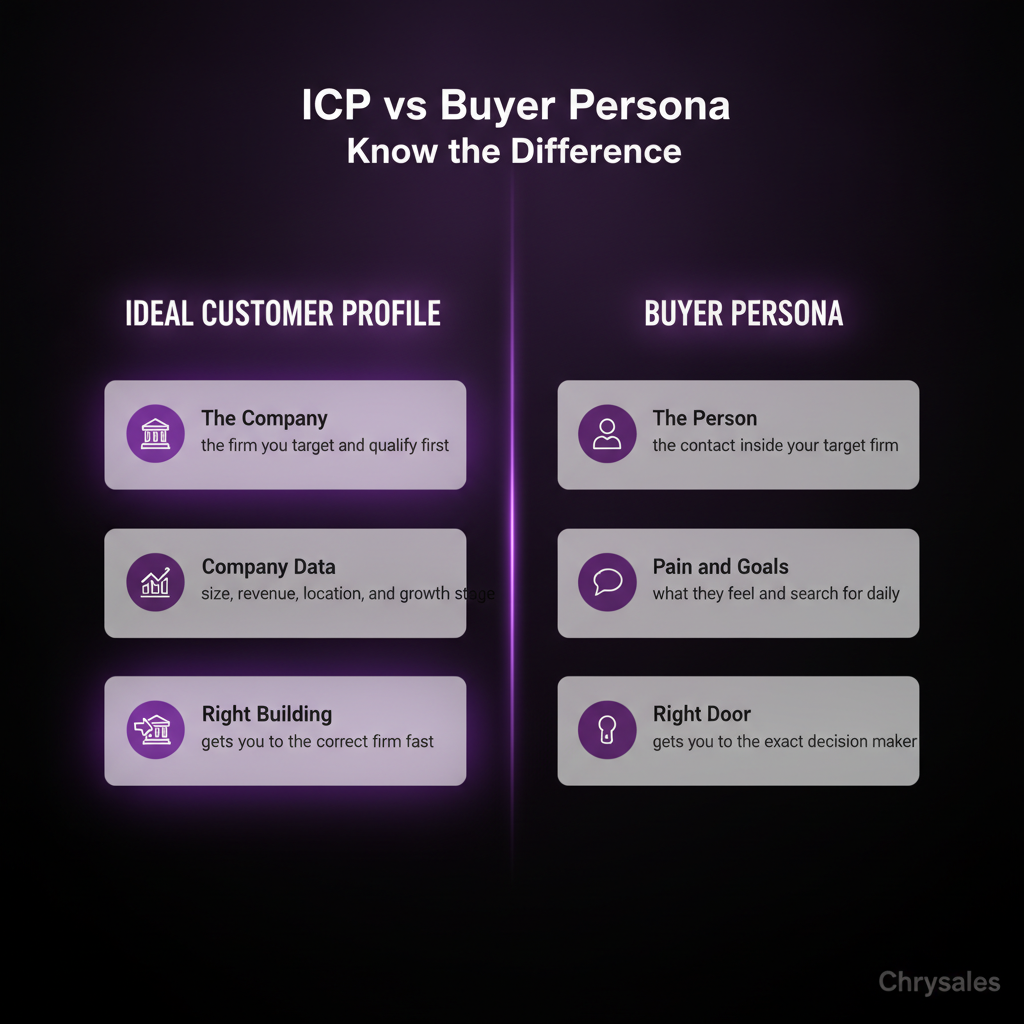
Here's the thing: ICP and buyer persona are not the same. Your ICP is the company. Your buyer persona is the person inside that company.
ICP example: A 20-50 person SaaS company in the U.S., $2M-$10M revenue, selling to enterprise clients, with no in-house sales team.
Buyer persona example: The founder or head of growth, age 30-45, frustrated with inconsistent revenue, Googles "how to hire a sales team," reads LinkedIn posts at night.
You need both. ICP gets you to the right building. Buyer persona gets you to the right door inside. Learn more about how ICP and buyer persona work together to refine your targeting.
Pro Tip: Build your ICP first. Then map personas inside it. Not the other way around.
How to Define Your ICP for B2B Sales
Defining your ideal customer profile for B2B starts with your best clients. Not your biggest. Your best. The ones that bought fast, paid on time, got results, and stayed.
Pull up your CRM. Look at your last 10-15 closed deals. Find the 3-5 that were the smoothest. Now ask:
- What industry were they in?
- How many employees did they have?
- What was their revenue range?
- Where were they located?
- What problem were they trying to solve?
- How long did the sales cycle take?
- Did they need tons of convincing, or did they just get it?
Firmographics: The Company Data That Matters
Firmographics are the hard facts about a company. These are the easiest to filter by, so start here:
- Industry: Tech, consulting, marketing agencies, logistics, etc.
- Company size: 10-50 employees, 50-200, 200+
- Revenue: $1M-$5M, $5M-$20M, $20M+
- Location: U.S. only, Europe, remote-first companies
- Growth stage: Bootstrapped, Series A, profitable for 3+ years
One consulting firm we worked with thought their ICP was "any B2B company." After we dug into their data, we found 80% of their revenue came from 15-40 person consulting firms in Germany selling to enterprise clients. That's an ICP. Everything else was noise.
Technographics: What Tools They Use
Technographics tell you what software and systems a company already runs. This matters more than most people think. If you sell sales automation and your best clients all use HubSpot, that's a signal. If they all run on spreadsheets, that's a different signal.
Look for:
- CRM platform (HubSpot, Salesforce, Pipedrive, none)
- Marketing tools (ActiveCampaign, Mailchimp, none)
- Tech stack size (5 tools vs. 30 tools tells you something)
- Job postings (hiring a sales role = buying intent)
Watch out: Don't over-filter on tech. A company using the "wrong" CRM isn't a dealbreaker if everything else fits.
Behavioral Signals: What They Do Before They Buy
Behavioral signals are actions that show buying intent. These are gold for lead generation and outbound sales. Examples:
- Just raised a funding round
- Hiring for sales or marketing roles
- Launched a new product line
- Expanded into a new region
- Posted on LinkedIn about revenue goals or sales challenges
A 30-person marketing agency posted "we need to stop relying on referrals" on LinkedIn. That's a behavioral signal. They're aware of the problem. They're talking about it publicly. That's your cue.
Why Your ICP Is the Foundation of Your Entire Sales System
Here's what most teams miss: your ICP isn't just for prospecting. It shapes your entire B2B sales process. A bad ICP breaks everything downstream.
Your messaging sounds generic because you're trying to talk to everyone. Your pitch doesn't land because the pain points don't match. Your close rate tanks because half the pipeline was never a fit. Your new sales hire struggles because they don't know who to call.
Picture this: you spend two weeks writing the perfect cold email sequence. You send it to 500 companies. You get 3 replies. The problem wasn't the email. The problem was the list. That's the ICP trap.
How ICP Drives Lead Generation
Your ICP is the blueprint for your lead list. If your ICP says "20-50 person tech consulting firms in Europe," your lead gen team knows exactly what to pull. No guessing. No "let's try this segment and see."
We see this all the time with new clients. They come in with a 5,000-contact list. We ask: "How many of these actually fit your ICP?" They look closer. Maybe 600 do. We cut the list to 600, rewrite the messaging to speak directly to that profile, and replies jump from 1% to 4%. Same person sending emails. Better list.
For more on targeting the right prospects, watch these 4 ways to find clients who need your services right now to see how ICP definition translates into actionable lead generation.
How ICP Shapes Your Offer and Messaging
Your offer has to match the pain your ICP feels. If your ICP is early-stage startups, your offer should solve "we have no sales process." If your ICP is 100-person companies, your offer should solve "our sales team exists but isn't hitting targets."
One SaaS company thought their ICP was any company that needed analytics. Their messaging was vague. "Get better insights." Nobody cared. We narrowed the ICP to 30-80 person e-commerce brands struggling with customer retention. The new messaging: "Know which customers are about to churn before they do." Meetings doubled in 6 weeks.
Common mistake: Writing one pitch and sending it to five different ICP types. It lands with none of them.
How to Build an ICP in 6 Steps
Building an ideal customer profile template doesn't take a full day. You can do this in a few hours if you have the data.
Step 1: Pull your top 10 clients. Best clients, not biggest. Look for speed to close, satisfaction, results, and retention.
Step 2: List the firmographics. Industry, size, revenue, location. Write it all down in a spreadsheet.
Step 3: Add technographics. What tools do they use? What does their website look like? Are they hiring?
Step 4: Note behavioral patterns. What triggered the sale? Did they find you, or did you find them? What was the pain point they mentioned first?
Step 5: Look for the pattern. What do 7 out of 10 have in common? That's your ICP.
Step 6: Write it in one sentence. Example: "20-50 person B2B consulting firms in Europe, $2M-$8M revenue, no dedicated sales team, currently relying on referrals and inbound only."
Now you have a working ICP. It's not set in stone. You'll refine it. But you have a target. For a complete framework on how to build your ideal customer profile, this guide provides additional templates and examples.
Using Your ICP to Build Repeatable Client Acquisition
Once your ICP is clear, you can build systems around it. Sales systems work when they're repeatable. Repeatable means "same input, same output." Your ICP is the input.
To see how a well-defined ICP enables predictable growth, learn how to build a sales system so powerful clients come to you by aligning ICP targeting with inbound and outbound processes.
Scoring Your Leads Against Your ICP
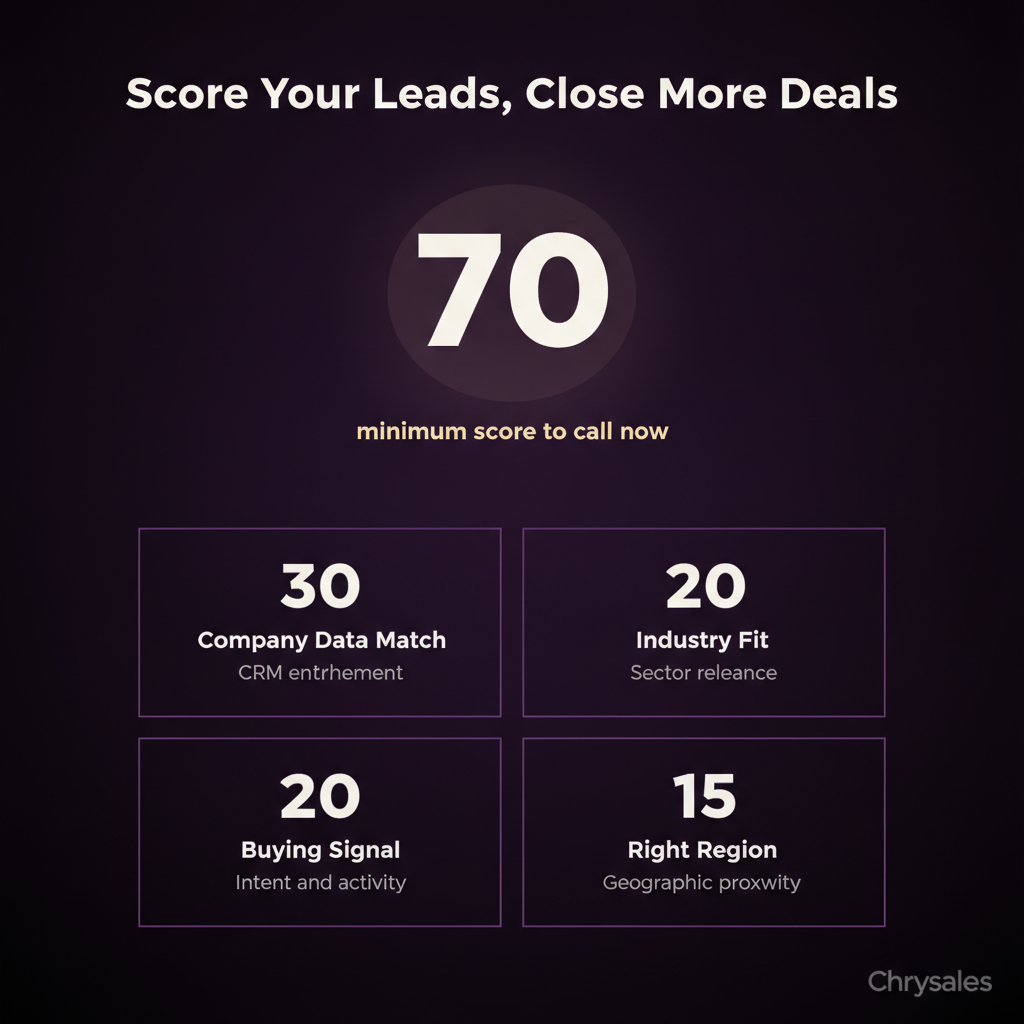
Not every lead that fits your ICP is ready to buy. But every lead that doesn't fit your ICP is a waste of time. Set up a simple scoring system. Example:
- Fits ICP firmographics: +30 points
- Matches ICP industry: +20 points
- Shows behavioral signal (hiring, funding, etc.): +20 points
- Right company size: +15 points
- Located in target region: +15 points
Anything scoring above 70 goes to the top of your call list. Anything under 40 gets dropped or nurtured long-term.
One tech company we worked with had a 0% close rate on leads under 50 points. Zero. They were spending hours on calls that never had a shot. We set a floor at 60 points. Their sales team's calendar freed up. Close rate went from 8% to 14% in one quarter.
Training Your Sales Team Around the ICP
If you hire a salesperson and don't give them a clear ICP, they'll chase anything. A clear ICP is like handing someone a recipe. Follow these steps, get this result.
At Chrysales, we've trained 500+ sales teams, and the ones that ramp fastest are the ones with a tight ICP. New hires know who to call, what pain to lead with, and what objections to expect. No wandering in the dark.
Pro Tip: Make your ICP a one-page doc. Pin it in Slack. Reference it in onboarding. Make it impossible to ignore.
When you're ready to scale, understanding how to build a sales system that actually scales will show you how to operationalize your ICP across every stage of client acquisition.
How ICP Connects to the Rest of Your GTM Strategy
Your go-to-market strategy is only as strong as your ICP definition. Everything in your GTM flows from it.
- Positioning: If your ICP is enterprise companies, you position as stable and secure. If it's startups, you position as fast and flexible.
- Pricing: Enterprise ICP = higher price, annual contracts. Startup ICP = lower entry price, monthly plans.
- Channel: LinkedIn works for one ICP. Cold email works for another. Events work for a third.
- Content: Blog topics, case studies, and sales collateral should all speak to your ICP's pain.
A marketing agency came to us with a content calendar full of generic posts. "5 tips to grow your business." We rewrote it around their ICP: 20-50 person agencies struggling to scale past $3M. New topics: "How to hire your first sales hire when you've only done referrals" and "Why most agencies stall at $3M and what to do about it." Engagement tripled. Inbound leads doubled.
Aligning Sales and Marketing with One ICP
Sales and marketing fight when they don't share an ICP. Marketing generates leads that sales calls "garbage." Sales complains that marketing doesn't understand the customer.
The fix? One ICP document both teams build together. Marketing uses the ICP to target ads, write content, and run campaigns. Sales uses the ICP to cold outreach, qualify leads, and close deals. Both point at the same target.
For a comprehensive look at aligning your teams around one target, explore our guide on building a b2b go-to-market strategy that unifies sales, marketing, and product.
Refining Your ICP Over Time
Your ICP today won't be your ICP in two years. Markets shift. Your product changes. You get better data. Set a review every 6 months. Ask:
- Which clients are we closing fastest now?
- Which clients have the highest lifetime value?
- Which industries are responding best to outreach?
- What new pain points are we hearing on sales calls?
One SaaS client started with an ICP of 10-30 person companies. After a year, they realized their 40-80 person clients stayed twice as long and paid three times more. We shifted the ICP up. Outreach changed. Messaging changed. Average deal size went from €8K to €22K.
Watch out: Don't chase one big deal and rewrite your whole ICP around it. Look for patterns across 10+ deals, not one outlier.
Frequently Asked Questions
Q: What does ICP stand for in business and sales?
ICP stands for Ideal Customer Profile. In sales, it means the type of company that's the best fit for what you sell. It's not just any company that might buy. It's the company that buys fast, uses your product well, stays long, and doesn't cause headaches. Think of it as a filter for your lead list. Companies that fit your ICP go to the top of your outreach queue. Companies that don't get skipped or saved for later.
Q: How is an ICP different from a buyer persona?
An ICP describes the company. A buyer persona describes the person inside that company. Your ICP might be "30-60 person consulting firms in the U.S. with $3M-$10M revenue." Your buyer persona inside that ICP is "the founder or VP of sales, age 35-50, frustrated with inconsistent revenue, active on LinkedIn." You need both. ICP tells you which companies to target. Buyer persona tells you who to reach out to and what pain points to lead with in your messaging.
Q: Can a company have more than one ICP?
Yes, but keep it simple. Most companies do best with one primary ICP and maybe one secondary. If you try to serve three or four ICPs at once, your messaging gets watered down and your sales team gets confused. Start with one. Nail it. Build systems around it. Then, if the data supports it, add a second. A 15-person consulting firm tried targeting both tech startups and enterprise logistics companies. Two totally different sales cycles, two different pains. They picked one, revenue stabilized, and close rates doubled.
Q: How do I know if my ICP is too narrow or too broad?
If your ICP is too broad, your cold outreach reply rates stay under 2% and your sales calls feel all over the place. If it's too narrow, you run out of leads to call in a few weeks. A good ICP gives you at least 500-1,000 companies to target in your region and niche. If you have fewer than that, widen one variable like company size or location. If you have more than 10,000, tighten it up by adding another filter like industry or revenue range.
Q: Do I need fancy tools to define my ICP, or can I do it manually?
You can do it manually. Start with a spreadsheet. List your last 15 clients. Add columns for industry, size, revenue, location, and deal speed. Look for patterns. That's your ICP draft. Once you have it, tools like LinkedIn Sales Navigator, Apollo, or Clay can help you build lead lists that match it. But the ICP itself comes from your own client data, not a tool. We've helped clients define their ICP in under two hours with nothing but a Google sheet and honest answers.
Q: Why is understanding ICP meaning critical for b2b lead generation?
Understanding ICP meaning is critical because it ensures your b2b lead generation efforts target companies that actually buy. Without it, you waste time on leads that never close. A clear ICP improves your lead generation quality and boosts client acquisition rates. It also makes sales training more effective since reps know exactly who to call. When your gtm strategy aligns with a strong ICP, your b2b sales process becomes repeatable and predictable. That is why mastering ICP meaning is the first step in any successful sales system.
ICP meaning in B2B sales refers to the specific type of company that gets the most value from your product and pays without drama. It acts as a filter to ensure your team only targets leads that are a true fit.
Most cold emails tank before the words even matter. The real problem? Teams send them to the wrong list. You spend hours writing smart copy, but if half your list isn't even a fit, the message dies on arrival. That's what happens when you skip the ICP step.
ICP stands for Ideal Customer Profile, and it's the single biggest difference between outreach that fills your calendar and outreach that gets ignored. Get the ICP right, and everything downstream gets easier. Get it wrong, and no clever email saves you.
What Does ICP Mean in Sales?
ICP meaning in sales is simple: it's the type of company that gets the most value from what you sell and pays you without drama. Not just any company that might buy. The company that buys fast, stays long, and tells their friends about you.
Think of your ICP as a filter. You put 1,000 companies into the top. The ones that make it through the filter are worth calling. The ones that don't? Skip them. No guilt. No second-guessing.
Why ICP Isn't Just a Marketing Thing
Most people think ICP is a marketing term. It's not. Sales teams that ignore their ICP waste half their time on leads that were never going to close. A 200-person company that just did layoffs is not a hot lead. It's a bad fit, full stop. Your ICP tells you that before you waste a week chasing it.
ICP vs Buyer Persona: What's the Difference?
Here's the thing: ICP and buyer persona are not the same. Your ICP is the company. Your buyer persona is the person inside that company.
ICP example: A 20-50 person SaaS company in the U.S., $2M-$10M revenue, selling to enterprise clients, with no in-house sales team.
Buyer persona example: The founder or head of growth, age 30-45, frustrated with inconsistent revenue, Googles "how to hire a sales team," reads LinkedIn posts at night.
You need both. ICP gets you to the right building. Buyer persona gets you to the right door inside. Learn more about how ICP and buyer persona work together to refine your targeting.
Pro Tip: Build your ICP first. Then map personas inside it. Not the other way around.
How to Define Your ICP for B2B Sales
Defining your ideal customer profile for B2B starts with your best clients. Not your biggest. Your best. The ones that bought fast, paid on time, got results, and stayed.
Pull up your CRM. Look at your last 10-15 closed deals. Find the 3-5 that were the smoothest. Now ask:
- What industry were they in?
- How many employees did they have?
- What was their revenue range?
- Where were they located?
- What problem were they trying to solve?
- How long did the sales cycle take?
- Did they need tons of convincing, or did they just get it?
Firmographics: The Company Data That Matters
Firmographics are the hard facts about a company. These are the easiest to filter by, so start here:
- Industry: Tech, consulting, marketing agencies, logistics, etc.
- Company size: 10-50 employees, 50-200, 200+
- Revenue: $1M-$5M, $5M-$20M, $20M+
- Location: U.S. only, Europe, remote-first companies
- Growth stage: Bootstrapped, Series A, profitable for 3+ years
One consulting firm we worked with thought their ICP was "any B2B company." After we dug into their data, we found 80% of their revenue came from 15-40 person consulting firms in Germany selling to enterprise clients. That's an ICP. Everything else was noise.
Technographics: What Tools They Use
Technographics tell you what software and systems a company already runs. This matters more than most people think. If you sell sales automation and your best clients all use HubSpot, that's a signal. If they all run on spreadsheets, that's a different signal.
Look for:
- CRM platform (HubSpot, Salesforce, Pipedrive, none)
- Marketing tools (ActiveCampaign, Mailchimp, none)
- Tech stack size (5 tools vs. 30 tools tells you something)
- Job postings (hiring a sales role = buying intent)
Watch out: Don't over-filter on tech. A company using the "wrong" CRM isn't a dealbreaker if everything else fits.
Behavioral Signals: What They Do Before They Buy
Behavioral signals are actions that show buying intent. These are gold for lead generation and outbound sales. Examples:
- Just raised a funding round
- Hiring for sales or marketing roles
- Launched a new product line
- Expanded into a new region
- Posted on LinkedIn about revenue goals or sales challenges
A 30-person marketing agency posted "we need to stop relying on referrals" on LinkedIn. That's a behavioral signal. They're aware of the problem. They're talking about it publicly. That's your cue.
Why Your ICP Is the Foundation of Your Entire Sales System
Here's what most teams miss: your ICP isn't just for prospecting. It shapes your entire B2B sales process. A bad ICP breaks everything downstream.
Your messaging sounds generic because you're trying to talk to everyone. Your pitch doesn't land because the pain points don't match. Your close rate tanks because half the pipeline was never a fit. Your new sales hire struggles because they don't know who to call.
Picture this: you spend two weeks writing the perfect cold email sequence. You send it to 500 companies. You get 3 replies. The problem wasn't the email. The problem was the list. That's the ICP trap.
How ICP Drives Lead Generation
Your ICP is the blueprint for your lead list. If your ICP says "20-50 person tech consulting firms in Europe," your lead gen team knows exactly what to pull. No guessing. No "let's try this segment and see."
We see this all the time with new clients. They come in with a 5,000-contact list. We ask: "How many of these actually fit your ICP?" They look closer. Maybe 600 do. We cut the list to 600, rewrite the messaging to speak directly to that profile, and replies jump from 1% to 4%. Same person sending emails. Better list.
For more on targeting the right prospects, watch these 4 ways to find clients who need your services right now to see how ICP definition translates into actionable lead generation.
How ICP Shapes Your Offer and Messaging
Your offer has to match the pain your ICP feels. If your ICP is early-stage startups, your offer should solve "we have no sales process." If your ICP is 100-person companies, your offer should solve "our sales team exists but isn't hitting targets."
One SaaS company thought their ICP was any company that needed analytics. Their messaging was vague. "Get better insights." Nobody cared. We narrowed the ICP to 30-80 person e-commerce brands struggling with customer retention. The new messaging: "Know which customers are about to churn before they do." Meetings doubled in 6 weeks.
Common mistake: Writing one pitch and sending it to five different ICP types. It lands with none of them.
How to Build an ICP in 6 Steps
Building an ideal customer profile template doesn't take a full day. You can do this in a few hours if you have the data.
Step 1: Pull your top 10 clients. Best clients, not biggest. Look for speed to close, satisfaction, results, and retention.
Step 2: List the firmographics. Industry, size, revenue, location. Write it all down in a spreadsheet.
Step 3: Add technographics. What tools do they use? What does their website look like? Are they hiring?
Step 4: Note behavioral patterns. What triggered the sale? Did they find you, or did you find them? What was the pain point they mentioned first?
Step 5: Look for the pattern. What do 7 out of 10 have in common? That's your ICP.
Step 6: Write it in one sentence. Example: "20-50 person B2B consulting firms in Europe, $2M-$8M revenue, no dedicated sales team, currently relying on referrals and inbound only."
Now you have a working ICP. It's not set in stone. You'll refine it. But you have a target. For a complete framework on how to build your ideal customer profile, this guide provides additional templates and examples.
Using Your ICP to Build Repeatable Client Acquisition
Once your ICP is clear, you can build systems around it. Sales systems work when they're repeatable. Repeatable means "same input, same output." Your ICP is the input.
To see how a well-defined ICP enables predictable growth, learn how to build a sales system so powerful clients come to you by aligning ICP targeting with inbound and outbound processes.
Scoring Your Leads Against Your ICP
Not every lead that fits your ICP is ready to buy. But every lead that doesn't fit your ICP is a waste of time. Set up a simple scoring system. Example:
- Fits ICP firmographics: +30 points
- Matches ICP industry: +20 points
- Shows behavioral signal (hiring, funding, etc.): +20 points
- Right company size: +15 points
- Located in target region: +15 points
Anything scoring above 70 goes to the top of your call list. Anything under 40 gets dropped or nurtured long-term.
One tech company we worked with had a 0% close rate on leads under 50 points. Zero. They were spending hours on calls that never had a shot. We set a floor at 60 points. Their sales team's calendar freed up. Close rate went from 8% to 14% in one quarter.
Training Your Sales Team Around the ICP
If you hire a salesperson and don't give them a clear ICP, they'll chase anything. A clear ICP is like handing someone a recipe. Follow these steps, get this result.
At Chrysales, we've trained 500+ sales teams, and the ones that ramp fastest are the ones with a tight ICP. New hires know who to call, what pain to lead with, and what objections to expect. No wandering in the dark.
Pro Tip: Make your ICP a one-page doc. Pin it in Slack. Reference it in onboarding. Make it impossible to ignore.
When you're ready to scale, understanding how to build a sales system that actually scales will show you how to operationalize your ICP across every stage of client acquisition.
How ICP Connects to the Rest of Your GTM Strategy
Your go-to-market strategy is only as strong as your ICP definition. Everything in your GTM flows from it.
- Positioning: If your ICP is enterprise companies, you position as stable and secure. If it's startups, you position as fast and flexible.
- Pricing: Enterprise ICP = higher price, annual contracts. Startup ICP = lower entry price, monthly plans.
- Channel: LinkedIn works for one ICP. Cold email works for another. Events work for a third.
- Content: Blog topics, case studies, and sales collateral should all speak to your ICP's pain.
A marketing agency came to us with a content calendar full of generic posts. "5 tips to grow your business." We rewrote it around their ICP: 20-50 person agencies struggling to scale past $3M. New topics: "How to hire your first sales hire when you've only done referrals" and "Why most agencies stall at $3M and what to do about it." Engagement tripled. Inbound leads doubled.
Aligning Sales and Marketing with One ICP
Sales and marketing fight when they don't share an ICP. Marketing generates leads that sales calls "garbage." Sales complains that marketing doesn't understand the customer.
The fix? One ICP document both teams build together. Marketing uses the ICP to target ads, write content, and run campaigns. Sales uses the ICP to cold outreach, qualify leads, and close deals. Both point at the same target.
For a comprehensive look at aligning your teams around one target, explore our guide on building a b2b go-to-market strategy that unifies sales, marketing, and product.
Refining Your ICP Over Time
Your ICP today won't be your ICP in two years. Markets shift. Your product changes. You get better data. Set a review every 6 months. Ask:
- Which clients are we closing fastest now?
- Which clients have the highest lifetime value?
- Which industries are responding best to outreach?
- What new pain points are we hearing on sales calls?
One SaaS client started with an ICP of 10-30 person companies. After a year, they realized their 40-80 person clients stayed twice as long and paid three times more. We shifted the ICP up. Outreach changed. Messaging changed. Average deal size went from €8K to €22K.
Watch out: Don't chase one big deal and rewrite your whole ICP around it. Look for patterns across 10+ deals, not one outlier.
Frequently Asked Questions
Q: What does ICP stand for in business and sales?
ICP stands for Ideal Customer Profile. In sales, it means the type of company that's the best fit for what you sell. It's not just any company that might buy. It's the company that buys fast, uses your product well, stays long, and doesn't cause headaches. Think of it as a filter for your lead list. Companies that fit your ICP go to the top of your outreach queue. Companies that don't get skipped or saved for later.
Q: How is an ICP different from a buyer persona?
An ICP describes the company. A buyer persona describes the person inside that company. Your ICP might be "30-60 person consulting firms in the U.S. with $3M-$10M revenue." Your buyer persona inside that ICP is "the founder or VP of sales, age 35-50, frustrated with inconsistent revenue, active on LinkedIn." You need both. ICP tells you which companies to target. Buyer persona tells you who to reach out to and what pain points to lead with in your messaging.
Q: Can a company have more than one ICP?
Yes, but keep it simple. Most companies do best with one primary ICP and maybe one secondary. If you try to serve three or four ICPs at once, your messaging gets watered down and your sales team gets confused. Start with one. Nail it. Build systems around it. Then, if the data supports it, add a second. A 15-person consulting firm tried targeting both tech startups and enterprise logistics companies. Two totally different sales cycles, two different pains. They picked one, revenue stabilized, and close rates doubled.
Q: How do I know if my ICP is too narrow or too broad?
If your ICP is too broad, your cold outreach reply rates stay under 2% and your sales calls feel all over the place. If it's too narrow, you run out of leads to call in a few weeks. A good ICP gives you at least 500-1,000 companies to target in your region and niche. If you have fewer than that, widen one variable like company size or location. If you have more than 10,000, tighten it up by adding another filter like industry or revenue range.
Q: Do I need fancy tools to define my ICP, or can I do it manually?
You can do it manually. Start with a spreadsheet. List your last 15 clients. Add columns for industry, size, revenue, location, and deal speed. Look for patterns. That's your ICP draft. Once you have it, tools like LinkedIn Sales Navigator, Apollo, or Clay can help you build lead lists that match it. But the ICP itself comes from your own client data, not a tool. We've helped clients define their ICP in under two hours with nothing but a Google sheet and honest answers.
Q: Why is understanding ICP meaning critical for b2b lead generation?
Understanding ICP meaning is critical because it ensures your b2b lead generation efforts target companies that actually buy. Without it, you waste time on leads that never close. A clear ICP improves your lead generation quality and boosts client acquisition rates. It also makes sales training more effective since reps know exactly who to call. When your gtm strategy aligns with a strong ICP, your b2b sales process becomes repeatable and predictable. That is why mastering ICP meaning is the first step in any successful sales system.
Scaling Is Not Hard If You Have The Right Systems
If you’re serious about leveling up your scaling game, you need the right system, the right training, and the right team behind you. We're here to give you the exact tools and strategies top entrepreneurs use to dominate.

Discover the latest tips
View All.avif)
Chrysales was formed from the words "chrysalis" the stage where a caterpillar transforms into a butterfly and "sales".
It stands for one thing: sales transformation.Because scaling doesn’t happen by doing more of the same. Scaling only happens when you go through real transformation in your systems, your offer, team and the way you sell.
.avif)


