.avif)
How to Use Instagram to Get B2B Clients
How to use Instagram to get clients means using the platform to build trust, start conversations, and turn attention into qualified calls for B2B work. Picture this: you're scrolling Instagram at lunch, and between food pics and travel posts, you see a consulting firm booking three discovery calls from DMs they sent that morning. No ad spend. No agency retainer. Just a smart system that turns Instagram into a client acquisition machine.
Why Instagram Works for B2B Lead Generation (Even Though Everyone Says It Doesn't)
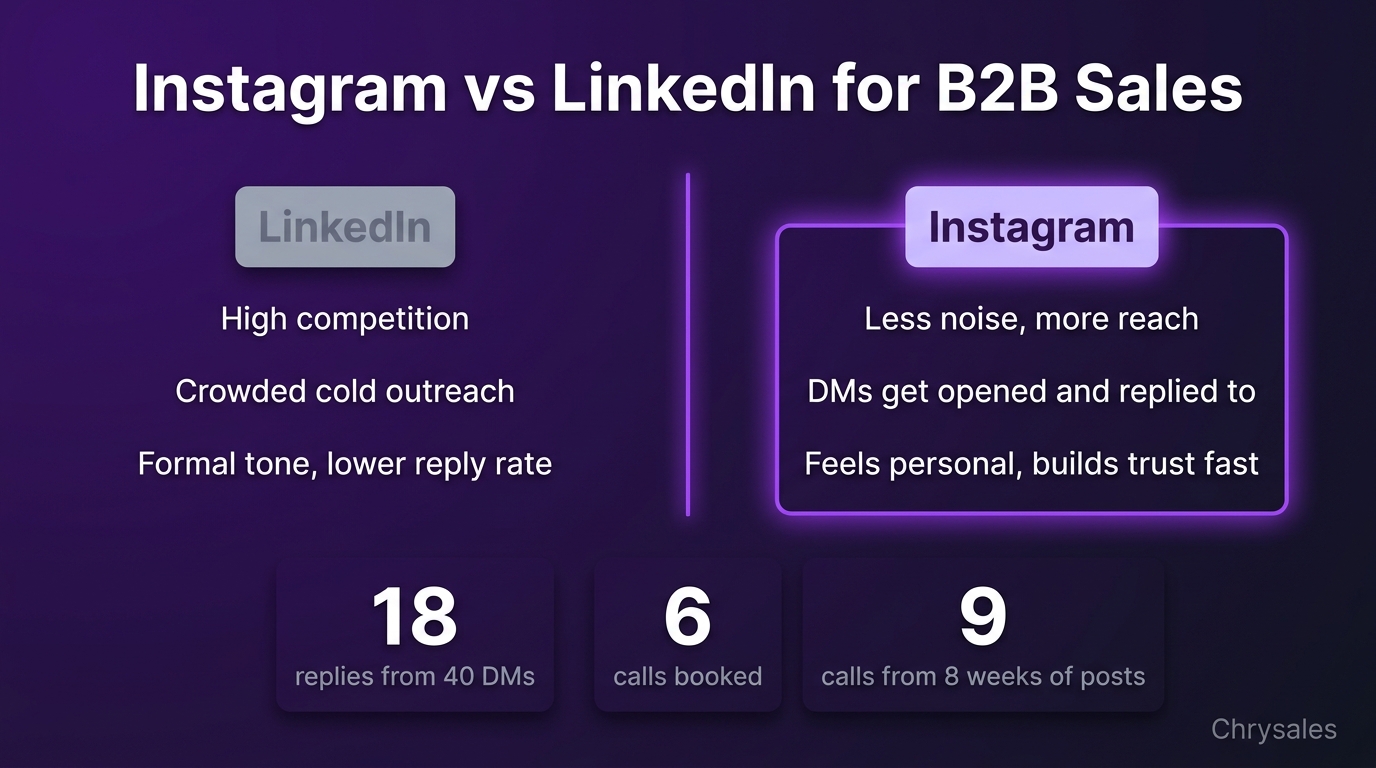
Most people think Instagram is for selling sneakers and smoothies. Wrong. Instagram has over 2 billion users, and a huge chunk of them are decision makers scrolling during breaks, commutes, and late nights. The difference between Instagram and LinkedIn? Less competition. Way less noise. And DMs that actually get opened.
Here's the thing: B2B sales don't happen on Instagram. They happen because of Instagram. You use the platform to start conversations, build credibility, and book calls. The actual sale happens on Zoom, just like every other B2B deal.
Instagram is the top of your funnel. It's where you prove you know what you're talking about and get people curious enough to jump on a call.
Instagram vs. LinkedIn for Client Acquisition
LinkedIn is crowded. Everyone's doing cold outreach, posting thought leadership, and running connection request campaigns. Instagram feels more personal. When someone accepts your follow request or replies to your Story, it feels like a real interaction, not a sales pitch. That's the edge.
Use both platforms, but don't sleep on Instagram just because it's "not a B2B platform." Some of the best B2B lead generation happens where your competitors aren't looking.
Pro Tip: If your ideal clients are on Instagram (and most professionals are), you're leaving money on the table by ignoring it.
Set Up Your Profile Like a Landing Page, Not a Personal Account
Your Instagram profile is your homepage. If someone lands on it, they should know in 3 seconds what you do and who it's for. Most profiles are vague. "Helping businesses grow." That tells me nothing. You need clarity.
Write a Bio That Says Exactly What You Do
Your bio has 150 characters. Use them like a headline. State the problem you solve and who you solve it for. Skip the fluff.
Bad bio: "Sales expert | Helping companies grow | DM me for info"
Good bio: "Custom sales systems for B2B teams | Book 10+ qualified calls/month | Berlin → Worldwide"
The second one tells you what I do, what result I deliver, and gives a location anchor for credibility. Add a link to book a call or download a lead magnet. If you're sending people to a generic homepage, you're wasting clicks.
Pick a Profile Photo and Username That Look Professional
Use a clean headshot or a simple logo. Not a group photo. Not a vacation pic. Your username should be your business name or your personal brand. Easy to find, easy to remember.
If your ideal clients can't tell you're a business account in 2 seconds, they'll scroll past.
Watch out: Private accounts kill B2B lead generation. Keep your profile public so people can see your content before they follow.
Post Content That Proves You Know What You're Talking About
Content is what makes Instagram work for client acquisition. You're not trying to go viral. You're trying to show up consistently and demonstrate expertise.
Think of your feed as proof. Every post is a mini case study, a lesson, or a behind-the-scenes look at how you work.
What to Post (and What Not to Waste Time On)
Post content that speaks directly to the problems your clients deal with every day. If you help B2B teams with sales training, post about cold email mistakes, objection handling scripts, and how to hire closers.
Mix formats: carousels, single-image posts with text overlays, short videos, and occasional Reels. Carousels work incredibly well for Instagram for B2B because people can save them and come back later. A 7-slide carousel breaking down your discovery call structure or a step-by-step Instagram outreach script is more valuable than a pretty photo with a vague caption.
Common mistake: Posting motivational quotes and generic business advice. Your feed should be so specific to your niche that a random person scrolls past, but your ideal client stops and says "this is exactly what I need."
How Often to Post (Without Burning Out)
Aim for 3 to 5 posts per week. Consistency beats volume. If you post twice a week for 6 months, you'll build more credibility than someone who posts daily for 3 weeks and disappears.
Batch your content. Spend one afternoon writing 10 carousel ideas, then design and schedule them. Use Instagram Stories daily to stay top of mind between posts. Stories are low-pressure and high-engagement.
A 15-person consulting firm we worked with posted 4 times a week for 8 weeks. They gained 340 followers (all in their niche) and booked 9 calls from DM conversations that started with "saw your post on objection handling, can we chat?"
Use Stories and Reels to Build Trust Before You Pitch
Posts are for reach. Stories are for relationship. Reels are for both.
If someone follows you but never sees your Stories, you're invisible to them. Instagram's algorithm prioritizes accounts you interact with. Post Stories daily to stay in their feed.
What to Share in Stories
Share quick wins, behind-the-scenes moments, quick tips, and reshares of your own posts. If you just closed a deal, share a screenshot (blur the client name). If you're prepping for a sales call, share your screen and talk through your process.
People buy from people they trust. Stories make you real, not just a business account.
Use the question sticker to ask your audience what they're struggling with. The responses become content ideas and conversation starters. If someone replies, move the conversation to DMs. That's where the magic happens.
Why Reels Matter for Instagram Sales Strategy
Reels get shown to people who don't follow you yet. That's the reach play. You don't need to dance or point at text. Just talk to the camera. Share one tip in 30 seconds. "Here's the biggest mistake I see in sales emails" then explain it. Simple. Direct. Useful.
Reels feel hard because you're on camera, but they work. One marketing agency posted 6 Reels in a month, got 14,000 views total, and landed 2 new clients from people who found them through Reels and then DMed. That's Instagram client acquisition in action. You can also watch these proven strategies for finding clients on social platforms to see exactly how this approach works in practice.
Find Your Ideal Clients and Start Real Conversations in DMs
Content builds credibility. DMs book calls. If you post great content but never reach out, you're hoping people come to you. That's passive. Active Instagram DM outreach is how you control your pipeline.
How to Find the Right People to Message
Use hashtags, location tags, and the search function to find accounts in your niche. If you sell to consulting firms, search hashtags like #consultinglife or #businessconsulting. Follow 10 to 15 accounts per day that fit your ideal client profile. Engage with their posts (like, comment with something real, not just a fire emoji). Do this for a few days before you DM them. You want to be familiar, not a stranger.
Another move: check who's following your competitors or who's engaging with posts in your space. If someone commented on a post about B2B sales, they care about B2B sales. Follow them. Engage with their content. Then send a DM.
Pro Tip: Don't just follow big accounts. Follow smaller accounts (500 to 5,000 followers) who are actually your ideal client. They're more likely to respond.
The DM Script That Doesn't Feel Gross
Cold DMs fail when they sound like a pitch. "Hey, I help businesses grow revenue, can we hop on a call?" Delete. That's spam.
Instead, open with value or a real observation.
Good DM opener: "Hey [name], saw your post about scaling your team. We've helped a few consulting firms build sales systems that don't rely on the founder doing every call. Would love to share what worked for them if you're interested."
You mentioned something specific (their post), you connected it to a result (sales systems that scale), and you made it about them, not you. If they reply, keep the conversation going. Ask a question. Offer a free resource. Then, after 2 to 3 messages, suggest a call. The same principles that work for how to write cold emails apply here: lead with value, personalize the message, and focus on their needs first.
Watch out: Don't pitch in the first message. Start a conversation. Pitching too early kills the thread.
Turn Engagement Into Booked Calls (The Part Most People Skip)
Getting a reply is step one. Booking the call is step two. Most people stop at step one. They get a few DM conversations going, chat for a while, and nothing happens.
You need a system to move people from "interested" to "booked."
Ask for the Call at the Right Time
After 2 to 4 message exchanges, if the conversation is going well, make the ask.
"This sounds like something we could help with. Want to jump on a quick 20-minute call to see if it's a fit?"
Keep it low-pressure. You're not asking for a sale. You're asking for 20 minutes. Include a link to your calendar (Calendly, Google Calendar, whatever). Make it easy. If you ask for their availability and try to coordinate over DM, you lose half the bookings. One click should get them to a booking page.
One tech company tried this for a month. They sent 40 DMs, got 18 replies, and booked 6 calls. That's a 15% booking rate from cold outreach. Not bad for free Instagram client acquisition. If you want to turn these conversations into consistent pipeline, learn more about how to build sales pipeline that converts.
Follow Up Without Being Annoying
If someone doesn't reply to your first DM, wait 3 to 5 days and send a follow-up.
"Hey [name], just circling back. Let me know if you'd like to chat about [specific thing]."
If no reply after that, move on. Don't send 5 follow-ups. You're not chasing. You're filtering for people who are actually interested.
If someone says "not right now," reply with "No worries. I'll check back in a few months. In the meantime, here's a [resource] that might help." Stay top of mind. A "not now" can turn into a "yes" 3 months later if you stay helpful.
Automate the Repetitive Stuff (Without Losing the Personal Touch)
Instagram for B2B lead generation works best when it's systematized. You don't have time to manually respond to every Story reply and DM at 11 p.m. Set up automation for the repetitive parts so you can focus on real conversations. To see how this fits into a broader approach, watch this guide on building a sales system that brings clients to you consistently.
Use DM Automation Tools to Handle FAQs and Replies
Tools like ManyChat let you set up auto-replies triggered by specific keywords or Story interactions. Someone replies to your Story with a keyword like "guide," and they get an auto-DM with a link to your lead magnet.
You can also set up quick replies for common questions. This isn't about replacing human conversation. It's about handling the easy stuff so you spend time on qualified leads.
We've seen this work for service businesses. A consulting firm set up a Story with a swipe-up link to a free sales audit. Anyone who swiped got an auto-DM asking a qualifying question. Based on the answer, the system either sent them a booking link or tagged them for manual follow-up. They booked 8 calls in the first 2 weeks.
Schedule Posts and Stories So You're Not Posting Live Every Day
Batch your content and schedule it. Apps like Later, Buffer, or Meta Business Suite let you schedule posts and, sometimes, Stories in advance. Spend 2 hours on a Sunday, create a week of content, and schedule it.
You still need to engage daily (reply to comments, check DMs, post live Stories when something timely happens), but scheduling takes the pressure off daily content creation.
Pro Tip: Don't automate DMs to the point where it feels robotic. Use automation for filtering and FAQs, but when someone's actually interested, take over the conversation personally.
Measure What's Working and Double Down
You can't improve what you don't track. Most people post on Instagram, send some DMs, and hope for the best. That's not a system. That's a guess.
Track your numbers weekly so you know what's working.
The Numbers That Actually Matter
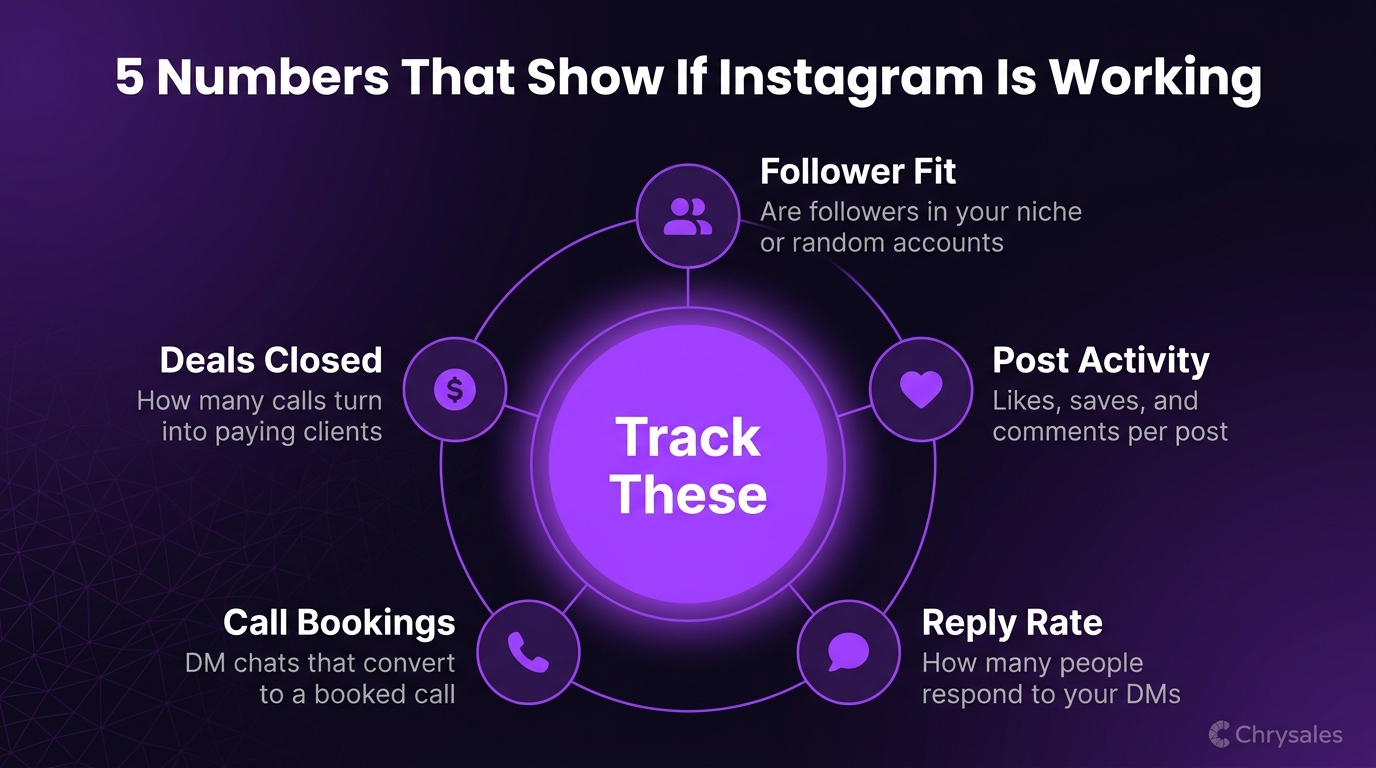
Track these:
- Follower growth (are you attracting your niche, or random accounts?)
- Post engagement rate (likes + comments + saves divided by followers)
- DM reply rate (how many people reply to your outreach?)
- Call booking rate (how many DM conversations turn into booked calls?)
- Calls to clients (how many of those calls actually close?)
If your DM reply rate is under 10%, your message is off or you're targeting the wrong people. If your call booking rate is low, you're not asking for the call clearly enough. If calls aren't closing, the issue isn't Instagram. It's your sales process. Avoid common pitfalls by reviewing these 5 costly mistakes killing your deals that hurt conversion rates.
One marketing agency tracked this for 12 weeks. They realized their Reels got 5x more engagement than static posts, so they shifted 60% of their content to Reels. Their follower growth doubled, and they booked 4 more calls per month just from Reels reach.
Adjust Based on What the Data Tells You
If a certain type of post (like carousels on sales objections) gets tons of saves and shares, make more of those. If a specific DM opener gets 30% reply rates, use that template. If Stories about behind-the-scenes work get tons of replies, post more of those.
Instagram client acquisition gets easier when you know what works and do more of it.
Common mistake: Changing strategy every 2 weeks because you're not seeing instant results. Give it 6 to 8 weeks before you switch tactics. Consistency compounds.
Frequently Asked Questions
Q: How long does it take to get clients from Instagram if I'm starting from zero?
If you're starting with a new account, give it 8 to 12 weeks of consistent posting and outreach before you expect regular bookings. The first month is about building credibility and a small following. The second and third months are when DM conversations start turning into calls. One consulting firm we worked with posted 4 times a week and sent 10 DMs a day. They booked their first call in week 5 and had 3 clients by month 4.
Q: Do I need a big following to use Instagram for B2B sales?
No. You need the right following, not a big one. An account with 400 followers who are all in your niche is better than 4,000 random followers. Quality beats quantity. We've seen accounts with under 1,000 followers book multiple high-ticket clients because every follower was a potential buyer.
Q: What's the best way to get started if I've never posted business content on Instagram before?
Start by posting 3 pieces of content this week. One carousel on a topic your clients care about. One short video or Reel explaining a common mistake. One Story asking your audience a question. Then send 5 DMs to people in your niche. Don't overthink it. The first 10 posts won't be perfect. That's fine. You get better by doing it, not by planning forever.
Q: Can I use Instagram lead generation if I'm also doing cold email and LinkedIn outreach?
Absolutely. In fact, you should. Instagram is one channel in your overall client acquisition system. Use cold email for volume, LinkedIn for professional credibility, and Instagram for personal connection. They work together. Someone might ignore your cold email, but then see you on Instagram, recognize your name, and reply. Multi-channel outreach always wins. For a comprehensive approach, explore more about Instagram outreach for B2B lead generation as part of your full strategy.
Q: How do I avoid sounding spammy when I DM people I don't know?
Lead with value, not a pitch. Comment on something specific from their profile or recent post. Offer a resource or insight before you ask for anything. Keep the first message short and focused on them, not you. If you sound like every other person sliding into DMs with "I help businesses scale," you'll get ignored. Be specific, be helpful, and don't ask for a call in the first message.
Q: Should I pay for Instagram ads or stick to organic?
Start with organic. If you can't get Instagram to work without ads, throwing money at it won't fix the real issue (your content, your targeting, or your offer). Once you have a working organic system that books calls, then consider ads to scale reach. But most B2B companies can book 5 to 15 calls a month from organic Instagram alone if they do it right.
Q: What if my competitors are already doing Instagram outreach in my niche?
Good. That means it works. Don't try to out-post them or copy what they're doing. Find a different angle. If they post carousels, do more video. If they focus on one service, focus on a different one. If they target one industry, target another. There's room for multiple players. The businesses that win are the ones who show up consistently and build real relationships, not the ones who were "first."
How to use Instagram to get clients means using the platform to build trust, start conversations, and turn attention into qualified calls for B2B work. Picture this: you're scrolling Instagram at lunch, and between food pics and travel posts, you see a consulting firm booking three discovery calls from DMs they sent that morning. No ad spend. No agency retainer. Just a smart system that turns Instagram into a client acquisition machine.
Why Instagram Works for B2B Lead Generation (Even Though Everyone Says It Doesn't)
Most people think Instagram is for selling sneakers and smoothies. Wrong. Instagram has over 2 billion users, and a huge chunk of them are decision makers scrolling during breaks, commutes, and late nights. The difference between Instagram and LinkedIn? Less competition. Way less noise. And DMs that actually get opened.
Here's the thing: B2B sales don't happen on Instagram. They happen because of Instagram. You use the platform to start conversations, build credibility, and book calls. The actual sale happens on Zoom, just like every other B2B deal.
Instagram is the top of your funnel. It's where you prove you know what you're talking about and get people curious enough to jump on a call.
Instagram vs. LinkedIn for Client Acquisition
LinkedIn is crowded. Everyone's doing cold outreach, posting thought leadership, and running connection request campaigns. Instagram feels more personal. When someone accepts your follow request or replies to your Story, it feels like a real interaction, not a sales pitch. That's the edge.
Use both platforms, but don't sleep on Instagram just because it's "not a B2B platform." Some of the best B2B lead generation happens where your competitors aren't looking.
Pro Tip: If your ideal clients are on Instagram (and most professionals are), you're leaving money on the table by ignoring it.
Set Up Your Profile Like a Landing Page, Not a Personal Account
Your Instagram profile is your homepage. If someone lands on it, they should know in 3 seconds what you do and who it's for. Most profiles are vague. "Helping businesses grow." That tells me nothing. You need clarity.
Write a Bio That Says Exactly What You Do
Your bio has 150 characters. Use them like a headline. State the problem you solve and who you solve it for. Skip the fluff.
Bad bio: "Sales expert | Helping companies grow | DM me for info"
Good bio: "Custom sales systems for B2B teams | Book 10+ qualified calls/month | Berlin → Worldwide"
The second one tells you what I do, what result I deliver, and gives a location anchor for credibility. Add a link to book a call or download a lead magnet. If you're sending people to a generic homepage, you're wasting clicks.
Pick a Profile Photo and Username That Look Professional
Use a clean headshot or a simple logo. Not a group photo. Not a vacation pic. Your username should be your business name or your personal brand. Easy to find, easy to remember.
If your ideal clients can't tell you're a business account in 2 seconds, they'll scroll past.
Watch out: Private accounts kill B2B lead generation. Keep your profile public so people can see your content before they follow.
Post Content That Proves You Know What You're Talking About
Content is what makes Instagram work for client acquisition. You're not trying to go viral. You're trying to show up consistently and demonstrate expertise.
Think of your feed as proof. Every post is a mini case study, a lesson, or a behind-the-scenes look at how you work.
What to Post (and What Not to Waste Time On)
Post content that speaks directly to the problems your clients deal with every day. If you help B2B teams with sales training, post about cold email mistakes, objection handling scripts, and how to hire closers.
Mix formats: carousels, single-image posts with text overlays, short videos, and occasional Reels. Carousels work incredibly well for Instagram for B2B because people can save them and come back later. A 7-slide carousel breaking down your discovery call structure or a step-by-step Instagram outreach script is more valuable than a pretty photo with a vague caption.
Common mistake: Posting motivational quotes and generic business advice. Your feed should be so specific to your niche that a random person scrolls past, but your ideal client stops and says "this is exactly what I need."
How Often to Post (Without Burning Out)
Aim for 3 to 5 posts per week. Consistency beats volume. If you post twice a week for 6 months, you'll build more credibility than someone who posts daily for 3 weeks and disappears.
Batch your content. Spend one afternoon writing 10 carousel ideas, then design and schedule them. Use Instagram Stories daily to stay top of mind between posts. Stories are low-pressure and high-engagement.
A 15-person consulting firm we worked with posted 4 times a week for 8 weeks. They gained 340 followers (all in their niche) and booked 9 calls from DM conversations that started with "saw your post on objection handling, can we chat?"
Use Stories and Reels to Build Trust Before You Pitch
Posts are for reach. Stories are for relationship. Reels are for both.
If someone follows you but never sees your Stories, you're invisible to them. Instagram's algorithm prioritizes accounts you interact with. Post Stories daily to stay in their feed.
What to Share in Stories
Share quick wins, behind-the-scenes moments, quick tips, and reshares of your own posts. If you just closed a deal, share a screenshot (blur the client name). If you're prepping for a sales call, share your screen and talk through your process.
People buy from people they trust. Stories make you real, not just a business account.
Use the question sticker to ask your audience what they're struggling with. The responses become content ideas and conversation starters. If someone replies, move the conversation to DMs. That's where the magic happens.
Why Reels Matter for Instagram Sales Strategy
Reels get shown to people who don't follow you yet. That's the reach play. You don't need to dance or point at text. Just talk to the camera. Share one tip in 30 seconds. "Here's the biggest mistake I see in sales emails" then explain it. Simple. Direct. Useful.
Reels feel hard because you're on camera, but they work. One marketing agency posted 6 Reels in a month, got 14,000 views total, and landed 2 new clients from people who found them through Reels and then DMed. That's Instagram client acquisition in action. You can also watch these proven strategies for finding clients on social platforms to see exactly how this approach works in practice.
Find Your Ideal Clients and Start Real Conversations in DMs
Content builds credibility. DMs book calls. If you post great content but never reach out, you're hoping people come to you. That's passive. Active Instagram DM outreach is how you control your pipeline.
How to Find the Right People to Message
Use hashtags, location tags, and the search function to find accounts in your niche. If you sell to consulting firms, search hashtags like #consultinglife or #businessconsulting. Follow 10 to 15 accounts per day that fit your ideal client profile. Engage with their posts (like, comment with something real, not just a fire emoji). Do this for a few days before you DM them. You want to be familiar, not a stranger.
Another move: check who's following your competitors or who's engaging with posts in your space. If someone commented on a post about B2B sales, they care about B2B sales. Follow them. Engage with their content. Then send a DM.
Pro Tip: Don't just follow big accounts. Follow smaller accounts (500 to 5,000 followers) who are actually your ideal client. They're more likely to respond.
The DM Script That Doesn't Feel Gross
Cold DMs fail when they sound like a pitch. "Hey, I help businesses grow revenue, can we hop on a call?" Delete. That's spam.
Instead, open with value or a real observation.
Good DM opener: "Hey [name], saw your post about scaling your team. We've helped a few consulting firms build sales systems that don't rely on the founder doing every call. Would love to share what worked for them if you're interested."
You mentioned something specific (their post), you connected it to a result (sales systems that scale), and you made it about them, not you. If they reply, keep the conversation going. Ask a question. Offer a free resource. Then, after 2 to 3 messages, suggest a call. The same principles that work for how to write cold emails apply here: lead with value, personalize the message, and focus on their needs first.
Watch out: Don't pitch in the first message. Start a conversation. Pitching too early kills the thread.
Turn Engagement Into Booked Calls (The Part Most People Skip)
Getting a reply is step one. Booking the call is step two. Most people stop at step one. They get a few DM conversations going, chat for a while, and nothing happens.
You need a system to move people from "interested" to "booked."
Ask for the Call at the Right Time
After 2 to 4 message exchanges, if the conversation is going well, make the ask.
"This sounds like something we could help with. Want to jump on a quick 20-minute call to see if it's a fit?"
Keep it low-pressure. You're not asking for a sale. You're asking for 20 minutes. Include a link to your calendar (Calendly, Google Calendar, whatever). Make it easy. If you ask for their availability and try to coordinate over DM, you lose half the bookings. One click should get them to a booking page.
One tech company tried this for a month. They sent 40 DMs, got 18 replies, and booked 6 calls. That's a 15% booking rate from cold outreach. Not bad for free Instagram client acquisition. If you want to turn these conversations into consistent pipeline, learn more about how to build sales pipeline that converts.
Follow Up Without Being Annoying
If someone doesn't reply to your first DM, wait 3 to 5 days and send a follow-up.
"Hey [name], just circling back. Let me know if you'd like to chat about [specific thing]."
If no reply after that, move on. Don't send 5 follow-ups. You're not chasing. You're filtering for people who are actually interested.
If someone says "not right now," reply with "No worries. I'll check back in a few months. In the meantime, here's a [resource] that might help." Stay top of mind. A "not now" can turn into a "yes" 3 months later if you stay helpful.
Automate the Repetitive Stuff (Without Losing the Personal Touch)
Instagram for B2B lead generation works best when it's systematized. You don't have time to manually respond to every Story reply and DM at 11 p.m. Set up automation for the repetitive parts so you can focus on real conversations. To see how this fits into a broader approach, watch this guide on building a sales system that brings clients to you consistently.
Use DM Automation Tools to Handle FAQs and Replies
Tools like ManyChat let you set up auto-replies triggered by specific keywords or Story interactions. Someone replies to your Story with a keyword like "guide," and they get an auto-DM with a link to your lead magnet.
You can also set up quick replies for common questions. This isn't about replacing human conversation. It's about handling the easy stuff so you spend time on qualified leads.
We've seen this work for service businesses. A consulting firm set up a Story with a swipe-up link to a free sales audit. Anyone who swiped got an auto-DM asking a qualifying question. Based on the answer, the system either sent them a booking link or tagged them for manual follow-up. They booked 8 calls in the first 2 weeks.
Schedule Posts and Stories So You're Not Posting Live Every Day
Batch your content and schedule it. Apps like Later, Buffer, or Meta Business Suite let you schedule posts and, sometimes, Stories in advance. Spend 2 hours on a Sunday, create a week of content, and schedule it.
You still need to engage daily (reply to comments, check DMs, post live Stories when something timely happens), but scheduling takes the pressure off daily content creation.
Pro Tip: Don't automate DMs to the point where it feels robotic. Use automation for filtering and FAQs, but when someone's actually interested, take over the conversation personally.
Measure What's Working and Double Down
You can't improve what you don't track. Most people post on Instagram, send some DMs, and hope for the best. That's not a system. That's a guess.
Track your numbers weekly so you know what's working.
The Numbers That Actually Matter
Track these:
- Follower growth (are you attracting your niche, or random accounts?)
- Post engagement rate (likes + comments + saves divided by followers)
- DM reply rate (how many people reply to your outreach?)
- Call booking rate (how many DM conversations turn into booked calls?)
- Calls to clients (how many of those calls actually close?)
If your DM reply rate is under 10%, your message is off or you're targeting the wrong people. If your call booking rate is low, you're not asking for the call clearly enough. If calls aren't closing, the issue isn't Instagram. It's your sales process. Avoid common pitfalls by reviewing these 5 costly mistakes killing your deals that hurt conversion rates.
One marketing agency tracked this for 12 weeks. They realized their Reels got 5x more engagement than static posts, so they shifted 60% of their content to Reels. Their follower growth doubled, and they booked 4 more calls per month just from Reels reach.
Adjust Based on What the Data Tells You
If a certain type of post (like carousels on sales objections) gets tons of saves and shares, make more of those. If a specific DM opener gets 30% reply rates, use that template. If Stories about behind-the-scenes work get tons of replies, post more of those.
Instagram client acquisition gets easier when you know what works and do more of it.
Common mistake: Changing strategy every 2 weeks because you're not seeing instant results. Give it 6 to 8 weeks before you switch tactics. Consistency compounds.
Frequently Asked Questions
Q: How long does it take to get clients from Instagram if I'm starting from zero?
If you're starting with a new account, give it 8 to 12 weeks of consistent posting and outreach before you expect regular bookings. The first month is about building credibility and a small following. The second and third months are when DM conversations start turning into calls. One consulting firm we worked with posted 4 times a week and sent 10 DMs a day. They booked their first call in week 5 and had 3 clients by month 4.
Q: Do I need a big following to use Instagram for B2B sales?
No. You need the right following, not a big one. An account with 400 followers who are all in your niche is better than 4,000 random followers. Quality beats quantity. We've seen accounts with under 1,000 followers book multiple high-ticket clients because every follower was a potential buyer.
Q: What's the best way to get started if I've never posted business content on Instagram before?
Start by posting 3 pieces of content this week. One carousel on a topic your clients care about. One short video or Reel explaining a common mistake. One Story asking your audience a question. Then send 5 DMs to people in your niche. Don't overthink it. The first 10 posts won't be perfect. That's fine. You get better by doing it, not by planning forever.
Q: Can I use Instagram lead generation if I'm also doing cold email and LinkedIn outreach?
Absolutely. In fact, you should. Instagram is one channel in your overall client acquisition system. Use cold email for volume, LinkedIn for professional credibility, and Instagram for personal connection. They work together. Someone might ignore your cold email, but then see you on Instagram, recognize your name, and reply. Multi-channel outreach always wins. For a comprehensive approach, explore more about Instagram outreach for B2B lead generation as part of your full strategy.
Q: How do I avoid sounding spammy when I DM people I don't know?
Lead with value, not a pitch. Comment on something specific from their profile or recent post. Offer a resource or insight before you ask for anything. Keep the first message short and focused on them, not you. If you sound like every other person sliding into DMs with "I help businesses scale," you'll get ignored. Be specific, be helpful, and don't ask for a call in the first message.
Q: Should I pay for Instagram ads or stick to organic?
Start with organic. If you can't get Instagram to work without ads, throwing money at it won't fix the real issue (your content, your targeting, or your offer). Once you have a working organic system that books calls, then consider ads to scale reach. But most B2B companies can book 5 to 15 calls a month from organic Instagram alone if they do it right.
Q: What if my competitors are already doing Instagram outreach in my niche?
Good. That means it works. Don't try to out-post them or copy what they're doing. Find a different angle. If they post carousels, do more video. If they focus on one service, focus on a different one. If they target one industry, target another. There's room for multiple players. The businesses that win are the ones who show up consistently and build real relationships, not the ones who were "first."
Scaling Is Not Hard If You Have The Right Systems
If you’re serious about leveling up your scaling game, you need the right system, the right training, and the right team behind you. We're here to give you the exact tools and strategies top entrepreneurs use to dominate.

Discover the latest tips
View All.avif)
Chrysales was formed from the words "chrysalis" the stage where a caterpillar transforms into a butterfly and "sales".
It stands for one thing: sales transformation.Because scaling doesn’t happen by doing more of the same. Scaling only happens when you go through real transformation in your systems, your offer, team and the way you sell.
.avif)


