
How to sell B2B services: the proof buyers need before a call
How to sell B2B services comes down to one problem: the buyer can't try the service before paying, so they decide on evidence that limits what they can lose. Show that evidence in the order the buyer needs it. Before the call, show who you help and a sample of your work; on the call, show the people and the process; before signing, show a one-page scope and a small paid first step.
If you have no case studies yet, use what you can show honestly: your process, a sample you made yourself, your thinking in public and a small first project. This guide is for founders who have sold on referrals and their own name so far and now need strangers to say yes.
Why is a B2B service harder to sell than a product?
A product can be demoed, trialed or sent back. A service mostly exists after the contract is signed, so the buyer has to decide on a promise about work that hasn't happened yet. Some services are hard to judge even after delivery. That leaves the risk with the buyer, and a buyer carrying risk delays or asks for one more reference.
Theodore Levitt wrote about this in 1981, and a service has even more of the part a buyer can't hold. "Everybody sells intangibles in the marketplace, no matter what is produced in the factory," he wrote in Harvard Business Review.
Economists call this a credence good: something the buyer finds difficult or impossible to judge, sometimes even after buying. If your work is advice, a plan or a fix, your client often can't tell whether someone else would have done better.
The buying side makes it harder still. Forrester's State of Business Buying 2024, based on a survey of more than 16,000 buyers, found that on average 13 people are involved in a buying decision. It also found that 91% of purchases stall at some point and that 81% of buyers are dissatisfied with the provider they chose.
Read those numbers from the buyer's chair. Many of the people deciding may never talk to you, and many have been let down by a provider before. Your proof has to travel without you and has to answer a careful reader.
When proof is missing, the deal rarely ends with a clear no. It ends with "sounds good, let me think about it", and if you're already there, see what to do when a buyer says they need to think about it. Blair Enns, founder of Win Without Pitching, writes about proposals that die with prospects who were interested in change but not ready to decide. His line: "I'll venture that your largest competitor right now is indecision."
What proof do B2B buyers actually look for?
Buyers look for signs that you've produced results for people like them, and a plain statement of what changes if they hire you. In an older Hinge Research Institute study of 822 buyers and 533 sellers of professional services, reputation tipped the final choice more often than expertise did. The sellers ranked expertise first, so a list of credentials carries less weight than most sellers expect.
Here is what tipped the final decision in that study, as buyers and sellers reported it (Hinge, How Buyers Buy):
| What tipped the final choice | Buyers | Sellers |
|---|---|---|
| Good reputation | 21% | 12% |
| Expertise or specialization | 12% | 31% |
| Experience or past performance | 11% | 24% |
| Better value proposition | 10% | 4% |
| Referrals or references | 4% | 5% |
"Sellers grossly overestimate the importance of expertise and experience in the final selection," the study's summary says. Buyers named "Reputation for Producing Results" as the best marketing approach (47%), and the report calls cost "a minor consideration in the final selection". When looking for a new provider, buyers turned first to friends and colleagues 71% of the time.
Treat this as direction for your market. It doesn't measure it: the study is old and drawn from a handful of professional fields. Still, it matches a simple idea: buyers want to know what happened for clients like them, and they don't get that from a page of certificates.
Charles H. Green's Trust Equation splits trust into parts, two of which matter most for proof. Credibility answers "Can we be believed?" and reliability answers "Do we meet expectations?"
Proof you show before the call works on credibility. How you behave between the first call and the contract works on reliability.
So lead with who you help and what changes for them. Back it with results you can name. Put credentials last, as a footnote.
Judgment-heavy work is exactly the part a buyer can't check in advance, which is why proof matters more for it. Sabir's video on the new way to grow B2B sales makes a related point. In its description he writes that as AI tools handle basic outreach, your value proposition needs to move toward areas where human judgment is still the bottleneck.
What proof should you show at each stage of the sale?
Show the proof that answers the question the buyer has at that moment. Before the call they ask whether you're relevant, so show who you help and a sample of the work. On the call they ask whether you understood them and who will do the work. Before signing they ask what they could lose, so show the scope, the exclusions and a small first step.
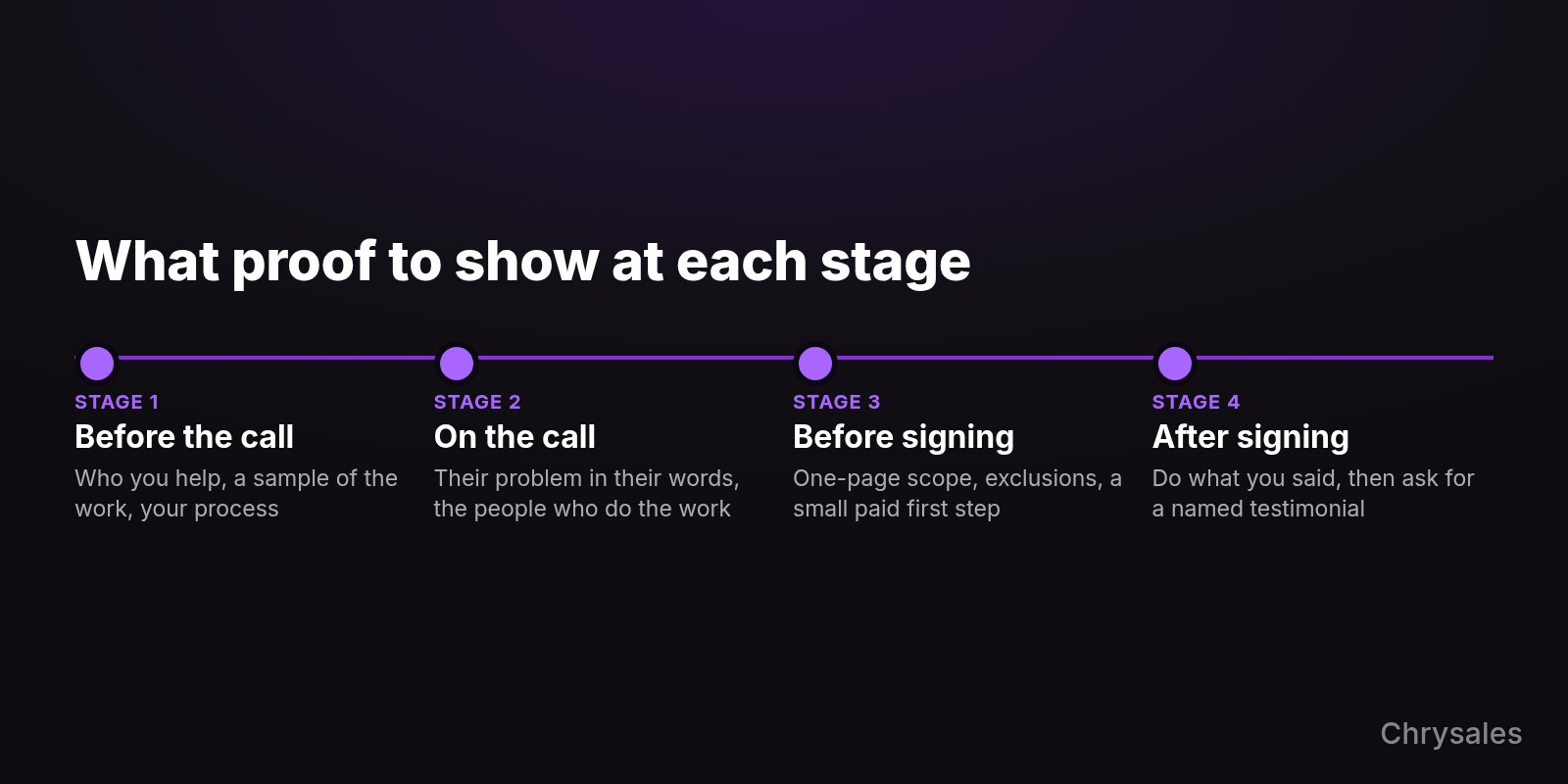
Order matters because buyers do much of their checking alone. In a Gartner survey of 632 B2B buyers, released in June 2025, 61% said they prefer a rep-free buying experience, and 73% said they actively avoid suppliers who send irrelevant outreach (Gartner). Gartner's Alice Walmesley drew the lesson for sellers: "Instead of offering generic information that buyers can find elsewhere, sellers should offer unique guidance."
What you're after is a confident buyer. In a later Gartner survey of 646 B2B buyers, confident buyers were twice as likely to report a high-quality deal as buyers with low decision confidence (reprint of the Gartner release). Gartner's releases don't say what the respondents were buying, so treat these figures as a signal for services, without reading them as proof.
| Stage | The buyer's question | Proof that answers it | What to avoid |
|---|---|---|---|
| Before the call | "Are they relevant to us?" | One line on who you help and what changes, a sample of the work, your process in public | A list of credentials, generic content anyone could write |
| On the call | "Did they understand us, and who does the work?" | Their problem repeated in their words, the people who would do the work, a similar past project described honestly | Pitching before you understand the problem |
| Before signing | "What could we lose?" | A one-page scope with exclusions, a small paid first step, named references offered now | A long proposal before the problem is agreed |
| After signing | "Did we choose well?" | Doing what you said, reporting against the scope, then asking for a named testimonial | Promises in the sale that delivery can't keep |
The call itself has its own craft, and the guide on how to run a discovery call covers it. What matters here is that the call confirms proof the buyer has already seen, because one call is too short to create all of it.
A worked example makes this concrete. The company below is fictional.
A 30-person B2B company sells a done-for-you service and wins most work through referrals. To reach buyers who don't know it, the founder sets up proof for each stage.
- In outreach and on the website, ahead of any call, they say in one sentence who they help and what changes, and link to a sample deliverable with client details removed.
- On the call, the founder repeats the buyer's problem back in the buyer's words and brings the person who would lead the project.
- Before signing, the buyer gets a one-page scope with what's excluded and an offer to start with a short paid first step.
- After signing, the team reports against that scope, and at the end the founder asks for a testimonial with the client's name and role.
How do you make a service buyers can see before they buy?
Turn the service into things a buyer can read, open and compare before paying. That means a one-line statement of who it's for, a one-page scope with exclusions and a page that shows your process. Add a sample of the output, the names of the people who'll do the work and a fixed first step. Each one answers a doubt the buyer would otherwise carry into the call.
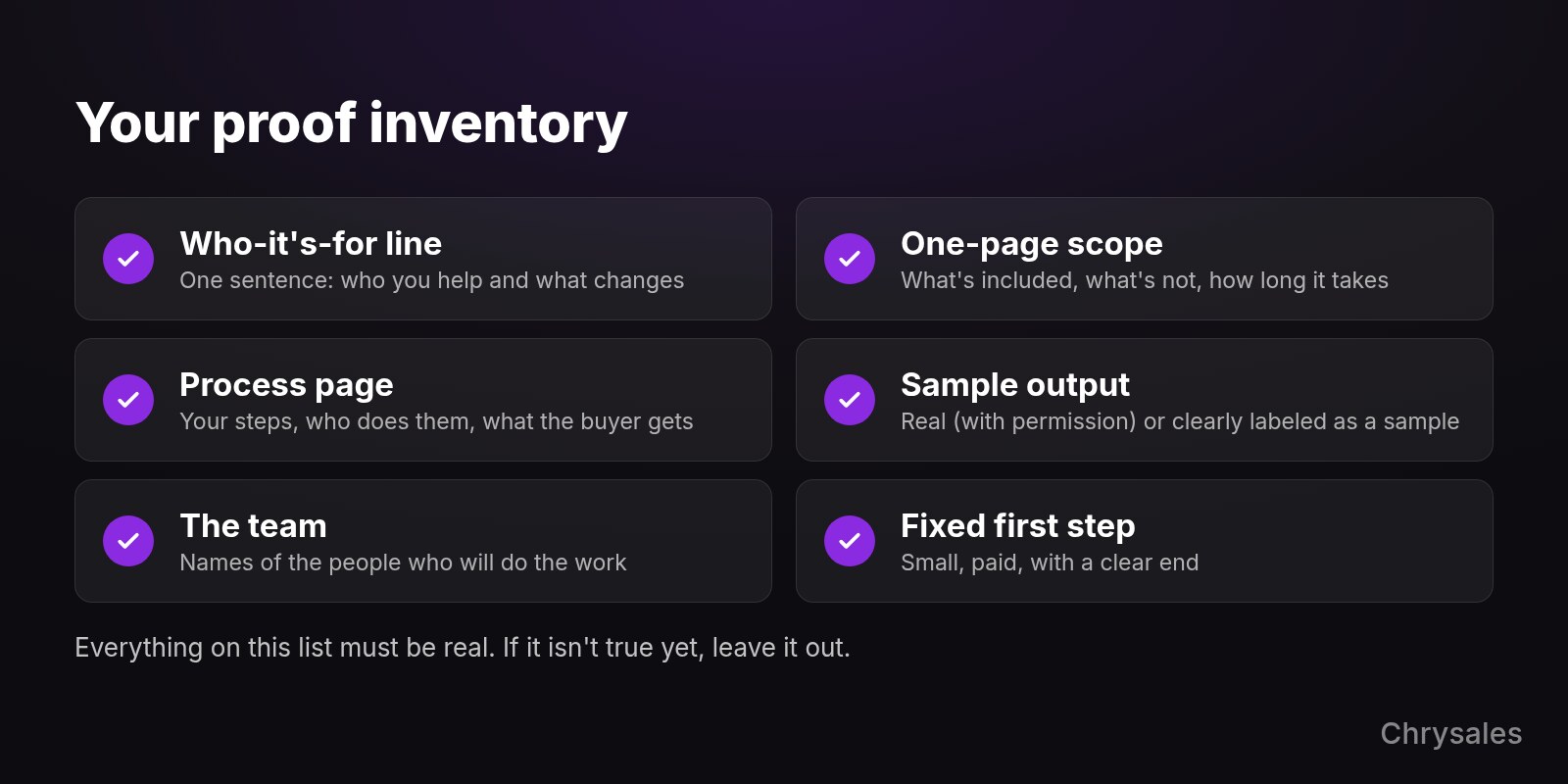
You can build this proof inventory from work you've already done. Build it in this order:
- Write the who-it's-for line. One sentence that names the kind of B2B company you help, the situation they're in and what changes after working with you. If you can't write it, the buyer can't repeat it to the other people in the decision.
- Narrow what you sell, because a packaged project is far easier to describe, price and prove than "whatever you need". On Hacker News, Thomas Ptacek, co-founder of Matasano, told a founder to "try to pick 1 or 2 kinds of projects that you can standardize and package".
- Write a one-page scope for that package. Use the template below, and spend the most time on what's not included, because that's where disappointment starts.
- Publish your process. thoughtbot publishes its playbook openly, including how it runs business development (thoughtbot Playbook). Yours can be one page: the steps, who does each one and what the client receives at each point.
- Prepare a sample of the output. Baymard Institute offers a sample audit report on request and sells its checkout UX audit at a published fixed price of $7,000 for a 40-50 page report, as of November 2026 (Baymard). A buyer who has seen the sample knows what they're paying for.
- Name the team. thoughtbot's playbook says: "Potential clients should be able to talk to the people they'll work with." Put names and roles in the scope and bring the lead person to the call.
- Define a fixed first step with a clear end. The section on selling without case studies covers how to word it.
Some of this must be real, and some of it needs permission. A sample built from client work needs that client's written permission, with their details removed. If you don't have it, build a sample from your own fictional data and label it as a sample. Names of team members, process steps and past projects must match what actually happens.
A one-page scope can follow this outline:
Who this is for: B2B companies that [situation] and want [change].
What we do: [3-5 steps in plain words]
What you get: [deliverables, format, delivery date]
What's not included: [the things buyers often assume are included]
Who does the work: [names and roles]
Time: [number of weeks], starting [when]
Price: [fixed price or price range]
What we need from you: [access, people, hours per week]
First step: [the small paid start and what it ends with]
How do you sell a service with no case studies yet?
Sell a small, paid first step and show the proof you can honestly produce now: your process, a sample you made yourself, your thinking in public and the track record you really have. Blair Enns of Win Without Pitching recommends starting with a paid diagnostic, because it's easier to commit to than the whole project. Avoid free work dressed up under another name.
"It's easier for the client to commit to the briefer, less expensive diagnostic than it is to fully commit to the longer, more expensive project," Enns writes in The Answer Is: Sell a Diagnostic. He lists common names for it, such as "audit", "discovery", "analysis" and "workshop", and says it should be written up in a brief document, typically not longer than one page.
Size the first step so one decision maker can approve it without a long internal process. Give it a fixed price and a fixed end date. It should end with a written result the buyer keeps whether or not they hire you for the rest.
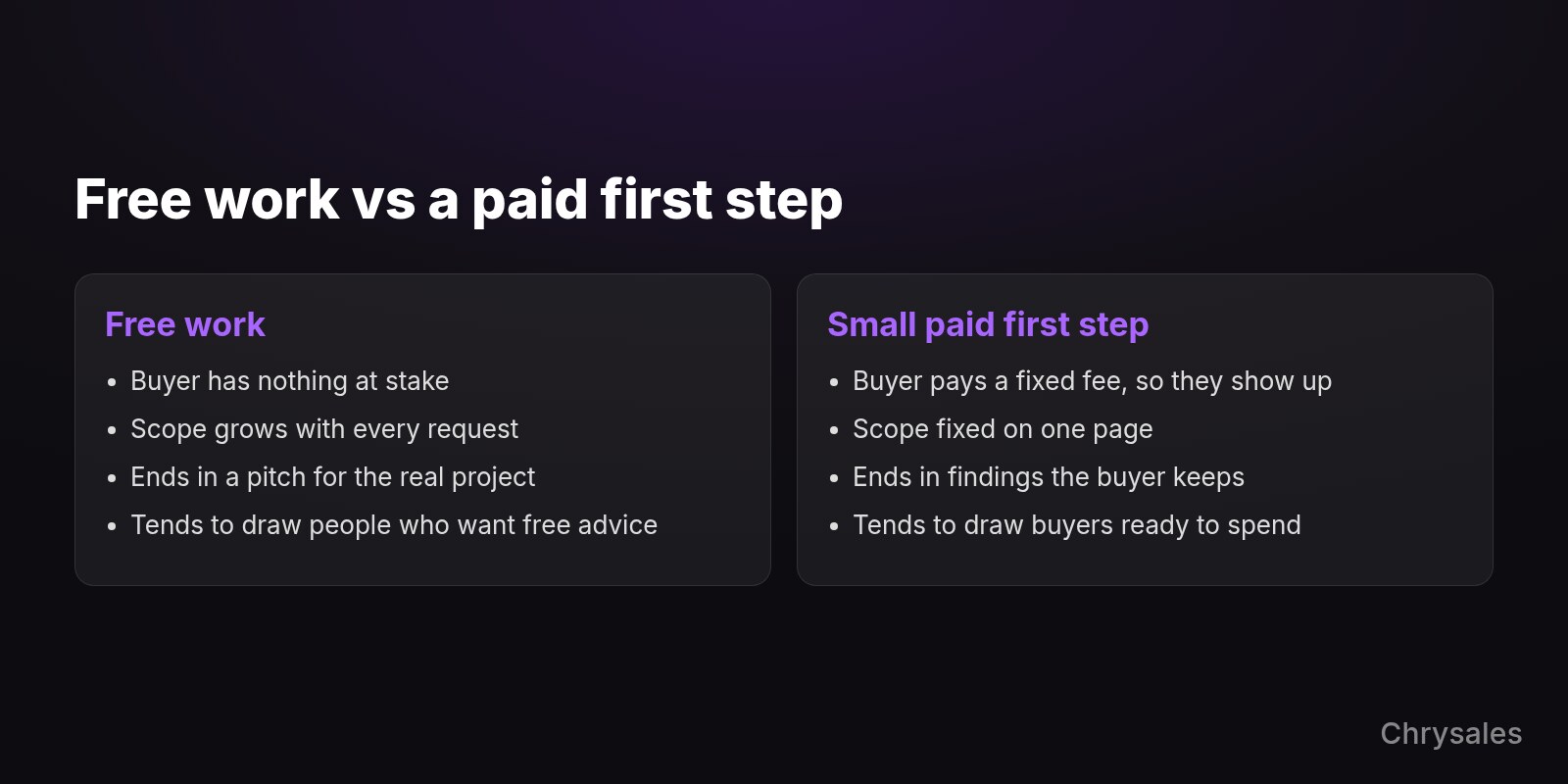
You may reach for free work instead, because it feels safer when you have no proof. The two compare like this:
| Free work | Small paid first step | |
|---|---|---|
| What the buyer has at stake | Buyer has nothing at stake | Buyer pays a fixed fee, so they show up |
| Scope | Scope grows with every request | Scope fixed on one page |
| How it ends | Ends in a pitch for the real project | Ends in findings the buyer keeps |
| Who it draws | Tends to draw people who want free advice | Tends to draw buyers ready to spend on the problem |
You can offer the first step in a few sentences, by email or at the end of a call:
Before we plan the full project, I'd suggest we start with a short paid [diagnostic / workshop].
It takes [number of days or weeks] and costs [fixed price].
You get [the findings and a plan for the next step] on one page.
You keep that page whether or not you hire us for the rest.
If the findings show you don't need the full project, we'll say so.
The other source of proof is work in public. Enns describes how he would build a client base from scratch today in Write or Die: long-form writing first, published as a blog, then video made from the writing. A buyer who has read three of your articles has already seen how you think about their problem.
Use your past honestly. Projects from earlier jobs can count if you describe your real role and the people involved agree to be named. Process proof also counts: a clear method, written down, shows the buyer what will happen even before anyone can tell them how it turned out.
How can you lower the buyer's risk without promising results?
Limit what the buyer can lose instead of promising what they'll gain. Keep the first commitment small, put the scope and exclusions in writing, give a clear point where they can stop, and say plainly what you can't promise. Every result, testimonial and client logo you show must be real, because misleading claims can break unfair-competition law in many markets, including for B2B (see the legal note at the end of this section).
Two public examples show what this looks like. Toptal's FAQ says "We make sure to start each engagement with a trial period of up to two weeks" and adds "If you're not completely satisfied, you won't be billed". Not every company can afford terms like that, but a small first step with its own end date gives the buyer a similar exit.
Baymard Institute shows the other half, which is naming a result and its limit on the same page. Its UX audit page names a client, Fast Growing Trees, and a result, "a 20% increase in warranties added". The same page also says "we don't promise a specific uplift." A named result next to a stated limit gives a careful buyer something to check.
Ways to limit what the buyer can lose, without promising an outcome:
- A small first step with a fixed price and a written result.
- A scope that lists exclusions, so the buyer knows what they're not paying for.
- A stop point after the first step, with no obligation to continue.
- Payment tied to delivered work, when your cash flow allows it.
- A plain sentence about what depends on the client and can't be promised.
The legal line is simple to state. In Germany, UWG § 5 forbids misleading commercial practices toward consumers and other market participants, which covers B2B, and that includes misleading statements about the results to be expected. In the US, the FTC announced a final rule banning fake reviews and testimonials on 14 August 2024 and can seek civil penalties against knowing violators. This is not legal advice; check your terms and claims with a lawyer in your market.
How should you use testimonials and case studies so buyers believe them?
Make each piece of proof specific and named, and match it to the buyer's situation. A testimonial with a full name, a role and a concrete change is more believable than praise from "a happy client". Get written permission, never round results up, and offer references late in the sale, when the buyer is checking a decision.
In the Hinge study, references were what tipped the final choice for only 4% of buyers. That doesn't make them useless. One likely reading is that buyers use them to check a choice they've mostly made, so keep the reference list for the end of the sale.
A case study starts with delivery. In Hinge's words, "the easiest way to damage client loyalty is not to do what you say you will". A client who got what the scope promised is the one who agrees to be named, and you can then ask happy clients for referrals as well.
Rules that keep testimonials believable:
- Use the client's name, role and company only with their written permission.
- Quote their words exactly, without editing them into a bigger result.
- State the starting point, what you did, what changed and over what time.
- Show the case closest to the buyer's size and problem first.
- Keep a short list of clients who agreed to take a reference call, and ask them again before each use.
A short case study can follow this outline:
Client: [name, role, company - with written permission]
Starting point: [the situation, in the client's words]
What we did: [the steps and the time frame]
What changed: [the result, how it was measured, over what period]
Limits: [what depended on the client or didn't change]
Quote: [their words, unedited]
Common mistakes when selling B2B services
Each mistake below is either the right proof shown at the wrong time or proof that isn't quite true. You can fix any of them on your next deal without a big budget. Deals that stall for these reasons also drag out the whole cycle, which the guide on how to shorten a B2B sales cycle covers from the timing side.
- Leading with credentials. Sellers in the Hinge study ranked expertise far higher than their buyers did. Move certificates and years in business to the end and lead with who you help and what changed for them.
- Pitching instead of proving. Sabir makes the same point in the description of his video on building trust. It says "trying to close a completely cold prospect in a single call is nearly impossible", and that prospects buy on results, not likability (YouTube). Send proof before the call so the call can confirm it.
- Free audits built to find problems. In our view, a free audit that always finds problems reads as a pitch. Charge for a scoped first step, and say so when the findings show the buyer doesn't need you.
- Sending a big proposal too early. A long document written before the problem is agreed costs you hours on a deal that may not exist. Agree the problem first, then see what goes in a B2B sales proposal.
- Using the same proof at every stage. A logo wall doesn't answer "who will do the work", and a case study doesn't answer "what could we lose". Check each stage against the question the buyer has at that point.
- Rounding results up. A result that grows in the retelling breaks trust when the buyer checks it, and in Germany it can break the law.
FAQ
What is the best way to sell consulting services?
The same way as any B2B service: show who you help and what changes, prove it with named results or a sample of the work, and make the first commitment small. Advice is often hard to judge even after delivery, so Blair Enns of Win Without Pitching recommends starting with a paid diagnostic written up on one page.
How do you sell professional services online, without meeting first?
Put the proof where buyers look before they contact you: a who-it's-for line, a process page, a sample of the output and named testimonials. Gartner's 2025 survey found that most B2B buyers prefer a rep-free buying experience, so your website and outreach have to answer the early questions without you. The call then confirms what they've already seen.
How many case studies do you need before you can sell?
There's no fixed number. One case that closely matches the buyer's size and problem usually does more than several unrelated ones. If you have none, start with a paid first step, process proof and a sample you built yourself.
Should you offer a free trial for a service?
Free work tends to grow in scope and attract people who want advice without paying. A small paid first step with a fixed end gives the buyer a low-cost way to test you and gives you a buyer who has committed. If you do offer an exit, write down the terms, as Toptal does with its trial period.
How do you price the first step?
Price it so one decision maker can approve it quickly, and fix both the price and the end date. Make sure the written result is worth paying for on its own. For the main offer and how to hold your price, see how to write the offer without a discount.
Sources
- Hinge Research Institute - How Buyers Buy, executive summary
- Forrester - The State of Business Buying, 2024
- Gartner - Sales survey: 61% of B2B buyers prefer a rep-free buying experience (June 2025)
- BizTech Reports - reprint of Gartner sales survey on decision confidence (2026)
- Harvard Business Review - Theodore Levitt, Marketing Intangible Products and Product Intangibles (1981)
- Wikipedia - Credence good
- Trusted Advisor Associates - The Trust Equation
- Win Without Pitching - Blair Enns, The Answer Is: Sell a Diagnostic
- Win Without Pitching - Blair Enns, Write or Die
- thoughtbot Playbook - Business development
- Baymard Institute - Checkout UX audit
- Baymard Institute - UX audit services
- Toptal - FAQ
- Hacker News - Thomas Ptacek on packaging services (2017)
- Gesetze im Internet - UWG § 5
- FTC - Final rule banning fake reviews and testimonials (2024)
If you want a second pair of eyes on which proof your buyers are missing and where your deals go quiet, Chrysales can go through it with you on a free strategy call, along with the outreach and pipeline around it. Find where your deals stall on a free call
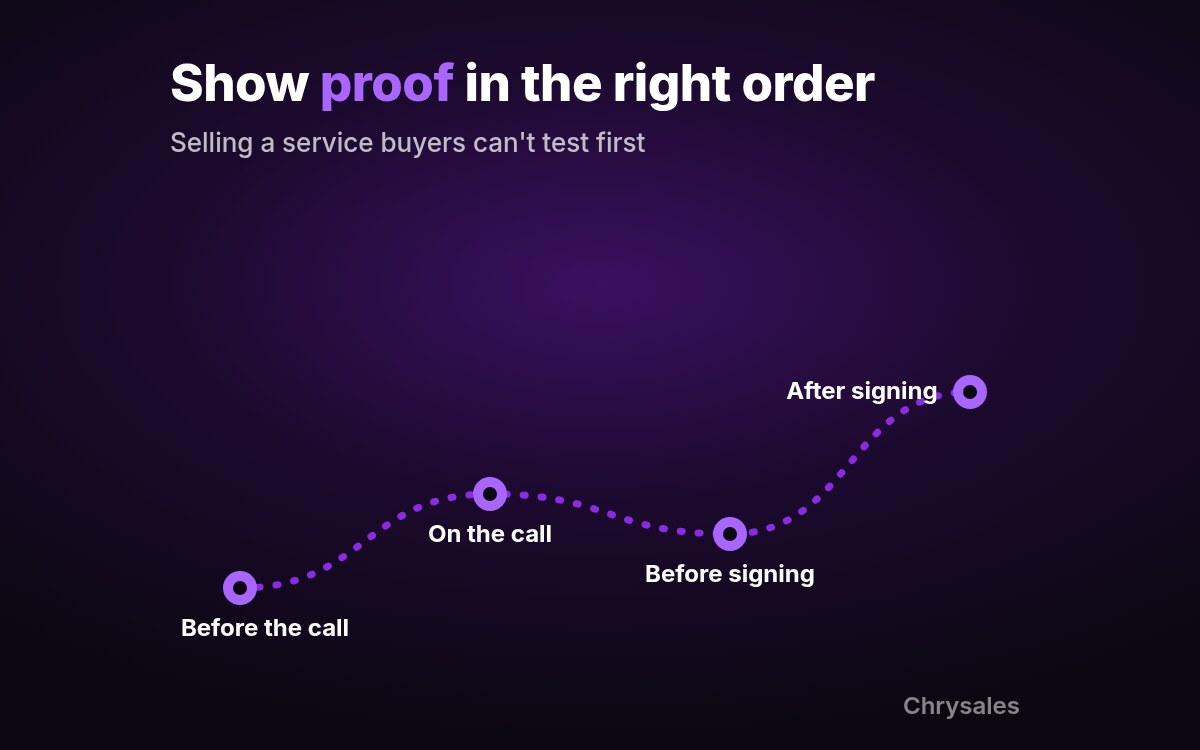
How to sell B2B services comes down to one problem: the buyer can't try the service before paying, so they decide on evidence that limits what they can lose. Show that evidence in the order the buyer needs it. Before the call, show who you help and a sample of your work; on the call, show the people and the process; before signing, show a one-page scope and a small paid first step.
If you have no case studies yet, use what you can show honestly: your process, a sample you made yourself, your thinking in public and a small first project. This guide is for founders who have sold on referrals and their own name so far and now need strangers to say yes.
Why is a B2B service harder to sell than a product?
A product can be demoed, trialed or sent back. A service mostly exists after the contract is signed, so the buyer has to decide on a promise about work that hasn't happened yet. Some services are hard to judge even after delivery. That leaves the risk with the buyer, and a buyer carrying risk delays or asks for one more reference.
Theodore Levitt wrote about this in 1981, and a service has even more of the part a buyer can't hold. "Everybody sells intangibles in the marketplace, no matter what is produced in the factory," he wrote in Harvard Business Review.
Economists call this a credence good: something the buyer finds difficult or impossible to judge, sometimes even after buying. If your work is advice, a plan or a fix, your client often can't tell whether someone else would have done better.
The buying side makes it harder still. Forrester's State of Business Buying 2024, based on a survey of more than 16,000 buyers, found that on average 13 people are involved in a buying decision. It also found that 91% of purchases stall at some point and that 81% of buyers are dissatisfied with the provider they chose.
Read those numbers from the buyer's chair. Many of the people deciding may never talk to you, and many have been let down by a provider before. Your proof has to travel without you and has to answer a careful reader.
When proof is missing, the deal rarely ends with a clear no. It ends with "sounds good, let me think about it", and if you're already there, see what to do when a buyer says they need to think about it. Blair Enns, founder of Win Without Pitching, writes about proposals that die with prospects who were interested in change but not ready to decide. His line: "I'll venture that your largest competitor right now is indecision."
What proof do B2B buyers actually look for?
Buyers look for signs that you've produced results for people like them, and a plain statement of what changes if they hire you. In an older Hinge Research Institute study of 822 buyers and 533 sellers of professional services, reputation tipped the final choice more often than expertise did. The sellers ranked expertise first, so a list of credentials carries less weight than most sellers expect.
Here is what tipped the final decision in that study, as buyers and sellers reported it (Hinge, How Buyers Buy):
| What tipped the final choice | Buyers | Sellers |
|---|---|---|
| Good reputation | 21% | 12% |
| Expertise or specialization | 12% | 31% |
| Experience or past performance | 11% | 24% |
| Better value proposition | 10% | 4% |
| Referrals or references | 4% | 5% |
"Sellers grossly overestimate the importance of expertise and experience in the final selection," the study's summary says. Buyers named "Reputation for Producing Results" as the best marketing approach (47%), and the report calls cost "a minor consideration in the final selection". When looking for a new provider, buyers turned first to friends and colleagues 71% of the time.
Treat this as direction for your market. It doesn't measure it: the study is old and drawn from a handful of professional fields. Still, it matches a simple idea: buyers want to know what happened for clients like them, and they don't get that from a page of certificates.
Charles H. Green's Trust Equation splits trust into parts, two of which matter most for proof. Credibility answers "Can we be believed?" and reliability answers "Do we meet expectations?"
Proof you show before the call works on credibility. How you behave between the first call and the contract works on reliability.
So lead with who you help and what changes for them. Back it with results you can name. Put credentials last, as a footnote.
Judgment-heavy work is exactly the part a buyer can't check in advance, which is why proof matters more for it. Sabir's video on the new way to grow B2B sales makes a related point. In its description he writes that as AI tools handle basic outreach, your value proposition needs to move toward areas where human judgment is still the bottleneck.
What proof should you show at each stage of the sale?
Show the proof that answers the question the buyer has at that moment. Before the call they ask whether you're relevant, so show who you help and a sample of the work. On the call they ask whether you understood them and who will do the work. Before signing they ask what they could lose, so show the scope, the exclusions and a small first step.
Order matters because buyers do much of their checking alone. In a Gartner survey of 632 B2B buyers, released in June 2025, 61% said they prefer a rep-free buying experience, and 73% said they actively avoid suppliers who send irrelevant outreach (Gartner). Gartner's Alice Walmesley drew the lesson for sellers: "Instead of offering generic information that buyers can find elsewhere, sellers should offer unique guidance."
What you're after is a confident buyer. In a later Gartner survey of 646 B2B buyers, confident buyers were twice as likely to report a high-quality deal as buyers with low decision confidence (reprint of the Gartner release). Gartner's releases don't say what the respondents were buying, so treat these figures as a signal for services, without reading them as proof.
| Stage | The buyer's question | Proof that answers it | What to avoid |
|---|---|---|---|
| Before the call | "Are they relevant to us?" | One line on who you help and what changes, a sample of the work, your process in public | A list of credentials, generic content anyone could write |
| On the call | "Did they understand us, and who does the work?" | Their problem repeated in their words, the people who would do the work, a similar past project described honestly | Pitching before you understand the problem |
| Before signing | "What could we lose?" | A one-page scope with exclusions, a small paid first step, named references offered now | A long proposal before the problem is agreed |
| After signing | "Did we choose well?" | Doing what you said, reporting against the scope, then asking for a named testimonial | Promises in the sale that delivery can't keep |
The call itself has its own craft, and the guide on how to run a discovery call covers it. What matters here is that the call confirms proof the buyer has already seen, because one call is too short to create all of it.
A worked example makes this concrete. The company below is fictional.
A 30-person B2B company sells a done-for-you service and wins most work through referrals. To reach buyers who don't know it, the founder sets up proof for each stage.
- In outreach and on the website, ahead of any call, they say in one sentence who they help and what changes, and link to a sample deliverable with client details removed.
- On the call, the founder repeats the buyer's problem back in the buyer's words and brings the person who would lead the project.
- Before signing, the buyer gets a one-page scope with what's excluded and an offer to start with a short paid first step.
- After signing, the team reports against that scope, and at the end the founder asks for a testimonial with the client's name and role.
How do you make a service buyers can see before they buy?
Turn the service into things a buyer can read, open and compare before paying. That means a one-line statement of who it's for, a one-page scope with exclusions and a page that shows your process. Add a sample of the output, the names of the people who'll do the work and a fixed first step. Each one answers a doubt the buyer would otherwise carry into the call.
You can build this proof inventory from work you've already done. Build it in this order:
- Write the who-it's-for line. One sentence that names the kind of B2B company you help, the situation they're in and what changes after working with you. If you can't write it, the buyer can't repeat it to the other people in the decision.
- Narrow what you sell, because a packaged project is far easier to describe, price and prove than "whatever you need". On Hacker News, Thomas Ptacek, co-founder of Matasano, told a founder to "try to pick 1 or 2 kinds of projects that you can standardize and package".
- Write a one-page scope for that package. Use the template below, and spend the most time on what's not included, because that's where disappointment starts.
- Publish your process. thoughtbot publishes its playbook openly, including how it runs business development (thoughtbot Playbook). Yours can be one page: the steps, who does each one and what the client receives at each point.
- Prepare a sample of the output. Baymard Institute offers a sample audit report on request and sells its checkout UX audit at a published fixed price of $7,000 for a 40-50 page report, as of November 2026 (Baymard). A buyer who has seen the sample knows what they're paying for.
- Name the team. thoughtbot's playbook says: "Potential clients should be able to talk to the people they'll work with." Put names and roles in the scope and bring the lead person to the call.
- Define a fixed first step with a clear end. The section on selling without case studies covers how to word it.
Some of this must be real, and some of it needs permission. A sample built from client work needs that client's written permission, with their details removed. If you don't have it, build a sample from your own fictional data and label it as a sample. Names of team members, process steps and past projects must match what actually happens.
A one-page scope can follow this outline:
Who this is for: B2B companies that [situation] and want [change].
What we do: [3-5 steps in plain words]
What you get: [deliverables, format, delivery date]
What's not included: [the things buyers often assume are included]
Who does the work: [names and roles]
Time: [number of weeks], starting [when]
Price: [fixed price or price range]
What we need from you: [access, people, hours per week]
First step: [the small paid start and what it ends with]
How do you sell a service with no case studies yet?
Sell a small, paid first step and show the proof you can honestly produce now: your process, a sample you made yourself, your thinking in public and the track record you really have. Blair Enns of Win Without Pitching recommends starting with a paid diagnostic, because it's easier to commit to than the whole project. Avoid free work dressed up under another name.
"It's easier for the client to commit to the briefer, less expensive diagnostic than it is to fully commit to the longer, more expensive project," Enns writes in The Answer Is: Sell a Diagnostic. He lists common names for it, such as "audit", "discovery", "analysis" and "workshop", and says it should be written up in a brief document, typically not longer than one page.
Size the first step so one decision maker can approve it without a long internal process. Give it a fixed price and a fixed end date. It should end with a written result the buyer keeps whether or not they hire you for the rest.
You may reach for free work instead, because it feels safer when you have no proof. The two compare like this:
| Free work | Small paid first step | |
|---|---|---|
| What the buyer has at stake | Buyer has nothing at stake | Buyer pays a fixed fee, so they show up |
| Scope | Scope grows with every request | Scope fixed on one page |
| How it ends | Ends in a pitch for the real project | Ends in findings the buyer keeps |
| Who it draws | Tends to draw people who want free advice | Tends to draw buyers ready to spend on the problem |
You can offer the first step in a few sentences, by email or at the end of a call:
Before we plan the full project, I'd suggest we start with a short paid [diagnostic / workshop].
It takes [number of days or weeks] and costs [fixed price].
You get [the findings and a plan for the next step] on one page.
You keep that page whether or not you hire us for the rest.
If the findings show you don't need the full project, we'll say so.
The other source of proof is work in public. Enns describes how he would build a client base from scratch today in Write or Die: long-form writing first, published as a blog, then video made from the writing. A buyer who has read three of your articles has already seen how you think about their problem.
Use your past honestly. Projects from earlier jobs can count if you describe your real role and the people involved agree to be named. Process proof also counts: a clear method, written down, shows the buyer what will happen even before anyone can tell them how it turned out.
How can you lower the buyer's risk without promising results?
Limit what the buyer can lose instead of promising what they'll gain. Keep the first commitment small, put the scope and exclusions in writing, give a clear point where they can stop, and say plainly what you can't promise. Every result, testimonial and client logo you show must be real, because misleading claims can break unfair-competition law in many markets, including for B2B (see the legal note at the end of this section).
Two public examples show what this looks like. Toptal's FAQ says "We make sure to start each engagement with a trial period of up to two weeks" and adds "If you're not completely satisfied, you won't be billed". Not every company can afford terms like that, but a small first step with its own end date gives the buyer a similar exit.
Baymard Institute shows the other half, which is naming a result and its limit on the same page. Its UX audit page names a client, Fast Growing Trees, and a result, "a 20% increase in warranties added". The same page also says "we don't promise a specific uplift." A named result next to a stated limit gives a careful buyer something to check.
Ways to limit what the buyer can lose, without promising an outcome:
- A small first step with a fixed price and a written result.
- A scope that lists exclusions, so the buyer knows what they're not paying for.
- A stop point after the first step, with no obligation to continue.
- Payment tied to delivered work, when your cash flow allows it.
- A plain sentence about what depends on the client and can't be promised.
The legal line is simple to state. In Germany, UWG § 5 forbids misleading commercial practices toward consumers and other market participants, which covers B2B, and that includes misleading statements about the results to be expected. In the US, the FTC announced a final rule banning fake reviews and testimonials on 14 August 2024 and can seek civil penalties against knowing violators. This is not legal advice; check your terms and claims with a lawyer in your market.
How should you use testimonials and case studies so buyers believe them?
Make each piece of proof specific and named, and match it to the buyer's situation. A testimonial with a full name, a role and a concrete change is more believable than praise from "a happy client". Get written permission, never round results up, and offer references late in the sale, when the buyer is checking a decision.
In the Hinge study, references were what tipped the final choice for only 4% of buyers. That doesn't make them useless. One likely reading is that buyers use them to check a choice they've mostly made, so keep the reference list for the end of the sale.
A case study starts with delivery. In Hinge's words, "the easiest way to damage client loyalty is not to do what you say you will". A client who got what the scope promised is the one who agrees to be named, and you can then ask happy clients for referrals as well.
Rules that keep testimonials believable:
- Use the client's name, role and company only with their written permission.
- Quote their words exactly, without editing them into a bigger result.
- State the starting point, what you did, what changed and over what time.
- Show the case closest to the buyer's size and problem first.
- Keep a short list of clients who agreed to take a reference call, and ask them again before each use.
A short case study can follow this outline:
Client: [name, role, company - with written permission]
Starting point: [the situation, in the client's words]
What we did: [the steps and the time frame]
What changed: [the result, how it was measured, over what period]
Limits: [what depended on the client or didn't change]
Quote: [their words, unedited]
Common mistakes when selling B2B services
Each mistake below is either the right proof shown at the wrong time or proof that isn't quite true. You can fix any of them on your next deal without a big budget. Deals that stall for these reasons also drag out the whole cycle, which the guide on how to shorten a B2B sales cycle covers from the timing side.
- Leading with credentials. Sellers in the Hinge study ranked expertise far higher than their buyers did. Move certificates and years in business to the end and lead with who you help and what changed for them.
- Pitching instead of proving. Sabir makes the same point in the description of his video on building trust. It says "trying to close a completely cold prospect in a single call is nearly impossible", and that prospects buy on results, not likability (YouTube). Send proof before the call so the call can confirm it.
- Free audits built to find problems. In our view, a free audit that always finds problems reads as a pitch. Charge for a scoped first step, and say so when the findings show the buyer doesn't need you.
- Sending a big proposal too early. A long document written before the problem is agreed costs you hours on a deal that may not exist. Agree the problem first, then see what goes in a B2B sales proposal.
- Using the same proof at every stage. A logo wall doesn't answer "who will do the work", and a case study doesn't answer "what could we lose". Check each stage against the question the buyer has at that point.
- Rounding results up. A result that grows in the retelling breaks trust when the buyer checks it, and in Germany it can break the law.
FAQ
What is the best way to sell consulting services?
The same way as any B2B service: show who you help and what changes, prove it with named results or a sample of the work, and make the first commitment small. Advice is often hard to judge even after delivery, so Blair Enns of Win Without Pitching recommends starting with a paid diagnostic written up on one page.
How do you sell professional services online, without meeting first?
Put the proof where buyers look before they contact you: a who-it's-for line, a process page, a sample of the output and named testimonials. Gartner's 2025 survey found that most B2B buyers prefer a rep-free buying experience, so your website and outreach have to answer the early questions without you. The call then confirms what they've already seen.
How many case studies do you need before you can sell?
There's no fixed number. One case that closely matches the buyer's size and problem usually does more than several unrelated ones. If you have none, start with a paid first step, process proof and a sample you built yourself.
Should you offer a free trial for a service?
Free work tends to grow in scope and attract people who want advice without paying. A small paid first step with a fixed end gives the buyer a low-cost way to test you and gives you a buyer who has committed. If you do offer an exit, write down the terms, as Toptal does with its trial period.
How do you price the first step?
Price it so one decision maker can approve it quickly, and fix both the price and the end date. Make sure the written result is worth paying for on its own. For the main offer and how to hold your price, see how to write the offer without a discount.
Sources
- Hinge Research Institute - How Buyers Buy, executive summary
- Forrester - The State of Business Buying, 2024
- Gartner - Sales survey: 61% of B2B buyers prefer a rep-free buying experience (June 2025)
- BizTech Reports - reprint of Gartner sales survey on decision confidence (2026)
- Harvard Business Review - Theodore Levitt, Marketing Intangible Products and Product Intangibles (1981)
- Wikipedia - Credence good
- Trusted Advisor Associates - The Trust Equation
- Win Without Pitching - Blair Enns, The Answer Is: Sell a Diagnostic
- Win Without Pitching - Blair Enns, Write or Die
- thoughtbot Playbook - Business development
- Baymard Institute - Checkout UX audit
- Baymard Institute - UX audit services
- Toptal - FAQ
- Hacker News - Thomas Ptacek on packaging services (2017)
- Gesetze im Internet - UWG § 5
- FTC - Final rule banning fake reviews and testimonials (2024)
If you want a second pair of eyes on which proof your buyers are missing and where your deals go quiet, Chrysales can go through it with you on a free strategy call, along with the outreach and pipeline around it. Find where your deals stall on a free call
Scaling Is Not Hard If You Have The Right Systems
If you’re serious about leveling up your scaling game, you need the right system, the right training, and the right team behind you. We're here to give you the exact tools and strategies top entrepreneurs use to dominate.

Discover the latest tips
View All
Chrysales was formed from the words "chrysalis" the stage where a caterpillar transforms into a butterfly and "sales".
It stands for one thing: sales transformation.Because scaling doesn’t happen by doing more of the same. Scaling only happens when you go through real transformation in your systems, your offer, team and the way you sell.


