.avif)
How to Scale a Sales Team That Runs Without You
To scale a sales team means building a repeatable sales system, clear training, and steady lead generation so people can sell without you on every call. Picture this: you've closed most of your company's biggest deals yourself. Your pitch is tight. Your discovery questions are on point. But now you need to hire salespeople to take over, and every time you do, things fall apart. Reps underperform. Deals stall. You end up jumping back on calls to save them. Sound familiar?
The problem isn't bad hires. It's trying to scale a sales team before you've built the system that lets it run without you. Here's how to fix that.
Why Most Sales Teams Fail Without the Founder
Most B2B companies hire their first sales rep too early. They think hiring solves the growth problem. It doesn't. It just exposes the fact that there's no repeatable process in place.
When you're the one closing deals, you're running on instinct. You know which questions to ask. You can read the room. You pivot when something feels off. That's not a system. That's experience. And experience doesn't transfer to a new hire through a quick onboarding doc.
A 20 person consulting firm we worked with made this exact mistake. They hired two salespeople in the same month. Both had good resumes. Both bombed. One quit after six weeks. The other stuck around but only closed two deals in four months. The founder thought the hires were bad. The real issue? There was no documented sales process. No call structure. No objection scripts. Just "figure it out like I did."
Watch out: Hiring sales reps before you have a documented, repeatable process is like handing someone a blank recipe card and asking them to bake your signature dish. They'll guess. They'll fail. And you'll blame them.
The Gap Between Selling and Scaling
Selling is one skill. Building a system that lets other people sell is a completely different skill. Most people who are great at closing are terrible at documenting what they do. They just do it. That's why scaling feels impossible.
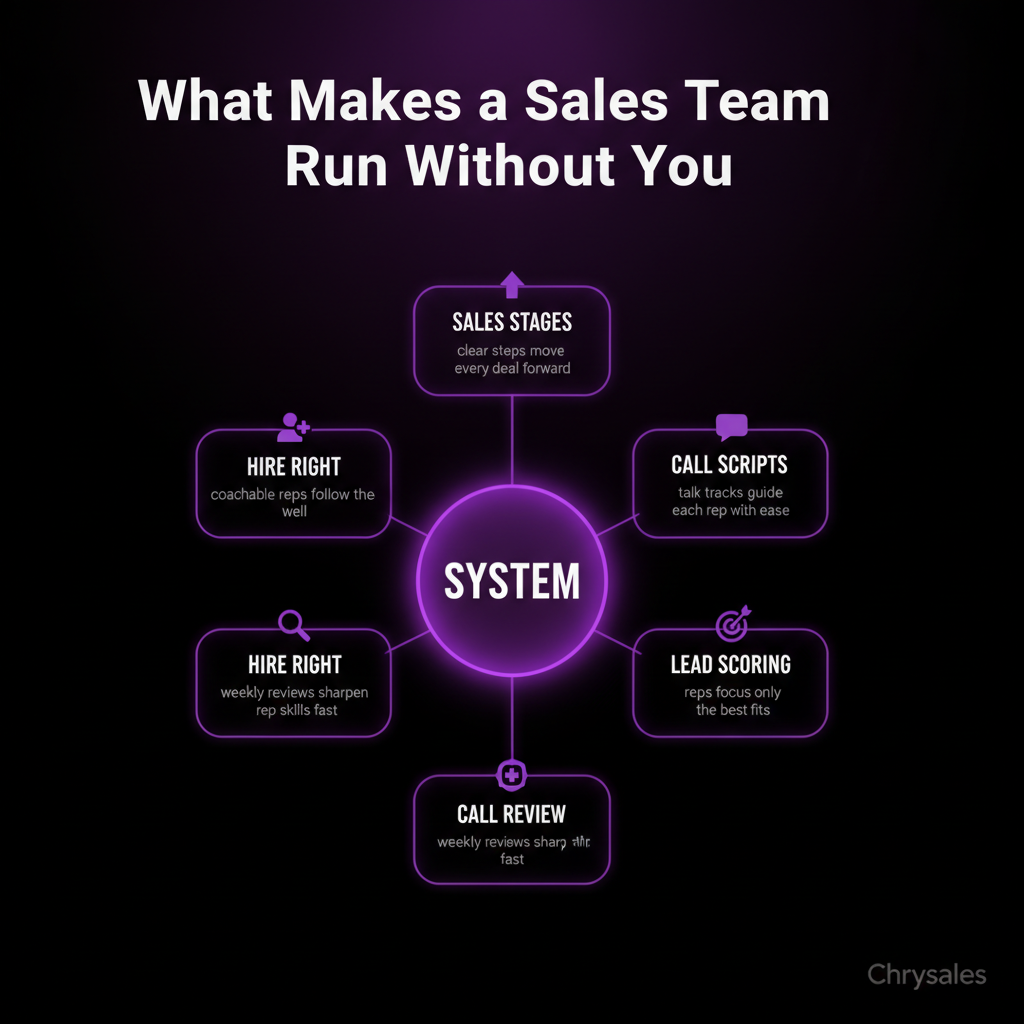
To scale a sales team, you need to turn your instincts into a step by step process that anyone can follow. That means writing down your discovery questions. Recording your best sales calls. Mapping out the exact stages a deal moves through. Documenting every objection you've ever handled and how you handled it.
What a Repeatable Sales Process Actually Looks Like
A repeatable sales process means a new hire can look at a document and know exactly what to do at every stage of a deal. Here's what that includes:
- Clear sales stages: Lead, qualified, demo booked, proposal sent, negotiation, closed. Each stage has a definition and exit criteria.
- Scripts and frameworks: Not word for word scripts, but question frameworks and talk tracks for discovery, demo, objection handling, and close.
- Deal qualification criteria: A simple scorecard that tells a rep if this lead is worth their time or not.
- Pipeline hygiene rules: When to follow up. When to move a deal to the next stage. When to mark it dead.
One marketing agency we worked with had a 12 step sales process. Sounds like a lot, but it worked. Every step had a clear action and a clear outcome. New hires could ramp in three weeks instead of three months because they weren't guessing.
Build the System Before You Hire
This is the part most people skip. They hire first, then try to build the system while the new rep is already on the clock. That's backwards.
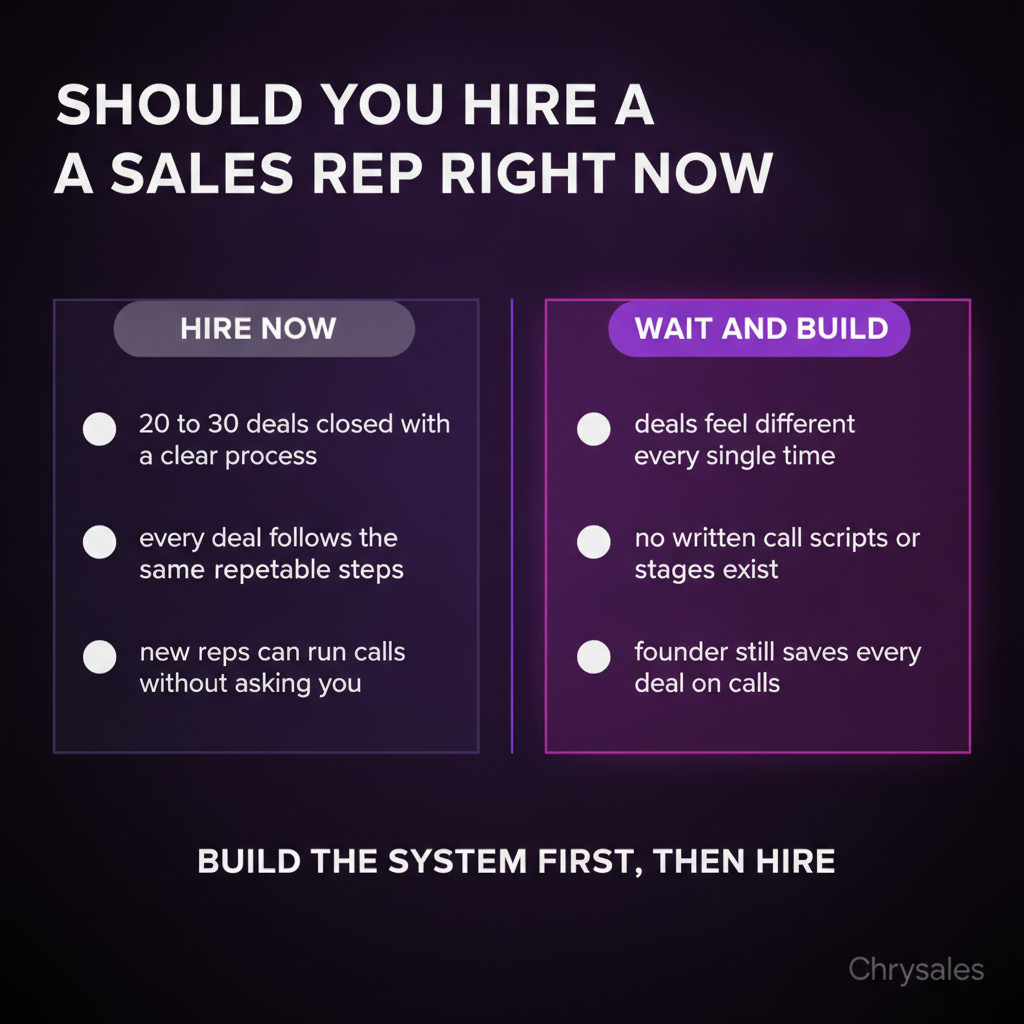
Before you post the job, you need to have your sales system documented and tested. That means you need to have closed at least 20 to 30 deals using a consistent process. If every deal feels different, you're not ready to hire yet.
Step 1: Document Your Best Sales Calls
Go back and listen to recordings of your best calls. The ones that turned into deals. What questions did you ask? What objections came up? How did you handle them? What made the prospect say yes? Write it all down. Turn it into a template. This becomes your discovery call script and your pitch framework.
Pro Tip: Don't try to document everything at once. Start with discovery. That's the most important part. If your rep nails discovery, the rest of the sales process gets easier.
Step 2: Map Your Sales Stages
Most small sales teams have no idea what their sales stages actually are. They just have "talking to them" and "closed." That's not enough.
Break your sales process into clear stages. Here's a simple B2B example:
- Lead: Contact info, fit unclear
- Qualified: Confirmed budget, authority, need, timing
- Discovery call booked: Meeting scheduled
- Proposal sent: Custom offer in their inbox
- Negotiation: Price or terms discussion
- Closed won or closed lost
Each stage should have a trigger that moves the deal forward. If a lead doesn't meet the qualification criteria, they don't move to the next stage. Simple.
Step 3: Create a Lead Scoring System
Not all leads are equal. A 200 person company that just did layoffs is not a hot lead. It's a bad fit, full stop. But most sales reps waste time on bad fits because no one told them how to score leads.
Build a simple scoring system. Assign points based on company size, industry, recent funding, tech stack, job title of the contact, and engagement level. Anything scoring above 70 goes to the top of your call list. Anything below 40 gets an email sequence, not a call.
This saves time and makes sure your team focuses on leads that actually convert.
Hire for System Execution, Not Sales Superstars
Once your system is built, you're ready to hire. But here's the thing: you don't need a sales superstar. You need someone who can follow the system.
Most B2B companies make the mistake of hiring expensive, experienced reps who want to do things their own way. That's a disaster. Your system works. You need someone who will run it, not reinvent it.
What to Look for in Your First Sales Hire
Your first sales hire should be a "mini-you" but with one key difference: they don't need to build the system. They just need to execute it. Understanding why your first sales hire fails can help you avoid common pitfalls during the selection process.
Look for:
- Coachability: Do they take feedback and apply it, or do they argue and defend their way?
- Process orientation: Do they like structure, or do they want to wing it?
- Consistency: Have they hit quota consistently in past roles, or are they a one hit wonder?
We worked with a tech company that hired three salespeople in one month. Two quit within 60 days. The one who stayed wasn't the most experienced. She was the most coachable. She followed the system. She asked questions. She took notes. She ramped faster than the other two combined.
Common mistake: Hiring someone with 10 years of sales experience who refuses to follow your process because "they've always done it this way." Experience without adaptability is useless.
Set Clear Expectations from Day One
Your new hire needs to know exactly what success looks like. That means clear KPIs tied to each stage of your sales process:
- Week 1 2: Learn the system, shadow calls, practice discovery scripts
- Week 3 4: Run discovery calls with support, book 5 demos
- Month 2: Run full sales cycle solo, close 2 deals minimum
- Month 3+: Hit quota consistently
If they're not hitting these benchmarks, you know immediately. You can coach them, or you can cut them. But you won't waste three months hoping they figure it out. You can learn more about how to build a sales system so powerful clients come to you for deeper guidance on creating a founder-independent process.
Train Your Sales Team Using Real Scenarios
Onboarding isn't a one week thing. It's ongoing. And the best training isn't a slide deck. It's real scenarios, role plays, and call reviews.
Weekly Call Reviews
Every week, sit down with your sales team and review recorded calls. Pick one good call and one bad call. Break them down. What worked? What didn't? What could they have said differently? According to best practices for effective sales coaching, consistent call reviews dramatically improve rep performance and confidence.
This is where the learning happens. Not in a training video. In the live breakdown of real conversations.
Build an Objection Handling Library
Every objection your reps hear should go into a shared doc with a proven response. Over time, this becomes your objection handling library. New hires can reference it before every call.
Common objections in B2B sales:
- "We don't have budget right now"
- "We're already working with someone"
- "Can you send me some info?"
- "I need to talk to my team"
For each one, document the best response you've used. Turn it into a framework, not a script. Your reps should sound like themselves, not robots.
Role Play the Hard Stuff
Most sales training skips role play because it's awkward. But role play is the fastest way to get your team ready for real objections. Resources like effective sales role play exercises can help structure these practice sessions for maximum impact.
Run mock discovery calls. Throw curveballs at them. Make them practice handling pushback.
A 15 person consulting firm we worked with added role play to their weekly sales meeting. Their close rate went up 18% in two months. Why? Because reps stopped freezing when a prospect pushed back. They'd already practiced the response.
Use Data to Improve Your Sales System Over Time
Your sales system isn't set in stone. It should evolve based on what's working and what's not. That's where data comes in.
Track everything. Call volume. Reply rates. Demo to close rate. Average deal size. Time to close. If you're not tracking it, you can't improve it.
Key Metrics to Monitor
Here are the core metrics every growing B2B sales team should track:
- Lead to qualified rate: What percentage of leads actually meet your criteria?
- Discovery to demo conversion: How many discovery calls turn into demos?
- Demo to close rate: How many demos turn into deals?
- Average sales cycle length: How long does it take to close a deal?
- Rep ramp time: How long until a new hire hits quota?
If your discovery to demo rate is low, your discovery process needs work. If your demo to close rate is low, your offer or pitch needs tweaking. The data tells you where to focus.
Pro Tip: Set a simple rule for your team. If a metric drops two weeks in a row, you run a call review session to figure out why. Don't wait for the month end report. Fix it fast.
Use AI to Score Leads and Prioritize Outreach
AI isn't just hype. It's a real tool that can save your sales team hours every week. Use AI to score leads based on fit, enrich contact data, and prioritize outreach. Our comprehensive AI sales enablement guide covers exactly how to implement these systems into your workflow.
For example, you can use a tool like Gemini based workflows to scan a lead's LinkedIn, website, and recent activity, then score them automatically. Leads scoring above 75 go straight to your top reps. Leads below 50 get an automated email sequence.
One client of ours cut their manual lead research time by 60% using AI lead scoring. Their reps went from spending two hours a day researching to spending that time on actual calls.
Split Roles as You Grow: SDRs vs Closers
Once you're past your first two or three sales hires, it's time to split roles. You don't need everyone doing everything. Specialization makes your team faster and better.
The SDR Role: Book Meetings
SDRs (Sales Development Reps) focus on one thing: booking qualified meetings. They handle cold outreach, lead qualification, and discovery calls. They don't close deals. They just get the right people on the calendar. For a deeper dive into this specialized role, check out what SDRs do and how they impact revenue to understand the full scope of responsibilities.
This lets your closers focus on what they do best: running demos and closing deals. It's a simple split, but it doubles productivity.
The Closer Role: Run Demos and Close
Closers take over after the discovery call is done. They run the demo, send the proposal, handle objections, and negotiate terms. They don't waste time on unqualified leads because the SDRs already filtered them out.
A marketing agency we worked with made this shift at 5 reps. Before the split, everyone was doing everything and close rates were inconsistent. After the split, their close rate jumped from 18% to 31% because closers only talked to qualified leads.
Watch out: Don't split roles too early. If you only have one or two reps, keep them full cycle. Specialization works when you have volume. If you're only booking 10 meetings a month, one person can handle it all.
What Chrysales Clients Do Differently
Most B2B companies try to figure this out on their own. They hire, fire, tweak, and repeat until something works. It takes months. Sometimes years.
The companies that work with Chrysales skip that trial and error phase. We build the entire sales system for them. Custom sales process. Lead scoring models. Discovery scripts. Objection frameworks. AI based lead prioritization. If you want to understand how to build a sales system that actually scales, we document every step so your team can execute without you on every call.
We train their first hires. We sit in on calls and give real time feedback. We've trained over 500 sales teams and helped generate more than €10M in client revenue.
Our 4 step method is simple: Learn your business, build the system, set up automation, then hire and scale the team. It's repeatable. It's predictable. And it works whether you're a 10 person consulting firm or a 50 person tech company.
If you're tired of being the only one who can close deals, that's fixable. You just need the system first.
Frequently Asked Questions
Q: How many deals should I close before hiring my first sales rep?
You should close at least 20 to 30 deals using a consistent process before you hire. If every deal feels different, you don't have a repeatable system yet. Hiring before that just creates expensive chaos. Focus on documenting what works first, then bring someone in to run that process.
Q: What's the biggest mistake when scaling a sales team?
Hiring before the system is built. Most companies think hiring solves their growth problem. It doesn't. It just exposes the lack of process. You end up with reps who underperform, high turnover, and wasted money. Build the system first. Hire second.
Q: Should my first sales hire be an SDR or a closer?
If you're still doing a lot of the closing yourself, hire an SDR to book meetings. If you have more leads than you can handle, hire a closer to take demos and close deals. Most small B2B teams should start with a full cycle rep who can do both, then specialize later.
Q: How long should it take a new sales rep to ramp up?
With a solid onboarding process and a documented sales system, a new rep should start closing deals within 60 to 90 days. If it's taking longer than that, your onboarding process needs work or your system isn't clear enough. Track ramp time as a key metric and improve it every quarter.
Q: How do I know if my sales process is repeatable enough to scale?
If you can hand your process doc to someone and they can run a discovery call without asking you 10 questions, it's repeatable. If they're constantly coming back for clarification, it's not. Record your best calls, document every step, and test it with a new hire. If they can follow it, you're ready to scale.
To scale a sales team means building a repeatable sales system, clear training, and steady lead generation so people can sell without you on every call. Picture this: you've closed most of your company's biggest deals yourself. Your pitch is tight. Your discovery questions are on point. But now you need to hire salespeople to take over, and every time you do, things fall apart. Reps underperform. Deals stall. You end up jumping back on calls to save them. Sound familiar?
The problem isn't bad hires. It's trying to scale a sales team before you've built the system that lets it run without you. Here's how to fix that.
Why Most Sales Teams Fail Without the Founder
Most B2B companies hire their first sales rep too early. They think hiring solves the growth problem. It doesn't. It just exposes the fact that there's no repeatable process in place.
When you're the one closing deals, you're running on instinct. You know which questions to ask. You can read the room. You pivot when something feels off. That's not a system. That's experience. And experience doesn't transfer to a new hire through a quick onboarding doc.
A 20 person consulting firm we worked with made this exact mistake. They hired two salespeople in the same month. Both had good resumes. Both bombed. One quit after six weeks. The other stuck around but only closed two deals in four months. The founder thought the hires were bad. The real issue? There was no documented sales process. No call structure. No objection scripts. Just "figure it out like I did."
Watch out: Hiring sales reps before you have a documented, repeatable process is like handing someone a blank recipe card and asking them to bake your signature dish. They'll guess. They'll fail. And you'll blame them.
The Gap Between Selling and Scaling
Selling is one skill. Building a system that lets other people sell is a completely different skill. Most people who are great at closing are terrible at documenting what they do. They just do it. That's why scaling feels impossible.
To scale a sales team, you need to turn your instincts into a step by step process that anyone can follow. That means writing down your discovery questions. Recording your best sales calls. Mapping out the exact stages a deal moves through. Documenting every objection you've ever handled and how you handled it.
What a Repeatable Sales Process Actually Looks Like
A repeatable sales process means a new hire can look at a document and know exactly what to do at every stage of a deal. Here's what that includes:
- Clear sales stages: Lead, qualified, demo booked, proposal sent, negotiation, closed. Each stage has a definition and exit criteria.
- Scripts and frameworks: Not word for word scripts, but question frameworks and talk tracks for discovery, demo, objection handling, and close.
- Deal qualification criteria: A simple scorecard that tells a rep if this lead is worth their time or not.
- Pipeline hygiene rules: When to follow up. When to move a deal to the next stage. When to mark it dead.
One marketing agency we worked with had a 12 step sales process. Sounds like a lot, but it worked. Every step had a clear action and a clear outcome. New hires could ramp in three weeks instead of three months because they weren't guessing.
Build the System Before You Hire
This is the part most people skip. They hire first, then try to build the system while the new rep is already on the clock. That's backwards.
Before you post the job, you need to have your sales system documented and tested. That means you need to have closed at least 20 to 30 deals using a consistent process. If every deal feels different, you're not ready to hire yet.
Step 1: Document Your Best Sales Calls
Go back and listen to recordings of your best calls. The ones that turned into deals. What questions did you ask? What objections came up? How did you handle them? What made the prospect say yes? Write it all down. Turn it into a template. This becomes your discovery call script and your pitch framework.
Pro Tip: Don't try to document everything at once. Start with discovery. That's the most important part. If your rep nails discovery, the rest of the sales process gets easier.
Step 2: Map Your Sales Stages
Most small sales teams have no idea what their sales stages actually are. They just have "talking to them" and "closed." That's not enough.
Break your sales process into clear stages. Here's a simple B2B example:
- Lead: Contact info, fit unclear
- Qualified: Confirmed budget, authority, need, timing
- Discovery call booked: Meeting scheduled
- Proposal sent: Custom offer in their inbox
- Negotiation: Price or terms discussion
- Closed won or closed lost
Each stage should have a trigger that moves the deal forward. If a lead doesn't meet the qualification criteria, they don't move to the next stage. Simple.
Step 3: Create a Lead Scoring System
Not all leads are equal. A 200 person company that just did layoffs is not a hot lead. It's a bad fit, full stop. But most sales reps waste time on bad fits because no one told them how to score leads.
Build a simple scoring system. Assign points based on company size, industry, recent funding, tech stack, job title of the contact, and engagement level. Anything scoring above 70 goes to the top of your call list. Anything below 40 gets an email sequence, not a call.
This saves time and makes sure your team focuses on leads that actually convert.
Hire for System Execution, Not Sales Superstars
Once your system is built, you're ready to hire. But here's the thing: you don't need a sales superstar. You need someone who can follow the system.
Most B2B companies make the mistake of hiring expensive, experienced reps who want to do things their own way. That's a disaster. Your system works. You need someone who will run it, not reinvent it.
What to Look for in Your First Sales Hire
Your first sales hire should be a "mini-you" but with one key difference: they don't need to build the system. They just need to execute it. Understanding why your first sales hire fails can help you avoid common pitfalls during the selection process.
Look for:
- Coachability: Do they take feedback and apply it, or do they argue and defend their way?
- Process orientation: Do they like structure, or do they want to wing it?
- Consistency: Have they hit quota consistently in past roles, or are they a one hit wonder?
We worked with a tech company that hired three salespeople in one month. Two quit within 60 days. The one who stayed wasn't the most experienced. She was the most coachable. She followed the system. She asked questions. She took notes. She ramped faster than the other two combined.
Common mistake: Hiring someone with 10 years of sales experience who refuses to follow your process because "they've always done it this way." Experience without adaptability is useless.
Set Clear Expectations from Day One
Your new hire needs to know exactly what success looks like. That means clear KPIs tied to each stage of your sales process:
- Week 1 2: Learn the system, shadow calls, practice discovery scripts
- Week 3 4: Run discovery calls with support, book 5 demos
- Month 2: Run full sales cycle solo, close 2 deals minimum
- Month 3+: Hit quota consistently
If they're not hitting these benchmarks, you know immediately. You can coach them, or you can cut them. But you won't waste three months hoping they figure it out. You can learn more about how to build a sales system so powerful clients come to you for deeper guidance on creating a founder-independent process.
Train Your Sales Team Using Real Scenarios
Onboarding isn't a one week thing. It's ongoing. And the best training isn't a slide deck. It's real scenarios, role plays, and call reviews.
Weekly Call Reviews
Every week, sit down with your sales team and review recorded calls. Pick one good call and one bad call. Break them down. What worked? What didn't? What could they have said differently? According to best practices for effective sales coaching, consistent call reviews dramatically improve rep performance and confidence.
This is where the learning happens. Not in a training video. In the live breakdown of real conversations.
Build an Objection Handling Library
Every objection your reps hear should go into a shared doc with a proven response. Over time, this becomes your objection handling library. New hires can reference it before every call.
Common objections in B2B sales:
- "We don't have budget right now"
- "We're already working with someone"
- "Can you send me some info?"
- "I need to talk to my team"
For each one, document the best response you've used. Turn it into a framework, not a script. Your reps should sound like themselves, not robots.
Role Play the Hard Stuff
Most sales training skips role play because it's awkward. But role play is the fastest way to get your team ready for real objections. Resources like effective sales role play exercises can help structure these practice sessions for maximum impact.
Run mock discovery calls. Throw curveballs at them. Make them practice handling pushback.
A 15 person consulting firm we worked with added role play to their weekly sales meeting. Their close rate went up 18% in two months. Why? Because reps stopped freezing when a prospect pushed back. They'd already practiced the response.
Use Data to Improve Your Sales System Over Time
Your sales system isn't set in stone. It should evolve based on what's working and what's not. That's where data comes in.
Track everything. Call volume. Reply rates. Demo to close rate. Average deal size. Time to close. If you're not tracking it, you can't improve it.
Key Metrics to Monitor
Here are the core metrics every growing B2B sales team should track:
- Lead to qualified rate: What percentage of leads actually meet your criteria?
- Discovery to demo conversion: How many discovery calls turn into demos?
- Demo to close rate: How many demos turn into deals?
- Average sales cycle length: How long does it take to close a deal?
- Rep ramp time: How long until a new hire hits quota?
If your discovery to demo rate is low, your discovery process needs work. If your demo to close rate is low, your offer or pitch needs tweaking. The data tells you where to focus.
Pro Tip: Set a simple rule for your team. If a metric drops two weeks in a row, you run a call review session to figure out why. Don't wait for the month end report. Fix it fast.
Use AI to Score Leads and Prioritize Outreach
AI isn't just hype. It's a real tool that can save your sales team hours every week. Use AI to score leads based on fit, enrich contact data, and prioritize outreach. Our comprehensive AI sales enablement guide covers exactly how to implement these systems into your workflow.
For example, you can use a tool like Gemini based workflows to scan a lead's LinkedIn, website, and recent activity, then score them automatically. Leads scoring above 75 go straight to your top reps. Leads below 50 get an automated email sequence.
One client of ours cut their manual lead research time by 60% using AI lead scoring. Their reps went from spending two hours a day researching to spending that time on actual calls.
Split Roles as You Grow: SDRs vs Closers
Once you're past your first two or three sales hires, it's time to split roles. You don't need everyone doing everything. Specialization makes your team faster and better.
The SDR Role: Book Meetings
SDRs (Sales Development Reps) focus on one thing: booking qualified meetings. They handle cold outreach, lead qualification, and discovery calls. They don't close deals. They just get the right people on the calendar. For a deeper dive into this specialized role, check out what SDRs do and how they impact revenue to understand the full scope of responsibilities.
This lets your closers focus on what they do best: running demos and closing deals. It's a simple split, but it doubles productivity.
The Closer Role: Run Demos and Close
Closers take over after the discovery call is done. They run the demo, send the proposal, handle objections, and negotiate terms. They don't waste time on unqualified leads because the SDRs already filtered them out.
A marketing agency we worked with made this shift at 5 reps. Before the split, everyone was doing everything and close rates were inconsistent. After the split, their close rate jumped from 18% to 31% because closers only talked to qualified leads.
Watch out: Don't split roles too early. If you only have one or two reps, keep them full cycle. Specialization works when you have volume. If you're only booking 10 meetings a month, one person can handle it all.
What Chrysales Clients Do Differently
Most B2B companies try to figure this out on their own. They hire, fire, tweak, and repeat until something works. It takes months. Sometimes years.
The companies that work with Chrysales skip that trial and error phase. We build the entire sales system for them. Custom sales process. Lead scoring models. Discovery scripts. Objection frameworks. AI based lead prioritization. If you want to understand how to build a sales system that actually scales, we document every step so your team can execute without you on every call.
We train their first hires. We sit in on calls and give real time feedback. We've trained over 500 sales teams and helped generate more than €10M in client revenue.
Our 4 step method is simple: Learn your business, build the system, set up automation, then hire and scale the team. It's repeatable. It's predictable. And it works whether you're a 10 person consulting firm or a 50 person tech company.
If you're tired of being the only one who can close deals, that's fixable. You just need the system first.
Frequently Asked Questions
Q: How many deals should I close before hiring my first sales rep?
You should close at least 20 to 30 deals using a consistent process before you hire. If every deal feels different, you don't have a repeatable system yet. Hiring before that just creates expensive chaos. Focus on documenting what works first, then bring someone in to run that process.
Q: What's the biggest mistake when scaling a sales team?
Hiring before the system is built. Most companies think hiring solves their growth problem. It doesn't. It just exposes the lack of process. You end up with reps who underperform, high turnover, and wasted money. Build the system first. Hire second.
Q: Should my first sales hire be an SDR or a closer?
If you're still doing a lot of the closing yourself, hire an SDR to book meetings. If you have more leads than you can handle, hire a closer to take demos and close deals. Most small B2B teams should start with a full cycle rep who can do both, then specialize later.
Q: How long should it take a new sales rep to ramp up?
With a solid onboarding process and a documented sales system, a new rep should start closing deals within 60 to 90 days. If it's taking longer than that, your onboarding process needs work or your system isn't clear enough. Track ramp time as a key metric and improve it every quarter.
Q: How do I know if my sales process is repeatable enough to scale?
If you can hand your process doc to someone and they can run a discovery call without asking you 10 questions, it's repeatable. If they're constantly coming back for clarification, it's not. Record your best calls, document every step, and test it with a new hire. If they can follow it, you're ready to scale.
Scaling Is Not Hard If You Have The Right Systems
If you’re serious about leveling up your scaling game, you need the right system, the right training, and the right team behind you. We're here to give you the exact tools and strategies top entrepreneurs use to dominate.

Discover the latest tips
View All.avif)
Chrysales was formed from the words "chrysalis" the stage where a caterpillar transforms into a butterfly and "sales".
It stands for one thing: sales transformation.Because scaling doesn’t happen by doing more of the same. Scaling only happens when you go through real transformation in your systems, your offer, team and the way you sell.
.avif)


