.avif)
Why Most Cold Call Scripts Fail in 10 Seconds
How to cold call is the skill of starting a sales call in a natural way so the prospect stays on the line long enough to hear a reason to keep talking. Picture this: you dial the number, the prospect picks up, you launch into your script, and before you finish your second sentence, you hear a click. That's it. Ten seconds, maybe less. This happens thousands of times a day to sales teams everywhere. The problem isn't that cold calling doesn't work anymore. The problem is most cold call scripts sound exactly like cold call scripts. And the second a prospect hears that familiar rhythm, that scripted tone, that same opening line they've heard five times this week, they're out. Here's what actually works in those critical first ten seconds.
The Real Reason Most Cold Call Openers Fail
Most cold call scripts fail because they sound like every other cold call. Not because the words are bad. Not because the offer isn't good. Because they trigger the same mental alarm in the prospect's head that says "sales call, hang up now." Think of it like this: your brain has a spam filter. When you see an email subject line that screams "marketing email," you don't even open it. Cold calls work the same way. The first few seconds tell the prospect whether this is worth their time or just another pitch.
The Pattern Interrupt Problem
Sales coaches love talking about pattern interrupts. The idea is solid: say something unexpected to break the prospect's auto reject response. But most "pattern interrupts" have become their own pattern. Opening with "Did I catch you at a bad time?" used to work. Now it's a red flag. Saying "I'll be brief" or "I promise this will only take a minute" signals you know you're interrupting and you're hoping they'll give you charity time. That's not how B2B sales conversations start.
The Scripted Tonality Trap
Here's what happens when you read a script word for word: you sound like you're reading a script word for word. Your tonality goes flat. Your pacing gets weird. You hit the same emphasis points everyone else hits because that's how the script is written. We worked with a tech company whose reps were getting hung up on within seconds. The script itself wasn't terrible. But every rep sounded identical. Monotone. Rushed. Clearly reading. The fix wasn't rewriting the script. It was teaching them to say the same core points like actual human beings having a conversation.
Watch out: If you can't deliver your opening line without looking at your screen, you're not ready to dial yet. The first ten seconds have to sound natural, not performed.
What Actually Happens in the First 10 Seconds
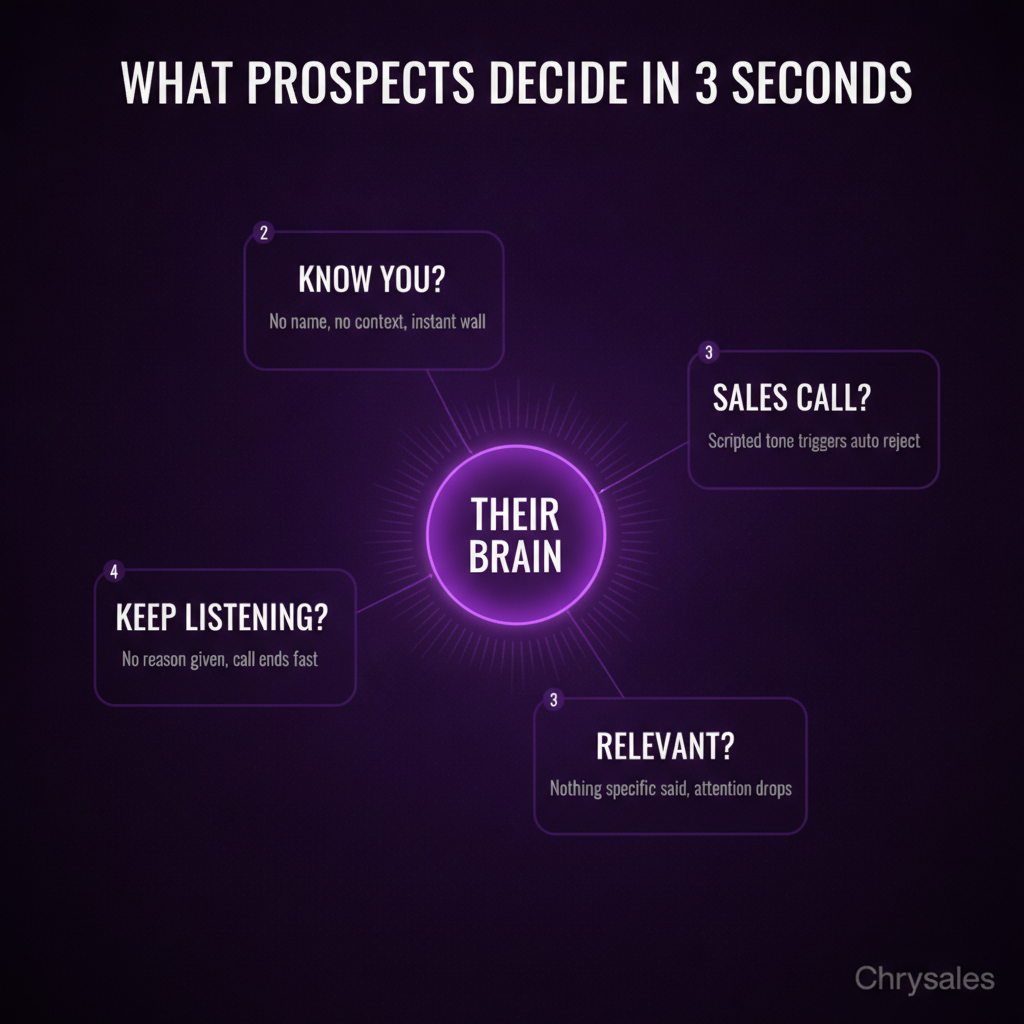
Let's break down what is really going on in those first few moments. The prospect picks up. They weren't expecting your call. They were in the middle of something else. Their brain is now making a split second decision: is this worth my attention or do I end this immediately? You have about three sentences to answer that question. Not three sentences to pitch. Three sentences to prove this might actually be relevant.
The Mental Checklist Prospects Run
When a prospect hears your voice in the first few seconds, they're unconsciously checking:
- Do I know this person? (No)
- Does this sound like a sales call? (Probably)
- Did they say anything specific to me or my company? (Usually no)
- Is there a reason to keep listening? (Not yet)
If you don't give them a reason by sentence three, they're gone. And "I want to tell you about our solution" is not a reason. Neither is "We help companies like yours."
Timing and Pacing Matter More Than You Think
Most reps talk too fast in the opening. They're nervous. They know they have seconds to make an impression. So they speed through the intro trying to get to the "good part." This backfires. Fast talking signals nervousness and scripts. Slow down. Pause between sentences. Let the prospect's brain process what you just said before you pile on the next sentence. A 15 person consulting firm we worked with cut their hang up rate in half just by teaching their reps to pause for a full second after stating their name and company. That one second pause made them sound confident instead of desperate.
How to Build a Cold Call Opener That Actually Works
A good how to cold call opener does three things: it sounds human, it establishes relevance fast, and it creates a small reason to continue the conversation. That's it. You're not closing a deal in ten seconds. You're earning ten more seconds.
Start With Your Name and Why You're Calling (But Make It Specific)
The opening should be clean and direct. State your name, your company, and a specific reason you're calling. Not a generic reason. A specific one tied to something real about their business.
Bad opener: "Hi, this is Sarah from Chrysales. We help companies improve their sales process and I wanted to see if you'd be open to a quick conversation."
Better opener: "Hi, this is Sarah. I'm calling because I noticed your team just posted three sales roles in the last month, and I work with companies scaling their sales team to build the systems that actually make those hires successful. Do you have two minutes?"
The second version is specific. It references something real. It hints at a relevant problem without assuming. And it asks for a tiny commitment, not a meeting.
Reference Something Specific (Without Sounding Like a Stalker)
Personalization works, but it has to be natural. Mentioning you saw their LinkedIn post or noticed a job opening is fine. Mentioning you know where they went to college and what their dog's name is crosses a line. Good cold calling for B2B lead generation means doing just enough research to sound relevant without doing so much research that it feels invasive. You're looking for signal: recent funding, new hires, a product launch, a job posting, a pain point mentioned in a podcast. One marketing agency we trained had their reps spend 60 seconds before each call finding one specific, recent thing about the prospect's company. Not deep research. Just one thing. Their connect rate went up 30% in two weeks.
Ask for Permission (But Not the Way Most People Do)
Asking "Is now a good time?" sounds polite but it invites a no. Asking "Do you have two minutes?" sets a boundary and signals you're not about to launch into a 20 minute pitch. The key is to sound like you actually mean it. If they say no, respect it and ask when would be better. Most reps say "Do you have two minutes?" but then keep talking regardless of the answer. That destroys trust instantly.
Pro Tip: If a prospect says "I only have a minute," say "That works, I'll keep it tight" and actually keep it tight. Respecting their time in the first call makes the second call way easier to book.
The Four Cold Call Opening Structures That Work Right Now
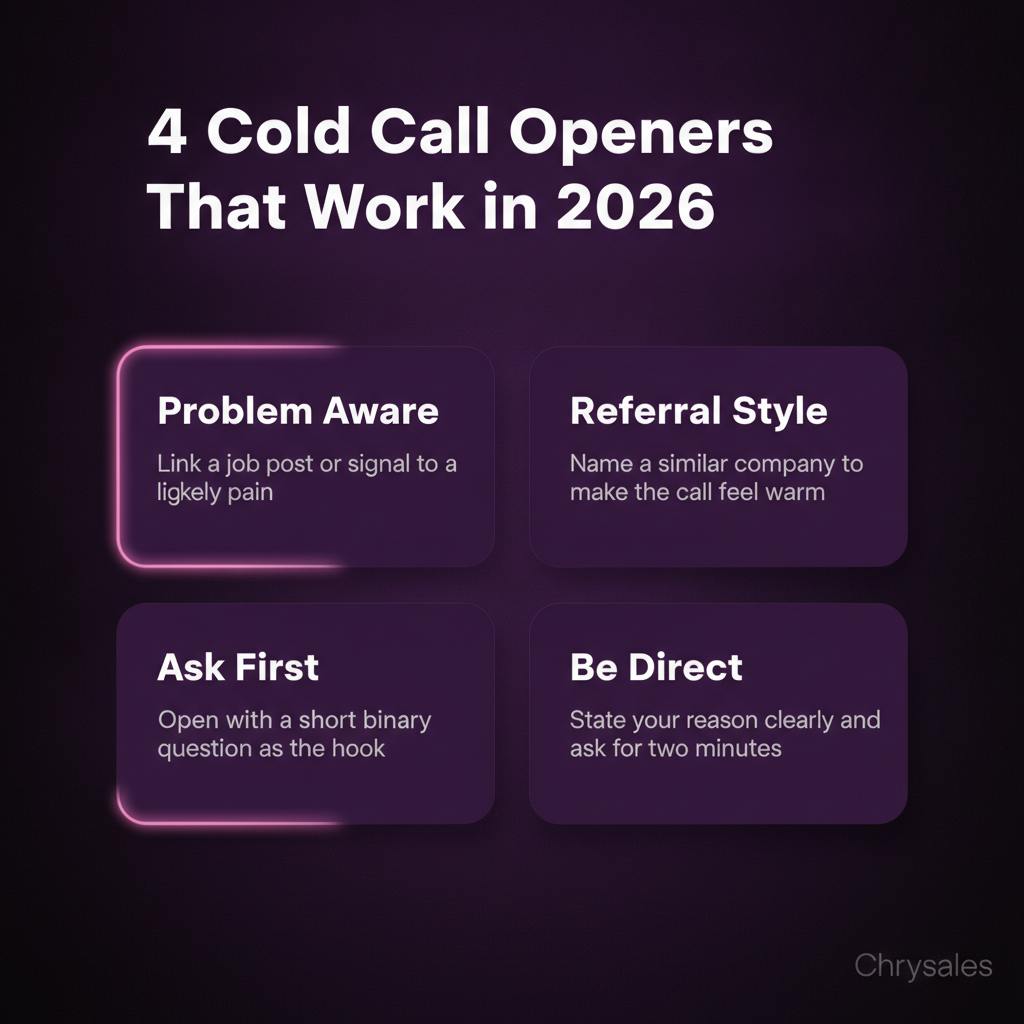
Not every cold call needs the same opener. The best B2B cold calling strategy adapts based on context. Here are four structures that work depending on the situation. For more examples and detailed breakdowns of high-performing openers, check out our cold call opener guide for B2B sales teams.
Structure 1: The Problem-Aware Opener
Use this when you know the prospect is dealing with a specific, visible problem. Maybe they're hiring. Maybe they just lost a big client (if it's public). Maybe their industry is going through a shift.
"Hi [Name], this is [Your Name]. I'm calling because I saw you're hiring two account execs right now, and most companies we talk to struggle to ramp new sales hires without a clear system in place. I work with sales teams to build that system so new hires actually hit quota. Do you have three minutes to talk through how that works?"
This works because it connects a visible signal (the job posting) to a likely problem (ramping new hires) and offers a specific solution angle.
Structure 2: The Referral-Style Opener
Use this when you have any kind of connection, even a weak one. Worked with a similar company. Saw them mentioned in an article. Noticed you're in the same LinkedIn group.
"Hi [Name], this is [Your Name]. I was just working with another consulting firm in your space and they mentioned the biggest challenge right now is finding qualified leads without burning budget on ads. I'm calling to see if that's something you're dealing with too."
Even without a direct referral, the "I was just working with a similar company" frame makes the call feel less random.
Structure 3: The Curiosity Opener
Use this when you don't have a strong signal but you have a hypothesis about a problem they might have based on their company size, industry, or stage.
"Hi [Name], this is [Your Name]. Quick question: are you handling outbound sales in house right now, or is that not a priority at the moment?"
The question itself is the hook. It's relevant, it's binary (easy to answer), and it opens a door to the real conversation depending on how they answer.
Structure 4: The Directness Opener
Sometimes the best approach is just being direct. No tricks. No clever hooks. Just a clear, honest reason you're calling.
"Hi [Name], this is [Your Name] from Chrysales. I'm calling because we help B2B companies build repeatable sales systems, and based on your company's growth in the last year, I thought it might be worth a conversation. Do you have a few minutes, or should I call back at a better time?"
This works when your offer is strong and the fit is obvious. You're not trying to be clever. You're just being clear.
Common mistake: Mixing these structures. Pick one and commit. Trying to combine the curiosity opener with the problem aware opener makes you sound confused, not strategic.
Cold Call Objection Handling in the First 10 Seconds
You won't always get ten full seconds before a prospect throws up a wall. "I'm not interested." "Send me an email." "We're all set." These aren't real objections yet. They're reflexes. Here's how to handle them without sounding pushy.
"I'm Not Interested"
This usually means "I don't know what you're offering yet, so my default answer is no." Don't argue. Don't say "I understand, but..." Just acknowledge and reframe.
"Totally fair. I'm not calling to pitch you anything right now. I'm calling because I noticed [specific thing] and wanted to ask one quick question about how you're handling [specific challenge]. If it's not relevant, I'll let you go. Fair?"
You're giving them an out while also creating a tiny opening. Most prospects will give you the 15 seconds to ask the question.
"Send Me an Email"
This is a brush off 90% of the time. But it's also a test. If you just say "okay, what's your email?" you lose. If you push back too hard, you lose. The move is to agree and add one sentence of context.
"Happy to. Before I do, can I ask one quick question so I send you something actually relevant? Are you currently [doing X] or [doing Y]?"
If they answer, you're in a conversation. If they don't, send the email and follow up. But you tried.
"We're All Set" or "We Already Have Someone"
This is actually useful information. It tells you they have a solution in place, which means there's a current state you can compare against.
"Got it. Can I ask who you're working with now, just so I know?"
Or: "Makes sense. Out of curiosity, what's working well about your current setup?"
These questions feel consultative, not sales y. And sometimes the prospect will reveal a crack in their current solution without you having to push. If you want to see how these principles scale when calling senior decision-makers who are even harder to reach, watch this breakdown of how to close busy CEOs who never reply to your messages.
Pro Tip: The first objection is almost never the real objection. It's a test to see if you'll go away easily. Handle it calmly, ask one follow up question, and you'll often get a real conversation.
What to Say After the First 10 Seconds (The Bridge)
Let's say you made it past the opener. The prospect didn't hang up. They said "okay, what's this about?" or "I have a minute, go ahead." Now what? This is where most reps blow it. They survived the first ten seconds and now they launch into a full pitch. Wrong move. The goal of the next 20 to 30 seconds is to confirm relevance and book a real conversation, not to close a deal.
The Two Sentence Bridge
After your opener, you need a bridge that explains what you do and why it matters to them, in two sentences max. Then you stop talking and let them respond.
"We build custom sales systems for B2B companies, which basically means we help you turn cold outreach into predictable client acquisition without hiring a huge sales team. Based on [the thing you mentioned in your opener], I thought it might be worth a 15 minute call to see if we could do something similar for you."
That's it. You've explained what you do. You've tied it back to something specific about them. You've asked for a small next step. Now you let them talk.
Give Them Room to Respond
Silence is your friend here. After you ask for the call, stop talking. Let them process. Let them ask a question. Let them say yes or no. Most reps get nervous in the silence and start filling it with more talking. "We've worked with companies like Amazon and Vodafone, we have a 99.4% client satisfaction rate, we've generated over €10M in client revenue..." Stop. You're not on a pitch call. You're on a qualification call.
Qualify Before You Book
If the prospect seems interested, ask one or two qualifying questions before you lock in a meeting. This does two things: it makes sure the meeting will actually be useful, and it makes the prospect feel like you're selective, not desperate.
"Before we set something up, can I ask: are you currently doing any outbound, or is that something you're looking to start?"
"Just to make sure this would be relevant, are you open to working with an outside sales coach, or are you looking to build everything in house?"
These questions help you avoid wasting time on bad fit meetings. And they make the prospect feel like the meeting is valuable, not just another sales pitch.
Building Your Own Cold Call Script (The Right Way)
Here's the thing: you do need a script. Not because you're going to read it word for word, but because you need a structure. A repeatable framework that you can adapt on the fly based on how the call goes. Most sales training programs teach scripts as fixed text. That's the problem. A good cold call script is more like a decision tree. If they say X, you say Y. If they ask Z, you have an answer ready. Because cold calling is one piece of a larger system, you should also explore how to build a sales system that actually scales to understand the full context of where these scripts fit.
Start With Your Core Opening (Three Versions)
Write out three versions of your opener based on the three most common scenarios you'll encounter:
- Cold call to a company you researched (use the problem aware or referral style opener)
- Cold call to a prospect from a good list but no deep research (use the curiosity or directness opener)
- Follow up call after a previous touchpoint (reference the email/LinkedIn message/voicemail)
Each version should be 2 to 3 sentences. Write them out. Say them out loud 20 times until you can say them naturally without looking at a screen.
Map Out the Top 5 Responses and Your Answers
After your opener, the prospect will respond in one of about five ways:
- "What's this about?" (bridge to the value prop)
- "I'm not interested" (handle the reflex objection)
- "Send me an email" (agree and ask one qualifying question first)
- "I'm busy right now" (respect it and ask when to call back)
- "Tell me more" (qualify and book the meeting)
Write out your response to each one. Practice them. Make them sound conversational, not scripted.
Know Your Qualifying Questions
Before you get on the phone, know the 3 to 5 questions that tell you if this prospect is a good fit. These aren't pitch questions. They're discovery questions. For a sales coaching offer, good qualifying questions might be:
- Are you doing any outbound sales right now, or is it all inbound?
- How big is your sales team currently?
- Are you open to working with an outside coach, or are you building everything in house?
- What's the biggest sales challenge you're dealing with right now?
Pick the top three. Ask them naturally during the conversation. If the answers indicate a bad fit, politely end the call. If the answers indicate a good fit, book the meeting.
Watch out: Don't ask qualifying questions that sound like a survey. Ask them like you're trying to figure out if you can actually help, because you are.
Common Cold Calling Mistakes That Kill Conversations
Even with a solid opener and a good script structure, there are a handful of mistakes that kill cold calls every single time. Here are the big ones we see with new clients.
Talking Too Much
The biggest mistake is talking too much in the first 30 seconds. You're nervous. You want to get all the information out. So you keep talking. And talking. And the prospect zones out or interrupts or hangs up. Your opening should be 2 to 3 sentences. Your bridge should be 2 sentences. Then you stop. Let them talk. Cold calling is a conversation, not a monologue.
Apologizing for Calling
Never say "Sorry to bother you" or "I know you're busy, but..." The second you apologize, you position yourself as an interruption, not a potential solution. You're not bothering them. You're offering them something that might be valuable. Act like it.
Not Having a Clear Ask
Every cold call should end with a clear next step. Not "Let me know if you're interested." Not "Feel free to reach out." A clear ask: "Does Thursday at 2pm work for a 15 minute call?" or "Can I send you a quick email with some examples and we can hop on a call next week?" If you don't ask for something specific, nothing happens. The call ends and you're hoping they'll reach back out. They won't.
Ignoring Tonality
You can say the right words in the wrong tone and still get hung up on. If you sound bored, nervous, scripted, or pushy, the prospect feels it. Record yourself. Listen back. Do you sound like someone you'd want to talk to? Good tonality is confident but not cocky. Friendly but not fake. Relaxed but not lazy. It takes practice. But it matters more than the actual words. Research consistently shows that tonality and voice quality are critical factors in winning meetings on cold calls.
Pro Tip: Smile when you talk. It sounds ridiculous, but people can hear it in your voice. A smile changes your tonality in a way that makes you sound more approachable.
Not Following Up
Most sales prospecting techniques fail because there's no follow up. You make the cold call. The prospect says "send me an email." You send the email. Then nothing. No second call. No second email. No sequence. The average prospect needs 8 touchpoints before they convert. One cold call isn't enough. One email isn't enough. You need a system. Call, email, call again, LinkedIn message, call again, email again. Stay consistent without being annoying. To understand how cold calling fits into a multi-touch outbound sequence, review our guide on B2B sales call patterns.
Frequently Asked Questions
Q: How many times should I call a prospect before giving up?
Most sales teams give up after one or two calls. That's way too early. A good rule is 6 to 8 touches over 3 to 4 weeks, mixing calls, emails, and LinkedIn messages. If you've done that and gotten zero response, move on. But one call and done leaves tons of pipeline on the table. Persistence matters, but spread it out. Calling five times in one day is spam. Calling once a week for a month is professional follow up.
Q: What time of day is best for cold calling?
Studies show the best times are mid morning (10am to 11am) and mid afternoon (2pm to 4pm). Avoid Monday mornings (everyone's catching up from the weekend) and Friday afternoons (everyone's checked out). That said, every industry is different. Test your own windows. Track your connect rates by time slot and double down on what works for your specific audience. For detailed data on optimal calling times across different industries, see this analysis of the best times to cold call in B2B.
Q: Should I leave a voicemail if they don't pick up?
Yes, but keep it short. A good voicemail is 20 to 30 seconds max. State your name, company, one specific reason you're calling, and your number. Then hang up. Don't pitch in the voicemail. The goal is to make them curious enough to call back or at least recognize your name when you call again. Most people won't call back from a voicemail, but it warms them up for the next touchpoint.
Q: How do I cold call without sounding too salesy?
Sound like a human, not a sales robot. Use natural language. Pause between sentences. Don't read a script word for word. Reference something specific about their company. Ask real questions and actually listen to the answers. The salesiest thing you can do is launch into a pitch before you know if they even have the problem you solve. Slow down. Be curious. Be helpful. That's the opposite of salesy. If you're curious how cold calling compares to other outbound channels in terms of speed to revenue, watch this comparison of cold email versus cold calling to see which makes you money faster.
Q: What's the difference between a good cold call script and a bad one?
A bad cold call script is rigid, generic, and sounds like every other sales call. It opens with a cliche, pitches too early, and doesn't adapt based on the prospect's responses. A good script is a flexible framework. It has a strong, specific opener. It includes decision points based on how the prospect responds. It focuses on earning the next 10 seconds, not closing the deal in the first minute. And it sounds conversational, not performed. Write it. Practice it. Then put it away and have real conversations.
How to cold call is the skill of starting a sales call in a natural way so the prospect stays on the line long enough to hear a reason to keep talking. Picture this: you dial the number, the prospect picks up, you launch into your script, and before you finish your second sentence, you hear a click. That's it. Ten seconds, maybe less. This happens thousands of times a day to sales teams everywhere. The problem isn't that cold calling doesn't work anymore. The problem is most cold call scripts sound exactly like cold call scripts. And the second a prospect hears that familiar rhythm, that scripted tone, that same opening line they've heard five times this week, they're out. Here's what actually works in those critical first ten seconds.
The Real Reason Most Cold Call Openers Fail
Most cold call scripts fail because they sound like every other cold call. Not because the words are bad. Not because the offer isn't good. Because they trigger the same mental alarm in the prospect's head that says "sales call, hang up now." Think of it like this: your brain has a spam filter. When you see an email subject line that screams "marketing email," you don't even open it. Cold calls work the same way. The first few seconds tell the prospect whether this is worth their time or just another pitch.
The Pattern Interrupt Problem
Sales coaches love talking about pattern interrupts. The idea is solid: say something unexpected to break the prospect's auto reject response. But most "pattern interrupts" have become their own pattern. Opening with "Did I catch you at a bad time?" used to work. Now it's a red flag. Saying "I'll be brief" or "I promise this will only take a minute" signals you know you're interrupting and you're hoping they'll give you charity time. That's not how B2B sales conversations start.
The Scripted Tonality Trap
Here's what happens when you read a script word for word: you sound like you're reading a script word for word. Your tonality goes flat. Your pacing gets weird. You hit the same emphasis points everyone else hits because that's how the script is written. We worked with a tech company whose reps were getting hung up on within seconds. The script itself wasn't terrible. But every rep sounded identical. Monotone. Rushed. Clearly reading. The fix wasn't rewriting the script. It was teaching them to say the same core points like actual human beings having a conversation.
Watch out: If you can't deliver your opening line without looking at your screen, you're not ready to dial yet. The first ten seconds have to sound natural, not performed.
What Actually Happens in the First 10 Seconds
Let's break down what is really going on in those first few moments. The prospect picks up. They weren't expecting your call. They were in the middle of something else. Their brain is now making a split second decision: is this worth my attention or do I end this immediately? You have about three sentences to answer that question. Not three sentences to pitch. Three sentences to prove this might actually be relevant.
The Mental Checklist Prospects Run
When a prospect hears your voice in the first few seconds, they're unconsciously checking:
- Do I know this person? (No)
- Does this sound like a sales call? (Probably)
- Did they say anything specific to me or my company? (Usually no)
- Is there a reason to keep listening? (Not yet)
If you don't give them a reason by sentence three, they're gone. And "I want to tell you about our solution" is not a reason. Neither is "We help companies like yours."
Timing and Pacing Matter More Than You Think
Most reps talk too fast in the opening. They're nervous. They know they have seconds to make an impression. So they speed through the intro trying to get to the "good part." This backfires. Fast talking signals nervousness and scripts. Slow down. Pause between sentences. Let the prospect's brain process what you just said before you pile on the next sentence. A 15 person consulting firm we worked with cut their hang up rate in half just by teaching their reps to pause for a full second after stating their name and company. That one second pause made them sound confident instead of desperate.
How to Build a Cold Call Opener That Actually Works
A good how to cold call opener does three things: it sounds human, it establishes relevance fast, and it creates a small reason to continue the conversation. That's it. You're not closing a deal in ten seconds. You're earning ten more seconds.
Start With Your Name and Why You're Calling (But Make It Specific)
The opening should be clean and direct. State your name, your company, and a specific reason you're calling. Not a generic reason. A specific one tied to something real about their business.
Bad opener: "Hi, this is Sarah from Chrysales. We help companies improve their sales process and I wanted to see if you'd be open to a quick conversation."
Better opener: "Hi, this is Sarah. I'm calling because I noticed your team just posted three sales roles in the last month, and I work with companies scaling their sales team to build the systems that actually make those hires successful. Do you have two minutes?"
The second version is specific. It references something real. It hints at a relevant problem without assuming. And it asks for a tiny commitment, not a meeting.
Reference Something Specific (Without Sounding Like a Stalker)
Personalization works, but it has to be natural. Mentioning you saw their LinkedIn post or noticed a job opening is fine. Mentioning you know where they went to college and what their dog's name is crosses a line. Good cold calling for B2B lead generation means doing just enough research to sound relevant without doing so much research that it feels invasive. You're looking for signal: recent funding, new hires, a product launch, a job posting, a pain point mentioned in a podcast. One marketing agency we trained had their reps spend 60 seconds before each call finding one specific, recent thing about the prospect's company. Not deep research. Just one thing. Their connect rate went up 30% in two weeks.
Ask for Permission (But Not the Way Most People Do)
Asking "Is now a good time?" sounds polite but it invites a no. Asking "Do you have two minutes?" sets a boundary and signals you're not about to launch into a 20 minute pitch. The key is to sound like you actually mean it. If they say no, respect it and ask when would be better. Most reps say "Do you have two minutes?" but then keep talking regardless of the answer. That destroys trust instantly.
Pro Tip: If a prospect says "I only have a minute," say "That works, I'll keep it tight" and actually keep it tight. Respecting their time in the first call makes the second call way easier to book.
The Four Cold Call Opening Structures That Work Right Now
Not every cold call needs the same opener. The best B2B cold calling strategy adapts based on context. Here are four structures that work depending on the situation. For more examples and detailed breakdowns of high-performing openers, check out our cold call opener guide for B2B sales teams.
Structure 1: The Problem-Aware Opener
Use this when you know the prospect is dealing with a specific, visible problem. Maybe they're hiring. Maybe they just lost a big client (if it's public). Maybe their industry is going through a shift.
"Hi [Name], this is [Your Name]. I'm calling because I saw you're hiring two account execs right now, and most companies we talk to struggle to ramp new sales hires without a clear system in place. I work with sales teams to build that system so new hires actually hit quota. Do you have three minutes to talk through how that works?"
This works because it connects a visible signal (the job posting) to a likely problem (ramping new hires) and offers a specific solution angle.
Structure 2: The Referral-Style Opener
Use this when you have any kind of connection, even a weak one. Worked with a similar company. Saw them mentioned in an article. Noticed you're in the same LinkedIn group.
"Hi [Name], this is [Your Name]. I was just working with another consulting firm in your space and they mentioned the biggest challenge right now is finding qualified leads without burning budget on ads. I'm calling to see if that's something you're dealing with too."
Even without a direct referral, the "I was just working with a similar company" frame makes the call feel less random.
Structure 3: The Curiosity Opener
Use this when you don't have a strong signal but you have a hypothesis about a problem they might have based on their company size, industry, or stage.
"Hi [Name], this is [Your Name]. Quick question: are you handling outbound sales in house right now, or is that not a priority at the moment?"
The question itself is the hook. It's relevant, it's binary (easy to answer), and it opens a door to the real conversation depending on how they answer.
Structure 4: The Directness Opener
Sometimes the best approach is just being direct. No tricks. No clever hooks. Just a clear, honest reason you're calling.
"Hi [Name], this is [Your Name] from Chrysales. I'm calling because we help B2B companies build repeatable sales systems, and based on your company's growth in the last year, I thought it might be worth a conversation. Do you have a few minutes, or should I call back at a better time?"
This works when your offer is strong and the fit is obvious. You're not trying to be clever. You're just being clear.
Common mistake: Mixing these structures. Pick one and commit. Trying to combine the curiosity opener with the problem aware opener makes you sound confused, not strategic.
Cold Call Objection Handling in the First 10 Seconds
You won't always get ten full seconds before a prospect throws up a wall. "I'm not interested." "Send me an email." "We're all set." These aren't real objections yet. They're reflexes. Here's how to handle them without sounding pushy.
"I'm Not Interested"
This usually means "I don't know what you're offering yet, so my default answer is no." Don't argue. Don't say "I understand, but..." Just acknowledge and reframe.
"Totally fair. I'm not calling to pitch you anything right now. I'm calling because I noticed [specific thing] and wanted to ask one quick question about how you're handling [specific challenge]. If it's not relevant, I'll let you go. Fair?"
You're giving them an out while also creating a tiny opening. Most prospects will give you the 15 seconds to ask the question.
"Send Me an Email"
This is a brush off 90% of the time. But it's also a test. If you just say "okay, what's your email?" you lose. If you push back too hard, you lose. The move is to agree and add one sentence of context.
"Happy to. Before I do, can I ask one quick question so I send you something actually relevant? Are you currently [doing X] or [doing Y]?"
If they answer, you're in a conversation. If they don't, send the email and follow up. But you tried.
"We're All Set" or "We Already Have Someone"
This is actually useful information. It tells you they have a solution in place, which means there's a current state you can compare against.
"Got it. Can I ask who you're working with now, just so I know?"
Or: "Makes sense. Out of curiosity, what's working well about your current setup?"
These questions feel consultative, not sales y. And sometimes the prospect will reveal a crack in their current solution without you having to push. If you want to see how these principles scale when calling senior decision-makers who are even harder to reach, watch this breakdown of how to close busy CEOs who never reply to your messages.
Pro Tip: The first objection is almost never the real objection. It's a test to see if you'll go away easily. Handle it calmly, ask one follow up question, and you'll often get a real conversation.
What to Say After the First 10 Seconds (The Bridge)
Let's say you made it past the opener. The prospect didn't hang up. They said "okay, what's this about?" or "I have a minute, go ahead." Now what? This is where most reps blow it. They survived the first ten seconds and now they launch into a full pitch. Wrong move. The goal of the next 20 to 30 seconds is to confirm relevance and book a real conversation, not to close a deal.
The Two Sentence Bridge
After your opener, you need a bridge that explains what you do and why it matters to them, in two sentences max. Then you stop talking and let them respond.
"We build custom sales systems for B2B companies, which basically means we help you turn cold outreach into predictable client acquisition without hiring a huge sales team. Based on [the thing you mentioned in your opener], I thought it might be worth a 15 minute call to see if we could do something similar for you."
That's it. You've explained what you do. You've tied it back to something specific about them. You've asked for a small next step. Now you let them talk.
Give Them Room to Respond
Silence is your friend here. After you ask for the call, stop talking. Let them process. Let them ask a question. Let them say yes or no. Most reps get nervous in the silence and start filling it with more talking. "We've worked with companies like Amazon and Vodafone, we have a 99.4% client satisfaction rate, we've generated over €10M in client revenue..." Stop. You're not on a pitch call. You're on a qualification call.
Qualify Before You Book
If the prospect seems interested, ask one or two qualifying questions before you lock in a meeting. This does two things: it makes sure the meeting will actually be useful, and it makes the prospect feel like you're selective, not desperate.
"Before we set something up, can I ask: are you currently doing any outbound, or is that something you're looking to start?"
"Just to make sure this would be relevant, are you open to working with an outside sales coach, or are you looking to build everything in house?"
These questions help you avoid wasting time on bad fit meetings. And they make the prospect feel like the meeting is valuable, not just another sales pitch.
Building Your Own Cold Call Script (The Right Way)
Here's the thing: you do need a script. Not because you're going to read it word for word, but because you need a structure. A repeatable framework that you can adapt on the fly based on how the call goes. Most sales training programs teach scripts as fixed text. That's the problem. A good cold call script is more like a decision tree. If they say X, you say Y. If they ask Z, you have an answer ready. Because cold calling is one piece of a larger system, you should also explore how to build a sales system that actually scales to understand the full context of where these scripts fit.
Start With Your Core Opening (Three Versions)
Write out three versions of your opener based on the three most common scenarios you'll encounter:
- Cold call to a company you researched (use the problem aware or referral style opener)
- Cold call to a prospect from a good list but no deep research (use the curiosity or directness opener)
- Follow up call after a previous touchpoint (reference the email/LinkedIn message/voicemail)
Each version should be 2 to 3 sentences. Write them out. Say them out loud 20 times until you can say them naturally without looking at a screen.
Map Out the Top 5 Responses and Your Answers
After your opener, the prospect will respond in one of about five ways:
- "What's this about?" (bridge to the value prop)
- "I'm not interested" (handle the reflex objection)
- "Send me an email" (agree and ask one qualifying question first)
- "I'm busy right now" (respect it and ask when to call back)
- "Tell me more" (qualify and book the meeting)
Write out your response to each one. Practice them. Make them sound conversational, not scripted.
Know Your Qualifying Questions
Before you get on the phone, know the 3 to 5 questions that tell you if this prospect is a good fit. These aren't pitch questions. They're discovery questions. For a sales coaching offer, good qualifying questions might be:
- Are you doing any outbound sales right now, or is it all inbound?
- How big is your sales team currently?
- Are you open to working with an outside coach, or are you building everything in house?
- What's the biggest sales challenge you're dealing with right now?
Pick the top three. Ask them naturally during the conversation. If the answers indicate a bad fit, politely end the call. If the answers indicate a good fit, book the meeting.
Watch out: Don't ask qualifying questions that sound like a survey. Ask them like you're trying to figure out if you can actually help, because you are.
Common Cold Calling Mistakes That Kill Conversations
Even with a solid opener and a good script structure, there are a handful of mistakes that kill cold calls every single time. Here are the big ones we see with new clients.
Talking Too Much
The biggest mistake is talking too much in the first 30 seconds. You're nervous. You want to get all the information out. So you keep talking. And talking. And the prospect zones out or interrupts or hangs up. Your opening should be 2 to 3 sentences. Your bridge should be 2 sentences. Then you stop. Let them talk. Cold calling is a conversation, not a monologue.
Apologizing for Calling
Never say "Sorry to bother you" or "I know you're busy, but..." The second you apologize, you position yourself as an interruption, not a potential solution. You're not bothering them. You're offering them something that might be valuable. Act like it.
Not Having a Clear Ask
Every cold call should end with a clear next step. Not "Let me know if you're interested." Not "Feel free to reach out." A clear ask: "Does Thursday at 2pm work for a 15 minute call?" or "Can I send you a quick email with some examples and we can hop on a call next week?" If you don't ask for something specific, nothing happens. The call ends and you're hoping they'll reach back out. They won't.
Ignoring Tonality
You can say the right words in the wrong tone and still get hung up on. If you sound bored, nervous, scripted, or pushy, the prospect feels it. Record yourself. Listen back. Do you sound like someone you'd want to talk to? Good tonality is confident but not cocky. Friendly but not fake. Relaxed but not lazy. It takes practice. But it matters more than the actual words. Research consistently shows that tonality and voice quality are critical factors in winning meetings on cold calls.
Pro Tip: Smile when you talk. It sounds ridiculous, but people can hear it in your voice. A smile changes your tonality in a way that makes you sound more approachable.
Not Following Up
Most sales prospecting techniques fail because there's no follow up. You make the cold call. The prospect says "send me an email." You send the email. Then nothing. No second call. No second email. No sequence. The average prospect needs 8 touchpoints before they convert. One cold call isn't enough. One email isn't enough. You need a system. Call, email, call again, LinkedIn message, call again, email again. Stay consistent without being annoying. To understand how cold calling fits into a multi-touch outbound sequence, review our guide on B2B sales call patterns.
Frequently Asked Questions
Q: How many times should I call a prospect before giving up?
Most sales teams give up after one or two calls. That's way too early. A good rule is 6 to 8 touches over 3 to 4 weeks, mixing calls, emails, and LinkedIn messages. If you've done that and gotten zero response, move on. But one call and done leaves tons of pipeline on the table. Persistence matters, but spread it out. Calling five times in one day is spam. Calling once a week for a month is professional follow up.
Q: What time of day is best for cold calling?
Studies show the best times are mid morning (10am to 11am) and mid afternoon (2pm to 4pm). Avoid Monday mornings (everyone's catching up from the weekend) and Friday afternoons (everyone's checked out). That said, every industry is different. Test your own windows. Track your connect rates by time slot and double down on what works for your specific audience. For detailed data on optimal calling times across different industries, see this analysis of the best times to cold call in B2B.
Q: Should I leave a voicemail if they don't pick up?
Yes, but keep it short. A good voicemail is 20 to 30 seconds max. State your name, company, one specific reason you're calling, and your number. Then hang up. Don't pitch in the voicemail. The goal is to make them curious enough to call back or at least recognize your name when you call again. Most people won't call back from a voicemail, but it warms them up for the next touchpoint.
Q: How do I cold call without sounding too salesy?
Sound like a human, not a sales robot. Use natural language. Pause between sentences. Don't read a script word for word. Reference something specific about their company. Ask real questions and actually listen to the answers. The salesiest thing you can do is launch into a pitch before you know if they even have the problem you solve. Slow down. Be curious. Be helpful. That's the opposite of salesy. If you're curious how cold calling compares to other outbound channels in terms of speed to revenue, watch this comparison of cold email versus cold calling to see which makes you money faster.
Q: What's the difference between a good cold call script and a bad one?
A bad cold call script is rigid, generic, and sounds like every other sales call. It opens with a cliche, pitches too early, and doesn't adapt based on the prospect's responses. A good script is a flexible framework. It has a strong, specific opener. It includes decision points based on how the prospect responds. It focuses on earning the next 10 seconds, not closing the deal in the first minute. And it sounds conversational, not performed. Write it. Practice it. Then put it away and have real conversations.
Scaling Is Not Hard If You Have The Right Systems
If you’re serious about leveling up your scaling game, you need the right system, the right training, and the right team behind you. We're here to give you the exact tools and strategies top entrepreneurs use to dominate.

Discover the latest tips
View All.avif)
Chrysales was formed from the words "chrysalis" the stage where a caterpillar transforms into a butterfly and "sales".
It stands for one thing: sales transformation.Because scaling doesn’t happen by doing more of the same. Scaling only happens when you go through real transformation in your systems, your offer, team and the way you sell.
.avif)


