.avif)
How to Be a Good Salesman: 5 Things That Matter
How to be a good salesman means using a clear system, asking the right questions, and following up well so you can turn interest into client acquisition. Picture this: a company spends six months searching for the "perfect" salesperson. They finally hire someone with 10 years of experience and a killer resume. Three months later, that person is barely hitting 50% of quota. Meanwhile, a different company hires someone brand new, gives them a clear system, and they're closing deals in week two.
Start with the List, Not the Pitch
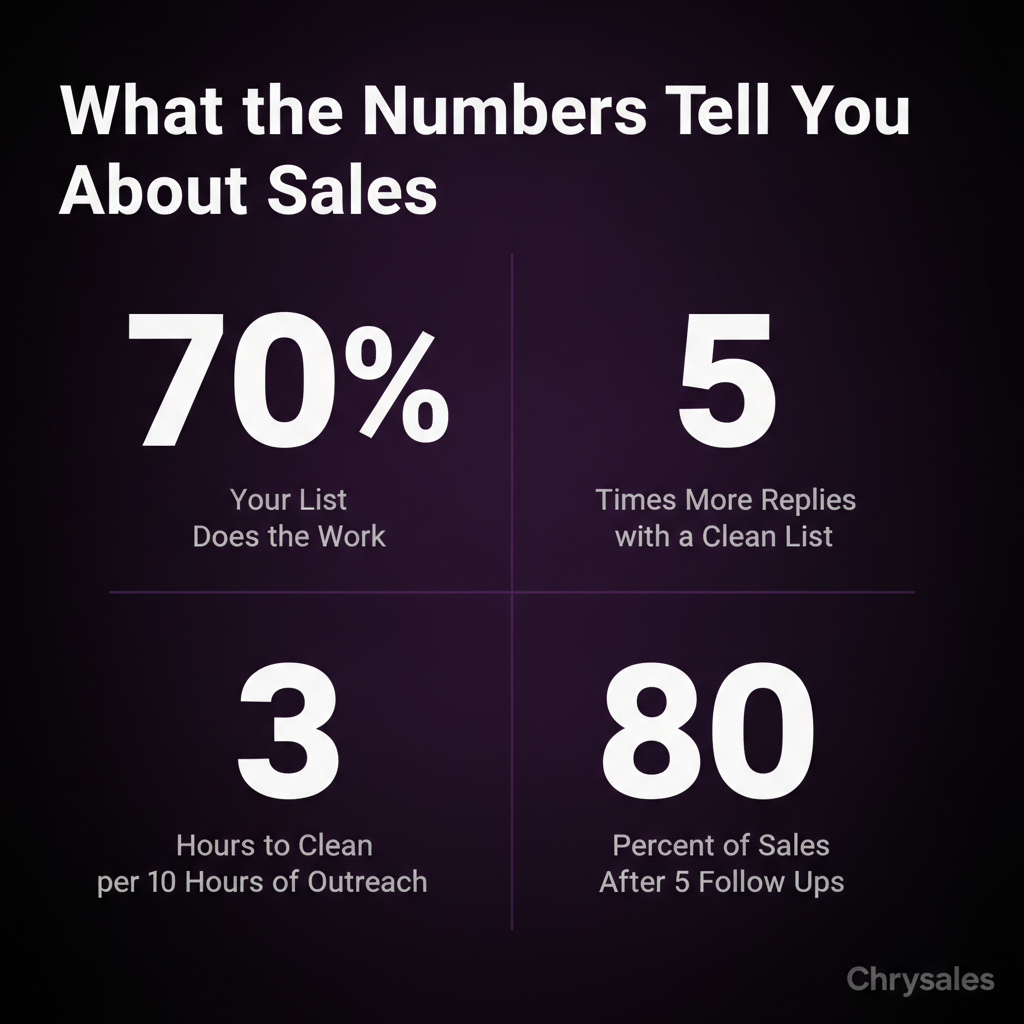
Most people think being good at sales means having great words. The reality? Your list does 70% of the work before you ever open your mouth. Think of your sales pipeline like a phone contact list. If half the numbers don't work, no message gets through. A bad list means you're pitching to people who can't buy, don't need what you're selling, or aren't even in the market. That's not a sales skill problem. That's a setup problem.
What Makes a List Actually Good
A good list has three things: the right companies, the right people, and the right timing. The right companies match your ideal customer profile. If you sell to tech companies with 50-200 employees, a 15-person consulting firm probably isn't the move. The right people are the ones who actually make buying decisions or influence them. Emailing a junior coordinator when you need to talk to the head of sales wastes everyone's time. The right timing is harder but matters just as much. A 200-person company that just did layoffs is not a "hot lead." It's a bad fit, full stop. Companies that just raised funding, hired for a specific role, or posted about a problem you solve? Those are worth your time.
Pro Tip: Score your leads before you reach out. Give points for company size, recent activity, tech stack, and hiring signals using proven B2B lead scoring models. Anything scoring above 70 goes to the top of your call list. Anything below 50 gets dropped or saved for later.
How to Build a List That Converts
Most B2B companies pull lists from LinkedIn, databases, or scraping tools. That's fine. The problem is they don't clean or verify the data. Email bounce rates kill your domain reputation. Calling disconnected numbers burns time. Here's a simple rule: if you're going to spend 10 hours on outreach, spend 3 of those hours cleaning your list first. Remove duplicates. Verify emails. Check LinkedIn profiles to confirm the person still works there. This sounds boring. It's also the difference between a 1% reply rate and a 5% reply rate.
A marketing agency we worked with had a 0.3% reply rate on cold emails. They thought their messaging was broken. We looked at the list. Half the contacts were outdated. Another 30% were the wrong seniority level. We rebuilt the list using proven methods for building targeted lead lists, kept the same email copy, and the reply rate jumped to 4.2%. Same words. Better list.
Master the Framework, Not the Script
Here's the thing nobody tells you: top salespeople don't memorize scripts. They memorize frameworks. A script is word-for-word. A framework is a structure you can adapt on the fly. Good salespeople know the flow of a call: opening, discovery, positioning, objection handling, close. They know what questions to ask and when to ask them. But they don't sound robotic because they're reacting to what the other person says, not reading from a doc.
The 5-Part Call Framework
Every solid B2B sales call follows the same basic structure, even if the words change:
- Opening (30 seconds): Introduce yourself, confirm you're not catching them at a bad time, set the agenda for the call.
- Discovery (10-15 minutes): Ask questions to understand their situation, pain points, and what they've tried before.
- Positioning (5-7 minutes): Explain how what you do solves the specific problems they just told you about.
- Objection handling (5-10 minutes): Address concerns, clarify misunderstandings, and remove blockers.
- Close (2-3 minutes): Propose next steps, confirm commitment, and lock in a follow-up.
This framework works whether you're selling software, consulting, or lead generation services, and you can see real examples of B2B sales call patterns that work. The questions change. The flow stays the same.
Watch out: Most people skip discovery and jump straight to pitching. That's why they lose deals. If you don't know the problem, you can't position the solution.
Practice the Framework Until It's Automatic
Being a good salesman means running this framework so many times that you don't have to think about it. You just know when to shift from discovery to positioning because you've done it 200 times. You recognize objections before the person finishes the sentence because you've heard them all before.
One consulting firm trained their team on this exact framework. No scripts. Just the five parts, with 10 sample questions for discovery and 5 common objections. After three weeks of practice calls, their close rate went from 18% to 31%. Same people. Same service. Better structure. You can watch how to progress through the 7 levels of sales from struggling to closing effortlessly to see this framework in action.
Ask Better Questions Than Your Competitors
Most salespeople ask surface-level questions. "What are your biggest challenges?" or "What's your revenue goal this year?" Those are fine. They're also what everyone else asks. Good salespeople dig three levels deeper. They ask questions that make the person stop and think. Questions that uncover the real problem, not just the symptom.
The Three Levels of Discovery Questions
Level 1 (Surface): "Are you currently doing any cold outreach?" This gets a yes or no. Not helpful.
Level 2 (Context): "What's working in your current outreach process, and where are you seeing drop-off?" This gets specifics. Better.
Level 3 (Impact): "If you could book 10 qualified calls a week instead of 2, what would that change for your business in the next six months?" This connects the problem to a bigger outcome. Now you're talking about what actually matters.
Most sales training stops at Level 2. The best salespeople live in Level 3. They don't just identify problems. They help the person see the cost of not fixing those problems.
Common mistake: Asking too many questions without giving value back. Discovery isn't an interrogation. After every 2-3 questions, share a quick insight or observation to keep the conversation balanced.
How to Build Your Question Bank
Start by writing down the 10 most common problems your clients have before they work with you. Then write three questions for each problem: one to confirm it exists, one to understand the impact, and one to explore what they've tried before. You don't need 100 questions. You need 10 really good ones that you can adapt based on the conversation. That's the difference between sounding like a checklist and sounding like someone who gets it.
Handle Objections Like a Doctor, Not a Debater
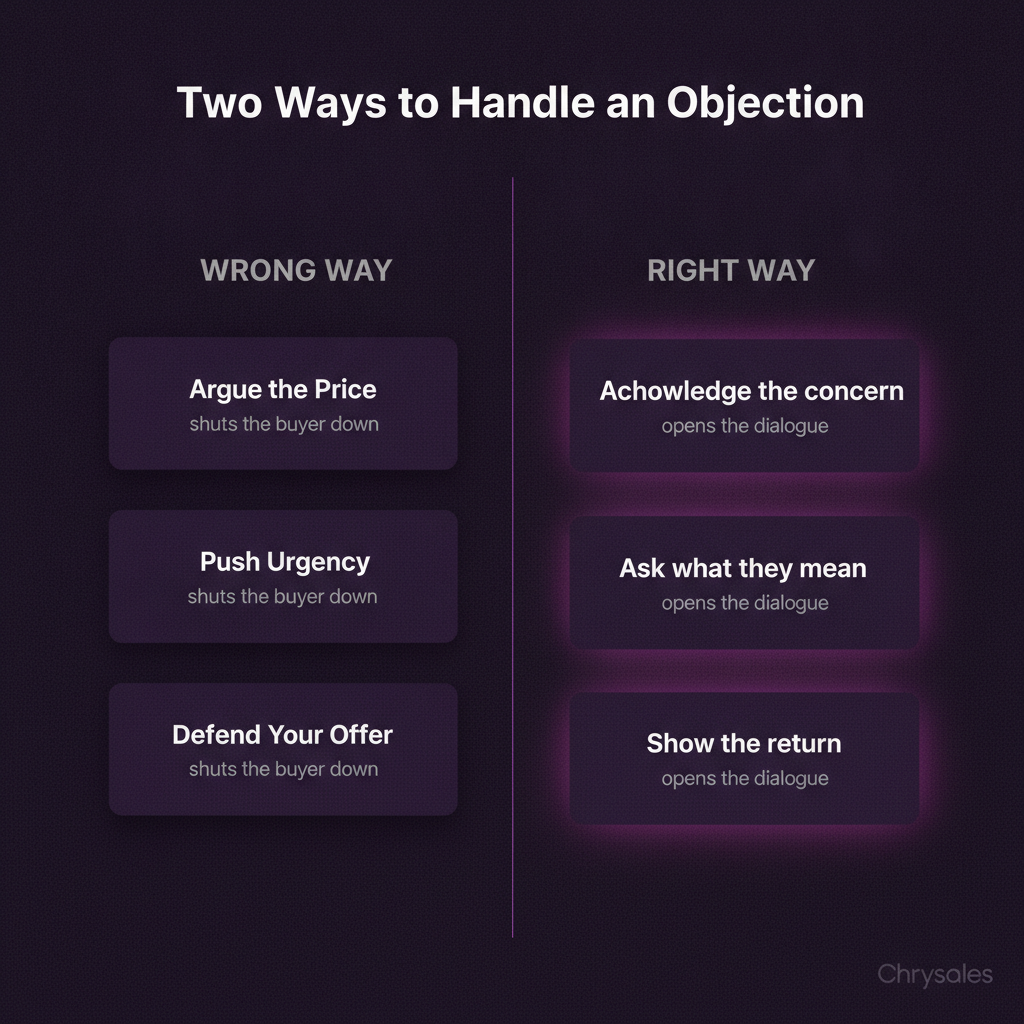
Here's where most people mess up. They hear an objection and immediately try to argue it away. That makes the person defensive. The sale is over before the close even starts. Good salespeople treat objections like symptoms. A doctor doesn't argue when you say your knee hurts. They ask follow-up questions to figure out what's actually wrong. Same thing here.
The 3-Step Objection Framework
When someone says "It's too expensive" or "We don't have time for this right now," don't jump to defending your price or pushing urgency. Do this instead:
- Acknowledge: "That makes sense. Budget is always a consideration."
- Clarify: "When you say it's too expensive, is it the total cost, or more about the timing of the investment?"
- Reframe: "Most of our clients felt the same way before they saw the ROI. Here's what typically happens in month one..."
This doesn't work every time. Nothing does. But it works way more often than saying "Actually, we're very affordable compared to competitors." That's defending. Not selling.
Pro Tip: Build a one-page objection guide with the top 5-7 objections you hear and a 3-sentence response for each using proven B2B objection handling techniques. Practice these out loud until they sound natural, not memorized.
Why Most Objections Aren't Really Objections
A lot of the time, "It's too expensive" actually means "I don't see enough value yet" or "I'm not the final decision maker and I don't know how to sell this internally." "We need to think about it" usually means "I'm not convinced this will work for us." The best way to handle objections is to prevent them in discovery. If you've asked good questions and positioned your solution clearly, most objections disappear before they come up. The ones that remain are usually real blockers, which is fine. Not every deal should close.
Follow Up Like You Mean It
Here's a stat most people don't know: 80% of sales happen after the fifth follow-up. Most salespeople give up after two. That's the gap. Being a good salesman isn't about being pushy. It's about being consistent. If someone showed interest, went quiet, and didn't say no, they're still in play. Life gets busy. Emails get buried. People forget. Your job is to stay on their radar without being annoying.
The Follow-Up Cadence That Works
After an initial call or email, follow up on these intervals:
- Day 3: Quick check-in referencing something specific from your last conversation
- Day 7: Share a relevant resource (case study, article, example)
- Day 14: Ask a new question or offer a different angle
- Day 30: Final check-in with a clear ask (book a call, review a proposal, etc.)
If you get no response after four touchpoints, move them to a "long-term nurture" list and check back in three months. Don't delete them. Just stop the active follow-up.
Watch out: Generic follow-ups like "Just checking in" or "Wanted to circle back" get ignored. Every follow-up needs a reason. Share something new, ask a question, or reference a recent event related to their business.
Automate the Reminders, Personalize the Messages
You don't need to remember every follow-up manually. Use a CRM or even a simple spreadsheet with reminders. The system tracks the timing. You write the message.
A small tech company we worked with used automated follow-up reminders in a simple CRM to track their outreach. No fancy AI. Just a note system that pinged them every few days with who to contact next. Their follow-up rate went from 40% to 95%, and their closed deals increased by 22% in one quarter. Same team. Same skills. Better system.
The One Thing That Doesn't Matter as Much as You Think
Most people obsess over charisma. They think being good at sales means being the loudest person in the room, cracking jokes, and making instant friends with everyone. That's not it. Some of the best salespeople we've trained are quiet, analytical, and not "natural people persons." What they are is prepared, systematic, and clear. Charisma helps in some situations. It's never the deciding factor. A clear offer, a clean process, and consistent follow-up beat charisma every time.
If you're relying on personality to close deals, you don't have a sales skill. You have a dependency on being "on" all the time. That doesn't work long-term, and it definitely doesn't let you hire and train other people to do what you do. The real skill is building a system where the process does most of the work. The list filters for the right people. The framework keeps the call on track. The follow-ups happen on time. The objection responses are ready to go. You're not winging it. You're running a system that works whether you're having a great day or a rough one.
You can learn how to build a sales system so powerful clients come to you, which removes the need to rely on charisma or mood to close deals consistently.
Frequently Asked Questions
Q: How long does it take to become a good salesman?
Most people see real improvement in 60 to 90 days if they're practicing daily. That means running live calls, not just reading about sales. You need reps. If you're doing 5 to 10 calls a week, expect three months to feel confident. If you're doing 20 calls a week, you'll get there faster. The timeline depends on volume and feedback. Working with a coach or using a proven framework cuts the learning curve in half.
Q: Do I need sales experience to be good at B2B sales?
No. Some of the best B2B salespeople we've seen came from teaching, customer support, or project management. What matters is being able to listen, follow a process, and stay consistent. Sales experience helps, but it's not required. A clear system and good training matter more than years on a resume. We've trained people with zero sales background who outperformed 10-year veterans within six months because they followed the framework and didn't bring bad habits.
Q: What's the biggest mistake new salespeople make?
Talking too much. New salespeople think they need to explain everything, cover every feature, and answer questions that haven't been asked yet. The biggest mistake is skipping discovery and jumping straight to pitching. If you don't know the problem, you can't position the solution. The second biggest mistake is giving up after one or two follow-ups. Most deals close after the fifth touchpoint, but most people stop at two.
Q: How do I know if my sales process is the problem or if I'm just bad at sales?
If your close rate is under 15% and you're talking to qualified leads, the problem is usually the process, not you. Look at where deals drop off. Is it during discovery? After the first call? During objection handling? If the drop-off happens at the same stage every time, that's a process issue. If it's random and all over the place, you probably need more practice with the framework. Track your calls for two weeks and look for patterns. That'll tell you what to fix.
Q: Can I be good at sales if I hate cold calling?
Yes. Cold calling is one channel, not the whole job. Plenty of great salespeople focus on warm outreach, referrals, inbound leads, or LinkedIn. That said, most B2B sales roles require some form of outreach. If you hate talking to strangers, work on your messaging and list quality first. A good list and a strong offer make cold outreach way less painful. If you still hate it after that, focus on roles where inbound lead generation handles the top of the funnel and you just close deals.
How to be a good salesman means using a clear system, asking the right questions, and following up well so you can turn interest into client acquisition. Picture this: a company spends six months searching for the "perfect" salesperson. They finally hire someone with 10 years of experience and a killer resume. Three months later, that person is barely hitting 50% of quota. Meanwhile, a different company hires someone brand new, gives them a clear system, and they're closing deals in week two.
Start with the List, Not the Pitch
Most people think being good at sales means having great words. The reality? Your list does 70% of the work before you ever open your mouth. Think of your sales pipeline like a phone contact list. If half the numbers don't work, no message gets through. A bad list means you're pitching to people who can't buy, don't need what you're selling, or aren't even in the market. That's not a sales skill problem. That's a setup problem.
What Makes a List Actually Good
A good list has three things: the right companies, the right people, and the right timing. The right companies match your ideal customer profile. If you sell to tech companies with 50-200 employees, a 15-person consulting firm probably isn't the move. The right people are the ones who actually make buying decisions or influence them. Emailing a junior coordinator when you need to talk to the head of sales wastes everyone's time. The right timing is harder but matters just as much. A 200-person company that just did layoffs is not a "hot lead." It's a bad fit, full stop. Companies that just raised funding, hired for a specific role, or posted about a problem you solve? Those are worth your time.
Pro Tip: Score your leads before you reach out. Give points for company size, recent activity, tech stack, and hiring signals using proven B2B lead scoring models. Anything scoring above 70 goes to the top of your call list. Anything below 50 gets dropped or saved for later.
How to Build a List That Converts
Most B2B companies pull lists from LinkedIn, databases, or scraping tools. That's fine. The problem is they don't clean or verify the data. Email bounce rates kill your domain reputation. Calling disconnected numbers burns time. Here's a simple rule: if you're going to spend 10 hours on outreach, spend 3 of those hours cleaning your list first. Remove duplicates. Verify emails. Check LinkedIn profiles to confirm the person still works there. This sounds boring. It's also the difference between a 1% reply rate and a 5% reply rate.
A marketing agency we worked with had a 0.3% reply rate on cold emails. They thought their messaging was broken. We looked at the list. Half the contacts were outdated. Another 30% were the wrong seniority level. We rebuilt the list using proven methods for building targeted lead lists, kept the same email copy, and the reply rate jumped to 4.2%. Same words. Better list.
Master the Framework, Not the Script
Here's the thing nobody tells you: top salespeople don't memorize scripts. They memorize frameworks. A script is word-for-word. A framework is a structure you can adapt on the fly. Good salespeople know the flow of a call: opening, discovery, positioning, objection handling, close. They know what questions to ask and when to ask them. But they don't sound robotic because they're reacting to what the other person says, not reading from a doc.
The 5-Part Call Framework
Every solid B2B sales call follows the same basic structure, even if the words change:
- Opening (30 seconds): Introduce yourself, confirm you're not catching them at a bad time, set the agenda for the call.
- Discovery (10-15 minutes): Ask questions to understand their situation, pain points, and what they've tried before.
- Positioning (5-7 minutes): Explain how what you do solves the specific problems they just told you about.
- Objection handling (5-10 minutes): Address concerns, clarify misunderstandings, and remove blockers.
- Close (2-3 minutes): Propose next steps, confirm commitment, and lock in a follow-up.
This framework works whether you're selling software, consulting, or lead generation services, and you can see real examples of B2B sales call patterns that work. The questions change. The flow stays the same.
Watch out: Most people skip discovery and jump straight to pitching. That's why they lose deals. If you don't know the problem, you can't position the solution.
Practice the Framework Until It's Automatic
Being a good salesman means running this framework so many times that you don't have to think about it. You just know when to shift from discovery to positioning because you've done it 200 times. You recognize objections before the person finishes the sentence because you've heard them all before.
One consulting firm trained their team on this exact framework. No scripts. Just the five parts, with 10 sample questions for discovery and 5 common objections. After three weeks of practice calls, their close rate went from 18% to 31%. Same people. Same service. Better structure. You can watch how to progress through the 7 levels of sales from struggling to closing effortlessly to see this framework in action.
Ask Better Questions Than Your Competitors
Most salespeople ask surface-level questions. "What are your biggest challenges?" or "What's your revenue goal this year?" Those are fine. They're also what everyone else asks. Good salespeople dig three levels deeper. They ask questions that make the person stop and think. Questions that uncover the real problem, not just the symptom.
The Three Levels of Discovery Questions
Level 1 (Surface): "Are you currently doing any cold outreach?" This gets a yes or no. Not helpful.
Level 2 (Context): "What's working in your current outreach process, and where are you seeing drop-off?" This gets specifics. Better.
Level 3 (Impact): "If you could book 10 qualified calls a week instead of 2, what would that change for your business in the next six months?" This connects the problem to a bigger outcome. Now you're talking about what actually matters.
Most sales training stops at Level 2. The best salespeople live in Level 3. They don't just identify problems. They help the person see the cost of not fixing those problems.
Common mistake: Asking too many questions without giving value back. Discovery isn't an interrogation. After every 2-3 questions, share a quick insight or observation to keep the conversation balanced.
How to Build Your Question Bank
Start by writing down the 10 most common problems your clients have before they work with you. Then write three questions for each problem: one to confirm it exists, one to understand the impact, and one to explore what they've tried before. You don't need 100 questions. You need 10 really good ones that you can adapt based on the conversation. That's the difference between sounding like a checklist and sounding like someone who gets it.
Handle Objections Like a Doctor, Not a Debater
Here's where most people mess up. They hear an objection and immediately try to argue it away. That makes the person defensive. The sale is over before the close even starts. Good salespeople treat objections like symptoms. A doctor doesn't argue when you say your knee hurts. They ask follow-up questions to figure out what's actually wrong. Same thing here.
The 3-Step Objection Framework
When someone says "It's too expensive" or "We don't have time for this right now," don't jump to defending your price or pushing urgency. Do this instead:
- Acknowledge: "That makes sense. Budget is always a consideration."
- Clarify: "When you say it's too expensive, is it the total cost, or more about the timing of the investment?"
- Reframe: "Most of our clients felt the same way before they saw the ROI. Here's what typically happens in month one..."
This doesn't work every time. Nothing does. But it works way more often than saying "Actually, we're very affordable compared to competitors." That's defending. Not selling.
Pro Tip: Build a one-page objection guide with the top 5-7 objections you hear and a 3-sentence response for each using proven B2B objection handling techniques. Practice these out loud until they sound natural, not memorized.
Why Most Objections Aren't Really Objections
A lot of the time, "It's too expensive" actually means "I don't see enough value yet" or "I'm not the final decision maker and I don't know how to sell this internally." "We need to think about it" usually means "I'm not convinced this will work for us." The best way to handle objections is to prevent them in discovery. If you've asked good questions and positioned your solution clearly, most objections disappear before they come up. The ones that remain are usually real blockers, which is fine. Not every deal should close.
Follow Up Like You Mean It
Here's a stat most people don't know: 80% of sales happen after the fifth follow-up. Most salespeople give up after two. That's the gap. Being a good salesman isn't about being pushy. It's about being consistent. If someone showed interest, went quiet, and didn't say no, they're still in play. Life gets busy. Emails get buried. People forget. Your job is to stay on their radar without being annoying.
The Follow-Up Cadence That Works
After an initial call or email, follow up on these intervals:
- Day 3: Quick check-in referencing something specific from your last conversation
- Day 7: Share a relevant resource (case study, article, example)
- Day 14: Ask a new question or offer a different angle
- Day 30: Final check-in with a clear ask (book a call, review a proposal, etc.)
If you get no response after four touchpoints, move them to a "long-term nurture" list and check back in three months. Don't delete them. Just stop the active follow-up.
Watch out: Generic follow-ups like "Just checking in" or "Wanted to circle back" get ignored. Every follow-up needs a reason. Share something new, ask a question, or reference a recent event related to their business.
Automate the Reminders, Personalize the Messages
You don't need to remember every follow-up manually. Use a CRM or even a simple spreadsheet with reminders. The system tracks the timing. You write the message.
A small tech company we worked with used automated follow-up reminders in a simple CRM to track their outreach. No fancy AI. Just a note system that pinged them every few days with who to contact next. Their follow-up rate went from 40% to 95%, and their closed deals increased by 22% in one quarter. Same team. Same skills. Better system.
The One Thing That Doesn't Matter as Much as You Think
Most people obsess over charisma. They think being good at sales means being the loudest person in the room, cracking jokes, and making instant friends with everyone. That's not it. Some of the best salespeople we've trained are quiet, analytical, and not "natural people persons." What they are is prepared, systematic, and clear. Charisma helps in some situations. It's never the deciding factor. A clear offer, a clean process, and consistent follow-up beat charisma every time.
If you're relying on personality to close deals, you don't have a sales skill. You have a dependency on being "on" all the time. That doesn't work long-term, and it definitely doesn't let you hire and train other people to do what you do. The real skill is building a system where the process does most of the work. The list filters for the right people. The framework keeps the call on track. The follow-ups happen on time. The objection responses are ready to go. You're not winging it. You're running a system that works whether you're having a great day or a rough one.
You can learn how to build a sales system so powerful clients come to you, which removes the need to rely on charisma or mood to close deals consistently.
Frequently Asked Questions
Q: How long does it take to become a good salesman?
Most people see real improvement in 60 to 90 days if they're practicing daily. That means running live calls, not just reading about sales. You need reps. If you're doing 5 to 10 calls a week, expect three months to feel confident. If you're doing 20 calls a week, you'll get there faster. The timeline depends on volume and feedback. Working with a coach or using a proven framework cuts the learning curve in half.
Q: Do I need sales experience to be good at B2B sales?
No. Some of the best B2B salespeople we've seen came from teaching, customer support, or project management. What matters is being able to listen, follow a process, and stay consistent. Sales experience helps, but it's not required. A clear system and good training matter more than years on a resume. We've trained people with zero sales background who outperformed 10-year veterans within six months because they followed the framework and didn't bring bad habits.
Q: What's the biggest mistake new salespeople make?
Talking too much. New salespeople think they need to explain everything, cover every feature, and answer questions that haven't been asked yet. The biggest mistake is skipping discovery and jumping straight to pitching. If you don't know the problem, you can't position the solution. The second biggest mistake is giving up after one or two follow-ups. Most deals close after the fifth touchpoint, but most people stop at two.
Q: How do I know if my sales process is the problem or if I'm just bad at sales?
If your close rate is under 15% and you're talking to qualified leads, the problem is usually the process, not you. Look at where deals drop off. Is it during discovery? After the first call? During objection handling? If the drop-off happens at the same stage every time, that's a process issue. If it's random and all over the place, you probably need more practice with the framework. Track your calls for two weeks and look for patterns. That'll tell you what to fix.
Q: Can I be good at sales if I hate cold calling?
Yes. Cold calling is one channel, not the whole job. Plenty of great salespeople focus on warm outreach, referrals, inbound leads, or LinkedIn. That said, most B2B sales roles require some form of outreach. If you hate talking to strangers, work on your messaging and list quality first. A good list and a strong offer make cold outreach way less painful. If you still hate it after that, focus on roles where inbound lead generation handles the top of the funnel and you just close deals.
Scaling Is Not Hard If You Have The Right Systems
If you’re serious about leveling up your scaling game, you need the right system, the right training, and the right team behind you. We're here to give you the exact tools and strategies top entrepreneurs use to dominate.

Discover the latest tips
View All.avif)
Chrysales was formed from the words "chrysalis" the stage where a caterpillar transforms into a butterfly and "sales".
It stands for one thing: sales transformation.Because scaling doesn’t happen by doing more of the same. Scaling only happens when you go through real transformation in your systems, your offer, team and the way you sell.
.avif)


