.avif)
High Income Skills That Create Repeatable B2B Revenue
A high income skill is a repeatable ability that helps you generate predictable revenue, build systems, and create results you can use again and again. Here's something most people get backwards: they think a high income skill is about landing one big client or closing one huge deal. That's nice, but it's not repeatable. The real high income skills are the ones you can use over and over to generate predictable results. We're talking about skills that let you build systems, not just get lucky once. If you can't repeat it, you can't scale it. And if you can't scale it, you're trading time for money forever.
Why Most High Income Skills Don't Actually Pay What You Think
The internet loves listicles about coding, design, or consulting paying six figures. Some of that's true. But here's what nobody mentions: most of those skills only pay well when you're working for someone else or hustling project to project. That's not a high income skill. That's a high-stress treadmill. A real high income skill does three things. It generates money predictably. It works across different businesses and industries. And it compounds over time because you get better at it the more you use it. Most skills people chase fail at least one of these tests.
The Difference Between a Skill and a System
Think of it this way: writing one great cold email is a skill. Building a cold outreach system that books 10 calls a week for the next two years is a different game entirely. One is a nice-to-have. The other is a business asset. When you're looking at what high income skill to learn, ask yourself if it helps you build something repeatable or just complete one-off tasks. The best skills let you create systems that run without you after a while.
The One High Income Skill That Beats Everything Else

Sales. Full stop. Not "sales" like working a car lot. Sales as in the ability to get another human to say yes to working with you or buying what you offer. Every other business skill depends on this one. You can be the best coder, the smartest consultant, or the most creative designer. If you can't close deals, you're hoping someone else will sell for you. That's a terrible position to be in.
Here's the thing: B2B sales is the most transferable high income skill because it works in every industry. A good closer can sell software, consulting, marketing services, or industrial equipment. The frameworks are the same. You learn prospect research, offer positioning, objection handling, and deal structure once. Then you apply it forever.
Why B2B Sales Outperforms Other High Income Skills
Most high income skills have a ceiling. A great copywriter might charge $5K per project. A developer might make $150K salary. Both are solid. But sales has no ceiling because you're directly tied to revenue. Close bigger deals, make more money. Build a sales system that works without you, and you've created an asset that prints money while you sleep.
We've trained over 1,000 business owners and 500+ sales teams. The pattern is always the same. The ones who learn to close deals and build repeatable systems grow faster than everyone else. The ones who outsource sales to "someone else" stay stuck.
Pro Tip: If you're learning sales, focus on B2B, not B2C. B2B deals are bigger, relationships last longer, and clients actually respond to logic and value instead of emotion and impulse.
Lead Generation: The High Income Skill Nobody Talks About Enough
Closing deals gets all the attention. But lead generation is where most businesses actually break. You can be the best closer in the world, but if your pipeline is empty or full of bad fits, you're still broke. Lead generation means finding people who actually need what you sell and getting in front of them. It's part research, part targeting, part outreach. And it's one of the most valuable high income skills because it's the top of the funnel for everything else.
The Two Parts of Lead Gen That Matter Most
First, building the right list. Most cold outreach fails because the list is terrible. Sending perfect emails to people who don't need your service is like texting your high school ex asking if they want to buy something. Awkward and ignored. A good list means targeting companies that match your ideal client profile. Right size, right industry, right timing. If you're selling to marketing agencies, a 200-person company that just did layoffs is not a hot lead. It's a bad fit.
Second, the outreach system. Once you have a good list, you need a repeatable way to contact them. Cold email, LinkedIn, calls, or a mix. The key is consistency and tracking. Most people send 20 emails, get no response, and quit. A real lead generation system means sending 500 emails, tracking open rates, testing subject lines, and improving every week.
Common mistake: Spending two weeks writing the perfect email template but only 20 minutes building your list. The list does most of the heavy lifting. Get that right first.
Client Acquisition Systems: Turning Skills Into Predictable Revenue
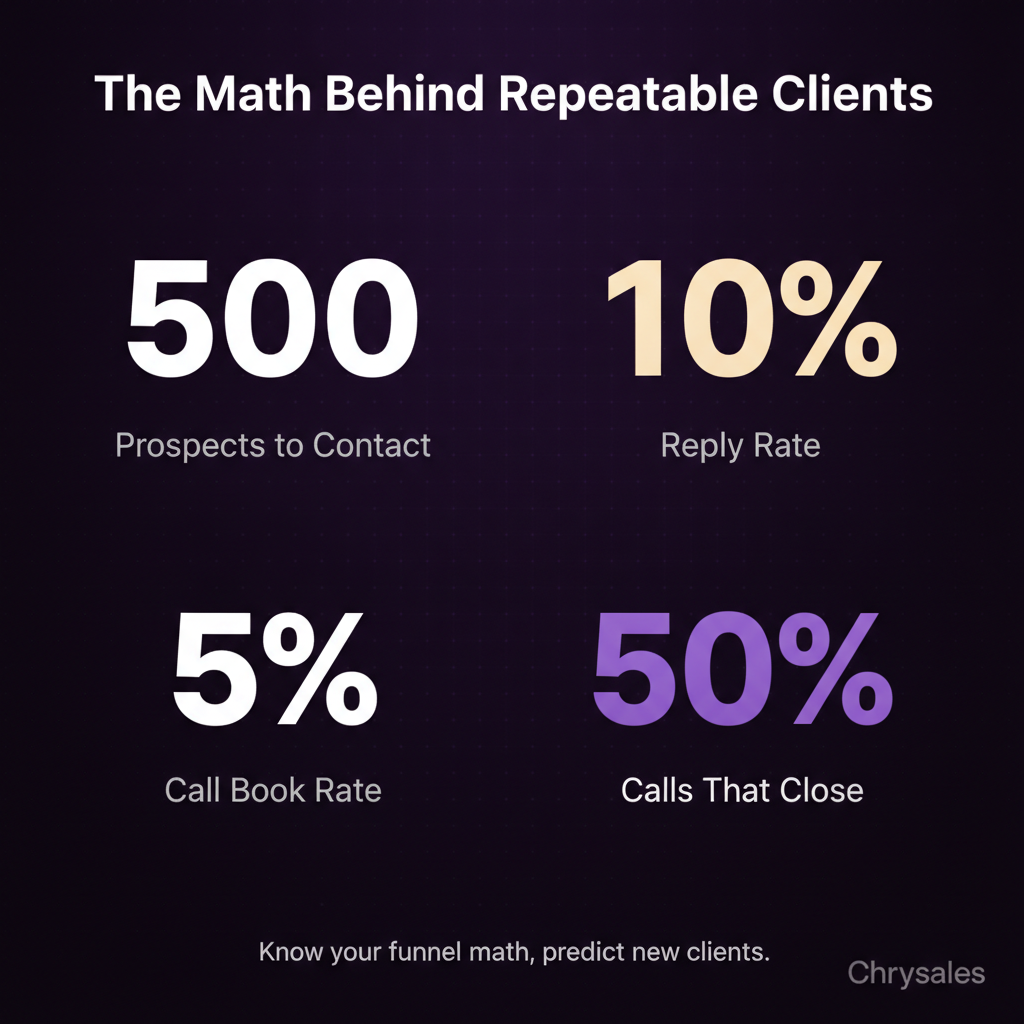
Here's where it all comes together. Client acquisition is the full system from cold outreach to signed contract. It's not just one skill. It's the combination of lead generation, sales calls, follow-ups, objection handling, and offer positioning all working together. Most businesses treat client acquisition like a random event. They post on LinkedIn and hope someone reaches out. They ask for referrals and pray. That's not a system. That's luck.
A real client acquisition system looks like this: You build a list of 500 targeted prospects. You send a cold outreach sequence. 10% reply. 5% book a call. 50% of those close. Now you have predictable math. If you need five new clients this month, you know exactly how many people to contact at the top of the funnel.
How to Build Your First Client Acquisition System in 30 Days
Start with one channel. Pick cold email or LinkedIn, not both. Build a list of 200 ideal prospects using tools like Apollo or LinkedIn Sales Navigator. Write a simple three-email sequence. Send 10 emails a day. Track replies and book rates in a basic spreadsheet. After 20 days, you'll have real data. Maybe your reply rate is 3%. Maybe it's 10%. Either way, now you know what to improve.
Bad reply rate usually means bad list or weak subject lines. Good reply rate but no bookings means your offer positioning is off. According to cold email reply rate benchmarks, successful campaigns typically see reply rates between 5% and 15% when targeting is precise. One marketing agency we worked with had a 0.5% reply rate on cold email. After rebuilding their list and changing their angle from "we do social media" to "we book sales calls for B2B companies using LinkedIn ads," their reply rate jumped to 4%. Same service, better positioning, way more leads.
Watch out: Don't try to automate everything on day one. Send emails manually for the first 100. You'll learn what works faster than if you set up a fancy tool and blast 1,000 bad emails. For more on creating effective outreach messages, check out our guide on how to write cold emails that get replies.
Sales Training: The Skill That Multiplies Everything Else
Learning to sell yourself is powerful. Teaching others to sell for you is where real scale happens. Sales training isn't just a nice-to-have for big companies. It's a high income skill because people will pay you a lot of money to teach their teams how to close deals. If you can take someone from zero sales experience to booking five calls a week and closing two, you've just created serious value. That's why sales coaching and consulting businesses exist. The ROI is immediate and measurable.
What Good Sales Training Actually Covers
Most sales training is trash. It's either motivational fluff with no real frameworks or overly complicated playbooks nobody uses. Good sales training teaches three things: how to research prospects before the call, how to structure the call so you're asking questions instead of pitching, and how to handle objections without sounding desperate.
Here's what that looks like in practice. Before the call, you spend 10 minutes researching the company. What do they sell? Who are their clients? What problems do they probably have? On the call, you ask discovery questions for the first 15 minutes. You're not pitching yet. You're listening. Then you position your offer as the solution to the specific problem they just told you about. When they object, you don't argue. You clarify, reframe, and ask what would need to be true for this to be a yes.
We've trained teams at companies like Amazon, Vodafone, and Cloudification. The pattern is always the same. The teams that follow a clear call structure close 30% to 50% more deals than the ones winging it.
Pro Tip: Record every sales call. Listen back once a week. You'll hear your own mistakes way faster than any coach can point them out.
Hiring and Scaling Sales Teams: The High Income Skill for Growth
Here's the truth: you can't scale a business by doing all the sales yourself forever. At some point, you need to hire setters and closers. Knowing how to hire, train, and manage a sales team is one of the most valuable high income skills because it's what separates a $500K business from a $5M business. But here's the trap. Hiring salespeople without a system is like giving someone car keys and saying "figure out how to drive." Most new sales hires fail not because they're bad at sales, but because the business didn't set them up to succeed.
The Right Way to Hire Your First Sales Rep
Before you hire anyone, build the system first. That means having a working lead list, a cold outreach process, a call script, objection handling docs, and a CRM to track everything. Your first sales hire should be stepping into a machine that already works. Their job is to run the machine, not build it from scratch. Learn more about how to build a sales system that actually scales before bringing on your first rep.
One tech company we worked with hired three salespeople in one month. Two quit within 60 days. The problem wasn't the hires. It was that there was no onboarding, no sales training, and no process. They were told "go get clients" with zero support. After we built a proper sales system and trained the next hire, that person closed six deals in their first 90 days.
When you're ready to hire, look for people who are coachable, consistent, and comfortable talking to strangers. You can teach scripts and frameworks. You can't teach work ethic or willingness to hear no 20 times before getting a yes.
Common mistake: Hiring a senior "sales leader" as your first hire. You don't need strategy. You need someone who will do 50 cold calls a day and not quit. Save the VP of Sales hire for when you're doing $2M+ a year.
AI and Sales Automation: The New High Income Skill for 2025
Most people still think AI in sales means chatbots and automated emails. That's the surface level. The real opportunity is using AI to score leads, write personalized outreach at scale, and automate follow-ups based on behavior. If you can build AI-powered sales workflows, you're suddenly 10 times more valuable than someone doing everything manually. We're talking about tools like Gemini-based lead scoring, AI that writes custom first lines for every email, and systems that trigger follow-ups when a prospect opens your email three times but doesn't reply.
How to Start Using AI in Your Sales Process This Week
You don't need to be a developer. Start simple. Use AI tools to research prospects faster. Feed ChatGPT or Claude a company name and ask it to summarize what they do, who their customers are, and what problems they likely face. That cuts research time from 10 minutes to 90 seconds per lead.
Next, use AI to write outreach templates. Give it your offer, your ideal client profile, and three examples of emails that worked. It'll generate 20 variations you can test. Some will flop. A few will crush. Research from Salesforce's 2024 sales AI statistics shows teams using AI tools for personalization see significant improvements in engagement rates.
The biggest opportunity is lead scoring. Feed AI your CRM data and let it score every lead based on fit, engagement, and timing. Anything scoring above 70 goes to the top of your call list. Anything under 40 gets a nurture sequence. This alone saves 10 hours a week for most sales teams. You can watch how AI sales automation drives record revenue to see these workflows in action.
Watch out: AI can write emails and score leads, but it can't close deals. Don't use it to replace human touch on calls. Use it to get to the call faster and more prepared. For a complete framework on integrating AI into your sales process, explore the only AI sales system you need in 2026.
Frequently Asked Questions
Q: What is the best high income skill to learn in 2025?
B2B sales and client acquisition systems. You can learn coding or design, but if you can't get clients, you're stuck working for someone else. Sales is the most transferable high income skill because it works in every industry and directly ties to revenue. Focus on learning cold outreach, sales call structure, and objection handling first.
Q: How long does it take to master a high income skill like sales?
You can learn the basics in 30 days if you're doing it every day. Book 20 sales calls in a month and you'll improve faster than someone who spends six months reading books. Real mastery takes 6 to 12 months of consistent practice. The key is repetition and feedback. Record your calls, track your numbers, and adjust what's not working every week.
Q: Can high income skills work for small businesses or just big companies?
High income skills like lead generation and sales systems work better for small businesses because you see results faster. A 15 person consulting firm can build a cold outreach system in two weeks and start booking calls immediately. Big companies move slower. The same skills apply, but small teams can test, fail, and improve way faster than enterprises.
Q: What's the difference between learning sales as a skill and building a sales system?
Learning sales as a skill means you personally get better at closing deals. Building a sales system means creating a repeatable process that works even when you're not the one doing the calls. The skill is personal. The system is a business asset. Both matter, but the system is what lets you scale past doing everything yourself. You can see how to build a sales system so powerful clients come to you for a step-by-step walkthrough.
Q: How do I know if I should focus on lead generation or closing deals first?
If your pipeline is empty, focus on lead generation first. You can't close deals if you have nobody to talk to. If you're getting calls but not closing them, work on your sales call structure and objection handling. Most businesses need both, but start with whichever is the bigger bottleneck right now. Fix the top of the funnel before worrying about the close rate. Our resource on how to build sales pipeline walks through identifying and fixing your biggest constraint.
A high income skill is a repeatable ability that helps you generate predictable revenue, build systems, and create results you can use again and again. Here's something most people get backwards: they think a high income skill is about landing one big client or closing one huge deal. That's nice, but it's not repeatable. The real high income skills are the ones you can use over and over to generate predictable results. We're talking about skills that let you build systems, not just get lucky once. If you can't repeat it, you can't scale it. And if you can't scale it, you're trading time for money forever.
Why Most High Income Skills Don't Actually Pay What You Think
The internet loves listicles about coding, design, or consulting paying six figures. Some of that's true. But here's what nobody mentions: most of those skills only pay well when you're working for someone else or hustling project to project. That's not a high income skill. That's a high-stress treadmill. A real high income skill does three things. It generates money predictably. It works across different businesses and industries. And it compounds over time because you get better at it the more you use it. Most skills people chase fail at least one of these tests.
The Difference Between a Skill and a System
Think of it this way: writing one great cold email is a skill. Building a cold outreach system that books 10 calls a week for the next two years is a different game entirely. One is a nice-to-have. The other is a business asset. When you're looking at what high income skill to learn, ask yourself if it helps you build something repeatable or just complete one-off tasks. The best skills let you create systems that run without you after a while.
The One High Income Skill That Beats Everything Else
Sales. Full stop. Not "sales" like working a car lot. Sales as in the ability to get another human to say yes to working with you or buying what you offer. Every other business skill depends on this one. You can be the best coder, the smartest consultant, or the most creative designer. If you can't close deals, you're hoping someone else will sell for you. That's a terrible position to be in.
Here's the thing: B2B sales is the most transferable high income skill because it works in every industry. A good closer can sell software, consulting, marketing services, or industrial equipment. The frameworks are the same. You learn prospect research, offer positioning, objection handling, and deal structure once. Then you apply it forever.
Why B2B Sales Outperforms Other High Income Skills
Most high income skills have a ceiling. A great copywriter might charge $5K per project. A developer might make $150K salary. Both are solid. But sales has no ceiling because you're directly tied to revenue. Close bigger deals, make more money. Build a sales system that works without you, and you've created an asset that prints money while you sleep.
We've trained over 1,000 business owners and 500+ sales teams. The pattern is always the same. The ones who learn to close deals and build repeatable systems grow faster than everyone else. The ones who outsource sales to "someone else" stay stuck.
Pro Tip: If you're learning sales, focus on B2B, not B2C. B2B deals are bigger, relationships last longer, and clients actually respond to logic and value instead of emotion and impulse.
Lead Generation: The High Income Skill Nobody Talks About Enough
Closing deals gets all the attention. But lead generation is where most businesses actually break. You can be the best closer in the world, but if your pipeline is empty or full of bad fits, you're still broke. Lead generation means finding people who actually need what you sell and getting in front of them. It's part research, part targeting, part outreach. And it's one of the most valuable high income skills because it's the top of the funnel for everything else.
The Two Parts of Lead Gen That Matter Most
First, building the right list. Most cold outreach fails because the list is terrible. Sending perfect emails to people who don't need your service is like texting your high school ex asking if they want to buy something. Awkward and ignored. A good list means targeting companies that match your ideal client profile. Right size, right industry, right timing. If you're selling to marketing agencies, a 200-person company that just did layoffs is not a hot lead. It's a bad fit.
Second, the outreach system. Once you have a good list, you need a repeatable way to contact them. Cold email, LinkedIn, calls, or a mix. The key is consistency and tracking. Most people send 20 emails, get no response, and quit. A real lead generation system means sending 500 emails, tracking open rates, testing subject lines, and improving every week.
Common mistake: Spending two weeks writing the perfect email template but only 20 minutes building your list. The list does most of the heavy lifting. Get that right first.
Client Acquisition Systems: Turning Skills Into Predictable Revenue
Here's where it all comes together. Client acquisition is the full system from cold outreach to signed contract. It's not just one skill. It's the combination of lead generation, sales calls, follow-ups, objection handling, and offer positioning all working together. Most businesses treat client acquisition like a random event. They post on LinkedIn and hope someone reaches out. They ask for referrals and pray. That's not a system. That's luck.
A real client acquisition system looks like this: You build a list of 500 targeted prospects. You send a cold outreach sequence. 10% reply. 5% book a call. 50% of those close. Now you have predictable math. If you need five new clients this month, you know exactly how many people to contact at the top of the funnel.
How to Build Your First Client Acquisition System in 30 Days
Start with one channel. Pick cold email or LinkedIn, not both. Build a list of 200 ideal prospects using tools like Apollo or LinkedIn Sales Navigator. Write a simple three-email sequence. Send 10 emails a day. Track replies and book rates in a basic spreadsheet. After 20 days, you'll have real data. Maybe your reply rate is 3%. Maybe it's 10%. Either way, now you know what to improve.
Bad reply rate usually means bad list or weak subject lines. Good reply rate but no bookings means your offer positioning is off. According to cold email reply rate benchmarks, successful campaigns typically see reply rates between 5% and 15% when targeting is precise. One marketing agency we worked with had a 0.5% reply rate on cold email. After rebuilding their list and changing their angle from "we do social media" to "we book sales calls for B2B companies using LinkedIn ads," their reply rate jumped to 4%. Same service, better positioning, way more leads.
Watch out: Don't try to automate everything on day one. Send emails manually for the first 100. You'll learn what works faster than if you set up a fancy tool and blast 1,000 bad emails. For more on creating effective outreach messages, check out our guide on how to write cold emails that get replies.
Sales Training: The Skill That Multiplies Everything Else
Learning to sell yourself is powerful. Teaching others to sell for you is where real scale happens. Sales training isn't just a nice-to-have for big companies. It's a high income skill because people will pay you a lot of money to teach their teams how to close deals. If you can take someone from zero sales experience to booking five calls a week and closing two, you've just created serious value. That's why sales coaching and consulting businesses exist. The ROI is immediate and measurable.
What Good Sales Training Actually Covers
Most sales training is trash. It's either motivational fluff with no real frameworks or overly complicated playbooks nobody uses. Good sales training teaches three things: how to research prospects before the call, how to structure the call so you're asking questions instead of pitching, and how to handle objections without sounding desperate.
Here's what that looks like in practice. Before the call, you spend 10 minutes researching the company. What do they sell? Who are their clients? What problems do they probably have? On the call, you ask discovery questions for the first 15 minutes. You're not pitching yet. You're listening. Then you position your offer as the solution to the specific problem they just told you about. When they object, you don't argue. You clarify, reframe, and ask what would need to be true for this to be a yes.
We've trained teams at companies like Amazon, Vodafone, and Cloudification. The pattern is always the same. The teams that follow a clear call structure close 30% to 50% more deals than the ones winging it.
Pro Tip: Record every sales call. Listen back once a week. You'll hear your own mistakes way faster than any coach can point them out.
Hiring and Scaling Sales Teams: The High Income Skill for Growth
Here's the truth: you can't scale a business by doing all the sales yourself forever. At some point, you need to hire setters and closers. Knowing how to hire, train, and manage a sales team is one of the most valuable high income skills because it's what separates a $500K business from a $5M business. But here's the trap. Hiring salespeople without a system is like giving someone car keys and saying "figure out how to drive." Most new sales hires fail not because they're bad at sales, but because the business didn't set them up to succeed.
The Right Way to Hire Your First Sales Rep
Before you hire anyone, build the system first. That means having a working lead list, a cold outreach process, a call script, objection handling docs, and a CRM to track everything. Your first sales hire should be stepping into a machine that already works. Their job is to run the machine, not build it from scratch. Learn more about how to build a sales system that actually scales before bringing on your first rep.
One tech company we worked with hired three salespeople in one month. Two quit within 60 days. The problem wasn't the hires. It was that there was no onboarding, no sales training, and no process. They were told "go get clients" with zero support. After we built a proper sales system and trained the next hire, that person closed six deals in their first 90 days.
When you're ready to hire, look for people who are coachable, consistent, and comfortable talking to strangers. You can teach scripts and frameworks. You can't teach work ethic or willingness to hear no 20 times before getting a yes.
Common mistake: Hiring a senior "sales leader" as your first hire. You don't need strategy. You need someone who will do 50 cold calls a day and not quit. Save the VP of Sales hire for when you're doing $2M+ a year.
AI and Sales Automation: The New High Income Skill for 2025
Most people still think AI in sales means chatbots and automated emails. That's the surface level. The real opportunity is using AI to score leads, write personalized outreach at scale, and automate follow-ups based on behavior. If you can build AI-powered sales workflows, you're suddenly 10 times more valuable than someone doing everything manually. We're talking about tools like Gemini-based lead scoring, AI that writes custom first lines for every email, and systems that trigger follow-ups when a prospect opens your email three times but doesn't reply.
How to Start Using AI in Your Sales Process This Week
You don't need to be a developer. Start simple. Use AI tools to research prospects faster. Feed ChatGPT or Claude a company name and ask it to summarize what they do, who their customers are, and what problems they likely face. That cuts research time from 10 minutes to 90 seconds per lead.
Next, use AI to write outreach templates. Give it your offer, your ideal client profile, and three examples of emails that worked. It'll generate 20 variations you can test. Some will flop. A few will crush. Research from Salesforce's 2024 sales AI statistics shows teams using AI tools for personalization see significant improvements in engagement rates.
The biggest opportunity is lead scoring. Feed AI your CRM data and let it score every lead based on fit, engagement, and timing. Anything scoring above 70 goes to the top of your call list. Anything under 40 gets a nurture sequence. This alone saves 10 hours a week for most sales teams. You can watch how AI sales automation drives record revenue to see these workflows in action.
Watch out: AI can write emails and score leads, but it can't close deals. Don't use it to replace human touch on calls. Use it to get to the call faster and more prepared. For a complete framework on integrating AI into your sales process, explore the only AI sales system you need in 2026.
Frequently Asked Questions
Q: What is the best high income skill to learn in 2025?
B2B sales and client acquisition systems. You can learn coding or design, but if you can't get clients, you're stuck working for someone else. Sales is the most transferable high income skill because it works in every industry and directly ties to revenue. Focus on learning cold outreach, sales call structure, and objection handling first.
Q: How long does it take to master a high income skill like sales?
You can learn the basics in 30 days if you're doing it every day. Book 20 sales calls in a month and you'll improve faster than someone who spends six months reading books. Real mastery takes 6 to 12 months of consistent practice. The key is repetition and feedback. Record your calls, track your numbers, and adjust what's not working every week.
Q: Can high income skills work for small businesses or just big companies?
High income skills like lead generation and sales systems work better for small businesses because you see results faster. A 15 person consulting firm can build a cold outreach system in two weeks and start booking calls immediately. Big companies move slower. The same skills apply, but small teams can test, fail, and improve way faster than enterprises.
Q: What's the difference between learning sales as a skill and building a sales system?
Learning sales as a skill means you personally get better at closing deals. Building a sales system means creating a repeatable process that works even when you're not the one doing the calls. The skill is personal. The system is a business asset. Both matter, but the system is what lets you scale past doing everything yourself. You can see how to build a sales system so powerful clients come to you for a step-by-step walkthrough.
Q: How do I know if I should focus on lead generation or closing deals first?
If your pipeline is empty, focus on lead generation first. You can't close deals if you have nobody to talk to. If you're getting calls but not closing them, work on your sales call structure and objection handling. Most businesses need both, but start with whichever is the bigger bottleneck right now. Fix the top of the funnel before worrying about the close rate. Our resource on how to build sales pipeline walks through identifying and fixing your biggest constraint.
Scaling Is Not Hard If You Have The Right Systems
If you’re serious about leveling up your scaling game, you need the right system, the right training, and the right team behind you. We're here to give you the exact tools and strategies top entrepreneurs use to dominate.

Discover the latest tips
View All.avif)
Chrysales was formed from the words "chrysalis" the stage where a caterpillar transforms into a butterfly and "sales".
It stands for one thing: sales transformation.Because scaling doesn’t happen by doing more of the same. Scaling only happens when you go through real transformation in your systems, your offer, team and the way you sell.
.avif)


