.avif)
What Does GTM Ops Mean for B2B Growth?

The gtm ops meaning is the system that connects sales, marketing, and customer success so they work from the same playbook and use the same data. Picture this: your sales team books meetings your marketing team says aren't qualified. Your customer success team has no idea what promises were made during the sale. Everyone blames everyone else when deals fall through. That's what happens when you don't have GTM ops.
GTM operations, or go to market operations, is the system that connects your sales, marketing, and customer success teams so they work from the same playbook, chase the same goals, and use the same data. It's not another buzzword. It's the infrastructure that turns chaotic growth attempts into predictable revenue.
What GTM Ops Actually Means (And Why It Matters Now)
GTM ops is the operational backbone of your entire go to market strategy. Think of it as the air traffic control system for your revenue teams. Without it, everyone's flying blind, guessing at what the other teams are doing.
The term "GTM operations" gets thrown around a lot, but here's what it actually covers: pipeline management, revenue forecasting, tech stack setup, sales process design, lead routing, data infrastructure, and cross functional alignment. It sits between strategy and execution. Strategy says "we're going after enterprise clients in fintech." GTM ops builds the actual systems that make that happen.
Why Teams Need GTM Operations
Most B2B companies start with founder led sales. One person knows everything. When you're small, that works. But the moment you add a second salesperson, a marketing person, or a customer success manager, things get messy fast.
Here's what breaks without GTM ops:
- Sales reps waste time on leads that were never qualified by marketing
- Marketing has no clue which campaigns actually close deals
- Customer success doesn't know what was promised during the sale
- Nobody agrees on what counts as a "qualified lead"
- Your CRM is a mess of duplicate records and missing data
- Forecasting is guesswork based on gut feelings
Watch out: Most teams think they can skip GTM ops until they hit 20 or 30 people. By then, bad habits are baked in and harder to fix. If you want to understand how founder-led sales becomes a growth bottleneck once you try to scale, you need to build operational infrastructure early.
GTM Operations vs Revenue Operations
People confuse these two all the time. They overlap, but they're not the same thing.
Revenue operations (RevOps) focuses internally on making your existing processes more efficient. It's about cleaning data, improving conversion rates between pipeline stages, and making sure your tools talk to each other.
GTM operations is more external. It's about how you enter markets, position your offer, generate pipeline, and coordinate teams around a go to market strategy. GTM ops asks "how do we win new clients?" RevOps asks "how do we run our revenue engine better?"
A 50 person tech company might have one person doing both. Larger companies split the roles. Either way, GTM ops is the function that makes sure your sales process optimization actually connects to real market motion.
The Core Functions of Go to Market Operations

GTM ops isn't one job. It's a collection of functions that keep your revenue machine running. Let's break down what actually happens day to day.
Pipeline Management and Forecasting
This is about knowing what's coming. How many deals are in your pipeline? Which stage are they in? What's the close rate at each stage? When will revenue actually hit your bank account?
Without clean pipeline management, your forecast is fiction. We've seen companies predict €100K months that turn into €30K because nobody tracked deal slippage or stage conversion rates.
Good GTM ops sets up:
- Clear pipeline stages everyone agrees on
- Entry and exit criteria for each stage
- Weekly pipeline reviews with real data
- Deal scoring based on fit and engagement
- Slippage tracking so you know which deals are stalling
Pro Tip: Set up a simple weekly dashboard that shows pipeline value, stage distribution, and average deal size. Five minutes of review every Monday prevents nasty surprises at month end. For practical tactics on how to build sales pipeline that feeds your revenue teams consistently, focus on pipeline hygiene from day one.
Tech Stack Management and Integration
Your sales team uses a CRM. Marketing uses an automation platform. Customer success has their own tool. If these don't talk to each other, you're running three separate businesses.
GTM operations owns the tech stack setup. That means picking tools, connecting them, and making sure data flows between them. A lead comes in from a marketing campaign, gets scored, routed to the right sales rep, tracked through the deal cycle, and handed off to customer success when it closes. All automatically.
Most tech stacks are bloated with tools nobody uses. GTM ops cuts the waste and builds what actually drives B2B sales.
Lead Routing and Territory Planning
Who gets which leads? Sounds simple. It's not.
A marketing agency gets 50 inbound leads a week. If you just round robin them to your sales team, you're wasting opportunities. Some leads are enterprise deals that need your best closer. Some are small companies that fit a junior rep. Some aren't even in your target market.
GTM operations builds the routing logic:
- Lead scoring based on company size, industry, engagement
- Territory assignment by geography, vertical, or deal size
- Rules for when a lead goes to sales vs customer success
- Escalation paths for high value opportunities
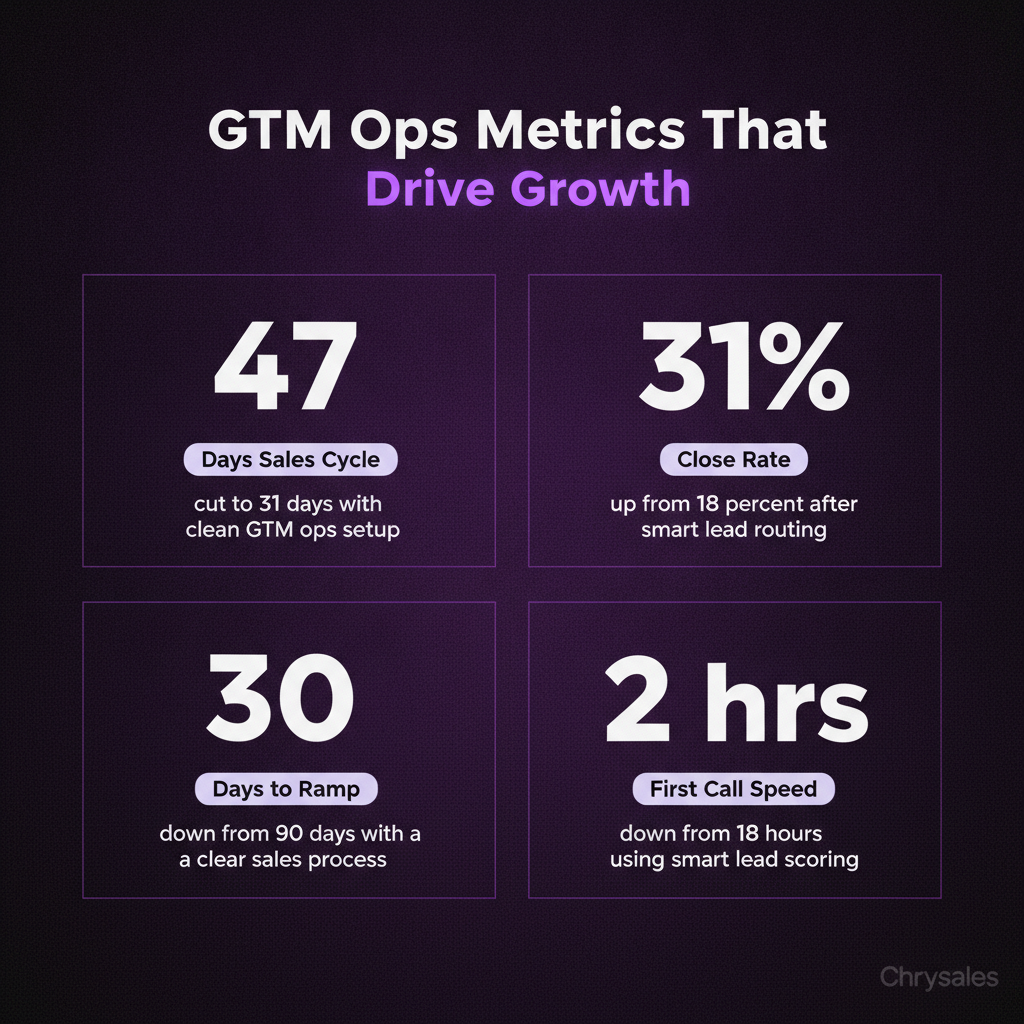
One consulting firm we worked with had zero routing logic. Their best closer was getting the same number of junk leads as everyone else. After setting up proper lead scoring and routing, their close rate jumped from 18% to 31% in two months.
Building a GTM Operations System for B2B Lead Generation
Let's get tactical. If you're building GTM ops from scratch, here's what to focus on first.
Step 1: Define Your Ideal Customer Profile Together
This sounds basic, but most teams skip it. Sales thinks the ideal customer is anyone with a budget. Marketing thinks it's companies that match demographic filters. Customer success knows which clients actually stick around and grow.
Lock everyone in a room (real or virtual) and answer these questions:
- What size companies do we close fastest?
- Which industries have the highest LTV?
- What problems do our best clients have before they buy?
- Who's the actual decision maker?
- What disqualifies a lead immediately?
Write it down. Make it specific. "B2B companies" is not an ICP. "50 to 200 person IT consulting firms in DACH region with no formal sales process" is an ICP.
Common mistake: Building an ICP based on who you wish you could sell to instead of who actually buys. Look at your last 20 closed deals. What do they have in common? Start there.
Step 2: Map Your Buyer Journey and Handoff Points
Your buyer doesn't care about your org chart. They care about their experience. Map out what that journey looks like from their perspective:
- They have a problem
- They research solutions
- They find your content or outreach
- They book a call
- They evaluate your offer
- They decide to buy
- They onboard and start using your service
Now map what happens on your side at each stage. Who owns each step? What data gets captured? Where do handoffs happen between marketing, sales, and customer success?
Every handoff is a place where things break. A lead fills out a form but nobody calls them. A deal closes but customer success doesn't know what was promised. GTM ops makes handoffs smooth.
Step 3: Build Your Sales Process and Sales Enablement System
A repeatable sales process is the core of GTM operations. Without it, every sales rep does their own thing and results are random.
Your sales process should cover:
- How you qualify leads (discovery questions to ask)
- Your call structure (intro, discovery, pitch, close)
- Objection handling scripts for common pushbacks
- Proposal and pricing frameworks
- Follow up cadences for deals in each stage
This is where sales training comes in. You can't just hire salespeople and hope they figure it out. Build the system, train them on it, and give them the tools to execute.
We train sales teams to use a 4 part discovery framework: current state, desired state, gap, and cost of inaction. Sounds simple. Most reps skip at least two parts and wonder why their close rate is 10%.
Step 4: Set Up Data Infrastructure and Reporting
You can't improve what you don't measure. GTM operations sets up the dashboards and reports that tell you what's actually happening.
Track these metrics at minimum:
- Lead volume by source
- Lead to opportunity conversion rate
- Opportunity to close rate
- Average deal size
- Sales cycle length
- Pipeline velocity (how fast deals move through stages)
- CAC (customer acquisition cost)
- Win rate by rep, by source, by vertical
Set up weekly reviews where the whole revenue team looks at these numbers together. When pipeline velocity drops or conversion rates fall, you catch it fast and fix it.
A 30 person consulting firm we worked with had zero visibility into their pipeline. They were flying blind every month. After setting up basic GTM ops reporting, they cut their sales cycle from 47 days to 31 days just by identifying where deals were stalling.
How GTM Operations Improves Client Acquisition
GTM ops isn't just internal cleanup. It directly impacts how many clients you win and how fast you close them.
Better Lead Quality Through Smarter Scoring
Not all leads are equal. A 200 person company that just did layoffs is not a hot lead. It's a bad fit, full stop.
Lead scoring is how you prioritize. Assign points based on:
- Company size and revenue
- Industry and vertical fit
- Job title of the contact
- Engagement level (email opens, content downloads, site visits)
- Intent signals (pricing page visits, demo requests)
Set a simple rule: anything scoring above 70 goes to the top of your call list. Everything below 50 goes into a nurture campaign. Your sales team stops wasting time on junk leads and focuses on real opportunities.
Pro Tip: Review your scoring model every quarter. What worked six months ago might not work now. If high scoring leads aren't converting, adjust the weights.
Faster Sales Cycles Through Process Optimization
Every extra day in your sales cycle costs money. The longer a deal sits, the more likely it is to die.
GTM operations shortens sales cycles by removing friction:
- Automated follow ups so no lead falls through the cracks
- Pre built proposal templates so you're not starting from scratch every time
- Clear stage criteria so deals don't sit in limbo
- Escalation paths for stalled deals
- Call scripts and discovery frameworks so every rep hits the key points
One marketing agency cut their sales cycle from 35 days to 22 days just by cleaning up their pipeline stages and automating follow ups. Same team, same offer. Better system.
Higher Win Rates Through Alignment
When sales, marketing, and customer success are aligned, win rates go up. Here's why:
Marketing generates leads that actually fit your ICP because they know what sales can close. Sales reps have better conversations because marketing warmed up the lead with relevant content. Customer success knows what was promised so onboarding is smooth, which leads to happier clients and more referrals.
It's a flywheel. GTM operations builds the infrastructure that keeps it spinning. If you want to see how to build a sales system so powerful clients come to you, watch how GTM operations translates into a repeatable sales engine that compounds over time.
Integrating Sales Automation and AI into GTM Operations
Automation and AI aren't optional anymore. They're table stakes for B2B sales systems that scale.
Where Automation Fits in Your GTM Strategy
Automation handles the repetitive stuff so your team can focus on high value activities. Here's what to automate first:
- Lead enrichment (pulling company data, contact info, social profiles)
- Lead scoring and routing
- Follow up sequences for leads not ready to buy
- Meeting booking and calendar coordination
- Data entry into your CRM
- Weekly pipeline reports
Most teams build a 40 step workflow when 12 steps would do the job. Start simple. Automate the biggest time wasters first.
AI for Lead Scoring and Pipeline Prediction
AI takes your GTM operations to the next level. Instead of rule based scoring (company size + industry + engagement), AI looks at hundreds of signals and predicts which leads are most likely to close.
We use Gemini based workflows to:
- Score leads based on historical win patterns
- Flag deals at risk of slipping
- Suggest next steps for stalled opportunities
- Identify cross sell and upsell opportunities in your customer base
A 60 person tech company we worked with used AI lead scoring and cut their time to first call from 18 hours to 2 hours. They prioritized better and closed faster.
Watch out: AI is only as good as your data. If your CRM is a mess, AI will give you garbage predictions. Clean your data first, then add AI.
Automating Sales Enablement and Training
Sales enablement is part of GTM ops. Your reps need training, call scripts, battlecards, and objection handling guides.
Automate the delivery:
- New hire onboarding sequences with video training and quizzes
- Weekly tip emails with best practices and win stories
- Real time battlecards that pop up in your CRM during calls
- Call recording analysis that flags coaching opportunities
This scales your sales training without adding headcount. One sales leader can coach 10 reps as effectively as 3 because the system does the heavy lifting.
Scaling Your Sales Team with GTM Operations in Place
Hiring salespeople without GTM ops is like giving someone car keys and saying "figure out how to drive." It doesn't work.
Hiring and Onboarding with a System
When you have GTM operations built, hiring gets easier. You're not looking for a magical unicorn who can figure everything out. You're looking for someone who can execute a proven system.
Your hiring process should test for:
- Ability to follow a sales process (not freelance their way through calls)
- Coachability (can they take feedback and improve?)
- Work ethic (sales is a grind, not a shortcut)
- Culture fit with your team
Once you hire, onboarding is plug and play. Here's the new call script. Here's the discovery framework. Here's the objection handling guide. Here are the five most common deals we close. Now practice.
A strong GTM operations system cuts ramp time from 90 days to 30 days because new reps aren't reinventing the wheel.
Building a Sales Infrastructure That Grows with You
Predictable revenue comes from systems, not heroes. Your best sales rep might close 30% more deals than average. Great. But you can't clone them.
GTM operations builds the infrastructure that makes average reps good and good reps great:
- Call recording libraries with examples of great discovery calls
- Deal review processes where the team learns from wins and losses
- Compensation structures that reward the right behaviors
- Performance dashboards so reps know where they stand
- Regular training and coaching built into the calendar
We've trained over 500 sales teams. The ones that scale fastest treat sales like a system, not a personality contest. When you treat GTM operations as the infrastructure of your revenue engine, you're really talking about how to build a sales system that actually scales across multiple reps and teams.
When to Hire a GTM Ops Leader
If you're under 10 people, the founder or sales leader usually handles GTM ops part time. Once you hit 15 to 20 people, it's time to hire someone dedicated.
A GTM operations leader owns:
- CRM setup and data hygiene
- Sales process documentation and improvement
- Tool selection and integration
- Metrics and reporting
- Sales training and enablement
- Lead routing and territory planning
This isn't a junior role. You need someone who understands B2B sales, knows tech, and can work across teams. If you don't yet have someone owning GTM ops, you effectively need a GTM engineer for your B2B sales system who can connect strategy, tools, and day-to-day workflows. Expect to pay well for the right person. They'll pay for themselves in closed deals and saved time.
Frequently Asked Questions
Q: What does GTM ops mean in simple terms?
GTM ops, or go to market operations, is the system that aligns your sales, marketing, and customer success teams so they work from the same plan, use the same data, and chase the same goals. It covers pipeline management, lead routing, tech stack setup, sales process design, and reporting. Think of it as the infrastructure that turns random growth efforts into predictable revenue.
Q: How is GTM operations different from sales operations?
Sales operations focuses only on the sales team. It handles CRM management, quota setting, sales training, and rep productivity. GTM operations is broader. It includes sales ops but also covers how marketing generates leads, how those leads get routed to sales, and how customer success takes over after the deal closes. GTM ops connects all your revenue teams into one system.
Q: What are the main responsibilities of a GTM team?
A GTM team builds and runs the systems that drive revenue. They own pipeline management, lead scoring and routing, tech stack integration, sales process documentation, revenue forecasting, data reporting, and cross functional alignment between sales, marketing, and customer success. They make sure everyone works from the same playbook and uses clean, accurate data.
Q: Can small B2B companies benefit from GTM operations?
Absolutely. You don't need 100 people to benefit from GTM ops. Even a 10 person team gets value from clear pipeline stages, lead scoring, and a documented sales process. Start simple. Define your ICP together, map your buyer journey, build a basic sales process, and set up a CRM with clean data. You can add automation and advanced reporting as you grow. To understand why most founders get stuck at a revenue plateau without scalable sales systems, see how weak GTM operations and lack of systems keep founder-led companies stuck at low revenue plateaus.
Q: What tools do you need to build GTM operations?
Start with a CRM like HubSpot or Pipedrive. Add a marketing automation tool if you're running campaigns. Use a meeting scheduler like Calendly. Add enrichment tools like Clearbit or Apollo for lead data. For reporting, most CRMs have basic dashboards built in. As you scale, you might add dedicated sales enablement platforms or AI tools for lead scoring. Don't over buy. Most teams have too many tools, not too few.
Q: How does GTM ops improve lead generation and client acquisition?
GTM ops makes lead generation more efficient by connecting marketing and sales around the same ICP and buyer journey. Lead scoring prioritizes the best opportunities so sales reps spend time on real deals, not junk leads. Automated routing gets leads to the right rep fast. Clear sales processes and call scripts increase close rates. Clean data and reporting show which campaigns actually drive revenue so you double down on what works.
Q: What's the difference between a GTM strategy and GTM operations?
GTM strategy is the plan. It answers questions like: who are we selling to, what's our offer, how do we position ourselves, what channels do we use? GTM operations is the execution layer. It builds the systems, processes, tools, and workflows that make the strategy real. Strategy says "we're targeting enterprise clients." GTM ops builds the lead scoring, routing rules, and sales process that actually wins those clients.
The gtm ops meaning is the system that connects sales, marketing, and customer success so they work from the same playbook and use the same data. Picture this: your sales team books meetings your marketing team says aren't qualified. Your customer success team has no idea what promises were made during the sale. Everyone blames everyone else when deals fall through. That's what happens when you don't have GTM ops.
GTM operations, or go to market operations, is the system that connects your sales, marketing, and customer success teams so they work from the same playbook, chase the same goals, and use the same data. It's not another buzzword. It's the infrastructure that turns chaotic growth attempts into predictable revenue.
What GTM Ops Actually Means (And Why It Matters Now)
GTM ops is the operational backbone of your entire go to market strategy. Think of it as the air traffic control system for your revenue teams. Without it, everyone's flying blind, guessing at what the other teams are doing.
The term "GTM operations" gets thrown around a lot, but here's what it actually covers: pipeline management, revenue forecasting, tech stack setup, sales process design, lead routing, data infrastructure, and cross functional alignment. It sits between strategy and execution. Strategy says "we're going after enterprise clients in fintech." GTM ops builds the actual systems that make that happen.
Why Teams Need GTM Operations
Most B2B companies start with founder led sales. One person knows everything. When you're small, that works. But the moment you add a second salesperson, a marketing person, or a customer success manager, things get messy fast.
Here's what breaks without GTM ops:
- Sales reps waste time on leads that were never qualified by marketing
- Marketing has no clue which campaigns actually close deals
- Customer success doesn't know what was promised during the sale
- Nobody agrees on what counts as a "qualified lead"
- Your CRM is a mess of duplicate records and missing data
- Forecasting is guesswork based on gut feelings
Watch out: Most teams think they can skip GTM ops until they hit 20 or 30 people. By then, bad habits are baked in and harder to fix. If you want to understand how founder-led sales becomes a growth bottleneck once you try to scale, you need to build operational infrastructure early.
GTM Operations vs Revenue Operations
People confuse these two all the time. They overlap, but they're not the same thing.
Revenue operations (RevOps) focuses internally on making your existing processes more efficient. It's about cleaning data, improving conversion rates between pipeline stages, and making sure your tools talk to each other.
GTM operations is more external. It's about how you enter markets, position your offer, generate pipeline, and coordinate teams around a go to market strategy. GTM ops asks "how do we win new clients?" RevOps asks "how do we run our revenue engine better?"
A 50 person tech company might have one person doing both. Larger companies split the roles. Either way, GTM ops is the function that makes sure your sales process optimization actually connects to real market motion.
The Core Functions of Go to Market Operations
GTM ops isn't one job. It's a collection of functions that keep your revenue machine running. Let's break down what actually happens day to day.
Pipeline Management and Forecasting
This is about knowing what's coming. How many deals are in your pipeline? Which stage are they in? What's the close rate at each stage? When will revenue actually hit your bank account?
Without clean pipeline management, your forecast is fiction. We've seen companies predict €100K months that turn into €30K because nobody tracked deal slippage or stage conversion rates.
Good GTM ops sets up:
- Clear pipeline stages everyone agrees on
- Entry and exit criteria for each stage
- Weekly pipeline reviews with real data
- Deal scoring based on fit and engagement
- Slippage tracking so you know which deals are stalling
Pro Tip: Set up a simple weekly dashboard that shows pipeline value, stage distribution, and average deal size. Five minutes of review every Monday prevents nasty surprises at month end. For practical tactics on how to build sales pipeline that feeds your revenue teams consistently, focus on pipeline hygiene from day one.
Tech Stack Management and Integration
Your sales team uses a CRM. Marketing uses an automation platform. Customer success has their own tool. If these don't talk to each other, you're running three separate businesses.
GTM operations owns the tech stack setup. That means picking tools, connecting them, and making sure data flows between them. A lead comes in from a marketing campaign, gets scored, routed to the right sales rep, tracked through the deal cycle, and handed off to customer success when it closes. All automatically.
Most tech stacks are bloated with tools nobody uses. GTM ops cuts the waste and builds what actually drives B2B sales.
Lead Routing and Territory Planning
Who gets which leads? Sounds simple. It's not.
A marketing agency gets 50 inbound leads a week. If you just round robin them to your sales team, you're wasting opportunities. Some leads are enterprise deals that need your best closer. Some are small companies that fit a junior rep. Some aren't even in your target market.
GTM operations builds the routing logic:
- Lead scoring based on company size, industry, engagement
- Territory assignment by geography, vertical, or deal size
- Rules for when a lead goes to sales vs customer success
- Escalation paths for high value opportunities
One consulting firm we worked with had zero routing logic. Their best closer was getting the same number of junk leads as everyone else. After setting up proper lead scoring and routing, their close rate jumped from 18% to 31% in two months.
Building a GTM Operations System for B2B Lead Generation
Let's get tactical. If you're building GTM ops from scratch, here's what to focus on first.
Step 1: Define Your Ideal Customer Profile Together
This sounds basic, but most teams skip it. Sales thinks the ideal customer is anyone with a budget. Marketing thinks it's companies that match demographic filters. Customer success knows which clients actually stick around and grow.
Lock everyone in a room (real or virtual) and answer these questions:
- What size companies do we close fastest?
- Which industries have the highest LTV?
- What problems do our best clients have before they buy?
- Who's the actual decision maker?
- What disqualifies a lead immediately?
Write it down. Make it specific. "B2B companies" is not an ICP. "50 to 200 person IT consulting firms in DACH region with no formal sales process" is an ICP.
Common mistake: Building an ICP based on who you wish you could sell to instead of who actually buys. Look at your last 20 closed deals. What do they have in common? Start there.
Step 2: Map Your Buyer Journey and Handoff Points
Your buyer doesn't care about your org chart. They care about their experience. Map out what that journey looks like from their perspective:
- They have a problem
- They research solutions
- They find your content or outreach
- They book a call
- They evaluate your offer
- They decide to buy
- They onboard and start using your service
Now map what happens on your side at each stage. Who owns each step? What data gets captured? Where do handoffs happen between marketing, sales, and customer success?
Every handoff is a place where things break. A lead fills out a form but nobody calls them. A deal closes but customer success doesn't know what was promised. GTM ops makes handoffs smooth.
Step 3: Build Your Sales Process and Sales Enablement System
A repeatable sales process is the core of GTM operations. Without it, every sales rep does their own thing and results are random.
Your sales process should cover:
- How you qualify leads (discovery questions to ask)
- Your call structure (intro, discovery, pitch, close)
- Objection handling scripts for common pushbacks
- Proposal and pricing frameworks
- Follow up cadences for deals in each stage
This is where sales training comes in. You can't just hire salespeople and hope they figure it out. Build the system, train them on it, and give them the tools to execute.
We train sales teams to use a 4 part discovery framework: current state, desired state, gap, and cost of inaction. Sounds simple. Most reps skip at least two parts and wonder why their close rate is 10%.
Step 4: Set Up Data Infrastructure and Reporting
You can't improve what you don't measure. GTM operations sets up the dashboards and reports that tell you what's actually happening.
Track these metrics at minimum:
- Lead volume by source
- Lead to opportunity conversion rate
- Opportunity to close rate
- Average deal size
- Sales cycle length
- Pipeline velocity (how fast deals move through stages)
- CAC (customer acquisition cost)
- Win rate by rep, by source, by vertical
Set up weekly reviews where the whole revenue team looks at these numbers together. When pipeline velocity drops or conversion rates fall, you catch it fast and fix it.
A 30 person consulting firm we worked with had zero visibility into their pipeline. They were flying blind every month. After setting up basic GTM ops reporting, they cut their sales cycle from 47 days to 31 days just by identifying where deals were stalling.
How GTM Operations Improves Client Acquisition
GTM ops isn't just internal cleanup. It directly impacts how many clients you win and how fast you close them.
Better Lead Quality Through Smarter Scoring
Not all leads are equal. A 200 person company that just did layoffs is not a hot lead. It's a bad fit, full stop.
Lead scoring is how you prioritize. Assign points based on:
- Company size and revenue
- Industry and vertical fit
- Job title of the contact
- Engagement level (email opens, content downloads, site visits)
- Intent signals (pricing page visits, demo requests)
Set a simple rule: anything scoring above 70 goes to the top of your call list. Everything below 50 goes into a nurture campaign. Your sales team stops wasting time on junk leads and focuses on real opportunities.
Pro Tip: Review your scoring model every quarter. What worked six months ago might not work now. If high scoring leads aren't converting, adjust the weights.
Faster Sales Cycles Through Process Optimization
Every extra day in your sales cycle costs money. The longer a deal sits, the more likely it is to die.
GTM operations shortens sales cycles by removing friction:
- Automated follow ups so no lead falls through the cracks
- Pre built proposal templates so you're not starting from scratch every time
- Clear stage criteria so deals don't sit in limbo
- Escalation paths for stalled deals
- Call scripts and discovery frameworks so every rep hits the key points
One marketing agency cut their sales cycle from 35 days to 22 days just by cleaning up their pipeline stages and automating follow ups. Same team, same offer. Better system.
Higher Win Rates Through Alignment
When sales, marketing, and customer success are aligned, win rates go up. Here's why:
Marketing generates leads that actually fit your ICP because they know what sales can close. Sales reps have better conversations because marketing warmed up the lead with relevant content. Customer success knows what was promised so onboarding is smooth, which leads to happier clients and more referrals.
It's a flywheel. GTM operations builds the infrastructure that keeps it spinning. If you want to see how to build a sales system so powerful clients come to you, watch how GTM operations translates into a repeatable sales engine that compounds over time.
Integrating Sales Automation and AI into GTM Operations
Automation and AI aren't optional anymore. They're table stakes for B2B sales systems that scale.
Where Automation Fits in Your GTM Strategy
Automation handles the repetitive stuff so your team can focus on high value activities. Here's what to automate first:
- Lead enrichment (pulling company data, contact info, social profiles)
- Lead scoring and routing
- Follow up sequences for leads not ready to buy
- Meeting booking and calendar coordination
- Data entry into your CRM
- Weekly pipeline reports
Most teams build a 40 step workflow when 12 steps would do the job. Start simple. Automate the biggest time wasters first.
AI for Lead Scoring and Pipeline Prediction
AI takes your GTM operations to the next level. Instead of rule based scoring (company size + industry + engagement), AI looks at hundreds of signals and predicts which leads are most likely to close.
We use Gemini based workflows to:
- Score leads based on historical win patterns
- Flag deals at risk of slipping
- Suggest next steps for stalled opportunities
- Identify cross sell and upsell opportunities in your customer base
A 60 person tech company we worked with used AI lead scoring and cut their time to first call from 18 hours to 2 hours. They prioritized better and closed faster.
Watch out: AI is only as good as your data. If your CRM is a mess, AI will give you garbage predictions. Clean your data first, then add AI.
Automating Sales Enablement and Training
Sales enablement is part of GTM ops. Your reps need training, call scripts, battlecards, and objection handling guides.
Automate the delivery:
- New hire onboarding sequences with video training and quizzes
- Weekly tip emails with best practices and win stories
- Real time battlecards that pop up in your CRM during calls
- Call recording analysis that flags coaching opportunities
This scales your sales training without adding headcount. One sales leader can coach 10 reps as effectively as 3 because the system does the heavy lifting.
Scaling Your Sales Team with GTM Operations in Place
Hiring salespeople without GTM ops is like giving someone car keys and saying "figure out how to drive." It doesn't work.
Hiring and Onboarding with a System
When you have GTM operations built, hiring gets easier. You're not looking for a magical unicorn who can figure everything out. You're looking for someone who can execute a proven system.
Your hiring process should test for:
- Ability to follow a sales process (not freelance their way through calls)
- Coachability (can they take feedback and improve?)
- Work ethic (sales is a grind, not a shortcut)
- Culture fit with your team
Once you hire, onboarding is plug and play. Here's the new call script. Here's the discovery framework. Here's the objection handling guide. Here are the five most common deals we close. Now practice.
A strong GTM operations system cuts ramp time from 90 days to 30 days because new reps aren't reinventing the wheel.
Building a Sales Infrastructure That Grows with You
Predictable revenue comes from systems, not heroes. Your best sales rep might close 30% more deals than average. Great. But you can't clone them.
GTM operations builds the infrastructure that makes average reps good and good reps great:
- Call recording libraries with examples of great discovery calls
- Deal review processes where the team learns from wins and losses
- Compensation structures that reward the right behaviors
- Performance dashboards so reps know where they stand
- Regular training and coaching built into the calendar
We've trained over 500 sales teams. The ones that scale fastest treat sales like a system, not a personality contest. When you treat GTM operations as the infrastructure of your revenue engine, you're really talking about how to build a sales system that actually scales across multiple reps and teams.
When to Hire a GTM Ops Leader
If you're under 10 people, the founder or sales leader usually handles GTM ops part time. Once you hit 15 to 20 people, it's time to hire someone dedicated.
A GTM operations leader owns:
- CRM setup and data hygiene
- Sales process documentation and improvement
- Tool selection and integration
- Metrics and reporting
- Sales training and enablement
- Lead routing and territory planning
This isn't a junior role. You need someone who understands B2B sales, knows tech, and can work across teams. If you don't yet have someone owning GTM ops, you effectively need a GTM engineer for your B2B sales system who can connect strategy, tools, and day-to-day workflows. Expect to pay well for the right person. They'll pay for themselves in closed deals and saved time.
Frequently Asked Questions
Q: What does GTM ops mean in simple terms?
GTM ops, or go to market operations, is the system that aligns your sales, marketing, and customer success teams so they work from the same plan, use the same data, and chase the same goals. It covers pipeline management, lead routing, tech stack setup, sales process design, and reporting. Think of it as the infrastructure that turns random growth efforts into predictable revenue.
Q: How is GTM operations different from sales operations?
Sales operations focuses only on the sales team. It handles CRM management, quota setting, sales training, and rep productivity. GTM operations is broader. It includes sales ops but also covers how marketing generates leads, how those leads get routed to sales, and how customer success takes over after the deal closes. GTM ops connects all your revenue teams into one system.
Q: What are the main responsibilities of a GTM team?
A GTM team builds and runs the systems that drive revenue. They own pipeline management, lead scoring and routing, tech stack integration, sales process documentation, revenue forecasting, data reporting, and cross functional alignment between sales, marketing, and customer success. They make sure everyone works from the same playbook and uses clean, accurate data.
Q: Can small B2B companies benefit from GTM operations?
Absolutely. You don't need 100 people to benefit from GTM ops. Even a 10 person team gets value from clear pipeline stages, lead scoring, and a documented sales process. Start simple. Define your ICP together, map your buyer journey, build a basic sales process, and set up a CRM with clean data. You can add automation and advanced reporting as you grow. To understand why most founders get stuck at a revenue plateau without scalable sales systems, see how weak GTM operations and lack of systems keep founder-led companies stuck at low revenue plateaus.
Q: What tools do you need to build GTM operations?
Start with a CRM like HubSpot or Pipedrive. Add a marketing automation tool if you're running campaigns. Use a meeting scheduler like Calendly. Add enrichment tools like Clearbit or Apollo for lead data. For reporting, most CRMs have basic dashboards built in. As you scale, you might add dedicated sales enablement platforms or AI tools for lead scoring. Don't over buy. Most teams have too many tools, not too few.
Q: How does GTM ops improve lead generation and client acquisition?
GTM ops makes lead generation more efficient by connecting marketing and sales around the same ICP and buyer journey. Lead scoring prioritizes the best opportunities so sales reps spend time on real deals, not junk leads. Automated routing gets leads to the right rep fast. Clear sales processes and call scripts increase close rates. Clean data and reporting show which campaigns actually drive revenue so you double down on what works.
Q: What's the difference between a GTM strategy and GTM operations?
GTM strategy is the plan. It answers questions like: who are we selling to, what's our offer, how do we position ourselves, what channels do we use? GTM operations is the execution layer. It builds the systems, processes, tools, and workflows that make the strategy real. Strategy says "we're targeting enterprise clients." GTM ops builds the lead scoring, routing rules, and sales process that actually wins those clients.
Scaling Is Not Hard If You Have The Right Systems
If you’re serious about leveling up your scaling game, you need the right system, the right training, and the right team behind you. We're here to give you the exact tools and strategies top entrepreneurs use to dominate.

Discover the latest tips
View All.avif)
Chrysales was formed from the words "chrysalis" the stage where a caterpillar transforms into a butterfly and "sales".
It stands for one thing: sales transformation.Because scaling doesn’t happen by doing more of the same. Scaling only happens when you go through real transformation in your systems, your offer, team and the way you sell.
.avif)


