
How to find a decision maker's business email address
Here is how to find a decision maker's email address: start with free sources like the company website. Use one known address to work out the company's email pattern. Then check your guess with a verifier, a tool that tests whether the inbox exists, and only send when it checks out.
A wrong address costs more than one lost email. Bounces (emails that come back undelivered) can push your later emails toward spam. Before you send, also check the email rules in the person's country, because they differ a lot.
Where to find a decision maker's email for free
You can usually find the right name, and often one real address, without paying anything.
The team or about page often lists the founder, the managing director and department heads. Press releases can add a name, and sometimes a direct contact.
German company websites must have a legal notice page, called the Impressum. By law (§ 5 DDG) it lists an email address and, for companies, the legal representative, such as the managing director. That email is often a general inbox like info@, but it gives you the name and the domain (the part after the @).
LinkedIn helps you pick the person, but it rarely shows the address. By default, LinkedIn shows a member's email only to their direct connections and people already in their email contacts. Members can also hide it completely.
To shortlist buyers at your target companies, use these Sales Navigator filters to find the right buyers.
In this video, Sabir shows how to use AI to find decision makers. He starts from a strict ideal client profile (a written picture of the clients you want) with four criteria and location targeting.
Work out the company's email pattern
Most companies give every employee an address in the same shape. Find one real address on the domain and apply its shape to your person's name.
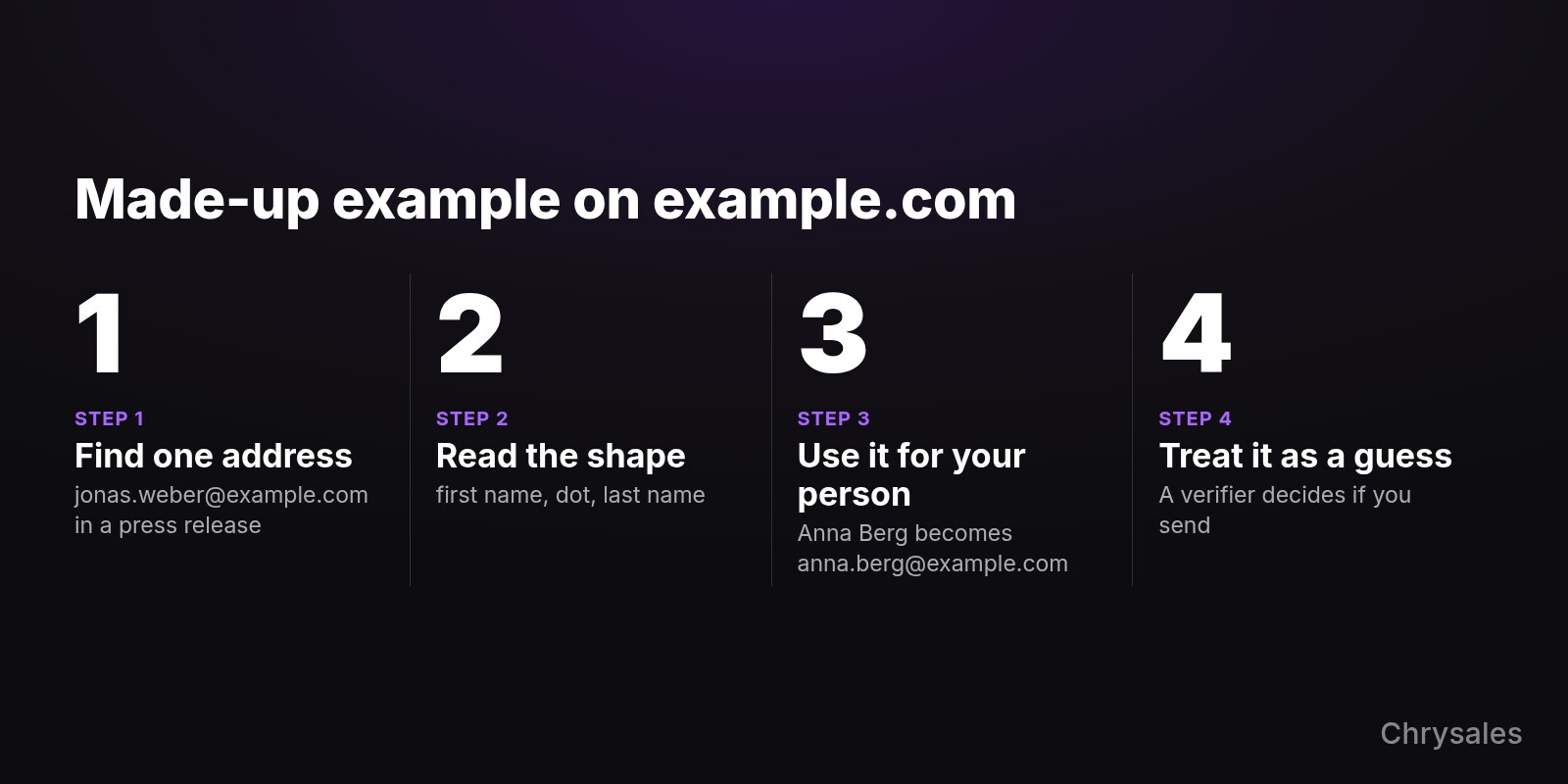
Look for that address in press releases, author boxes, event speaker pages or an old email from someone there. Common shapes are the first name alone, first name dot last name, or first initial plus last name.
Don't send to every possible shape to see which one works. Each wrong guess can bounce, and bounces hurt your sending reputation.
Check the address before you send
Run every guessed or found address through a verifier, and only send when the result is valid.
Email finder tools do the guessing for you. Hunter says its finder builds the address from a name and company domain using public sources, then checks it. As of November 2026, Hunter's free plan gives 50 credits a month, and one found email costs one credit.
Don't trust a finder blindly, though. In BuzzStream's test of email lookup tools, only 38% of found emails were correct after a manual check. Of the wrong ones, 59% would never bounce, so you would never learn your email missed.
That test used 553 journalist emails, not B2B buyers, but the warning still fits.
Verifiers sort each address into a few results. Hunter's status guide uses these names; other tools word them a little differently.
| Result | What it means | What to do |
|---|---|---|
| Valid | The inbox exists | Send |
| Accept-all | The server accepts any address | Send only if confirmed elsewhere |
| Invalid | No such inbox | Don't send, re-check the name and pattern |
| Unknown | The check couldn't decide | Check again later or switch channel |
Accept-all is the tricky one. In a small test by Hunter, these addresses bounced 27% of the time, against 1% for valid ones.
When you send, start with a small batch and watch the bounces. Google's sender guidelines tell senders to reduce volume when messages start bouncing. For more on this, read how spam filters judge your domain.
Is a paid finder worth it? In our view, free sources and a free plan cover a few people a week. Pay when you need dozens a week and your time costs more than the plan.
Know the email rules where they live
A valid address tells you the inbox exists. Whether you may send them advertising depends on the country. This is a plain summary, not legal advice, so check your setup with a lawyer.
In the EU, the GDPR lets you email for marketing if you have a good reason that fits what the person would expect. Recital 47 calls this a legitimate interest.
You must also say where you got their address, at the latest in your first message (Article 14). If they object, you must stop (Article 21).
The GDPR is only one layer. Each EU country also has its own rule for marketing email, and some are much stricter.
In the UK, the ICO says the PECR email rule doesn't apply to emails sent to companies, including an employee's work address. PECR is the UK's law on marketing by email and phone. You still have to say who you are and give a way to opt out.
UK GDPR still applies. Sole traders and some partnerships count as private individuals, so the stricter rule applies to them. As of November 2026, the ICO says this guidance is under review.
Germany is stricter. Under § 7 UWG, the German law against unfair competition, advertising email needs the recipient's prior express consent. There is no general exception for businesses, only a narrow one for existing customers.
In 2009, Germany's highest civil court ruled that an email address on a company website is not consent to advertising email. Sales calls to German businesses also need at least presumed consent under the same law. Other countries, such as Switzerland, have their own laws too.
When to stop and switch channels
Set a stop rule before you start. We suggest this one: no valid address after the free sources and one finder check means you stop searching. Then reach the person another way.
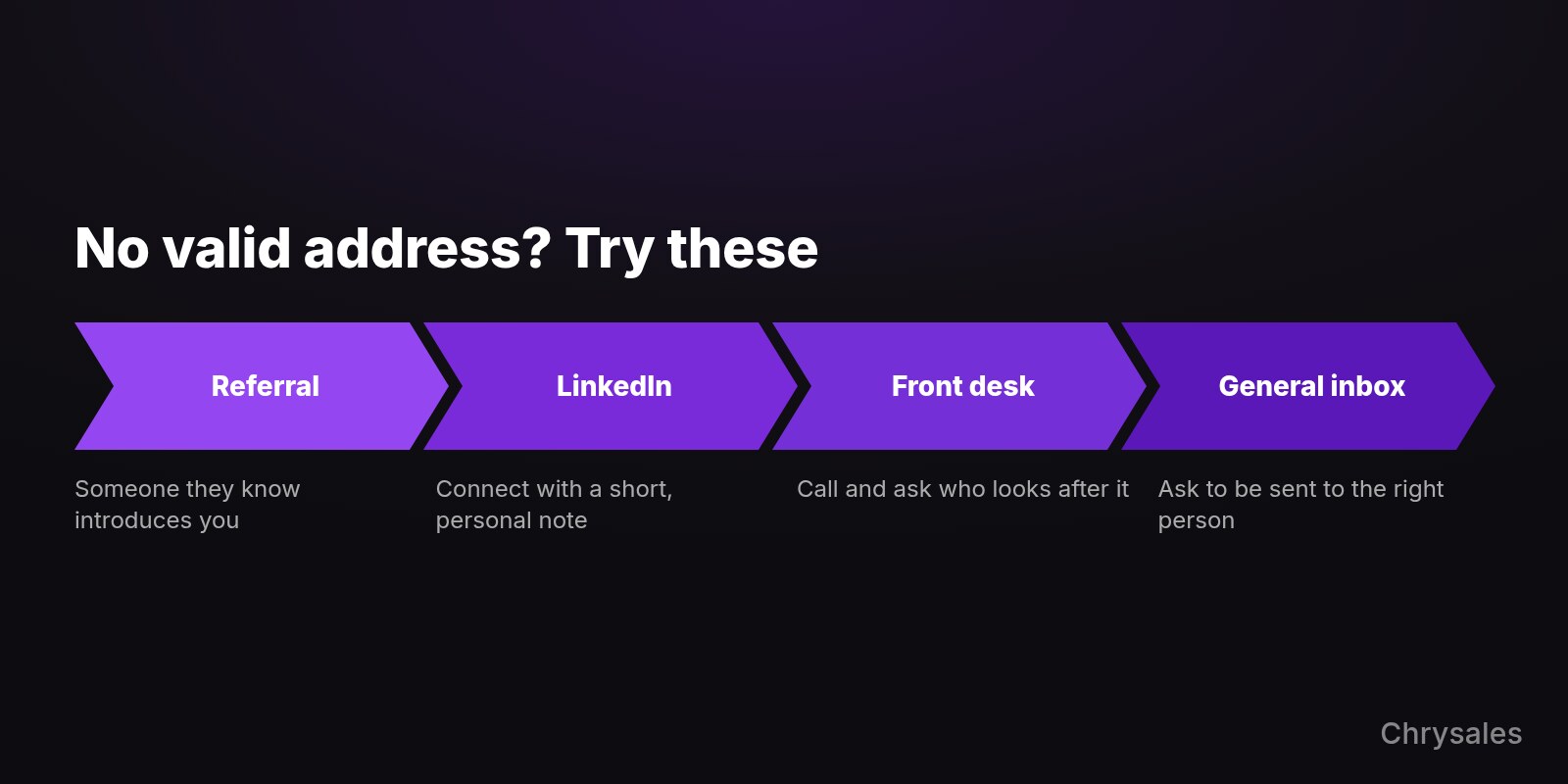
A referral is the warmest route, so start there and work down to the general inbox.
The country rules above apply to every channel. In Germany, a referral or a contact who asked to hear from you is the safest start.
At the front desk, keep the call short and only ask who the right person is, not for a sale.
Hi, this is [your name] from [your company]. Who looks after [area] at your company, and what's the best way to reach them?Conclusion: Start with one person
Pick one person you really want to reach. Run the whole routine once by hand: free sources, the pattern, a verifier check, then the rules in their country.
Once the address is valid and the rules allow it, write the email itself. For many people rather than one, build a full lead list with the same check before you send.
Want checked addresses to turn into real conversations? On a free strategy call, you can walk Chrysales through how you find and contact prospects today. Talk through your outreach on a free call
Here is how to find a decision maker's email address: start with free sources like the company website. Use one known address to work out the company's email pattern. Then check your guess with a verifier, a tool that tests whether the inbox exists, and only send when it checks out.
A wrong address costs more than one lost email. Bounces (emails that come back undelivered) can push your later emails toward spam. Before you send, also check the email rules in the person's country, because they differ a lot.
Where to find a decision maker's email for free
You can usually find the right name, and often one real address, without paying anything.
The team or about page often lists the founder, the managing director and department heads. Press releases can add a name, and sometimes a direct contact.
German company websites must have a legal notice page, called the Impressum. By law (§ 5 DDG) it lists an email address and, for companies, the legal representative, such as the managing director. That email is often a general inbox like info@, but it gives you the name and the domain (the part after the @).
LinkedIn helps you pick the person, but it rarely shows the address. By default, LinkedIn shows a member's email only to their direct connections and people already in their email contacts. Members can also hide it completely.
To shortlist buyers at your target companies, use these Sales Navigator filters to find the right buyers.
In this video, Sabir shows how to use AI to find decision makers. He starts from a strict ideal client profile (a written picture of the clients you want) with four criteria and location targeting.
Work out the company's email pattern
Most companies give every employee an address in the same shape. Find one real address on the domain and apply its shape to your person's name.
Look for that address in press releases, author boxes, event speaker pages or an old email from someone there. Common shapes are the first name alone, first name dot last name, or first initial plus last name.
Don't send to every possible shape to see which one works. Each wrong guess can bounce, and bounces hurt your sending reputation.
Check the address before you send
Run every guessed or found address through a verifier, and only send when the result is valid.
Email finder tools do the guessing for you. Hunter says its finder builds the address from a name and company domain using public sources, then checks it. As of November 2026, Hunter's free plan gives 50 credits a month, and one found email costs one credit.
Don't trust a finder blindly, though. In BuzzStream's test of email lookup tools, only 38% of found emails were correct after a manual check. Of the wrong ones, 59% would never bounce, so you would never learn your email missed.
That test used 553 journalist emails, not B2B buyers, but the warning still fits.
Verifiers sort each address into a few results. Hunter's status guide uses these names; other tools word them a little differently.
| Result | What it means | What to do |
|---|---|---|
| Valid | The inbox exists | Send |
| Accept-all | The server accepts any address | Send only if confirmed elsewhere |
| Invalid | No such inbox | Don't send, re-check the name and pattern |
| Unknown | The check couldn't decide | Check again later or switch channel |
Accept-all is the tricky one. In a small test by Hunter, these addresses bounced 27% of the time, against 1% for valid ones.
When you send, start with a small batch and watch the bounces. Google's sender guidelines tell senders to reduce volume when messages start bouncing. For more on this, read how spam filters judge your domain.
Is a paid finder worth it? In our view, free sources and a free plan cover a few people a week. Pay when you need dozens a week and your time costs more than the plan.
Know the email rules where they live
A valid address tells you the inbox exists. Whether you may send them advertising depends on the country. This is a plain summary, not legal advice, so check your setup with a lawyer.
In the EU, the GDPR lets you email for marketing if you have a good reason that fits what the person would expect. Recital 47 calls this a legitimate interest.
You must also say where you got their address, at the latest in your first message (Article 14). If they object, you must stop (Article 21).
The GDPR is only one layer. Each EU country also has its own rule for marketing email, and some are much stricter.
In the UK, the ICO says the PECR email rule doesn't apply to emails sent to companies, including an employee's work address. PECR is the UK's law on marketing by email and phone. You still have to say who you are and give a way to opt out.
UK GDPR still applies. Sole traders and some partnerships count as private individuals, so the stricter rule applies to them. As of November 2026, the ICO says this guidance is under review.
Germany is stricter. Under § 7 UWG, the German law against unfair competition, advertising email needs the recipient's prior express consent. There is no general exception for businesses, only a narrow one for existing customers.
In 2009, Germany's highest civil court ruled that an email address on a company website is not consent to advertising email. Sales calls to German businesses also need at least presumed consent under the same law. Other countries, such as Switzerland, have their own laws too.
When to stop and switch channels
Set a stop rule before you start. We suggest this one: no valid address after the free sources and one finder check means you stop searching. Then reach the person another way.
A referral is the warmest route, so start there and work down to the general inbox.
The country rules above apply to every channel. In Germany, a referral or a contact who asked to hear from you is the safest start.
At the front desk, keep the call short and only ask who the right person is, not for a sale.
Hi, this is [your name] from [your company]. Who looks after [area] at your company, and what's the best way to reach them?Conclusion: Start with one person
Pick one person you really want to reach. Run the whole routine once by hand: free sources, the pattern, a verifier check, then the rules in their country.
Once the address is valid and the rules allow it, write the email itself. For many people rather than one, build a full lead list with the same check before you send.
Want checked addresses to turn into real conversations? On a free strategy call, you can walk Chrysales through how you find and contact prospects today. Talk through your outreach on a free call
Scaling Is Not Hard If You Have The Right Systems
If you’re serious about leveling up your scaling game, you need the right system, the right training, and the right team behind you. We're here to give you the exact tools and strategies top entrepreneurs use to dominate.

Discover the latest tips
View All
Chrysales was formed from the words "chrysalis" the stage where a caterpillar transforms into a butterfly and "sales".
It stands for one thing: sales transformation.Because scaling doesn’t happen by doing more of the same. Scaling only happens when you go through real transformation in your systems, your offer, team and the way you sell.


