.avif)
Why Your Content Calendar Is Your Best B2B Sales Tool

A content calendar for B2B is a simple plan for what you publish and when, built to support lead generation, b2b sales, and client acquisition. Most sales teams burn time chasing cold prospects one by one. They send emails, make calls, follow up three times, and move on. But here's the thing: content does the outreach for you while you sleep. When you publish helpful content regularly, people find you, trust you, and reach out first. That's the difference between hunting and building a magnet. A content calendar for B2B isn't just a marketing tool. It's a lead generation machine that runs on autopilot.
Content Beats Cold Outreach Because It Compounds
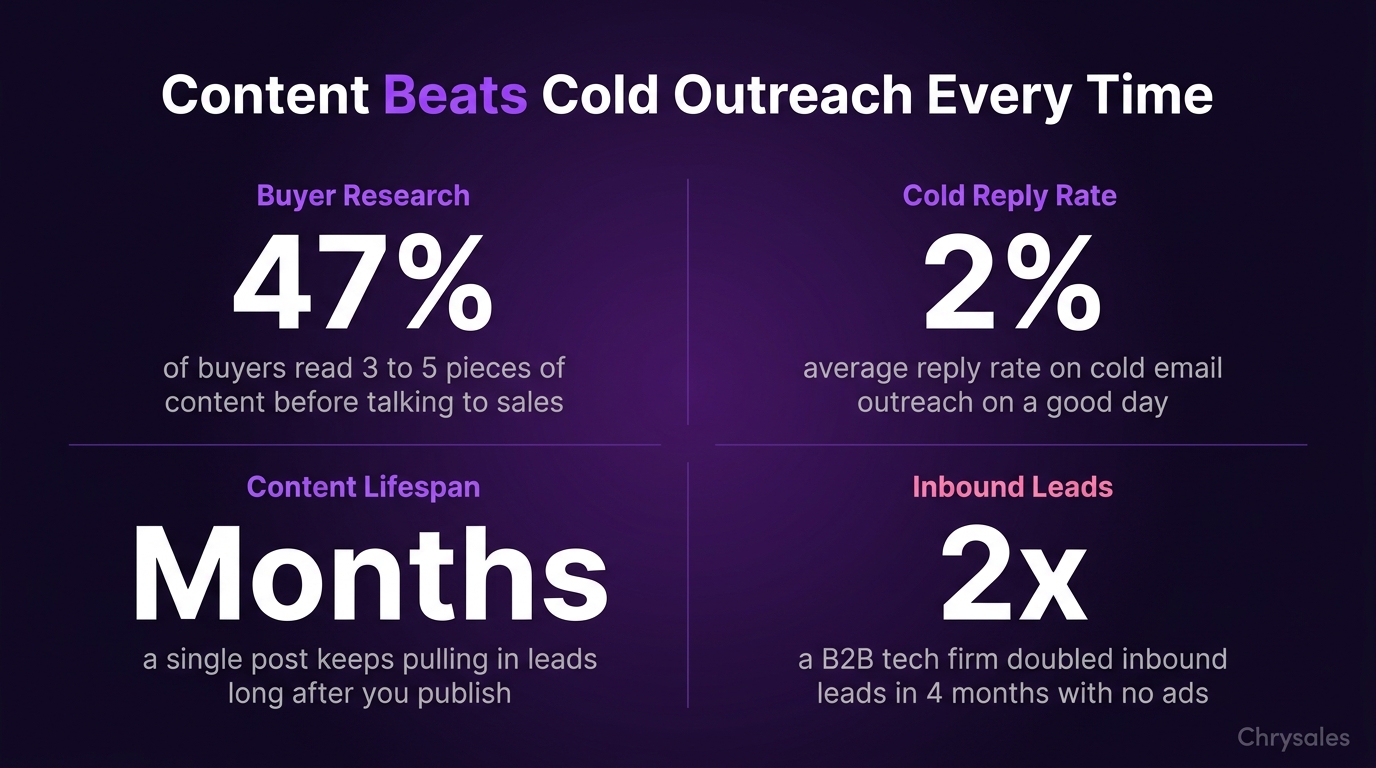
Cold emails die after three days. A phone call ends when you hang up. But a single blog post or LinkedIn article works for months. Maybe years. Picture this: you write one helpful post about fixing a common sales problem. It ranks on Google. Someone reads it six months later, shares it with their team, and books a call with you. You didn't chase them. They came to you because you taught them something useful first. That's the power of content as a B2B sales strategy. It compounds. Every piece you publish adds to a library that keeps working. The more you publish, the more paths lead back to you.
The Math Behind the Magnet
A study from HubSpot's marketing statistics found that 47% of buyers view three to five pieces of content before ever talking to a sales rep. They're researching you before you know they exist. If your content answers their questions, you're already ahead. Cold outreach has a reply rate around 1% to 3% on a good day. Content that ranks well can pull in hundreds of visitors per month, and a portion of those turn into leads without you lifting a finger after you hit publish.
Pro Tip: One well-written piece that ranks for a high-intent keyword can bring in more qualified leads than 500 cold emails.
A Content Calendar for B2B Keeps You Consistent
Publishing once and disappearing doesn't work. Neither does posting randomly when you feel like it. Consistency builds trust. Trust builds client acquisition. A content calendar is just a plan for what you'll publish and when. Simple as that. You pick topics, assign dates, and follow through. It's the difference between posting twice this month and going silent for six weeks versus showing up every week with something helpful.
What a Simple Content Calendar Looks like
You don't need a 40-tab spreadsheet. Start with this:
- Topic: What you're writing about
- Publish date: When it goes live
- Keyword: The main search term you're aiming for
- Format: Blog, LinkedIn post, video, case study
- Status: Draft, scheduled, published
That's it. You can build this in a Google Sheet in 10 minutes.
Common mistake: Most teams plan content around what they want to say, not what their prospects need to hear. Flip that. Write about the problems your prospects search for at 11 PM when they can't sleep.
Start With the Questions Your Prospects Already Ask
The best content topics are hiding in plain sight. They're the questions prospects ask on discovery calls, the objections they bring up, the things they Google before they ever talk to you. A 20-person tech company we worked with last year had a list of seven questions they heard on every single call. We turned each one into a blog post. Within three months, those posts were ranking. Prospects started showing up to calls already half-sold because they'd read the answers.
Where to Find Your Best Topics
Pull from these places:
- Sales call recordings: Listen for repeated questions and write posts that answer them
- Support tickets or emails: Common confusion points make great content
- LinkedIn comments: See what people ask or complain about in your space
- Google autocomplete: Type your main keyword and see what finishes the sentence
- Reddit and Quora: Real people asking real questions in plain language
Pick 12 to 20 topics. That's your first quarter of content. You now have a B2B content strategy that's based on what people actually care about, not what you assume they want.
Watch out: Don't write about things only you find interesting. If it doesn't solve a problem or answer a question your prospect has, skip it.
Match Your Content to the Buyer Journey
Not every piece of content should ask for a sale. Some content builds awareness. Some educates. Some closes. Think of your sales pipeline like a contact list. At the top are people who barely know you exist. At the bottom are people ready to buy. Content moves them down.
The Three Stages
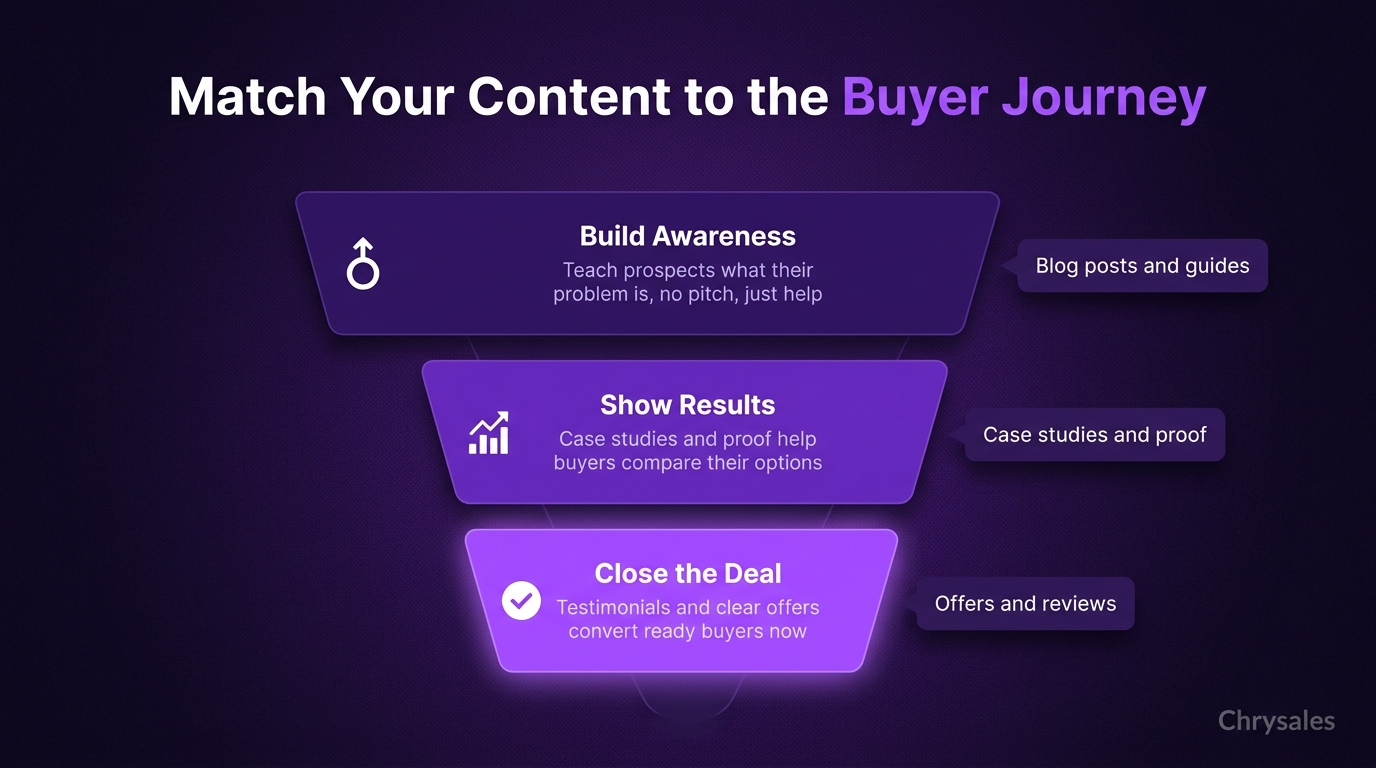
Awareness stage: Prospects just realized they have a problem. They're searching for what it is, not who can fix it. Write educational content here. Blog posts like "Why your cold emails get ignored" or "Signs your sales process is broken." No pitch. Just help.
Consideration stage: They know the problem. Now they're comparing solutions. Case studies, comparison posts, and "how we do it" content work here. Show results. A marketing agency might publish "How we helped a consulting firm book 30 calls in 60 days."
Decision stage: They're ready to pick someone. Testimonials, detailed service breakdowns, ROI calculators, and "why us" content seal the deal. This is where you make the ask clear.
A good content calendar for B2B spreads content across all three stages. You're not just publishing to publish, you're building a sales pipeline that content can feed from strangers to buyers.
Pro Tip: For every decision-stage post, write two awareness-stage posts. You need a wider top of funnel to fill the pipeline.
Repurpose Everything to Multiply Your Reach
Most teams think publishing one blog is one task. Wrong. One blog is five tasks if you do it right. A single 1,500-word post becomes:
- A LinkedIn article
- Three short LinkedIn posts pulling key points
- A Twitter thread
- An email to your list
- A script for a short video or voice note
You spent the time writing it once. Now you milk it. That's how a 30-person consulting firm keeps showing up everywhere without hiring a content team.
Repurposing in Practice
We worked with a B2B tech company that published one blog per week. They also turned each blog into a five-part LinkedIn series and sent the best ones to their email list. Same content, three channels. Their inbound leads doubled in four months without spending a dollar on ads. The content calendar should include repurposing steps right in the plan. Don't treat it as bonus work. Treat it as part of the process. For more on how to create LinkedIn content that turns into leads, layer your content strategy across multiple formats.
Common mistake: Publishing a blog and calling it done. The blog is the seed. Repurposing is how you plant it everywhere.
Build Lead Generation Right Into the Content
Content isn't just for awareness. It's a direct sales tool if you build it right. Every piece you publish should have a next step. Not a pushy sales pitch. A helpful next step. That might be a lead magnet, a free audit, a scorecard, a template, or a booked call.
What This Looks Like
A post about fixing low reply rates on cold emails ends with: "Want our exact cold email template that gets 8% reply rates? Grab it here." That link goes to a simple form. You capture the lead. Now they're in your system.
Or a post about hiring salespeople ends with: "Not sure if your sales team structure is set up to scale? Book a 20-minute audit call and we'll walk you through it." Clear offer. Easy yes. Sales enablement content that teaches and converts at the same time is the sweet spot. You're not tricking anyone. You're giving value and making it easy to take the next step.
Pro Tip: Every post should answer one question fully and offer one clear next step at the end. No seven CTAs. Just one.
Use Data to Know What's Working
Publishing content without tracking it is like sending cold emails into the void and never checking replies. You need to know what's landing. Track these basics:
- Page views: Are people finding it?
- Time on page: Are they reading it or bouncing?
- Conversions: Are they taking the next step?
- Keyword rankings: Is it showing up in search?
- Inbound mentions or links: Are people sharing it?
If a post gets 50 views and no conversions, it's not resonating. If a post gets 800 views and books three calls, do more like that.
Adjust Based on What You See
A marketing agency we trained published 15 blog posts in three months. Five of them drove 70% of all inbound traffic. They doubled down on those topics and formats. Six months later, they were getting 40 to 50 inbound leads per month from content alone. The content calendar isn't set in stone. Review it monthly. Cut what's not working. Do more of what is. Predictable client acquisition comes from repeating what works, not guessing every time. For more on leveraging B2B website SEO to amplify content performance, refine your keyword strategy and on-page optimization.
Watch out: Don't obsess over vanity metrics like social shares if they're not turning into leads. Focus on what moves the business forward.
Automate the Heavy Lifting With Simple Systems
You don't need to write every word from scratch every time. A smart B2B content planning approach includes templates, outlines, and AI tools to speed things up. Use AI to draft outlines, pull research, or write first drafts you edit. Use templates for recurring content types like case studies, how-to posts, or listicles. Build a swipe file of great headlines and structures you can remix.
A Simple Weekly Content System
Here's a system that works for small sales teams and solo operators:
- Monday: Pick the topic from your content calendar
- Tuesday: Outline the post and gather examples
- Wednesday: Write the first draft (or AI-draft and edit)
- Thursday: Edit, add examples, tighten it up
- Friday: Publish and repurpose into LinkedIn posts and email
One blog per week. Four blogs per month. Forty-eight per year. That library becomes a lead generation engine. Sales automation and content planning overlap more than people think, both are about building systems that run without you babysitting them, especially when you start layering in AI-powered sales systems to streamline drafting and distribution. AI in sales is making this faster. Tools like Gemini can help draft outlines or research competitors in minutes. You still add the voice and examples, but the grunt work is gone.
Pro Tip: Batch similar tasks. Write three outlines in one sitting. Edit three posts in one sitting. You'll get faster and stay in the flow.
Stop Chasing and Start Attracting
Cold outreach has a place. But when you pair it with consistent content, you're not just chasing cold prospects anymore, and to get the most from the cold side of your mix, make sure your team is following cold email best practices that respect reply rates and personalization. You're building a system where warm leads come to you. Content is the best outreach because it works while you're doing something else. It reaches people you'd never find on a cold list. It builds trust before the first conversation. And it compounds. The more you publish, the stronger the magnet gets. If you want to see how content plugs into a broader inbound engine, watch how to build a sales system so powerful clients come to you for a complete walkthrough of the entire system.
A solid content calendar for B2B isn't about posting for the sake of posting. It's about showing up with helpful, clear, real content that solves problems and moves people toward working with you. That's how small sales teams compete with big budgets. That's how you build predictable client acquisition without burning out your team on cold calls. Start simple. Pick 12 topics. Schedule them. Publish weekly. Track what works. Adjust. Repeat.
Frequently Asked Questions
Q: How often should I publish content to see real results?
Once a week is the sweet spot for most B2B companies. It's enough to stay consistent and build momentum without overwhelming your team. Publishing less than twice a month makes it hard to gain traction. Publishing daily is overkill unless you have a dedicated content team. Stick to weekly. Track results for three months before you decide to change the pace.
Q: What if I don't have time to write content every week?
Then repurpose what you already have. Record a five-minute voice note answering a common question and transcribe it. Turn a sales pitch deck into a blog post. Pull insights from a client call and write them up. You can also batch-write three posts in one session and schedule them out. The goal is consistency, not perfection. A short helpful post beats no post.
Q: Do I need fancy tools to manage a content calendar?
Not at all. A simple Google Sheet works. Add columns for topic, publish date, keyword, format, and status. That's all you need to start. As you scale, tools like Notion, Trello, or Asana can help if you're managing a team. But don't let tool shopping delay you from actually publishing.
Q: How do I know which topics will actually bring in leads?
Start with the questions your prospects ask on sales calls. If three people ask the same thing, write about it. Use keyword research tools like Google autocomplete or AnswerThePublic to see what people search for. Look at what your competitors write about and do it better. The best topics solve real problems your ideal clients are Googling right now.
Q: Can content replace cold outreach completely?
Not completely, but it can reduce how much cold outreach you need. Content brings in warm inbound leads who already trust you. Cold outreach fills gaps and speeds things up. The best approach is both: publish helpful content to attract leads, and use smart cold outreach to reach specific targets. Content makes your outreach easier because people have already seen your name.
Q: How long does it take to see results from publishing content?
Expect three to six months before you see consistent inbound leads from content. The first few posts won't rank right away. But as you build a library and Google sees you publishing regularly, your visibility grows. Some posts get traction in weeks. Others take months. The key is sticking with it. Content compounds. The teams that quit after two months miss the payoff.
Q: Should I focus on blogs or social media posts first?
Blogs. They rank in search, work as lead magnets, and give you long-form space to teach. Social posts are great for distribution and engagement, but they disappear fast. Write the blog first, then chop it into social posts. That way you're feeding multiple channels from one piece of content. Blogs are the foundation. Social is the amplifier.
A content calendar for B2B is a simple plan for what you publish and when, built to support lead generation, b2b sales, and client acquisition. Most sales teams burn time chasing cold prospects one by one. They send emails, make calls, follow up three times, and move on. But here's the thing: content does the outreach for you while you sleep. When you publish helpful content regularly, people find you, trust you, and reach out first. That's the difference between hunting and building a magnet. A content calendar for B2B isn't just a marketing tool. It's a lead generation machine that runs on autopilot.
Content Beats Cold Outreach Because It Compounds
Cold emails die after three days. A phone call ends when you hang up. But a single blog post or LinkedIn article works for months. Maybe years. Picture this: you write one helpful post about fixing a common sales problem. It ranks on Google. Someone reads it six months later, shares it with their team, and books a call with you. You didn't chase them. They came to you because you taught them something useful first. That's the power of content as a B2B sales strategy. It compounds. Every piece you publish adds to a library that keeps working. The more you publish, the more paths lead back to you.
The Math Behind the Magnet
A study from HubSpot's marketing statistics found that 47% of buyers view three to five pieces of content before ever talking to a sales rep. They're researching you before you know they exist. If your content answers their questions, you're already ahead. Cold outreach has a reply rate around 1% to 3% on a good day. Content that ranks well can pull in hundreds of visitors per month, and a portion of those turn into leads without you lifting a finger after you hit publish.
Pro Tip: One well-written piece that ranks for a high-intent keyword can bring in more qualified leads than 500 cold emails.
A Content Calendar for B2B Keeps You Consistent
Publishing once and disappearing doesn't work. Neither does posting randomly when you feel like it. Consistency builds trust. Trust builds client acquisition. A content calendar is just a plan for what you'll publish and when. Simple as that. You pick topics, assign dates, and follow through. It's the difference between posting twice this month and going silent for six weeks versus showing up every week with something helpful.
What a Simple Content Calendar Looks like
You don't need a 40-tab spreadsheet. Start with this:
- Topic: What you're writing about
- Publish date: When it goes live
- Keyword: The main search term you're aiming for
- Format: Blog, LinkedIn post, video, case study
- Status: Draft, scheduled, published
That's it. You can build this in a Google Sheet in 10 minutes.
Common mistake: Most teams plan content around what they want to say, not what their prospects need to hear. Flip that. Write about the problems your prospects search for at 11 PM when they can't sleep.
Start With the Questions Your Prospects Already Ask
The best content topics are hiding in plain sight. They're the questions prospects ask on discovery calls, the objections they bring up, the things they Google before they ever talk to you. A 20-person tech company we worked with last year had a list of seven questions they heard on every single call. We turned each one into a blog post. Within three months, those posts were ranking. Prospects started showing up to calls already half-sold because they'd read the answers.
Where to Find Your Best Topics
Pull from these places:
- Sales call recordings: Listen for repeated questions and write posts that answer them
- Support tickets or emails: Common confusion points make great content
- LinkedIn comments: See what people ask or complain about in your space
- Google autocomplete: Type your main keyword and see what finishes the sentence
- Reddit and Quora: Real people asking real questions in plain language
Pick 12 to 20 topics. That's your first quarter of content. You now have a B2B content strategy that's based on what people actually care about, not what you assume they want.
Watch out: Don't write about things only you find interesting. If it doesn't solve a problem or answer a question your prospect has, skip it.
Match Your Content to the Buyer Journey
Not every piece of content should ask for a sale. Some content builds awareness. Some educates. Some closes. Think of your sales pipeline like a contact list. At the top are people who barely know you exist. At the bottom are people ready to buy. Content moves them down.
The Three Stages
Awareness stage: Prospects just realized they have a problem. They're searching for what it is, not who can fix it. Write educational content here. Blog posts like "Why your cold emails get ignored" or "Signs your sales process is broken." No pitch. Just help.
Consideration stage: They know the problem. Now they're comparing solutions. Case studies, comparison posts, and "how we do it" content work here. Show results. A marketing agency might publish "How we helped a consulting firm book 30 calls in 60 days."
Decision stage: They're ready to pick someone. Testimonials, detailed service breakdowns, ROI calculators, and "why us" content seal the deal. This is where you make the ask clear.
A good content calendar for B2B spreads content across all three stages. You're not just publishing to publish, you're building a sales pipeline that content can feed from strangers to buyers.
Pro Tip: For every decision-stage post, write two awareness-stage posts. You need a wider top of funnel to fill the pipeline.
Repurpose Everything to Multiply Your Reach
Most teams think publishing one blog is one task. Wrong. One blog is five tasks if you do it right. A single 1,500-word post becomes:
- A LinkedIn article
- Three short LinkedIn posts pulling key points
- A Twitter thread
- An email to your list
- A script for a short video or voice note
You spent the time writing it once. Now you milk it. That's how a 30-person consulting firm keeps showing up everywhere without hiring a content team.
Repurposing in Practice
We worked with a B2B tech company that published one blog per week. They also turned each blog into a five-part LinkedIn series and sent the best ones to their email list. Same content, three channels. Their inbound leads doubled in four months without spending a dollar on ads. The content calendar should include repurposing steps right in the plan. Don't treat it as bonus work. Treat it as part of the process. For more on how to create LinkedIn content that turns into leads, layer your content strategy across multiple formats.
Common mistake: Publishing a blog and calling it done. The blog is the seed. Repurposing is how you plant it everywhere.
Build Lead Generation Right Into the Content
Content isn't just for awareness. It's a direct sales tool if you build it right. Every piece you publish should have a next step. Not a pushy sales pitch. A helpful next step. That might be a lead magnet, a free audit, a scorecard, a template, or a booked call.
What This Looks Like
A post about fixing low reply rates on cold emails ends with: "Want our exact cold email template that gets 8% reply rates? Grab it here." That link goes to a simple form. You capture the lead. Now they're in your system.
Or a post about hiring salespeople ends with: "Not sure if your sales team structure is set up to scale? Book a 20-minute audit call and we'll walk you through it." Clear offer. Easy yes. Sales enablement content that teaches and converts at the same time is the sweet spot. You're not tricking anyone. You're giving value and making it easy to take the next step.
Pro Tip: Every post should answer one question fully and offer one clear next step at the end. No seven CTAs. Just one.
Use Data to Know What's Working
Publishing content without tracking it is like sending cold emails into the void and never checking replies. You need to know what's landing. Track these basics:
- Page views: Are people finding it?
- Time on page: Are they reading it or bouncing?
- Conversions: Are they taking the next step?
- Keyword rankings: Is it showing up in search?
- Inbound mentions or links: Are people sharing it?
If a post gets 50 views and no conversions, it's not resonating. If a post gets 800 views and books three calls, do more like that.
Adjust Based on What You See
A marketing agency we trained published 15 blog posts in three months. Five of them drove 70% of all inbound traffic. They doubled down on those topics and formats. Six months later, they were getting 40 to 50 inbound leads per month from content alone. The content calendar isn't set in stone. Review it monthly. Cut what's not working. Do more of what is. Predictable client acquisition comes from repeating what works, not guessing every time. For more on leveraging B2B website SEO to amplify content performance, refine your keyword strategy and on-page optimization.
Watch out: Don't obsess over vanity metrics like social shares if they're not turning into leads. Focus on what moves the business forward.
Automate the Heavy Lifting With Simple Systems
You don't need to write every word from scratch every time. A smart B2B content planning approach includes templates, outlines, and AI tools to speed things up. Use AI to draft outlines, pull research, or write first drafts you edit. Use templates for recurring content types like case studies, how-to posts, or listicles. Build a swipe file of great headlines and structures you can remix.
A Simple Weekly Content System
Here's a system that works for small sales teams and solo operators:
- Monday: Pick the topic from your content calendar
- Tuesday: Outline the post and gather examples
- Wednesday: Write the first draft (or AI-draft and edit)
- Thursday: Edit, add examples, tighten it up
- Friday: Publish and repurpose into LinkedIn posts and email
One blog per week. Four blogs per month. Forty-eight per year. That library becomes a lead generation engine. Sales automation and content planning overlap more than people think, both are about building systems that run without you babysitting them, especially when you start layering in AI-powered sales systems to streamline drafting and distribution. AI in sales is making this faster. Tools like Gemini can help draft outlines or research competitors in minutes. You still add the voice and examples, but the grunt work is gone.
Pro Tip: Batch similar tasks. Write three outlines in one sitting. Edit three posts in one sitting. You'll get faster and stay in the flow.
Stop Chasing and Start Attracting
Cold outreach has a place. But when you pair it with consistent content, you're not just chasing cold prospects anymore, and to get the most from the cold side of your mix, make sure your team is following cold email best practices that respect reply rates and personalization. You're building a system where warm leads come to you. Content is the best outreach because it works while you're doing something else. It reaches people you'd never find on a cold list. It builds trust before the first conversation. And it compounds. The more you publish, the stronger the magnet gets. If you want to see how content plugs into a broader inbound engine, watch how to build a sales system so powerful clients come to you for a complete walkthrough of the entire system.
A solid content calendar for B2B isn't about posting for the sake of posting. It's about showing up with helpful, clear, real content that solves problems and moves people toward working with you. That's how small sales teams compete with big budgets. That's how you build predictable client acquisition without burning out your team on cold calls. Start simple. Pick 12 topics. Schedule them. Publish weekly. Track what works. Adjust. Repeat.
Frequently Asked Questions
Q: How often should I publish content to see real results?
Once a week is the sweet spot for most B2B companies. It's enough to stay consistent and build momentum without overwhelming your team. Publishing less than twice a month makes it hard to gain traction. Publishing daily is overkill unless you have a dedicated content team. Stick to weekly. Track results for three months before you decide to change the pace.
Q: What if I don't have time to write content every week?
Then repurpose what you already have. Record a five-minute voice note answering a common question and transcribe it. Turn a sales pitch deck into a blog post. Pull insights from a client call and write them up. You can also batch-write three posts in one session and schedule them out. The goal is consistency, not perfection. A short helpful post beats no post.
Q: Do I need fancy tools to manage a content calendar?
Not at all. A simple Google Sheet works. Add columns for topic, publish date, keyword, format, and status. That's all you need to start. As you scale, tools like Notion, Trello, or Asana can help if you're managing a team. But don't let tool shopping delay you from actually publishing.
Q: How do I know which topics will actually bring in leads?
Start with the questions your prospects ask on sales calls. If three people ask the same thing, write about it. Use keyword research tools like Google autocomplete or AnswerThePublic to see what people search for. Look at what your competitors write about and do it better. The best topics solve real problems your ideal clients are Googling right now.
Q: Can content replace cold outreach completely?
Not completely, but it can reduce how much cold outreach you need. Content brings in warm inbound leads who already trust you. Cold outreach fills gaps and speeds things up. The best approach is both: publish helpful content to attract leads, and use smart cold outreach to reach specific targets. Content makes your outreach easier because people have already seen your name.
Q: How long does it take to see results from publishing content?
Expect three to six months before you see consistent inbound leads from content. The first few posts won't rank right away. But as you build a library and Google sees you publishing regularly, your visibility grows. Some posts get traction in weeks. Others take months. The key is sticking with it. Content compounds. The teams that quit after two months miss the payoff.
Q: Should I focus on blogs or social media posts first?
Blogs. They rank in search, work as lead magnets, and give you long-form space to teach. Social posts are great for distribution and engagement, but they disappear fast. Write the blog first, then chop it into social posts. That way you're feeding multiple channels from one piece of content. Blogs are the foundation. Social is the amplifier.
Scaling Is Not Hard If You Have The Right Systems
If you’re serious about leveling up your scaling game, you need the right system, the right training, and the right team behind you. We're here to give you the exact tools and strategies top entrepreneurs use to dominate.

Discover the latest tips
View All.avif)
Chrysales was formed from the words "chrysalis" the stage where a caterpillar transforms into a butterfly and "sales".
It stands for one thing: sales transformation.Because scaling doesn’t happen by doing more of the same. Scaling only happens when you go through real transformation in your systems, your offer, team and the way you sell.
.avif)


