.avif)
Why Commission-only Sales Reps Almost Never Work
A commission structure for sales reps pays only on results, which can hurt ramp up, retention, and steady growth when the team needs support and training. Picture this: you post a sales job with 100% commission structure, no base salary. You get flooded with 50 applications. Sounds great, right? Here's what actually happens.
The Math Problem Nobody Talks About
Most businesses think commission-only models save money. The logic goes like this: pay nothing until the rep brings in revenue. Zero risk, all reward. But the math tells a different story.
A good B2B sales rep expects to earn something while ramping up. The average sales cycle in consulting, tech services, or agency work runs 30 to 90 days. Sometimes longer. That means your new hire could work for two or three months before their first deal closes. On straight commission, that's two or three months of zero income.
Watch out: The reps willing to work for free during ramp up are usually the ones who couldn't get hired anywhere offering a base salary.
The Quality Problem
Here's what we see with clients who try commission-only hiring. The candidate pool skews heavily toward three groups:
- Brand new salespeople with no track record (high risk, long training curve)
- Experienced reps between jobs who need something fast (often gone in 60 days)
- Low performers who burned out at their last role and can't land a base-plus-commission offer
The top performers? They have options. A skilled sales rep with a solid track record gets offers with base salary, benefits, and commission on top. They don't gamble on your 100% commission offer when three other companies are offering $50K base plus 20% commission.
The Retention Math
One marketing agency we worked with hired three commission-only reps in a single month. All three quit within 60 days. The cost wasn't just the lost hires. It was the time spent training them, the deals they touched but never closed, and the damage to client relationships when reps disappeared mid-conversation.
The real cost of a bad sales hire runs 3x to 5x their expected annual earnings when you factor in training time, lost deals, and the cost of re-hiring. A commission-only model that cycles through five reps a year costs more than paying two good reps a solid base plus commission, and this is exactly why the first sales hire fails for so many growing companies.
What Top Sales Reps Actually Want
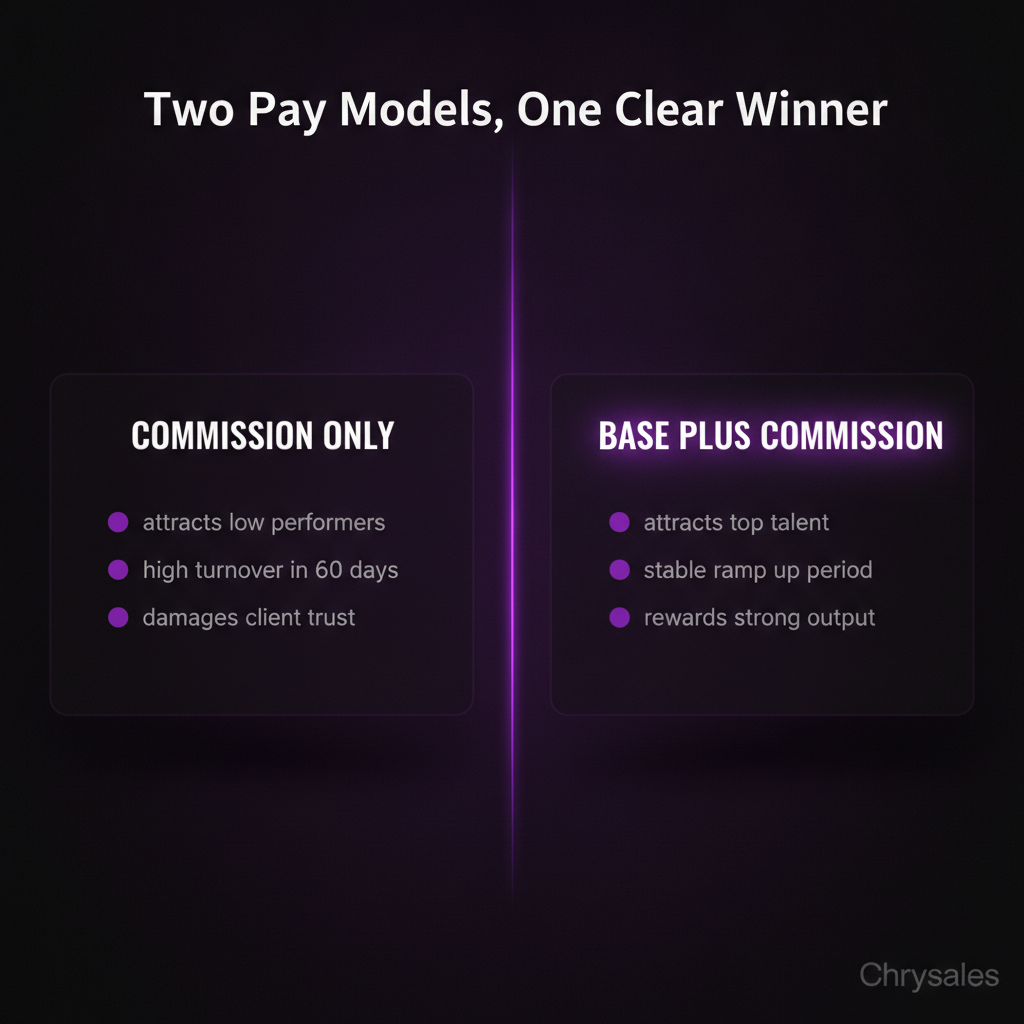
Talk to any high-performing sales rep, and they'll tell you the same thing. They want predictable income while they ramp, clear OTE sales compensation targets, and commission structures that reward performance without punishing them during slow months.
Base Plus Commission Wins
The base plus commission model dominates B2B sales for a reason. It works. Most successful sales teams pay a base salary that covers living expenses, then add commission that scales with performance. A typical split looks like this:
- $40K to $70K base salary (depends on market and experience level)
- 10% to 25% commission on closed deals
- Total OTE (On-Target Earnings) of $80K to $150K+ for hitting quota
This structure attracts better candidates, keeps reps motivated during ramp-up, and aligns incentives. The rep earns while learning your product and process. Once they start closing, commission kicks in and rewards performance.
Pro Tip: Set your base salary at 50% to 60% of total OTE. If you want a rep earning $100K a year, pay $50K base and structure commission so they hit $50K more at quota.
Tiered Commission Plans Drive Performance
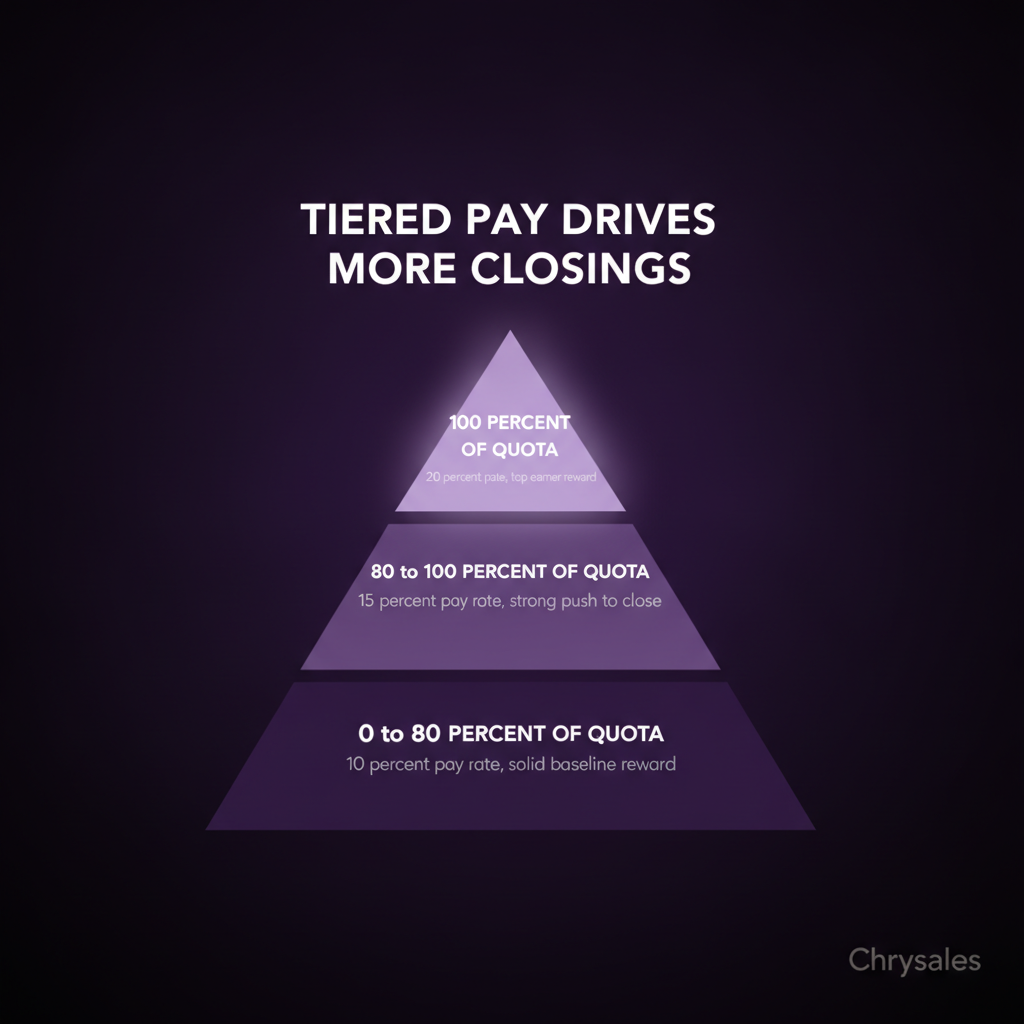
A flat commission rate works, but a tiered commission plan works better. The idea is simple: pay higher commission rates as reps exceed quota. Here's an example:
- 0% to 80% of quota: 10% commission
- 80% to 100% of quota: 15% commission
- 100%+ of quota: 20% commission
This structure pushes reps to hit and exceed targets. The jump from 15% to 20% commission at quota creates a strong incentive to close one more deal instead of coasting.
One 30-person consulting firm we worked with added a tiered commission structure with accelerators and saw average deal volume per rep jump 22% in one quarter. Same team, same offer, better sales commission structure.
Why Commission-Only Models Fail in Practice
The problems go beyond just attracting the wrong candidates. Commission-only structures create operational chaos that most teams don't anticipate.
Inconsistent Sales Activity
Sales reps on pure commission tend to focus only on the easiest, fastest deals. They cherry-pick leads, avoid complex sales cycles, and ignore relationship-building that doesn't close this month. Why? Because they need money now.
A rep with no base salary can't afford to spend three months nurturing a big deal when they have rent due in two weeks. They chase small quick wins and skip the strategic plays that build long-term revenue.
No Control Over Training or Process
When you hire commission-only reps, you lose leverage. They're technically contractors or independent workers in many cases. That means less control over how they sell, what scripts they use, and whether they follow your process.
A sales rep on base plus commission is an employee. You can require them to log calls in your CRM, follow your sales call structure, use your discovery questions, and stick to your objection-handling scripts. A commission-only rep can push back and say, "I'll do it my way or I'll leave."
Common mistake: Treating commission-only reps like employees without giving them employee-level stability. This creates resentment and high turnover.
Misaligned Incentives
Pure commission structures often reward behavior that hurts the business. Reps overpromise to close deals, discount aggressively to speed up decisions, or focus on high-commission products even when a different solution fits the client better.
One tech company we worked with had commission-only reps selling annual contracts at heavy discounts just to hit monthly income targets. The company closed deals, but margins tanked and client churn skyrocketed because customers felt misled.
A good commission structure for sales reps aligns individual goals with company goals. Pure commission makes the rep's goal "close anything fast." That's rarely what the business needs, which is one reason why 100% commission compensation plans limit strategic growth.
What Actually Works: Three Better Models
If commission-only fails, what should you use instead? Here are three sales rep compensation plans that work for growing B2B companies.
1. Base Plus Commission (The Standard)
This is the default for a reason. Pay a livable base salary, add commission that scales with performance. Most B2B sales teams use a 50/50 or 60/40 split (base to commission ratio).
Example:
- $50K base
- 15% commission on all closed deals
- $100K OTE at quota ($333K in sales at 15% = $50K commission)
This model attracts quality candidates, supports ramp-up, and rewards top performers. It's predictable for budgeting and fair for reps.
2. Draw Against Commission (Short-Term Bridge)
A draw against commission gives reps guaranteed pay upfront, but it's an advance on future commissions, not a salary. If the rep earns $5K in commission this month but you paid them a $7K draw, they owe you $2K. That deficit either gets deducted from next month's commission or repaid if they leave.
Draws work for short ramp periods (first 60 to 90 days) but create tension if used long-term. Reps feel like they're in debt to the company, which kills motivation.
Watch out: Recoverable draws (where you claw back the difference) can backfire legally and culturally. Non-recoverable draws (you eat the difference) are safer but more expensive.
3. Tiered or Accelerator Commission (For Mature Teams)
Once your sales team is performing consistently, add accelerators. These are commission multipliers that kick in when reps exceed quota.
Example:
- 0% to 100% of quota: 12% commission
- 100% to 120% of quota: 18% commission
- 120%+ of quota: 25% commission
This structure is common in SaaS and high-growth B2B businesses. It keeps top performers hungry and rewards the reps who blow past targets.
We worked with a 15-person consulting firm that added an accelerator at 110% quota. Three reps who were coasting at 95% to 100% suddenly pushed harder. Two of them hit 115% and 118% the next quarter. The extra commission cost was worth the revenue jump.
How to Structure Commission Without Killing Margins
A bad commission structure can wreck your margins. If you pay 30% commission on gross revenue but your service costs eat 60% of the deal, you're left with 10% profit before overhead. That's not sustainable.
Commission on Gross Margin, Not Revenue
One fix: pay commission on gross margin instead of total deal size. This aligns rep incentives with profitability.
Example:
- Deal size: $50K
- Cost to deliver: $30K
- Gross margin: $20K
- Commission: 25% of $20K = $5K
The rep still earns well, but you're not paying commission on money that goes straight to delivery costs.
Pro Tip: If you sell multiple services with different margins, adjust commission rates by product. High-margin offers get higher commission. Low-margin offers get lower commission. This steers reps toward profitable sales.
Cap Commission on Discounts
If your reps can discount deals, tie their commission to the discount level. A rep who closes a $100K deal at full price earns 20% commission. A rep who discounts the same deal to $80K earns 15% commission.
This stops reps from slashing prices to close faster. They have skin in the game when they discount.
Set Clear Quotas and Activity Metrics
Commission structures work best when paired with clear quotas. Don't just say "sell as much as you can." Set a specific monthly or quarterly target.
Example:
- Monthly quota: $40K in closed deals
- Minimum activity: 50 outbound calls, 20 discovery calls, 10 demos per week
- Commission: 15% on all deals, 20% on deals above quota
Activity metrics keep reps focused even in slow months. If they're not closing, they should be filling the pipeline.
When Commission-Only Might Work (Rare Cases)
Look, there are scenarios where commission-only structures make sense. They're just rare.
Inbound-Heavy, Transactional Sales
If your leads are inbound, qualified, and ready to buy, commission-only can work. Think e-commerce B2B, where the product sells itself and the rep's job is order-taking, not complex selling.
A company selling software licenses to IT departments with a 7-day sales cycle and 80% close rate? Sure, commission-only could work. But that's not most B2B businesses.
Reps Who Already Have a Book of Business
Sometimes experienced reps join a company and bring their own clients. They're not ramping up, they're closing deals from day one.
In this case, a commission-only or heavy-commission structure (like 70% commission, 30% base) makes sense. But again, this is the exception. Most hires don't walk in with a $500K pipeline.
Very High Ticket, Long Cycle Sales (If Reps Are Well-Capitalized)
Some enterprise sales roles pay 100% commission because single deals are worth $500K to $2M. Reps in these roles expect six-figure commission checks and can afford to wait 6 to 12 months for a deal to close.
This works in industries like commercial real estate or enterprise SaaS sales, where reps are effectively independent business owners. But for small sales teams at growing B2B companies, this model is out of reach.
How Chrysales Builds Sales Compensation Into Custom Systems
At Chrysales, we don't just drop a commission structure on a team and hope it works. Sales rep compensation is one piece of a full custom sales system that includes lead generation, offer positioning, sales call structures, and hiring.
When we build a sales system, we start by understanding your sales cycle, average deal size, and margin structure. Then we design a commission structure that aligns with your business model, and you can watch how to build a sales system so powerful clients come to you to see this process in action.
We've worked with 500+ sales teams and trained over 1,000 business owners, and we've seen every commission model succeed and fail depending on context. Most clients come to us after trying commission-only hiring and cycling through reps for six months. The fix isn't just tweaking commission percentages. It's building a sales system that actually scales with predictable compensation and repeatable processes.
We also help clients hire and train elite setters and closers, and we integrate AI-based lead scoring and sales automation so your team focuses on high-value activity, not admin work. The result is a sales team that performs consistently, sticks around, and scales without chaos.
Frequently Asked Questions
Q: What is the best commission structure for sales reps in B2B?
Base plus commission works best for most B2B sales teams. A 50/50 or 60/40 split (base salary to commission) attracts quality candidates, supports ramp-up, and rewards performance. Tiered commission plans or accelerators add extra motivation once reps are performing consistently. Avoid pure commission unless your sales cycle is very short and leads are inbound and pre-qualified.
Q: How much commission should I pay on B2B sales?
Most B2B sales commission rates range from 10% to 25% of deal value, depending on deal size and sales complexity. For consulting, tech services, and agency work, 15% to 20% is common. If you're paying commission on gross margin instead of revenue, rates can go higher, like 25% to 40% of margin. Adjust based on your cost structure and how much support the rep needs to close.
Q: Can I use commission-only to save money when hiring sales reps?
Not really. Commission-only structures attract lower-quality candidates, create high turnover, and cost more in the long run due to constant re-hiring and lost deals. You'll spend less upfront but lose more in wasted training time, damaged client relationships, and missed revenue. A base plus commission model costs more per month but delivers better hires and more predictable sales growth, and learning how to find and hire top performing sales reps with the right compensation makes all the difference.
Q: What is OTE in sales compensation?
OTE stands for On-Target Earnings. It's the total amount a sales rep should earn in a year if they hit 100% of quota. OTE includes base salary plus expected commission. For example, if a rep has a $50K base and should earn $50K in commission at quota, their OTE is $100K. Top sales reps use OTE to compare job offers, so make sure your OTE is competitive for your market.
Q: How do I prevent sales reps from discounting too much?
Tie commission to discount levels. If a rep closes a deal at full price, they earn the standard commission rate. If they discount, their commission rate drops. For example, 0% to 10% discount gets 20% commission, 10% to 20% discount gets 15% commission, and anything over 20% discount gets 10% commission. This makes reps think twice before slashing prices and keeps your margins healthy.
A commission structure for sales reps pays only on results, which can hurt ramp up, retention, and steady growth when the team needs support and training. Picture this: you post a sales job with 100% commission structure, no base salary. You get flooded with 50 applications. Sounds great, right? Here's what actually happens.
The Math Problem Nobody Talks About
Most businesses think commission-only models save money. The logic goes like this: pay nothing until the rep brings in revenue. Zero risk, all reward. But the math tells a different story.
A good B2B sales rep expects to earn something while ramping up. The average sales cycle in consulting, tech services, or agency work runs 30 to 90 days. Sometimes longer. That means your new hire could work for two or three months before their first deal closes. On straight commission, that's two or three months of zero income.
Watch out: The reps willing to work for free during ramp up are usually the ones who couldn't get hired anywhere offering a base salary.
The Quality Problem
Here's what we see with clients who try commission-only hiring. The candidate pool skews heavily toward three groups:
- Brand new salespeople with no track record (high risk, long training curve)
- Experienced reps between jobs who need something fast (often gone in 60 days)
- Low performers who burned out at their last role and can't land a base-plus-commission offer
The top performers? They have options. A skilled sales rep with a solid track record gets offers with base salary, benefits, and commission on top. They don't gamble on your 100% commission offer when three other companies are offering $50K base plus 20% commission.
The Retention Math
One marketing agency we worked with hired three commission-only reps in a single month. All three quit within 60 days. The cost wasn't just the lost hires. It was the time spent training them, the deals they touched but never closed, and the damage to client relationships when reps disappeared mid-conversation.
The real cost of a bad sales hire runs 3x to 5x their expected annual earnings when you factor in training time, lost deals, and the cost of re-hiring. A commission-only model that cycles through five reps a year costs more than paying two good reps a solid base plus commission, and this is exactly why the first sales hire fails for so many growing companies.
What Top Sales Reps Actually Want
Talk to any high-performing sales rep, and they'll tell you the same thing. They want predictable income while they ramp, clear OTE sales compensation targets, and commission structures that reward performance without punishing them during slow months.
Base Plus Commission Wins
The base plus commission model dominates B2B sales for a reason. It works. Most successful sales teams pay a base salary that covers living expenses, then add commission that scales with performance. A typical split looks like this:
- $40K to $70K base salary (depends on market and experience level)
- 10% to 25% commission on closed deals
- Total OTE (On-Target Earnings) of $80K to $150K+ for hitting quota
This structure attracts better candidates, keeps reps motivated during ramp-up, and aligns incentives. The rep earns while learning your product and process. Once they start closing, commission kicks in and rewards performance.
Pro Tip: Set your base salary at 50% to 60% of total OTE. If you want a rep earning $100K a year, pay $50K base and structure commission so they hit $50K more at quota.
Tiered Commission Plans Drive Performance
A flat commission rate works, but a tiered commission plan works better. The idea is simple: pay higher commission rates as reps exceed quota. Here's an example:
- 0% to 80% of quota: 10% commission
- 80% to 100% of quota: 15% commission
- 100%+ of quota: 20% commission
This structure pushes reps to hit and exceed targets. The jump from 15% to 20% commission at quota creates a strong incentive to close one more deal instead of coasting.
One 30-person consulting firm we worked with added a tiered commission structure with accelerators and saw average deal volume per rep jump 22% in one quarter. Same team, same offer, better sales commission structure.
Why Commission-Only Models Fail in Practice
The problems go beyond just attracting the wrong candidates. Commission-only structures create operational chaos that most teams don't anticipate.
Inconsistent Sales Activity
Sales reps on pure commission tend to focus only on the easiest, fastest deals. They cherry-pick leads, avoid complex sales cycles, and ignore relationship-building that doesn't close this month. Why? Because they need money now.
A rep with no base salary can't afford to spend three months nurturing a big deal when they have rent due in two weeks. They chase small quick wins and skip the strategic plays that build long-term revenue.
No Control Over Training or Process
When you hire commission-only reps, you lose leverage. They're technically contractors or independent workers in many cases. That means less control over how they sell, what scripts they use, and whether they follow your process.
A sales rep on base plus commission is an employee. You can require them to log calls in your CRM, follow your sales call structure, use your discovery questions, and stick to your objection-handling scripts. A commission-only rep can push back and say, "I'll do it my way or I'll leave."
Common mistake: Treating commission-only reps like employees without giving them employee-level stability. This creates resentment and high turnover.
Misaligned Incentives
Pure commission structures often reward behavior that hurts the business. Reps overpromise to close deals, discount aggressively to speed up decisions, or focus on high-commission products even when a different solution fits the client better.
One tech company we worked with had commission-only reps selling annual contracts at heavy discounts just to hit monthly income targets. The company closed deals, but margins tanked and client churn skyrocketed because customers felt misled.
A good commission structure for sales reps aligns individual goals with company goals. Pure commission makes the rep's goal "close anything fast." That's rarely what the business needs, which is one reason why 100% commission compensation plans limit strategic growth.
What Actually Works: Three Better Models
If commission-only fails, what should you use instead? Here are three sales rep compensation plans that work for growing B2B companies.
1. Base Plus Commission (The Standard)
This is the default for a reason. Pay a livable base salary, add commission that scales with performance. Most B2B sales teams use a 50/50 or 60/40 split (base to commission ratio).
Example:
- $50K base
- 15% commission on all closed deals
- $100K OTE at quota ($333K in sales at 15% = $50K commission)
This model attracts quality candidates, supports ramp-up, and rewards top performers. It's predictable for budgeting and fair for reps.
2. Draw Against Commission (Short-Term Bridge)
A draw against commission gives reps guaranteed pay upfront, but it's an advance on future commissions, not a salary. If the rep earns $5K in commission this month but you paid them a $7K draw, they owe you $2K. That deficit either gets deducted from next month's commission or repaid if they leave.
Draws work for short ramp periods (first 60 to 90 days) but create tension if used long-term. Reps feel like they're in debt to the company, which kills motivation.
Watch out: Recoverable draws (where you claw back the difference) can backfire legally and culturally. Non-recoverable draws (you eat the difference) are safer but more expensive.
3. Tiered or Accelerator Commission (For Mature Teams)
Once your sales team is performing consistently, add accelerators. These are commission multipliers that kick in when reps exceed quota.
Example:
- 0% to 100% of quota: 12% commission
- 100% to 120% of quota: 18% commission
- 120%+ of quota: 25% commission
This structure is common in SaaS and high-growth B2B businesses. It keeps top performers hungry and rewards the reps who blow past targets.
We worked with a 15-person consulting firm that added an accelerator at 110% quota. Three reps who were coasting at 95% to 100% suddenly pushed harder. Two of them hit 115% and 118% the next quarter. The extra commission cost was worth the revenue jump.
How to Structure Commission Without Killing Margins
A bad commission structure can wreck your margins. If you pay 30% commission on gross revenue but your service costs eat 60% of the deal, you're left with 10% profit before overhead. That's not sustainable.
Commission on Gross Margin, Not Revenue
One fix: pay commission on gross margin instead of total deal size. This aligns rep incentives with profitability.
Example:
- Deal size: $50K
- Cost to deliver: $30K
- Gross margin: $20K
- Commission: 25% of $20K = $5K
The rep still earns well, but you're not paying commission on money that goes straight to delivery costs.
Pro Tip: If you sell multiple services with different margins, adjust commission rates by product. High-margin offers get higher commission. Low-margin offers get lower commission. This steers reps toward profitable sales.
Cap Commission on Discounts
If your reps can discount deals, tie their commission to the discount level. A rep who closes a $100K deal at full price earns 20% commission. A rep who discounts the same deal to $80K earns 15% commission.
This stops reps from slashing prices to close faster. They have skin in the game when they discount.
Set Clear Quotas and Activity Metrics
Commission structures work best when paired with clear quotas. Don't just say "sell as much as you can." Set a specific monthly or quarterly target.
Example:
- Monthly quota: $40K in closed deals
- Minimum activity: 50 outbound calls, 20 discovery calls, 10 demos per week
- Commission: 15% on all deals, 20% on deals above quota
Activity metrics keep reps focused even in slow months. If they're not closing, they should be filling the pipeline.
When Commission-Only Might Work (Rare Cases)
Look, there are scenarios where commission-only structures make sense. They're just rare.
Inbound-Heavy, Transactional Sales
If your leads are inbound, qualified, and ready to buy, commission-only can work. Think e-commerce B2B, where the product sells itself and the rep's job is order-taking, not complex selling.
A company selling software licenses to IT departments with a 7-day sales cycle and 80% close rate? Sure, commission-only could work. But that's not most B2B businesses.
Reps Who Already Have a Book of Business
Sometimes experienced reps join a company and bring their own clients. They're not ramping up, they're closing deals from day one.
In this case, a commission-only or heavy-commission structure (like 70% commission, 30% base) makes sense. But again, this is the exception. Most hires don't walk in with a $500K pipeline.
Very High Ticket, Long Cycle Sales (If Reps Are Well-Capitalized)
Some enterprise sales roles pay 100% commission because single deals are worth $500K to $2M. Reps in these roles expect six-figure commission checks and can afford to wait 6 to 12 months for a deal to close.
This works in industries like commercial real estate or enterprise SaaS sales, where reps are effectively independent business owners. But for small sales teams at growing B2B companies, this model is out of reach.
How Chrysales Builds Sales Compensation Into Custom Systems
At Chrysales, we don't just drop a commission structure on a team and hope it works. Sales rep compensation is one piece of a full custom sales system that includes lead generation, offer positioning, sales call structures, and hiring.
When we build a sales system, we start by understanding your sales cycle, average deal size, and margin structure. Then we design a commission structure that aligns with your business model, and you can watch how to build a sales system so powerful clients come to you to see this process in action.
We've worked with 500+ sales teams and trained over 1,000 business owners, and we've seen every commission model succeed and fail depending on context. Most clients come to us after trying commission-only hiring and cycling through reps for six months. The fix isn't just tweaking commission percentages. It's building a sales system that actually scales with predictable compensation and repeatable processes.
We also help clients hire and train elite setters and closers, and we integrate AI-based lead scoring and sales automation so your team focuses on high-value activity, not admin work. The result is a sales team that performs consistently, sticks around, and scales without chaos.
Frequently Asked Questions
Q: What is the best commission structure for sales reps in B2B?
Base plus commission works best for most B2B sales teams. A 50/50 or 60/40 split (base salary to commission) attracts quality candidates, supports ramp-up, and rewards performance. Tiered commission plans or accelerators add extra motivation once reps are performing consistently. Avoid pure commission unless your sales cycle is very short and leads are inbound and pre-qualified.
Q: How much commission should I pay on B2B sales?
Most B2B sales commission rates range from 10% to 25% of deal value, depending on deal size and sales complexity. For consulting, tech services, and agency work, 15% to 20% is common. If you're paying commission on gross margin instead of revenue, rates can go higher, like 25% to 40% of margin. Adjust based on your cost structure and how much support the rep needs to close.
Q: Can I use commission-only to save money when hiring sales reps?
Not really. Commission-only structures attract lower-quality candidates, create high turnover, and cost more in the long run due to constant re-hiring and lost deals. You'll spend less upfront but lose more in wasted training time, damaged client relationships, and missed revenue. A base plus commission model costs more per month but delivers better hires and more predictable sales growth, and learning how to find and hire top performing sales reps with the right compensation makes all the difference.
Q: What is OTE in sales compensation?
OTE stands for On-Target Earnings. It's the total amount a sales rep should earn in a year if they hit 100% of quota. OTE includes base salary plus expected commission. For example, if a rep has a $50K base and should earn $50K in commission at quota, their OTE is $100K. Top sales reps use OTE to compare job offers, so make sure your OTE is competitive for your market.
Q: How do I prevent sales reps from discounting too much?
Tie commission to discount levels. If a rep closes a deal at full price, they earn the standard commission rate. If they discount, their commission rate drops. For example, 0% to 10% discount gets 20% commission, 10% to 20% discount gets 15% commission, and anything over 20% discount gets 10% commission. This makes reps think twice before slashing prices and keeps your margins healthy.
Scaling Is Not Hard If You Have The Right Systems
If you’re serious about leveling up your scaling game, you need the right system, the right training, and the right team behind you. We're here to give you the exact tools and strategies top entrepreneurs use to dominate.

Discover the latest tips
View All.avif)
Chrysales was formed from the words "chrysalis" the stage where a caterpillar transforms into a butterfly and "sales".
It stands for one thing: sales transformation.Because scaling doesn’t happen by doing more of the same. Scaling only happens when you go through real transformation in your systems, your offer, team and the way you sell.
.avif)


