.avif)
24 Chatgpt Hacks That Improve B2B Sales Results

Chat gpt hacks are simple ways to use AI for lead generation, b2b sales, sales training, client acquisition, and other everyday business tasks. Most teams use ChatGPT like a fancy search engine. They type a question, get an answer, and call it a day. That's like buying a sports car and only driving it to the grocery store.
The real power shows up when you treat ChatGPT like a business partner who never sleeps, never complains, and can handle the boring stuff you hate doing. We're talking about chat gpt tricks that actually move the needle on B2B sales, lead generation, and client acquisition.
Use ChatGPT to Score Your Leads Before You Even Pick Up the Phone
Here's the thing: most cold outreach dies because the list is garbage, not because the message is weak. You can write the best email in the world, but if you're sending it to someone who left their job six months ago or works in the wrong department, you're toast.
ChatGPT can help you build a simple lead scoring system. Feed it your ICP criteria, then paste in a list of prospects with their job titles, company info, and any notes you scraped from LinkedIn. Ask it to score each lead from 1 to 100 based on fit.
How to Set This Up
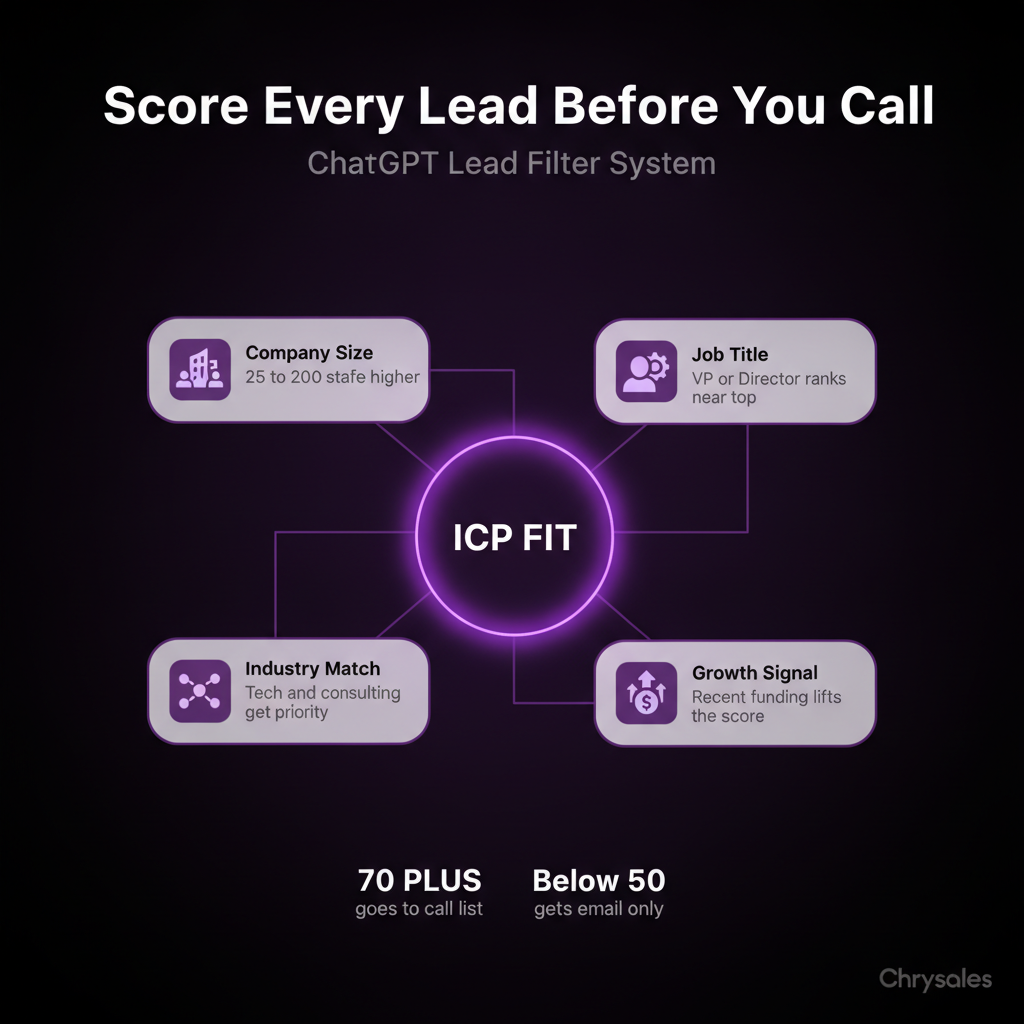
Give ChatGPT a scoring rubric. Something like: "Score leads based on company size (25-200 employees = higher), job title (VP or Director = higher), industry match (tech/consulting = higher), recent funding or growth signals (higher)." Then paste your list and let it run.
Pro Tip: Set a rule where anything scoring above 70 goes straight to your call list. Everything below 50 gets a quick email instead of a call. Saves hours every week.
Why This Works for B2B Sales
You're not guessing anymore. A 200-person company that just did layoffs? That's a bad fit, full stop. ChatGPT spots it faster than you can. One consulting firm we worked with cut their outreach list by 40% using this method. Their reply rate jumped from 2% to 6% because they stopped wasting time on dead ends.
Turn ChatGPT Into Your Personal Cold Email Writer Who Never Gets Tired
Writing cold emails sucks. Writing 50 personalized cold emails really sucks. ChatGPT can do the heavy lifting if you give it the right instructions. Don't just say "write me a cold email." That gets you generic junk. Instead, give it a role, a goal, and a sample.
Try this: "Act like a B2B sales expert. Write a 90-word cold email to a marketing director at a 40-person agency. Mention their recent blog post about SEO strategy. Offer a 15-minute call to discuss lead generation systems. Keep it casual and direct."
The Formula That Works Every Time
Use this structure in your ChatGPT prompts:
- Role: "Act like [specific expert type]"
- Context: "Writing to [specific person/role] at [specific company type]"
- Hook: "Reference [something real about them]"
- Offer: "Propose [specific low-commitment next step]"
- Tone: "Keep it [casual/professional/funny]"
Watch out: ChatGPT loves to add fluff. Always cut the first sentence if it starts with "I hope this email finds you well" or anything similar. Get to the point fast.
Build a Sales Script Library in 10 Minutes
Every sales call has the same 6-7 questions you ask over and over. Discovery calls, demo calls, closing calls. They follow patterns. ChatGPT can write those scripts faster than you can order lunch.
Prompt it like this: "Write a discovery call script for a B2B sales call with a tech company. Include 8 open-ended questions about their current sales process, pain points, and goals. Make it conversational, not robotic."
How to Make It Sound Like You
Once ChatGPT spits out the script, read it out loud. Mark the parts that sound weird. Then tell ChatGPT: "Make this sound more casual. Remove the corporate language." It'll rewrite it. Repeat until it sounds like something you'd actually say.
A 30-person consulting firm tried this last quarter. They built scripts for every stage of their pipeline in one afternoon. New hires got up to speed in days instead of weeks because they had a playbook to follow.
Use ChatGPT to Handle Objections Before They Kill Your Deal

Objections kill deals. "It's too expensive." "We need to think about it." "Can you send me more info?" Most sales reps freeze when they hear these. ChatGPT can prep you with 10 different responses for every common objection.
Try this: "List 10 objections a marketing agency might have about investing in sales training. Then write 3 responses for each that reframe the objection without being pushy."
Practice Mode: Role-Play With ChatGPT
Here's a wild one: use ChatGPT as a fake prospect. Tell it: "Act like a skeptical marketing director who thinks they don't need help with B2B lead generation. I'm going to pitch you. Push back on everything I say." Then practice. ChatGPT will throw objections at you. You respond. It counters. You learn what works without burning a real opportunity.
Common mistake: Teams write objection responses and never practice them. Writing them down is 10% of the work. Saying them out loud until they feel natural is the other 90%.
Generate a Full Sales Process Map in One Prompt
Most teams build a 40-step workflow when 12 steps would do the job. ChatGPT can map out your entire sales process from first contact to closed deal.
Ask it: "Map out a 10-step B2B sales process for a consulting firm that sells to tech companies. Start from cold outreach and end at contract signed. Include what happens at each step and who's responsible."
Turn the Map Into a Checklist
Once you have the steps, ask ChatGPT to turn each one into a checklist. "For step 3 (discovery call), create a 5-item checklist a salesperson should complete before moving to step 4." Now you have a system. New hires follow it. You audit it. Deals stop falling through the cracks because everyone knows what comes next.
Write Your Entire Follow-Up Sequence in 20 Minutes
Following up is where most deals get won or lost. You send one email after the call, maybe two, then you give up. ChatGPT can write a 7-email follow-up sequence in one shot.
Prompt: "Write a 7-email follow-up sequence for a B2B sales prospect who went cold after a discovery call. Space them out over 3 weeks. Mix value-driven content with soft asks to reconnect. Keep each email under 80 words."
Make It Feel Human
ChatGPT's first draft will sound a little robotic. Tell it: "Rewrite email 3 to sound like a text message from a friend checking in." That's the tone you want. Casual, helpful, not desperate.
Pro Tip: Don't send all 7 emails to every prospect. If someone replies on email 2, stop the sequence. Sounds obvious, but you'd be shocked how many teams mess this up with automation, which is why cold email follow-up templates that you can customize work better than generic sequences.
Use ChatGPT to Build Your ICP in Under an Hour
Your Ideal Customer Profile is the foundation of everything. Bad ICP means bad leads, bad sales calls, bad close rates. ChatGPT can help you nail it down fast.
Ask it: "Help me define an Ideal Customer Profile for a B2B sales coaching service. Ask me 10 questions about my best clients, then summarize the ICP based on my answers." Answer its questions. ChatGPT will spit out a clean ICP summary with company size, industry, job titles, pain points, and buying signals. Use that as your targeting filter for everything.
Test Your ICP With Real Data
Once you have the ICP, paste in a list of your last 20 clients. Ask ChatGPT: "Which of these clients match the ICP we just built? Which ones don't? What patterns do you see?" It'll spot things you missed. Like, "8 of your best clients were tech companies with 30-80 employees who just raised a Series A." That's gold, and you can watch how top sales teams identify their ideal clients and find prospects who need your services right now to see this process in action.
Create Onboarding Documents for New Sales Hires in Minutes
Hiring a salesperson without training them is like handing someone car keys and saying "figure out how to drive." Most companies skip this because writing training docs takes forever. ChatGPT does it in 10 minutes.
Prompt: "Write a 1-page onboarding doc for a new sales rep. Cover: our ICP, our sales process, common objections, and how to book the first call. Make it simple and actionable."
Add Real Examples to Make It Stick
The first draft will be generic. Tell ChatGPT: "Add 3 real examples of successful cold emails we've sent." Paste in your best emails. It'll weave them into the doc. Now your new hire has templates to copy, not just theory to read.
One marketing agency we know hired three salespeople last month. Two were making calls by day three because the onboarding doc had every answer they needed.
Use ChatGPT to Rewrite Weak Offers Into No-Brainer Deals
Your offer is the menu. Your sales call is the waiter. If the menu is confusing, the waiter has no chance. ChatGPT can help you sharpen your positioning.
Try this: "Here's my current offer: [paste your offer]. Rewrite it to sound more specific, more valuable, and easier to say yes to. Focus on outcomes, not features."
Test Five Versions Before You Pick One
Ask ChatGPT to generate five different versions of your offer. Read them all. Pick the one that makes you think, "I'd buy that." Then test it on real prospects for two weeks. If close rates go up, keep it.
Watch out: ChatGPT loves to oversell. If your rewritten offer sounds too good to be true, it probably is. Dial it back until it feels honest.
Turn Meeting Notes Into Action Items in Seconds
Sales calls generate a ton of notes. Most reps write them down and never look at them again. ChatGPT can turn messy notes into a clean action plan.
After a call, paste your notes into ChatGPT and say: "Summarize these notes into 5 bullet points. Then list 3 action items I should do this week to move this deal forward."
Auto-Generate Follow-Up Emails From Your Notes
Here's a killer move: after ChatGPT summarizes your notes, ask it: "Write a follow-up email to the prospect based on these notes. Reference the 2 biggest pain points they mentioned and propose next steps." You're done in 60 seconds. The email is personalized because it's based on what they actually said. Your prospect feels heard. You look sharp.
Build a Cold Outreach List From Scratch Using ChatGPT Prompts
List building is the worst part of sales. You need names, emails, company info, and signals that someone's actually a fit. ChatGPT can't scrape data (it's not a tool for that), but it can help you build the search strategy and write the boolean strings you need for LinkedIn or sales tools.
Ask it: "Write 5 LinkedIn boolean search strings to find VPs of Sales at tech companies with 50-200 employees in the US who posted about hiring in the last 30 days."
Turn Raw Prospect Data Into Outreach-Ready Lists
Once you pull a list of prospects from LinkedIn or a database, paste it into ChatGPT. Say: "Clean this list. Remove duplicates, flag anyone with a generic title like 'Manager,' and rank the rest by seniority." It won't be perfect, but it's 80% faster than doing it by hand.
Use ChatGPT to Research Prospects in Bulk Before Calls
Picture this: you have 12 discovery calls this week. You know you should research each prospect before the call, but who has time for that? ChatGPT does.
Paste a prospect's LinkedIn profile summary and company website copy into ChatGPT. Ask: "Summarize this person's role and their company's focus in 3 sentences. Then suggest 2 pain points they likely have based on their industry."
Create a Pre-Call Brief Template
Set up a repeatable template. Every time you have a call, paste the prospect's info into ChatGPT and say: "Fill out this pre-call brief: [Name], [Company], [Role], [2 likely pain points], [1 personalized hook for my opening]."
Pro Tip: Do this for all 12 calls on Sunday night. Save each brief in a doc. Walk into Monday with every call prepped. Your close rate will jump because you sound like you actually know who you're talking to.
Let ChatGPT Write Your Sales Proposals So You Don't Have To
Proposals take hours. You copy an old one, change the names, tweak the numbers, and hope it doesn't look recycled. ChatGPT can write a solid first draft in 5 minutes.
Prompt: "Write a 2-page sales proposal for a B2B lead generation service. Client is a 50-person marketing agency. They need 20 qualified leads per month. Pricing is $3K/month. Include: problem statement, solution overview, deliverables, timeline, and next steps."
Customize It Without Starting From Scratch
Once ChatGPT drafts the proposal, you tweak the specifics. Add real client names (if you have permission). Swap in exact numbers. Adjust the tone. You're not writing from zero anymore. You're editing, which is 10x faster.
One tech company we worked with cut proposal turnaround time from 3 days to 4 hours using this method. Their close rate didn't drop. Speed just isn't a quality killer if the content is solid.
Use ChatGPT to Write LinkedIn Posts That Actually Get Seen
B2B sales and LinkedIn go together like coffee and mornings. But most LinkedIn posts flop because they're boring or too salesy. ChatGPT can help you write posts that people actually read.
Try: "Write a 150-word LinkedIn post about a mistake most B2B companies make with lead generation. Make it punchy and end with a question to drive comments."
Turn One Post Into Five Different Formats
Ask ChatGPT: "Rewrite this LinkedIn post as: (1) a story, (2) a list, (3) a controversial opinion, (4) a step-by-step tip, (5) a question to the audience." Now you have five posts instead of one. Test them. See which format gets the most engagement. Double down on what works.
Common mistake: People write LinkedIn posts and disappear. The real magic happens in the comments. ChatGPT can even help you write 10 thoughtful replies to use when people comment on your posts.
Build a Custom Sales Playbook in One Afternoon
A good sales system is like a recipe. Follow the steps, get the same result every time. But writing a playbook from scratch is brutal. ChatGPT makes it manageable.
Ask: "Help me build a sales playbook for a B2B sales team selling to consulting firms. Include: ICP definition, outreach strategy, discovery call script, objection handling, proposal template, and follow-up process. Keep each section under 200 words."
Add Your Own Voice to the Playbook
ChatGPT's first draft will be solid but generic. Go through it and add examples from real deals you closed. Add the exact phrases that work for you. Turn "handle objections with empathy" into "when they say it's too expensive, I always say: 'I get it. Let me ask you this. What's it costing you to not fix this problem?'" That's the difference between a playbook people skim and one they actually use, and you can learn more about applying AI tools to sales materials in this AI sales enablement guide for onboarding, scripts, and proposals.
Have ChatGPT Audit Your Sales Process for Weak Spots
Most sales processes have leaks. Deals stall at a certain stage. Follow-ups don't happen. Proposals sit in inboxes for weeks. ChatGPT can help you spot the weak spots if you ask it the right way.
Describe your current process step-by-step. Then ask: "Where are the most common places deals stall in this process? For each weak spot, suggest one fix."
Run a Gap Analysis on Your Current System
If you're more advanced, feed ChatGPT your CRM data (numbers only, no names). Say: "Here's my pipeline data: 100 leads, 40 discovery calls, 15 proposals sent, 3 closed. What stage has the biggest drop-off? Why might that be happening?" It'll give you hypotheses. Test them. Fix the leaks. Watch your close rate climb.
Use ChatGPT to Prep for Tough Negotiations
Negotiations make most salespeople sweat. You don't know what the prospect will ask for. You don't want to give too much away. ChatGPT can run you through practice scenarios before the real call.
Ask: "I'm negotiating a $50K deal with a tech company. They'll probably ask for a discount, a longer payment plan, and extra deliverables. Roleplay this with me. You're the prospect. Push back hard."
Build a Negotiation Cheat Sheet
After the roleplay, ask ChatGPT: "Based on that practice negotiation, write a 1-page cheat sheet with: 3 concessions I can offer, 3 things I should never give away, and 5 phrases to use when they ask for a discount." Walk into the real negotiation with that cheat sheet open on your screen. You'll sound calm and ready because you practiced.
Generate Client Onboarding Checklists That Make You Look Pro
You close the deal. Congrats. Now what? Most companies fumble the onboarding. Clients get confused. Expectations don't match. The relationship starts rocky. ChatGPT can write a clean onboarding checklist in 2 minutes.
Try: "Write a 10-step onboarding checklist for a new B2B sales coaching client. Include: kickoff call, account setup, discovery workshop, system audit, first action plan, and weekly check-ins."
Send It to Clients the Day They Sign
The second the contract is signed, send the checklist. It shows you're organized. It sets expectations. It makes clients feel like they made the right choice.
Pro Tip: Ask ChatGPT to write a short welcome email to go with the checklist. "Write a 60-word welcome email for a new client. Thank them, include the onboarding checklist, and set a date for the kickoff call."
Create a Library of Sales Email Templates for Every Situation
You need different emails for different moments. Cold outreach. Post-demo follow-up. Proposal sent, no reply. Deal going cold. ChatGPT can write all of them at once.
Ask: "Write 10 B2B sales email templates: (1) cold intro, (2) post-discovery follow-up, (3) proposal reminder, (4) re-engagement after silence, (5) referral request, (6) thank you after close, (7) calendar invite for next call, (8) case study share, (9) price objection response, (10) timeline objection response. Keep each under 100 words."
Save Them Where Your Team Can Actually Find Them
Drop all 10 templates into a shared doc. Your whole team uses them. Consistency goes up. Quality stays high even when someone's having an off day.
One sales training company we know built a library of 20 templates. New hires stopped asking "what do I say?" every 10 minutes because the answer was already written, and their outreach improved dramatically once they learned how to write cold emails that get replies.
Ask ChatGPT to Simplify Complex Offers Into One-Liners
If you can't explain your offer in one sentence, your prospects definitely can't either. ChatGPT is great at boiling down complicated services into simple language.
Paste your full offer description into ChatGPT. Then say: "Simplify this into one sentence a 10-year-old could understand."
Test Your One-Liner in Real Conversations
Take the simplified version ChatGPT gave you. Use it on the next 5 sales calls. If prospects nod and ask follow-up questions, keep it. If they look confused, go back to ChatGPT and say: "That version didn't land. Simplify it even more."
Watch out: Simple doesn't mean vague. "We help companies grow" is simple but useless. "We build systems that book 15 sales calls per month" is simple and clear.
Use ChatGPT to Write Case Studies That Sell Without Sounding Salesy
Case studies are proof. But most sound like corporate reports. ChatGPT can help you write ones that actually get read.
Prompt: "Write a 300-word case study about a marketing agency that went from 5 sales calls per month to 20 using a new lead generation system. Use this structure: problem, solution, result. Make it conversational, not formal."
Drop Real Numbers and Specific Details
The more specific the case study, the more believable it is. "Increased revenue" is weak. "Went from $30K/month to $65K/month in 90 days" is strong. Feed ChatGPT real numbers. It'll weave them into the story.
Send case studies to prospects right after discovery calls. "Here's a company that had the exact same problem you mentioned. Here's what we built for them." Simple. Effective.
Let ChatGPT Help You Build a Simple CRM Workflow (Even Without a CRM)
Not every team has a fancy CRM. ChatGPT can help you build a lightweight system in a Google Sheet or Notion that actually works.
Ask: "Design a simple sales pipeline tracking system for a 5-person sales team. Include: lead source, contact info, stage, last touch date, next action, and deal value. Format it as a table."
Turn the Table Into a Process
Once you have the structure, ask ChatGPT: "Write 5 rules this team should follow to keep the pipeline clean. Example: update stage after every call, add notes within 24 hours, mark deals dead after 60 days of no reply." Now you have a system. It's not perfect, but it's 100x better than sticky notes and memory, and if you want to see this integrated into a full workflow, watch how AI sales systems bring in record revenue with unlimited demand through automation and smart processes.
Have ChatGPT Rewrite Your Boring Outreach Into Something People Actually Reply To
Most cold emails die because they're boring. No personality. No reason to care. ChatGPT can take your flat message and turn it into something that gets replies.
Paste your current cold email into ChatGPT. Say: "Rewrite this to be more engaging, more specific, and shorter. Add one sentence that references something real about the prospect's company."
A/B Test the Old Version vs. ChatGPT's Version
Send 20 emails with your old message. Send 20 with ChatGPT's rewrite. Track replies. Whichever wins becomes your new baseline. Repeat every month. Your outreach gets better over time without you having to be a copywriting genius, and the results align with what cold email statistics show about personalization and response rates in B2B outreach.
Frequently Asked Questions
Q: Can ChatGPT actually replace a salesperson or sales coach?
No. ChatGPT is a tool, not a human. It can write scripts, draft emails, and map processes, but it can't read a room on a sales call or adapt in real time when a prospect throws a curveball. Think of it like a calculator. Super useful for doing math fast, but it doesn't understand why the math matters. Sales coaching is about judgment, experience, and feel. ChatGPT supports that. It doesn't replace it.
Q: How do I get ChatGPT to stop sounding so robotic?
Tell it exactly how you want it to sound. Instead of "write an email," say "write an email that sounds like a friend texting, not a marketer pitching." After it gives you the first draft, give feedback: "Make this less formal," "Cut the fluff," "Sound more direct." The more specific you are, the better the output. Also, always read the final version out loud and tweak anything that sounds off.
Q: Is it okay to use ChatGPT-generated content in client-facing emails and proposals?
Yes, as long as you review and personalize it first. Never copy-paste ChatGPT output directly into a client email. Read it, check for mistakes, add details only you know (like their company name, a specific pain point from your call, or a real number). ChatGPT gives you the 80% draft. You add the 20% that makes it feel human and accurate.
Q: What's the biggest mistake people make when using ChatGPT for sales?
They use it like Google. They ask one vague question, get one vague answer, and give up. The real power comes from having a conversation with it. Ask a question. Review the answer. Then say "make this shorter," "add an example," "rewrite this for a skeptical prospect." The second and third prompts are where the magic happens. Treat it like a back-and-forth, not a one-shot tool, and for a deeper dive on this, check out how B2B sales teams are using AI in 2026 to transform their workflows.
Q: Do I need the paid version of ChatGPT or is the free version enough?
The free version works fine for most of these hacks. The paid version (ChatGPT Plus) is faster, handles longer inputs, and doesn't have usage limits during peak times. If you're using ChatGPT multiple times a day for client work, proposals, and scripts, the paid version is worth it. If you're just testing it out once or twice a week, free is plenty to start.
Chat gpt hacks are simple ways to use AI for lead generation, b2b sales, sales training, client acquisition, and other everyday business tasks. Most teams use ChatGPT like a fancy search engine. They type a question, get an answer, and call it a day. That's like buying a sports car and only driving it to the grocery store.
The real power shows up when you treat ChatGPT like a business partner who never sleeps, never complains, and can handle the boring stuff you hate doing. We're talking about chat gpt tricks that actually move the needle on B2B sales, lead generation, and client acquisition.
Use ChatGPT to Score Your Leads Before You Even Pick Up the Phone
Here's the thing: most cold outreach dies because the list is garbage, not because the message is weak. You can write the best email in the world, but if you're sending it to someone who left their job six months ago or works in the wrong department, you're toast.
ChatGPT can help you build a simple lead scoring system. Feed it your ICP criteria, then paste in a list of prospects with their job titles, company info, and any notes you scraped from LinkedIn. Ask it to score each lead from 1 to 100 based on fit.
How to Set This Up
Give ChatGPT a scoring rubric. Something like: "Score leads based on company size (25-200 employees = higher), job title (VP or Director = higher), industry match (tech/consulting = higher), recent funding or growth signals (higher)." Then paste your list and let it run.
Pro Tip: Set a rule where anything scoring above 70 goes straight to your call list. Everything below 50 gets a quick email instead of a call. Saves hours every week.
Why This Works for B2B Sales
You're not guessing anymore. A 200-person company that just did layoffs? That's a bad fit, full stop. ChatGPT spots it faster than you can. One consulting firm we worked with cut their outreach list by 40% using this method. Their reply rate jumped from 2% to 6% because they stopped wasting time on dead ends.
Turn ChatGPT Into Your Personal Cold Email Writer Who Never Gets Tired
Writing cold emails sucks. Writing 50 personalized cold emails really sucks. ChatGPT can do the heavy lifting if you give it the right instructions. Don't just say "write me a cold email." That gets you generic junk. Instead, give it a role, a goal, and a sample.
Try this: "Act like a B2B sales expert. Write a 90-word cold email to a marketing director at a 40-person agency. Mention their recent blog post about SEO strategy. Offer a 15-minute call to discuss lead generation systems. Keep it casual and direct."
The Formula That Works Every Time
Use this structure in your ChatGPT prompts:
- Role: "Act like [specific expert type]"
- Context: "Writing to [specific person/role] at [specific company type]"
- Hook: "Reference [something real about them]"
- Offer: "Propose [specific low-commitment next step]"
- Tone: "Keep it [casual/professional/funny]"
Watch out: ChatGPT loves to add fluff. Always cut the first sentence if it starts with "I hope this email finds you well" or anything similar. Get to the point fast.
Build a Sales Script Library in 10 Minutes
Every sales call has the same 6-7 questions you ask over and over. Discovery calls, demo calls, closing calls. They follow patterns. ChatGPT can write those scripts faster than you can order lunch.
Prompt it like this: "Write a discovery call script for a B2B sales call with a tech company. Include 8 open-ended questions about their current sales process, pain points, and goals. Make it conversational, not robotic."
How to Make It Sound Like You
Once ChatGPT spits out the script, read it out loud. Mark the parts that sound weird. Then tell ChatGPT: "Make this sound more casual. Remove the corporate language." It'll rewrite it. Repeat until it sounds like something you'd actually say.
A 30-person consulting firm tried this last quarter. They built scripts for every stage of their pipeline in one afternoon. New hires got up to speed in days instead of weeks because they had a playbook to follow.
Use ChatGPT to Handle Objections Before They Kill Your Deal
Objections kill deals. "It's too expensive." "We need to think about it." "Can you send me more info?" Most sales reps freeze when they hear these. ChatGPT can prep you with 10 different responses for every common objection.
Try this: "List 10 objections a marketing agency might have about investing in sales training. Then write 3 responses for each that reframe the objection without being pushy."
Practice Mode: Role-Play With ChatGPT
Here's a wild one: use ChatGPT as a fake prospect. Tell it: "Act like a skeptical marketing director who thinks they don't need help with B2B lead generation. I'm going to pitch you. Push back on everything I say." Then practice. ChatGPT will throw objections at you. You respond. It counters. You learn what works without burning a real opportunity.
Common mistake: Teams write objection responses and never practice them. Writing them down is 10% of the work. Saying them out loud until they feel natural is the other 90%.
Generate a Full Sales Process Map in One Prompt
Most teams build a 40-step workflow when 12 steps would do the job. ChatGPT can map out your entire sales process from first contact to closed deal.
Ask it: "Map out a 10-step B2B sales process for a consulting firm that sells to tech companies. Start from cold outreach and end at contract signed. Include what happens at each step and who's responsible."
Turn the Map Into a Checklist
Once you have the steps, ask ChatGPT to turn each one into a checklist. "For step 3 (discovery call), create a 5-item checklist a salesperson should complete before moving to step 4." Now you have a system. New hires follow it. You audit it. Deals stop falling through the cracks because everyone knows what comes next.
Write Your Entire Follow-Up Sequence in 20 Minutes
Following up is where most deals get won or lost. You send one email after the call, maybe two, then you give up. ChatGPT can write a 7-email follow-up sequence in one shot.
Prompt: "Write a 7-email follow-up sequence for a B2B sales prospect who went cold after a discovery call. Space them out over 3 weeks. Mix value-driven content with soft asks to reconnect. Keep each email under 80 words."
Make It Feel Human
ChatGPT's first draft will sound a little robotic. Tell it: "Rewrite email 3 to sound like a text message from a friend checking in." That's the tone you want. Casual, helpful, not desperate.
Pro Tip: Don't send all 7 emails to every prospect. If someone replies on email 2, stop the sequence. Sounds obvious, but you'd be shocked how many teams mess this up with automation, which is why cold email follow-up templates that you can customize work better than generic sequences.
Use ChatGPT to Build Your ICP in Under an Hour
Your Ideal Customer Profile is the foundation of everything. Bad ICP means bad leads, bad sales calls, bad close rates. ChatGPT can help you nail it down fast.
Ask it: "Help me define an Ideal Customer Profile for a B2B sales coaching service. Ask me 10 questions about my best clients, then summarize the ICP based on my answers." Answer its questions. ChatGPT will spit out a clean ICP summary with company size, industry, job titles, pain points, and buying signals. Use that as your targeting filter for everything.
Test Your ICP With Real Data
Once you have the ICP, paste in a list of your last 20 clients. Ask ChatGPT: "Which of these clients match the ICP we just built? Which ones don't? What patterns do you see?" It'll spot things you missed. Like, "8 of your best clients were tech companies with 30-80 employees who just raised a Series A." That's gold, and you can watch how top sales teams identify their ideal clients and find prospects who need your services right now to see this process in action.
Create Onboarding Documents for New Sales Hires in Minutes
Hiring a salesperson without training them is like handing someone car keys and saying "figure out how to drive." Most companies skip this because writing training docs takes forever. ChatGPT does it in 10 minutes.
Prompt: "Write a 1-page onboarding doc for a new sales rep. Cover: our ICP, our sales process, common objections, and how to book the first call. Make it simple and actionable."
Add Real Examples to Make It Stick
The first draft will be generic. Tell ChatGPT: "Add 3 real examples of successful cold emails we've sent." Paste in your best emails. It'll weave them into the doc. Now your new hire has templates to copy, not just theory to read.
One marketing agency we know hired three salespeople last month. Two were making calls by day three because the onboarding doc had every answer they needed.
Use ChatGPT to Rewrite Weak Offers Into No-Brainer Deals
Your offer is the menu. Your sales call is the waiter. If the menu is confusing, the waiter has no chance. ChatGPT can help you sharpen your positioning.
Try this: "Here's my current offer: [paste your offer]. Rewrite it to sound more specific, more valuable, and easier to say yes to. Focus on outcomes, not features."
Test Five Versions Before You Pick One
Ask ChatGPT to generate five different versions of your offer. Read them all. Pick the one that makes you think, "I'd buy that." Then test it on real prospects for two weeks. If close rates go up, keep it.
Watch out: ChatGPT loves to oversell. If your rewritten offer sounds too good to be true, it probably is. Dial it back until it feels honest.
Turn Meeting Notes Into Action Items in Seconds
Sales calls generate a ton of notes. Most reps write them down and never look at them again. ChatGPT can turn messy notes into a clean action plan.
After a call, paste your notes into ChatGPT and say: "Summarize these notes into 5 bullet points. Then list 3 action items I should do this week to move this deal forward."
Auto-Generate Follow-Up Emails From Your Notes
Here's a killer move: after ChatGPT summarizes your notes, ask it: "Write a follow-up email to the prospect based on these notes. Reference the 2 biggest pain points they mentioned and propose next steps." You're done in 60 seconds. The email is personalized because it's based on what they actually said. Your prospect feels heard. You look sharp.
Build a Cold Outreach List From Scratch Using ChatGPT Prompts
List building is the worst part of sales. You need names, emails, company info, and signals that someone's actually a fit. ChatGPT can't scrape data (it's not a tool for that), but it can help you build the search strategy and write the boolean strings you need for LinkedIn or sales tools.
Ask it: "Write 5 LinkedIn boolean search strings to find VPs of Sales at tech companies with 50-200 employees in the US who posted about hiring in the last 30 days."
Turn Raw Prospect Data Into Outreach-Ready Lists
Once you pull a list of prospects from LinkedIn or a database, paste it into ChatGPT. Say: "Clean this list. Remove duplicates, flag anyone with a generic title like 'Manager,' and rank the rest by seniority." It won't be perfect, but it's 80% faster than doing it by hand.
Use ChatGPT to Research Prospects in Bulk Before Calls
Picture this: you have 12 discovery calls this week. You know you should research each prospect before the call, but who has time for that? ChatGPT does.
Paste a prospect's LinkedIn profile summary and company website copy into ChatGPT. Ask: "Summarize this person's role and their company's focus in 3 sentences. Then suggest 2 pain points they likely have based on their industry."
Create a Pre-Call Brief Template
Set up a repeatable template. Every time you have a call, paste the prospect's info into ChatGPT and say: "Fill out this pre-call brief: [Name], [Company], [Role], [2 likely pain points], [1 personalized hook for my opening]."
Pro Tip: Do this for all 12 calls on Sunday night. Save each brief in a doc. Walk into Monday with every call prepped. Your close rate will jump because you sound like you actually know who you're talking to.
Let ChatGPT Write Your Sales Proposals So You Don't Have To
Proposals take hours. You copy an old one, change the names, tweak the numbers, and hope it doesn't look recycled. ChatGPT can write a solid first draft in 5 minutes.
Prompt: "Write a 2-page sales proposal for a B2B lead generation service. Client is a 50-person marketing agency. They need 20 qualified leads per month. Pricing is $3K/month. Include: problem statement, solution overview, deliverables, timeline, and next steps."
Customize It Without Starting From Scratch
Once ChatGPT drafts the proposal, you tweak the specifics. Add real client names (if you have permission). Swap in exact numbers. Adjust the tone. You're not writing from zero anymore. You're editing, which is 10x faster.
One tech company we worked with cut proposal turnaround time from 3 days to 4 hours using this method. Their close rate didn't drop. Speed just isn't a quality killer if the content is solid.
Use ChatGPT to Write LinkedIn Posts That Actually Get Seen
B2B sales and LinkedIn go together like coffee and mornings. But most LinkedIn posts flop because they're boring or too salesy. ChatGPT can help you write posts that people actually read.
Try: "Write a 150-word LinkedIn post about a mistake most B2B companies make with lead generation. Make it punchy and end with a question to drive comments."
Turn One Post Into Five Different Formats
Ask ChatGPT: "Rewrite this LinkedIn post as: (1) a story, (2) a list, (3) a controversial opinion, (4) a step-by-step tip, (5) a question to the audience." Now you have five posts instead of one. Test them. See which format gets the most engagement. Double down on what works.
Common mistake: People write LinkedIn posts and disappear. The real magic happens in the comments. ChatGPT can even help you write 10 thoughtful replies to use when people comment on your posts.
Build a Custom Sales Playbook in One Afternoon
A good sales system is like a recipe. Follow the steps, get the same result every time. But writing a playbook from scratch is brutal. ChatGPT makes it manageable.
Ask: "Help me build a sales playbook for a B2B sales team selling to consulting firms. Include: ICP definition, outreach strategy, discovery call script, objection handling, proposal template, and follow-up process. Keep each section under 200 words."
Add Your Own Voice to the Playbook
ChatGPT's first draft will be solid but generic. Go through it and add examples from real deals you closed. Add the exact phrases that work for you. Turn "handle objections with empathy" into "when they say it's too expensive, I always say: 'I get it. Let me ask you this. What's it costing you to not fix this problem?'" That's the difference between a playbook people skim and one they actually use, and you can learn more about applying AI tools to sales materials in this AI sales enablement guide for onboarding, scripts, and proposals.
Have ChatGPT Audit Your Sales Process for Weak Spots
Most sales processes have leaks. Deals stall at a certain stage. Follow-ups don't happen. Proposals sit in inboxes for weeks. ChatGPT can help you spot the weak spots if you ask it the right way.
Describe your current process step-by-step. Then ask: "Where are the most common places deals stall in this process? For each weak spot, suggest one fix."
Run a Gap Analysis on Your Current System
If you're more advanced, feed ChatGPT your CRM data (numbers only, no names). Say: "Here's my pipeline data: 100 leads, 40 discovery calls, 15 proposals sent, 3 closed. What stage has the biggest drop-off? Why might that be happening?" It'll give you hypotheses. Test them. Fix the leaks. Watch your close rate climb.
Use ChatGPT to Prep for Tough Negotiations
Negotiations make most salespeople sweat. You don't know what the prospect will ask for. You don't want to give too much away. ChatGPT can run you through practice scenarios before the real call.
Ask: "I'm negotiating a $50K deal with a tech company. They'll probably ask for a discount, a longer payment plan, and extra deliverables. Roleplay this with me. You're the prospect. Push back hard."
Build a Negotiation Cheat Sheet
After the roleplay, ask ChatGPT: "Based on that practice negotiation, write a 1-page cheat sheet with: 3 concessions I can offer, 3 things I should never give away, and 5 phrases to use when they ask for a discount." Walk into the real negotiation with that cheat sheet open on your screen. You'll sound calm and ready because you practiced.
Generate Client Onboarding Checklists That Make You Look Pro
You close the deal. Congrats. Now what? Most companies fumble the onboarding. Clients get confused. Expectations don't match. The relationship starts rocky. ChatGPT can write a clean onboarding checklist in 2 minutes.
Try: "Write a 10-step onboarding checklist for a new B2B sales coaching client. Include: kickoff call, account setup, discovery workshop, system audit, first action plan, and weekly check-ins."
Send It to Clients the Day They Sign
The second the contract is signed, send the checklist. It shows you're organized. It sets expectations. It makes clients feel like they made the right choice.
Pro Tip: Ask ChatGPT to write a short welcome email to go with the checklist. "Write a 60-word welcome email for a new client. Thank them, include the onboarding checklist, and set a date for the kickoff call."
Create a Library of Sales Email Templates for Every Situation
You need different emails for different moments. Cold outreach. Post-demo follow-up. Proposal sent, no reply. Deal going cold. ChatGPT can write all of them at once.
Ask: "Write 10 B2B sales email templates: (1) cold intro, (2) post-discovery follow-up, (3) proposal reminder, (4) re-engagement after silence, (5) referral request, (6) thank you after close, (7) calendar invite for next call, (8) case study share, (9) price objection response, (10) timeline objection response. Keep each under 100 words."
Save Them Where Your Team Can Actually Find Them
Drop all 10 templates into a shared doc. Your whole team uses them. Consistency goes up. Quality stays high even when someone's having an off day.
One sales training company we know built a library of 20 templates. New hires stopped asking "what do I say?" every 10 minutes because the answer was already written, and their outreach improved dramatically once they learned how to write cold emails that get replies.
Ask ChatGPT to Simplify Complex Offers Into One-Liners
If you can't explain your offer in one sentence, your prospects definitely can't either. ChatGPT is great at boiling down complicated services into simple language.
Paste your full offer description into ChatGPT. Then say: "Simplify this into one sentence a 10-year-old could understand."
Test Your One-Liner in Real Conversations
Take the simplified version ChatGPT gave you. Use it on the next 5 sales calls. If prospects nod and ask follow-up questions, keep it. If they look confused, go back to ChatGPT and say: "That version didn't land. Simplify it even more."
Watch out: Simple doesn't mean vague. "We help companies grow" is simple but useless. "We build systems that book 15 sales calls per month" is simple and clear.
Use ChatGPT to Write Case Studies That Sell Without Sounding Salesy
Case studies are proof. But most sound like corporate reports. ChatGPT can help you write ones that actually get read.
Prompt: "Write a 300-word case study about a marketing agency that went from 5 sales calls per month to 20 using a new lead generation system. Use this structure: problem, solution, result. Make it conversational, not formal."
Drop Real Numbers and Specific Details
The more specific the case study, the more believable it is. "Increased revenue" is weak. "Went from $30K/month to $65K/month in 90 days" is strong. Feed ChatGPT real numbers. It'll weave them into the story.
Send case studies to prospects right after discovery calls. "Here's a company that had the exact same problem you mentioned. Here's what we built for them." Simple. Effective.
Let ChatGPT Help You Build a Simple CRM Workflow (Even Without a CRM)
Not every team has a fancy CRM. ChatGPT can help you build a lightweight system in a Google Sheet or Notion that actually works.
Ask: "Design a simple sales pipeline tracking system for a 5-person sales team. Include: lead source, contact info, stage, last touch date, next action, and deal value. Format it as a table."
Turn the Table Into a Process
Once you have the structure, ask ChatGPT: "Write 5 rules this team should follow to keep the pipeline clean. Example: update stage after every call, add notes within 24 hours, mark deals dead after 60 days of no reply." Now you have a system. It's not perfect, but it's 100x better than sticky notes and memory, and if you want to see this integrated into a full workflow, watch how AI sales systems bring in record revenue with unlimited demand through automation and smart processes.
Have ChatGPT Rewrite Your Boring Outreach Into Something People Actually Reply To
Most cold emails die because they're boring. No personality. No reason to care. ChatGPT can take your flat message and turn it into something that gets replies.
Paste your current cold email into ChatGPT. Say: "Rewrite this to be more engaging, more specific, and shorter. Add one sentence that references something real about the prospect's company."
A/B Test the Old Version vs. ChatGPT's Version
Send 20 emails with your old message. Send 20 with ChatGPT's rewrite. Track replies. Whichever wins becomes your new baseline. Repeat every month. Your outreach gets better over time without you having to be a copywriting genius, and the results align with what cold email statistics show about personalization and response rates in B2B outreach.
Frequently Asked Questions
Q: Can ChatGPT actually replace a salesperson or sales coach?
No. ChatGPT is a tool, not a human. It can write scripts, draft emails, and map processes, but it can't read a room on a sales call or adapt in real time when a prospect throws a curveball. Think of it like a calculator. Super useful for doing math fast, but it doesn't understand why the math matters. Sales coaching is about judgment, experience, and feel. ChatGPT supports that. It doesn't replace it.
Q: How do I get ChatGPT to stop sounding so robotic?
Tell it exactly how you want it to sound. Instead of "write an email," say "write an email that sounds like a friend texting, not a marketer pitching." After it gives you the first draft, give feedback: "Make this less formal," "Cut the fluff," "Sound more direct." The more specific you are, the better the output. Also, always read the final version out loud and tweak anything that sounds off.
Q: Is it okay to use ChatGPT-generated content in client-facing emails and proposals?
Yes, as long as you review and personalize it first. Never copy-paste ChatGPT output directly into a client email. Read it, check for mistakes, add details only you know (like their company name, a specific pain point from your call, or a real number). ChatGPT gives you the 80% draft. You add the 20% that makes it feel human and accurate.
Q: What's the biggest mistake people make when using ChatGPT for sales?
They use it like Google. They ask one vague question, get one vague answer, and give up. The real power comes from having a conversation with it. Ask a question. Review the answer. Then say "make this shorter," "add an example," "rewrite this for a skeptical prospect." The second and third prompts are where the magic happens. Treat it like a back-and-forth, not a one-shot tool, and for a deeper dive on this, check out how B2B sales teams are using AI in 2026 to transform their workflows.
Q: Do I need the paid version of ChatGPT or is the free version enough?
The free version works fine for most of these hacks. The paid version (ChatGPT Plus) is faster, handles longer inputs, and doesn't have usage limits during peak times. If you're using ChatGPT multiple times a day for client work, proposals, and scripts, the paid version is worth it. If you're just testing it out once or twice a week, free is plenty to start.
Scaling Is Not Hard If You Have The Right Systems
If you’re serious about leveling up your scaling game, you need the right system, the right training, and the right team behind you. We're here to give you the exact tools and strategies top entrepreneurs use to dominate.

Discover the latest tips
View All.avif)
Chrysales was formed from the words "chrysalis" the stage where a caterpillar transforms into a butterfly and "sales".
It stands for one thing: sales transformation.Because scaling doesn’t happen by doing more of the same. Scaling only happens when you go through real transformation in your systems, your offer, team and the way you sell.
.avif)


