
B2B sales proposal: what to put in it so the buyer can say yes
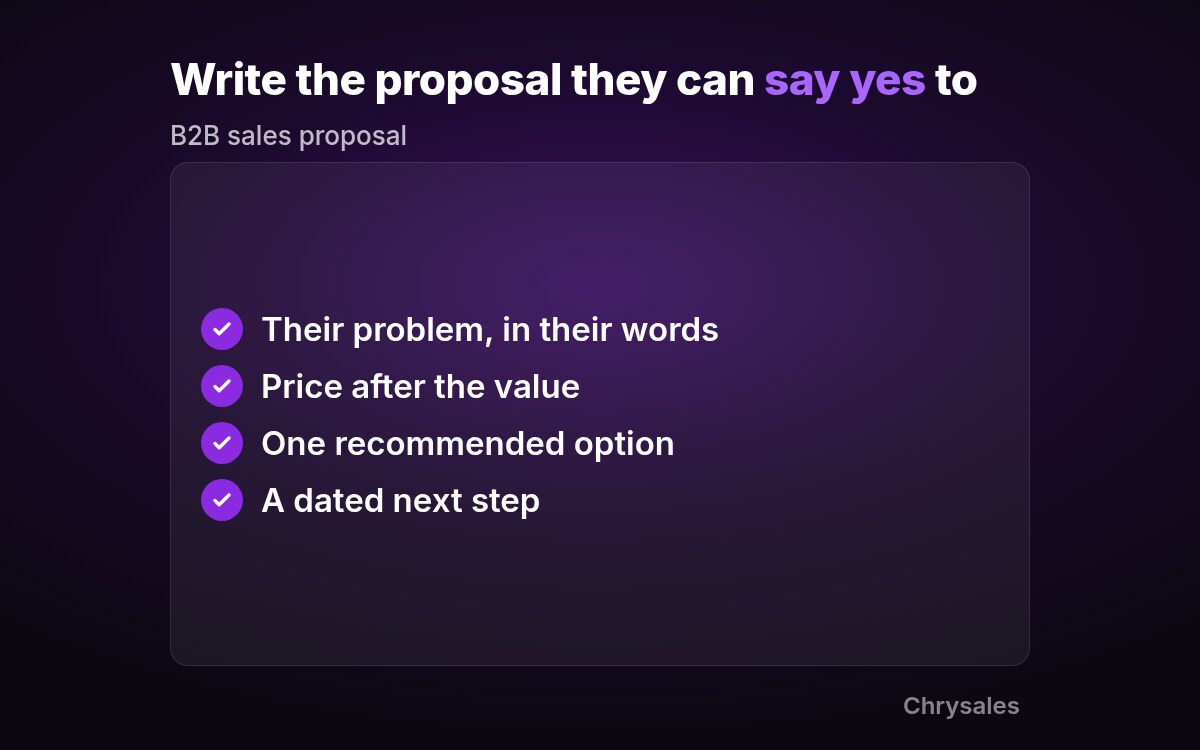
A B2B sales proposal works when it puts in writing what you and the prospect already agreed. That means their problem in their words, the result they want, the scope, the price with two or three options at most, and a dated next step. Keep it short enough for people who missed the conversation, put the price after the value, and present it live to the decision maker instead of emailing it and waiting. If the problem, the budget or the person who signs is still unclear, you aren't ready to write it.
Below you'll find a readiness check, the sections in order, rules for price and options, a plain-text skeleton to copy, a pre-send check and a delivery routine. This post doesn't cover large tenders, proposal software or contract law.
Are you ready to write the proposal yet?
You're ready when three things are settled. The prospect has described the problem and what it costs them in their own words, you have a budget range, and you know who signs and who else will read the document. If one of the three is missing, the proposal becomes a guess. Have another conversation, or send a short written summary without a price.
Run these three checks against your notes from the conversation:
- The problem and its cost. You can write the problem in a sentence they said, and you know what it costs them to leave it as it is. If you're paraphrasing your own pitch back to yourself, you don't have it yet.
- A budget range. They have named a range or reacted to one you gave. A number they have never heard will land in the middle of the document with no context.
- The signer and the readers. You know who signs, and who else reads it on the way to them. Alan Weiss puts the bar for the signer plainly: "A true buyer can move money from one budget to another, or create a new budget" (Weiss, Who Is The Buyer, Anyway?).
The Chrysales view, from the post on when to send a proposal, adds another sign. The prospect can explain your solution back to you in their own words and has introduced you to everyone involved. When you can't tick these yet, the fix sits in the call itself. Here is how to run the discovery call so the proposal only has to confirm it.
Two business advisers make the same point from the cost side in the 2Bobs episode Dealing With the Ghosting Problem. David C. Baker: "The ghosting clock doesn't start until you send a proposal, and you don't send a proposal until you think somebody wants one." Blair Enns: "We need to quit writing proposals for somebody who's merely interested."
If you skip the check, the cost is your evening. One consultant wrote on Hacker News: "Every consulting proposal I write takes 2-4 hours from my life, minimally." That's one person's anecdote, so count your own hours on the last few proposals that went nowhere.
Understanding the prospect comes first, ahead of any document. Sabir's video on the seven levels of sales calls the Pitcher level a trap and labels the move to the Investigator level the biggest jump in all seven. The video is about selling in general and doesn't cover proposals.
What goes in a B2B sales proposal?
You need nine short sections. They cover their situation in their words, the result and how you'll both measure it, what that result is worth to them, the scope and approach, and the options with their price. Then come timing, who does what on both sides, the terms with a validity date, and how to accept. Each section confirms something you already discussed together.
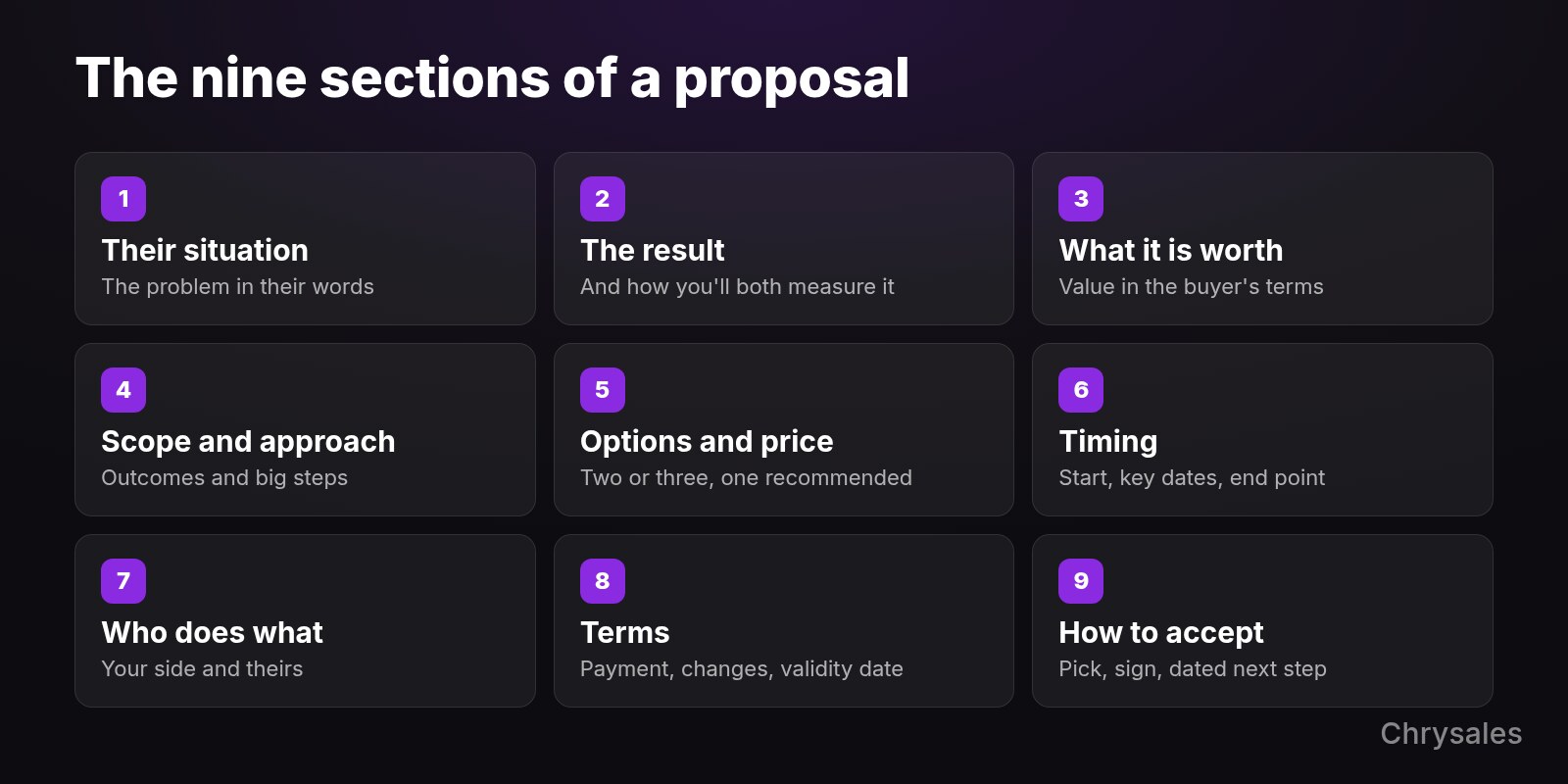
Here are the sections in order, with the job each one does:
- Their situation. The problem in the client's words, plus what it costs them today. The reader should nod at the opening paragraph.
- The result and how you'll measure it. What changes when the work is done, and the measure you both agreed to use.
- What it is worth to them. The value of reaching that result, in the terms they used, such as time saved or revenue protected.
- Scope and approach. What you will do, in outcomes and big steps. Task lists and hours belong in a statement of work.
- Options and price. A small set of options, each with its fee and how it is paid, and the one you recommend.
- Timing. When the work starts, the milestones in between and when it ends.
- Who does what. Your responsibilities and theirs, because a project usually needs time from their people too.
- Terms. Payment terms, what happens if scope changes, and how long the fees stay valid.
- How to accept. Which option they pick, how they sign, and the next step with its day in the calendar.
The order comes from a published format. Alan Weiss, a consultant and author, defines a proposal in How to Write a Short, Effective Proposal. His wording: "It is a written statement of the conceptual agreement already gained in prior discussions with the economic buyer." In his August 2012 newsletter he wrote: "There are nine parts to a proposal, requiring about 2.5 pages, no matter what the size of the project."
His nine parts there are situation appraisal, objectives, metrics, value, methodology and options, timing, joint accountabilities, terms and conditions, and acceptance. Terms cover the fee for each option and how it is paid, and acceptance means choosing an option. His undated hot-tip version lists credentials instead of a separate value section. The list above is adapted from the 2012 version for a B2B sale.
The document has to work without you in the room, because other people read it after you hang up. In a Gartner survey of 632 B2B buyers in 2024, 74% of buyer teams showed unhealthy conflict during the buying decision. Gartner counts conflicting goals, disagreement on what to do and being overruled by outside decision makers as unhealthy conflict (Gartner via BizTechReports). A finance lead who missed both calls should still understand the problem, the result and the price from page one.
It also helps to keep your offer and your proposal apart. Your offer is the standing package: outcome, scope, price and terms. A proposal applies that offer to a single client's numbers and timeline. As the Chrysales post on turning your service into an offer puts it: "If you rewrite the whole thing for each deal, you probably don't have an offer yet."
How long should a B2B sales proposal be?
As short as the decision allows. Weiss keeps his to about 2.5 pages regardless of project size, and HubSpot's editorial advice is that it can be as simple as one page with the contract attached. Put delivery detail, such as task lists and hours, in an appendix or a separate statement of work. The main document only has to carry the decision.
Length grows when a proposal tries to do work the call should have done. If you find yourself explaining the problem for two pages, the prospect probably didn't agree on it yet. If you're listing every task, you're writing the statement of work early.
Not every practitioner lands on the same number. Jonathan Stark, who writes about value pricing, uses a five-page template, with project options as its third section (Stark, Project Options). Five pages that each serve the decision are fine. Fifteen pages written to look thorough only give the reader more to skip on the way to the price.
A simple test: could the signer read page one and know the problem, the result, the recommended option and its price? If yes, the length is working. If they would have to dig, move the detail back.
How do you present price and options?
Put the price after the problem, the value and the scope, so the first number they see sits next to the result you agreed on. Offer two or three options that differ in a way that matters to them, and say which you recommend and why. Leave out menus of add-ons and fake options built only to make another one look good.
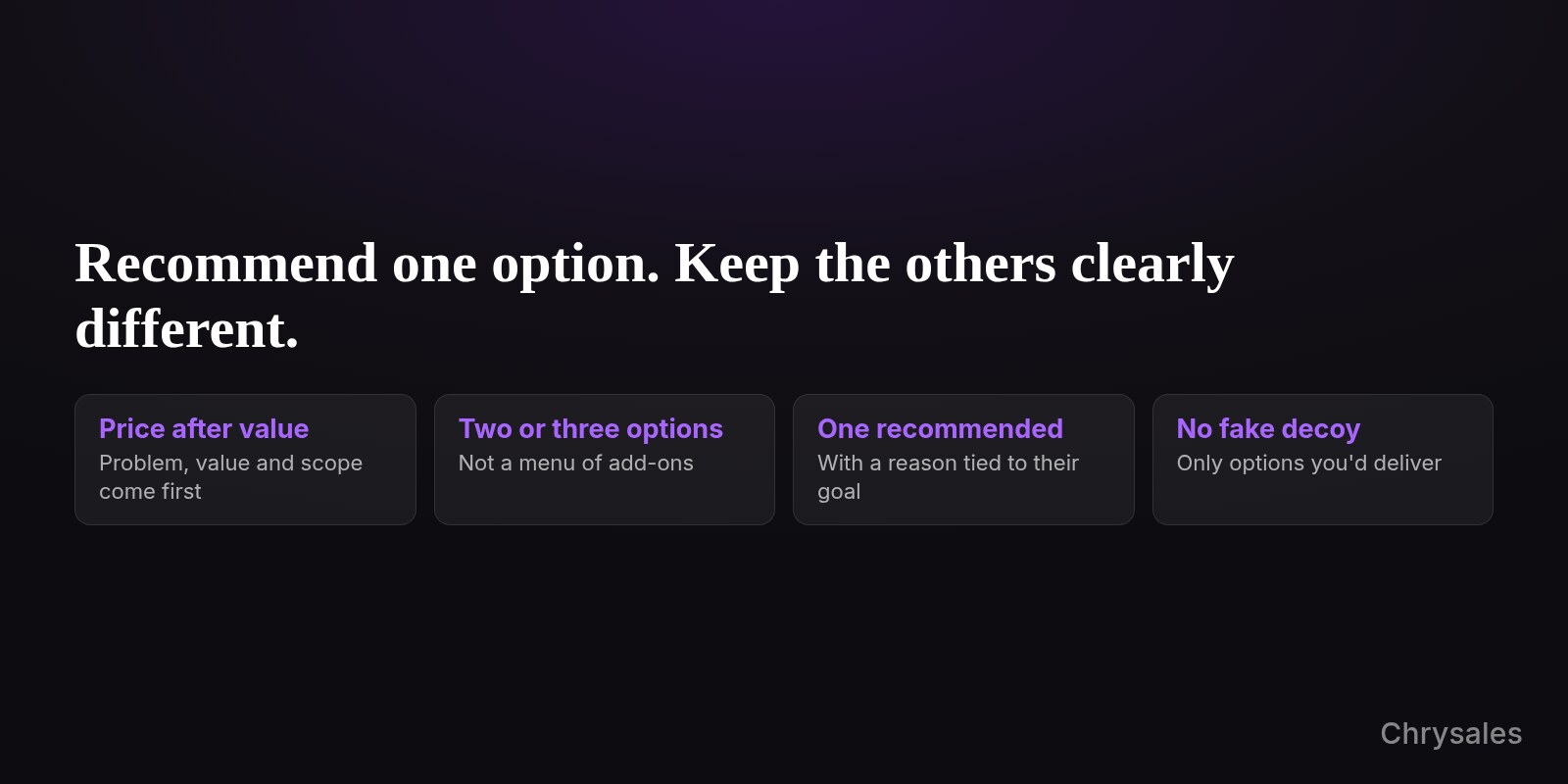
Practitioners disagree on the exact number. Here is what each says:
- Jonathan Stark recommends "three options - no more, no less" (Stark, But what about three-option project proposals?). In his Project Options post he makes them incremental: the second contains the first, and the third contains both. He also warns that a la carte options can be a sign the sales conversation didn't dig deep enough to find the outcome the client wants most (Stark, Project Options).
- Blair Enns: "Three is better than two, four is fine, five, I think you start to introduce the paradox of choice." He adds that he hasn't seen research that puts the line at five. His preferred version: "The highest expression is the idea that your three options represent three different ways of doing business together." (2Bobs, The Perils of Good/Better/Best Pricing)
- Brennan Dunn opens his proposals with the pain behind the project, then the future state. He puts what is at stake in money ahead of his price and always presents more than one offer, two in his example (Dunn, Writing proposals that win you projects).
The research on choice overload is mixed. A meta-analysis of 50 experiments found "a mean effect size of virtually zero but considerable variance between studies" for choice overload (Scheibehenne, Greifeneder and Todd, 2010). A later meta-analysis found overload more likely when the choice is complex, the task is hard, preferences are uncertain and the chooser wants to keep effort low (Chernev, Böckenholt and Goodman, 2015). A B2B purchase usually checks most of those boxes, though that link is our reading of the research and not a finding about proposals.
Matt Dixon, who studied indecision in sales calls, lists offering a personal recommendation and limiting purchase exploration among the behaviors that help customers decide (CustomerThink interview). So mark one option as your recommendation and explain it in a sentence tied to their goal.
Two more cautions apply. Decoy pricing is shaky. In a 2014 reply, the researchers who first described the decoy effect summarized the critique: it shows up when options are "represented numerically, but not otherwise" (Huber, Payne and Puto, 2014). They still hold that the effect replicates under its original conditions, but it is too fragile to build a proposal on.
Order matters too. Harvard's Program on Negotiation says the first offer on the table has a strong anchoring effect on the negotiation that follows (PON, When to Make the First Offer). So let the price they read follow the value you discussed.
| Approach | When it fits | Main risk |
|---|---|---|
| One price | Scope is fixed and the client asked for exactly that | Nothing to choose except yes, no or a discount |
| Two or three incremental options, one recommended | Most service deals where the client could start smaller or go further | Options that differ only in size can feel padded |
| A la carte menu of add-ons | Rarely; they have already bought from you and add pieces | The client designs the project, and price becomes the whole conversation |
A proposal skeleton you can copy
Copy the skeleton below and fill each line from your call notes. Every heading has a one-line prompt and an example line for a fictional client, a 30-person B2B company whose new clients wait too long for their first deliverable. Replace the bracketed parts with the buyer's own words and numbers. A line you can't fill from what they told you is the question for your next call.
The example company is invented to show the format. It isn't a real company or a Chrysales client, and the skeleton contains no real results.
PROPOSAL FOR [BUYER COMPANY] - prepared for [signer name], [date]
Valid until [date tied to their planned start]

1. YOUR SITUATION
Prompt: the problem in their words, and what it costs today.
Example: "New clients wait [X weeks] before they see anything from us,
and [name] said clients raised it at renewal."

2. THE RESULT WE AGREED ON, AND HOW WE'LL MEASURE IT
Prompt: what changes, and the one or two measures you both accepted.
Example: First deliverable within [X days] of signing, tracked on the
onboarding dashboard [name] already uses.

3. WHAT THAT IS WORTH TO YOU
Prompt: the value in their terms, using the figure they gave you.
Example: You estimated each delayed start costs about [their figure].

4. SCOPE AND APPROACH
Prompt: outcomes and big steps, no task list.
Example: Map the current handover, redesign the first [X] days,
train the two onboarding leads, review after the first cohort.

5. OPTIONS AND INVESTMENT
Prompt: two or three options, each with fee and payment terms; mark one.
Option A - [name]: [scope]. [Fee], [payment terms].
Option B - [name], recommended: Option A plus [what it adds].
          [Fee], [payment terms].
          Why we recommend it: [one sentence tied to their goal].
Option C - [name]: Option B plus [what it adds]. [Fee], [terms].

6. TIMING
Prompt: start date, key dates, end point.
Example: Start [date], first review [date], handover [date].

7. WHO DOES WHAT
Prompt: your side and theirs.
Us: [deliverables, meetings].
You: [named owner], [hours per week], access to [systems] by [date].

8. TERMS
Prompt: payment, scope changes, validity.
Fees are valid until [date]. Changes in scope are agreed in writing
before work on them starts. [Other terms - check with your lawyer.]

9. HOW TO GO AHEAD
Prompt: pick an option, how to sign, the dated next step.
Choose an option and sign below. We meet on [date] to [kickoff step].

Option chosen: ____   Name: ____   Signature: ____   Date: ____
Weiss's 2012 format ends with acceptance in the same spirit: choosing an option also means accepting the terms. Keep your own terms short and have a lawyer check the legal wording once, then reuse it. Once the skeleton works, keep it with the rest of your B2B sales playbook so anyone who sells for you starts from the same document.
Proposal, quote, SOW or contract: which one do you need?
Each document answers a different question. A proposal asks for a decision: problem, result, options and price. A quote prices a defined item, and a statement of work (SOW) spells out delivery once the decision is made, while the contract is the legally binding agreement. Many service deals use a short proposal, then an SOW or contract that the client signs.
| Document | What it does | When you send it | Who signs |
|---|---|---|---|
| Proposal | Confirms the problem and result, and offers options and price | After discovery, once problem, budget and signer are clear | The client, if it includes acceptance |
| Quote | Prices an item or a defined piece of work | When the client already knows exactly what they want | Often nobody; it is accepted with an order |
| Statement of work | Defines deliverables, acceptance and responsibilities | After the client picks an option | Both sides, usually as part of the contract |
| Contract | Makes the agreement legally binding | Together with the SOW or with the accepted proposal | Both sides |
These are working definitions, not legal ones. Some companies merge the proposal, SOW and contract into one signed document. Others run all three separately. Either is fine if each part does its job.
A useful model for the SOW comes from US government purchasing. The US federal acquisition rules (FAR 37.602) ask agencies to describe work in terms of the required results, rather than how it is done or the number of hours (acquisition.gov, FAR 37.602). That rule covers government contracts only, but the habit works in any SOW: write deliverables as results the client can check. Contract terms differ by country, so check them with a lawyer.
How do you deliver the proposal so it gets a decision?
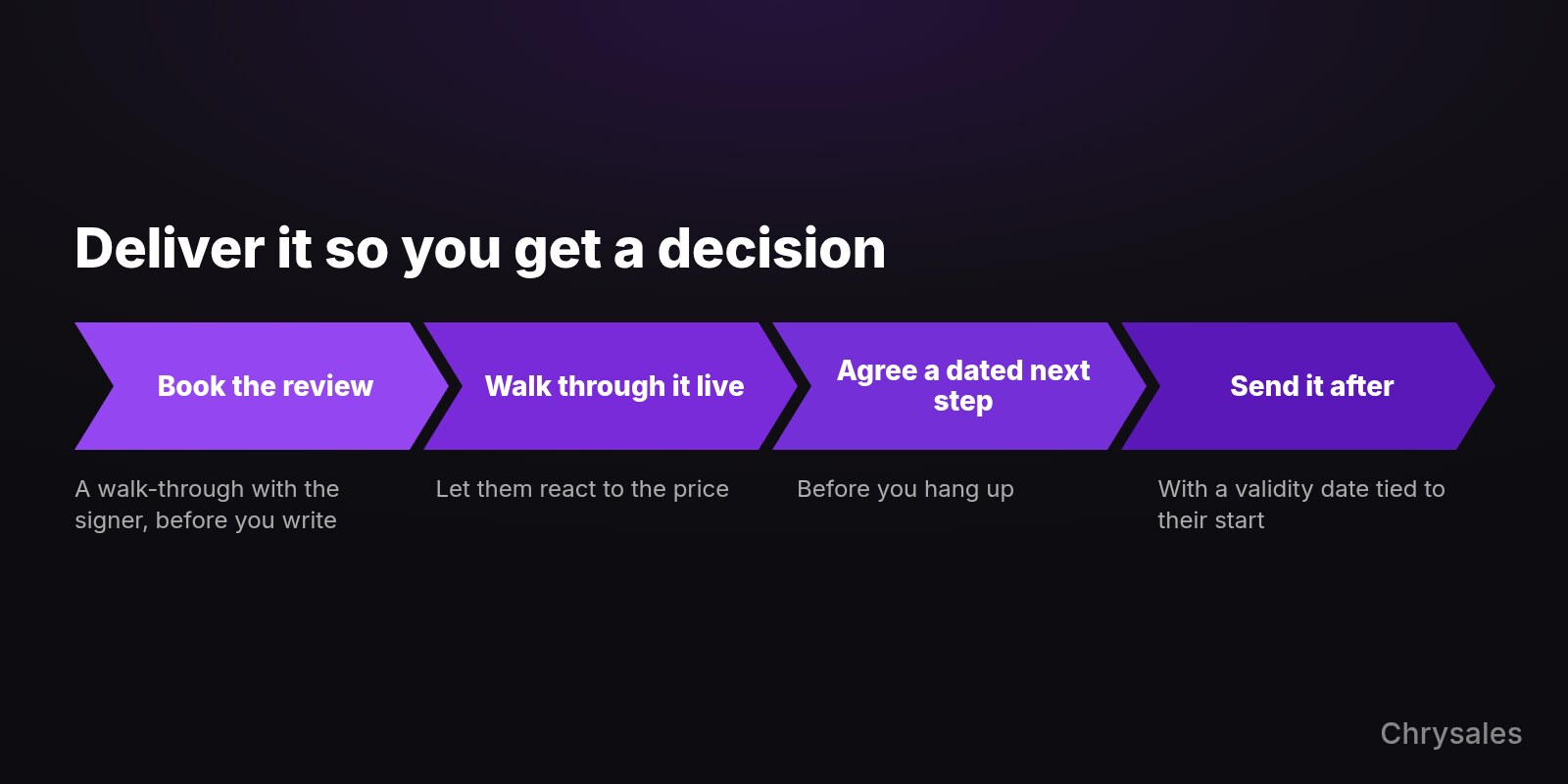
Book a walk-through ahead of sending anything, then go through the proposal live with the decision maker and let them react to the price while you're there to answer. Agree on the next step and its day while you're still talking. Send the document afterwards as a written record of the conversation, with fees valid until their planned start, and follow up once, on the agreed day.
Emailing the document and waiting leaves the objection unspoken. Matt Dixon and Ted McKenna studied more than 2.5 million recorded sales conversations. They found that 40% to 60% of deals were lost to customers who said they intended to buy and then didn't act (HBR, Stop Losing Sales to Customer Indecision). In an interview with CustomerThink, Dixon describes the cause: "It's that they're worried about making a big mistake." A live walk-through lets you answer that worry while it's in the room.
- Book the walk-through while you're still talking. At the end of the discovery call, put a review of about an hour in the calendar with the signer. HubSpot's Jami Oetting suggests about an hour and writes that "email is probably not the best way to communicate something of such importance to your business" (HubSpot).
- Walk through it live, section by section. Share your screen and start with their situation. Ask whether it still describes the problem, then move on.
- Let them react to the price in the room. Show the options, say which one you recommend and why, then stop talking. A question or an objection now is better than silence later.
- Agree on the next step and put it in the calendar. A decision meeting, a call with their finance lead, or a signature by a named day. As the Chrysales post on how to handle "I need to think about it" puts it: "A specific time and date keeps the deal alive."
- Send the document after the call. It now records what you just went through, so it should hold no surprises. State how long the fees stay valid, tied to their planned start.
- Follow up once, on the agreed day. If that day passes in silence, treat it as a stall: ask what is holding the decision instead of sending a string of "just checking in" emails.
Sample lines for each moment:
Booking the walk-through (end of the discovery call):
"I'll put this into a short proposal. Can we take an hour on
[day] to go through it together, with [signer] on the call?"

Checking the situation (start of the walk-through):
"Before we get to options - is this still how you'd describe the problem?"

After showing the price:
"We recommend option B because it covers [their goal]. How does
that sit with the budget you mentioned?"

Agreeing the next step (before you hang up):
"What needs to happen on your side to decide? Can we put
[date] in the calendar for that?"

Sending the document (same day):
"As discussed, here's the proposal we went through. Option B is
marked as recommended. Fees are valid until [date], which matches
the [start date] you mentioned. Talk on [date]."
A validity date protects you without inventing urgency. One member of the Archinect forum explained why fees need one: "You don't want to get stuck with a 2-year old fee quote when the client finally decides to get started." (Archinect forum) Practitioners differ here. Brennan Dunn puts no "valid until" date on his proposals at all, because he sees it as artificial urgency, and lists a start date "at least a few weeks out" instead (Dunn). If you do use a validity date, tie it to the client's own planned start, so the reason is plain to both sides.
If your deals stall after the proposal goes out, here is how to shorten the B2B sales cycle without discounting.
Check before you send
Go through this list with the finished document open. Each line takes seconds. If one fails, fix the document or book another conversation.
- The situation section uses the client's words, not your marketing copy.
- The value section uses the number they gave you, not a figure you estimated alone.
- Every person who will read it is named, including the signer.
- A single option is marked as recommended, with a short reason.
- No option exists only to make another look cheaper.
- The price matches what you discussed live, with nothing new added afterwards.
- The fees carry a validity date tied to their start.
- The last section names the next step and when it happens.
- The first page alone tells a reader the problem, the result and the recommended price.
Common mistakes with B2B sales proposals
Many of these mistakes happen before you open the document. Each one below comes with its fix, so you can hold your last few proposals against the list and see which one keeps showing up.
- Writing for the merely interested. A prospect who hasn't agreed on the problem or budget will compare your proposal with others. Run the three readiness checks first.
- Homework-length documents. Pages of method and task lists bury the decision. Keep the main document short and move delivery detail to the SOW.
- A menu of options. Too many choices hand the design of the project to the client. Two or three options, one of them recommended, are enough.
- A fake decoy. An option nobody would pick tends to read as a trick. Every option should be one you'd be glad to deliver.
- A price surprise. A number that wasn't discussed on the call starts a new negotiation. Test the range on the call and present the price live.
- Emailing and waiting. You lose the chance to hear the objection while you can still answer it. Book the walk-through at the end of discovery instead.
- No validity date. Fees quoted without an end point can follow you for years. Make the fees valid until their planned start.
- A vague next step. "Let me know what you think" invites silence. End every walk-through with an entry in both calendars.
One line from the description of Sabir's video on closing fits the second mistake: "Most people treat sales like a boring presentation or a product demo, but that is exactly why deals die." (Sales Closing Secrets, YouTube) A proposal that reads like a brochure about your company has the same problem.
FAQ
Should I email a sales proposal or present it?
Present it first, then email it. A live walk-through with the decision maker lets you hear objections to the price and agree on the next step while you're both there. Jami Oetting at HubSpot gives the same advice and suggests about an hour for the review. If the prospect refuses any meeting, send a short version and ask for a short call to go through it.
Should a B2B sales proposal have a deadline?
If you set one, tie it to the client's planned start, as a validity date on the fees. That protects you from old prices and gives both sides a real reason for the date. Some practitioners, like Brennan Dunn, skip validity dates entirely. Either way, avoid invented deadlines that have nothing to do with their plans.
How many pricing options should a proposal have?
The practitioners quoted here use two or three, with one option marked as recommended. Stark argues for exactly three incremental options, Dunn shows two in his example, and Enns says four is fine. The research on choice overload is mixed, so the safer rule is a few clearly different options rather than a long menu.
Should I send a proposal if they ask for one on the first call?
Usually not straight away. Ask what they will do with it and who will read it, then check whether you know the problem, the budget range and the signer. If the answers are vague, send a short written summary without a price and book a second conversation.
Do I need a proposal template?
A fixed skeleton saves time and keeps you from skipping sections, so yes, keep one. Rewrite the situation, value and options for each buyer, though. If you find yourself rewriting everything each time, the missing piece is a standing offer.
Sources
- Alan Weiss - How to Write a Short, Effective Proposal
- Alan Weiss - Million Dollar Consulting Mindset, August 2012
- Alan Weiss - Who Is The Buyer, Anyway?
- Harvard Business Review - Dixon and McKenna, Stop Losing Sales to Customer Indecision
- CustomerThink - Interview with Matt Dixon on customer indecision
- BizTechReports - Gartner survey: 74% of B2B buyer teams show unhealthy conflict
- Scheibehenne, Greifeneder and Todd (2010) - meta-analysis of choice overload, Journal of Consumer Research 37(3)
- Kellogg School - Chernev, Böckenholt and Goodman (2015), When product assortment leads to choice overload
- Huber, Payne and Puto (2014) - Let's Be Honest About the Attraction Effect
- Harvard Program on Negotiation - When to Make the First Offer in Negotiation
- Jonathan Stark - Project Options
- Jonathan Stark - But what about three-option project proposals?
- 2Bobs - The Perils of Good/Better/Best Pricing
- 2Bobs - Dealing With the Ghosting Problem
- Brennan Dunn - Writing proposals that win you projects
- HubSpot - Jami Oetting, why you should never email a proposal
- acquisition.gov - FAR 37.602
- Hacker News - comment on time spent writing consulting proposals
- Archinect forum - Proposal out, nothing back
Is your next proposal going to someone who can actually say yes? If you want help building the closing step of your sales process, bring your last proposal to a free strategy call with Chrysales. Talk through your closing step on a free call
A B2B sales proposal works when it puts in writing what you and the prospect already agreed. That means their problem in their words, the result they want, the scope, the price with two or three options at most, and a dated next step. Keep it short enough for people who missed the conversation, put the price after the value, and present it live to the decision maker instead of emailing it and waiting. If the problem, the budget or the person who signs is still unclear, you aren't ready to write it.
Below you'll find a readiness check, the sections in order, rules for price and options, a plain-text skeleton to copy, a pre-send check and a delivery routine. This post doesn't cover large tenders, proposal software or contract law.
Are you ready to write the proposal yet?
You're ready when three things are settled. The prospect has described the problem and what it costs them in their own words, you have a budget range, and you know who signs and who else will read the document. If one of the three is missing, the proposal becomes a guess. Have another conversation, or send a short written summary without a price.
Run these three checks against your notes from the conversation:
- The problem and its cost. You can write the problem in a sentence they said, and you know what it costs them to leave it as it is. If you're paraphrasing your own pitch back to yourself, you don't have it yet.
- A budget range. They have named a range or reacted to one you gave. A number they have never heard will land in the middle of the document with no context.
- The signer and the readers. You know who signs, and who else reads it on the way to them. Alan Weiss puts the bar for the signer plainly: "A true buyer can move money from one budget to another, or create a new budget" (Weiss, Who Is The Buyer, Anyway?).
The Chrysales view, from the post on when to send a proposal, adds another sign. The prospect can explain your solution back to you in their own words and has introduced you to everyone involved. When you can't tick these yet, the fix sits in the call itself. Here is how to run the discovery call so the proposal only has to confirm it.
Two business advisers make the same point from the cost side in the 2Bobs episode Dealing With the Ghosting Problem. David C. Baker: "The ghosting clock doesn't start until you send a proposal, and you don't send a proposal until you think somebody wants one." Blair Enns: "We need to quit writing proposals for somebody who's merely interested."
If you skip the check, the cost is your evening. One consultant wrote on Hacker News: "Every consulting proposal I write takes 2-4 hours from my life, minimally." That's one person's anecdote, so count your own hours on the last few proposals that went nowhere.
Understanding the prospect comes first, ahead of any document. Sabir's video on the seven levels of sales calls the Pitcher level a trap and labels the move to the Investigator level the biggest jump in all seven. The video is about selling in general and doesn't cover proposals.
What goes in a B2B sales proposal?
You need nine short sections. They cover their situation in their words, the result and how you'll both measure it, what that result is worth to them, the scope and approach, and the options with their price. Then come timing, who does what on both sides, the terms with a validity date, and how to accept. Each section confirms something you already discussed together.
Here are the sections in order, with the job each one does:
- Their situation. The problem in the client's words, plus what it costs them today. The reader should nod at the opening paragraph.
- The result and how you'll measure it. What changes when the work is done, and the measure you both agreed to use.
- What it is worth to them. The value of reaching that result, in the terms they used, such as time saved or revenue protected.
- Scope and approach. What you will do, in outcomes and big steps. Task lists and hours belong in a statement of work.
- Options and price. A small set of options, each with its fee and how it is paid, and the one you recommend.
- Timing. When the work starts, the milestones in between and when it ends.
- Who does what. Your responsibilities and theirs, because a project usually needs time from their people too.
- Terms. Payment terms, what happens if scope changes, and how long the fees stay valid.
- How to accept. Which option they pick, how they sign, and the next step with its day in the calendar.
The order comes from a published format. Alan Weiss, a consultant and author, defines a proposal in How to Write a Short, Effective Proposal. His wording: "It is a written statement of the conceptual agreement already gained in prior discussions with the economic buyer." In his August 2012 newsletter he wrote: "There are nine parts to a proposal, requiring about 2.5 pages, no matter what the size of the project."
His nine parts there are situation appraisal, objectives, metrics, value, methodology and options, timing, joint accountabilities, terms and conditions, and acceptance. Terms cover the fee for each option and how it is paid, and acceptance means choosing an option. His undated hot-tip version lists credentials instead of a separate value section. The list above is adapted from the 2012 version for a B2B sale.
The document has to work without you in the room, because other people read it after you hang up. In a Gartner survey of 632 B2B buyers in 2024, 74% of buyer teams showed unhealthy conflict during the buying decision. Gartner counts conflicting goals, disagreement on what to do and being overruled by outside decision makers as unhealthy conflict (Gartner via BizTechReports). A finance lead who missed both calls should still understand the problem, the result and the price from page one.
It also helps to keep your offer and your proposal apart. Your offer is the standing package: outcome, scope, price and terms. A proposal applies that offer to a single client's numbers and timeline. As the Chrysales post on turning your service into an offer puts it: "If you rewrite the whole thing for each deal, you probably don't have an offer yet."
How long should a B2B sales proposal be?
As short as the decision allows. Weiss keeps his to about 2.5 pages regardless of project size, and HubSpot's editorial advice is that it can be as simple as one page with the contract attached. Put delivery detail, such as task lists and hours, in an appendix or a separate statement of work. The main document only has to carry the decision.
Length grows when a proposal tries to do work the call should have done. If you find yourself explaining the problem for two pages, the prospect probably didn't agree on it yet. If you're listing every task, you're writing the statement of work early.
Not every practitioner lands on the same number. Jonathan Stark, who writes about value pricing, uses a five-page template, with project options as its third section (Stark, Project Options). Five pages that each serve the decision are fine. Fifteen pages written to look thorough only give the reader more to skip on the way to the price.
A simple test: could the signer read page one and know the problem, the result, the recommended option and its price? If yes, the length is working. If they would have to dig, move the detail back.
How do you present price and options?
Put the price after the problem, the value and the scope, so the first number they see sits next to the result you agreed on. Offer two or three options that differ in a way that matters to them, and say which you recommend and why. Leave out menus of add-ons and fake options built only to make another one look good.
Practitioners disagree on the exact number. Here is what each says:
- Jonathan Stark recommends "three options - no more, no less" (Stark, But what about three-option project proposals?). In his Project Options post he makes them incremental: the second contains the first, and the third contains both. He also warns that a la carte options can be a sign the sales conversation didn't dig deep enough to find the outcome the client wants most (Stark, Project Options).
- Blair Enns: "Three is better than two, four is fine, five, I think you start to introduce the paradox of choice." He adds that he hasn't seen research that puts the line at five. His preferred version: "The highest expression is the idea that your three options represent three different ways of doing business together." (2Bobs, The Perils of Good/Better/Best Pricing)
- Brennan Dunn opens his proposals with the pain behind the project, then the future state. He puts what is at stake in money ahead of his price and always presents more than one offer, two in his example (Dunn, Writing proposals that win you projects).
The research on choice overload is mixed. A meta-analysis of 50 experiments found "a mean effect size of virtually zero but considerable variance between studies" for choice overload (Scheibehenne, Greifeneder and Todd, 2010). A later meta-analysis found overload more likely when the choice is complex, the task is hard, preferences are uncertain and the chooser wants to keep effort low (Chernev, Böckenholt and Goodman, 2015). A B2B purchase usually checks most of those boxes, though that link is our reading of the research and not a finding about proposals.
Matt Dixon, who studied indecision in sales calls, lists offering a personal recommendation and limiting purchase exploration among the behaviors that help customers decide (CustomerThink interview). So mark one option as your recommendation and explain it in a sentence tied to their goal.
Two more cautions apply. Decoy pricing is shaky. In a 2014 reply, the researchers who first described the decoy effect summarized the critique: it shows up when options are "represented numerically, but not otherwise" (Huber, Payne and Puto, 2014). They still hold that the effect replicates under its original conditions, but it is too fragile to build a proposal on.
Order matters too. Harvard's Program on Negotiation says the first offer on the table has a strong anchoring effect on the negotiation that follows (PON, When to Make the First Offer). So let the price they read follow the value you discussed.
| Approach | When it fits | Main risk |
|---|---|---|
| One price | Scope is fixed and the client asked for exactly that | Nothing to choose except yes, no or a discount |
| Two or three incremental options, one recommended | Most service deals where the client could start smaller or go further | Options that differ only in size can feel padded |
| A la carte menu of add-ons | Rarely; they have already bought from you and add pieces | The client designs the project, and price becomes the whole conversation |
A proposal skeleton you can copy
Copy the skeleton below and fill each line from your call notes. Every heading has a one-line prompt and an example line for a fictional client, a 30-person B2B company whose new clients wait too long for their first deliverable. Replace the bracketed parts with the buyer's own words and numbers. A line you can't fill from what they told you is the question for your next call.
The example company is invented to show the format. It isn't a real company or a Chrysales client, and the skeleton contains no real results.
PROPOSAL FOR [BUYER COMPANY] - prepared for [signer name], [date]
Valid until [date tied to their planned start]

1. YOUR SITUATION
Prompt: the problem in their words, and what it costs today.
Example: "New clients wait [X weeks] before they see anything from us,
and [name] said clients raised it at renewal."

2. THE RESULT WE AGREED ON, AND HOW WE'LL MEASURE IT
Prompt: what changes, and the one or two measures you both accepted.
Example: First deliverable within [X days] of signing, tracked on the
onboarding dashboard [name] already uses.

3. WHAT THAT IS WORTH TO YOU
Prompt: the value in their terms, using the figure they gave you.
Example: You estimated each delayed start costs about [their figure].

4. SCOPE AND APPROACH
Prompt: outcomes and big steps, no task list.
Example: Map the current handover, redesign the first [X] days,
train the two onboarding leads, review after the first cohort.

5. OPTIONS AND INVESTMENT
Prompt: two or three options, each with fee and payment terms; mark one.
Option A - [name]: [scope]. [Fee], [payment terms].
Option B - [name], recommended: Option A plus [what it adds].
          [Fee], [payment terms].
          Why we recommend it: [one sentence tied to their goal].
Option C - [name]: Option B plus [what it adds]. [Fee], [terms].

6. TIMING
Prompt: start date, key dates, end point.
Example: Start [date], first review [date], handover [date].

7. WHO DOES WHAT
Prompt: your side and theirs.
Us: [deliverables, meetings].
You: [named owner], [hours per week], access to [systems] by [date].

8. TERMS
Prompt: payment, scope changes, validity.
Fees are valid until [date]. Changes in scope are agreed in writing
before work on them starts. [Other terms - check with your lawyer.]

9. HOW TO GO AHEAD
Prompt: pick an option, how to sign, the dated next step.
Choose an option and sign below. We meet on [date] to [kickoff step].

Option chosen: ____   Name: ____   Signature: ____   Date: ____
Weiss's 2012 format ends with acceptance in the same spirit: choosing an option also means accepting the terms. Keep your own terms short and have a lawyer check the legal wording once, then reuse it. Once the skeleton works, keep it with the rest of your B2B sales playbook so anyone who sells for you starts from the same document.
Proposal, quote, SOW or contract: which one do you need?
Each document answers a different question. A proposal asks for a decision: problem, result, options and price. A quote prices a defined item, and a statement of work (SOW) spells out delivery once the decision is made, while the contract is the legally binding agreement. Many service deals use a short proposal, then an SOW or contract that the client signs.
| Document | What it does | When you send it | Who signs |
|---|---|---|---|
| Proposal | Confirms the problem and result, and offers options and price | After discovery, once problem, budget and signer are clear | The client, if it includes acceptance |
| Quote | Prices an item or a defined piece of work | When the client already knows exactly what they want | Often nobody; it is accepted with an order |
| Statement of work | Defines deliverables, acceptance and responsibilities | After the client picks an option | Both sides, usually as part of the contract |
| Contract | Makes the agreement legally binding | Together with the SOW or with the accepted proposal | Both sides |
These are working definitions, not legal ones. Some companies merge the proposal, SOW and contract into one signed document. Others run all three separately. Either is fine if each part does its job.
A useful model for the SOW comes from US government purchasing. The US federal acquisition rules (FAR 37.602) ask agencies to describe work in terms of the required results, rather than how it is done or the number of hours (acquisition.gov, FAR 37.602). That rule covers government contracts only, but the habit works in any SOW: write deliverables as results the client can check. Contract terms differ by country, so check them with a lawyer.
How do you deliver the proposal so it gets a decision?
Book a walk-through ahead of sending anything, then go through the proposal live with the decision maker and let them react to the price while you're there to answer. Agree on the next step and its day while you're still talking. Send the document afterwards as a written record of the conversation, with fees valid until their planned start, and follow up once, on the agreed day.
Emailing the document and waiting leaves the objection unspoken. Matt Dixon and Ted McKenna studied more than 2.5 million recorded sales conversations. They found that 40% to 60% of deals were lost to customers who said they intended to buy and then didn't act (HBR, Stop Losing Sales to Customer Indecision). In an interview with CustomerThink, Dixon describes the cause: "It's that they're worried about making a big mistake." A live walk-through lets you answer that worry while it's in the room.
- Book the walk-through while you're still talking. At the end of the discovery call, put a review of about an hour in the calendar with the signer. HubSpot's Jami Oetting suggests about an hour and writes that "email is probably not the best way to communicate something of such importance to your business" (HubSpot).
- Walk through it live, section by section. Share your screen and start with their situation. Ask whether it still describes the problem, then move on.
- Let them react to the price in the room. Show the options, say which one you recommend and why, then stop talking. A question or an objection now is better than silence later.
- Agree on the next step and put it in the calendar. A decision meeting, a call with their finance lead, or a signature by a named day. As the Chrysales post on how to handle "I need to think about it" puts it: "A specific time and date keeps the deal alive."
- Send the document after the call. It now records what you just went through, so it should hold no surprises. State how long the fees stay valid, tied to their planned start.
- Follow up once, on the agreed day. If that day passes in silence, treat it as a stall: ask what is holding the decision instead of sending a string of "just checking in" emails.
Sample lines for each moment:
Booking the walk-through (end of the discovery call):
"I'll put this into a short proposal. Can we take an hour on
[day] to go through it together, with [signer] on the call?"

Checking the situation (start of the walk-through):
"Before we get to options - is this still how you'd describe the problem?"

After showing the price:
"We recommend option B because it covers [their goal]. How does
that sit with the budget you mentioned?"

Agreeing the next step (before you hang up):
"What needs to happen on your side to decide? Can we put
[date] in the calendar for that?"

Sending the document (same day):
"As discussed, here's the proposal we went through. Option B is
marked as recommended. Fees are valid until [date], which matches
the [start date] you mentioned. Talk on [date]."
A validity date protects you without inventing urgency. One member of the Archinect forum explained why fees need one: "You don't want to get stuck with a 2-year old fee quote when the client finally decides to get started." (Archinect forum) Practitioners differ here. Brennan Dunn puts no "valid until" date on his proposals at all, because he sees it as artificial urgency, and lists a start date "at least a few weeks out" instead (Dunn). If you do use a validity date, tie it to the client's own planned start, so the reason is plain to both sides.
If your deals stall after the proposal goes out, here is how to shorten the B2B sales cycle without discounting.
Check before you send
Go through this list with the finished document open. Each line takes seconds. If one fails, fix the document or book another conversation.
- The situation section uses the client's words, not your marketing copy.
- The value section uses the number they gave you, not a figure you estimated alone.
- Every person who will read it is named, including the signer.
- A single option is marked as recommended, with a short reason.
- No option exists only to make another look cheaper.
- The price matches what you discussed live, with nothing new added afterwards.
- The fees carry a validity date tied to their start.
- The last section names the next step and when it happens.
- The first page alone tells a reader the problem, the result and the recommended price.
Common mistakes with B2B sales proposals
Many of these mistakes happen before you open the document. Each one below comes with its fix, so you can hold your last few proposals against the list and see which one keeps showing up.
- Writing for the merely interested. A prospect who hasn't agreed on the problem or budget will compare your proposal with others. Run the three readiness checks first.
- Homework-length documents. Pages of method and task lists bury the decision. Keep the main document short and move delivery detail to the SOW.
- A menu of options. Too many choices hand the design of the project to the client. Two or three options, one of them recommended, are enough.
- A fake decoy. An option nobody would pick tends to read as a trick. Every option should be one you'd be glad to deliver.
- A price surprise. A number that wasn't discussed on the call starts a new negotiation. Test the range on the call and present the price live.
- Emailing and waiting. You lose the chance to hear the objection while you can still answer it. Book the walk-through at the end of discovery instead.
- No validity date. Fees quoted without an end point can follow you for years. Make the fees valid until their planned start.
- A vague next step. "Let me know what you think" invites silence. End every walk-through with an entry in both calendars.
One line from the description of Sabir's video on closing fits the second mistake: "Most people treat sales like a boring presentation or a product demo, but that is exactly why deals die." (Sales Closing Secrets, YouTube) A proposal that reads like a brochure about your company has the same problem.
FAQ
Should I email a sales proposal or present it?
Present it first, then email it. A live walk-through with the decision maker lets you hear objections to the price and agree on the next step while you're both there. Jami Oetting at HubSpot gives the same advice and suggests about an hour for the review. If the prospect refuses any meeting, send a short version and ask for a short call to go through it.
Should a B2B sales proposal have a deadline?
If you set one, tie it to the client's planned start, as a validity date on the fees. That protects you from old prices and gives both sides a real reason for the date. Some practitioners, like Brennan Dunn, skip validity dates entirely. Either way, avoid invented deadlines that have nothing to do with their plans.
How many pricing options should a proposal have?
The practitioners quoted here use two or three, with one option marked as recommended. Stark argues for exactly three incremental options, Dunn shows two in his example, and Enns says four is fine. The research on choice overload is mixed, so the safer rule is a few clearly different options rather than a long menu.
Should I send a proposal if they ask for one on the first call?
Usually not straight away. Ask what they will do with it and who will read it, then check whether you know the problem, the budget range and the signer. If the answers are vague, send a short written summary without a price and book a second conversation.
Do I need a proposal template?
A fixed skeleton saves time and keeps you from skipping sections, so yes, keep one. Rewrite the situation, value and options for each buyer, though. If you find yourself rewriting everything each time, the missing piece is a standing offer.
Sources
- Alan Weiss - How to Write a Short, Effective Proposal
- Alan Weiss - Million Dollar Consulting Mindset, August 2012
- Alan Weiss - Who Is The Buyer, Anyway?
- Harvard Business Review - Dixon and McKenna, Stop Losing Sales to Customer Indecision
- CustomerThink - Interview with Matt Dixon on customer indecision
- BizTechReports - Gartner survey: 74% of B2B buyer teams show unhealthy conflict
- Scheibehenne, Greifeneder and Todd (2010) - meta-analysis of choice overload, Journal of Consumer Research 37(3)
- Kellogg School - Chernev, Böckenholt and Goodman (2015), When product assortment leads to choice overload
- Huber, Payne and Puto (2014) - Let's Be Honest About the Attraction Effect
- Harvard Program on Negotiation - When to Make the First Offer in Negotiation
- Jonathan Stark - Project Options
- Jonathan Stark - But what about three-option project proposals?
- 2Bobs - The Perils of Good/Better/Best Pricing
- 2Bobs - Dealing With the Ghosting Problem
- Brennan Dunn - Writing proposals that win you projects
- HubSpot - Jami Oetting, why you should never email a proposal
- acquisition.gov - FAR 37.602
- Hacker News - comment on time spent writing consulting proposals
- Archinect forum - Proposal out, nothing back
Is your next proposal going to someone who can actually say yes? If you want help building the closing step of your sales process, bring your last proposal to a free strategy call with Chrysales. Talk through your closing step on a free call
Scaling Is Not Hard If You Have The Right Systems
If you’re serious about leveling up your scaling game, you need the right system, the right training, and the right team behind you. We're here to give you the exact tools and strategies top entrepreneurs use to dominate.

Discover the latest tips
View All
Chrysales was formed from the words "chrysalis" the stage where a caterpillar transforms into a butterfly and "sales".
It stands for one thing: sales transformation.Because scaling doesn’t happen by doing more of the same. Scaling only happens when you go through real transformation in your systems, your offer, team and the way you sell.


