
B2B sales playbook: how to build one from your won deals
If you still close most deals yourself and want a second person to sell, build your B2B sales playbook from your own recent won and lost deals, not from a template. Start with a short document: who to sell to, how to qualify, how the call runs, the top objections and the follow-up. Then have someone else run a real call from it. It's only worth writing once you have wins you can repeat.
This is for you if every deal still runs through you and founder-led selling has become the bottleneck. By the end you'll have a short first version, one test run with another person, and a rule for keeping it current. A playbook won't produce revenue by itself. It gives someone else a way to repeat what already works.
What is a B2B sales playbook?
A B2B sales playbook is a working document that shows someone other than you how your deals get won: who to talk to, what to ask, how a call runs and what happens next. GitLab's public handbook calls a playbook "a structured, repeatable guide for a particular customer engagement or sales motion from start to finish."
GitLab's handbook keeps playbooks separate from processes, and that split is useful. People use these four words as if they meant the same thing, and they don't.
| Document | What it answers | What it can't do alone |
|---|---|---|
| Playbook | How we win a deal here, and why | Bring in leads or replace practice |
| Process | Which stages a deal moves through | Tell a seller what to say or ask |
| Script | The exact words for one moment | Handle a buyer who goes off the page |
| Template | Which headings a document could have | Say anything about your buyers |
Is a sales playbook template enough? It saves you a little time on headings. It can't tell you why your buyers said yes, what they pushed back on, or which leads you should have dropped early, and those answers are the whole value of the document. Use a template as a page layout, then fill it from your own deals.
The wider difference between a sales system and a sales process is a separate question. The playbook is the written part you hand to another person.
When is it too early to write a sales playbook?
It's too early when your wins don't look alike yet. If you can't say who bought, why they bought and what nearly stopped them, you only have guesses, and writing them down freezes them. Repeatability is the test, and any deal count you read is a rough range.
The numbers people quote are opinions, and they're about hiring, which comes after the first draft of a playbook. Penny Mares of Unusual Ventures tells Mercury that in many cases founders should "close at least 10 customers on their own" before bringing on a salesperson, and Mercury says that principle rests on "pattern quality", not a magic number. Mercury adds that "if every deal looks different, your company may still be learning where demand is strongest."
Pete Kazanjy's hiring markers, as Dock reports them, are a 15-25% win rate and 10-20 referenceable customers. That's a rule of thumb from the startup world.
Messy evidence can still be enough to start. Sharon K. Gillenwater, co-founder of Boardroom Insiders, writes that with "about 30 closed deals" her team "tried to analyze patterns but couldn't see any".
She still "had enough evidence to know" a few things, including "Our primary buyers were in marketing." That gave her team the confidence to bring on a first dedicated salesperson. It's one founder's account about hiring, and we'd apply the same logic to a first version: partial evidence can be enough to start.
A quick check we'd use, as a rule of thumb, is to look at your recent closed deals and answer three questions:
- Can one sentence describe most of the buyers?
- Did most of them buy for the same reason?
- Do the same objections keep coming back?
Three yeses means start writing, and two means write the parts you're sure of and mark the rest as guesses. With one or none, keep selling, keep notes and check again in a few months.
Which deals do you pull, and what do you pull from them?
Pull your 5 most recent wins and your 5 most recent losses, then go through each as a specific story: what started it, who was involved, what was said and where it turned. You can't reliably describe your own selling from memory. The 5 and 5 is our starting point, so adjust it to your volume.
People who are good at something leave a lot out when they explain it. Yates, Feldon and Clark put a number on it in a 2011 workshop abstract: "Experts omit about 70% of the decisions they make when they describe how to perform a complex task." That work isn't about sales, but the same risk applies when you try to write down how you sell.
Asking about specific events helps. Nielsen Norman Group describes this as the critical incident technique. A person recalls "a time when a behavior, action, or occurrence impacted (either positively or negatively) a specified outcome." NN/g also warns that recall is fallible and that extreme events get over-reported, so use the record wherever you have one.
Mares puts the record first: "The most critical is call transcripts because you can build out almost any analysis from there."
Before you record a call, get consent and check the rules where you and your buyers are. In Germany, recording a private conversation without authorization is an offense under section 201 of the Criminal Code. This isn't legal advice, so check with a lawyer before you start recording.
Block time for it, since how long it takes depends on how good your notes are:
- List the deals. Take them from your CRM or inbox. Leave out favors from friends, because a new seller can't repeat those.
- Gather the record for each one. Start with transcripts or recordings, then add emails, proposals and your notes.
- Fill in one file per deal, using the fields below.
- Mark what repeats. Anything in most of your wins goes into the playbook. One-offs stay in the file.
- Compare wins with losses. Whatever was present in the wins and missing in the losses becomes a qualification question.
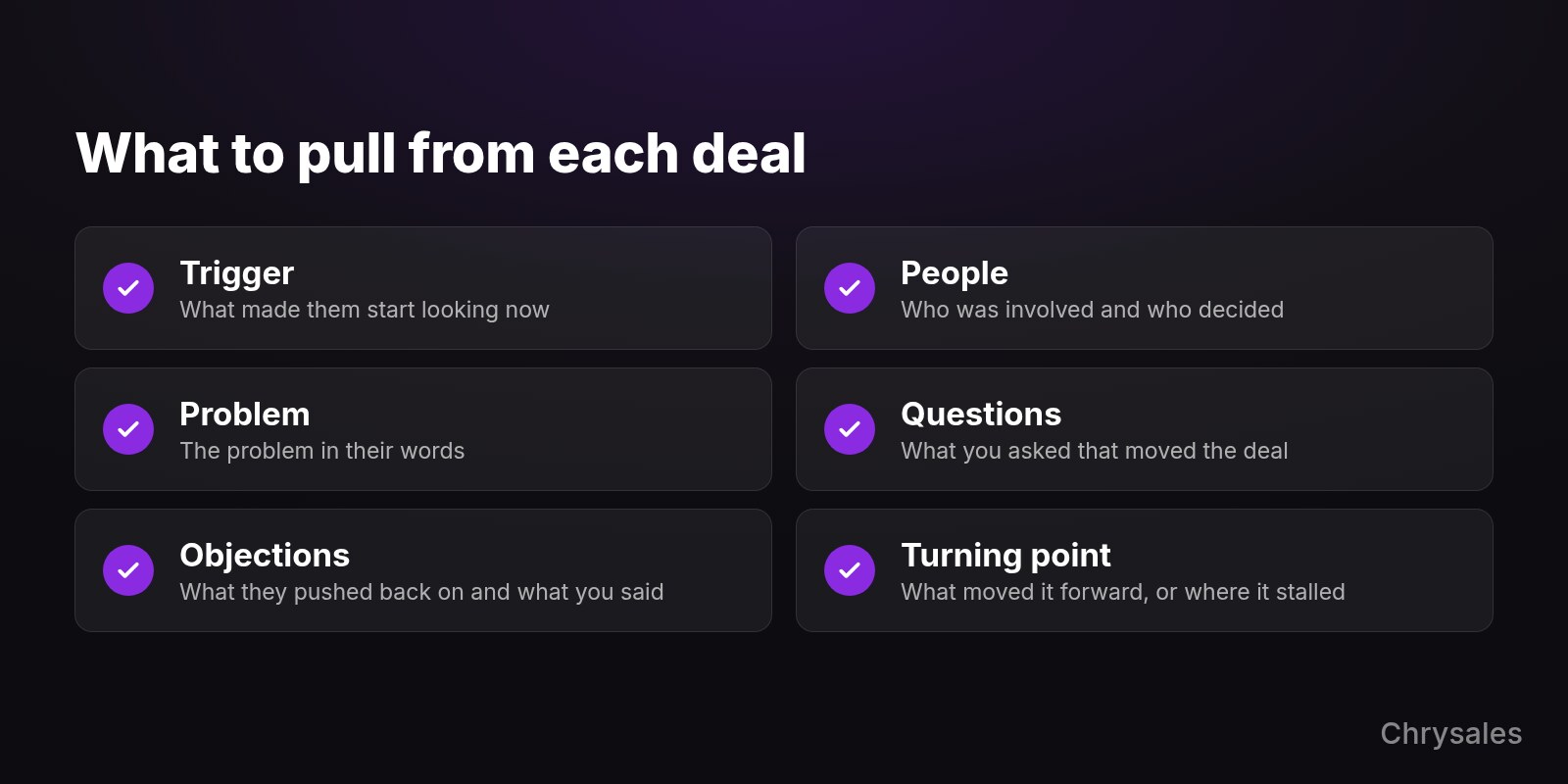
Deal:
Result: won / lost

Trigger: what made them start looking now
People: who was involved and who decided
Problem: the problem in their words
Questions: what you asked that moved the deal
Objections: what they pushed back on and what you said
Turning point: what moved it forward, or where it stalled
Before any new campaign, Sabir asks himself one question: "What are my clients already saying yes to? Start there." The same question works here, and your won deals answer it.
Treat the lost deals with more care, because your own loss reasons can be wrong. Clozd, a vendor that sells win-loss interviews, reports that buyer and seller reasons for lost deals "align only 15% of the time", so read that as a vendor's figure. Challenger's summary of the JOLT study covers 2.5 million sales conversations. It says "around half (40-60%) of all lost deals ended in no decision." Summaries of that study differ on the base, but the warning holds: a deal you logged as lost to a price objection may have died because nobody decided.
So call two or three lost buyers yourself. We haven't seen research that tests founder-run calls, so this is our advice. Buyers may be polite with you, so treat what you hear as a lead to check against the record.
This isn't a call to reopen anything. I'm trying to understand how we sell.
What was happening on your side when you first talked to us?
What made you decide the way you did?
What would have had to be different?What should you write first?
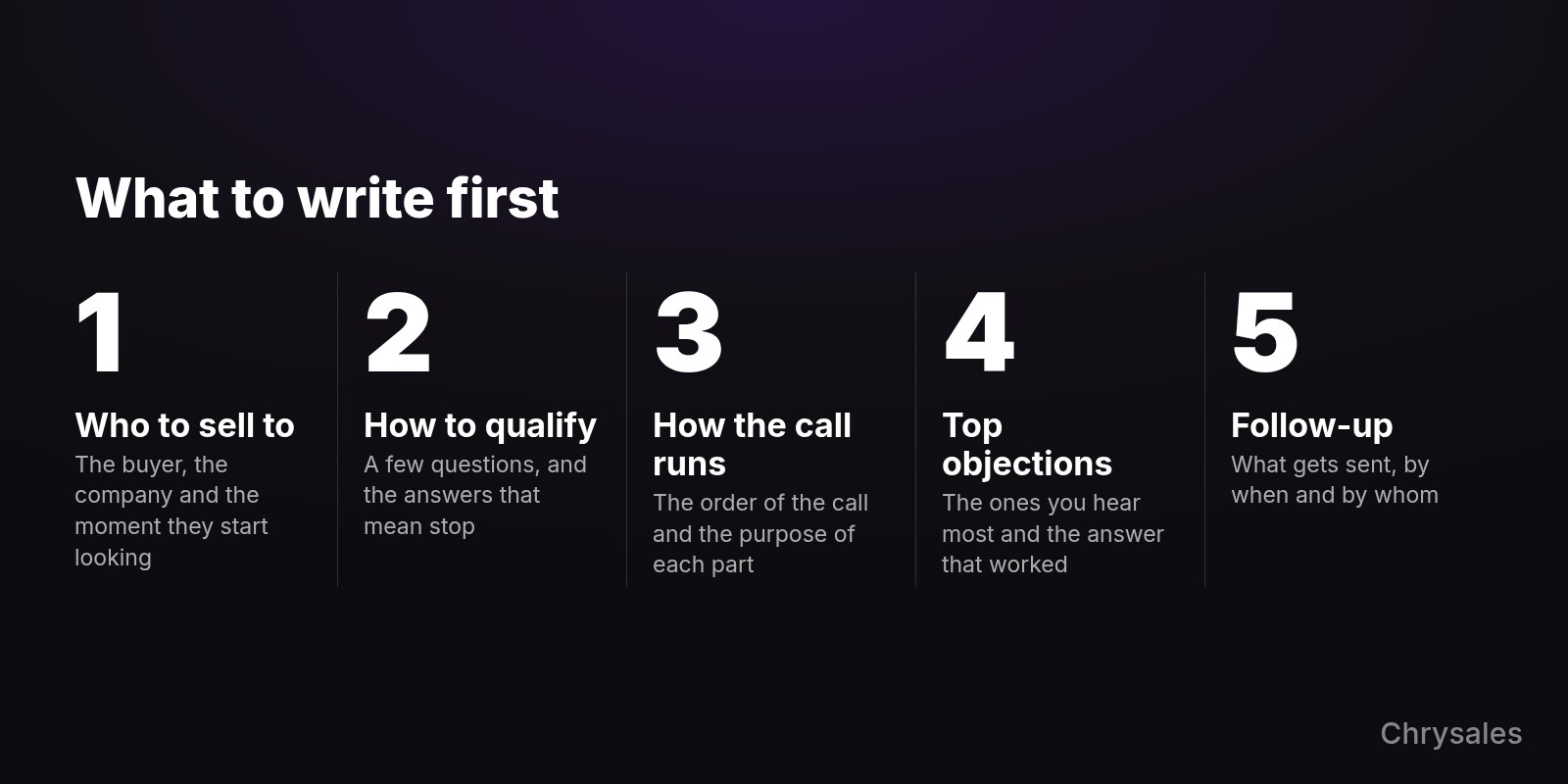
Write in the order a new seller meets the work: who to sell to, how to qualify, how the call runs, the top objections, then the follow-up. Those five sections run from first contact to next step. Leave positioning detail and proof points for the second pass, once the five hold up on real calls.
Mercury's handoff guide gives a longer list of contents, including ideal customer profile and qualification, positioning, discovery questions, objection tips, proof points and a simple call or demo structure. All of it is useful eventually. We start with the five above because a new seller can't get through a call without them.
The table below uses an invented example: a 30-person B2B company that sells a yearly service contract to heads of operations. The company, its deals and every figure in the last column are made up to show the format, and no result is claimed.
| Section | Source in your deals | What to write | Invented example |
|---|---|---|---|
| Who to sell to | Trigger and People fields of your wins | The buyer, the company and the moment they start looking | Head of operations at a company of 100-500 people, right after a missed delivery date |
| How to qualify | Wins compared with losses | A few questions, and the answers that mean stop | 4 of 5 wins had the budget holder on the second call, and none of the 5 losses did. Ask: "Who signs this, and can they join next time?" |
| How the call runs | Transcripts of your best won calls | The order of the call and the purpose of each part | Agenda, the last missed date, what it cost, who decides, short answer, dated next step |
| Top objections | Objections field, wins and losses | The ones you hear most and the answer that worked | "Too expensive" came up in 6 of 10 deals. It eased when the talk went back to the cost of the missed date |
| Follow-up | Turning point field | What gets sent, by when and by whom | Recap the same day, next meeting booked before the call ends |
For the call section, start from a 30-minute discovery call structure and change it to match your transcripts. For the objections, handling "I need to think about it" gives a sense of how much detail one answer can carry.
Write rules a person can act on without asking you. PostHog's public sales handbook has a clean example: "If you haven't identified a next step, the opportunity is Closed - Lost." Next to each rule, note the deal it came from, so a new seller who doubts it can read the evidence.
Do the writing even if it feels slow. Kazanjy, author of Founding Sales, makes the same point in the Dock interview: "having a demo flow in your head is not great. You should have it documented."
How long should the first version be?
No research we know of gives an ideal length for a sales playbook. Our call is to keep the first version short enough that someone can read it in one sitting before a call. Every line should trace back to a real deal. If a section has nothing behind it, leave it out until it does.
You can copy the outline below as your own sales playbook template. Each heading asks for something you've already pulled, so a blank line tells you what to look at again.
B2B sales playbook - version 1
Owner:
Last updated:

1. Who to sell to
Buyer and company:
What makes them start looking:
Who we walk away from:

2. How to qualify
Questions to ask:
Answers that mean stop:

3. How the call runs
Order of the call:
Purpose of each part:
Next step to ask for:

4. Top objections
Objection:
What's behind it:
Answer that worked:
Deal it came from:

5. Follow-up
What gets sent:
By when, and by whom:
What to do if there's no reply:
How do you test the playbook on someone else?
Give the playbook to someone who has never sold your offer, let them prepare from the document alone, and have them run a real call while you listen. Where they stall, the document has a gap. We haven't seen a study of this test, so it's our advice, and it shows you the gaps while a real person is using the document.
- Pick the person. Choose a colleague or new hire who knows the company but hasn't run your sales calls.
- Hand over the document and nothing else. Write down every question they ask while preparing, since each one points to a gap.
- Run one practice call. You play the buyer and use an objection from your deal files.
- Choose a real call with a lead who fits. Tell the prospect who's joining, and agree beforehand when you'd step in.
- Listen, then debrief the same day. Fix the document first, then coach the person.
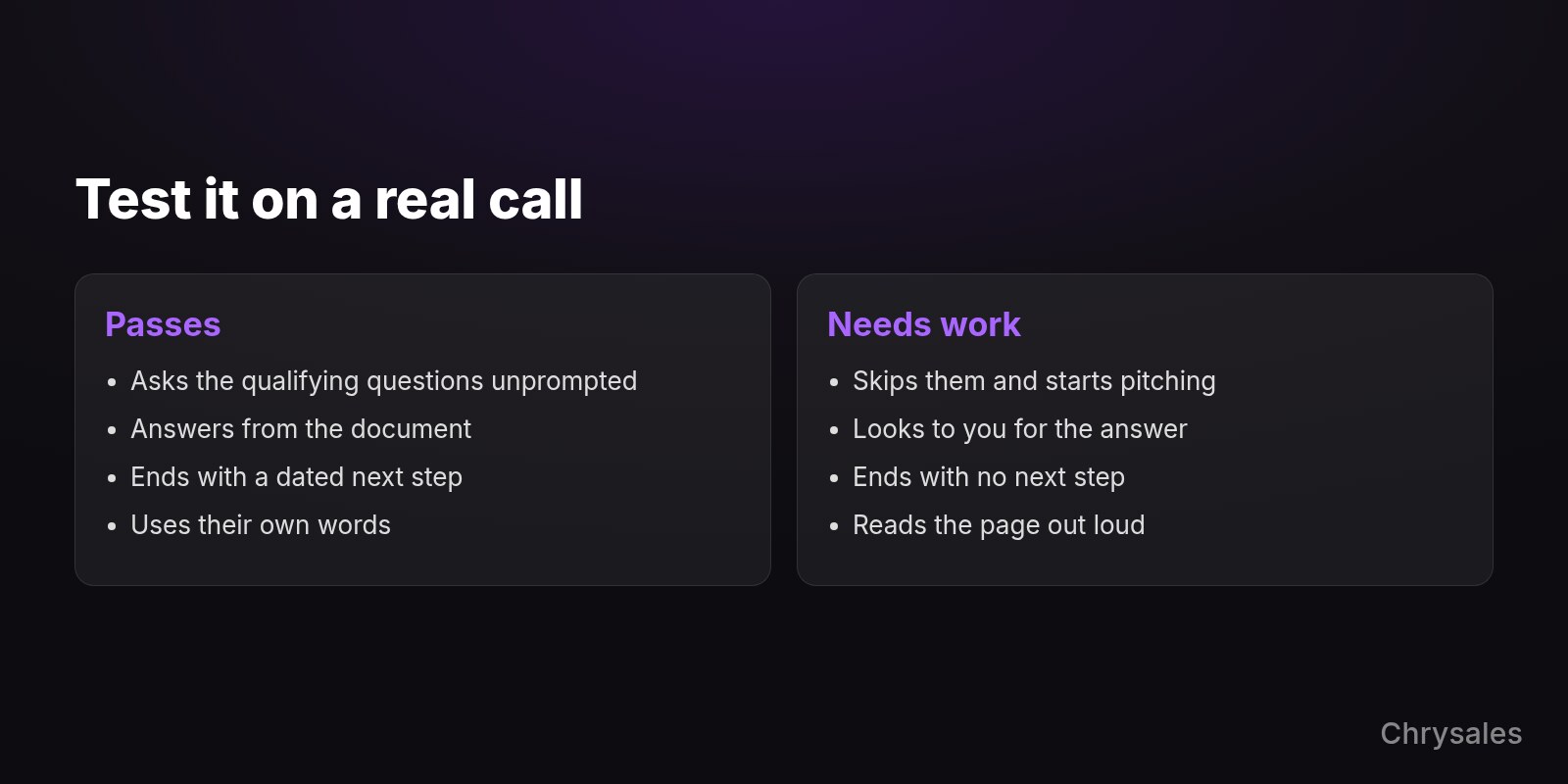
Repeat on the next few calls, and judge the signals below instead of the outcome of one deal.
| Area | Passes | Needs work |
|---|---|---|
| Qualifying | Asks the qualifying questions unprompted | Skips them and starts pitching |
| Objections | Answers from the document | Looks to you for the answer |
| Next step | Ends with a dated next step | Ends with no next step |
| Delivery | Uses their own words | Reads the page out loud |
A pass shows the document worked on that call. It says nothing yet about revenue, or about whether this person should become your seller.
Sitting in also gives you something to judge against. Mercury asks founders whether they're judging a hire against "a flawed memory" of how their deals actually worked, and says the fair comparison needs "good documentation from your own founder-led sales." Jason Lemkin of SaaStr makes a related point about a lone first hire: "If your first rep does poorly, you'll have no idea why." A written playbook and calls you've heard give you a way to tell a gap in the document from a gap in the person. For the hiring side, read why a first sales hire fails.
Expect the person to change it. Kathryn O'Day of The O'Daily puts it bluntly: "You can't sell how the founder sells." Keep the rules and let them rewrite the wording in their own voice.
How do you keep the playbook current and used?
Give the playbook one named owner, keep it in one shared place, and update it when something changes: a new objection, a deal won a new way, a loss that broke a rule. Add a short monthly review on top. Set the owner, triggers and rhythm to fit how often you close deals.
Sabir's version is to capture what wins, keep it in one place and update it every time something new works. Without that, a company's best sales knowledge can walk out when someone leaves.
The update rule fits in four lines:
- Owner. You at first, then your first seller once they run calls alone.
- Triggers. Any objection heard twice that the document doesn't answer, any deal won in a new way, and any lost deal that followed every rule.
- Review. Once a month, read recent calls against the document and delete what nobody used.
- Version. Put the date at the top and keep a single copy, so nobody sells from an old one.
To keep it in use, make it part of the work. Prepare each call from the document, and start each debrief from it. In our view, a playbook that only gets opened during onboarding goes stale.
A playbook is one part of a bigger setup. In this video, Sabir walks through three sales systems. We'd pay most attention to the closing and scaling ones once someone else starts selling.
Common mistakes when building a sales playbook
Most mistakes with a sales playbook come from writing from the wrong material or asking the document to do too much. If you only change one thing, work from real deals, since everything else in the document depends on them.
- Writing from memory. You'll leave out decisions you no longer notice. Work from transcripts and deal files.
- Trusting the loss reasons in your CRM. Those are your side of the story. Ask a few lost buyers directly and compare.
- Locking it down too soon. Mercury warns that "implementing too much process too early can actually impede learning." Mark your guesses as guesses and expect version 1 to change.
- Treating the document as the whole system. A playbook still needs leads, follow-up and a person to run it, which is why it sits inside the full sales system.
FAQ
How many deals do I need before I write a sales playbook?
There's no proven number. Penny Mares suggests founders close at least 10 customers themselves before bringing on a salesperson, and Mercury says that rests on pattern quality, not a magic number. That's a hiring marker, so treat it as a rough guide here. For the deal file itself, we'd start with 5 won and 5 lost, then add more if the patterns stay unclear.
Who should write the first version?
You should, because the knowledge sits with you. Your first seller then rewrites it through use. That keeps the facts from you and the wording from the person who has to say it.
Do I need software for a sales playbook?
No. A shared document is enough for a first version. HubSpot's playbooks feature, for example, needs a Sales Hub or Service Hub Professional or Enterprise subscription as of October 2026, and you can add a tool like that later if the document proves useful.
Do I need a playbook before my first sales hire?
We'd say yes, if your wins already repeat. Even a short version gives a new seller a starting point and gives you something to judge them against. If your wins don't repeat yet, keep selling yourself and keep notes.
Sources
- Mercury - Tips on how to hand off founder-led sales without the guesswork
- Dock - The founder's guide to sales by 3X founder Peter Kazanjy
- Sharon K. Gillenwater - Sell It Yourself, Dammit
- GitLab Handbook - SA Engagement Playbooks
- PostHog Handbook - New business sales
- Yates, Feldon and Clark - AERA workshop abstract, 2011
- Nielsen Norman Group - Critical incident technique
- Clozd - Win loss analysis guide
- Challenger - How to Overcome Customer Indecision Using the JOLT Effect Approach
- Jason Lemkin, SaaStr - When You Hire Your First Sales Rep, Just Make Sure You Hire Two
- Kathryn O'Day, The O'Daily - Transitioning Away From Founder-Led Sales?
- HubSpot Knowledge Base - Use playbooks
- German Criminal Code - Section 201
Want a second person selling from a playbook built on your own deals? Chrysales works with you and your team on the sales system around it. Map this out on a free call

If you still close most deals yourself and want a second person to sell, build your B2B sales playbook from your own recent won and lost deals, not from a template. Start with a short document: who to sell to, how to qualify, how the call runs, the top objections and the follow-up. Then have someone else run a real call from it. It's only worth writing once you have wins you can repeat.
This is for you if every deal still runs through you and founder-led selling has become the bottleneck. By the end you'll have a short first version, one test run with another person, and a rule for keeping it current. A playbook won't produce revenue by itself. It gives someone else a way to repeat what already works.
What is a B2B sales playbook?
A B2B sales playbook is a working document that shows someone other than you how your deals get won: who to talk to, what to ask, how a call runs and what happens next. GitLab's public handbook calls a playbook "a structured, repeatable guide for a particular customer engagement or sales motion from start to finish."
GitLab's handbook keeps playbooks separate from processes, and that split is useful. People use these four words as if they meant the same thing, and they don't.
| Document | What it answers | What it can't do alone |
|---|---|---|
| Playbook | How we win a deal here, and why | Bring in leads or replace practice |
| Process | Which stages a deal moves through | Tell a seller what to say or ask |
| Script | The exact words for one moment | Handle a buyer who goes off the page |
| Template | Which headings a document could have | Say anything about your buyers |
Is a sales playbook template enough? It saves you a little time on headings. It can't tell you why your buyers said yes, what they pushed back on, or which leads you should have dropped early, and those answers are the whole value of the document. Use a template as a page layout, then fill it from your own deals.
The wider difference between a sales system and a sales process is a separate question. The playbook is the written part you hand to another person.
When is it too early to write a sales playbook?
It's too early when your wins don't look alike yet. If you can't say who bought, why they bought and what nearly stopped them, you only have guesses, and writing them down freezes them. Repeatability is the test, and any deal count you read is a rough range.
The numbers people quote are opinions, and they're about hiring, which comes after the first draft of a playbook. Penny Mares of Unusual Ventures tells Mercury that in many cases founders should "close at least 10 customers on their own" before bringing on a salesperson, and Mercury says that principle rests on "pattern quality", not a magic number. Mercury adds that "if every deal looks different, your company may still be learning where demand is strongest."
Pete Kazanjy's hiring markers, as Dock reports them, are a 15-25% win rate and 10-20 referenceable customers. That's a rule of thumb from the startup world.
Messy evidence can still be enough to start. Sharon K. Gillenwater, co-founder of Boardroom Insiders, writes that with "about 30 closed deals" her team "tried to analyze patterns but couldn't see any".
She still "had enough evidence to know" a few things, including "Our primary buyers were in marketing." That gave her team the confidence to bring on a first dedicated salesperson. It's one founder's account about hiring, and we'd apply the same logic to a first version: partial evidence can be enough to start.
A quick check we'd use, as a rule of thumb, is to look at your recent closed deals and answer three questions:
- Can one sentence describe most of the buyers?
- Did most of them buy for the same reason?
- Do the same objections keep coming back?
Three yeses means start writing, and two means write the parts you're sure of and mark the rest as guesses. With one or none, keep selling, keep notes and check again in a few months.
Which deals do you pull, and what do you pull from them?
Pull your 5 most recent wins and your 5 most recent losses, then go through each as a specific story: what started it, who was involved, what was said and where it turned. You can't reliably describe your own selling from memory. The 5 and 5 is our starting point, so adjust it to your volume.
People who are good at something leave a lot out when they explain it. Yates, Feldon and Clark put a number on it in a 2011 workshop abstract: "Experts omit about 70% of the decisions they make when they describe how to perform a complex task." That work isn't about sales, but the same risk applies when you try to write down how you sell.
Asking about specific events helps. Nielsen Norman Group describes this as the critical incident technique. A person recalls "a time when a behavior, action, or occurrence impacted (either positively or negatively) a specified outcome." NN/g also warns that recall is fallible and that extreme events get over-reported, so use the record wherever you have one.
Mares puts the record first: "The most critical is call transcripts because you can build out almost any analysis from there."
Before you record a call, get consent and check the rules where you and your buyers are. In Germany, recording a private conversation without authorization is an offense under section 201 of the Criminal Code. This isn't legal advice, so check with a lawyer before you start recording.
Block time for it, since how long it takes depends on how good your notes are:
- List the deals. Take them from your CRM or inbox. Leave out favors from friends, because a new seller can't repeat those.
- Gather the record for each one. Start with transcripts or recordings, then add emails, proposals and your notes.
- Fill in one file per deal, using the fields below.
- Mark what repeats. Anything in most of your wins goes into the playbook. One-offs stay in the file.
- Compare wins with losses. Whatever was present in the wins and missing in the losses becomes a qualification question.
Deal:
Result: won / lost

Trigger: what made them start looking now
People: who was involved and who decided
Problem: the problem in their words
Questions: what you asked that moved the deal
Objections: what they pushed back on and what you said
Turning point: what moved it forward, or where it stalled
Before any new campaign, Sabir asks himself one question: "What are my clients already saying yes to? Start there." The same question works here, and your won deals answer it.
Treat the lost deals with more care, because your own loss reasons can be wrong. Clozd, a vendor that sells win-loss interviews, reports that buyer and seller reasons for lost deals "align only 15% of the time", so read that as a vendor's figure. Challenger's summary of the JOLT study covers 2.5 million sales conversations. It says "around half (40-60%) of all lost deals ended in no decision." Summaries of that study differ on the base, but the warning holds: a deal you logged as lost to a price objection may have died because nobody decided.
So call two or three lost buyers yourself. We haven't seen research that tests founder-run calls, so this is our advice. Buyers may be polite with you, so treat what you hear as a lead to check against the record.
This isn't a call to reopen anything. I'm trying to understand how we sell.
What was happening on your side when you first talked to us?
What made you decide the way you did?
What would have had to be different?What should you write first?
Write in the order a new seller meets the work: who to sell to, how to qualify, how the call runs, the top objections, then the follow-up. Those five sections run from first contact to next step. Leave positioning detail and proof points for the second pass, once the five hold up on real calls.
Mercury's handoff guide gives a longer list of contents, including ideal customer profile and qualification, positioning, discovery questions, objection tips, proof points and a simple call or demo structure. All of it is useful eventually. We start with the five above because a new seller can't get through a call without them.
The table below uses an invented example: a 30-person B2B company that sells a yearly service contract to heads of operations. The company, its deals and every figure in the last column are made up to show the format, and no result is claimed.
| Section | Source in your deals | What to write | Invented example |
|---|---|---|---|
| Who to sell to | Trigger and People fields of your wins | The buyer, the company and the moment they start looking | Head of operations at a company of 100-500 people, right after a missed delivery date |
| How to qualify | Wins compared with losses | A few questions, and the answers that mean stop | 4 of 5 wins had the budget holder on the second call, and none of the 5 losses did. Ask: "Who signs this, and can they join next time?" |
| How the call runs | Transcripts of your best won calls | The order of the call and the purpose of each part | Agenda, the last missed date, what it cost, who decides, short answer, dated next step |
| Top objections | Objections field, wins and losses | The ones you hear most and the answer that worked | "Too expensive" came up in 6 of 10 deals. It eased when the talk went back to the cost of the missed date |
| Follow-up | Turning point field | What gets sent, by when and by whom | Recap the same day, next meeting booked before the call ends |
For the call section, start from a 30-minute discovery call structure and change it to match your transcripts. For the objections, handling "I need to think about it" gives a sense of how much detail one answer can carry.
Write rules a person can act on without asking you. PostHog's public sales handbook has a clean example: "If you haven't identified a next step, the opportunity is Closed - Lost." Next to each rule, note the deal it came from, so a new seller who doubts it can read the evidence.
Do the writing even if it feels slow. Kazanjy, author of Founding Sales, makes the same point in the Dock interview: "having a demo flow in your head is not great. You should have it documented."
How long should the first version be?
No research we know of gives an ideal length for a sales playbook. Our call is to keep the first version short enough that someone can read it in one sitting before a call. Every line should trace back to a real deal. If a section has nothing behind it, leave it out until it does.
You can copy the outline below as your own sales playbook template. Each heading asks for something you've already pulled, so a blank line tells you what to look at again.
B2B sales playbook - version 1
Owner:
Last updated:

1. Who to sell to
Buyer and company:
What makes them start looking:
Who we walk away from:

2. How to qualify
Questions to ask:
Answers that mean stop:

3. How the call runs
Order of the call:
Purpose of each part:
Next step to ask for:

4. Top objections
Objection:
What's behind it:
Answer that worked:
Deal it came from:

5. Follow-up
What gets sent:
By when, and by whom:
What to do if there's no reply:
How do you test the playbook on someone else?
Give the playbook to someone who has never sold your offer, let them prepare from the document alone, and have them run a real call while you listen. Where they stall, the document has a gap. We haven't seen a study of this test, so it's our advice, and it shows you the gaps while a real person is using the document.
- Pick the person. Choose a colleague or new hire who knows the company but hasn't run your sales calls.
- Hand over the document and nothing else. Write down every question they ask while preparing, since each one points to a gap.
- Run one practice call. You play the buyer and use an objection from your deal files.
- Choose a real call with a lead who fits. Tell the prospect who's joining, and agree beforehand when you'd step in.
- Listen, then debrief the same day. Fix the document first, then coach the person.
Repeat on the next few calls, and judge the signals below instead of the outcome of one deal.
| Area | Passes | Needs work |
|---|---|---|
| Qualifying | Asks the qualifying questions unprompted | Skips them and starts pitching |
| Objections | Answers from the document | Looks to you for the answer |
| Next step | Ends with a dated next step | Ends with no next step |
| Delivery | Uses their own words | Reads the page out loud |
A pass shows the document worked on that call. It says nothing yet about revenue, or about whether this person should become your seller.
Sitting in also gives you something to judge against. Mercury asks founders whether they're judging a hire against "a flawed memory" of how their deals actually worked, and says the fair comparison needs "good documentation from your own founder-led sales." Jason Lemkin of SaaStr makes a related point about a lone first hire: "If your first rep does poorly, you'll have no idea why." A written playbook and calls you've heard give you a way to tell a gap in the document from a gap in the person. For the hiring side, read why a first sales hire fails.
Expect the person to change it. Kathryn O'Day of The O'Daily puts it bluntly: "You can't sell how the founder sells." Keep the rules and let them rewrite the wording in their own voice.
How do you keep the playbook current and used?
Give the playbook one named owner, keep it in one shared place, and update it when something changes: a new objection, a deal won a new way, a loss that broke a rule. Add a short monthly review on top. Set the owner, triggers and rhythm to fit how often you close deals.
Sabir's version is to capture what wins, keep it in one place and update it every time something new works. Without that, a company's best sales knowledge can walk out when someone leaves.
The update rule fits in four lines:
- Owner. You at first, then your first seller once they run calls alone.
- Triggers. Any objection heard twice that the document doesn't answer, any deal won in a new way, and any lost deal that followed every rule.
- Review. Once a month, read recent calls against the document and delete what nobody used.
- Version. Put the date at the top and keep a single copy, so nobody sells from an old one.
To keep it in use, make it part of the work. Prepare each call from the document, and start each debrief from it. In our view, a playbook that only gets opened during onboarding goes stale.
A playbook is one part of a bigger setup. In this video, Sabir walks through three sales systems. We'd pay most attention to the closing and scaling ones once someone else starts selling.
Common mistakes when building a sales playbook
Most mistakes with a sales playbook come from writing from the wrong material or asking the document to do too much. If you only change one thing, work from real deals, since everything else in the document depends on them.
- Writing from memory. You'll leave out decisions you no longer notice. Work from transcripts and deal files.
- Trusting the loss reasons in your CRM. Those are your side of the story. Ask a few lost buyers directly and compare.
- Locking it down too soon. Mercury warns that "implementing too much process too early can actually impede learning." Mark your guesses as guesses and expect version 1 to change.
- Treating the document as the whole system. A playbook still needs leads, follow-up and a person to run it, which is why it sits inside the full sales system.
FAQ
How many deals do I need before I write a sales playbook?
There's no proven number. Penny Mares suggests founders close at least 10 customers themselves before bringing on a salesperson, and Mercury says that rests on pattern quality, not a magic number. That's a hiring marker, so treat it as a rough guide here. For the deal file itself, we'd start with 5 won and 5 lost, then add more if the patterns stay unclear.
Who should write the first version?
You should, because the knowledge sits with you. Your first seller then rewrites it through use. That keeps the facts from you and the wording from the person who has to say it.
Do I need software for a sales playbook?
No. A shared document is enough for a first version. HubSpot's playbooks feature, for example, needs a Sales Hub or Service Hub Professional or Enterprise subscription as of October 2026, and you can add a tool like that later if the document proves useful.
Do I need a playbook before my first sales hire?
We'd say yes, if your wins already repeat. Even a short version gives a new seller a starting point and gives you something to judge them against. If your wins don't repeat yet, keep selling yourself and keep notes.
Sources
- Mercury - Tips on how to hand off founder-led sales without the guesswork
- Dock - The founder's guide to sales by 3X founder Peter Kazanjy
- Sharon K. Gillenwater - Sell It Yourself, Dammit
- GitLab Handbook - SA Engagement Playbooks
- PostHog Handbook - New business sales
- Yates, Feldon and Clark - AERA workshop abstract, 2011
- Nielsen Norman Group - Critical incident technique
- Clozd - Win loss analysis guide
- Challenger - How to Overcome Customer Indecision Using the JOLT Effect Approach
- Jason Lemkin, SaaStr - When You Hire Your First Sales Rep, Just Make Sure You Hire Two
- Kathryn O'Day, The O'Daily - Transitioning Away From Founder-Led Sales?
- HubSpot Knowledge Base - Use playbooks
- German Criminal Code - Section 201
Want a second person selling from a playbook built on your own deals? Chrysales works with you and your team on the sales system around it. Map this out on a free call
Scaling Is Not Hard If You Have The Right Systems
If you’re serious about leveling up your scaling game, you need the right system, the right training, and the right team behind you. We're here to give you the exact tools and strategies top entrepreneurs use to dominate.

Discover the latest tips
View All
Chrysales was formed from the words "chrysalis" the stage where a caterpillar transforms into a butterfly and "sales".
It stands for one thing: sales transformation.Because scaling doesn’t happen by doing more of the same. Scaling only happens when you go through real transformation in your systems, your offer, team and the way you sell.


