.avif)
B2B Sales Call Patterns That Close More Deals

These B2B sales call patterns show how the best reps use discovery, pitch, objection handling, and follow-up to close more deals.
Picture this: you're sitting in a quiet room with headphones on, listening to call after call. Some reps crush it. Others fumble from minute one. After analyzing over 1,000 recorded B2B sales calls, the patterns that separate closers from time-wasters became crystal clear. The wild part? Most of the difference happens in the first five minutes, and it has nothing to do with being naturally charismatic or having years of experience.
The First 90 Seconds Decide Everything in B2B Sales
Most people think sales calls are won or lost during the pitch or the close. Wrong. The calls that turn into deals are decided in the first minute and a half.
The Permission Pattern
Top performers always asked for permission to continue. They'd open with something like: "I have three things I want to cover today. Should take about 20 minutes. Does that still work for you?"
Simple. Direct. Respectful.
The calls that died early? They jumped straight into pitching without checking if the person even had time. A consulting firm might have the perfect solution, but if the person on the other end is thinking about their next meeting, nothing sticks.
Pro Tip: Ask "Is now still a good time?" within the first 30 seconds. If they say no, reschedule. A rushed call is a lost deal.
The Agenda Flip
Here's what closers did differently: they set the agenda, then asked if the prospect wanted to add anything.
"Here's what I thought we'd cover: your current lead generation process, what's working, what's not, and whether it makes sense to keep talking. Anything else you want to make sure we hit?"
That tiny move changed the whole dynamic. It stopped feeling like a sales call and started feeling like a planning session.
Discovery Questions That Actually Uncover Real Problems
Bad discovery sounds like an interrogation. Good discovery sounds like curiosity. After listening to hundreds of calls, the difference became obvious.
The Three-Layer Question System
The best sales reps asked questions in three layers:
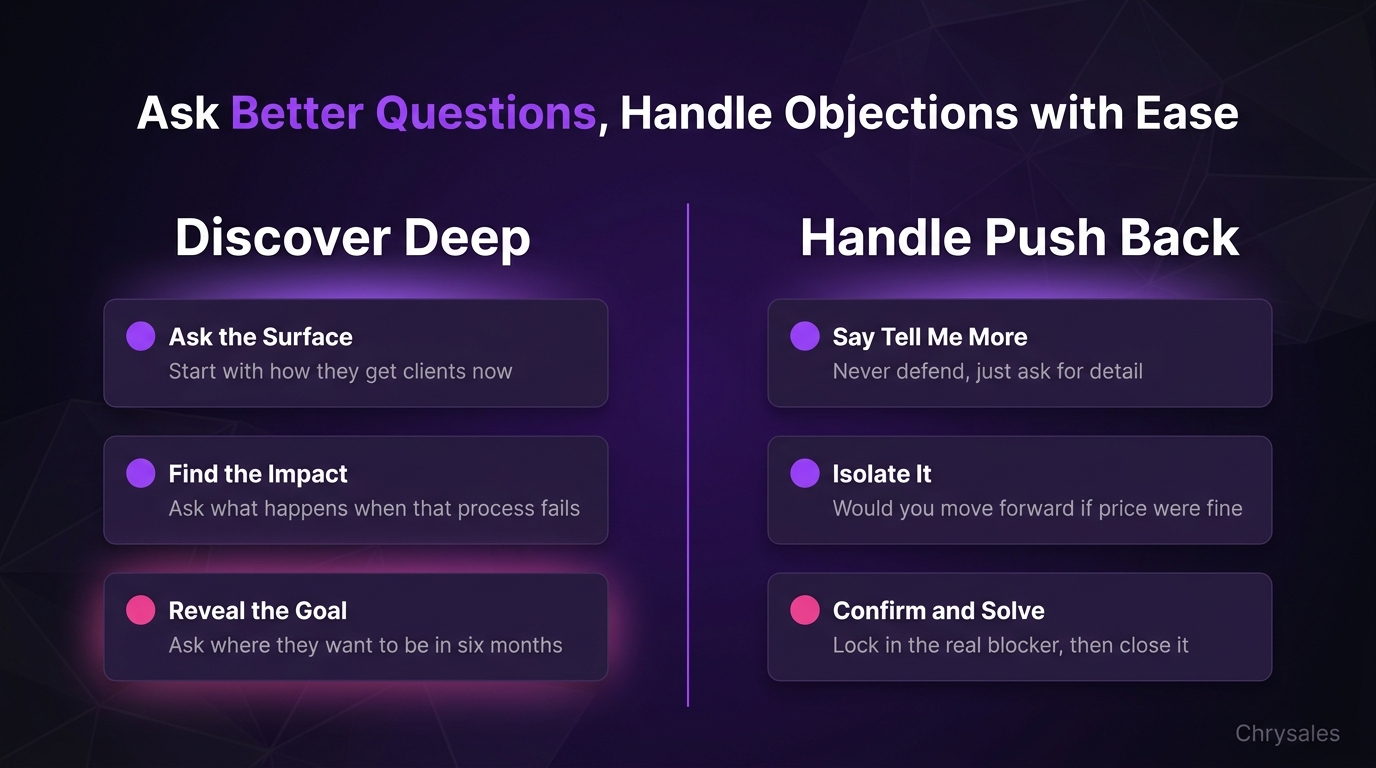
- Surface question: "How are you getting clients right now?"
- Impact question: "What happens when that slows down?"
- Future question: "Where do you want this to be in six months?"
Most reps stopped at layer one. They'd hear "we do cold email" and move on. The closers kept digging. They wanted to know what happens when cold email stops working, how that affects the business, and what the ideal state looks like.
A 20-person marketing agency that just answers "we do referrals" isn't giving you enough. The real answer might be: "Referrals work until they don't. Last quarter we had two months with zero new clients. We want consistent pipeline so we're not scrambling every time someone doesn't refer us."
The Money Question Nobody Asks
Most reps dance around budget. The top performers asked it directly: "What does it cost you when a month goes by without new clients?"
That question reframes everything. It's not about what they'll pay for sales training or lead generation. It's about what they're already losing by not fixing the problem.
Watch out: Asking about budget too early feels pushy. Wait until they've talked about the problem for at least five minutes first.
The Decision-Maker Test
Here's a question that saved dozens of calls from going nowhere: "Who else needs to be part of this decision?"
If the answer is "my business partner" or "our CFO," you need them on the next call. Period.
One B2B consulting firm wasted three weeks going back and forth with someone who couldn't actually sign off on anything, a mistake outlined in the 5 Costly Mistakes Killing Your Deals and How to Fix Them.
The Pitch Structure That Lands With Buyers
The pitch is where most calls fall apart. Too long, too complicated, or too focused on features nobody cares about.
Mirror Their Words Back
The reps who closed the most deals barely pitched at all. They reflected.
If a prospect said "our sales process is a mess," the rep would say: "So if I'm hearing you right, the process itself is the issue, not just the results. That usually means there's no clear system for how calls should go. Is that what you're seeing?"
When you mirror their exact words, they feel heard. When you add your own interpretation, they tune out.
The Before-and-After Frame
Every strong pitch followed the same structure:
- Here's where you are now (repeat their problem)
- Here's where you want to be (repeat their goal)
- Here's what's in the way (name the gap)
- Here's how we close that gap (the solution)
A tech company stuck at 10 qualified leads per month wants 40. The gap isn't effort. It's that their outbound list is full of bad contacts and their messaging is generic. The solution isn't "work harder." It's cleaning the list and personalizing the first line of every email.
Common mistake: Jumping straight to "here's what we do" without laying out the gap first. The gap is what makes the solution matter.
Keep It Under Five Minutes
The longest successful pitches clocked in at four and a half minutes. The shortest was two minutes.
The ones that lost deals? Eight to twelve minutes of feature-dumping.
If you can't explain what you do and why it fixes their problem in under five minutes, you don't understand it well enough yet.
Objection Handling That Doesn't Sound Defensive
Objections killed more deals than anything else. Not because they came up, but because of how reps responded.
The "Tell Me More" Move
When someone said "this is too expensive" or "we're not ready," weak reps went into defense mode. They explained. They justified. They pushed.
Top performers said: "Tell me more about that."
That's it. No defense. Just curiosity.
"This is too expensive." "Got it. Tell me more about that. What were you expecting?"
Nine times out of ten, the prospect explained the real objection. It wasn't price. It was that they didn't see enough value yet, or they were burned by something similar before, or they had budget concerns three months from now.
The Isolate-and-Confirm Pattern
Here's how closers handled objections in three steps:
- Isolate it: "So if price wasn't an issue, would this solve the problem?"
- Confirm it: "Meaning if we can figure out the investment part, you're ready to move forward?"
- Solve it: "Let's talk about what that looks like."
A consulting firm once said they needed to "think about it." The rep isolated: "Totally fair. Just so I understand, is there something specific you need to think through, or is this more about timing?"
Turns out, they wanted to finish Q4 before starting anything new. The rep moved the start date and closed the deal that day.
Pro Tip: Most objections aren't real blockers. They're requests for more clarity. Treat them like questions, not rejections.
The Time Objection
"We need to think about it" or "let's revisit this next quarter" showed up in 40% of calls.
The reps who lost those deals said "no problem, I'll follow up."
The reps who closed said: "Makes sense. What specifically do you need to think through?"
That follow-up question separated the real delays from the polite brush-offs. If they can't name what they need to think about, they're not going to buy later either.
The Follow-Up System That Keeps Deals Moving
Most deals don't close on the first call. The second call is where things usually die. Not because the prospect lost interest, but because there was no clear next step.
Book the Next Call Before You Hang Up
Every single call that turned into a deal had a scheduled follow-up before the first call ended.
Not "I'll send you some times," but "I'm looking at my calendar right now. Does Tuesday at 2 p.m. work, or is Thursday better?"
A 30-person tech company went from 12% close rate to 34% just by scheduling the next call on the spot. When you leave it open-ended, it dies in email.
The One-Thing Follow-Up Email
After the call, top reps sent a short email. Not a novel. One thing: "Here's what we agreed to cover next time. Let me know if anything changes before then."
That's it. No attachments. No links to case studies. Just confirmation.
The reps who sent long follow-ups with five attachments got lower response rates. People are busy. Make it easy.
For more follow-up strategies that keep deals alive, check out these Cold Email Follow-Up Templates that apply the same principles.
The Accountability Question
Before ending any call, closers asked: "What's the one thing you're going to do before we talk next?"
Then they did the same: "On my end, I'm going to send over that pricing breakdown and a sample timeline."
When both sides have homework, the deal stays alive. When only the rep has homework, it's already dead.
Watch out: Don't let a call end with "I'll think about it" and no next step. That's code for "I'm not interested but too polite to say it."
What the Data Says About Call Length and Close Rates
After tracking call duration against outcomes, the pattern was clear.
Calls under 15 minutes rarely closed. Calls over 50 minutes also rarely closed.
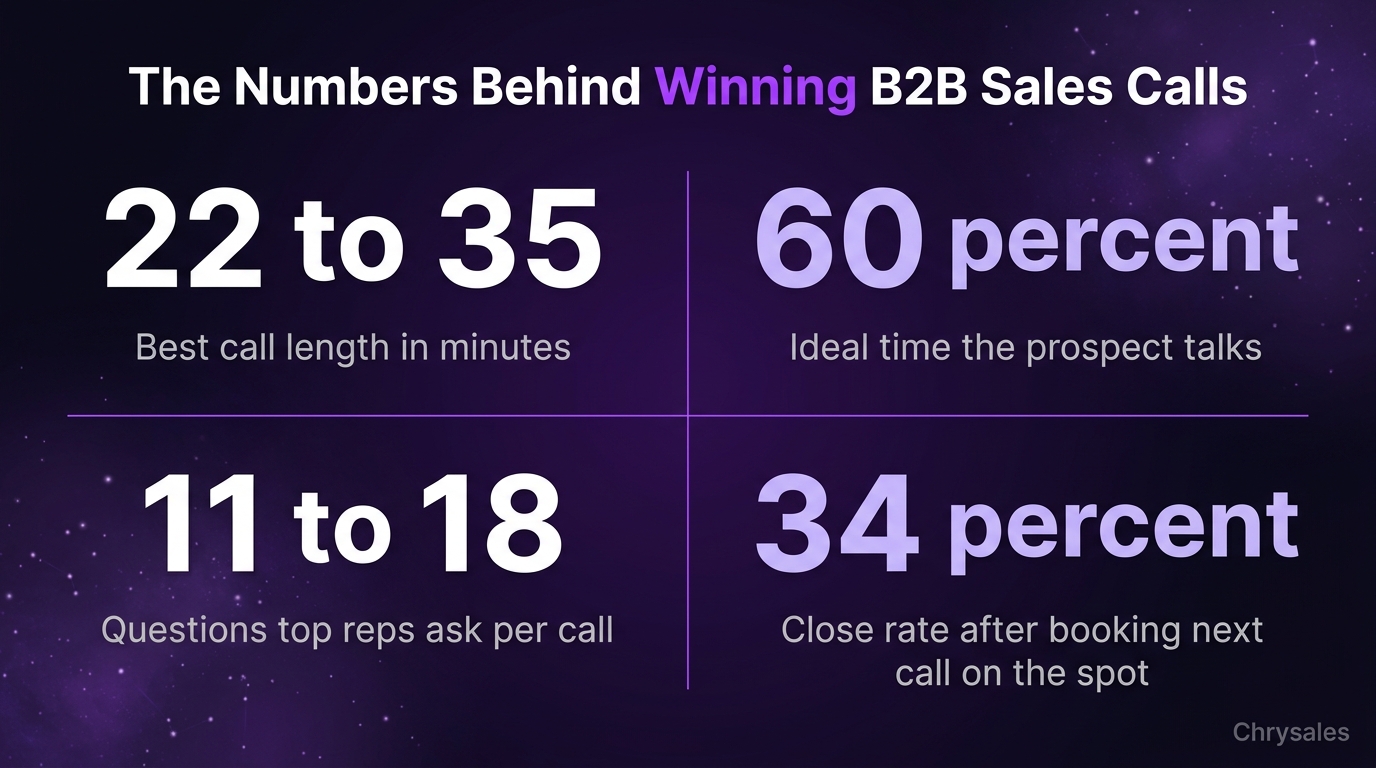
The sweet spot? 22 to 35 minutes.
Short calls meant the rep didn't dig deep enough into the problem. Long calls meant they were either talking too much or the prospect was stalling.
The 60/40 Talk Ratio
Here's the ratio that showed up in almost every winning call: the prospect talked 60% of the time, the rep talked 40%.
When that flipped, the close rate dropped.
Sales isn't about talking. It's about getting the other person to talk, then responding to what they actually said.
A B2B lead generation agency tracked this for three months. Their reps who talked more than 50% of the call closed 18% of deals. The reps who kept it under 45% closed 41%.
The Question Density Test
Top performers asked 11 to 18 questions per call. Low performers asked 4 to 7.
More questions meant better discovery, which meant better pitches, which meant more closed deals.
But here's the thing: the questions weren't random. They built on each other. Each answer led to the next question. It felt like a conversation, not an interview.
The No-Brainer Offer Pattern That Shows Up in Winning Calls
Some offers are easy yeses. Others make people hesitate. The difference isn't always the service itself. It's how it's positioned.
Risk Reversal Language
The reps who closed the most deals used risk-reversal language without being asked.
"If you don't see results in 90 days, we'll keep working until you do" or "We don't get paid until you book calls."
A marketing agency was struggling to close sales consulting deals. Once they added "You only pay after the first 10 qualified meetings are booked," their close rate jumped from 22% to 58% in six weeks.
Risk reversal works because it moves the risk off the buyer and onto the seller. Most B2B sales training programs won't do that because they can't deliver. If you can, it's the fastest way to stand out.
The Micro-Commitment Close
Instead of asking for a big yes, top closers asked for tiny yeses throughout the call.
"Does that make sense so far?" Yes. "Is this the kind of problem you want solved?" Yes. "Would it help to see what this looks like in practice?" Yes.
By the time they asked for the deal, the prospect had already said yes a dozen times. The final close felt like the obvious next step, not a big decision.
If you want to see this entire progression in action, watch the 7 Levels of Sales: From Struggling to Closing Effortlessly breakdown.
The Three-Option Structure
When presenting pricing or packages, the best reps gave three options: a basic version, a middle version, and a premium version.
Almost everyone picked the middle.
Why three? Because two options feel like a yes-or-no decision. Three options feel like a choice.
People don't want to look cheap (so they skip the basic), but they also don't want to overspend (so they skip the premium).
One B2B consulting firm tested this with sales system builds. Before the three-option model, 29% of prospects moved forward. After, 52% did. Same service, different presentation.
The Post-Close Patterns That Prevent Buyer's Remorse
Closing the deal isn't the end. The 24 hours after someone says yes are where deals either stick or fall apart.
The Immediate Confirmation
Top performers sent a confirmation within an hour of the close. Not a contract (that came next), but a simple "excited to work together" email with the next two steps clearly laid out.
When there's radio silence after a yes, people start second-guessing. A quick confirmation kills that doubt.
The Welcome Sequence
The reps who kept deals closed had a mini onboarding process ready. Within 48 hours, new clients got:
- A welcome email with what to expect
- A calendar invite for the kickoff
- A simple questionnaire or prep doc
This wasn't complicated. It was just structured. Structure makes people feel like they made the right choice.
Pro Tip: The faster you move after a yes, the less likely the deal falls through. Aim for next steps within 24 hours, kickoff within 7 days max.
The Check-In Call
A week after closing, the best reps scheduled a quick 10-minute check-in. Not a sales call. Just "How are you feeling? Any questions before we officially start?"
That tiny call caught doubts early. A tech company saved 11 deals in six months just by adding this step. People who were quietly freaking out got reassurance before they ghosted.
This approach ties directly into the practices outlined in the guide on How to Build a Sales Pipeline that stays full and moving forward.
Frequently Asked Questions
Q: How long should a typical B2B sales call last?
The best close rates happen between 22 and 35 minutes. Shorter than that, and you probably didn't dig deep enough into their problem. Longer than that, and either you're talking too much or they're not ready to decide. Aim for 30 minutes as your target and let the conversation guide whether you go a bit shorter or longer.
Q: What's the biggest mistake reps make during discovery?
They stop asking questions after the first answer. If someone says "we need more leads," most reps move on. The real question is: why do you need more leads? What happens when you don't have them? What does success look like? Top performers ask 11 to 18 questions per call. Weak performers ask 4 to 7. Discovery is where deals are won or lost.
Q: How do you handle price objections without sounding desperate?
Say "tell me more about that" instead of defending your price. Most price objections aren't really about the number. They're about perceived value or past bad experiences or timing. Get them talking and the real objection comes out. Then you can actually address it instead of just lowering your price and hoping they say yes.
Q: Should you send a follow-up email after every call?
Yes, but keep it short. One paragraph max. Confirm what you agreed to discuss next time and include the calendar invite for the next call. Don't send a essay with five attachments. People are busy. The shorter your follow-up, the more likely they'll read it and respond.
Q: What's the best way to get someone to schedule the next call on the spot?
Ask directly while you're still on the call: "I'm looking at my calendar now. Does Tuesday at 2 work, or is Thursday better?" Give two specific options. When you say "I'll send you some times," it dies in email. Scheduling the next call before hanging up increases show-up rates by over 60% compared to trying to schedule later.
Q: How many questions should you ask before pitching your solution?
At least 8 to 10 questions about their current situation, what's not working, what they've tried, and what success looks like. If you pitch before understanding the full picture, your pitch won't land. The best pitches are just mirrors of what the prospect already told you. You can't mirror what you didn't hear.
Q: How do you know if someone is the actual decision maker?
Ask: "Who else needs to be part of this decision?" If they name someone, you need that person on the next call. Don't waste three weeks going back and forth with someone who has to ask permission. Get all decision makers in one room (or on one Zoom) and close the deal faster. A 15-person consulting firm saved two weeks per deal just by asking this question earlier in the process, and you can learn even more about reaching these gatekeepers in How to Close Busy CEOs Who Never Reply to Your Messages.
These B2B sales call patterns show how the best reps use discovery, pitch, objection handling, and follow-up to close more deals.
Picture this: you're sitting in a quiet room with headphones on, listening to call after call. Some reps crush it. Others fumble from minute one. After analyzing over 1,000 recorded B2B sales calls, the patterns that separate closers from time-wasters became crystal clear. The wild part? Most of the difference happens in the first five minutes, and it has nothing to do with being naturally charismatic or having years of experience.
The First 90 Seconds Decide Everything in B2B Sales
Most people think sales calls are won or lost during the pitch or the close. Wrong. The calls that turn into deals are decided in the first minute and a half.
The Permission Pattern
Top performers always asked for permission to continue. They'd open with something like: "I have three things I want to cover today. Should take about 20 minutes. Does that still work for you?"
Simple. Direct. Respectful.
The calls that died early? They jumped straight into pitching without checking if the person even had time. A consulting firm might have the perfect solution, but if the person on the other end is thinking about their next meeting, nothing sticks.
Pro Tip: Ask "Is now still a good time?" within the first 30 seconds. If they say no, reschedule. A rushed call is a lost deal.
The Agenda Flip
Here's what closers did differently: they set the agenda, then asked if the prospect wanted to add anything.
"Here's what I thought we'd cover: your current lead generation process, what's working, what's not, and whether it makes sense to keep talking. Anything else you want to make sure we hit?"
That tiny move changed the whole dynamic. It stopped feeling like a sales call and started feeling like a planning session.
Discovery Questions That Actually Uncover Real Problems
Bad discovery sounds like an interrogation. Good discovery sounds like curiosity. After listening to hundreds of calls, the difference became obvious.
The Three-Layer Question System
The best sales reps asked questions in three layers:
- Surface question: "How are you getting clients right now?"
- Impact question: "What happens when that slows down?"
- Future question: "Where do you want this to be in six months?"
Most reps stopped at layer one. They'd hear "we do cold email" and move on. The closers kept digging. They wanted to know what happens when cold email stops working, how that affects the business, and what the ideal state looks like.
A 20-person marketing agency that just answers "we do referrals" isn't giving you enough. The real answer might be: "Referrals work until they don't. Last quarter we had two months with zero new clients. We want consistent pipeline so we're not scrambling every time someone doesn't refer us."
The Money Question Nobody Asks
Most reps dance around budget. The top performers asked it directly: "What does it cost you when a month goes by without new clients?"
That question reframes everything. It's not about what they'll pay for sales training or lead generation. It's about what they're already losing by not fixing the problem.
Watch out: Asking about budget too early feels pushy. Wait until they've talked about the problem for at least five minutes first.
The Decision-Maker Test
Here's a question that saved dozens of calls from going nowhere: "Who else needs to be part of this decision?"
If the answer is "my business partner" or "our CFO," you need them on the next call. Period.
One B2B consulting firm wasted three weeks going back and forth with someone who couldn't actually sign off on anything, a mistake outlined in the 5 Costly Mistakes Killing Your Deals and How to Fix Them.
The Pitch Structure That Lands With Buyers
The pitch is where most calls fall apart. Too long, too complicated, or too focused on features nobody cares about.
Mirror Their Words Back
The reps who closed the most deals barely pitched at all. They reflected.
If a prospect said "our sales process is a mess," the rep would say: "So if I'm hearing you right, the process itself is the issue, not just the results. That usually means there's no clear system for how calls should go. Is that what you're seeing?"
When you mirror their exact words, they feel heard. When you add your own interpretation, they tune out.
The Before-and-After Frame
Every strong pitch followed the same structure:
- Here's where you are now (repeat their problem)
- Here's where you want to be (repeat their goal)
- Here's what's in the way (name the gap)
- Here's how we close that gap (the solution)
A tech company stuck at 10 qualified leads per month wants 40. The gap isn't effort. It's that their outbound list is full of bad contacts and their messaging is generic. The solution isn't "work harder." It's cleaning the list and personalizing the first line of every email.
Common mistake: Jumping straight to "here's what we do" without laying out the gap first. The gap is what makes the solution matter.
Keep It Under Five Minutes
The longest successful pitches clocked in at four and a half minutes. The shortest was two minutes.
The ones that lost deals? Eight to twelve minutes of feature-dumping.
If you can't explain what you do and why it fixes their problem in under five minutes, you don't understand it well enough yet.
Objection Handling That Doesn't Sound Defensive
Objections killed more deals than anything else. Not because they came up, but because of how reps responded.
The "Tell Me More" Move
When someone said "this is too expensive" or "we're not ready," weak reps went into defense mode. They explained. They justified. They pushed.
Top performers said: "Tell me more about that."
That's it. No defense. Just curiosity.
"This is too expensive." "Got it. Tell me more about that. What were you expecting?"
Nine times out of ten, the prospect explained the real objection. It wasn't price. It was that they didn't see enough value yet, or they were burned by something similar before, or they had budget concerns three months from now.
The Isolate-and-Confirm Pattern
Here's how closers handled objections in three steps:
- Isolate it: "So if price wasn't an issue, would this solve the problem?"
- Confirm it: "Meaning if we can figure out the investment part, you're ready to move forward?"
- Solve it: "Let's talk about what that looks like."
A consulting firm once said they needed to "think about it." The rep isolated: "Totally fair. Just so I understand, is there something specific you need to think through, or is this more about timing?"
Turns out, they wanted to finish Q4 before starting anything new. The rep moved the start date and closed the deal that day.
Pro Tip: Most objections aren't real blockers. They're requests for more clarity. Treat them like questions, not rejections.
The Time Objection
"We need to think about it" or "let's revisit this next quarter" showed up in 40% of calls.
The reps who lost those deals said "no problem, I'll follow up."
The reps who closed said: "Makes sense. What specifically do you need to think through?"
That follow-up question separated the real delays from the polite brush-offs. If they can't name what they need to think about, they're not going to buy later either.
The Follow-Up System That Keeps Deals Moving
Most deals don't close on the first call. The second call is where things usually die. Not because the prospect lost interest, but because there was no clear next step.
Book the Next Call Before You Hang Up
Every single call that turned into a deal had a scheduled follow-up before the first call ended.
Not "I'll send you some times," but "I'm looking at my calendar right now. Does Tuesday at 2 p.m. work, or is Thursday better?"
A 30-person tech company went from 12% close rate to 34% just by scheduling the next call on the spot. When you leave it open-ended, it dies in email.
The One-Thing Follow-Up Email
After the call, top reps sent a short email. Not a novel. One thing: "Here's what we agreed to cover next time. Let me know if anything changes before then."
That's it. No attachments. No links to case studies. Just confirmation.
The reps who sent long follow-ups with five attachments got lower response rates. People are busy. Make it easy.
For more follow-up strategies that keep deals alive, check out these Cold Email Follow-Up Templates that apply the same principles.
The Accountability Question
Before ending any call, closers asked: "What's the one thing you're going to do before we talk next?"
Then they did the same: "On my end, I'm going to send over that pricing breakdown and a sample timeline."
When both sides have homework, the deal stays alive. When only the rep has homework, it's already dead.
Watch out: Don't let a call end with "I'll think about it" and no next step. That's code for "I'm not interested but too polite to say it."
What the Data Says About Call Length and Close Rates
After tracking call duration against outcomes, the pattern was clear.
Calls under 15 minutes rarely closed. Calls over 50 minutes also rarely closed.
The sweet spot? 22 to 35 minutes.
Short calls meant the rep didn't dig deep enough into the problem. Long calls meant they were either talking too much or the prospect was stalling.
The 60/40 Talk Ratio
Here's the ratio that showed up in almost every winning call: the prospect talked 60% of the time, the rep talked 40%.
When that flipped, the close rate dropped.
Sales isn't about talking. It's about getting the other person to talk, then responding to what they actually said.
A B2B lead generation agency tracked this for three months. Their reps who talked more than 50% of the call closed 18% of deals. The reps who kept it under 45% closed 41%.
The Question Density Test
Top performers asked 11 to 18 questions per call. Low performers asked 4 to 7.
More questions meant better discovery, which meant better pitches, which meant more closed deals.
But here's the thing: the questions weren't random. They built on each other. Each answer led to the next question. It felt like a conversation, not an interview.
The No-Brainer Offer Pattern That Shows Up in Winning Calls
Some offers are easy yeses. Others make people hesitate. The difference isn't always the service itself. It's how it's positioned.
Risk Reversal Language
The reps who closed the most deals used risk-reversal language without being asked.
"If you don't see results in 90 days, we'll keep working until you do" or "We don't get paid until you book calls."
A marketing agency was struggling to close sales consulting deals. Once they added "You only pay after the first 10 qualified meetings are booked," their close rate jumped from 22% to 58% in six weeks.
Risk reversal works because it moves the risk off the buyer and onto the seller. Most B2B sales training programs won't do that because they can't deliver. If you can, it's the fastest way to stand out.
The Micro-Commitment Close
Instead of asking for a big yes, top closers asked for tiny yeses throughout the call.
"Does that make sense so far?" Yes. "Is this the kind of problem you want solved?" Yes. "Would it help to see what this looks like in practice?" Yes.
By the time they asked for the deal, the prospect had already said yes a dozen times. The final close felt like the obvious next step, not a big decision.
If you want to see this entire progression in action, watch the 7 Levels of Sales: From Struggling to Closing Effortlessly breakdown.
The Three-Option Structure
When presenting pricing or packages, the best reps gave three options: a basic version, a middle version, and a premium version.
Almost everyone picked the middle.
Why three? Because two options feel like a yes-or-no decision. Three options feel like a choice.
People don't want to look cheap (so they skip the basic), but they also don't want to overspend (so they skip the premium).
One B2B consulting firm tested this with sales system builds. Before the three-option model, 29% of prospects moved forward. After, 52% did. Same service, different presentation.
The Post-Close Patterns That Prevent Buyer's Remorse
Closing the deal isn't the end. The 24 hours after someone says yes are where deals either stick or fall apart.
The Immediate Confirmation
Top performers sent a confirmation within an hour of the close. Not a contract (that came next), but a simple "excited to work together" email with the next two steps clearly laid out.
When there's radio silence after a yes, people start second-guessing. A quick confirmation kills that doubt.
The Welcome Sequence
The reps who kept deals closed had a mini onboarding process ready. Within 48 hours, new clients got:
- A welcome email with what to expect
- A calendar invite for the kickoff
- A simple questionnaire or prep doc
This wasn't complicated. It was just structured. Structure makes people feel like they made the right choice.
Pro Tip: The faster you move after a yes, the less likely the deal falls through. Aim for next steps within 24 hours, kickoff within 7 days max.
The Check-In Call
A week after closing, the best reps scheduled a quick 10-minute check-in. Not a sales call. Just "How are you feeling? Any questions before we officially start?"
That tiny call caught doubts early. A tech company saved 11 deals in six months just by adding this step. People who were quietly freaking out got reassurance before they ghosted.
This approach ties directly into the practices outlined in the guide on How to Build a Sales Pipeline that stays full and moving forward.
Frequently Asked Questions
Q: How long should a typical B2B sales call last?
The best close rates happen between 22 and 35 minutes. Shorter than that, and you probably didn't dig deep enough into their problem. Longer than that, and either you're talking too much or they're not ready to decide. Aim for 30 minutes as your target and let the conversation guide whether you go a bit shorter or longer.
Q: What's the biggest mistake reps make during discovery?
They stop asking questions after the first answer. If someone says "we need more leads," most reps move on. The real question is: why do you need more leads? What happens when you don't have them? What does success look like? Top performers ask 11 to 18 questions per call. Weak performers ask 4 to 7. Discovery is where deals are won or lost.
Q: How do you handle price objections without sounding desperate?
Say "tell me more about that" instead of defending your price. Most price objections aren't really about the number. They're about perceived value or past bad experiences or timing. Get them talking and the real objection comes out. Then you can actually address it instead of just lowering your price and hoping they say yes.
Q: Should you send a follow-up email after every call?
Yes, but keep it short. One paragraph max. Confirm what you agreed to discuss next time and include the calendar invite for the next call. Don't send a essay with five attachments. People are busy. The shorter your follow-up, the more likely they'll read it and respond.
Q: What's the best way to get someone to schedule the next call on the spot?
Ask directly while you're still on the call: "I'm looking at my calendar now. Does Tuesday at 2 work, or is Thursday better?" Give two specific options. When you say "I'll send you some times," it dies in email. Scheduling the next call before hanging up increases show-up rates by over 60% compared to trying to schedule later.
Q: How many questions should you ask before pitching your solution?
At least 8 to 10 questions about their current situation, what's not working, what they've tried, and what success looks like. If you pitch before understanding the full picture, your pitch won't land. The best pitches are just mirrors of what the prospect already told you. You can't mirror what you didn't hear.
Q: How do you know if someone is the actual decision maker?
Ask: "Who else needs to be part of this decision?" If they name someone, you need that person on the next call. Don't waste three weeks going back and forth with someone who has to ask permission. Get all decision makers in one room (or on one Zoom) and close the deal faster. A 15-person consulting firm saved two weeks per deal just by asking this question earlier in the process, and you can learn even more about reaching these gatekeepers in How to Close Busy CEOs Who Never Reply to Your Messages.
Scaling Is Not Hard If You Have The Right Systems
If you’re serious about leveling up your scaling game, you need the right system, the right training, and the right team behind you. We're here to give you the exact tools and strategies top entrepreneurs use to dominate.

Discover the latest tips
View All.avif)
Chrysales was formed from the words "chrysalis" the stage where a caterpillar transforms into a butterfly and "sales".
It stands for one thing: sales transformation.Because scaling doesn’t happen by doing more of the same. Scaling only happens when you go through real transformation in your systems, your offer, team and the way you sell.
.avif)


