
How to write a B2B offer that sells without a discount
Good B2B offer positioning starts with one buyer and one costly problem, then puts the outcome, scope and terms in writing. Give two or three options, so the buyer has something to weigh besides a discount. When someone pushes on price, you trade scope or terms and leave the rate alone. This works only if you can deliver the outcome and the buyer really has the problem.
You'll finish with a one-page written offer and a rule for what to trade when a buyer asks for a lower price. It's written for founders and sales leads who sell on trust and referrals and have started cutting prices to close. It won't set your price for you, and it can't promise a higher close rate.
What is a B2B offer, and how is it different from a service?
A B2B offer is the specific outcome a buyer gets from you, packaged with a scope, a price and terms so they can say yes to it. A service is the work you do, and a proposal is the document that prices one offer for one buyer. You can sell the same service through very different offers.
| What it describes | Example line | |
|---|---|---|
| Service | The work you do | "We do process consulting" |
| Offer | The result, scope, price and terms a buyer can accept | "Invoices out within one working day by the end of the quarter, for a fixed fee" |
| Proposal | One offer, adapted to one buyer's numbers and dates | "For your finance team, starting next month" |
A buyer can compare a service only with the next firm's rate, and that's how price becomes the whole conversation. Chrysales has written about an offer that sounds like everyone else's as one reason sales slow down. Bain's B2B Elements of Value lists 40 elements in five categories and treats price as table stakes, so meeting your price gets you considered and doesn't set you apart.
Chrysales' own About page lists the offer among the things a scaling business has to change: "your systems, your offer, team and the way you sell."
Why do discounts cost more than they look?
A discount comes straight out of profit, because your costs stay the same while the price drops. On a thin margin, a small cut can remove most of what the deal earned. It also tells the buyer the first number had room in it, which makes your next price talk harder.
Here's the math on a deal with made-up numbers. Delivery costs don't change, and no extra deals come in because of the cut.
| Illustrative deal | Full price | 10% off |
|---|---|---|
| Price | EUR 40,000 | EUR 36,000 |
| Cost to deliver | EUR 34,000 | EUR 34,000 |
| Profit | EUR 6,000 | EUR 2,000 |
A 10% discount took away two-thirds of the profit. You'd now need 3 deals to earn what 1 deal earned at full price, and each of those deals takes the same delivery work.
An HBR article on good-better-best pricing makes the wider point. "Companies often crimp profits by using discounts to attract price-sensitive customers." Simon-Kucher's 2016 Global Pricing Study, a self-reported survey with 2,186 participants, found 49% of companies saying they were in a price war. In the same study, 50% named better value communication as the most suitable answer to price pressure. That's what managers said in 2016, so read it as opinion and not as a measured effect.
Discounts can also stretch out the deal itself. The Chrysales guide on why discounts slow deals down covers that side, with swaps aimed at a faster close.
How do you write the offer, step by step?
Write the offer in six steps: pick one buyer, name their costly problem, state the outcome and its measure, set the scope, add proof, and add one term that lowers their risk. Work in this order, because each step narrows the next one. All six fit on a single page.
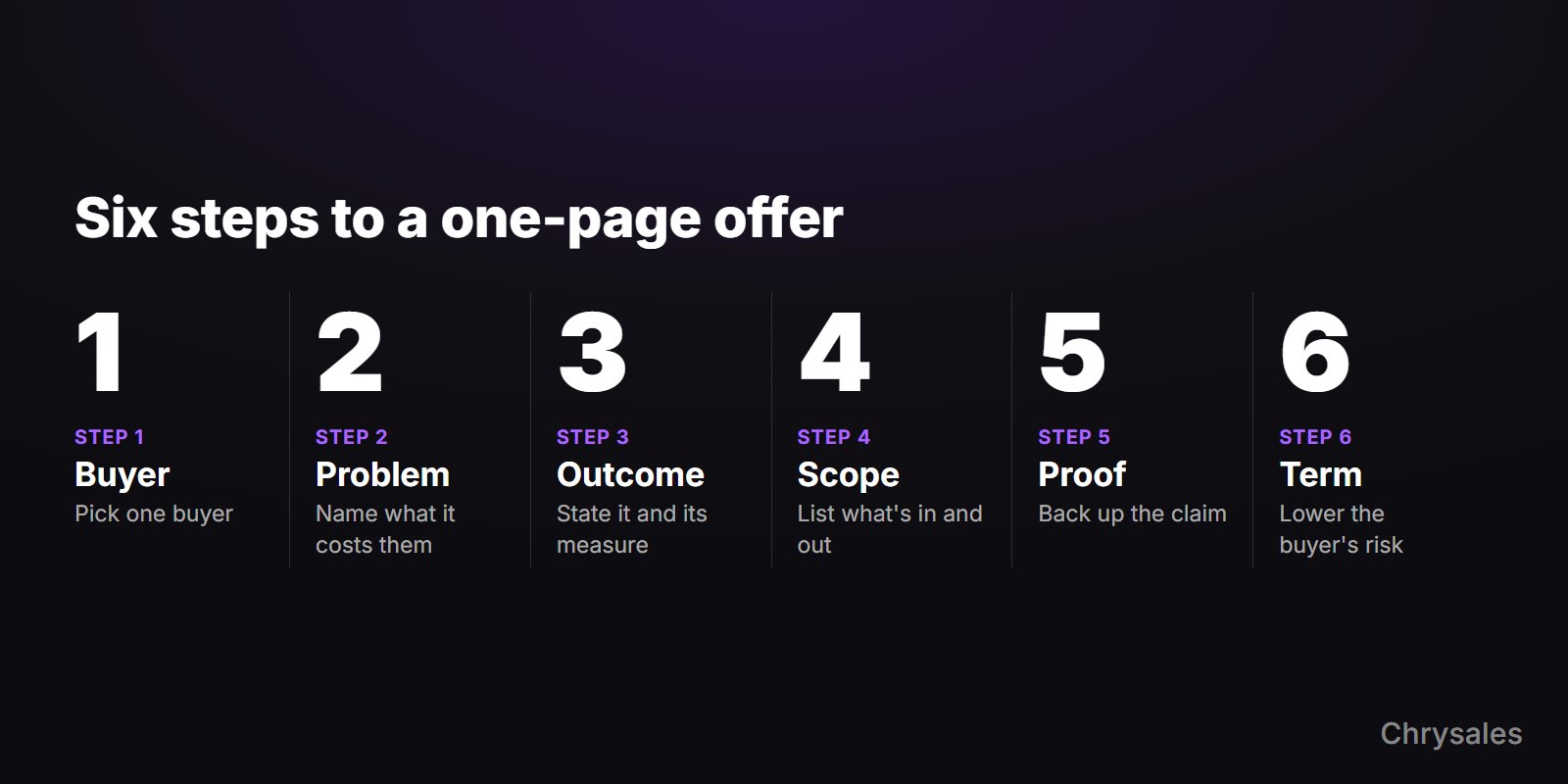
- Pick one buyer. Name the role and the kind of company, and define one ideal customer profile first if you don't have one yet. An offer written for everyone gives nobody a reason to pick it.
- Name the costly problem. Write it in the buyer's own words and ask what it costs them. Then ask the question from April Dunford's guide to positioning: "What would a customer do if your offering didn't exist?" Sometimes the answer is "Do nothing", meaning the customer sticks with their current way of solving the problem. When that's the case, it's the option you're really priced against.
- State the outcome and its measure. Say what changes for the buyer, how you'll both check it, and by when. "Better processes" can't be checked, while a named figure in the buyer's own system can.
- Set the scope, in and out. List what's included, then what isn't. The second list gives you something to trade later.
- Add proof. Anderson, Narus and van Rossum wrote in HBR in 2006 that "most value propositions make claims of savings and benefits to the customer without backing them up". Use a past result you're allowed to share, or a calculation the buyer can repeat with their own numbers.
- Add one term that lowers the buyer's risk. That can be staged payment, a fixed fee per result or a money-back promise. Write only a term you can afford to honor, with its conditions in plain view.
To check the page, read it to someone outside your industry. If they can't repeat who it's for and what they'd get in one sentence, the page isn't finished.
Fix the offer before you add volume. It's the first part of a client acquisition system, and more outreach on a vague offer only brings more people asking if you can do better on price.
What does a finished one-page offer look like?
A finished offer fits on one page and names the buyer, problem, outcome, scope, proof, price and term. The example below is made up. Example Co is an illustrative B2B company, its numbers are invented to show the format, and the brackets mark what you'd fill in from your own deals.
Before the work, Example Co describes itself like this:
We offer process consulting and operational support for growing
companies. Flexible packages, tailored to your needs. Price on request.
After the six steps, the same company reads like this:
EXAMPLE CO - ILLUSTRATIVE OFFER

For: finance leads at B2B companies that still send invoices by hand.

Problem: invoices go out late and with errors, so cash arrives later
and your team spends its days fixing them.
What it costs you: [the buyer's own figure from the first call]

Outcome: every invoice goes out within one working day of delivery by
the end of the quarter, measured in your own billing system.

Included: one billing process mapped and rebuilt, your team trained,
one review meeting at the end.
Not included: changing your accounting software, work for other
departments, support after the quarter.

Proof: [one past project you may share, with before and after figures]

Price: EUR 40,000, half at the start and half at the end.

Term: if the target isn't met by the end of the quarter, we keep
working at no extra fee until it is.

Next step: a short call to check your numbers against this page.
Three things changed. The buyer can now see who it's for, so a reader outside that group drops out early. The outcome can be checked, so "tailored to your needs" no longer has to do the selling. The "Not included" line gives both sides something to talk about other than the rate.
The term has a real cost. At these made-up numbers, Example Co earns EUR 6,000 on this deal, and extra work after the quarter comes out of that profit. It should write this term only if it's confident in hitting the target. If it isn't, a staged payment is the more honest choice.
How should you set up three options?
Build three options around one outcome. Keep the buyer and the problem the same, and change the scope, the support and the price together. A buyer who wants to spend less can then choose less, without asking you for a cut. Two options work too, if a third would only be filler.
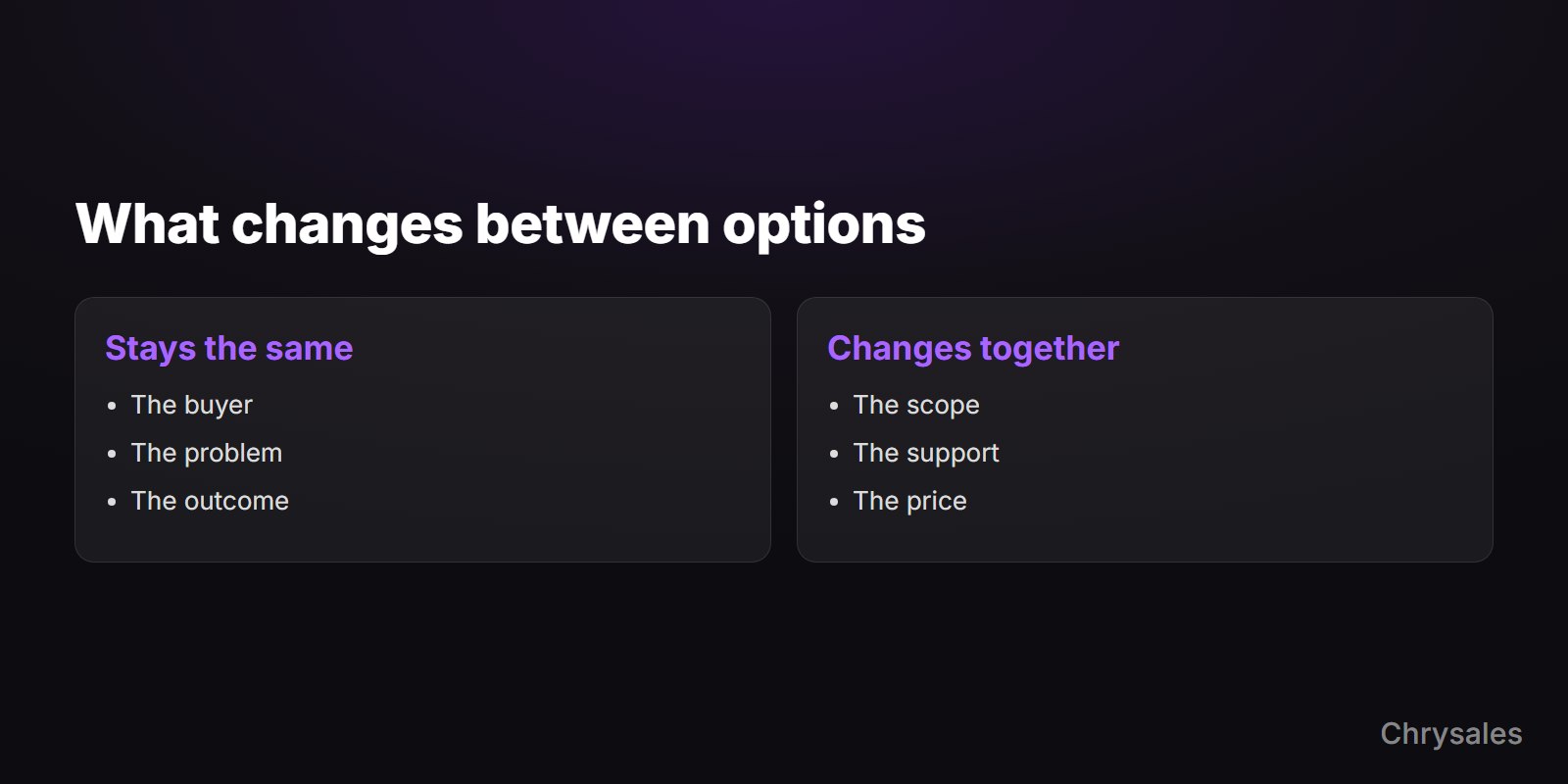
Example Co could lay the options out like this. The prices are placeholders around the EUR 40,000 offer, because the real numbers depend on your own costs.
| Example Co | Smaller | Core | Larger |
|---|---|---|---|
| Scope | One invoice type | The full billing process | Full process plus month-end reporting |
| Support | Review meeting at the end | Team training and review | Training, review and a follow-up check |
| Price | Below EUR 40,000 | EUR 40,000 | Above EUR 40,000 |
Each step down removes work, so your margin should hold if the smaller scope really costs you less to deliver. Give every option its own measure, and make sure you'd be glad to deliver the smallest one.
Options are often sold as a psychology trick, and the evidence for that in real buying is thin. Frederick, Lee and Baskin's 2014 paper found the attraction effect, where an added option pulls choices toward another one, only when options were shown as numbers. That was consumer choice and the finding is disputed. We found no B2B field test, so don't count on a lift in sales from the layout alone.
The layout fails in two common cases. If a buyer picks the cheapest whatever you show, the smallest option becomes your real offer, so price and scope it as one. If the options differ in ways the buyer can't compare, they'll ask you to explain them, and you're back to talking about price.
What do you trade when a buyer asks for a lower price?
Trade something of equal value and leave your rate alone. If the buyer pays less, the scope or the terms change with it. Harvard's Program on Negotiation calls this logrolling, meaning "trading across issues in a negotiation." State the rule before talks start, so a trade feels normal.
Say this one sentence before anyone asks for money off:
Our price changes only when something else in the deal changes: less
scope, a longer commitment or earlier payment.
Then answer by the reason behind the request, because each reason calls for a different trade.
| What the buyer says | What you ask or give | Why it protects your margin |
|---|---|---|
| "Our budget stops below that" | Remove a named item from the scope, in writing | The fee falls along with your cost |
| "Another firm quoted less" | Compare both scopes line by line, and hold the price if yours covers more | You find out whether it's the same offer |
| "There'll be more work after this" | Write the later work into the contract, with the lower rate starting on that work | You give the price only once the volume exists |
| "We need a saving for procurement" | Offer a lower price for full payment upfront or a longer commitment | You get cash or certainty in return |
| "This feels risky" | Add a stated target and what happens if it's missed, at the same price | The worry gets answered with a term |
| "Can you do better?" with no reason given | Ask what's behind the question, and hold the price until you know | You don't pay for a reflex |
Two advisors say the same thing. Karl Sakas says "don't offer a discount without a scope reduction". Michael Zipursky of Consulting Success suggests saying "I can reduce my fee if we reduce the scope of the project, what did you have in mind?"
This section covers what to put on the table. For the conversation itself, see the guide on handling "I need to think about it" on the call.
In this video, Sabir explains why founders often lose deals for reasons other than price, and the psychological triggers that make prospects trust you.
Which companies write their terms this way?
PostHog ties discounts to what a buyer commits, Rolls-Royce prices engine service per flying hour, Fin (formerly Intercom) prices its AI agent per outcome, and Slack credits you for inactive members. Each of them answers a price worry with something written into the deal. They're large companies, so take the idea and skip the details.
PostHog publishes its sales contract rules. "Our general principle is that discounts are earned, not given." Discounts are tied to volume and to multi-year payment upfront. The handbook also says "We don't offer discounts to customers paying monthly, irrespective of commitment" and rules out extra discounts in exchange for a case study. PostHog does give discounts, then, but its standard sales discounts come with a trade, and it hasn't published what this does to sales.
Rolls-Royce sold engine service on a fixed cost per flying hour from 1962. Today its TotalCare service, in the company's own words, "transfers both time-on-wing and shop visit cost risks back to Rolls-Royce".
Fin, the company called Intercom until May 2026, prices its AI agent at $0.99 per outcome, as of October 2026. Handoffs can count as outcomes, so read the definition before you admire the model.
Slack's fair billing policy treats a member who hasn't used Slack in over 28 days as inactive, stops billing for them and adds a prorated credit. On plans bought through Slack's website and paid by card or self-serve invoicing, that eases the worry about paying for unused seats with no change to the price.
When is a discount fine?
A discount is fine when the buyer gives you something real for it, such as a bigger volume or paying upfront, or when the deal truly costs you less to deliver. It also works as a written rule that applies to every buyer. The cut to avoid is the one given for nothing.
Use these conditions as a check:
- The buyer gives something you can name, like upfront payment or a signed commitment.
- Your cost to deliver really falls, for example because of a smaller scope.
- The rule is written down, so two buyers in the same position get the same answer.
- The new number still leaves a profit you'd accept on every deal.
Advisors differ on how far to go. Zipursky lists 5-10% off for long-term or large-scale work as one possible reply, Sakas wants a scope cut, and PostHog's handbook sets out what buyers must give to earn a discount.
Writing a tighter offer stops helping in three cases. If you can't deliver the outcome reliably, fix delivery before you write the term. If the buyer doesn't have the problem, a better page won't help, and you should let the deal go. If your offer really does match the next one line for line, price will decide, so change the offer or accept the lower margin.
How do you test the offer without a new website?
Use the deals you already have. Take 3-5 open deals, send the one-page offer or walk through it in your next meeting, and record which option they pick and what they try to trade. After that batch, change what caused confusion. A batch this small shows where the page fails, but it can't prove a close rate.
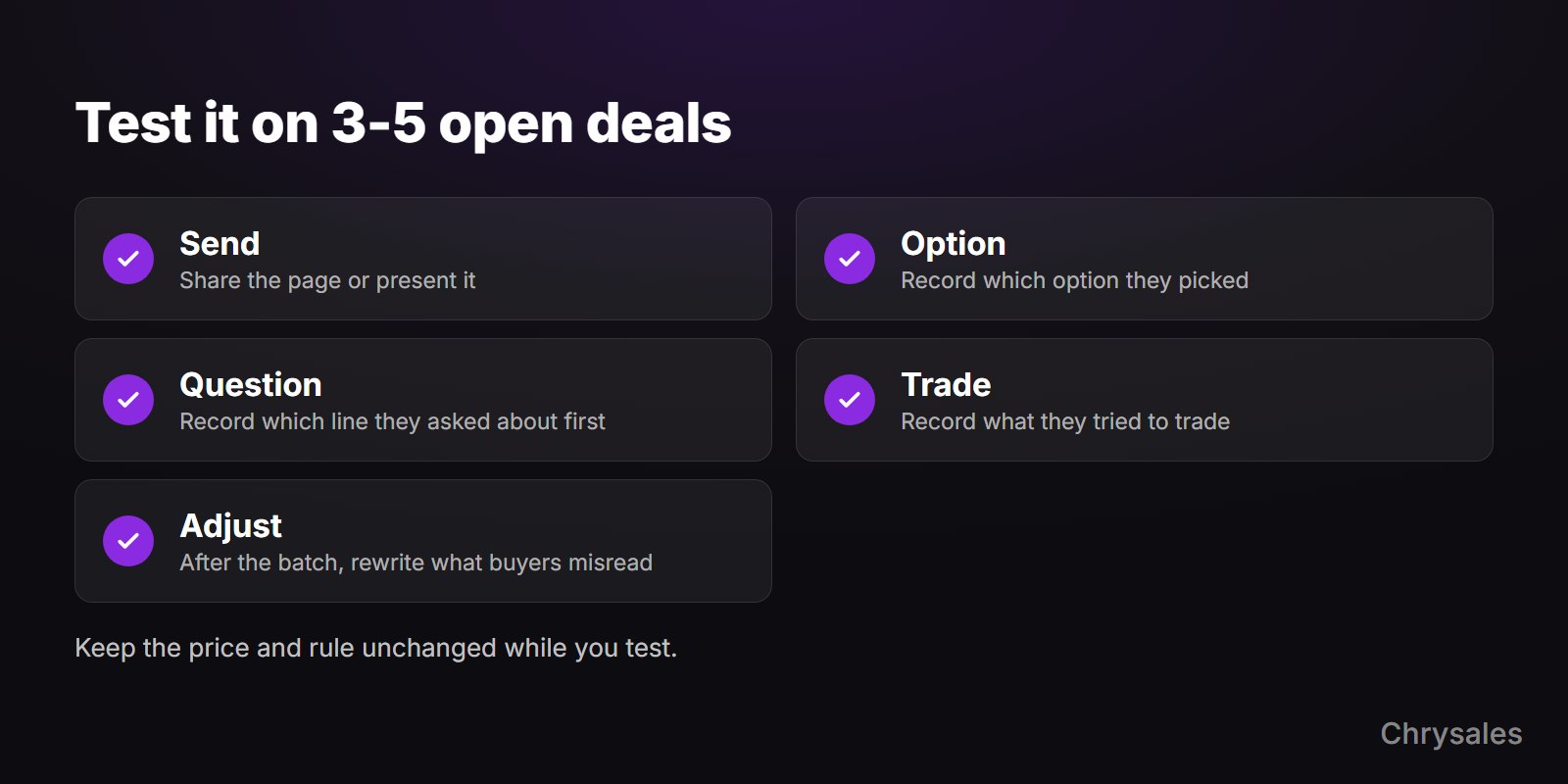
- Pick 3-5 open deals where the buyer has confirmed the problem. If you're not sure they have, go back to what to ask before you present the offer.
- Send the page or present it, and leave your site and sales deck as they are.
- Record which option each buyer picked, and which line they asked about first.
- Record what they tried to trade, and whether the price came up at all.
- After the batch, rewrite any line that more than one buyer misread. Keep the price and rule unchanged while you test, or you won't know what moved the answer.
If every buyer picks the smallest option, look at the scope of the others before you touch the price. If buyers argue about the outcome, your measure may be wrong for them.
Common mistakes with B2B offers
Offer mistakes tend to start with a skipped step on the page, and they show up later in the negotiation. The list below comes from practitioner write-ups, forum threads and our own reading of them. Treat these as common patterns, since we found no study measuring them, and check your own page against each one.
- Cutting the price while nothing else changes teaches the buyer that the first number was soft, so change the scope or the terms along with it.
- Claiming value with no proof. Anderson and his co-authors warn that a customer manager "will likely dismiss it as marketing puffery". Add a figure the buyer can check.
- Discounting to win a first deal. The low price becomes the buyer's reference for the next one. Use a smaller first scope at your normal rate.
- Accepting "more work later" as payment. Put the later work into the contract, or leave the price where it is.
- Writing a money-back promise with vague conditions. State who qualifies, by when and how it's measured, or leave it out.
- Letting discounts depend on who's selling. Simon-Kucher authors wrote that discounts for the same deal "typically vary immensely from one sales representative to the next". That problem starts the day a founder hands over sales, so write the trade rule down before then.
FAQ
What is the difference between a B2B offer and a proposal?
An offer is the standing package: who it's for, the outcome, the scope, the price and the terms. A proposal applies that offer to one buyer, with their numbers and dates. If you rewrite the whole thing for each deal, you probably don't have an offer yet.
How many options should a B2B offer have?
Two or three is enough for most offers. Each option should differ in scope or support, and the buyer should be able to see why the price differs. Add an option only if you'd be happy to deliver it.
What if a buyer still asks for a discount?
Ask what's behind the request, then use your trade rule: the price moves only when something else in the deal moves. If they have no budget for any option and nothing to trade, it's fine to let the deal go or set a date to talk again.
Should a B2B offer include a money-back promise?
Only if you can afford to honor it and can state its conditions clearly. We found no independent B2B data on how such promises affect sales or refund rates, so treat it as your own judgment call. A staged payment or a target with a stated remedy can lower the buyer's risk at less cost to you.
Sources
- Simon-Kucher - Global Pricing Study 2016
- The Pricing Advisor - Successful customer discounting in B2B
- Harvard Business Review - The good-better-best approach to pricing
- Bain - The B2B Elements of Value
- Anderson, Narus, van Rossum - Customer value propositions in business markets, HBR 2006
- April Dunford - A quickstart guide to positioning
- Program on Negotiation, Harvard Law School - Breaking a partial impasse
- Frederick, Lee, Baskin - The limits of attraction, 2014
- Sakas & Company - When a client demands a discount
- Consulting Success - Michael Zipursky on discount requests
- PostHog - Contract rules
- Rolls-Royce - Power-by-the-Hour press release, 2012
- Rolls-Royce - TotalCare
- Fin (formerly Intercom) - Pricing
- Slack - Fair billing policy
Want your offer and the sales system around it built properly? Chrysales helps you and your team build the sales system around your offer. Get your offer reviewed on a free call
Good B2B offer positioning starts with one buyer and one costly problem, then puts the outcome, scope and terms in writing. Give two or three options, so the buyer has something to weigh besides a discount. When someone pushes on price, you trade scope or terms and leave the rate alone. This works only if you can deliver the outcome and the buyer really has the problem.
You'll finish with a one-page written offer and a rule for what to trade when a buyer asks for a lower price. It's written for founders and sales leads who sell on trust and referrals and have started cutting prices to close. It won't set your price for you, and it can't promise a higher close rate.
What is a B2B offer, and how is it different from a service?
A B2B offer is the specific outcome a buyer gets from you, packaged with a scope, a price and terms so they can say yes to it. A service is the work you do, and a proposal is the document that prices one offer for one buyer. You can sell the same service through very different offers.
| What it describes | Example line | |
|---|---|---|
| Service | The work you do | "We do process consulting" |
| Offer | The result, scope, price and terms a buyer can accept | "Invoices out within one working day by the end of the quarter, for a fixed fee" |
| Proposal | One offer, adapted to one buyer's numbers and dates | "For your finance team, starting next month" |
A buyer can compare a service only with the next firm's rate, and that's how price becomes the whole conversation. Chrysales has written about an offer that sounds like everyone else's as one reason sales slow down. Bain's B2B Elements of Value lists 40 elements in five categories and treats price as table stakes, so meeting your price gets you considered and doesn't set you apart.
Chrysales' own About page lists the offer among the things a scaling business has to change: "your systems, your offer, team and the way you sell."
Why do discounts cost more than they look?
A discount comes straight out of profit, because your costs stay the same while the price drops. On a thin margin, a small cut can remove most of what the deal earned. It also tells the buyer the first number had room in it, which makes your next price talk harder.
Here's the math on a deal with made-up numbers. Delivery costs don't change, and no extra deals come in because of the cut.
| Illustrative deal | Full price | 10% off |
|---|---|---|
| Price | EUR 40,000 | EUR 36,000 |
| Cost to deliver | EUR 34,000 | EUR 34,000 |
| Profit | EUR 6,000 | EUR 2,000 |
A 10% discount took away two-thirds of the profit. You'd now need 3 deals to earn what 1 deal earned at full price, and each of those deals takes the same delivery work.
An HBR article on good-better-best pricing makes the wider point. "Companies often crimp profits by using discounts to attract price-sensitive customers." Simon-Kucher's 2016 Global Pricing Study, a self-reported survey with 2,186 participants, found 49% of companies saying they were in a price war. In the same study, 50% named better value communication as the most suitable answer to price pressure. That's what managers said in 2016, so read it as opinion and not as a measured effect.
Discounts can also stretch out the deal itself. The Chrysales guide on why discounts slow deals down covers that side, with swaps aimed at a faster close.
How do you write the offer, step by step?
Write the offer in six steps: pick one buyer, name their costly problem, state the outcome and its measure, set the scope, add proof, and add one term that lowers their risk. Work in this order, because each step narrows the next one. All six fit on a single page.
- Pick one buyer. Name the role and the kind of company, and define one ideal customer profile first if you don't have one yet. An offer written for everyone gives nobody a reason to pick it.
- Name the costly problem. Write it in the buyer's own words and ask what it costs them. Then ask the question from April Dunford's guide to positioning: "What would a customer do if your offering didn't exist?" Sometimes the answer is "Do nothing", meaning the customer sticks with their current way of solving the problem. When that's the case, it's the option you're really priced against.
- State the outcome and its measure. Say what changes for the buyer, how you'll both check it, and by when. "Better processes" can't be checked, while a named figure in the buyer's own system can.
- Set the scope, in and out. List what's included, then what isn't. The second list gives you something to trade later.
- Add proof. Anderson, Narus and van Rossum wrote in HBR in 2006 that "most value propositions make claims of savings and benefits to the customer without backing them up". Use a past result you're allowed to share, or a calculation the buyer can repeat with their own numbers.
- Add one term that lowers the buyer's risk. That can be staged payment, a fixed fee per result or a money-back promise. Write only a term you can afford to honor, with its conditions in plain view.
To check the page, read it to someone outside your industry. If they can't repeat who it's for and what they'd get in one sentence, the page isn't finished.
Fix the offer before you add volume. It's the first part of a client acquisition system, and more outreach on a vague offer only brings more people asking if you can do better on price.
What does a finished one-page offer look like?
A finished offer fits on one page and names the buyer, problem, outcome, scope, proof, price and term. The example below is made up. Example Co is an illustrative B2B company, its numbers are invented to show the format, and the brackets mark what you'd fill in from your own deals.
Before the work, Example Co describes itself like this:
We offer process consulting and operational support for growing
companies. Flexible packages, tailored to your needs. Price on request.
After the six steps, the same company reads like this:
EXAMPLE CO - ILLUSTRATIVE OFFER

For: finance leads at B2B companies that still send invoices by hand.

Problem: invoices go out late and with errors, so cash arrives later
and your team spends its days fixing them.
What it costs you: [the buyer's own figure from the first call]

Outcome: every invoice goes out within one working day of delivery by
the end of the quarter, measured in your own billing system.

Included: one billing process mapped and rebuilt, your team trained,
one review meeting at the end.
Not included: changing your accounting software, work for other
departments, support after the quarter.

Proof: [one past project you may share, with before and after figures]

Price: EUR 40,000, half at the start and half at the end.

Term: if the target isn't met by the end of the quarter, we keep
working at no extra fee until it is.

Next step: a short call to check your numbers against this page.
Three things changed. The buyer can now see who it's for, so a reader outside that group drops out early. The outcome can be checked, so "tailored to your needs" no longer has to do the selling. The "Not included" line gives both sides something to talk about other than the rate.
The term has a real cost. At these made-up numbers, Example Co earns EUR 6,000 on this deal, and extra work after the quarter comes out of that profit. It should write this term only if it's confident in hitting the target. If it isn't, a staged payment is the more honest choice.
How should you set up three options?
Build three options around one outcome. Keep the buyer and the problem the same, and change the scope, the support and the price together. A buyer who wants to spend less can then choose less, without asking you for a cut. Two options work too, if a third would only be filler.
Example Co could lay the options out like this. The prices are placeholders around the EUR 40,000 offer, because the real numbers depend on your own costs.
| Example Co | Smaller | Core | Larger |
|---|---|---|---|
| Scope | One invoice type | The full billing process | Full process plus month-end reporting |
| Support | Review meeting at the end | Team training and review | Training, review and a follow-up check |
| Price | Below EUR 40,000 | EUR 40,000 | Above EUR 40,000 |
Each step down removes work, so your margin should hold if the smaller scope really costs you less to deliver. Give every option its own measure, and make sure you'd be glad to deliver the smallest one.
Options are often sold as a psychology trick, and the evidence for that in real buying is thin. Frederick, Lee and Baskin's 2014 paper found the attraction effect, where an added option pulls choices toward another one, only when options were shown as numbers. That was consumer choice and the finding is disputed. We found no B2B field test, so don't count on a lift in sales from the layout alone.
The layout fails in two common cases. If a buyer picks the cheapest whatever you show, the smallest option becomes your real offer, so price and scope it as one. If the options differ in ways the buyer can't compare, they'll ask you to explain them, and you're back to talking about price.
What do you trade when a buyer asks for a lower price?
Trade something of equal value and leave your rate alone. If the buyer pays less, the scope or the terms change with it. Harvard's Program on Negotiation calls this logrolling, meaning "trading across issues in a negotiation." State the rule before talks start, so a trade feels normal.
Say this one sentence before anyone asks for money off:
Our price changes only when something else in the deal changes: less
scope, a longer commitment or earlier payment.
Then answer by the reason behind the request, because each reason calls for a different trade.
| What the buyer says | What you ask or give | Why it protects your margin |
|---|---|---|
| "Our budget stops below that" | Remove a named item from the scope, in writing | The fee falls along with your cost |
| "Another firm quoted less" | Compare both scopes line by line, and hold the price if yours covers more | You find out whether it's the same offer |
| "There'll be more work after this" | Write the later work into the contract, with the lower rate starting on that work | You give the price only once the volume exists |
| "We need a saving for procurement" | Offer a lower price for full payment upfront or a longer commitment | You get cash or certainty in return |
| "This feels risky" | Add a stated target and what happens if it's missed, at the same price | The worry gets answered with a term |
| "Can you do better?" with no reason given | Ask what's behind the question, and hold the price until you know | You don't pay for a reflex |
Two advisors say the same thing. Karl Sakas says "don't offer a discount without a scope reduction". Michael Zipursky of Consulting Success suggests saying "I can reduce my fee if we reduce the scope of the project, what did you have in mind?"
This section covers what to put on the table. For the conversation itself, see the guide on handling "I need to think about it" on the call.
In this video, Sabir explains why founders often lose deals for reasons other than price, and the psychological triggers that make prospects trust you.
Which companies write their terms this way?
PostHog ties discounts to what a buyer commits, Rolls-Royce prices engine service per flying hour, Fin (formerly Intercom) prices its AI agent per outcome, and Slack credits you for inactive members. Each of them answers a price worry with something written into the deal. They're large companies, so take the idea and skip the details.
PostHog publishes its sales contract rules. "Our general principle is that discounts are earned, not given." Discounts are tied to volume and to multi-year payment upfront. The handbook also says "We don't offer discounts to customers paying monthly, irrespective of commitment" and rules out extra discounts in exchange for a case study. PostHog does give discounts, then, but its standard sales discounts come with a trade, and it hasn't published what this does to sales.
Rolls-Royce sold engine service on a fixed cost per flying hour from 1962. Today its TotalCare service, in the company's own words, "transfers both time-on-wing and shop visit cost risks back to Rolls-Royce".
Fin, the company called Intercom until May 2026, prices its AI agent at $0.99 per outcome, as of October 2026. Handoffs can count as outcomes, so read the definition before you admire the model.
Slack's fair billing policy treats a member who hasn't used Slack in over 28 days as inactive, stops billing for them and adds a prorated credit. On plans bought through Slack's website and paid by card or self-serve invoicing, that eases the worry about paying for unused seats with no change to the price.
When is a discount fine?
A discount is fine when the buyer gives you something real for it, such as a bigger volume or paying upfront, or when the deal truly costs you less to deliver. It also works as a written rule that applies to every buyer. The cut to avoid is the one given for nothing.
Use these conditions as a check:
- The buyer gives something you can name, like upfront payment or a signed commitment.
- Your cost to deliver really falls, for example because of a smaller scope.
- The rule is written down, so two buyers in the same position get the same answer.
- The new number still leaves a profit you'd accept on every deal.
Advisors differ on how far to go. Zipursky lists 5-10% off for long-term or large-scale work as one possible reply, Sakas wants a scope cut, and PostHog's handbook sets out what buyers must give to earn a discount.
Writing a tighter offer stops helping in three cases. If you can't deliver the outcome reliably, fix delivery before you write the term. If the buyer doesn't have the problem, a better page won't help, and you should let the deal go. If your offer really does match the next one line for line, price will decide, so change the offer or accept the lower margin.
How do you test the offer without a new website?
Use the deals you already have. Take 3-5 open deals, send the one-page offer or walk through it in your next meeting, and record which option they pick and what they try to trade. After that batch, change what caused confusion. A batch this small shows where the page fails, but it can't prove a close rate.
- Pick 3-5 open deals where the buyer has confirmed the problem. If you're not sure they have, go back to what to ask before you present the offer.
- Send the page or present it, and leave your site and sales deck as they are.
- Record which option each buyer picked, and which line they asked about first.
- Record what they tried to trade, and whether the price came up at all.
- After the batch, rewrite any line that more than one buyer misread. Keep the price and rule unchanged while you test, or you won't know what moved the answer.
If every buyer picks the smallest option, look at the scope of the others before you touch the price. If buyers argue about the outcome, your measure may be wrong for them.
Common mistakes with B2B offers
Offer mistakes tend to start with a skipped step on the page, and they show up later in the negotiation. The list below comes from practitioner write-ups, forum threads and our own reading of them. Treat these as common patterns, since we found no study measuring them, and check your own page against each one.
- Cutting the price while nothing else changes teaches the buyer that the first number was soft, so change the scope or the terms along with it.
- Claiming value with no proof. Anderson and his co-authors warn that a customer manager "will likely dismiss it as marketing puffery". Add a figure the buyer can check.
- Discounting to win a first deal. The low price becomes the buyer's reference for the next one. Use a smaller first scope at your normal rate.
- Accepting "more work later" as payment. Put the later work into the contract, or leave the price where it is.
- Writing a money-back promise with vague conditions. State who qualifies, by when and how it's measured, or leave it out.
- Letting discounts depend on who's selling. Simon-Kucher authors wrote that discounts for the same deal "typically vary immensely from one sales representative to the next". That problem starts the day a founder hands over sales, so write the trade rule down before then.
FAQ
What is the difference between a B2B offer and a proposal?
An offer is the standing package: who it's for, the outcome, the scope, the price and the terms. A proposal applies that offer to one buyer, with their numbers and dates. If you rewrite the whole thing for each deal, you probably don't have an offer yet.
How many options should a B2B offer have?
Two or three is enough for most offers. Each option should differ in scope or support, and the buyer should be able to see why the price differs. Add an option only if you'd be happy to deliver it.
What if a buyer still asks for a discount?
Ask what's behind the request, then use your trade rule: the price moves only when something else in the deal moves. If they have no budget for any option and nothing to trade, it's fine to let the deal go or set a date to talk again.
Should a B2B offer include a money-back promise?
Only if you can afford to honor it and can state its conditions clearly. We found no independent B2B data on how such promises affect sales or refund rates, so treat it as your own judgment call. A staged payment or a target with a stated remedy can lower the buyer's risk at less cost to you.
Sources
- Simon-Kucher - Global Pricing Study 2016
- The Pricing Advisor - Successful customer discounting in B2B
- Harvard Business Review - The good-better-best approach to pricing
- Bain - The B2B Elements of Value
- Anderson, Narus, van Rossum - Customer value propositions in business markets, HBR 2006
- April Dunford - A quickstart guide to positioning
- Program on Negotiation, Harvard Law School - Breaking a partial impasse
- Frederick, Lee, Baskin - The limits of attraction, 2014
- Sakas & Company - When a client demands a discount
- Consulting Success - Michael Zipursky on discount requests
- PostHog - Contract rules
- Rolls-Royce - Power-by-the-Hour press release, 2012
- Rolls-Royce - TotalCare
- Fin (formerly Intercom) - Pricing
- Slack - Fair billing policy
Want your offer and the sales system around it built properly? Chrysales helps you and your team build the sales system around your offer. Get your offer reviewed on a free call
Scaling Is Not Hard If You Have The Right Systems
If you’re serious about leveling up your scaling game, you need the right system, the right training, and the right team behind you. We're here to give you the exact tools and strategies top entrepreneurs use to dominate.

Discover the latest tips
View All
Chrysales was formed from the words "chrysalis" the stage where a caterpillar transforms into a butterfly and "sales".
It stands for one thing: sales transformation.Because scaling doesn’t happen by doing more of the same. Scaling only happens when you go through real transformation in your systems, your offer, team and the way you sell.


