.avif)
Why B2B Lead Generation Belongs Outside Your Sales Role
B2B lead generation is the work of finding and reaching the right prospects so your sales team can book meetings and close more deals. It works best when it is handled with focus, tools, and steady follow up. Most small sales teams spend 15 hours a week on lead generation and still end up with empty pipelines. The cold emails get ignored. The LinkedIn messages go nowhere. The problem isn't effort. It's that B2B lead generation done badly costs more than doing nothing at all. When you're juggling sales calls, team management, and actually closing deals, lead generation becomes the thing you squeeze in between everything else. That's when it stops working.
Lead Generation Takes Full-Time Focus to Work
Here's the thing: B2B lead generation isn't something you do for 30 minutes before lunch. The teams that actually fill their pipelines treat it like a full-time job. They're testing subject lines, cleaning lists, tracking reply rates, and adjusting targeting every single day. If you're running sales calls, managing clients, and trying to build a business at the same time, lead generation becomes the task that gets half your attention. And half-attention lead generation gets you half-results or worse.
The Hidden Time Cost Nobody Talks About
Picture this: you decide to run a cold email campaign. First, you need to build a list. That's 4 hours of scrolling LinkedIn and pulling contacts. Then you write the email. Another 2 hours. Then you set up the tool, test the deliverability, and fix the broken merge tags. Another 3 hours. You send 200 emails. You get 3 replies. Two are unsubscribes. One is a maybe. You just spent 9 hours for one lukewarm lead.
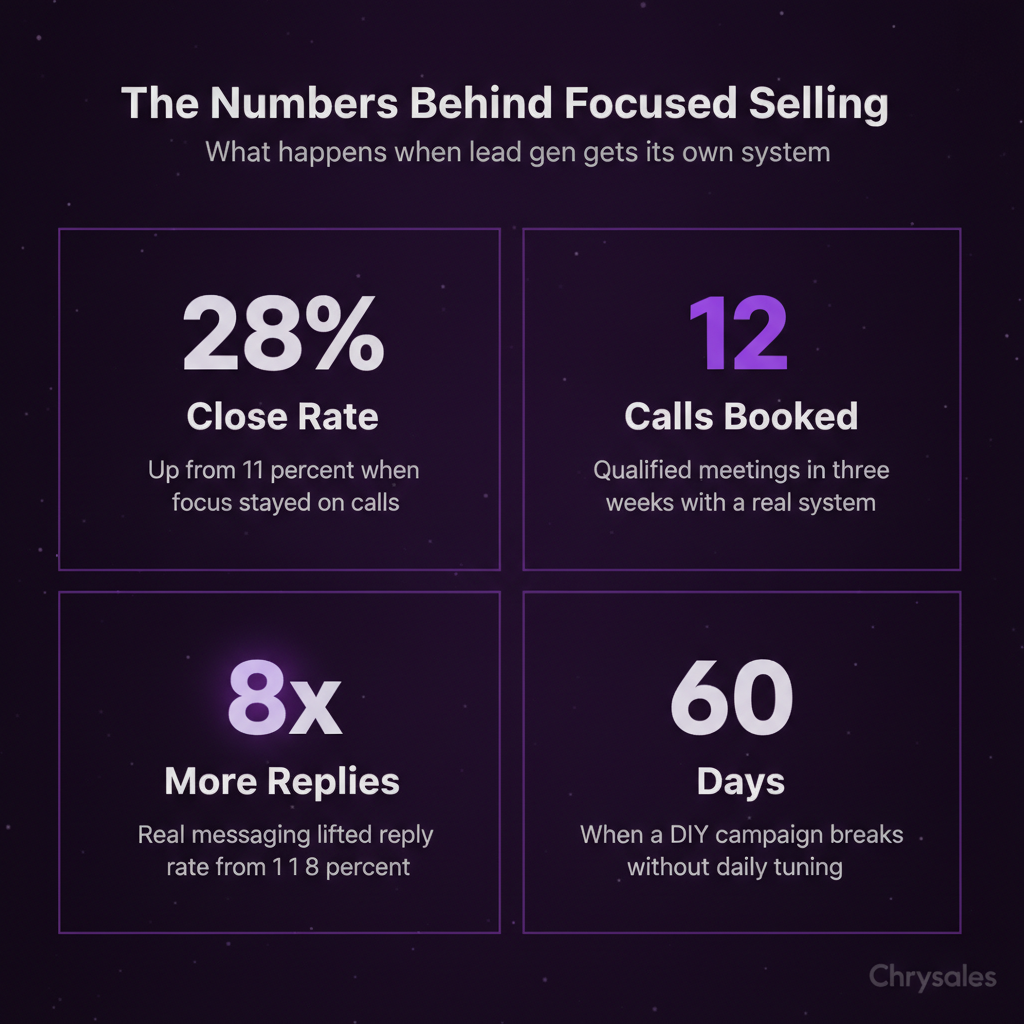
A 30-person consulting firm tried this last quarter. The team spent three weeks building their own outbound system. They sent 1,200 emails. Booked two calls. Both were bad fits. When they switched to a dedicated system built by someone who does this full-time, they booked 12 qualified calls in the same timeframe.
Common mistake: Thinking you can "set it and forget it" with lead generation. The best campaigns get tweaked daily based on real data.
You're Probably Targeting the Wrong People
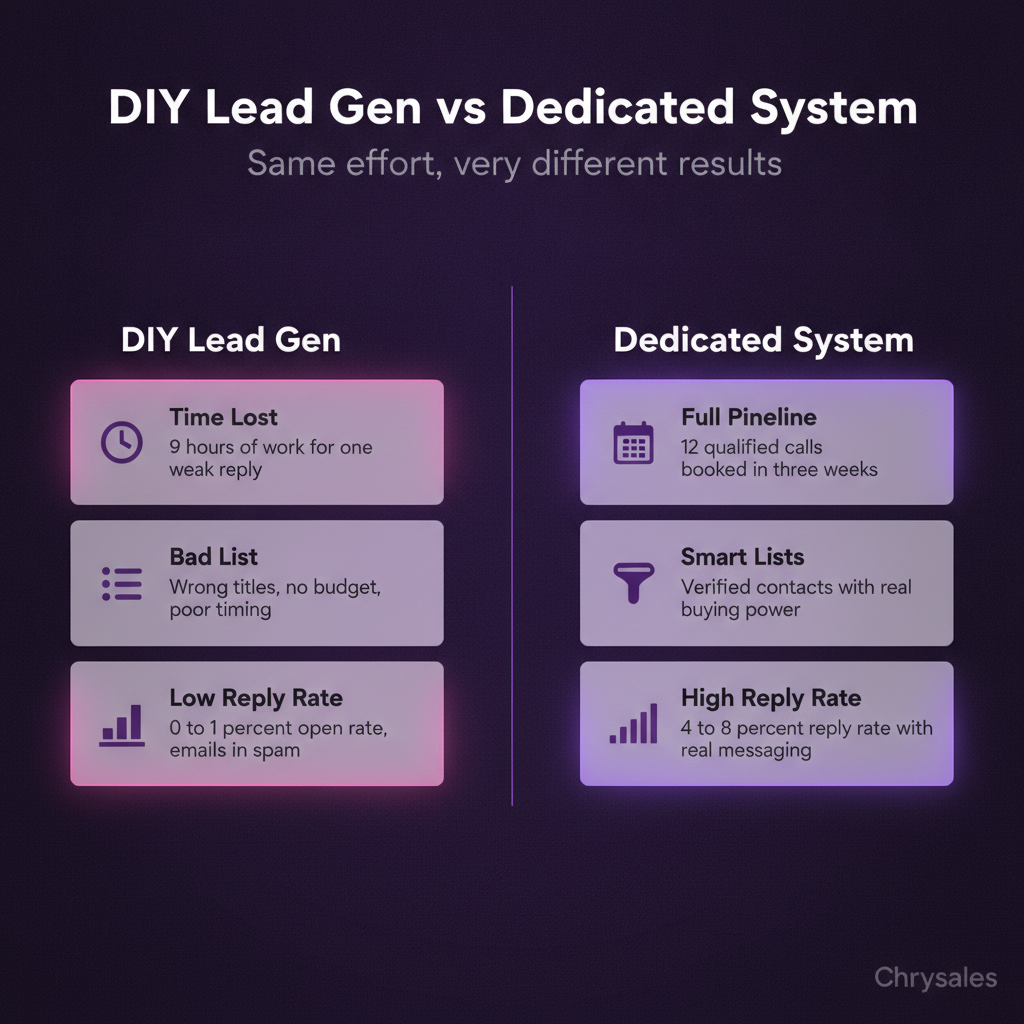
Most cold outreach flops because the list is bad, not the words. If you're doing your own B2B prospecting, you're likely pulling names from a database or scrolling LinkedIn for an hour and calling it a day. The result? You end up messaging people who don't have budget, don't have authority, or don't even need what you're selling.
List Quality Does Most of the Heavy Lifting
Think of your sales pipeline like a phone contact list. If half the numbers don't work, no message gets through. No matter how good the script is. A 200-person company that just did layoffs is not a hot lead. It's a bad fit, full stop. Same with messaging junior employees who can't make buying decisions, or companies in industries you've never served.
The teams that actually book meetings use AI lead scoring, intent data, and qualification filters before anyone types a single message. They're checking:
- Company size and revenue range
- Recent funding or growth signals
- Job titles with actual buying power
- Tech stack fit (if relevant)
- Timing signals like hiring spikes or new leadership
That takes tools, data sources, and honestly, a lot of boring repetitive work. If you're doing this yourself, you're either skipping these steps or spending 10 hours a week on list cleanup instead of closing deals. For more on identifying the right prospects, you can watch these 4 ways to find clients who need your services right now.
Pro Tip: Set a simple rule: anything scoring above 70 on your qualification checklist goes to the top of your call list. Everything else gets a different message or gets cut entirely.
Your Messaging Sounds Like Everyone Else's
When you write your own cold emails between meetings, they end up sounding generic. Not because you're bad at writing. Because you don't have time to research every single person you're messaging. So you write one template, swap in a company name, and hit send.
Personalization Is the Difference Between 1% and 5% Reply Rates
One marketing agency had a 0.5% reply rate on their cold emails. After switching to a system with real personalization (mentioning a recent hire, a podcast appearance, a product launch), their reply rate jumped to 4%. That's eight times more conversations from the same list size. Learning how to write cold emails that get replies through effective personalization is critical to modern B2B outreach.
Real personalization takes research. It takes knowing what each company cares about right now. Most teams doing their own lead generation don't have time for that level of detail. They send 200 identical emails and wonder why nobody replies.
Watch out: Fake personalization is worse than no personalization. If your opening line is "I saw you're doing great things at [Company]," everyone knows it's a template. Be specific or skip it.
Closing Deals and Chasing Leads Don't Mix
Cold email outreach and sales calls use completely different parts of your brain. One is volume, testing, and patience. The other is deep listening, handling objections, and closing. When you try to do both in the same day, both suffer.
Context Switching Kills Performance
Quick question: have you ever spent an hour writing cold emails, then jumped on a sales call, and felt off your game? That's because your brain was still in "batch outreach mode" instead of "deep conversation mode." The best closers protect their energy for calls. They don't spend the morning writing subject lines and the afternoon pitching six-figure deals.
We worked with a tech company where the sales lead was doing everything. Prospecting in the morning, calls in the afternoon, follow-ups at night. Their close rate was 11%. After they handed off all lead generation to a dedicated system and focused purely on calls, their close rate jumped to 28%. Same person. Same offer. Different focus.
Pro Tip: If you're booking three or more sales calls a week, your time is worth more on those calls than it is on lead generation. Full stop.
You're Missing the Tools and Data That Actually Work
B2B sales in 2025 runs on tools most people don't even know exist. AI lead scoring. Intent data. Multi channel sequencing. Deliverability monitoring. CRM integrations that trigger follow ups automatically. If you're doing your own lead generation, you're either paying for five different tools you barely use, or you're doing everything manually and losing to teams that aren't.
The Tech Stack Problem
Sales automation and appointment setting systems require a stack that costs anywhere from $300 to $1,200 a month, depending on scale. And that's before you learn how to use them. Most small sales teams buy a tool, set it up halfway, and let it sit there sending broken emails with bad merge tags. Implementing proven outbound email marketing best practices requires the right tools and constant optimization.
The teams getting consistent results from outbound lead generation use:
- Verified contact databases (not free scrapers)
- Email warmup tools to protect deliverability
- A/B testing platforms for subject lines and CTAs
- CRM workflows that route leads based on behavior
- AI lead scoring to prioritize outreach
Setting that up takes weeks. Using it effectively takes months. If you're trying to learn all this while also running your business, you're either going to do it badly or burn out trying.
Most DIY Lead Generation Systems Break After 60 Days
Here's what usually happens. You get excited. You set up a cold email campaign. It works okay for the first two weeks. Then your reply rates drop. Your emails start landing in spam. You're not sure why. You Google it. You try a few fixes. Nothing works. You give up and go back to referrals and inbound.
Why Outbound Campaigns Fall Apart
Outbound lead generation is not a "set it and forget it" system. Email providers change spam filters. LinkedIn updates its algorithm. Your target audience shifts. If you're not watching the data every single day and making adjustments, your campaign dies quietly while you're busy doing other things. According to expert B2B sales strategies, maintaining campaign health requires dedicated monitoring and rapid iteration.
A 15-person consulting firm set up their own cold email system using a popular tool. The first month, they booked five calls. The second month, two calls. The third month, zero. They didn't realize their domain reputation had tanked because they didn't rotate sending addresses or monitor bounce rates. By the time they noticed, they had to start over from scratch with a new domain.
Qualified lead generation systems stay alive because someone is watching them full-time. Testing. Tweaking. Fixing problems before they kill the whole campaign.
Common mistake: Assuming your campaign is fine because you're still sending emails. If your open rates drop from 40% to 18%, your emails are going to spam and you might not even know it.
What a Real Sales System Looks Like Instead
So what does this look like in practice? A real B2B sales system separates lead generation from closing. One part of the system is constantly filling the pipeline with qualified leads. The other part is closing those leads. They don't overlap. They don't compete for attention. They just work together.
The Four Parts of a System That Actually Scales
Most teams think sales is just "send emails and hop on calls." The systems that actually grow revenue predictably have four layers:
1. Lead generation that runs on autopilot. Someone (or a system) is constantly building lists, sending outreach, booking meetings, and feeding the pipeline. This happens whether you're on vacation or in back-to-back calls.
2. Qualification and handoff. Not every lead that replies is worth your time. A good system filters out tire kickers and only puts real opportunities on your calendar. Simple rules: Do they have budget? Do they have authority? Do they have a problem you solve?
3. Sales call structure. Once you're on the call, you need a repeatable framework. Discovery questions. Objection scripts. Pitch structure. Follow up sequences. Most people wing it. The best closers follow a system every single time.
4. Hiring and scaling. When you're ready to grow, you need to bring in setters and closers who can follow the same system. That only works if the system is documented and repeatable. Most teams skip this and wonder why new hires can't close.
Chrysales builds all four layers for B2B companies that want predictable client acquisition. We've trained 500+ sales teams and generated over €10M in client revenue by building custom systems that actually scale. The system does the heavy lifting. You focus on the part you're best at: closing deals. You can learn how to build a sales system so powerful clients come to you by following a structured, repeatable approach.
Pro Tip: If you can't explain your sales process in five steps or fewer, it's not a system yet. It's a loose collection of things you sometimes do.
When It Makes Sense to Keep Doing It Yourself
Look, the truth is: not everyone should hand off lead generation. If you're early stage, testing your offer, or still figuring out who your ideal customer is, doing your own cold outreach for a few months makes sense. You learn what messages land. You hear objections firsthand. You figure out who actually converts.
But once you know your offer works, once you've closed 10 or 20 clients and you understand the pattern, that's when doing your own lead generation stops being helpful and starts being expensive. Your time closing a $15K deal is worth more than your time writing cold emails. The math is simple. If you're booking four qualified calls a week and closing one or two, you've outgrown DIY lead generation. Hand it off. When you're ready to build a sales system that actually scales, it's time to separate lead generation from closing and focus on what you do best.
Frequently Asked Questions
Q: How much does it cost to hire someone to do lead generation for me?
Agencies typically charge $2,000 to $8,000 a month depending on volume and level of service. Hiring an in-house person costs $40K to $70K a year plus tools. A custom sales system with coaching to set it up and train your team ranges from $3K to $12K depending on complexity. The real question is: what's your time worth? If you're closing deals worth $10K to $50K, spending a few thousand a month to fill your pipeline consistently is a no-brainer.
Q: Can I just use a tool like Instantly or Apollo and do it myself?
You can, but tools don't build lists, write copy, monitor deliverability, or optimize campaigns. They just send emails. Most teams who try this route send a few hundred emails, get low reply rates, and assume the tool doesn't work. The tool is fine. The strategy, targeting, and messaging are usually the problem. If you don't have time to learn all that, a tool alone won't save you.
Q: What if I don't trust someone else to represent my brand?
That's fair. But here's the thing: a good lead generation system doesn't replace you. It books the meeting. You still show up, have the conversation, and close the deal. You're still the face of the business. The system just makes sure your calendar is full of people who actually want to talk to you. And honestly, a well-trained system will represent your brand better than a rushed email you wrote at 11 p.m. between client calls.
Q: How long does it take to see results if I hand off lead generation?
Most custom sales systems take 2 to 4 weeks to build and another 2 to 3 weeks to start booking consistent meetings. So figure 4 to 7 weeks from kickoff to seeing real pipeline activity. If someone promises you 50 meetings in the first week, run. Real B2B prospecting takes time to dial in targeting, test messaging, and build momentum. But once it's working, it keeps working. The key is learning to build a consistent sales pipeline that feeds your team qualified leads week after week.
Q: What's the difference between a lead generation agency and a sales system?
A lead generation agency usually focuses on appointment setting and hands you a calendar full of meetings. A sales system includes lead generation but also covers what happens after the meeting: how you qualify, how you pitch, how you handle objections, how you close, and how you scale. Chrysales builds the whole system, not just the top of the funnel. That's why our clients don't just get meetings, they get closed revenue.
Q: Is cold outreach even still working in 2025?
Yes, but only if it's done right. Spray and pray mass emails are dead. Hyper personalized outreach to well researched lists still works. Add in multi channel follow up (email, LinkedIn, maybe a call), and you've got a system that books real meetings. The teams struggling with cold outreach are usually the ones using bad lists, generic copy, and no follow up system. Research from modern B2B sales experts shows that personalized, strategic outbound is more effective than ever when executed properly. Fix those three things and outbound still works great.
Q: When should I hire a salesperson instead of outsourcing lead generation?
Hire a salesperson when you need help closing deals, not when you need more leads. If your calendar is already full and you're turning down meetings because you don't have time, hire a closer. If your calendar is empty and you're spending all your time trying to fill it, fix B2B lead generation first. Most teams hire salespeople too early, don't train them, and wonder why they fail. Build the system first. Then hire people to run it.
B2B lead generation is the work of finding and reaching the right prospects so your sales team can book meetings and close more deals. It works best when it is handled with focus, tools, and steady follow up. Most small sales teams spend 15 hours a week on lead generation and still end up with empty pipelines. The cold emails get ignored. The LinkedIn messages go nowhere. The problem isn't effort. It's that B2B lead generation done badly costs more than doing nothing at all. When you're juggling sales calls, team management, and actually closing deals, lead generation becomes the thing you squeeze in between everything else. That's when it stops working.
Lead Generation Takes Full-Time Focus to Work
Here's the thing: B2B lead generation isn't something you do for 30 minutes before lunch. The teams that actually fill their pipelines treat it like a full-time job. They're testing subject lines, cleaning lists, tracking reply rates, and adjusting targeting every single day. If you're running sales calls, managing clients, and trying to build a business at the same time, lead generation becomes the task that gets half your attention. And half-attention lead generation gets you half-results or worse.
The Hidden Time Cost Nobody Talks About
Picture this: you decide to run a cold email campaign. First, you need to build a list. That's 4 hours of scrolling LinkedIn and pulling contacts. Then you write the email. Another 2 hours. Then you set up the tool, test the deliverability, and fix the broken merge tags. Another 3 hours. You send 200 emails. You get 3 replies. Two are unsubscribes. One is a maybe. You just spent 9 hours for one lukewarm lead.
A 30-person consulting firm tried this last quarter. The team spent three weeks building their own outbound system. They sent 1,200 emails. Booked two calls. Both were bad fits. When they switched to a dedicated system built by someone who does this full-time, they booked 12 qualified calls in the same timeframe.
Common mistake: Thinking you can "set it and forget it" with lead generation. The best campaigns get tweaked daily based on real data.
You're Probably Targeting the Wrong People
Most cold outreach flops because the list is bad, not the words. If you're doing your own B2B prospecting, you're likely pulling names from a database or scrolling LinkedIn for an hour and calling it a day. The result? You end up messaging people who don't have budget, don't have authority, or don't even need what you're selling.
List Quality Does Most of the Heavy Lifting
Think of your sales pipeline like a phone contact list. If half the numbers don't work, no message gets through. No matter how good the script is. A 200-person company that just did layoffs is not a hot lead. It's a bad fit, full stop. Same with messaging junior employees who can't make buying decisions, or companies in industries you've never served.
The teams that actually book meetings use AI lead scoring, intent data, and qualification filters before anyone types a single message. They're checking:
- Company size and revenue range
- Recent funding or growth signals
- Job titles with actual buying power
- Tech stack fit (if relevant)
- Timing signals like hiring spikes or new leadership
That takes tools, data sources, and honestly, a lot of boring repetitive work. If you're doing this yourself, you're either skipping these steps or spending 10 hours a week on list cleanup instead of closing deals. For more on identifying the right prospects, you can watch these 4 ways to find clients who need your services right now.
Pro Tip: Set a simple rule: anything scoring above 70 on your qualification checklist goes to the top of your call list. Everything else gets a different message or gets cut entirely.
Your Messaging Sounds Like Everyone Else's
When you write your own cold emails between meetings, they end up sounding generic. Not because you're bad at writing. Because you don't have time to research every single person you're messaging. So you write one template, swap in a company name, and hit send.
Personalization Is the Difference Between 1% and 5% Reply Rates
One marketing agency had a 0.5% reply rate on their cold emails. After switching to a system with real personalization (mentioning a recent hire, a podcast appearance, a product launch), their reply rate jumped to 4%. That's eight times more conversations from the same list size. Learning how to write cold emails that get replies through effective personalization is critical to modern B2B outreach.
Real personalization takes research. It takes knowing what each company cares about right now. Most teams doing their own lead generation don't have time for that level of detail. They send 200 identical emails and wonder why nobody replies.
Watch out: Fake personalization is worse than no personalization. If your opening line is "I saw you're doing great things at [Company]," everyone knows it's a template. Be specific or skip it.
Closing Deals and Chasing Leads Don't Mix
Cold email outreach and sales calls use completely different parts of your brain. One is volume, testing, and patience. The other is deep listening, handling objections, and closing. When you try to do both in the same day, both suffer.
Context Switching Kills Performance
Quick question: have you ever spent an hour writing cold emails, then jumped on a sales call, and felt off your game? That's because your brain was still in "batch outreach mode" instead of "deep conversation mode." The best closers protect their energy for calls. They don't spend the morning writing subject lines and the afternoon pitching six-figure deals.
We worked with a tech company where the sales lead was doing everything. Prospecting in the morning, calls in the afternoon, follow-ups at night. Their close rate was 11%. After they handed off all lead generation to a dedicated system and focused purely on calls, their close rate jumped to 28%. Same person. Same offer. Different focus.
Pro Tip: If you're booking three or more sales calls a week, your time is worth more on those calls than it is on lead generation. Full stop.
You're Missing the Tools and Data That Actually Work
B2B sales in 2025 runs on tools most people don't even know exist. AI lead scoring. Intent data. Multi channel sequencing. Deliverability monitoring. CRM integrations that trigger follow ups automatically. If you're doing your own lead generation, you're either paying for five different tools you barely use, or you're doing everything manually and losing to teams that aren't.
The Tech Stack Problem
Sales automation and appointment setting systems require a stack that costs anywhere from $300 to $1,200 a month, depending on scale. And that's before you learn how to use them. Most small sales teams buy a tool, set it up halfway, and let it sit there sending broken emails with bad merge tags. Implementing proven outbound email marketing best practices requires the right tools and constant optimization.
The teams getting consistent results from outbound lead generation use:
- Verified contact databases (not free scrapers)
- Email warmup tools to protect deliverability
- A/B testing platforms for subject lines and CTAs
- CRM workflows that route leads based on behavior
- AI lead scoring to prioritize outreach
Setting that up takes weeks. Using it effectively takes months. If you're trying to learn all this while also running your business, you're either going to do it badly or burn out trying.
Most DIY Lead Generation Systems Break After 60 Days
Here's what usually happens. You get excited. You set up a cold email campaign. It works okay for the first two weeks. Then your reply rates drop. Your emails start landing in spam. You're not sure why. You Google it. You try a few fixes. Nothing works. You give up and go back to referrals and inbound.
Why Outbound Campaigns Fall Apart
Outbound lead generation is not a "set it and forget it" system. Email providers change spam filters. LinkedIn updates its algorithm. Your target audience shifts. If you're not watching the data every single day and making adjustments, your campaign dies quietly while you're busy doing other things. According to expert B2B sales strategies, maintaining campaign health requires dedicated monitoring and rapid iteration.
A 15-person consulting firm set up their own cold email system using a popular tool. The first month, they booked five calls. The second month, two calls. The third month, zero. They didn't realize their domain reputation had tanked because they didn't rotate sending addresses or monitor bounce rates. By the time they noticed, they had to start over from scratch with a new domain.
Qualified lead generation systems stay alive because someone is watching them full-time. Testing. Tweaking. Fixing problems before they kill the whole campaign.
Common mistake: Assuming your campaign is fine because you're still sending emails. If your open rates drop from 40% to 18%, your emails are going to spam and you might not even know it.
What a Real Sales System Looks Like Instead
So what does this look like in practice? A real B2B sales system separates lead generation from closing. One part of the system is constantly filling the pipeline with qualified leads. The other part is closing those leads. They don't overlap. They don't compete for attention. They just work together.
The Four Parts of a System That Actually Scales
Most teams think sales is just "send emails and hop on calls." The systems that actually grow revenue predictably have four layers:
1. Lead generation that runs on autopilot. Someone (or a system) is constantly building lists, sending outreach, booking meetings, and feeding the pipeline. This happens whether you're on vacation or in back-to-back calls.
2. Qualification and handoff. Not every lead that replies is worth your time. A good system filters out tire kickers and only puts real opportunities on your calendar. Simple rules: Do they have budget? Do they have authority? Do they have a problem you solve?
3. Sales call structure. Once you're on the call, you need a repeatable framework. Discovery questions. Objection scripts. Pitch structure. Follow up sequences. Most people wing it. The best closers follow a system every single time.
4. Hiring and scaling. When you're ready to grow, you need to bring in setters and closers who can follow the same system. That only works if the system is documented and repeatable. Most teams skip this and wonder why new hires can't close.
Chrysales builds all four layers for B2B companies that want predictable client acquisition. We've trained 500+ sales teams and generated over €10M in client revenue by building custom systems that actually scale. The system does the heavy lifting. You focus on the part you're best at: closing deals. You can learn how to build a sales system so powerful clients come to you by following a structured, repeatable approach.
Pro Tip: If you can't explain your sales process in five steps or fewer, it's not a system yet. It's a loose collection of things you sometimes do.
When It Makes Sense to Keep Doing It Yourself
Look, the truth is: not everyone should hand off lead generation. If you're early stage, testing your offer, or still figuring out who your ideal customer is, doing your own cold outreach for a few months makes sense. You learn what messages land. You hear objections firsthand. You figure out who actually converts.
But once you know your offer works, once you've closed 10 or 20 clients and you understand the pattern, that's when doing your own lead generation stops being helpful and starts being expensive. Your time closing a $15K deal is worth more than your time writing cold emails. The math is simple. If you're booking four qualified calls a week and closing one or two, you've outgrown DIY lead generation. Hand it off. When you're ready to build a sales system that actually scales, it's time to separate lead generation from closing and focus on what you do best.
Frequently Asked Questions
Q: How much does it cost to hire someone to do lead generation for me?
Agencies typically charge $2,000 to $8,000 a month depending on volume and level of service. Hiring an in-house person costs $40K to $70K a year plus tools. A custom sales system with coaching to set it up and train your team ranges from $3K to $12K depending on complexity. The real question is: what's your time worth? If you're closing deals worth $10K to $50K, spending a few thousand a month to fill your pipeline consistently is a no-brainer.
Q: Can I just use a tool like Instantly or Apollo and do it myself?
You can, but tools don't build lists, write copy, monitor deliverability, or optimize campaigns. They just send emails. Most teams who try this route send a few hundred emails, get low reply rates, and assume the tool doesn't work. The tool is fine. The strategy, targeting, and messaging are usually the problem. If you don't have time to learn all that, a tool alone won't save you.
Q: What if I don't trust someone else to represent my brand?
That's fair. But here's the thing: a good lead generation system doesn't replace you. It books the meeting. You still show up, have the conversation, and close the deal. You're still the face of the business. The system just makes sure your calendar is full of people who actually want to talk to you. And honestly, a well-trained system will represent your brand better than a rushed email you wrote at 11 p.m. between client calls.
Q: How long does it take to see results if I hand off lead generation?
Most custom sales systems take 2 to 4 weeks to build and another 2 to 3 weeks to start booking consistent meetings. So figure 4 to 7 weeks from kickoff to seeing real pipeline activity. If someone promises you 50 meetings in the first week, run. Real B2B prospecting takes time to dial in targeting, test messaging, and build momentum. But once it's working, it keeps working. The key is learning to build a consistent sales pipeline that feeds your team qualified leads week after week.
Q: What's the difference between a lead generation agency and a sales system?
A lead generation agency usually focuses on appointment setting and hands you a calendar full of meetings. A sales system includes lead generation but also covers what happens after the meeting: how you qualify, how you pitch, how you handle objections, how you close, and how you scale. Chrysales builds the whole system, not just the top of the funnel. That's why our clients don't just get meetings, they get closed revenue.
Q: Is cold outreach even still working in 2025?
Yes, but only if it's done right. Spray and pray mass emails are dead. Hyper personalized outreach to well researched lists still works. Add in multi channel follow up (email, LinkedIn, maybe a call), and you've got a system that books real meetings. The teams struggling with cold outreach are usually the ones using bad lists, generic copy, and no follow up system. Research from modern B2B sales experts shows that personalized, strategic outbound is more effective than ever when executed properly. Fix those three things and outbound still works great.
Q: When should I hire a salesperson instead of outsourcing lead generation?
Hire a salesperson when you need help closing deals, not when you need more leads. If your calendar is already full and you're turning down meetings because you don't have time, hire a closer. If your calendar is empty and you're spending all your time trying to fill it, fix B2B lead generation first. Most teams hire salespeople too early, don't train them, and wonder why they fail. Build the system first. Then hire people to run it.
Scaling Is Not Hard If You Have The Right Systems
If you’re serious about leveling up your scaling game, you need the right system, the right training, and the right team behind you. We're here to give you the exact tools and strategies top entrepreneurs use to dominate.

Discover the latest tips
View All.avif)
Chrysales was formed from the words "chrysalis" the stage where a caterpillar transforms into a butterfly and "sales".
It stands for one thing: sales transformation.Because scaling doesn’t happen by doing more of the same. Scaling only happens when you go through real transformation in your systems, your offer, team and the way you sell.
.avif)


