.avif)
How to Turn One Blog Post Into 30 B2B Content Touchpoints
B2B content marketing is the process of using one strong piece of content to create many touchpoints that support lead generation, b2b sales, client acquisition, and gtm. Most B2B content marketing gets created once, posted once, then forgotten. You write a blog post, share it on LinkedIn, maybe send it in one email, and that's it. Done. Meanwhile, your competitors are taking that same single piece of content and turning it into weeks of consistent visibility across every channel they use.
Here's the thing: the content isn't the bottleneck. The system around it is. When you know how to break down and redistribute one solid piece of content, you stop needing to create new stuff every single day and start building a content machine that feeds your B2B sales pipeline without burning you out.
The Real Problem: Most Teams Create Too Much and Use Too Little
Picture this: you spend three days writing a detailed guide on sales automation. It's good. You post it. You get 40 views, two likes, and zero leads. Then you panic and start writing the next piece because you think you need more content. Wrong move. The issue isn't that you need more content. It's that you didn't extract enough value from what you already made.
A 15-person consulting firm we worked with last year had this exact problem. They published 12 blog posts in three months. Total leads generated: two. When we audited their process, we found they were posting each blog once and moving on. No repurposing. No multi-channel distribution. No touchpoint strategy.
Most B2B companies treat content like a one-and-done task. Write it, post it, forget it. But B2B lead generation doesn't work that way. Your prospects don't see your content the first time. They need multiple exposures across multiple formats before they even remember your name, as confirmed by recent B2B buying behavior research.
Common mistake: Creating 30 new pieces of content when you could create one strong piece and turn it into 30 different touchpoints.
What a Touchpoint Actually Means in B2B Content Marketing
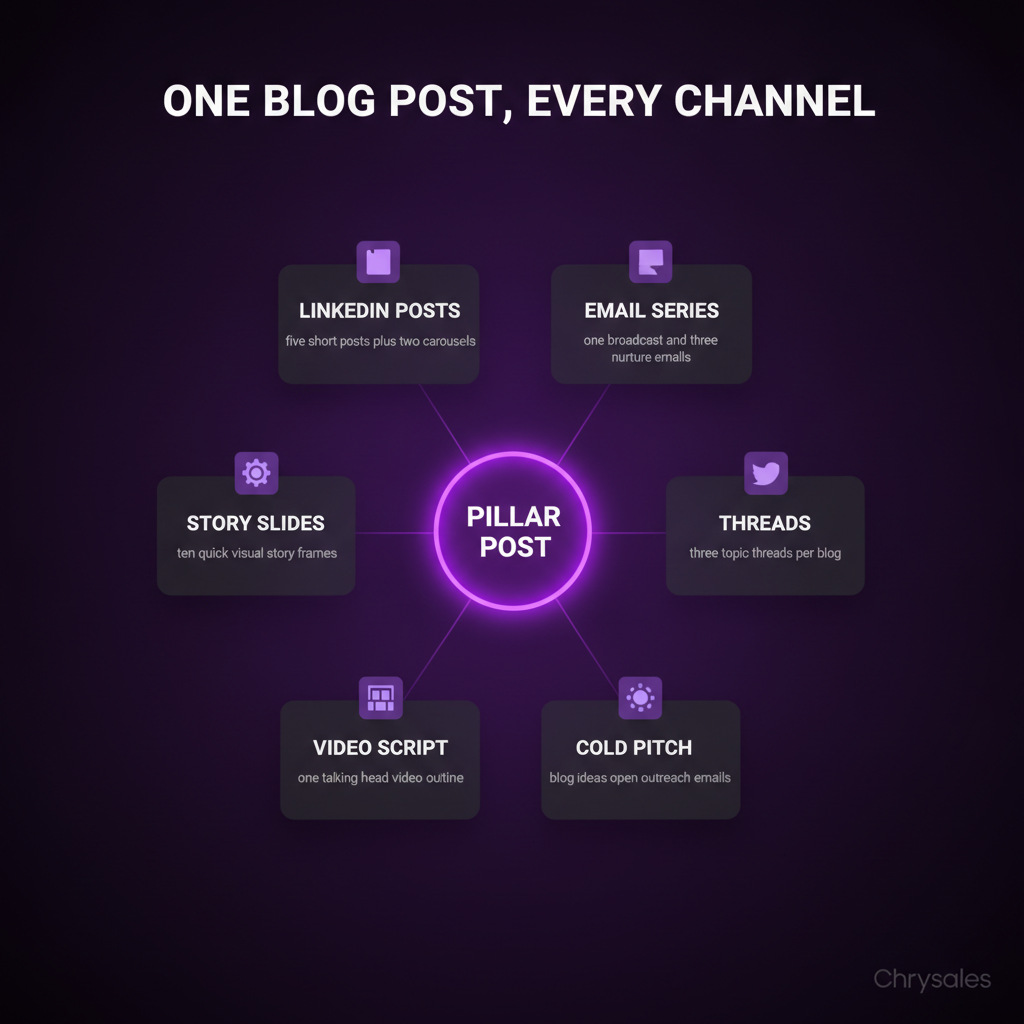
A touchpoint is any moment a prospect interacts with your content. It's not just a post. It's every individual time your message shows up in front of someone. One blog post can become:
- A LinkedIn carousel
- Five short LinkedIn posts
- Three Twitter threads
- An email to your list
- A cold outreach opener
- A slide deck
- A YouTube video
- Ten Instagram story slides
- A podcast episode outline
- Email nurture sequence content
Each of those is a separate touchpoint. Same core idea, different format, different placement, different audience segment. That's how you go from one asset to 30 exposures without starting from scratch every time.
Why This Matters for Client Acquisition
B2B sales cycles are long. Nobody books a call after seeing one post. They need to see your name, your ideas, and your authority multiple times before they trust you enough to reach out. A content marketing strategy built around touchpoints gives you that repeated visibility without demanding you produce new content every single day, and you can learn more about how to distribute one idea across multiple channels for 10x different results.
We see this all the time with new clients. They come in thinking they need to hire a full time content creator. What they actually need is a better system to multiply the content they already have.
The Math: One Asset, 30 Touchpoints, Zero Extra Writing
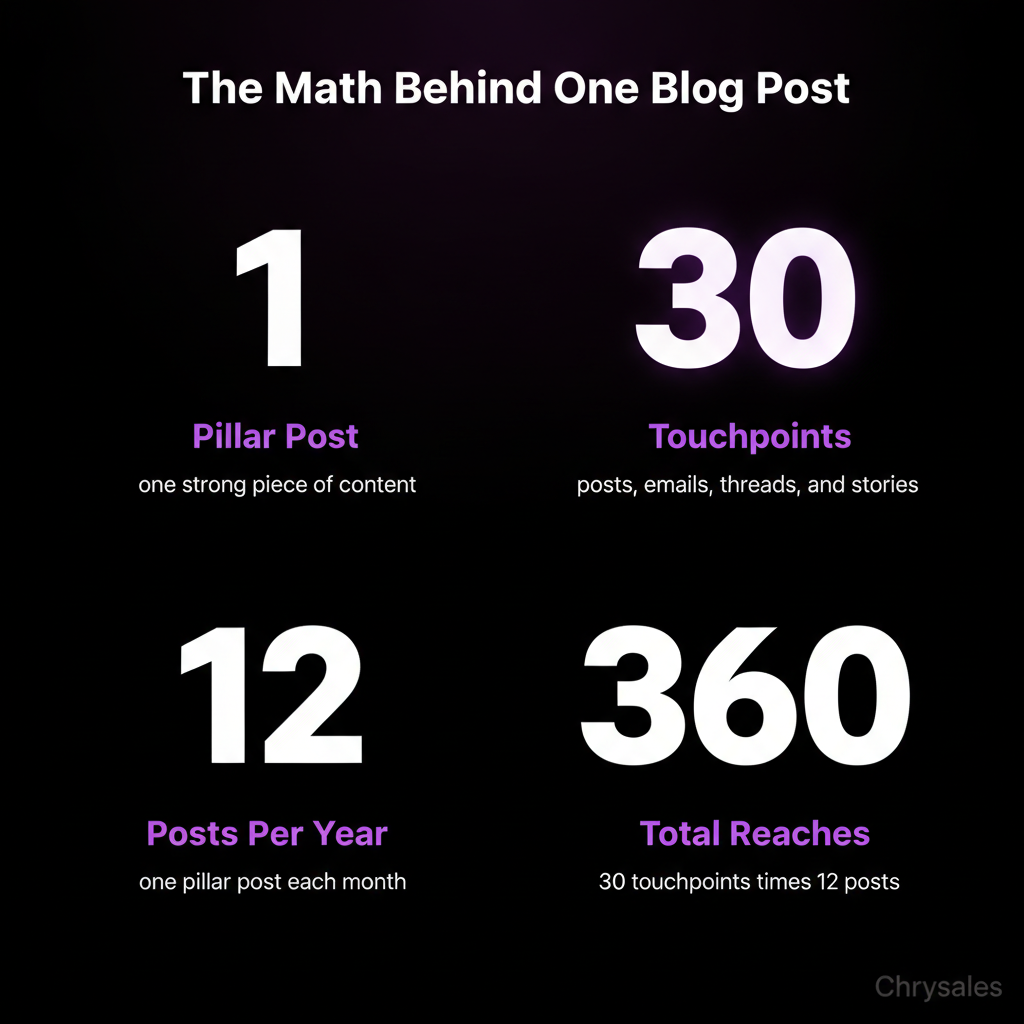
Let's say you publish one long form blog post per month. That's 12 posts a year. If you turn each post into 30 touchpoints, that's 360 total exposures across your audience. Compare that to the old way: 12 blog posts, posted once each, buried in a week. The content is the same. The output is 30x bigger.
Step 1: Start With One Strong Pillar Piece
Not every piece of content is worth breaking down into 30 touchpoints. You need something solid. A pillar piece is a deep, useful, structured piece of content that teaches something specific. Think:
- A complete how to guide
- A case study with real results
- A framework or system breakdown
- A detailed comparison or analysis
Good pillar content answers a question your prospects are actually searching for. It connects to your offer without being a sales pitch. It's the kind of thing someone bookmarks and shares.
Pro Tip: Pick topics that tie directly to what your B2B sales team talks about on calls. If your closers spend half their time explaining why cold outreach needs better list hygiene, write that guide. Now your content supports both inbound interest and sales call prep.
What Makes a Pillar Piece Repeatable
Your pillar content should include:
- A clear structure with headers and subheadings
- Real examples or mini case studies
- Actionable steps or frameworks
- Data points or stats that back up your claims
- Answers to the most common objections or questions
A marketing agency we worked with created one 2,000 word guide on lead scoring for B2B. That single piece became the foundation for six months of content across LinkedIn, email, and cold outreach. They didn't need to write anything new. They just remixed the same ideas.
Step 2: Break It Down Into Core Ideas
Once you have your pillar piece, pull out the main ideas. Each section of your blog, each subheading, each key point can become its own standalone touchpoint. Let's say your blog has five main sections. Each section is one core idea. Each idea can be:
- A LinkedIn post
- A Twitter thread
- An Instagram carousel slide
- An email
- A cold outreach line
- A talking point in a video
You're not copying and pasting the whole blog into a LinkedIn post. You're extracting the single most interesting point from each section and giving it its own moment.
Example Breakdown
Original blog section: "Why most cold email campaigns fail (bad list quality, not bad copy)"
Touchpoint variations:
- LinkedIn post: "Your cold email flopped. But the words weren't the problem. The list was."
- Twitter thread: "Thread: Why list quality beats email copy every time (and what to fix first)"
- Email subject line: "Bad list = dead campaign (even with great copy)"
- Instagram story slide: "Most teams blame the email. The real issue? The list."
- Cold outreach opener: "Quick question: how much time did you spend on your email copy vs. your list hygiene?"
Same idea. Five different formats. Five separate touchpoints.
Watch out: Don't just repost the same sentence five times. Reframe the angle slightly for each platform. LinkedIn likes bold statements. Twitter likes breakdowns. Email likes curiosity gaps.
Step 3: Adapt Formats for Each Platform
Every platform rewards different content formats. LinkedIn loves carousels and long form text posts. Twitter rewards threads. Email works best with curiosity driven subject lines and short paragraphs. Instagram stories need visuals and quick punches of text. Here's how to turn one blog into platform specific touchpoints:
LinkedIn (8-10 touchpoints)
- One long form post summarizing the full blog
- Five short posts, each highlighting one section
- Two carousels breaking down frameworks or steps
- One poll asking a question the blog answers
- One video of you talking through the main idea
If you want to maximize your LinkedIn presence, check out our guide on optimizing LinkedIn content for B2B lead generation.
Twitter (5-7 touchpoints)
- Three threads, each unpacking one section
- Four single tweets with pull quotes or stats from the blog
- One reply thread where you answer common questions
Email (4-6 touchpoints)
- One broadcast email linking to the blog
- Three nurture emails, each focused on one section
- Two cold outreach emails using ideas from the blog as conversation starters
Instagram or Stories (3-5 touchpoints)
- One carousel post (10 slides summarizing key points)
- Story slides with pull quotes or stats
- A Reel or short video explaining the main framework
A 30-person consulting firm tried this last quarter. They wrote one blog on B2B sales team scaling. From that, they created 12 LinkedIn posts, 6 email touchpoints, 4 Twitter threads, and 8 Instagram story slides. Total touchpoints: 30. Total new content written from scratch: zero after the original blog.
Step 4: Build a Simple Content Calendar
You don't need a fancy tool. You need a simple plan that tells you what to post, when, and where. A good content calendar for this strategy is just a spreadsheet with:
- The pillar piece title
- Platform
- Touchpoint type (post, thread, email, etc.)
- Post date
- Status (drafted, scheduled, posted)
Set a posting rhythm. For example:
- LinkedIn: 3 posts per week
- Email: 1 broadcast + 2 nurture emails per month
- Twitter: 2 threads per week
- Instagram: 2 story batches per week
Space out your 30 touchpoints over 4 to 6 weeks. That's one pillar piece feeding a month and a half of consistent content. By the time you finish distributing touchpoint 30, you're ready to publish your next pillar piece and start the cycle again, as detailed in our comprehensive guide on building a content calendar for B2B lead generation.
Pro Tip: Batch create your touchpoints in one session. Once your blog is done, spend two hours pulling quotes, writing short posts, and designing carousels. Schedule them all at once. Now you don't think about content again for a month.
Step 5: Tie Touchpoints Back to Your B2B Sales System
Content for content's sake is a waste. Every touchpoint should connect back to client acquisition, not just likes and shares. That means:
- Link posts back to a landing page or lead magnet
- Include a soft CTA in most posts ("Want help with this? DM me.")
- Use content ideas in cold outreach (reference a specific post in your opener)
- Repurpose content into sales training or discovery question prompts
One marketing agency had a 0.5% reply rate on cold outreach. After they started using blog ideas as conversation starters in their emails, their reply rate jumped to 4%. Same list, same offer. They just gave prospects something interesting to respond to instead of a generic pitch, according to current B2B sales performance benchmarks.
Your sales team should know what content you're posting. Your content should reflect what your sales team is hearing on calls. When those two things connect, content stops being a separate "marketing thing" and starts feeding the pipeline.
Connecting Content to Lead Generation
Think of your content machine like this:
- Pillar content pulls in cold traffic (SEO, shares, discovery)
- Touchpoints keep you visible (reminders, trust building)
- CTAs and lead magnets convert interest into contact info
- Sales conversations close the deal
If any part of that chain is missing, B2B content marketing ROI tanks. Most B2B companies create content but skip the CTA or don't connect it to their outreach. That's why they get views but no leads. To build a comprehensive approach, explore how to align your content strategy with your sales funnel for B2B leads.
Common mistake: Posting content with no clear next step. Every touchpoint should make it easy for someone to take action, even if it's just replying to a DM or clicking a link.
Step 6: Measure What Actually Matters
Vanity metrics don't pay the bills. Likes and shares feel good, but they don't tell you if your B2B content marketing strategy is working. Track:
- Click through rate on links in posts
- Replies or DMs generated per touchpoint
- Email opens and clicks from content based emails
- Leads or calls booked that mention seeing your content
- Conversion rate from content traffic to lead magnet signups
A good content machine should generate measurable pipeline movement. If you're getting tons of engagement but zero leads, something's broken. Either your CTA is weak, your offer isn't clear, or you're talking to the wrong audience.
We worked with a tech company who had great LinkedIn engagement. Thousands of impressions, hundreds of likes. But zero inbound calls. When we dug in, we found their posts were generic inspiration quotes with no tie to their actual service. They switched to posting real how to content tied to their sales process. Within six weeks, they booked eight calls directly from LinkedIn DMs.
Simple Weekly Check In
Every Friday, look at:
- How many people clicked links in this week's content
- How many replies or DMs you got
- How many new email subscribers came from content CTAs
- Any sales conversations that started because of a post
If those numbers are flat or dropping, adjust. Test different CTAs. Try different formats. Post at different times. But don't just keep posting without tracking whether it's working, and learn more strategies to track content impact throughout your sales funnel.
Automation and AI Support for Content Repurposing
You don't need to manually write 30 versions of the same idea. Use AI tools to speed up the process. Tools like ChatGPT or Gemini can:
- Pull key quotes from your blog
- Rewrite sections into shorter formats
- Generate thread structures from long form content
- Draft email subject lines based on blog headers
But here's the rule: AI drafts, you edit. Don't just copy paste AI output and call it done. The voice needs to sound like you. The examples need to be real. The ideas need to connect to your actual B2B sales process.
At Chrysales, we use AI heavily in sales workflows and content support. But the final output always gets a human pass. AI is fast. Humans make it sound real.
Pro Tip: Create a simple prompt template for your AI tool. Example: "Take this blog section and turn it into a 100 word LinkedIn post with a curiosity hook and a soft CTA." Save that prompt. Reuse it every time you repurpose content.
How Chrysales Helps B2B Companies Build Content Machines That Feed Sales Pipelines
Most B2B companies treat content marketing and sales as two separate things. Content team makes posts. Sales team makes calls. Nobody talks to each other. That's the gap Chrysales closes.
We build custom sales systems that connect content to actual client acquisition. That means:
- Repurposing sales calls into content (your best objection handling moments become LinkedIn posts)
- Using content ideas in cold outreach sequences (your blog becomes your opener)
- Training your sales team to share content that supports their pitch
- Building content calendars that reflect real buyer questions from discovery calls
We've trained 1,000+ business owners and 500+ sales teams. We don't just teach B2B content marketing theory. We build the full system: how to generate leads, how to close deals, how to scale without hiring an army of creators, and you can watch how to build a sales system so powerful clients come to you for a deeper walkthrough.
If you're stuck in the cycle of creating content that gets ignored, or if your team is burning out trying to post every day with zero leads to show for it, we can help. We've helped clients generate over €10M in revenue with sales systems that treat content as one part of a bigger lead generation machine, not a separate hobby.
Frequently Asked Questions
Q: How long does it take to create 30 touchpoints from one piece of content?
If your pillar content is already written, you can create 30 touchpoints in about 2-3 hours. The key is batching. Spend one session pulling quotes, rewriting key points into short posts, and drafting emails. Use AI tools to speed up the first draft, then edit everything for voice and accuracy. Most teams spread this over a week, doing a few touchpoints per day. Either way works. The important part is doing it all at once instead of scrambling every morning for something to post.
Q: What if my audience is only on one or two platforms?
That's fine. You don't need to be everywhere. If your prospects are only on LinkedIn and email, create 20 LinkedIn touchpoints and 10 email touchpoints from one blog. The method stays the same. Just skip the platforms your audience doesn't use. A B2B tech company doesn't need Instagram stories if their buyers aren't there. Focus your energy where your prospects actually spend time, and go deep on those channels instead of spreading thin.
Q: Can I repurpose old content this way, or does it need to be new?
Old content works great. Go back to your best performing blog posts from six months or a year ago. Most of your audience never saw them. Pull those posts, break them into touchpoints, and redistribute them now. If the information is still relevant, it's fair game. We've seen companies revive content from two years ago and generate more leads the second time around because they finally built a real distribution system instead of posting once and hoping.
Q: How do I avoid sounding repetitive if I'm posting the same ideas multiple times?
Reframe the angle each time. One post asks a question. The next makes a bold statement. The third tells a quick story. Same core idea, different entry point. Your audience isn't seeing every single post you make. Most people catch maybe 10% of your content. What feels repetitive to you is the first time most of your audience is hearing it. As long as you're changing the format and the hook, repetition isn't a problem. It's actually the strategy.
Q: What's a realistic lead generation result from one piece of content turned into 30 touchpoints?
It depends on your audience size and offer, but a solid content machine should generate 3-8 leads per pillar piece if you're doing it right. That's calls booked, email signups, or direct DMs from people who saw your content and want to talk. If you're getting zero leads after 30 touchpoints, the issue is either your CTA is missing, your content isn't solving a real problem, or your audience targeting is off. Track what's working, test different CTAs, and adjust. B2B content marketing for B2B isn't magic, but when the system is dialed in, one good piece can feed your pipeline for weeks.
B2B content marketing is the process of using one strong piece of content to create many touchpoints that support lead generation, b2b sales, client acquisition, and gtm. Most B2B content marketing gets created once, posted once, then forgotten. You write a blog post, share it on LinkedIn, maybe send it in one email, and that's it. Done. Meanwhile, your competitors are taking that same single piece of content and turning it into weeks of consistent visibility across every channel they use.
Here's the thing: the content isn't the bottleneck. The system around it is. When you know how to break down and redistribute one solid piece of content, you stop needing to create new stuff every single day and start building a content machine that feeds your B2B sales pipeline without burning you out.
The Real Problem: Most Teams Create Too Much and Use Too Little
Picture this: you spend three days writing a detailed guide on sales automation. It's good. You post it. You get 40 views, two likes, and zero leads. Then you panic and start writing the next piece because you think you need more content. Wrong move. The issue isn't that you need more content. It's that you didn't extract enough value from what you already made.
A 15-person consulting firm we worked with last year had this exact problem. They published 12 blog posts in three months. Total leads generated: two. When we audited their process, we found they were posting each blog once and moving on. No repurposing. No multi-channel distribution. No touchpoint strategy.
Most B2B companies treat content like a one-and-done task. Write it, post it, forget it. But B2B lead generation doesn't work that way. Your prospects don't see your content the first time. They need multiple exposures across multiple formats before they even remember your name, as confirmed by recent B2B buying behavior research.
Common mistake: Creating 30 new pieces of content when you could create one strong piece and turn it into 30 different touchpoints.
What a Touchpoint Actually Means in B2B Content Marketing
A touchpoint is any moment a prospect interacts with your content. It's not just a post. It's every individual time your message shows up in front of someone. One blog post can become:
- A LinkedIn carousel
- Five short LinkedIn posts
- Three Twitter threads
- An email to your list
- A cold outreach opener
- A slide deck
- A YouTube video
- Ten Instagram story slides
- A podcast episode outline
- Email nurture sequence content
Each of those is a separate touchpoint. Same core idea, different format, different placement, different audience segment. That's how you go from one asset to 30 exposures without starting from scratch every time.
Why This Matters for Client Acquisition
B2B sales cycles are long. Nobody books a call after seeing one post. They need to see your name, your ideas, and your authority multiple times before they trust you enough to reach out. A content marketing strategy built around touchpoints gives you that repeated visibility without demanding you produce new content every single day, and you can learn more about how to distribute one idea across multiple channels for 10x different results.
We see this all the time with new clients. They come in thinking they need to hire a full time content creator. What they actually need is a better system to multiply the content they already have.
The Math: One Asset, 30 Touchpoints, Zero Extra Writing
Let's say you publish one long form blog post per month. That's 12 posts a year. If you turn each post into 30 touchpoints, that's 360 total exposures across your audience. Compare that to the old way: 12 blog posts, posted once each, buried in a week. The content is the same. The output is 30x bigger.
Step 1: Start With One Strong Pillar Piece
Not every piece of content is worth breaking down into 30 touchpoints. You need something solid. A pillar piece is a deep, useful, structured piece of content that teaches something specific. Think:
- A complete how to guide
- A case study with real results
- A framework or system breakdown
- A detailed comparison or analysis
Good pillar content answers a question your prospects are actually searching for. It connects to your offer without being a sales pitch. It's the kind of thing someone bookmarks and shares.
Pro Tip: Pick topics that tie directly to what your B2B sales team talks about on calls. If your closers spend half their time explaining why cold outreach needs better list hygiene, write that guide. Now your content supports both inbound interest and sales call prep.
What Makes a Pillar Piece Repeatable
Your pillar content should include:
- A clear structure with headers and subheadings
- Real examples or mini case studies
- Actionable steps or frameworks
- Data points or stats that back up your claims
- Answers to the most common objections or questions
A marketing agency we worked with created one 2,000 word guide on lead scoring for B2B. That single piece became the foundation for six months of content across LinkedIn, email, and cold outreach. They didn't need to write anything new. They just remixed the same ideas.
Step 2: Break It Down Into Core Ideas
Once you have your pillar piece, pull out the main ideas. Each section of your blog, each subheading, each key point can become its own standalone touchpoint. Let's say your blog has five main sections. Each section is one core idea. Each idea can be:
- A LinkedIn post
- A Twitter thread
- An Instagram carousel slide
- An email
- A cold outreach line
- A talking point in a video
You're not copying and pasting the whole blog into a LinkedIn post. You're extracting the single most interesting point from each section and giving it its own moment.
Example Breakdown
Original blog section: "Why most cold email campaigns fail (bad list quality, not bad copy)"
Touchpoint variations:
- LinkedIn post: "Your cold email flopped. But the words weren't the problem. The list was."
- Twitter thread: "Thread: Why list quality beats email copy every time (and what to fix first)"
- Email subject line: "Bad list = dead campaign (even with great copy)"
- Instagram story slide: "Most teams blame the email. The real issue? The list."
- Cold outreach opener: "Quick question: how much time did you spend on your email copy vs. your list hygiene?"
Same idea. Five different formats. Five separate touchpoints.
Watch out: Don't just repost the same sentence five times. Reframe the angle slightly for each platform. LinkedIn likes bold statements. Twitter likes breakdowns. Email likes curiosity gaps.
Step 3: Adapt Formats for Each Platform
Every platform rewards different content formats. LinkedIn loves carousels and long form text posts. Twitter rewards threads. Email works best with curiosity driven subject lines and short paragraphs. Instagram stories need visuals and quick punches of text. Here's how to turn one blog into platform specific touchpoints:
LinkedIn (8-10 touchpoints)
- One long form post summarizing the full blog
- Five short posts, each highlighting one section
- Two carousels breaking down frameworks or steps
- One poll asking a question the blog answers
- One video of you talking through the main idea
If you want to maximize your LinkedIn presence, check out our guide on optimizing LinkedIn content for B2B lead generation.
Twitter (5-7 touchpoints)
- Three threads, each unpacking one section
- Four single tweets with pull quotes or stats from the blog
- One reply thread where you answer common questions
Email (4-6 touchpoints)
- One broadcast email linking to the blog
- Three nurture emails, each focused on one section
- Two cold outreach emails using ideas from the blog as conversation starters
Instagram or Stories (3-5 touchpoints)
- One carousel post (10 slides summarizing key points)
- Story slides with pull quotes or stats
- A Reel or short video explaining the main framework
A 30-person consulting firm tried this last quarter. They wrote one blog on B2B sales team scaling. From that, they created 12 LinkedIn posts, 6 email touchpoints, 4 Twitter threads, and 8 Instagram story slides. Total touchpoints: 30. Total new content written from scratch: zero after the original blog.
Step 4: Build a Simple Content Calendar
You don't need a fancy tool. You need a simple plan that tells you what to post, when, and where. A good content calendar for this strategy is just a spreadsheet with:
- The pillar piece title
- Platform
- Touchpoint type (post, thread, email, etc.)
- Post date
- Status (drafted, scheduled, posted)
Set a posting rhythm. For example:
- LinkedIn: 3 posts per week
- Email: 1 broadcast + 2 nurture emails per month
- Twitter: 2 threads per week
- Instagram: 2 story batches per week
Space out your 30 touchpoints over 4 to 6 weeks. That's one pillar piece feeding a month and a half of consistent content. By the time you finish distributing touchpoint 30, you're ready to publish your next pillar piece and start the cycle again, as detailed in our comprehensive guide on building a content calendar for B2B lead generation.
Pro Tip: Batch create your touchpoints in one session. Once your blog is done, spend two hours pulling quotes, writing short posts, and designing carousels. Schedule them all at once. Now you don't think about content again for a month.
Step 5: Tie Touchpoints Back to Your B2B Sales System
Content for content's sake is a waste. Every touchpoint should connect back to client acquisition, not just likes and shares. That means:
- Link posts back to a landing page or lead magnet
- Include a soft CTA in most posts ("Want help with this? DM me.")
- Use content ideas in cold outreach (reference a specific post in your opener)
- Repurpose content into sales training or discovery question prompts
One marketing agency had a 0.5% reply rate on cold outreach. After they started using blog ideas as conversation starters in their emails, their reply rate jumped to 4%. Same list, same offer. They just gave prospects something interesting to respond to instead of a generic pitch, according to current B2B sales performance benchmarks.
Your sales team should know what content you're posting. Your content should reflect what your sales team is hearing on calls. When those two things connect, content stops being a separate "marketing thing" and starts feeding the pipeline.
Connecting Content to Lead Generation
Think of your content machine like this:
- Pillar content pulls in cold traffic (SEO, shares, discovery)
- Touchpoints keep you visible (reminders, trust building)
- CTAs and lead magnets convert interest into contact info
- Sales conversations close the deal
If any part of that chain is missing, B2B content marketing ROI tanks. Most B2B companies create content but skip the CTA or don't connect it to their outreach. That's why they get views but no leads. To build a comprehensive approach, explore how to align your content strategy with your sales funnel for B2B leads.
Common mistake: Posting content with no clear next step. Every touchpoint should make it easy for someone to take action, even if it's just replying to a DM or clicking a link.
Step 6: Measure What Actually Matters
Vanity metrics don't pay the bills. Likes and shares feel good, but they don't tell you if your B2B content marketing strategy is working. Track:
- Click through rate on links in posts
- Replies or DMs generated per touchpoint
- Email opens and clicks from content based emails
- Leads or calls booked that mention seeing your content
- Conversion rate from content traffic to lead magnet signups
A good content machine should generate measurable pipeline movement. If you're getting tons of engagement but zero leads, something's broken. Either your CTA is weak, your offer isn't clear, or you're talking to the wrong audience.
We worked with a tech company who had great LinkedIn engagement. Thousands of impressions, hundreds of likes. But zero inbound calls. When we dug in, we found their posts were generic inspiration quotes with no tie to their actual service. They switched to posting real how to content tied to their sales process. Within six weeks, they booked eight calls directly from LinkedIn DMs.
Simple Weekly Check In
Every Friday, look at:
- How many people clicked links in this week's content
- How many replies or DMs you got
- How many new email subscribers came from content CTAs
- Any sales conversations that started because of a post
If those numbers are flat or dropping, adjust. Test different CTAs. Try different formats. Post at different times. But don't just keep posting without tracking whether it's working, and learn more strategies to track content impact throughout your sales funnel.
Automation and AI Support for Content Repurposing
You don't need to manually write 30 versions of the same idea. Use AI tools to speed up the process. Tools like ChatGPT or Gemini can:
- Pull key quotes from your blog
- Rewrite sections into shorter formats
- Generate thread structures from long form content
- Draft email subject lines based on blog headers
But here's the rule: AI drafts, you edit. Don't just copy paste AI output and call it done. The voice needs to sound like you. The examples need to be real. The ideas need to connect to your actual B2B sales process.
At Chrysales, we use AI heavily in sales workflows and content support. But the final output always gets a human pass. AI is fast. Humans make it sound real.
Pro Tip: Create a simple prompt template for your AI tool. Example: "Take this blog section and turn it into a 100 word LinkedIn post with a curiosity hook and a soft CTA." Save that prompt. Reuse it every time you repurpose content.
How Chrysales Helps B2B Companies Build Content Machines That Feed Sales Pipelines
Most B2B companies treat content marketing and sales as two separate things. Content team makes posts. Sales team makes calls. Nobody talks to each other. That's the gap Chrysales closes.
We build custom sales systems that connect content to actual client acquisition. That means:
- Repurposing sales calls into content (your best objection handling moments become LinkedIn posts)
- Using content ideas in cold outreach sequences (your blog becomes your opener)
- Training your sales team to share content that supports their pitch
- Building content calendars that reflect real buyer questions from discovery calls
We've trained 1,000+ business owners and 500+ sales teams. We don't just teach B2B content marketing theory. We build the full system: how to generate leads, how to close deals, how to scale without hiring an army of creators, and you can watch how to build a sales system so powerful clients come to you for a deeper walkthrough.
If you're stuck in the cycle of creating content that gets ignored, or if your team is burning out trying to post every day with zero leads to show for it, we can help. We've helped clients generate over €10M in revenue with sales systems that treat content as one part of a bigger lead generation machine, not a separate hobby.
Frequently Asked Questions
Q: How long does it take to create 30 touchpoints from one piece of content?
If your pillar content is already written, you can create 30 touchpoints in about 2-3 hours. The key is batching. Spend one session pulling quotes, rewriting key points into short posts, and drafting emails. Use AI tools to speed up the first draft, then edit everything for voice and accuracy. Most teams spread this over a week, doing a few touchpoints per day. Either way works. The important part is doing it all at once instead of scrambling every morning for something to post.
Q: What if my audience is only on one or two platforms?
That's fine. You don't need to be everywhere. If your prospects are only on LinkedIn and email, create 20 LinkedIn touchpoints and 10 email touchpoints from one blog. The method stays the same. Just skip the platforms your audience doesn't use. A B2B tech company doesn't need Instagram stories if their buyers aren't there. Focus your energy where your prospects actually spend time, and go deep on those channels instead of spreading thin.
Q: Can I repurpose old content this way, or does it need to be new?
Old content works great. Go back to your best performing blog posts from six months or a year ago. Most of your audience never saw them. Pull those posts, break them into touchpoints, and redistribute them now. If the information is still relevant, it's fair game. We've seen companies revive content from two years ago and generate more leads the second time around because they finally built a real distribution system instead of posting once and hoping.
Q: How do I avoid sounding repetitive if I'm posting the same ideas multiple times?
Reframe the angle each time. One post asks a question. The next makes a bold statement. The third tells a quick story. Same core idea, different entry point. Your audience isn't seeing every single post you make. Most people catch maybe 10% of your content. What feels repetitive to you is the first time most of your audience is hearing it. As long as you're changing the format and the hook, repetition isn't a problem. It's actually the strategy.
Q: What's a realistic lead generation result from one piece of content turned into 30 touchpoints?
It depends on your audience size and offer, but a solid content machine should generate 3-8 leads per pillar piece if you're doing it right. That's calls booked, email signups, or direct DMs from people who saw your content and want to talk. If you're getting zero leads after 30 touchpoints, the issue is either your CTA is missing, your content isn't solving a real problem, or your audience targeting is off. Track what's working, test different CTAs, and adjust. B2B content marketing for B2B isn't magic, but when the system is dialed in, one good piece can feed your pipeline for weeks.
Scaling Is Not Hard If You Have The Right Systems
If you’re serious about leveling up your scaling game, you need the right system, the right training, and the right team behind you. We're here to give you the exact tools and strategies top entrepreneurs use to dominate.

Discover the latest tips
View All.avif)
Chrysales was formed from the words "chrysalis" the stage where a caterpillar transforms into a butterfly and "sales".
It stands for one thing: sales transformation.Because scaling doesn’t happen by doing more of the same. Scaling only happens when you go through real transformation in your systems, your offer, team and the way you sell.
.avif)


