
B2B appointment setting cost: retainer vs pay per meeting
B2B appointment setting cost has no single market price. Vendors publish anything from under $100 to over $1,000 per meeting, as of November 2026. Entry-level retainers run from about $2,000 a month to $11,950 per 4 weeks for one SDR. The figures only become comparable once you turn every quote into cost per qualified meeting that actually took place, and then into cost per won deal using your own close rate.
This guide is for you if you have one or two agency quotes on the table and can't tell which is cheaper. You get a dated table of published prices, a worked calculation you can copy, the break-even point between a retainer and paying per meeting, and the contract terms that change the real price. If you first need the basics, here is what an appointment setter does.
How much does B2B appointment setting cost?
Published prices run from under $100 to over $1,000 per meeting, and the gap comes mostly from what each vendor counts as a meeting. A "scheduled" meeting is a cheaper product than one that was held and met agreed criteria. Retainers start at a few thousand dollars a month and pay for a team's time, not a meeting count. All figures below are vendor-reported and were checked on November 3, 2026.
Almost every price page on this topic belongs to a company that sells appointment setting. That makes the figures useful for "what this vendor charges" and weak for "what the market charges". Here is what the pages showed on the day of writing.
| Vendor and page | Model | Published price (vendor-reported, as of November 2026) | Page date |
|---|---|---|---|
| Belkins, pay-per-appointment page | Pay per appointment | From $750 per appointment, $1,500 one-time setup fee, 10-appointment starter package | Undated |
| CIENCE, pricing page | Hybrid | $2,000/month campaign team, $499/month platform, SDRs from $1,750 (offshore) or $3,500 (US/Europe) per SDR per month, plus a bonus tied to held meetings | Undated |
| SalesRoads, pricing page | Retainer | $11,950 per 4 weeks for one SDR, $16,750 for two | Undated |
| Sopro, pricing page | Retainer | Starts at around €3.4K a month | Undated |
| Cleverly, pay-per-appointment article | Retainer with a meeting range | $2,997/month for cold calling appointment setting, including 10-40 appointments a month | Modified July 13, 2026 |
| Cleverly, same article | Per held appointment (market bands) | $150-$400 SMB/mid-market, $400-$700 VP and above, $700-$1,000+ enterprise/C-suite | Modified July 13, 2026 |
| SalesBread, cost article | Market ranges | Retainer $2,000-$5,000 (no period stated); $75-$500 per scheduled meeting | September 23, 2025 |
| SalesRoads, pricing models article | Market range | Typical cost of a meeting $15 to $100 | Undated |
| Belkins, cost to outsource sales | Year-one estimate | $3,000-$5,000 per qualified meeting in year one | August 12, 2025 |
Don't average these numbers. They disagree for reasons you can name:
- The billable event differs. SalesBread's range is per scheduled meeting, Cleverly's bands are per held appointment, and the Belkins blog figure is per qualified meeting.
- The buyer's seniority moves the price. Cleverly's bands climb from $150-$400 for SMB/mid-market meetings to $700-$1,000+ for C-suite ones.
- A retainer buys capacity. SalesRoads and Sopro quote a team per month, so the cost per meeting depends on how many meetings that team books.
- Time frame matters. The Belkins blog figure covers year one only.
If you want to see who sells this before you compare prices, start with this list of appointment setting companies.
What do you get with a retainer, pay per meeting or a hybrid?
A retainer pays a team for a month of work, whatever the meeting count. Pay per meeting pays only for meetings that match an agreed definition. A hybrid combines a base fee with a bonus tied to meetings. The real difference is who carries two risks: the prospect not showing up, and the prospect turning out to be the wrong fit.
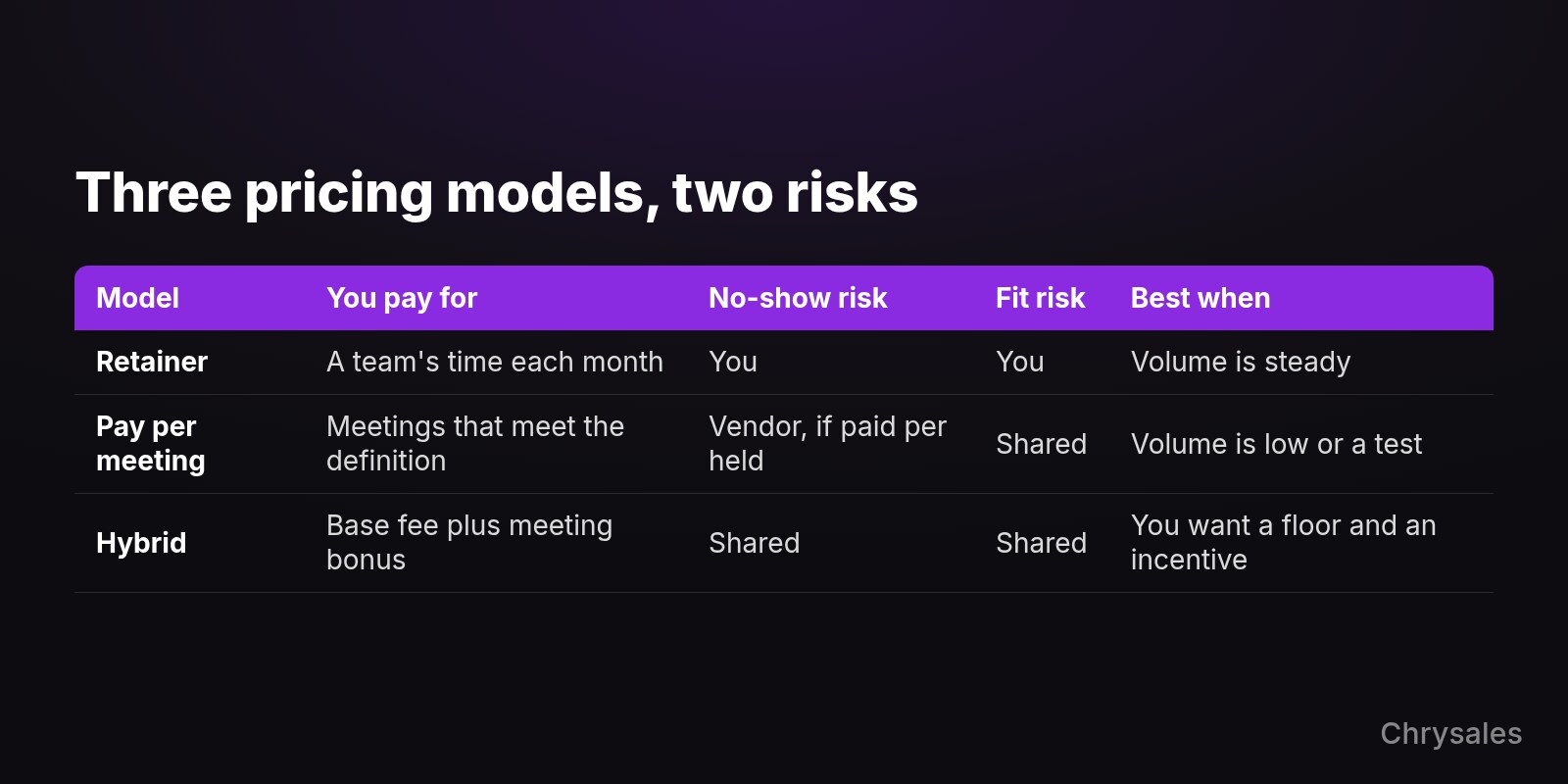
| Retainer | Pay per meeting | Hybrid | |
|---|---|---|---|
| You pay for | A team's time each month | Meetings that meet the definition | Base fee plus meeting bonus |
| No-show risk | You | Vendor, if paid per held | Shared |
| Fit risk | You | Shared | Shared |
| Cost per meeting | Falls as volume rises | Fixed per meeting | Partly fixed, partly per meeting |
| Best when | Volume is steady | Volume is low or a test | You want a floor and an incentive |
The published examples show how different these products are.
Belkins sells a pure pay-per-appointment package. It starts at $750 per appointment with a $1,500 one-time setup fee and a 10-appointment starter package, as of November 2026. The FAQ adds that the setup fee isn't refundable. A no-show doesn't use up an appointment, and a meeting that misses the agreed criteria goes back into the package.
SalesRoads sells a retainer billed per 4 weeks: $11,950 for one SDR (sales development rep) and $16,750 for two, with no long-term commitment. That price buys a team's time. It names no meeting count, so your cost per meeting depends on what the team delivers.
CIENCE publishes a hybrid. You pay $2,000 a month for a campaign team, $499 a month for its platform, and from $1,750 (offshore) or $3,500 (US/Europe) per SDR per month. Each SDR then earns a bonus tied to a target for held meetings, with one setup fee on top (the amount isn't published) and month-to-month terms.
Sopro starts at around €3.4K a month with no minimum contract. If you sell in the UK, DACH or the Nordics, it's the one price here already quoted in euros.
What counts as a meeting you pay for?
A payable meeting is whatever your contract says it is, and nobody else's definition applies. The same word can mean a booked slot, an accepted invite, a call that took place, or a call that took place with the right person. Each step down that list tends to cost more per meeting and moves more risk from you to the vendor.
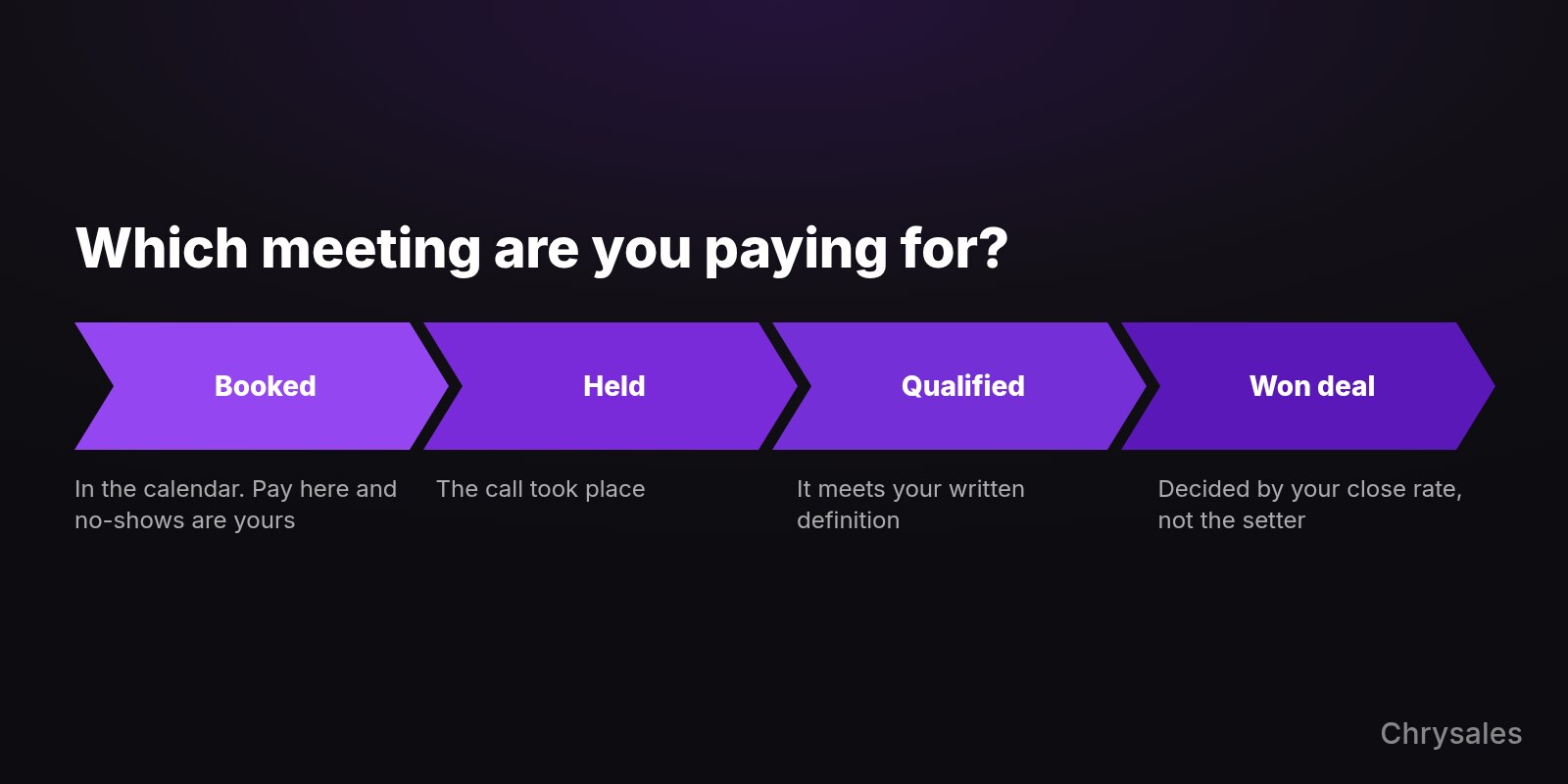
Dimitar Petkov of LeadHaste, a company that sells outbound, splits "meeting" into four billable events: booked, accepted, held, and held and qualified (LeadHaste, October 30, 2026). "There is no universal qualified-meeting definition," he writes. On billing at the early stage he adds, "If the contract bills on acceptance, the buyer carries no-show risk," so every no-show lands on your invoice.
Jack Reamer, CEO of SalesBread, warns from the vendor side that "before you choose this model, you must have very clear parameters of what qualifies as a booked meeting" (SalesBread, September 23, 2025).
The Belkins rules described above are one example of a buyer-friendly version: no-shows and meetings that miss the criteria don't count against the package.
Write the definition down before you sign. A workable one covers these points:
- The billable event. Pick held, or held and qualified, and say so in the contract.
- The fit criteria. Name the company size, role or seniority, and region that make a meeting count.
- The context. The prospect knows why they're on the call and what you sell.
- No-shows. Say whether a no-show is replaced, credited or simply not billed.
- The dispute window. Set how many days you have to flag a meeting, and who decides.
- Duplicates. A contact already in your CRM or already in talks with you doesn't count.
The tighter the definition, the higher the price per meeting tends to be. That's fine. A $750 held and qualified meeting and a $500 booked meeting are different products, so compare them only after you convert both to the same unit.
How do you turn a quote into cost per qualified meeting?
Add up everything a quote would cost you in a month, then divide it by the number of meetings that actually took place and met your criteria. Use the same volume assumption for every quote, so you compare prices on equal terms. The result is cost per qualified held meeting, the one number that lets a retainer and a per-meeting quote sit side by side.
Follow these steps for each quote:
- Write down what the quote bills for: a month of team time, booked meetings, held meetings, or held and qualified meetings.
- Pick one monthly volume assumption for all quotes: meetings booked, meetings held, and held meetings that meet your definition.
- Work out the monthly cost. Add the retainer or base fee, the per-meeting charges for the meetings that would be billed, and any setup fee spread over the months you expect to use the vendor.
- Divide the monthly cost by the qualified held meetings from step 2.
- Divide that result by your own close rate to get cost per won deal.
Monthly cost = retainer or base fee
             + (price per billed meeting x billed meetings)
             + (setup fee / months you spread it over)

Cost per qualified held meeting = monthly cost / qualified held meetings

Cost per won deal = cost per qualified held meeting / your close rate
Here is a worked example with three made-up quotes. These are example numbers, not a benchmark. Assume a month with 12 booked meetings, 10 of which took place, and 7 of those that met your definition.
| Example numbers, not a benchmark | Quote A: retainer | Quote B: per booked meeting | Quote C: per held, qualified meeting |
|---|---|---|---|
| Price | $5,000 a month | $500 per booked meeting | $750 per held, qualified meeting, $1,500 setup fee |
| Meetings billed | None (flat fee) | 12 | 7 |
| Monthly cost | $5,000 | $6,000 | $5,250, or $5,500 with the setup fee spread over 6 months |
| Cost per qualified held meeting | About $714 | About $857 | $750, or about $786 with the setup fee |
Quote B has the lowest sticker price per meeting and ends up the most expensive. You pay for 12 bookings to get 7 meetings that count, so each one costs about $857. Quote C looks pricey at $750, yet every billed meeting is one you'd want.
Quote A is cheapest in this example only because it delivered 7 qualified meetings. Change the volume assumption and the order changes, which is why you run the same numbers for every quote. The same logic sits behind cost per lead and CAC: a cheap unit that rarely converts can cost you more in the end.
When is a retainer cheaper than paying per meeting?
A retainer becomes cheaper than paying per meeting once it delivers more qualified held meetings than its monthly fee divided by the per-meeting price. With a $5,000 retainer against $750 per qualified held meeting, that line sits at about 6.7 meetings a month (example numbers). Below it, paying per meeting costs less. Above it, the retainer wins, as long as it really delivers.
Break-even = monthly retainer / price per qualified held meeting
Example:     $5,000 / $750 = about 6.7 qualified held meetings a month
A retainer's cost per meeting moves with volume, and Cleverly's published offer shows how much. Its cold calling appointment setting costs $2,997 a month and includes 10-40 appointments. At 40 appointments that's about $75 each. At 10 it's about $300 each, four times as much for the same invoice (our arithmetic from Cleverly's figures).
Use this as a rough guide to which model fits:
- A retainer fits when you know who you sell to, your messaging already works, and you expect steady volume for several months.
- Pay per meeting fits when you test a new market, your volume is uncertain, or you can't absorb a month with almost no meetings.
- A hybrid fits when you want a team working on your account every month and still want part of the fee tied to held meetings.
Before you rely on the break-even, check the retainer's history. Ask how many held meetings comparable clients got in months one to three. If the vendor can't answer, plan with your lowest guess.
What does a meeting cost once you count your close rate?
A qualified meeting is still not a deal, so the number that matters is cost per won deal: cost per qualified held meeting divided by your close rate. At a 15% close rate, an example meeting cost of $750 becomes $5,000 per won deal.
Here are the three example quotes again, run through two example close rates. These are example numbers, not benchmarks. Use your own close rate from qualified meeting to won deal.
| Example numbers, not benchmarks | Quote A: retainer | Quote B: per booked meeting | Quote C: per held, qualified meeting |
|---|---|---|---|
| Cost per qualified held meeting | About $714 | About $857 | $750 |
| Cost per won deal at a 15% close rate | About $4,760 | About $5,710 | $5,000 |
| Cost per won deal at a 25% close rate | About $2,860 | About $3,430 | $3,000 |
Moving the close rate from 15% to 25% cuts the cost per won deal far more than any price difference between the three quotes. Closing is the part you can't buy from a setter.
Belkins says on its pricing page that it doesn't promise closed-won deals or immediate revenue. A Hacker News commenter who was building an AI appointment setting tool explained why his team dropped a profit-share model. In his words, "you're getting paid based on the client's ability of closing a deal, not on the actual service you're providing" (Hacker News, January 6, 2024).
Chrysales' view is that getting the meeting is half the work. A setter who books anyone to hit a number wastes your closer's time, and a messy handoff between setter and closer breaks the model. Before you buy meetings, decide whether you need to hire the closer first or the setter.
In this video, Sabir compares cold email and cold calling for booking meetings, with chapters on what each one really costs and on why getting meetings is only half the battle.
Is an in-house SDR cheaper than an agency?
An in-house SDR costs more than the salary suggests once you count the ramp and the turnover. In the Bridge Group's 2025 survey, median SDR on-target earnings were $80K a year with a median quota of 10 held first meetings a month. That works out to about $670 per held meeting in pay alone, before tools, data, management and the ramp.
The Bridge Group's 2025 report surveyed 351 B2B companies, 83% of them SaaS and 78% based in North America. Treat the figures as a reference point from that group, not as the cost for every B2B company. Here is what it reported:
- Median SDR on-target earnings of $80K, split into $55K base and $25K variable.
- An average ramp time of 3.0 months.
- Median annual attrition of 40%.
- A median monthly quota of 10 held first meetings, with 6 converted to the next stage.
Our arithmetic: $80,000 divided by 12 is about $6,670 a month in pay. At 10 held meetings a month, that's about $670 per held meeting. Quotas are targets, and the figure leaves out tools, data, a manager's time and the months before the rep is fully productive.
With 40% median attrition, you should also expect to rehire and ramp again. With an agency, replacing a rep is the agency's job, though that cost sits somewhere in its price. The full in-house versus outsourced decision depends on more than cost, and this guide on when outsourcing sales works walks through it.
Which contract terms change the real price?
Six terms move the real price more than the headline rate: the setup fee, the minimum term, the delivery window, the dispute and replacement rule, who owns the data, and what gets reported. Two quotes with the same per-meeting price can end up far apart once these are written down: a $1,500 setup fee alone adds $250 a month over six months in the example above. Ask about each one before you compare.
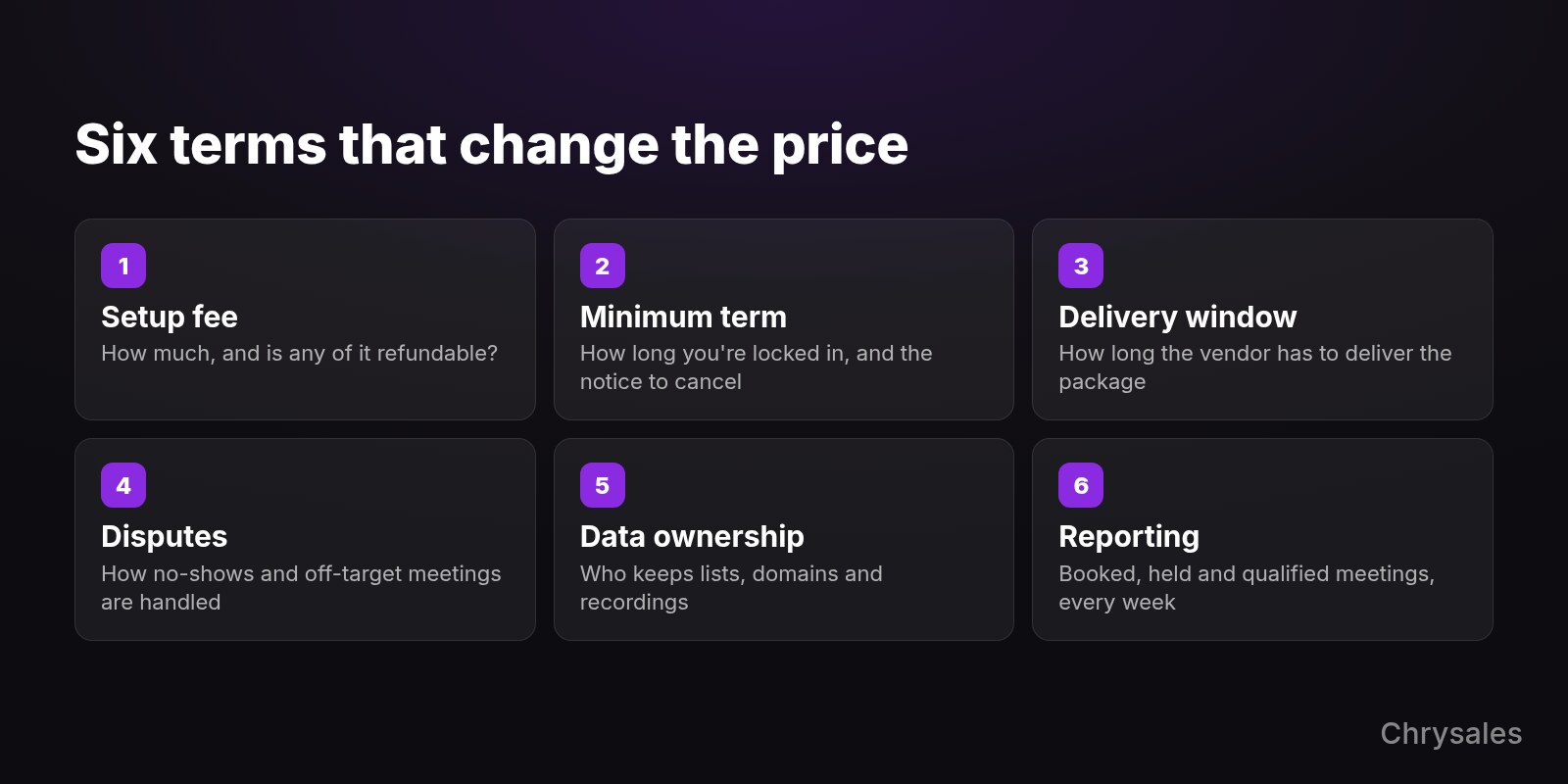
Published terms vary a lot, as of November 2026:
- Setup fee. Belkins charges a $1,500 one-time setup fee and says it isn't refundable. CIENCE charges one setup fee but doesn't publish the amount.
- Minimum term. Sopro has no minimum contract, SalesRoads says "No long-term commitment. Cancel anytime" on its pricing page, and CIENCE runs month to month.
- Billing cycle. SalesRoads bills per 4 weeks, which means 13 invoices a year rather than 12.
- Delivery window. Belkins delivers its package within six months of campaign launch.
- Disputes and no-shows. Ask for a written rule like the Belkins one above, and a set number of days to flag a meeting.
- Time to judge results. Plan for several months before you judge a vendor (see the FAQ).
Data ownership and reporting rarely appear on price pages, so ask about them directly. If the vendor keeps the contact list and the email domains when you leave, part of what you paid for leaves with them.
Take these questions to the pricing call:
1. What exactly do you bill for: booked, accepted, held, or held and qualified?
2. Is there a setup fee, how much is it, and is any of it refundable?
3. What is the minimum term, and how much notice do I give to cancel?
4. How are you billed: per calendar month or per 4 weeks?
5. If a meeting is a no-show, is it replaced, credited or not billed?
6. How many days do I have to flag a meeting that misses the criteria, and who decides?
7. Who owns the contact lists, the email domains and the call recordings when we stop?
8. What do I get each week: meetings booked, held, qualified, and the notes from each?
9. How many held meetings did comparable clients get in months one to three?
10. If you fall short of the package, what happens: make-up meetings, a refund, or nothing?
Common mistakes when buying appointment setting
In our view, a lot of the money lost on appointment setting goes on how it was bought. Vendor guides and buyer reviews point to the same five mistakes. Each one has a fix you can write into the contract or your own process before the first invoice.
Comparing sticker prices. A $500 booked meeting and a $750 held, qualified meeting are different products. Convert every quote to cost per qualified held meeting first, using the same volume assumption.
Paying per booking. Every no-show is your cost. Pay for held meetings, or for held and qualified ones, whenever the vendor allows it.
Signing without a written definition. One reviewer of an appointment setting vendor on Trustpilot wrote in April 2025, "I was still charged for others despite raising concerns about their lack of qualification" (Trustpilot). The vendor disputes the account on the same page, and that argument is exactly what a written definition prevents.
Judging the vendor in month one. If you fire a vendor after four weeks, you may be judging your own offer. "You will discover how bad your messaging is, very quickly when working with an outsourced team," Jason Bay says, quoted by LeadGenius. Give it the evaluation time covered in the FAQ below before you decide.
Rejecting every meeting that didn't close. LeadHaste warns about the opposite trap: a buyer can protect its invoice by calling every disappointing conversation unqualified. You might win the dispute, but you lose the vendor's goodwill and the feedback on why prospects didn't buy. Judge each meeting against the written definition, and review your own sales call separately.
FAQ
How do appointment setters get paid?
Outsourced appointment setters are paid through a monthly retainer, a fee per meeting, or a hybrid of a base fee and a bonus tied to held meetings, as CIENCE publishes. In-house SDRs usually get a base salary plus a variable part. The Bridge Group's 2025 survey put the median at $55K base and $25K variable.
Is pay per appointment cheaper than a retainer?
It depends on volume. Divide the monthly retainer by the per-meeting price to find the break-even. With example numbers of $5,000 and $750, that's about 6.7 qualified held meetings a month. Below that, paying per appointment costs less; above it, the retainer does, if it delivers.
How long until you can judge an appointment setting vendor?
LeadGenius writes that it typically takes at least six months to judge whether an external SDR team is delivering value. Track held, qualified meetings and your close rate from the first month, so you have data when that point comes. Agree on a minimum term you can live with for that long, or ask for month-to-month terms.
Is a very cheap price per meeting a red flag?
Cleverly, which sells appointment setting, calls per-appointment prices under $100 a red flag for unverified, low-quality meetings. SalesRoads, also a vendor, publishes $15 to $100 as a typical cost per meeting. Rather than judge the price alone, check what it bills for and run it through cost per qualified held meeting.
Sources
- Belkins - Pay per appointment (pricing and FAQ)
- Belkins - Cost to outsource sales
- CIENCE - Pricing
- SalesRoads - Pricing
- SalesRoads - Appointment setting pricing models
- Sopro - Pricing
- Cleverly - How pay-per-appointment lead generation works
- SalesBread - Appointment setting services cost and which model is best
- LeadHaste - Pay per meeting lead generation: how the model works and its risks
- The Bridge Group - 2025 SDR models, metrics and compensation report
- LeadGenius - Rethinking outsourcing: the perils and potential of external SDR functions
- Trustpilot - DealForce reviews
- Hacker News - comment on appointment setting and profit share
Want to know what a won deal would cost you with a setter, using your own close rate? Bring your quote and your numbers, and the Chrysales team will work through the outreach, pipeline and closing around those meetings with you. Work out your cost per deal on a free call
B2B appointment setting cost has no single market price. Vendors publish anything from under $100 to over $1,000 per meeting, as of November 2026. Entry-level retainers run from about $2,000 a month to $11,950 per 4 weeks for one SDR. The figures only become comparable once you turn every quote into cost per qualified meeting that actually took place, and then into cost per won deal using your own close rate.
This guide is for you if you have one or two agency quotes on the table and can't tell which is cheaper. You get a dated table of published prices, a worked calculation you can copy, the break-even point between a retainer and paying per meeting, and the contract terms that change the real price. If you first need the basics, here is what an appointment setter does.
How much does B2B appointment setting cost?
Published prices run from under $100 to over $1,000 per meeting, and the gap comes mostly from what each vendor counts as a meeting. A "scheduled" meeting is a cheaper product than one that was held and met agreed criteria. Retainers start at a few thousand dollars a month and pay for a team's time, not a meeting count. All figures below are vendor-reported and were checked on November 3, 2026.
Almost every price page on this topic belongs to a company that sells appointment setting. That makes the figures useful for "what this vendor charges" and weak for "what the market charges". Here is what the pages showed on the day of writing.
| Vendor and page | Model | Published price (vendor-reported, as of November 2026) | Page date |
|---|---|---|---|
| Belkins, pay-per-appointment page | Pay per appointment | From $750 per appointment, $1,500 one-time setup fee, 10-appointment starter package | Undated |
| CIENCE, pricing page | Hybrid | $2,000/month campaign team, $499/month platform, SDRs from $1,750 (offshore) or $3,500 (US/Europe) per SDR per month, plus a bonus tied to held meetings | Undated |
| SalesRoads, pricing page | Retainer | $11,950 per 4 weeks for one SDR, $16,750 for two | Undated |
| Sopro, pricing page | Retainer | Starts at around €3.4K a month | Undated |
| Cleverly, pay-per-appointment article | Retainer with a meeting range | $2,997/month for cold calling appointment setting, including 10-40 appointments a month | Modified July 13, 2026 |
| Cleverly, same article | Per held appointment (market bands) | $150-$400 SMB/mid-market, $400-$700 VP and above, $700-$1,000+ enterprise/C-suite | Modified July 13, 2026 |
| SalesBread, cost article | Market ranges | Retainer $2,000-$5,000 (no period stated); $75-$500 per scheduled meeting | September 23, 2025 |
| SalesRoads, pricing models article | Market range | Typical cost of a meeting $15 to $100 | Undated |
| Belkins, cost to outsource sales | Year-one estimate | $3,000-$5,000 per qualified meeting in year one | August 12, 2025 |
Don't average these numbers. They disagree for reasons you can name:
- The billable event differs. SalesBread's range is per scheduled meeting, Cleverly's bands are per held appointment, and the Belkins blog figure is per qualified meeting.
- The buyer's seniority moves the price. Cleverly's bands climb from $150-$400 for SMB/mid-market meetings to $700-$1,000+ for C-suite ones.
- A retainer buys capacity. SalesRoads and Sopro quote a team per month, so the cost per meeting depends on how many meetings that team books.
- Time frame matters. The Belkins blog figure covers year one only.
If you want to see who sells this before you compare prices, start with this list of appointment setting companies.
What do you get with a retainer, pay per meeting or a hybrid?
A retainer pays a team for a month of work, whatever the meeting count. Pay per meeting pays only for meetings that match an agreed definition. A hybrid combines a base fee with a bonus tied to meetings. The real difference is who carries two risks: the prospect not showing up, and the prospect turning out to be the wrong fit.
| Retainer | Pay per meeting | Hybrid | |
|---|---|---|---|
| You pay for | A team's time each month | Meetings that meet the definition | Base fee plus meeting bonus |
| No-show risk | You | Vendor, if paid per held | Shared |
| Fit risk | You | Shared | Shared |
| Cost per meeting | Falls as volume rises | Fixed per meeting | Partly fixed, partly per meeting |
| Best when | Volume is steady | Volume is low or a test | You want a floor and an incentive |
The published examples show how different these products are.
Belkins sells a pure pay-per-appointment package. It starts at $750 per appointment with a $1,500 one-time setup fee and a 10-appointment starter package, as of November 2026. The FAQ adds that the setup fee isn't refundable. A no-show doesn't use up an appointment, and a meeting that misses the agreed criteria goes back into the package.
SalesRoads sells a retainer billed per 4 weeks: $11,950 for one SDR (sales development rep) and $16,750 for two, with no long-term commitment. That price buys a team's time. It names no meeting count, so your cost per meeting depends on what the team delivers.
CIENCE publishes a hybrid. You pay $2,000 a month for a campaign team, $499 a month for its platform, and from $1,750 (offshore) or $3,500 (US/Europe) per SDR per month. Each SDR then earns a bonus tied to a target for held meetings, with one setup fee on top (the amount isn't published) and month-to-month terms.
Sopro starts at around €3.4K a month with no minimum contract. If you sell in the UK, DACH or the Nordics, it's the one price here already quoted in euros.
What counts as a meeting you pay for?
A payable meeting is whatever your contract says it is, and nobody else's definition applies. The same word can mean a booked slot, an accepted invite, a call that took place, or a call that took place with the right person. Each step down that list tends to cost more per meeting and moves more risk from you to the vendor.
Dimitar Petkov of LeadHaste, a company that sells outbound, splits "meeting" into four billable events: booked, accepted, held, and held and qualified (LeadHaste, October 30, 2026). "There is no universal qualified-meeting definition," he writes. On billing at the early stage he adds, "If the contract bills on acceptance, the buyer carries no-show risk," so every no-show lands on your invoice.
Jack Reamer, CEO of SalesBread, warns from the vendor side that "before you choose this model, you must have very clear parameters of what qualifies as a booked meeting" (SalesBread, September 23, 2025).
The Belkins rules described above are one example of a buyer-friendly version: no-shows and meetings that miss the criteria don't count against the package.
Write the definition down before you sign. A workable one covers these points:
- The billable event. Pick held, or held and qualified, and say so in the contract.
- The fit criteria. Name the company size, role or seniority, and region that make a meeting count.
- The context. The prospect knows why they're on the call and what you sell.
- No-shows. Say whether a no-show is replaced, credited or simply not billed.
- The dispute window. Set how many days you have to flag a meeting, and who decides.
- Duplicates. A contact already in your CRM or already in talks with you doesn't count.
The tighter the definition, the higher the price per meeting tends to be. That's fine. A $750 held and qualified meeting and a $500 booked meeting are different products, so compare them only after you convert both to the same unit.
How do you turn a quote into cost per qualified meeting?
Add up everything a quote would cost you in a month, then divide it by the number of meetings that actually took place and met your criteria. Use the same volume assumption for every quote, so you compare prices on equal terms. The result is cost per qualified held meeting, the one number that lets a retainer and a per-meeting quote sit side by side.
Follow these steps for each quote:
- Write down what the quote bills for: a month of team time, booked meetings, held meetings, or held and qualified meetings.
- Pick one monthly volume assumption for all quotes: meetings booked, meetings held, and held meetings that meet your definition.
- Work out the monthly cost. Add the retainer or base fee, the per-meeting charges for the meetings that would be billed, and any setup fee spread over the months you expect to use the vendor.
- Divide the monthly cost by the qualified held meetings from step 2.
- Divide that result by your own close rate to get cost per won deal.
Monthly cost = retainer or base fee
             + (price per billed meeting x billed meetings)
             + (setup fee / months you spread it over)

Cost per qualified held meeting = monthly cost / qualified held meetings

Cost per won deal = cost per qualified held meeting / your close rate
Here is a worked example with three made-up quotes. These are example numbers, not a benchmark. Assume a month with 12 booked meetings, 10 of which took place, and 7 of those that met your definition.
| Example numbers, not a benchmark | Quote A: retainer | Quote B: per booked meeting | Quote C: per held, qualified meeting |
|---|---|---|---|
| Price | $5,000 a month | $500 per booked meeting | $750 per held, qualified meeting, $1,500 setup fee |
| Meetings billed | None (flat fee) | 12 | 7 |
| Monthly cost | $5,000 | $6,000 | $5,250, or $5,500 with the setup fee spread over 6 months |
| Cost per qualified held meeting | About $714 | About $857 | $750, or about $786 with the setup fee |
Quote B has the lowest sticker price per meeting and ends up the most expensive. You pay for 12 bookings to get 7 meetings that count, so each one costs about $857. Quote C looks pricey at $750, yet every billed meeting is one you'd want.
Quote A is cheapest in this example only because it delivered 7 qualified meetings. Change the volume assumption and the order changes, which is why you run the same numbers for every quote. The same logic sits behind cost per lead and CAC: a cheap unit that rarely converts can cost you more in the end.
When is a retainer cheaper than paying per meeting?
A retainer becomes cheaper than paying per meeting once it delivers more qualified held meetings than its monthly fee divided by the per-meeting price. With a $5,000 retainer against $750 per qualified held meeting, that line sits at about 6.7 meetings a month (example numbers). Below it, paying per meeting costs less. Above it, the retainer wins, as long as it really delivers.
Break-even = monthly retainer / price per qualified held meeting
Example:     $5,000 / $750 = about 6.7 qualified held meetings a month
A retainer's cost per meeting moves with volume, and Cleverly's published offer shows how much. Its cold calling appointment setting costs $2,997 a month and includes 10-40 appointments. At 40 appointments that's about $75 each. At 10 it's about $300 each, four times as much for the same invoice (our arithmetic from Cleverly's figures).
Use this as a rough guide to which model fits:
- A retainer fits when you know who you sell to, your messaging already works, and you expect steady volume for several months.
- Pay per meeting fits when you test a new market, your volume is uncertain, or you can't absorb a month with almost no meetings.
- A hybrid fits when you want a team working on your account every month and still want part of the fee tied to held meetings.
Before you rely on the break-even, check the retainer's history. Ask how many held meetings comparable clients got in months one to three. If the vendor can't answer, plan with your lowest guess.
What does a meeting cost once you count your close rate?
A qualified meeting is still not a deal, so the number that matters is cost per won deal: cost per qualified held meeting divided by your close rate. At a 15% close rate, an example meeting cost of $750 becomes $5,000 per won deal.
Here are the three example quotes again, run through two example close rates. These are example numbers, not benchmarks. Use your own close rate from qualified meeting to won deal.
| Example numbers, not benchmarks | Quote A: retainer | Quote B: per booked meeting | Quote C: per held, qualified meeting |
|---|---|---|---|
| Cost per qualified held meeting | About $714 | About $857 | $750 |
| Cost per won deal at a 15% close rate | About $4,760 | About $5,710 | $5,000 |
| Cost per won deal at a 25% close rate | About $2,860 | About $3,430 | $3,000 |
Moving the close rate from 15% to 25% cuts the cost per won deal far more than any price difference between the three quotes. Closing is the part you can't buy from a setter.
Belkins says on its pricing page that it doesn't promise closed-won deals or immediate revenue. A Hacker News commenter who was building an AI appointment setting tool explained why his team dropped a profit-share model. In his words, "you're getting paid based on the client's ability of closing a deal, not on the actual service you're providing" (Hacker News, January 6, 2024).
Chrysales' view is that getting the meeting is half the work. A setter who books anyone to hit a number wastes your closer's time, and a messy handoff between setter and closer breaks the model. Before you buy meetings, decide whether you need to hire the closer first or the setter.
In this video, Sabir compares cold email and cold calling for booking meetings, with chapters on what each one really costs and on why getting meetings is only half the battle.
Is an in-house SDR cheaper than an agency?
An in-house SDR costs more than the salary suggests once you count the ramp and the turnover. In the Bridge Group's 2025 survey, median SDR on-target earnings were $80K a year with a median quota of 10 held first meetings a month. That works out to about $670 per held meeting in pay alone, before tools, data, management and the ramp.
The Bridge Group's 2025 report surveyed 351 B2B companies, 83% of them SaaS and 78% based in North America. Treat the figures as a reference point from that group, not as the cost for every B2B company. Here is what it reported:
- Median SDR on-target earnings of $80K, split into $55K base and $25K variable.
- An average ramp time of 3.0 months.
- Median annual attrition of 40%.
- A median monthly quota of 10 held first meetings, with 6 converted to the next stage.
Our arithmetic: $80,000 divided by 12 is about $6,670 a month in pay. At 10 held meetings a month, that's about $670 per held meeting. Quotas are targets, and the figure leaves out tools, data, a manager's time and the months before the rep is fully productive.
With 40% median attrition, you should also expect to rehire and ramp again. With an agency, replacing a rep is the agency's job, though that cost sits somewhere in its price. The full in-house versus outsourced decision depends on more than cost, and this guide on when outsourcing sales works walks through it.
Which contract terms change the real price?
Six terms move the real price more than the headline rate: the setup fee, the minimum term, the delivery window, the dispute and replacement rule, who owns the data, and what gets reported. Two quotes with the same per-meeting price can end up far apart once these are written down: a $1,500 setup fee alone adds $250 a month over six months in the example above. Ask about each one before you compare.
Published terms vary a lot, as of November 2026:
- Setup fee. Belkins charges a $1,500 one-time setup fee and says it isn't refundable. CIENCE charges one setup fee but doesn't publish the amount.
- Minimum term. Sopro has no minimum contract, SalesRoads says "No long-term commitment. Cancel anytime" on its pricing page, and CIENCE runs month to month.
- Billing cycle. SalesRoads bills per 4 weeks, which means 13 invoices a year rather than 12.
- Delivery window. Belkins delivers its package within six months of campaign launch.
- Disputes and no-shows. Ask for a written rule like the Belkins one above, and a set number of days to flag a meeting.
- Time to judge results. Plan for several months before you judge a vendor (see the FAQ).
Data ownership and reporting rarely appear on price pages, so ask about them directly. If the vendor keeps the contact list and the email domains when you leave, part of what you paid for leaves with them.
Take these questions to the pricing call:
1. What exactly do you bill for: booked, accepted, held, or held and qualified?
2. Is there a setup fee, how much is it, and is any of it refundable?
3. What is the minimum term, and how much notice do I give to cancel?
4. How are you billed: per calendar month or per 4 weeks?
5. If a meeting is a no-show, is it replaced, credited or not billed?
6. How many days do I have to flag a meeting that misses the criteria, and who decides?
7. Who owns the contact lists, the email domains and the call recordings when we stop?
8. What do I get each week: meetings booked, held, qualified, and the notes from each?
9. How many held meetings did comparable clients get in months one to three?
10. If you fall short of the package, what happens: make-up meetings, a refund, or nothing?
Common mistakes when buying appointment setting
In our view, a lot of the money lost on appointment setting goes on how it was bought. Vendor guides and buyer reviews point to the same five mistakes. Each one has a fix you can write into the contract or your own process before the first invoice.
Comparing sticker prices. A $500 booked meeting and a $750 held, qualified meeting are different products. Convert every quote to cost per qualified held meeting first, using the same volume assumption.
Paying per booking. Every no-show is your cost. Pay for held meetings, or for held and qualified ones, whenever the vendor allows it.
Signing without a written definition. One reviewer of an appointment setting vendor on Trustpilot wrote in April 2025, "I was still charged for others despite raising concerns about their lack of qualification" (Trustpilot). The vendor disputes the account on the same page, and that argument is exactly what a written definition prevents.
Judging the vendor in month one. If you fire a vendor after four weeks, you may be judging your own offer. "You will discover how bad your messaging is, very quickly when working with an outsourced team," Jason Bay says, quoted by LeadGenius. Give it the evaluation time covered in the FAQ below before you decide.
Rejecting every meeting that didn't close. LeadHaste warns about the opposite trap: a buyer can protect its invoice by calling every disappointing conversation unqualified. You might win the dispute, but you lose the vendor's goodwill and the feedback on why prospects didn't buy. Judge each meeting against the written definition, and review your own sales call separately.
FAQ
How do appointment setters get paid?
Outsourced appointment setters are paid through a monthly retainer, a fee per meeting, or a hybrid of a base fee and a bonus tied to held meetings, as CIENCE publishes. In-house SDRs usually get a base salary plus a variable part. The Bridge Group's 2025 survey put the median at $55K base and $25K variable.
Is pay per appointment cheaper than a retainer?
It depends on volume. Divide the monthly retainer by the per-meeting price to find the break-even. With example numbers of $5,000 and $750, that's about 6.7 qualified held meetings a month. Below that, paying per appointment costs less; above it, the retainer does, if it delivers.
How long until you can judge an appointment setting vendor?
LeadGenius writes that it typically takes at least six months to judge whether an external SDR team is delivering value. Track held, qualified meetings and your close rate from the first month, so you have data when that point comes. Agree on a minimum term you can live with for that long, or ask for month-to-month terms.
Is a very cheap price per meeting a red flag?
Cleverly, which sells appointment setting, calls per-appointment prices under $100 a red flag for unverified, low-quality meetings. SalesRoads, also a vendor, publishes $15 to $100 as a typical cost per meeting. Rather than judge the price alone, check what it bills for and run it through cost per qualified held meeting.
Sources
- Belkins - Pay per appointment (pricing and FAQ)
- Belkins - Cost to outsource sales
- CIENCE - Pricing
- SalesRoads - Pricing
- SalesRoads - Appointment setting pricing models
- Sopro - Pricing
- Cleverly - How pay-per-appointment lead generation works
- SalesBread - Appointment setting services cost and which model is best
- LeadHaste - Pay per meeting lead generation: how the model works and its risks
- The Bridge Group - 2025 SDR models, metrics and compensation report
- LeadGenius - Rethinking outsourcing: the perils and potential of external SDR functions
- Trustpilot - DealForce reviews
- Hacker News - comment on appointment setting and profit share
Want to know what a won deal would cost you with a setter, using your own close rate? Bring your quote and your numbers, and the Chrysales team will work through the outreach, pipeline and closing around those meetings with you. Work out your cost per deal on a free call
Scaling Is Not Hard If You Have The Right Systems
If you’re serious about leveling up your scaling game, you need the right system, the right training, and the right team behind you. We're here to give you the exact tools and strategies top entrepreneurs use to dominate.

Discover the latest tips
View All
Chrysales was formed from the words "chrysalis" the stage where a caterpillar transforms into a butterfly and "sales".
It stands for one thing: sales transformation.Because scaling doesn’t happen by doing more of the same. Scaling only happens when you go through real transformation in your systems, your offer, team and the way you sell.


