
How to ask clients for referrals without making it awkward
How to ask clients for referrals comes down to two things: when you ask and what you ask for. Ask right after a client has seen a concrete result, in a conversation you planned, and describe the kind of person you'd like to meet instead of asking whether they know "anyone". Then make the introduction easy with a short note they can forward, reply to the intro within a day, and tell the client what came of it.
Left alone, referrals show up only when a client happens to think of you, so plan them. What follows is a monthly routine for picking whom to ask, the words for each step, and a sheet for tracking what your asks produce.
When is the best time to ask a client for a referral?
The best time to ask a client for a referral is right after they've seen a result they care about, in a conversation you set up for it. Good moments are a project wrap-up meeting or a scheduled review call, and the minute a client praises your work. A line tacked onto the end of an unrelated email works worst.
Jonathan Stark, an independent consultant, describes a routine he runs after a successful project (How to ask for referrals, 2024). He holds a wrap-up meeting and thanks the client when they praise the work. Then he asks whether they can think of someone with his ideal buyer's job title who would be a good fit for an introduction. The ask sits right next to a result the client has just put into words.
Moments that work well:
- A wrap-up or milestone meeting, once the result is visible to the client.
- Unprompted praise in a call or message. Thank them, then ask, or book ten minutes for it.
- A review call every few months where you go through results first and ask at the end.
- A renewal or a second project, which tells you the client values the work.
Skip the first weeks before any result, any time a problem is still open, and invoice or admin emails.
Ask live when you can. In Stanford research by Frank Flynn and Vanessa Lake (2008), people asking for help overestimated by about 50% how many people they would need to ask before someone agreed (Medical Xpress). Those studies looked at direct requests for help, so they don't measure referrals, but the direction is useful: people say yes more often than askers expect.
Cornell psychologist Vanessa Bohns put the channel question plainly in a release on her study about asking friends for help: "If you really need a 'yes,' it's best to ask in person" (EurekAlert, 2021). If you can't meet, a video or phone call is the next best option, and email is for the follow-up.
Which clients should you ask this month?
Ask the clients who have seen a clear result, would happily take your call today, and know people who look like your best buyers. For most B2B companies that's a short list of three to five names a month, which is a rule of thumb rather than a researched number. A small, deliberate list gives each ask real attention and stops you from asking the same people too often.
Run this short routine on the first Monday of each month.
- Open your client list and mark everyone who saw a concrete result in the last few months, such as a delivered project or a number that moved.
- From those, keep the ones who would pick up if you called today. A client who answers a week late won't spend goodwill on you.
- Next to each name, write who they know: peers, former colleagues, people in the same founder group or industry association.
- Pick three to five names and give each a date: the next review call, a wrap-up meeting, or a short call you book for the purpose.
- For each one, write a one-line description of the person you'd like to meet, naming a role, a kind of company and a situation.
Clients tend to refer people like themselves. Research on a German bank, summarized by the American Marketing Association, found that referrers passed on people similar to themselves and also screened for fit. Referred customers there had 16% to 25% higher lifetime value (AMA, 2019).
That is consumer banking data, so take the direction and leave the numbers. The clients who most resemble your best buyers are the ones whose introductions are most likely to fit.
| Client situation | Ask this month? | Why |
|---|---|---|
| Saw a clear result recently, talks to you often | Yes | The result is fresh and the relationship is warm |
| Happy, but no visible result yet | Later | Wait for the milestone and ask at the wrap-up |
| Unhappy, or a problem is open | No | Fix the problem first |
| You asked in the last three months | No | Give them a break unless they offered more names |
How often you can ask the same client has no research behind it. A sensible limit is one direct ask per client per quarter, unless the client brings up names on their own.
How to ask clients for referrals: what to say
Name the kind of person you want to meet instead of asking for "anyone who might need help". A specific description gives your client a face to think of, while a vague question gets a polite "I'll keep you in mind". Ask live in two or three sentences, then send a short email the same day so the client has your words in writing.
Joanne Black, author of No More Cold Calling, swaps "if you know anyone who could benefit" for a direct question: "Who do you know that I should be talking to?" (Entrepreneur, 2018). Rory Vaden makes a related point about wording: ask to be introduced to "people who are the kind of people you do it for", rather than people who need what you sell (roryvaden.com).
A useful description has three parts: a role, a kind of company, and a situation. For example, "a founder of a 20 to 80-person B2B company who has just lost their head of sales". Your client can picture that person. "Companies that need sales help" fits half their contacts and none of them.
The scripts below are suggested wording for you to adapt, written for this post. They aren't taken from any client.
The ask, in person or on a call:
I'm really glad [result] worked out. Can I ask you something?
The people we help most are [role] at [kind of company] who are dealing with [situation].
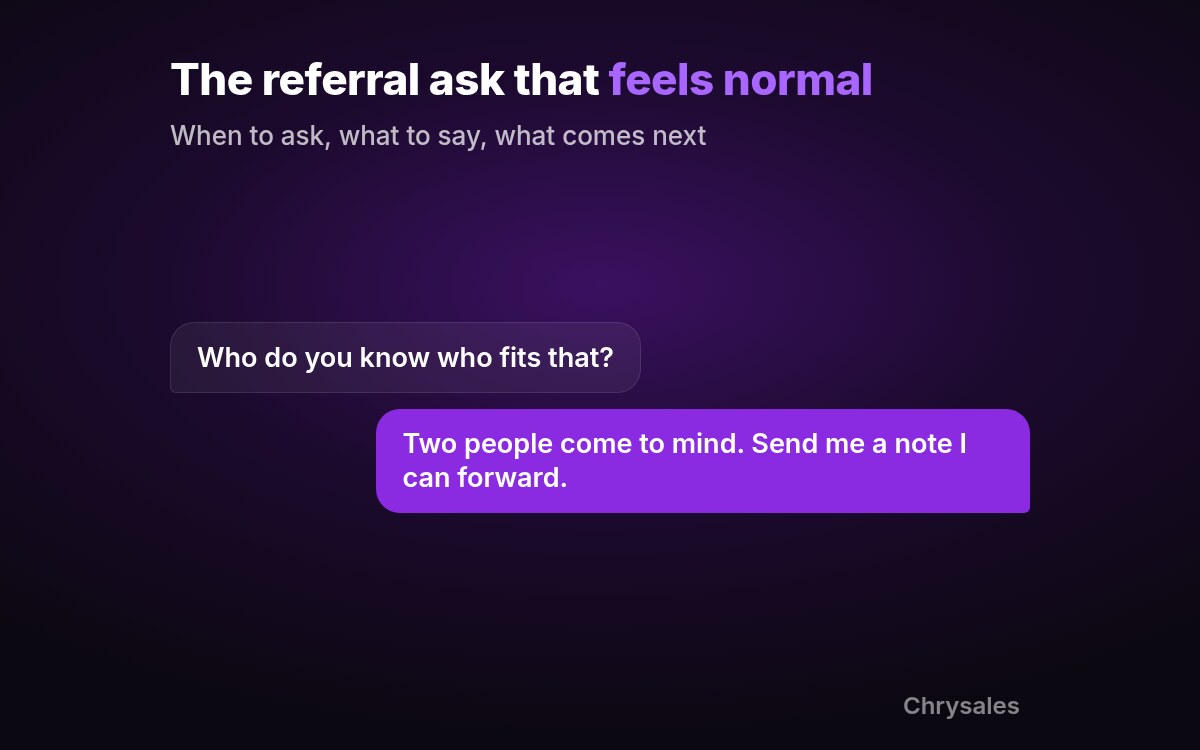
Who do you know who fits that? Even one name helps.
The email you send the same day:
Subject: Thanks for today, and the person we talked about

Hi [First name],

Thanks again for the time today, and for what you said about [result].

Like I said on the call, we do our best work for [role] at [kind of company] who [situation]. You mentioned [Contact] might fit. If you're comfortable with it, I'll send you a short note you can forward, so it takes you a minute.

And if nobody comes to mind, no problem at all.

[Your name]
When the client draws a blank, a memory-jogger helps more than repeating the question. Each one points to a specific kind of person. Pick one or two that fit.
Who in your peer group is hiring their first salespeople this year?
Who did you work with before [Client company] who now runs their own team?
Who has asked you about [problem we solved] in the last few months?
Who in your founder group has the problem you had a year ago?How do you make the introduction easy for your client?
Write the introduction for them. Send your client a short note about you that they can forward, and ask them to check with their contact before connecting you, which is called a double opt-in. Your client then spends a minute on a forward, and the other person agrees to the conversation before your name lands in their inbox.
Brad Feld, a venture investor at Foundry, asks people who want an introduction to send him a forwardable email of up to three paragraphs with links. In his words, "it'll take me 60 seconds to do it, rather than a few minutes to put a thoughtful email together" (Feld Thoughts, 2020).
Fred Wilson of Union Square Ventures described the rule he follows: "When introducing two people who don't know each other, ask each of them to opt-in to the introduction before making it" (AVC, 2009). Investor Chris Neumann adds that the introducer should "allow them to politely decline the introduction" (Why I won't promise you an intro). Your client knows both sides, so the check is quick, and it protects them if the timing is wrong for their contact.
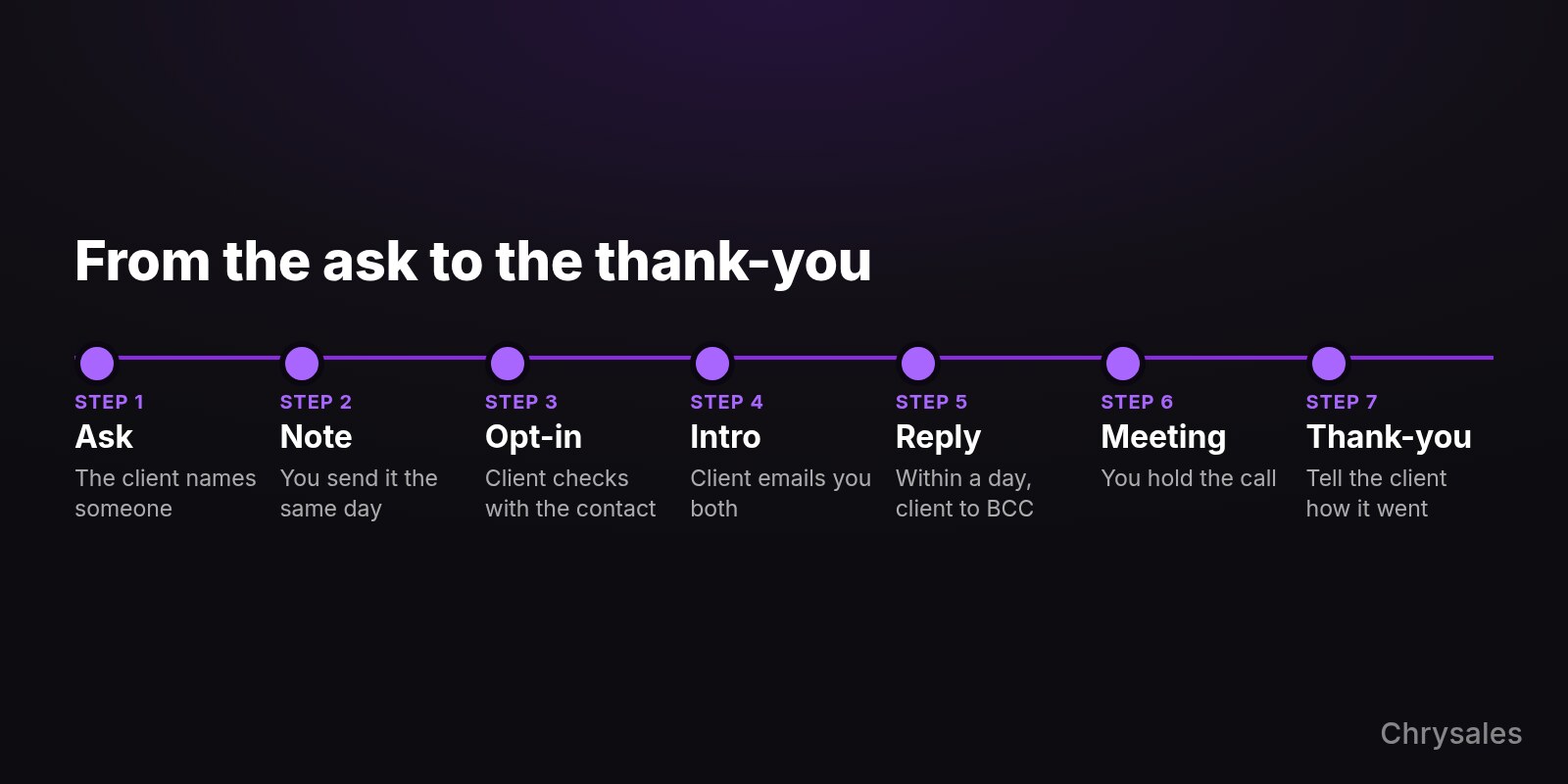
The order of events:
- You ask, and the client names someone. They might say something like "Two people come to mind."
- You send the forwardable note the same day.
- The client forwards it and asks their contact whether they'd like to be introduced.
- If the contact says yes, the client sends a short intro email to both of you.
- You reply within a day and move the client to BCC.
- You hold the meeting.
- You thank the client and tell them how it went.
If your client replies "Send me a note I can forward", this is the note. Write it in their voice and keep it under three short paragraphs:
Subject: Intro to [Your name] at [Your company]?

Hi [Contact first name],

[Your name] runs [Your company]. They help [kind of company] with [problem], mostly by [how, in plain words]. We worked with them on [project], and [result, in your client's words].

You mentioned [their situation], so I thought a short call could be useful. No pressure either way.

Would you like me to connect you? A quick yes or no is fine.

[Client's name]
Once the contact says yes, the intro your client sends can be two lines. You can offer this too:
Subject: [Contact] and [Your name]

[Contact], meet [Your name], who I mentioned. [Your name], meet [Contact], who runs [company] and is working on [situation].

I'll let you two take it from here.
What do you do after you get the introduction?
Reply within a day, thank your client in one line, and move them to BCC so they aren't copied on scheduling. Then book the call, check that your website and LinkedIn profile back up what your client said, and run the conversation like any first sales call. Finally, tell your client what happened, whether or not it turns into a deal.
Referred prospects are "already qualified and you begin with the credibility of a trusted peer," Scott Edinger wrote in Harvard Business Review (HBR, 2021). That credibility comes from your client, which is why a slow reply costs you.
The referred person may well look you up before the call. In a 2015 survey of 523 professional-services firms by Hinge, a marketing firm, 51.9% of respondents said they had ruled out a referred firm before speaking with it (Hinge, 2015). The top reasons were an unimpressive website and poor content. It's a vendor survey from more than ten years ago, but your own website is a cheap thing to check before the call.
Peer advice still carries weight. In a survey of 1,202 US business decision-makers, run by SurveyMonkey for Reddit and published in March 2026, 73% said they trust peer insights above vendor websites (55%) (SurveyMonkey, 2026). A client's word gets you the meeting, and your website and LinkedIn profile then have to back it up.
Your reply to the intro email:
Subject: Re: [Contact] and [Your name]

Thanks, [Client first name], I appreciate it. Moving you to BCC to spare your inbox.

Hi [Contact first name], good to meet you. [Client] mentioned you're working on [situation]. Would a 20-minute call next week be useful? Tuesday or Thursday morning both work for me, or pick a time here: [link].

[Your name]
The BCC step matters to your client. In the comments under Fred Wilson's double opt-in post, readers complained about being copied on every scheduling email after they had made an introduction.
On the call, ask about their situation before you talk about your offer. If you want a structure, here is how to run the call after the intro. A warm start doesn't mean the person is a fit, so qualify them the same way you would any lead. For how qualified leads fit into a wider system, see building a flow of sales qualified leads without paid ads.
Then close the loop with your client, even when the answer is no:
Hi [Client first name],

Quick update: [Contact] and I spoke on [day]. [One sentence: next step booked / not a fit right now / they'll come back to it in the spring].

Thank you for thinking of me.

[Your name]
Should you pay a referral fee or offer a reward?
Start with a thank-you before any money. A personal note, an update on how the introduction went and, where it fits, a small gift keep the referral about the relationship. If you want to pay a referral fee, first make sure it's allowed for your profession and country, and then be open about it with everyone involved.
If the person being introduced later finds out your client was paid, the recommendation looks like a sales pitch. Blair Enns of Win Without Pitching named the risk on the 2Bobs podcast: "I think the danger with referral fees is hiding it" (2Bobs, episode 170).
In some professions paid referrals are restricted or banned outright. A few examples of how strict the rules get:
| Where | Who it covers | What the rule says |
|---|---|---|
| England and Wales | Regulated persons handling personal injury and death claims | LASPO 2012, section 56 bans paying or receiving referral fees for this prescribed legal business |
| UK | Solicitors | The SRA Code of Conduct, rule 5.1: fee-sharing agreements must be in writing and clients told about any financial interest |
| Germany | Lawyers | BRAO § 49b(3) forbids paying or accepting a share of fees or other benefits for referring mandates |
| US | Real estate settlement services involving federally related mortgage loans | RESPA, 12 U.S.C. 2607 bans fees or kickbacks for referrals |
These are examples, not a full list, and this isn't legal advice. Check the rules for your own profession and country, or ask a lawyer, before you offer money, gifts or anything else of value for a referral.
What if the client says no or never makes the intro?
Accept a no at once and keep the relationship exactly as it was. If the client said yes but nothing happened, send one friendly reminder about a week later with the note attached again, then let it go until your next planned moment. Pushing harder costs you more goodwill than one introduction is worth.
When a client turned down his request to quote their praise on his site, Jonathan Stark replied with something like "No problem. I totally understand." (How to ask for referrals). The same short reply works when a client says no to a referral ask. Then move on to the rest of the conversation.
If nothing happens after a yes, the likely reasons are simple. The client got busy, or the description was too vague to act on. The reminder below handles both by putting a ready-made note back in front of them.
Subject: That note for [Contact]

Hi [First name],

No rush on this. In case it got buried, here's the short note about us again, ready to forward to [Contact].

If the timing's wrong or it doesn't feel right, just say so. No hard feelings.

[Your name]

[forwardable note]
No study sets a number here, so treat this cadence as a starting point.
- Send one reminder, about a week after the yes.
- If nothing comes of it, don't ask again until the next planned moment, such as a review call or a new result.
- After two declines, stop asking that client and keep doing good work. Some clients don't refer, and that's their call.
How do you track referrals, and why aren't they enough on their own?
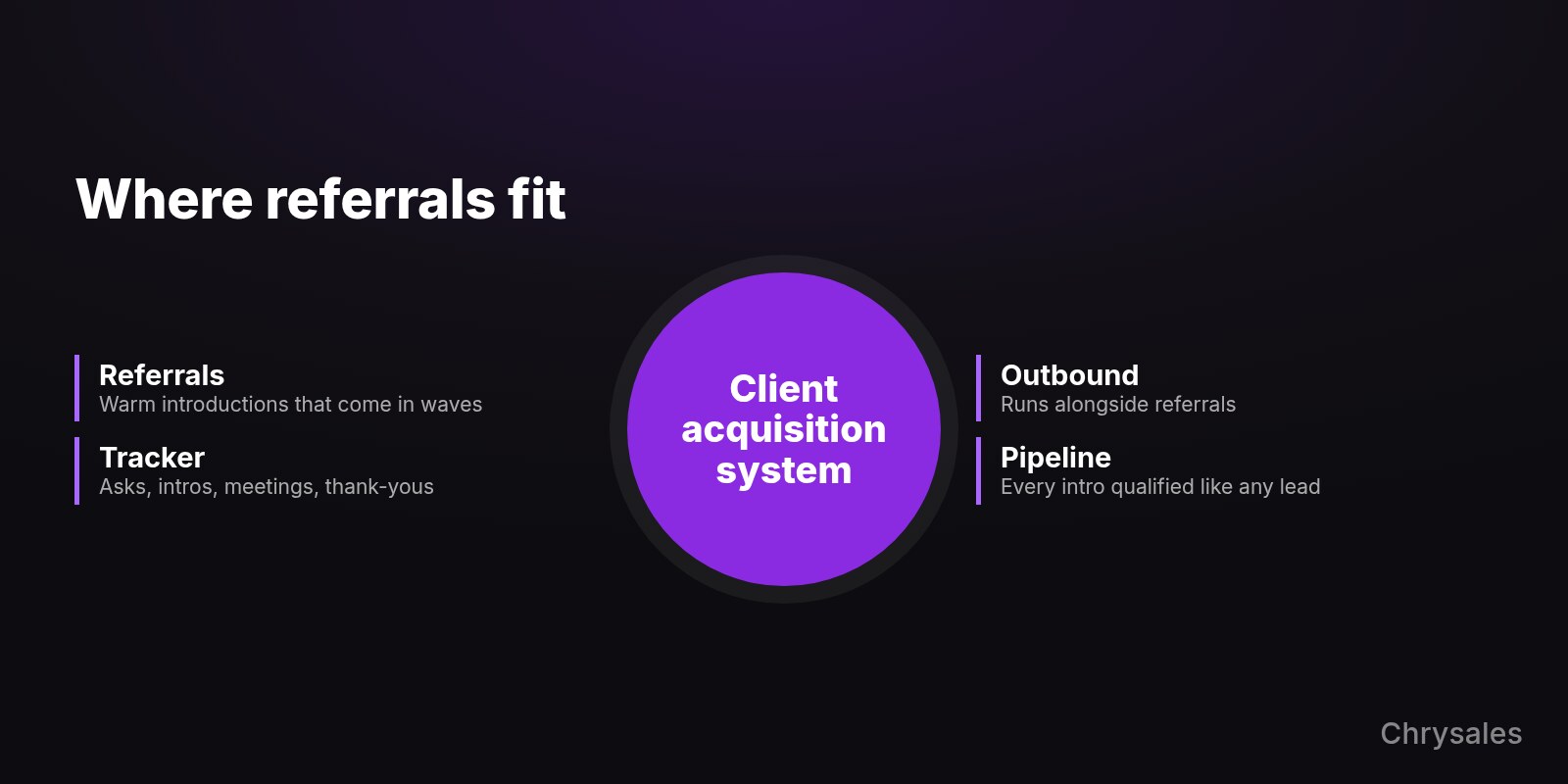
Track every ask in a simple sheet: client, date asked, how you asked, whether an introduction came, whether a meeting happened, the outcome, and whether you thanked them. After a few months you'll see which clients and which moments produce introductions. You'll also see the gaps between them, which is why referrals need outbound and a pipeline alongside.
A tracker with fictional example rows:
| Client | Asked on | How | Intro made | Meeting held | Outcome | Thanked |
|---|---|---|---|---|---|---|
| Client A, a 30-person B2B company | March 4 | Wrap-up call | Yes, 2 names | 1 of 2 | Proposal sent | Yes |
| Client B | March 12 | Review call | Said yes, no intro yet | - | Reminder sent March 19 | - |
| Client C | March 20 | In person | No | - | Ask again after the next project | Yes |
Add one question to every first call: "How did you hear about us?" Without it, you can't tell referred clients from the rest, and your sheet will undercount.
The sheet will also show that referrals come in waves. Hinge's 2018 buyer study, another vendor survey, concluded: "Relying on referrals alone is becoming a risky marketing strategy" (Hinge, 2018).
Chrysales takes the same view. Founders tend to win their early clients "on personality, referrals, and sheer effort", as the Chrysales About page puts it, and growth stalls when everything runs through them. The Chrysales post on why founder-led sales stalls when referrals dry up says it directly: "referrals don't scale in a straight line."
So keep asking, and run the other channels at the same time. For the options, see other lead generation channels beyond referrals and how referrals compare with outbound and other channels.
In this video, Sabir goes through four ways to find clients, including a chapter on why referrals cannot scale.
Common mistakes when asking for referrals
Most referral asks fail on wording or on the follow-through after the yes, and each of these has a simple fix.
- Asking "Do you know anyone?" and getting a polite maybe. Describe a role, a kind of company and a situation instead.
- Asking only by email, in passing. Ask live at a planned moment, then send the email the same day.
- Asking a client while a problem is still open. Fix the problem, wait for a result, then ask.
- Leaving your client to write the introduction from scratch. Send a note they can forward as it is.
- Getting introduced without the contact's agreement. Have your client check with them before sending the intro.
- Keeping your client copied on every scheduling email. Move them to BCC in your first reply.
- Replying to an introduction days later, after the client's endorsement has gone stale. Aim to answer within a day.
- Paying a fee quietly, or where it's banned. Check the rules and be open about any payment.
- Never telling the client what happened after their introduction. Send a two-line update, whatever the outcome.
- Counting on referrals to fill the pipeline. Track them and run outbound alongside.
FAQ
Can you ask clients for referrals by email?
Ask in person or on a call first, then use email to confirm what you said and offer the forwardable note. If email is your only option, keep it short. Thank them for a specific result and describe the kind of person you'd like to meet, then offer to write the note for them and give them an easy way to say no.
Can you ask for referrals on LinkedIn?
Send your client a normal LinkedIn message with the same description and offer of a forwardable note. Recommendations and reviews are different tools. As of November 2026, LinkedIn lets you request only one recommendation from a connection at a time (LinkedIn Help). A Service Page lets you invite up to 20 past clients to review your work, and those invitations expire after six months (LinkedIn Help).
What's the best way to ask past clients for referrals?
Reconnect before you ask. Send a short note about something relevant to them, or ask how the work you did is holding up. If the result still stands and the reply is warm, use the same ask on a call: the result, then the description of the person you'd like to meet.
How often can you ask the same client for a referral?
No study sets a safe number. A reasonable rule is one direct ask per client per quarter, tied to a planned moment like a review call or a new result. If a client offers names on their own, that doesn't count as an ask.
Should you ask for a referral before the work is finished?
Usually not. Clients refer when they can describe what you did for them, and that's hard before there's a result. The exception is a client who praises you mid-project and mentions someone by name. In that case, thank them and ask whether you can send a short note.
Sources
- Jonathan Stark - How to ask for referrals (2024)
- Entrepreneur - Joanne Black interview on referrals (2018)
- Rory Vaden - on asking for introductions
- Brad Feld - How to write an email intro request (2020)
- Fred Wilson, AVC - The double opt-in introduction (2009)
- Chris Neumann - Why I won't promise you an intro
- Medical Xpress - People underestimate others' willingness to help (2008)
- EurekAlert - Cornell release on asking for help in person (2021)
- American Marketing Association - Maximizing the benefits of customer referrals (2019)
- Hinge - Referral marketing for professional services firms (2015)
- Hinge - Changes in professional services buyer behavior (2018)
- SurveyMonkey - Reddit and SurveyMonkey B2B decision-maker survey (2026)
- Harvard Business Review - What an effective client referral strategy looks like (2021)
- 2Bobs - How to ask for referrals, episode 170
Want referrals to be one steady source of new clients instead of the only one? Chrysales works with you and your team on the outreach, pipeline and closing that sit around your warm introductions. Plan the rest of your client acquisition on a free call
How to ask clients for referrals comes down to two things: when you ask and what you ask for. Ask right after a client has seen a concrete result, in a conversation you planned, and describe the kind of person you'd like to meet instead of asking whether they know "anyone". Then make the introduction easy with a short note they can forward, reply to the intro within a day, and tell the client what came of it.
Left alone, referrals show up only when a client happens to think of you, so plan them. What follows is a monthly routine for picking whom to ask, the words for each step, and a sheet for tracking what your asks produce.
When is the best time to ask a client for a referral?
The best time to ask a client for a referral is right after they've seen a result they care about, in a conversation you set up for it. Good moments are a project wrap-up meeting or a scheduled review call, and the minute a client praises your work. A line tacked onto the end of an unrelated email works worst.
Jonathan Stark, an independent consultant, describes a routine he runs after a successful project (How to ask for referrals, 2024). He holds a wrap-up meeting and thanks the client when they praise the work. Then he asks whether they can think of someone with his ideal buyer's job title who would be a good fit for an introduction. The ask sits right next to a result the client has just put into words.
Moments that work well:
- A wrap-up or milestone meeting, once the result is visible to the client.
- Unprompted praise in a call or message. Thank them, then ask, or book ten minutes for it.
- A review call every few months where you go through results first and ask at the end.
- A renewal or a second project, which tells you the client values the work.
Skip the first weeks before any result, any time a problem is still open, and invoice or admin emails.
Ask live when you can. In Stanford research by Frank Flynn and Vanessa Lake (2008), people asking for help overestimated by about 50% how many people they would need to ask before someone agreed (Medical Xpress). Those studies looked at direct requests for help, so they don't measure referrals, but the direction is useful: people say yes more often than askers expect.
Cornell psychologist Vanessa Bohns put the channel question plainly in a release on her study about asking friends for help: "If you really need a 'yes,' it's best to ask in person" (EurekAlert, 2021). If you can't meet, a video or phone call is the next best option, and email is for the follow-up.
Which clients should you ask this month?
Ask the clients who have seen a clear result, would happily take your call today, and know people who look like your best buyers. For most B2B companies that's a short list of three to five names a month, which is a rule of thumb rather than a researched number. A small, deliberate list gives each ask real attention and stops you from asking the same people too often.
Run this short routine on the first Monday of each month.
- Open your client list and mark everyone who saw a concrete result in the last few months, such as a delivered project or a number that moved.
- From those, keep the ones who would pick up if you called today. A client who answers a week late won't spend goodwill on you.
- Next to each name, write who they know: peers, former colleagues, people in the same founder group or industry association.
- Pick three to five names and give each a date: the next review call, a wrap-up meeting, or a short call you book for the purpose.
- For each one, write a one-line description of the person you'd like to meet, naming a role, a kind of company and a situation.
Clients tend to refer people like themselves. Research on a German bank, summarized by the American Marketing Association, found that referrers passed on people similar to themselves and also screened for fit. Referred customers there had 16% to 25% higher lifetime value (AMA, 2019).
That is consumer banking data, so take the direction and leave the numbers. The clients who most resemble your best buyers are the ones whose introductions are most likely to fit.
| Client situation | Ask this month? | Why |
|---|---|---|
| Saw a clear result recently, talks to you often | Yes | The result is fresh and the relationship is warm |
| Happy, but no visible result yet | Later | Wait for the milestone and ask at the wrap-up |
| Unhappy, or a problem is open | No | Fix the problem first |
| You asked in the last three months | No | Give them a break unless they offered more names |
How often you can ask the same client has no research behind it. A sensible limit is one direct ask per client per quarter, unless the client brings up names on their own.
How to ask clients for referrals: what to say
Name the kind of person you want to meet instead of asking for "anyone who might need help". A specific description gives your client a face to think of, while a vague question gets a polite "I'll keep you in mind". Ask live in two or three sentences, then send a short email the same day so the client has your words in writing.
Joanne Black, author of No More Cold Calling, swaps "if you know anyone who could benefit" for a direct question: "Who do you know that I should be talking to?" (Entrepreneur, 2018). Rory Vaden makes a related point about wording: ask to be introduced to "people who are the kind of people you do it for", rather than people who need what you sell (roryvaden.com).
A useful description has three parts: a role, a kind of company, and a situation. For example, "a founder of a 20 to 80-person B2B company who has just lost their head of sales". Your client can picture that person. "Companies that need sales help" fits half their contacts and none of them.
The scripts below are suggested wording for you to adapt, written for this post. They aren't taken from any client.
The ask, in person or on a call:
I'm really glad [result] worked out. Can I ask you something?
The people we help most are [role] at [kind of company] who are dealing with [situation].
Who do you know who fits that? Even one name helps.
The email you send the same day:
Subject: Thanks for today, and the person we talked about

Hi [First name],

Thanks again for the time today, and for what you said about [result].

Like I said on the call, we do our best work for [role] at [kind of company] who [situation]. You mentioned [Contact] might fit. If you're comfortable with it, I'll send you a short note you can forward, so it takes you a minute.

And if nobody comes to mind, no problem at all.

[Your name]
When the client draws a blank, a memory-jogger helps more than repeating the question. Each one points to a specific kind of person. Pick one or two that fit.
Who in your peer group is hiring their first salespeople this year?
Who did you work with before [Client company] who now runs their own team?
Who has asked you about [problem we solved] in the last few months?
Who in your founder group has the problem you had a year ago?How do you make the introduction easy for your client?
Write the introduction for them. Send your client a short note about you that they can forward, and ask them to check with their contact before connecting you, which is called a double opt-in. Your client then spends a minute on a forward, and the other person agrees to the conversation before your name lands in their inbox.
Brad Feld, a venture investor at Foundry, asks people who want an introduction to send him a forwardable email of up to three paragraphs with links. In his words, "it'll take me 60 seconds to do it, rather than a few minutes to put a thoughtful email together" (Feld Thoughts, 2020).
Fred Wilson of Union Square Ventures described the rule he follows: "When introducing two people who don't know each other, ask each of them to opt-in to the introduction before making it" (AVC, 2009). Investor Chris Neumann adds that the introducer should "allow them to politely decline the introduction" (Why I won't promise you an intro). Your client knows both sides, so the check is quick, and it protects them if the timing is wrong for their contact.
The order of events:
- You ask, and the client names someone. They might say something like "Two people come to mind."
- You send the forwardable note the same day.
- The client forwards it and asks their contact whether they'd like to be introduced.
- If the contact says yes, the client sends a short intro email to both of you.
- You reply within a day and move the client to BCC.
- You hold the meeting.
- You thank the client and tell them how it went.
If your client replies "Send me a note I can forward", this is the note. Write it in their voice and keep it under three short paragraphs:
Subject: Intro to [Your name] at [Your company]?

Hi [Contact first name],

[Your name] runs [Your company]. They help [kind of company] with [problem], mostly by [how, in plain words]. We worked with them on [project], and [result, in your client's words].

You mentioned [their situation], so I thought a short call could be useful. No pressure either way.

Would you like me to connect you? A quick yes or no is fine.

[Client's name]
Once the contact says yes, the intro your client sends can be two lines. You can offer this too:
Subject: [Contact] and [Your name]

[Contact], meet [Your name], who I mentioned. [Your name], meet [Contact], who runs [company] and is working on [situation].

I'll let you two take it from here.
What do you do after you get the introduction?
Reply within a day, thank your client in one line, and move them to BCC so they aren't copied on scheduling. Then book the call, check that your website and LinkedIn profile back up what your client said, and run the conversation like any first sales call. Finally, tell your client what happened, whether or not it turns into a deal.
Referred prospects are "already qualified and you begin with the credibility of a trusted peer," Scott Edinger wrote in Harvard Business Review (HBR, 2021). That credibility comes from your client, which is why a slow reply costs you.
The referred person may well look you up before the call. In a 2015 survey of 523 professional-services firms by Hinge, a marketing firm, 51.9% of respondents said they had ruled out a referred firm before speaking with it (Hinge, 2015). The top reasons were an unimpressive website and poor content. It's a vendor survey from more than ten years ago, but your own website is a cheap thing to check before the call.
Peer advice still carries weight. In a survey of 1,202 US business decision-makers, run by SurveyMonkey for Reddit and published in March 2026, 73% said they trust peer insights above vendor websites (55%) (SurveyMonkey, 2026). A client's word gets you the meeting, and your website and LinkedIn profile then have to back it up.
Your reply to the intro email:
Subject: Re: [Contact] and [Your name]

Thanks, [Client first name], I appreciate it. Moving you to BCC to spare your inbox.

Hi [Contact first name], good to meet you. [Client] mentioned you're working on [situation]. Would a 20-minute call next week be useful? Tuesday or Thursday morning both work for me, or pick a time here: [link].

[Your name]
The BCC step matters to your client. In the comments under Fred Wilson's double opt-in post, readers complained about being copied on every scheduling email after they had made an introduction.
On the call, ask about their situation before you talk about your offer. If you want a structure, here is how to run the call after the intro. A warm start doesn't mean the person is a fit, so qualify them the same way you would any lead. For how qualified leads fit into a wider system, see building a flow of sales qualified leads without paid ads.
Then close the loop with your client, even when the answer is no:
Hi [Client first name],

Quick update: [Contact] and I spoke on [day]. [One sentence: next step booked / not a fit right now / they'll come back to it in the spring].

Thank you for thinking of me.

[Your name]
Should you pay a referral fee or offer a reward?
Start with a thank-you before any money. A personal note, an update on how the introduction went and, where it fits, a small gift keep the referral about the relationship. If you want to pay a referral fee, first make sure it's allowed for your profession and country, and then be open about it with everyone involved.
If the person being introduced later finds out your client was paid, the recommendation looks like a sales pitch. Blair Enns of Win Without Pitching named the risk on the 2Bobs podcast: "I think the danger with referral fees is hiding it" (2Bobs, episode 170).
In some professions paid referrals are restricted or banned outright. A few examples of how strict the rules get:
| Where | Who it covers | What the rule says |
|---|---|---|
| England and Wales | Regulated persons handling personal injury and death claims | LASPO 2012, section 56 bans paying or receiving referral fees for this prescribed legal business |
| UK | Solicitors | The SRA Code of Conduct, rule 5.1: fee-sharing agreements must be in writing and clients told about any financial interest |
| Germany | Lawyers | BRAO § 49b(3) forbids paying or accepting a share of fees or other benefits for referring mandates |
| US | Real estate settlement services involving federally related mortgage loans | RESPA, 12 U.S.C. 2607 bans fees or kickbacks for referrals |
These are examples, not a full list, and this isn't legal advice. Check the rules for your own profession and country, or ask a lawyer, before you offer money, gifts or anything else of value for a referral.
What if the client says no or never makes the intro?
Accept a no at once and keep the relationship exactly as it was. If the client said yes but nothing happened, send one friendly reminder about a week later with the note attached again, then let it go until your next planned moment. Pushing harder costs you more goodwill than one introduction is worth.
When a client turned down his request to quote their praise on his site, Jonathan Stark replied with something like "No problem. I totally understand." (How to ask for referrals). The same short reply works when a client says no to a referral ask. Then move on to the rest of the conversation.
If nothing happens after a yes, the likely reasons are simple. The client got busy, or the description was too vague to act on. The reminder below handles both by putting a ready-made note back in front of them.
Subject: That note for [Contact]

Hi [First name],

No rush on this. In case it got buried, here's the short note about us again, ready to forward to [Contact].

If the timing's wrong or it doesn't feel right, just say so. No hard feelings.

[Your name]

[forwardable note]
No study sets a number here, so treat this cadence as a starting point.
- Send one reminder, about a week after the yes.
- If nothing comes of it, don't ask again until the next planned moment, such as a review call or a new result.
- After two declines, stop asking that client and keep doing good work. Some clients don't refer, and that's their call.
How do you track referrals, and why aren't they enough on their own?
Track every ask in a simple sheet: client, date asked, how you asked, whether an introduction came, whether a meeting happened, the outcome, and whether you thanked them. After a few months you'll see which clients and which moments produce introductions. You'll also see the gaps between them, which is why referrals need outbound and a pipeline alongside.
A tracker with fictional example rows:
| Client | Asked on | How | Intro made | Meeting held | Outcome | Thanked |
|---|---|---|---|---|---|---|
| Client A, a 30-person B2B company | March 4 | Wrap-up call | Yes, 2 names | 1 of 2 | Proposal sent | Yes |
| Client B | March 12 | Review call | Said yes, no intro yet | - | Reminder sent March 19 | - |
| Client C | March 20 | In person | No | - | Ask again after the next project | Yes |
Add one question to every first call: "How did you hear about us?" Without it, you can't tell referred clients from the rest, and your sheet will undercount.
The sheet will also show that referrals come in waves. Hinge's 2018 buyer study, another vendor survey, concluded: "Relying on referrals alone is becoming a risky marketing strategy" (Hinge, 2018).
Chrysales takes the same view. Founders tend to win their early clients "on personality, referrals, and sheer effort", as the Chrysales About page puts it, and growth stalls when everything runs through them. The Chrysales post on why founder-led sales stalls when referrals dry up says it directly: "referrals don't scale in a straight line."
So keep asking, and run the other channels at the same time. For the options, see other lead generation channels beyond referrals and how referrals compare with outbound and other channels.
In this video, Sabir goes through four ways to find clients, including a chapter on why referrals cannot scale.
Common mistakes when asking for referrals
Most referral asks fail on wording or on the follow-through after the yes, and each of these has a simple fix.
- Asking "Do you know anyone?" and getting a polite maybe. Describe a role, a kind of company and a situation instead.
- Asking only by email, in passing. Ask live at a planned moment, then send the email the same day.
- Asking a client while a problem is still open. Fix the problem, wait for a result, then ask.
- Leaving your client to write the introduction from scratch. Send a note they can forward as it is.
- Getting introduced without the contact's agreement. Have your client check with them before sending the intro.
- Keeping your client copied on every scheduling email. Move them to BCC in your first reply.
- Replying to an introduction days later, after the client's endorsement has gone stale. Aim to answer within a day.
- Paying a fee quietly, or where it's banned. Check the rules and be open about any payment.
- Never telling the client what happened after their introduction. Send a two-line update, whatever the outcome.
- Counting on referrals to fill the pipeline. Track them and run outbound alongside.
FAQ
Can you ask clients for referrals by email?
Ask in person or on a call first, then use email to confirm what you said and offer the forwardable note. If email is your only option, keep it short. Thank them for a specific result and describe the kind of person you'd like to meet, then offer to write the note for them and give them an easy way to say no.
Can you ask for referrals on LinkedIn?
Send your client a normal LinkedIn message with the same description and offer of a forwardable note. Recommendations and reviews are different tools. As of November 2026, LinkedIn lets you request only one recommendation from a connection at a time (LinkedIn Help). A Service Page lets you invite up to 20 past clients to review your work, and those invitations expire after six months (LinkedIn Help).
What's the best way to ask past clients for referrals?
Reconnect before you ask. Send a short note about something relevant to them, or ask how the work you did is holding up. If the result still stands and the reply is warm, use the same ask on a call: the result, then the description of the person you'd like to meet.
How often can you ask the same client for a referral?
No study sets a safe number. A reasonable rule is one direct ask per client per quarter, tied to a planned moment like a review call or a new result. If a client offers names on their own, that doesn't count as an ask.
Should you ask for a referral before the work is finished?
Usually not. Clients refer when they can describe what you did for them, and that's hard before there's a result. The exception is a client who praises you mid-project and mentions someone by name. In that case, thank them and ask whether you can send a short note.
Sources
- Jonathan Stark - How to ask for referrals (2024)
- Entrepreneur - Joanne Black interview on referrals (2018)
- Rory Vaden - on asking for introductions
- Brad Feld - How to write an email intro request (2020)
- Fred Wilson, AVC - The double opt-in introduction (2009)
- Chris Neumann - Why I won't promise you an intro
- Medical Xpress - People underestimate others' willingness to help (2008)
- EurekAlert - Cornell release on asking for help in person (2021)
- American Marketing Association - Maximizing the benefits of customer referrals (2019)
- Hinge - Referral marketing for professional services firms (2015)
- Hinge - Changes in professional services buyer behavior (2018)
- SurveyMonkey - Reddit and SurveyMonkey B2B decision-maker survey (2026)
- Harvard Business Review - What an effective client referral strategy looks like (2021)
- 2Bobs - How to ask for referrals, episode 170
Want referrals to be one steady source of new clients instead of the only one? Chrysales works with you and your team on the outreach, pipeline and closing that sit around your warm introductions. Plan the rest of your client acquisition on a free call
Scaling Is Not Hard If You Have The Right Systems
If you’re serious about leveling up your scaling game, you need the right system, the right training, and the right team behind you. We're here to give you the exact tools and strategies top entrepreneurs use to dominate.

Discover the latest tips
View All
Chrysales was formed from the words "chrysalis" the stage where a caterpillar transforms into a butterfly and "sales".
It stands for one thing: sales transformation.Because scaling doesn’t happen by doing more of the same. Scaling only happens when you go through real transformation in your systems, your offer, team and the way you sell.


