.avif)
How to Build an AI Sales Stack That Scales
An AI sales stack is a set of connected tools that automate prospecting, outreach, and call tracking to make B2B sales faster and more efficient. Picture this: a sales team of eight people doing the work that used to take 25. No layoffs. No massive hiring spree. Just a smarter setup. That's what happens when you build an AI sales stack the right way.
Most B2B sales tools promise to automate everything, but the truth is simpler. The right AI tools don't replace your team. They replace the boring, repetitive stuff that burns people out and slows deals down. Here's what actually works in 2026, and how to build a stack that makes lead generation and client acquisition faster without making everything more complicated.
What Actually Changed in the AI Sales Stack This Year
The shift isn't about more tools. It's about fewer tools doing more. Three years ago, most sales tech stacks looked like a pile of disconnected apps. One for emails. One for tracking calls. One for lead data. One for scoring. None of them talked to each other. Every rep spent half their day switching tabs and copying info between systems.
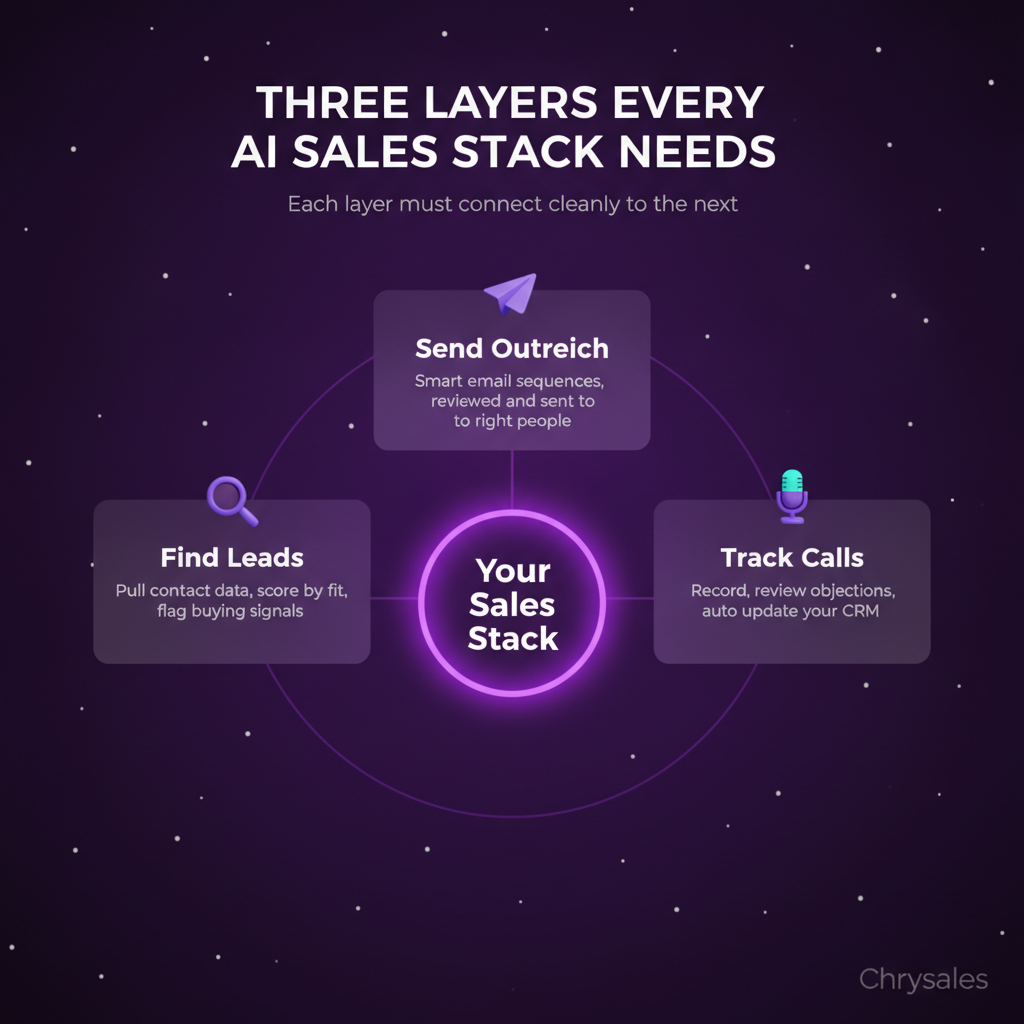
Now the best AI sales stacks look different. They're built around three layers: finding the right people, reaching them the right way, and closing deals faster. Each layer uses AI for B2B sales in a specific way. The prospecting layer pulls data and scores leads. The outreach layer writes personalized messages and tracks replies. The conversation layer listens to calls, flags objections, and coaches reps in real time.
Fewer Tools, Better Results
Here's the thing: most teams still have too many tools. We worked with a 40-person consulting firm last year. They had 18 different sales tools. Sounds impressive, right? It wasn't. Their reps spent more time managing the stack than selling. After cutting it down to six core tools that actually connected, their pipeline grew 60% in two months.
Common mistake: Thinking more AI sales tools equals better performance. It doesn't. A bloated stack creates its own problems. Data gets stuck. Reps get confused. Nobody knows which tool to check first. The winning move in 2026 is consolidation. Pick tools that do one job really well and connect cleanly to the rest of your setup. If a tool doesn't feed data into your next step, cut it.
The Three Core Layers Every Stack Needs
Every AI-powered sales process needs these three layers working together, as explained in the only AI sales system you need in 2026:
- Prospecting and enrichment – Pull contact data, score leads, find buying signals
- Outbound automation – Send personalized emails and LinkedIn messages, track replies, book meetings
- Conversation intelligence – Record calls, analyze objections, surface coaching moments, update your CRM automatically
If any layer is missing or disconnected, the whole thing breaks. A perfect outreach message means nothing if your list is full of bad contacts. A great sales call doesn't help if nobody writes down what happened or follows up. Most AI for sales teams fails because companies build one layer really well and ignore the others.
The Prospecting Layer: Where Good Sales Systems Start
Most cold emails flop because the list is bad, not the words. You can write the best subject line in the world. If you're sending it to someone who doesn't buy what you sell, it's noise. Think of your sales pipeline like a phone contact list. If half the numbers don't work, no message gets through.
The prospecting layer is where AI sales tools actually shine. They pull data from dozens of sources, verify contact info, and score leads based on real buying signals. No guessing. No hoping someone might be interested.
What This Layer Actually Does
The best AI sales stack setups use tools that scrape LinkedIn, company websites, job boards, and funding announcements. They pull info like company size, recent hires, tech stack, and whether a company just raised money or opened a new office. Then they score each lead.
A score isn't magic. It's just math. If a company matches your ideal customer profile and just posted a job for the exact problem you solve, that's a high score. If it's a 200-person company that just did layoffs and operates in a different country, that's a low score. Simple.
Pro Tip: Set a simple rule. Anything scoring above 70 goes to the top of your call list. Everything below 50 gets dropped or goes into a long-term nurture sequence. Don't waste time on bad fits.
Building Lists That Actually Convert
Here's what one marketing agency did. They were sending 500 cold emails a week with a 0.6% reply rate. Terrible. We looked at their list. Half the contacts were outdated. A third weren't even decision makers. They were reaching out to junior employees who couldn't buy anything.
After switching to an AI-powered prospecting tool that verified emails and enriched contact data with job titles and company signals, their reply rate jumped to 4.2%. Same email copy. Better list. The outbound sales stack didn't change. The input quality did, as confirmed by recent AI sales prospecting benchmarks for 2026.
Use tools that verify emails before you send. Use filters that check company headcount, location, and recent activity. Use scoring that flags companies showing buying intent. This part isn't sexy, but it does most of the heavy lifting.
The Outreach Layer: Automation That Doesn't Sound Like a Robot
Cold outreach in 2026 isn't about volume. It's about relevance. Sending 10,000 generic emails gets you nothing but spam complaints. Sending 500 personalized messages to the right people books meetings.
The outreach layer is where AI sales tools 2026 setups get interesting. Modern tools write first drafts of emails based on lead data. They pull info like recent job changes, funding news, or LinkedIn posts and drop it into your message. The result sounds like you did research because the AI did the research for you.
Personalization at Scale Without the Manual Work
Let's be clear: you still need to review what the AI writes. But instead of writing 100 emails from scratch, you're editing 100 emails that are already 80% there. Huge difference.
A 15-person consulting firm we worked with used to spend three hours a day writing cold emails. After setting up an AI outbound automation system that pulled LinkedIn activity and recent company news, that dropped to 30 minutes. The emails got better, not worse. Reply rates went from 2% to 5.8%.
Watch out: Don't let AI write your whole message without checking it. Sometimes it pulls weird info or makes assumptions that don't make sense. Always scan before you send.
What Good Outbound Sales Automation Looks Like
The best sales tech stack for agencies and small sales teams uses these steps:
- Pull enriched lead data – Company size, tech stack, recent news, LinkedIn activity
- Generate first draft – AI writes a short email using that data
- Human review – You tweak tone, fix weird lines, add a personal touch
- Send in sequences – Follow-ups go out automatically if no reply
- Track everything – Opens, clicks, replies all logged in one place
This isn't set-it-and-forget-it. It's set it, check it, tweak it. The AI does the boring research and drafting. You do the final 20% that makes it sound human.
One tech company tried running fully automated outreach with zero human review. Their emails sounded robotic. People could tell. Reply rates tanked. After adding a quick human review step, replies tripled. The lesson: AI for B2B sales works best when it supports people, not replaces them.
The Conversation Layer: Where Deals Actually Close
Outreach books the meeting. The sales call closes the deal. But here's the problem: most sales calls are a mess. Reps forget to ask key questions. Objections get handled badly. Nobody takes good notes. By the time the call ends, half the useful info is lost.
This is where conversation intelligence tools change everything. They record calls, transcribe them, and pull out the important parts. Which objections came up. What the prospect cared about most. Whether the rep followed the pitch structure. All of it gets logged automatically.
Real-Time Coaching During Calls
The newer AI sales tools go further. They listen to calls in real time and surface helpful info while you're still talking. Prospect mentions a competitor? The tool pops up a card with your comparison points. Prospect asks about pricing? The tool shows your discount structure and objection scripts.
It's like having a coach sitting next to you on every call. Except the coach is software, and it never gets tired or forgets the playbook, as detailed in this guide to conversation intelligence software.
Pro Tip: Use conversation intelligence to train new reps faster. Let them listen to top performers' calls and see exactly what questions they ask and how they handle pushback. Cuts onboarding time in half.
Connecting Calls to Your CRM Without Manual Data Entry
Nobody likes updating the CRM. It's boring. It takes forever. Most reps skip it or do it badly. But if your CRM is missing call notes, your follow-ups are weak and your pipeline data is useless.
Good AI-powered sales process tools solve this. After every call, the AI writes a summary and drops it into your CRM. It logs action items, flags objections, and updates deal stages. Zero manual work.
A 25-person tech company we worked with used to spend 90 minutes a week per rep updating CRM notes. After adding conversation intelligence, that dropped to zero. Their pipeline visibility got better, not worse. Sales managers could finally see what was actually happening on calls without asking reps to write reports, and they could use insights from common B2B sales call patterns to improve coaching.
Building Your Stack: Start Small, Add Deliberately
Most teams make the same mistake: they try to build the whole AI sales stack at once. They buy six tools in a month, overwhelm their team, and end up using none of them well. Here's a better way. Start with one layer. Get it working. Then add the next.
The 90-Day Build Plan
Month 1: Fix your prospecting. Pick one tool that enriches lead data and scores contacts. Build a clean list of 500 high-score leads. Test it with manual outreach first. Make sure the list quality is actually better.
Month 2: Add outreach automation. Connect your prospecting tool to an outbound platform. Set up three-step email sequences. A/B test subject lines. Track reply rates. Tweak until you hit at least 3% replies.
Month 3: Layer in conversation intelligence. Start recording sales calls. Review transcripts. Build a library of good calls and bad calls. Use it to coach your team and update your pitch.
This approach is boring. It's slow. It works. Rushing makes everything harder. Teams that take 90 days to build their stack end up with something they actually use. Teams that try to do it in two weeks end up with shelfware.
Connecting the Pieces Without Losing Your Mind
Integration is where most AI sales stacks fall apart. You've got five tools that don't talk to each other. Data lives in silos. Reps still copy-paste between systems.
The fix: pick tools that connect natively or use a simple automation platform to bridge them. If your prospecting tool can't push data into your outreach tool, you're going to hate your life.
Common mistake: Assuming all tools integrate just because they're modern. They don't. Check integrations before you buy, not after.
One consulting firm spent $8,000 on three tools that didn't connect. They had to hire someone just to export and import CSVs every week. Total mess. After switching to tools that had native integrations, the whole stack ran itself.
What This Looks Like for Different Team Sizes
The best AI sales stack isn't the same for everyone. A solo founder needs something different than a 50-person sales team.
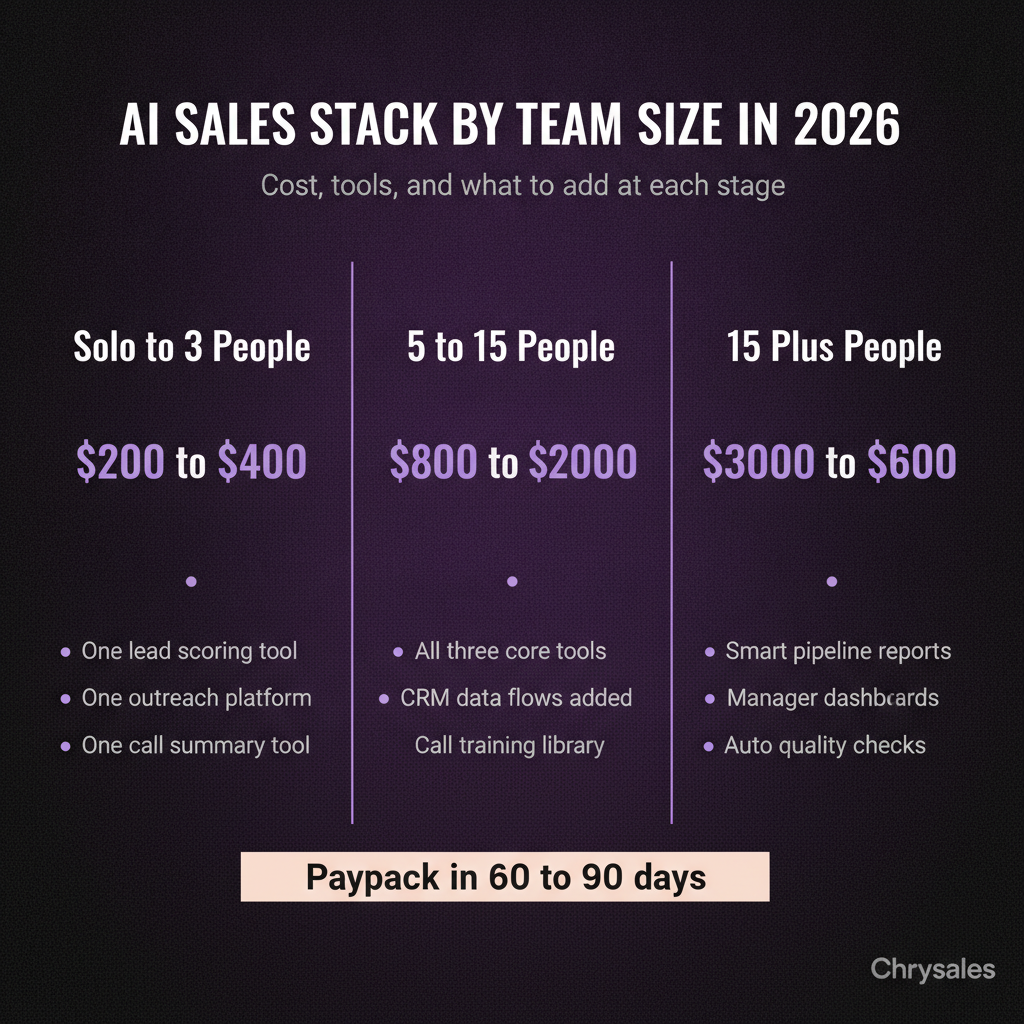
Solo or Small Teams (1-3 People)
Keep it simple. You need three tools max:
- One prospecting tool that pulls and scores leads
- One outreach platform that sends sequences and tracks replies
- One conversation tool that records calls and writes summaries
Total cost: $200-$400 a month. Total setup time: two weeks if you focus. You don't need advanced analytics or multi-layer automations. You need clean lists, good emails, and call notes that don't disappear.
Mid-Size Teams (5-15 People)
Add a layer of training and consistency. You need the same three core tools, plus:
- A sales training library built from recorded calls
- Lead scoring rules customized to your ideal customer profile
- CRM integration so data flows automatically
This is where conversation intelligence really pays off. Your reps will all pitch differently unless you show them what good looks like. Use AI to surface top performer calls and turn them into training content.
Larger Teams (15+ People)
At this size, you need full pipeline visibility and coaching at scale. Add:
- AI-powered pipeline forecasting
- Manager dashboards that surface coaching moments
- Automated quality assurance that flags bad calls or missed steps
We worked with a 30-person agency that used AI to analyze every sales call for 12 objections they commonly faced. When a rep handled an objection poorly, the system flagged it for their manager. Coaching became specific and fast. Close rates went up 18% in one quarter.
The Mistakes That Kill AI Sales Stacks
Even with the right tools, most setups fail. Here's why.
Mistake 1: No Sales System Underneath
AI only amplifies what you already do. If your sales process is broken, AI makes it break faster at higher volume. A bad pitch delivered to 1,000 people is still a bad pitch.
Before you build an AI sales stack, build a sales system. Write down your discovery questions. Script your objection responses. Define your ideal customer profile. Train your team on the basics. Then add AI to make the good process faster, following the principles in how to build a sales system that actually scales.
Watch out: If you don't know what a good sales call sounds like, conversation intelligence won't help. It'll just record bad calls faster.
Mistake 2: Ignoring the Human Part
Sales is still a people business. AI handles research, outreach, note-taking, and data entry. It doesn't build trust. It doesn't read the room. It doesn't close deals on its own.
The best sales tech stack for agencies and B2B companies puts AI in the background and reps in the front. Tools support people. People close deals.
One tech company fired half their sales team and replaced them with AI agents. Revenue dropped 40% in three months. Turns out, their customers wanted to talk to humans. They brought the team back and used AI to make each rep twice as productive instead. Revenue recovered and then grew.
Mistake 3: Tool Hopping Every Quarter
Every month, some new AI tool launches and promises to change everything. Most don't. Switching tools constantly means your team never masters any of them. Data gets lost. Integrations break. Everyone gets frustrated.
Pick your stack. Commit for at least six months. Learn it deeply. Optimize it. Only swap tools if something is genuinely broken, not just because something shinier appeared.
Mistake 4: Zero Training or Onboarding
You bought the tools. Great. Did you train your team? Did you build workflows? Did you write documentation?
Most teams skip this. They assume tools are "intuitive" and reps will figure it out. They don't. Three weeks later, nobody's using the new stack and everyone's back to their old habits.
Spend as much time on training as you do on tool selection. Run live walkthroughs. Record how-to videos. Assign someone to answer questions. Make adoption the goal, not just purchase.
How Chrysales Builds Custom AI Sales Systems
We've trained over 500 sales teams and generated more than €10M in client revenue. Here's what we've learned: the stack is only 30% of the solution. The other 70% is the system around it.
When we build a sales system for a B2B company, we start with the process. We map out your customer journey. We write your discovery questions, pitch structure, and objection scripts. We define your ideal customer profile and build lead scoring rules.
Then we pick the AI tools that fit that system. Not the other way around. Tools serve the system. The system serves revenue.
The 4-Step Build We Use
Step 1: Learn. We dig into your current process, your win rates, your top objections, and where deals stall. We don't assume. We ask.
Step 2: Build the system. We write your sales playbook, structure your calls, and create offer positioning that actually differentiates you. This is the foundation.
Step 3: Automate. We layer in AI sales tools for prospecting, outreach, and conversation tracking. We connect them to your CRM and build workflows that run on autopilot.
Step 4: Hire and train. If you need to scale, we help you hire elite setters and closers, then train them on your system and stack. They ramp faster because the system is clear.
This approach has helped clients like Cloudification, Amazon, and Vodafone build predictable client acquisition engines. Not just software. Systems. You can watch how an AI sales system gets you record revenue with unlimited demand to see the full build in action.
What's Coming Next in 2026 and Beyond
The AI sales stack isn't done evolving. Here's what's already happening and where it's headed, and you can learn how to survive in the AI era that kills most businesses for a deeper perspective on adapting to these changes.
Deeper Personalization Using Buyer Intent Signals
Tools are getting better at spotting real buying intent. Not just "this company fits your ICP." More like "this specific person just searched for your competitor, visited your pricing page twice, and downloaded a whitepaper."
When your outreach tool knows that, your first email can reference it. Reply rates go up. Meetings get booked faster. We're seeing early versions of this now. By the end of 2026, it'll be standard.
AI That Runs Full Discovery Calls
Some tools are testing AI agents that handle discovery calls start to finish. They ask questions, listen to answers, qualify leads, and book follow-ups.
It sounds wild. Early tests show it works for simple, transactional sales. For complex B2B deals? Not yet. But it's coming. In three years, AI might handle first calls while your reps focus on closing.
Tighter CRM and Sales Stack Integration
CRMs are starting to build AI directly into the platform. No more third-party tools bolted on. Everything lives in one place. Lead scoring, outreach tracking, call summaries, pipeline forecasting, all native, as analyzed in recent research on AI sales tool stack evolution for 2026.
When that happens, sales tech stacks get simpler. Fewer tools. Fewer integrations. Fewer headaches. That's the direction we're moving.
Frequently Asked Questions
Q: Do I need to replace my whole sales team with AI tools?
No. The best AI sales stack doesn't replace people. It makes each person on your team way more productive. Instead of doing manual research, data entry, and follow-up tracking, your reps focus on conversations and closing. You get better results with the same team, or you grow revenue without hiring 20 more people.
Q: How much does a solid AI sales stack cost?
For a small team, expect $200 to $500 a month for core tools. Mid-size teams with more integrations and training tools run $800 to $2,000 a month. Larger teams with advanced analytics and pipeline tools can hit $3,000 to $6,000 monthly. The ROI is fast if you set it up right. Most teams see payback in 60 to 90 days through better conversion rates and faster sales cycles.
Q: Can AI really personalize outreach at scale, or does it still sound robotic?
Good AI tools pull real data like LinkedIn activity, company news, and job changes to personalize emails. The first draft is usually 80% there. You review and tweak the last 20% to make it sound human. If you skip the review step, yeah, it sounds robotic. If you edit before sending, reply rates go up because the message feels relevant and timely.
Q: What's the biggest mistake teams make when building an AI sales stack?
Buying tools before fixing the sales process. If your pitch is unclear, your objection handling is weak, or your ideal customer profile is fuzzy, AI just scales the mess. Build the system first. Write your playbook. Train your team. Then add AI to make the good process faster and more consistent.
Q: How do I know which tools to pick when there are so many options?
Start with the problem, not the tool. Ask: where is my sales process breaking right now? Is it bad lead data? Low reply rates? Lost call notes? Weak follow-ups? Pick one problem. Find the tool that solves it best and integrates with what you already use. Add one tool at a time, get it working, then move to the next layer.
Q: Will my team actually use these tools, or will they just ignore them?
Adoption is everything. If you buy tools and don't train your team, they'll ignore them. Run live walkthroughs. Record quick how-to videos. Make someone the go-to person for questions. Show your team how the tools make their job easier, not harder. When reps see they're spending less time on admin and more time selling, they'll use the stack.
Q: How long does it take to build and launch an AI sales stack?
If you go slow and deliberate, 90 days is realistic. Month one for prospecting, month two for outreach, month three for conversation tools. Trying to do it all in two weeks leads to confusion and low adoption. Take time to train, test, and tweak. A slower build with high adoption beats a fast launch that nobody uses.
An AI sales stack is a set of connected tools that automate prospecting, outreach, and call tracking to make B2B sales faster and more efficient. Picture this: a sales team of eight people doing the work that used to take 25. No layoffs. No massive hiring spree. Just a smarter setup. That's what happens when you build an AI sales stack the right way.
Most B2B sales tools promise to automate everything, but the truth is simpler. The right AI tools don't replace your team. They replace the boring, repetitive stuff that burns people out and slows deals down. Here's what actually works in 2026, and how to build a stack that makes lead generation and client acquisition faster without making everything more complicated.
What Actually Changed in the AI Sales Stack This Year
The shift isn't about more tools. It's about fewer tools doing more. Three years ago, most sales tech stacks looked like a pile of disconnected apps. One for emails. One for tracking calls. One for lead data. One for scoring. None of them talked to each other. Every rep spent half their day switching tabs and copying info between systems.
Now the best AI sales stacks look different. They're built around three layers: finding the right people, reaching them the right way, and closing deals faster. Each layer uses AI for B2B sales in a specific way. The prospecting layer pulls data and scores leads. The outreach layer writes personalized messages and tracks replies. The conversation layer listens to calls, flags objections, and coaches reps in real time.
Fewer Tools, Better Results
Here's the thing: most teams still have too many tools. We worked with a 40-person consulting firm last year. They had 18 different sales tools. Sounds impressive, right? It wasn't. Their reps spent more time managing the stack than selling. After cutting it down to six core tools that actually connected, their pipeline grew 60% in two months.
Common mistake: Thinking more AI sales tools equals better performance. It doesn't. A bloated stack creates its own problems. Data gets stuck. Reps get confused. Nobody knows which tool to check first. The winning move in 2026 is consolidation. Pick tools that do one job really well and connect cleanly to the rest of your setup. If a tool doesn't feed data into your next step, cut it.
The Three Core Layers Every Stack Needs
Every AI-powered sales process needs these three layers working together, as explained in the only AI sales system you need in 2026:
- Prospecting and enrichment – Pull contact data, score leads, find buying signals
- Outbound automation – Send personalized emails and LinkedIn messages, track replies, book meetings
- Conversation intelligence – Record calls, analyze objections, surface coaching moments, update your CRM automatically
If any layer is missing or disconnected, the whole thing breaks. A perfect outreach message means nothing if your list is full of bad contacts. A great sales call doesn't help if nobody writes down what happened or follows up. Most AI for sales teams fails because companies build one layer really well and ignore the others.
The Prospecting Layer: Where Good Sales Systems Start
Most cold emails flop because the list is bad, not the words. You can write the best subject line in the world. If you're sending it to someone who doesn't buy what you sell, it's noise. Think of your sales pipeline like a phone contact list. If half the numbers don't work, no message gets through.
The prospecting layer is where AI sales tools actually shine. They pull data from dozens of sources, verify contact info, and score leads based on real buying signals. No guessing. No hoping someone might be interested.
What This Layer Actually Does
The best AI sales stack setups use tools that scrape LinkedIn, company websites, job boards, and funding announcements. They pull info like company size, recent hires, tech stack, and whether a company just raised money or opened a new office. Then they score each lead.
A score isn't magic. It's just math. If a company matches your ideal customer profile and just posted a job for the exact problem you solve, that's a high score. If it's a 200-person company that just did layoffs and operates in a different country, that's a low score. Simple.
Pro Tip: Set a simple rule. Anything scoring above 70 goes to the top of your call list. Everything below 50 gets dropped or goes into a long-term nurture sequence. Don't waste time on bad fits.
Building Lists That Actually Convert
Here's what one marketing agency did. They were sending 500 cold emails a week with a 0.6% reply rate. Terrible. We looked at their list. Half the contacts were outdated. A third weren't even decision makers. They were reaching out to junior employees who couldn't buy anything.
After switching to an AI-powered prospecting tool that verified emails and enriched contact data with job titles and company signals, their reply rate jumped to 4.2%. Same email copy. Better list. The outbound sales stack didn't change. The input quality did, as confirmed by recent AI sales prospecting benchmarks for 2026.
Use tools that verify emails before you send. Use filters that check company headcount, location, and recent activity. Use scoring that flags companies showing buying intent. This part isn't sexy, but it does most of the heavy lifting.
The Outreach Layer: Automation That Doesn't Sound Like a Robot
Cold outreach in 2026 isn't about volume. It's about relevance. Sending 10,000 generic emails gets you nothing but spam complaints. Sending 500 personalized messages to the right people books meetings.
The outreach layer is where AI sales tools 2026 setups get interesting. Modern tools write first drafts of emails based on lead data. They pull info like recent job changes, funding news, or LinkedIn posts and drop it into your message. The result sounds like you did research because the AI did the research for you.
Personalization at Scale Without the Manual Work
Let's be clear: you still need to review what the AI writes. But instead of writing 100 emails from scratch, you're editing 100 emails that are already 80% there. Huge difference.
A 15-person consulting firm we worked with used to spend three hours a day writing cold emails. After setting up an AI outbound automation system that pulled LinkedIn activity and recent company news, that dropped to 30 minutes. The emails got better, not worse. Reply rates went from 2% to 5.8%.
Watch out: Don't let AI write your whole message without checking it. Sometimes it pulls weird info or makes assumptions that don't make sense. Always scan before you send.
What Good Outbound Sales Automation Looks Like
The best sales tech stack for agencies and small sales teams uses these steps:
- Pull enriched lead data – Company size, tech stack, recent news, LinkedIn activity
- Generate first draft – AI writes a short email using that data
- Human review – You tweak tone, fix weird lines, add a personal touch
- Send in sequences – Follow-ups go out automatically if no reply
- Track everything – Opens, clicks, replies all logged in one place
This isn't set-it-and-forget-it. It's set it, check it, tweak it. The AI does the boring research and drafting. You do the final 20% that makes it sound human.
One tech company tried running fully automated outreach with zero human review. Their emails sounded robotic. People could tell. Reply rates tanked. After adding a quick human review step, replies tripled. The lesson: AI for B2B sales works best when it supports people, not replaces them.
The Conversation Layer: Where Deals Actually Close
Outreach books the meeting. The sales call closes the deal. But here's the problem: most sales calls are a mess. Reps forget to ask key questions. Objections get handled badly. Nobody takes good notes. By the time the call ends, half the useful info is lost.
This is where conversation intelligence tools change everything. They record calls, transcribe them, and pull out the important parts. Which objections came up. What the prospect cared about most. Whether the rep followed the pitch structure. All of it gets logged automatically.
Real-Time Coaching During Calls
The newer AI sales tools go further. They listen to calls in real time and surface helpful info while you're still talking. Prospect mentions a competitor? The tool pops up a card with your comparison points. Prospect asks about pricing? The tool shows your discount structure and objection scripts.
It's like having a coach sitting next to you on every call. Except the coach is software, and it never gets tired or forgets the playbook, as detailed in this guide to conversation intelligence software.
Pro Tip: Use conversation intelligence to train new reps faster. Let them listen to top performers' calls and see exactly what questions they ask and how they handle pushback. Cuts onboarding time in half.
Connecting Calls to Your CRM Without Manual Data Entry
Nobody likes updating the CRM. It's boring. It takes forever. Most reps skip it or do it badly. But if your CRM is missing call notes, your follow-ups are weak and your pipeline data is useless.
Good AI-powered sales process tools solve this. After every call, the AI writes a summary and drops it into your CRM. It logs action items, flags objections, and updates deal stages. Zero manual work.
A 25-person tech company we worked with used to spend 90 minutes a week per rep updating CRM notes. After adding conversation intelligence, that dropped to zero. Their pipeline visibility got better, not worse. Sales managers could finally see what was actually happening on calls without asking reps to write reports, and they could use insights from common B2B sales call patterns to improve coaching.
Building Your Stack: Start Small, Add Deliberately
Most teams make the same mistake: they try to build the whole AI sales stack at once. They buy six tools in a month, overwhelm their team, and end up using none of them well. Here's a better way. Start with one layer. Get it working. Then add the next.
The 90-Day Build Plan
Month 1: Fix your prospecting. Pick one tool that enriches lead data and scores contacts. Build a clean list of 500 high-score leads. Test it with manual outreach first. Make sure the list quality is actually better.
Month 2: Add outreach automation. Connect your prospecting tool to an outbound platform. Set up three-step email sequences. A/B test subject lines. Track reply rates. Tweak until you hit at least 3% replies.
Month 3: Layer in conversation intelligence. Start recording sales calls. Review transcripts. Build a library of good calls and bad calls. Use it to coach your team and update your pitch.
This approach is boring. It's slow. It works. Rushing makes everything harder. Teams that take 90 days to build their stack end up with something they actually use. Teams that try to do it in two weeks end up with shelfware.
Connecting the Pieces Without Losing Your Mind
Integration is where most AI sales stacks fall apart. You've got five tools that don't talk to each other. Data lives in silos. Reps still copy-paste between systems.
The fix: pick tools that connect natively or use a simple automation platform to bridge them. If your prospecting tool can't push data into your outreach tool, you're going to hate your life.
Common mistake: Assuming all tools integrate just because they're modern. They don't. Check integrations before you buy, not after.
One consulting firm spent $8,000 on three tools that didn't connect. They had to hire someone just to export and import CSVs every week. Total mess. After switching to tools that had native integrations, the whole stack ran itself.
What This Looks Like for Different Team Sizes
The best AI sales stack isn't the same for everyone. A solo founder needs something different than a 50-person sales team.
Solo or Small Teams (1-3 People)
Keep it simple. You need three tools max:
- One prospecting tool that pulls and scores leads
- One outreach platform that sends sequences and tracks replies
- One conversation tool that records calls and writes summaries
Total cost: $200-$400 a month. Total setup time: two weeks if you focus. You don't need advanced analytics or multi-layer automations. You need clean lists, good emails, and call notes that don't disappear.
Mid-Size Teams (5-15 People)
Add a layer of training and consistency. You need the same three core tools, plus:
- A sales training library built from recorded calls
- Lead scoring rules customized to your ideal customer profile
- CRM integration so data flows automatically
This is where conversation intelligence really pays off. Your reps will all pitch differently unless you show them what good looks like. Use AI to surface top performer calls and turn them into training content.
Larger Teams (15+ People)
At this size, you need full pipeline visibility and coaching at scale. Add:
- AI-powered pipeline forecasting
- Manager dashboards that surface coaching moments
- Automated quality assurance that flags bad calls or missed steps
We worked with a 30-person agency that used AI to analyze every sales call for 12 objections they commonly faced. When a rep handled an objection poorly, the system flagged it for their manager. Coaching became specific and fast. Close rates went up 18% in one quarter.
The Mistakes That Kill AI Sales Stacks
Even with the right tools, most setups fail. Here's why.
Mistake 1: No Sales System Underneath
AI only amplifies what you already do. If your sales process is broken, AI makes it break faster at higher volume. A bad pitch delivered to 1,000 people is still a bad pitch.
Before you build an AI sales stack, build a sales system. Write down your discovery questions. Script your objection responses. Define your ideal customer profile. Train your team on the basics. Then add AI to make the good process faster, following the principles in how to build a sales system that actually scales.
Watch out: If you don't know what a good sales call sounds like, conversation intelligence won't help. It'll just record bad calls faster.
Mistake 2: Ignoring the Human Part
Sales is still a people business. AI handles research, outreach, note-taking, and data entry. It doesn't build trust. It doesn't read the room. It doesn't close deals on its own.
The best sales tech stack for agencies and B2B companies puts AI in the background and reps in the front. Tools support people. People close deals.
One tech company fired half their sales team and replaced them with AI agents. Revenue dropped 40% in three months. Turns out, their customers wanted to talk to humans. They brought the team back and used AI to make each rep twice as productive instead. Revenue recovered and then grew.
Mistake 3: Tool Hopping Every Quarter
Every month, some new AI tool launches and promises to change everything. Most don't. Switching tools constantly means your team never masters any of them. Data gets lost. Integrations break. Everyone gets frustrated.
Pick your stack. Commit for at least six months. Learn it deeply. Optimize it. Only swap tools if something is genuinely broken, not just because something shinier appeared.
Mistake 4: Zero Training or Onboarding
You bought the tools. Great. Did you train your team? Did you build workflows? Did you write documentation?
Most teams skip this. They assume tools are "intuitive" and reps will figure it out. They don't. Three weeks later, nobody's using the new stack and everyone's back to their old habits.
Spend as much time on training as you do on tool selection. Run live walkthroughs. Record how-to videos. Assign someone to answer questions. Make adoption the goal, not just purchase.
How Chrysales Builds Custom AI Sales Systems
We've trained over 500 sales teams and generated more than €10M in client revenue. Here's what we've learned: the stack is only 30% of the solution. The other 70% is the system around it.
When we build a sales system for a B2B company, we start with the process. We map out your customer journey. We write your discovery questions, pitch structure, and objection scripts. We define your ideal customer profile and build lead scoring rules.
Then we pick the AI tools that fit that system. Not the other way around. Tools serve the system. The system serves revenue.
The 4-Step Build We Use
Step 1: Learn. We dig into your current process, your win rates, your top objections, and where deals stall. We don't assume. We ask.
Step 2: Build the system. We write your sales playbook, structure your calls, and create offer positioning that actually differentiates you. This is the foundation.
Step 3: Automate. We layer in AI sales tools for prospecting, outreach, and conversation tracking. We connect them to your CRM and build workflows that run on autopilot.
Step 4: Hire and train. If you need to scale, we help you hire elite setters and closers, then train them on your system and stack. They ramp faster because the system is clear.
This approach has helped clients like Cloudification, Amazon, and Vodafone build predictable client acquisition engines. Not just software. Systems. You can watch how an AI sales system gets you record revenue with unlimited demand to see the full build in action.
What's Coming Next in 2026 and Beyond
The AI sales stack isn't done evolving. Here's what's already happening and where it's headed, and you can learn how to survive in the AI era that kills most businesses for a deeper perspective on adapting to these changes.
Deeper Personalization Using Buyer Intent Signals
Tools are getting better at spotting real buying intent. Not just "this company fits your ICP." More like "this specific person just searched for your competitor, visited your pricing page twice, and downloaded a whitepaper."
When your outreach tool knows that, your first email can reference it. Reply rates go up. Meetings get booked faster. We're seeing early versions of this now. By the end of 2026, it'll be standard.
AI That Runs Full Discovery Calls
Some tools are testing AI agents that handle discovery calls start to finish. They ask questions, listen to answers, qualify leads, and book follow-ups.
It sounds wild. Early tests show it works for simple, transactional sales. For complex B2B deals? Not yet. But it's coming. In three years, AI might handle first calls while your reps focus on closing.
Tighter CRM and Sales Stack Integration
CRMs are starting to build AI directly into the platform. No more third-party tools bolted on. Everything lives in one place. Lead scoring, outreach tracking, call summaries, pipeline forecasting, all native, as analyzed in recent research on AI sales tool stack evolution for 2026.
When that happens, sales tech stacks get simpler. Fewer tools. Fewer integrations. Fewer headaches. That's the direction we're moving.
Frequently Asked Questions
Q: Do I need to replace my whole sales team with AI tools?
No. The best AI sales stack doesn't replace people. It makes each person on your team way more productive. Instead of doing manual research, data entry, and follow-up tracking, your reps focus on conversations and closing. You get better results with the same team, or you grow revenue without hiring 20 more people.
Q: How much does a solid AI sales stack cost?
For a small team, expect $200 to $500 a month for core tools. Mid-size teams with more integrations and training tools run $800 to $2,000 a month. Larger teams with advanced analytics and pipeline tools can hit $3,000 to $6,000 monthly. The ROI is fast if you set it up right. Most teams see payback in 60 to 90 days through better conversion rates and faster sales cycles.
Q: Can AI really personalize outreach at scale, or does it still sound robotic?
Good AI tools pull real data like LinkedIn activity, company news, and job changes to personalize emails. The first draft is usually 80% there. You review and tweak the last 20% to make it sound human. If you skip the review step, yeah, it sounds robotic. If you edit before sending, reply rates go up because the message feels relevant and timely.
Q: What's the biggest mistake teams make when building an AI sales stack?
Buying tools before fixing the sales process. If your pitch is unclear, your objection handling is weak, or your ideal customer profile is fuzzy, AI just scales the mess. Build the system first. Write your playbook. Train your team. Then add AI to make the good process faster and more consistent.
Q: How do I know which tools to pick when there are so many options?
Start with the problem, not the tool. Ask: where is my sales process breaking right now? Is it bad lead data? Low reply rates? Lost call notes? Weak follow-ups? Pick one problem. Find the tool that solves it best and integrates with what you already use. Add one tool at a time, get it working, then move to the next layer.
Q: Will my team actually use these tools, or will they just ignore them?
Adoption is everything. If you buy tools and don't train your team, they'll ignore them. Run live walkthroughs. Record quick how-to videos. Make someone the go-to person for questions. Show your team how the tools make their job easier, not harder. When reps see they're spending less time on admin and more time selling, they'll use the stack.
Q: How long does it take to build and launch an AI sales stack?
If you go slow and deliberate, 90 days is realistic. Month one for prospecting, month two for outreach, month three for conversation tools. Trying to do it all in two weeks leads to confusion and low adoption. Take time to train, test, and tweak. A slower build with high adoption beats a fast launch that nobody uses.
Scaling Is Not Hard If You Have The Right Systems
If you’re serious about leveling up your scaling game, you need the right system, the right training, and the right team behind you. We're here to give you the exact tools and strategies top entrepreneurs use to dominate.

Discover the latest tips
View All.avif)
Chrysales was formed from the words "chrysalis" the stage where a caterpillar transforms into a butterfly and "sales".
It stands for one thing: sales transformation.Because scaling doesn’t happen by doing more of the same. Scaling only happens when you go through real transformation in your systems, your offer, team and the way you sell.
.avif)


