.avif)
How to Use Youtube as Content for High-ticket Offers
Content for high ticket offers uses YouTube videos to build trust, explain your value, and warm potential buyers before a sales call. Most sales calls tank before they even start. The prospect shows up skeptical, their arms crossed mentally, and you spend 40 minutes building trust you should already have. Here's the thing: YouTube can do that trust-building for you while you sleep.
Why YouTube Works Better Than Any Other Pre-Call Content
YouTube isn't just another marketing channel. It's the only place where people willingly sit and watch you talk for 10, 20, even 40 minutes. No email list gets that kind of attention. No LinkedIn post holds focus that long. When someone watches your video, they're giving you something way more valuable than their email address. They're giving you their time and attention.
Here's what happens when a prospect watches your YouTube content before a discovery call. They already know your voice. They've seen how you think. They've watched you explain a concept and thought, "This person gets it." That's not something you can fake on a sales call. By the time they book a meeting, they're not wondering if you're credible. They're wondering if you're available.
The Trust Gap Most B2B Sales Teams Ignore
Most B2B companies pour money into lead generation, then wonder why their closing rate sits below 15%. The problem isn't the leads. It's the trust gap. You're asking people to hand over $10,000, $30,000, sometimes $100,000 based on one hour-long conversation. That's a huge ask when they just met you.
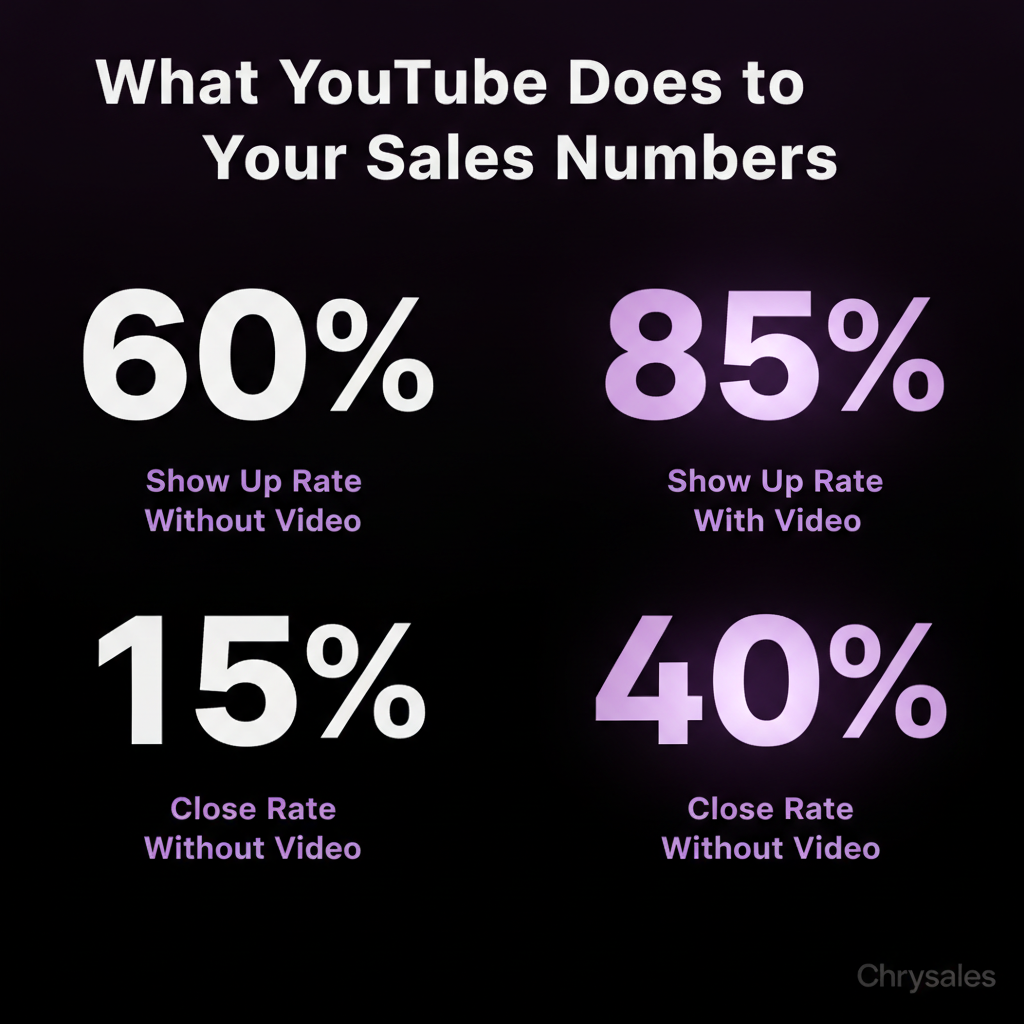
YouTube closes that gap before the call starts. When we work with clients on content for high ticket offers, the ones who use video pre-call content see show-up rates jump from 60% to 85%. More importantly, their closing rates go from 15-20% to 30-40%. The math is simple: people buy from people they trust, and video builds trust faster than any other medium.
Why Video Beats Written Content Every Time
You can write the perfect blog post explaining your sales system. It might even rank on Google. But reading isn't the same as watching. When someone reads, they're translating words into meaning in their head. When they watch a video, they're processing your tone, your confidence, your personality. That's the stuff that actually sells high-ticket services.
Pro tip: A 10-minute YouTube video explaining your method beats a 2,000-word blog post every time when it comes to pre-selling. Text informs. Video convinces.
What Kind of YouTube Content Actually Pre-Sells High-Ticket B2B Offers
Not every video moves the needle. Most YouTube content is either too broad or too salesy. The stuff that pre-sells sits right in the middle. It teaches something valuable while showing exactly how you think and work. Think of it like a sample chapter of a book, but way more personal.
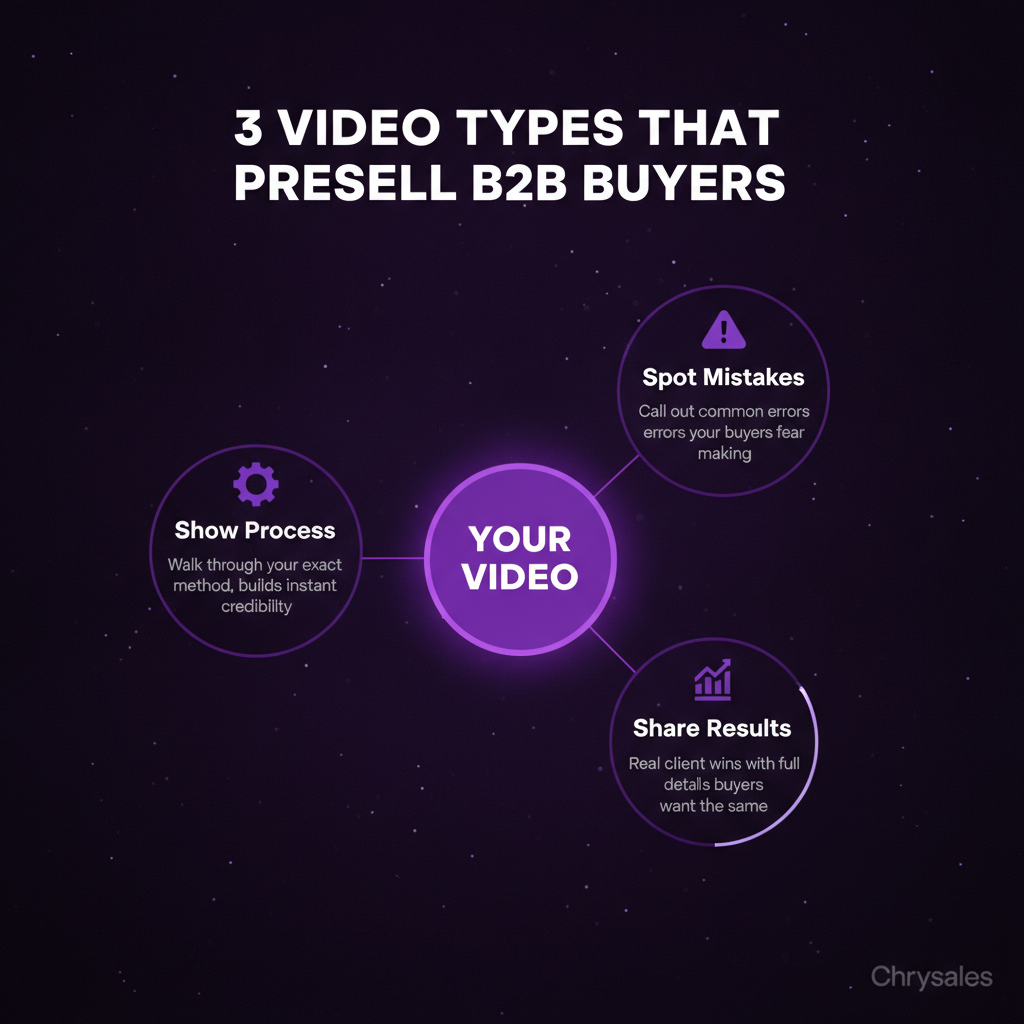
The "How We Do It" Video
This is the simplest format that works. Walk through your exact process. Not the fluffy overview. The real steps. If you help companies build sales systems, show how you build a sales system. If you run client acquisition for B2B companies, explain your discovery call structure or how you score leads.
A 20-person tech consulting firm we worked with posted a 12-minute video breaking down their project kickoff process. Nothing fancy. Just screen recording and talking. Three prospects mentioned that video on sales calls in the first month. All three closed. That's $180,000 in revenue from one video.
The "Common Mistake" Video
People love watching content that saves them from screwing up. Pick the biggest mistake you see in your space and make a video tearing it apart. If you help with B2B lead generation, make a video called "Why Your Cold Email List Is Killing Your Reply Rate." If you train sales teams, do "The Discovery Question That Tanks Your Close Rate."
These videos work because they position you as the expert who spots what others miss. When someone watches this before a call, they're already thinking, "If they caught that mistake in 8 minutes, imagine what they'll find in my business."
The "Real Example" Walkthrough
Pick a real result you got for a client. Change the name if you need to, but keep the details real. Walk through what the situation was, what you did, what happened. A marketing agency had a cold outreach reply rate of 0.6%. Here's what we changed. Here's how it jumped to 4.2%. Here's the exact first email we used.
Specificity sells. The more concrete your example, the more the viewer thinks, "I want those results."
Watch out: Don't make this a case study brag-fest. Focus on the process, not just the outcome. The viewer needs to see how you think, not just what you achieved.
How to Structure Videos That Move Prospects Closer to Buying
The structure matters more than most people think. You're not making entertainment. You're making a sales tool. Every video should have a job: answer a question, solve a small problem, or show how you work.
Start With the Problem, Not Your Intro
Most YouTube videos waste the first 90 seconds. "Hey everyone, welcome back to my channel, today we're going to talk about..." Skip all that. Open with the problem. "Most sales teams lose deals in the first 3 minutes of a discovery call. Here's why." Done. You just hooked everyone who has that problem.
The opening 15 seconds decide if someone keeps watching. Make them count. State the problem or the outcome immediately. If your video is about content for high ticket offers, your first sentence should be about high-ticket B2B offers, not about you or your company.
Teach One Thing Completely
Don't try to cover five topics in one video. Pick one. Teach it fully. If your video is about discovery call strategy, don't also try to cover objection handling and follow-up. Just do discovery. Go deep.
A 12-minute video that fully explains one concept is worth more than a 30-minute video that touches on six things. The viewer should finish and think, "I could actually do that." That's when they realize they'd rather hire you to do it.
End With a Soft Next Step
You're not selling in the video. But you're also not hiding that you offer help. At the end, mention the natural next step. "If you want help building this kind of system for your team, we do that 1-on-1. Link below." That's it. No hard pitch. No 5-minute CTA. Just a door.
Common mistake: Waiting until someone books a call to mention your services. If your YouTube content never mentions what you do, people won't connect the dots. You can pre-sell without hard selling.
Where YouTube Fits Into Your B2B Sales Process
YouTube isn't a replacement for client acquisition systems. It's a multiplier. The best use is right after someone enters your world and right before they book a call. This is where video does work your sales team can't do manually, and you can watch how to build a sales system so powerful clients come to you for a complete walkthrough of this approach.
Send Video Links in Your Outreach Sequences
When you're doing cold outreach, most people send 3-5 emails and give up. Add a video link in email 2 or 3. Not a sales video. A teaching video. "Here's a quick breakdown of the biggest mistake I see with sales hiring. Figured it might be useful."
This works because it's not asking for anything. You're just sharing something helpful. But if they watch that video, they're now warm. They've spent 10 minutes with you. When they reply or book a call two weeks later, you're not starting from zero.
One consulting firm added YouTube links to their cold email sequence. Their reply rate didn't change much. But their call-to-close rate jumped from 18% to 34%. The people who watched the videos showed up to calls already believing the firm knew what they were doing.
Embed Videos in Your Booking Confirmation Email
Someone just booked a discovery call with you. Most companies send a calendar invite and that's it. Huge miss. This is the perfect moment to send a video. "Hey, looking forward to our call. In the meantime, here's a short video on how we usually approach [their problem]. Will help us hit the ground running."
Now instead of showing up cold, they show up having watched 15 minutes of you explaining exactly how you think. The call becomes less "convince me" and more "let's figure out if this fits." This is exactly what an effective YouTube warm-up strategy for B2B sales accomplishes.
Build a "Start Here" Playlist for New Leads
When someone subscribes or fills out a form, send them a link to a playlist. Three to five videos. Total watch time 30-45 minutes. Think of it like a mini-course, but really it's a sales argument broken into pieces. Video 1: The problem. Video 2: Why most solutions don't work. Video 3: How we approach it differently. Video 4: What results look like.
A marketing agency built a 4-video playlist called "How We Book 15-20 Sales Calls a Month Without Ads." They send it to every new lead. About 40% of people watch at least two videos. Those people close at 50%. The ones who don't watch close at 12%. That's the power of pre-selling.
What to Actually Say in Your Videos Without Sounding Like a Sales Pitch
The tone matters as much as the content. You're teaching, not selling. But you're teaching in a way that makes it obvious you're the person to hire. It's a balance most people get wrong on both sides. Either they're too salesy and people tune out, or they're too neutral and people don't connect the video to the service.
Use "We" and "I" When You Tell Stories
When you're explaining a concept, use real examples from your work. "We worked with a B2B company last quarter who had this exact issue. Here's what we found." That's not bragging. That's proof. It shows you've done this before. The prospect starts thinking, "They could do this for us too."
Don't say "a company might do this" or "you could try this." Say "we did this" and "here's what happened." Real beats theoretical every time.
Break Down Your Unique Process Without Giving Away the Full System
You're not trying to turn viewers into DIY competitors. You're showing them how you think. Walk through your method at a high level. Explain the steps. Share the logic. But leave out the exact scripts, the specific tools, the custom workflows that make it actually work.
A sales training company made a video explaining their 5-step discovery call framework. They explained each step. What it does. Why it matters. But they didn't give the exact questions or the response scripts. Result: 8 inbound leads in 6 weeks, all of them mentioning that specific video. All of them wanting the full system built for their team.
Pro tip: If someone could watch your video and execute your full system perfectly, you gave away too much. If they watch and think "I get the idea but I'd need help making this work," you nailed it.
Talk Directly to the Person Watching, Not to "Everyone"
Don't say "companies need to focus on X" or "businesses should do Y." Say "you probably have this problem" and "here's what you can do." It feels like a conversation, not a lecture. The viewer should feel like you're talking to them, not at them.
Avoid business jargon. If you wouldn't say it in a real conversation, don't say it on video. "Implement a systematic methodology" sounds like a report. "Set up a system that works every time" sounds like a person.
How to Get Your Videos in Front of People Who Are Ready to Buy
Making great videos is step one. Getting them in front of high-intent prospects is step two. Most B2B companies post on YouTube and hope for the best. That's not a strategy. You need to actively put your content in the path of people who are already looking for what you sell.
Use YouTube SEO for High-Intent Search Terms
YouTube is the second-biggest search engine after Google. People search "how to scale a B2B sales team" or "best way to train sales reps" or "how to improve discovery calls." If your video ranks for those searches, you're getting traffic from people actively trying to solve the problem you solve.
Title your videos with search terms, not clever phrases. "How to Hire and Train a Sales Team That Actually Closes" beats "The Sales Hiring Secret Nobody Talks About." The first one gets searched. The second one doesn't.
Add a real description with the terms people search. First 2-3 sentences matter most. Include your main terms there. If the video is about selling high-ticket services, say that in the first line.
Send Videos Directly to Warm Leads and Email Lists
Don't wait for organic discovery. Send your videos directly. Email your list when you post something new. DM a video link to someone you've been talking to on LinkedIn. Include a video in your sales follow-up. "Hey, I made this for another client dealing with a similar issue. Thought it might be useful."
This is client acquisition through teaching. You're not asking them to buy. You're showing them you know what you're talking about. The sale becomes the obvious next step. This approach combines perfectly with proven tactics to find clients who need your services right now.
Watch out: Don't spam video links to cold contacts. Send them to people who already know you exist, or people who fit your exact target. A video sent to the wrong person is just noise.
Repurpose Sales Calls Into Teaching Content
You're already doing sales calls every week. Some of those calls are full of great teaching moments. Record them (with permission). Pull out 5-10 minute clips where you explain a concept, answer a tough question, or walk through your process. Boom, that's content.
Strip out any client-specific details. Add a quick intro explaining the context. Post it. Now your sales calls are doing double duty. They're closing deals and creating content that pre-sells future deals.
A B2B consulting firm pulls one clip from sales calls every week. They post it as a YouTube Short and a regular video. It takes 20 minutes of editing. They've gotten 6 inbound leads in 4 months directly from repurposed call content.
Common Mistakes That Kill Your YouTube Pre-Sell Strategy
Most B2B companies mess this up in predictable ways. They either overthink it and never start, or they underthink it and make content that doesn't move the needle. Here are the traps we see all the time.
Making Videos for Views Instead of Conversions
It's tempting to chase views. A video with 10,000 views feels like a win. But if none of those viewers are potential buyers, it's useless. You don't need a million views. You need 100 views from the right people.
Make content for your specific target, even if it's narrow. A video titled "How to Scale a Sales Team at a 20-50 Person SaaS Company" will get fewer views than "How to Scale a Sales Team." But the people who watch it are way more likely to be your buyers.
Overthinking Production Quality
You don't need a studio. You don't need fancy editing. You need clear audio, decent lighting, and something worth saying. Most successful B2B YouTube channels are just someone talking to a webcam or screen recording a walkthrough.
A 30-person tech company posted 15 videos in Q1. Every single one was recorded in 1-2 takes on Zoom. No editing beyond trimming the start and end. They booked 9 calls directly from those videos. Zero dollars spent on production.
Common mistake: Waiting to start until you can "do it right." Perfect is the enemy of done. Post the first video this week, even if it's rough. You'll get better as you go.
Not Tracking Which Videos Drive Calls
If you're not tracking where your calls come from, you have no idea if YouTube is working. Add a question to your booking form: "How did you hear about us?" or "Did you watch any of our videos before booking?" Most scheduling tools let you add custom questions.
When you see patterns like "8 of the last 12 calls mentioned the discovery call video," you know exactly what content to make more of. Double down on what works. Cut what doesn't. This tracking approach is central to effective YouTube for B2B lead generation strategies.
Frequently Asked Questions
Q: How long should my YouTube videos be to pre-sell high-ticket B2B services?
Aim for 8-15 minutes for teaching videos. That's long enough to go deep on one topic and show how you think, but short enough that busy people will actually watch. If you're walking through a detailed process, 15-20 minutes is fine. Avoid going over 25 minutes unless it's truly necessary. The goal is to build trust and demonstrate expertise, not to teach everything you know in one sitting. Shorter, focused videos that fully cover one topic work better than long videos that skim five topics.
Q: Do I need to be on camera or can I just do screen recordings?
Both work. On-camera builds more personal connection because people see your face and read your body language. But screen recordings work great for walkthrough content where you're showing a process, a tool, or breaking down data. Most successful B2B YouTube channels mix both. Start with whatever feels easier. If you're nervous on camera, start with screen recordings and add talking-head videos later. What you say matters way more than the format.
Q: How many videos do I need before YouTube starts working as a sales tool?
You can get results from a single great video if it's the right topic and you send it to the right people. But realistically, aim for 10-15 videos to start. That gives you enough content to build a "Start Here" playlist and cover your main topics. Post one video a week for three months and you'll have enough content to support your sales process. Quality beats quantity, but you need enough videos that prospects can binge a few and really get to know how you work, which is exactly what successful B2B video content lead generation campaigns require.
Q: Should I put pricing in my YouTube videos?
Not exact pricing, but you should mention the range or investment level. Saying "we work with companies investing $15,000 to $50,000 to build their sales system" filters out tire-kickers and attracts serious buyers. You're not trying to get everyone to book a call. You're trying to get qualified people who can afford your service and are ready to invest. Mentioning the investment level upfront saves everyone time and makes the calls you do get much higher quality.
Q: What if my competitors see my videos and copy my process?
They probably will. That's fine. Watching a video and actually executing a proven system are two completely different things. You're not giving away your full method, your exact tools, your custom workflows, or your years of experience. You're showing your thinking. If a competitor copies your surface-level process, they still don't have the depth, the reps, the intuition, or the trust you've built. Plus, every video they watch is a reminder that you're the original. The pros of pre-selling high-ticket offers through content massively outweigh the cons of competitors seeing your approach.
Content for high ticket offers uses YouTube videos to build trust, explain your value, and warm potential buyers before a sales call. Most sales calls tank before they even start. The prospect shows up skeptical, their arms crossed mentally, and you spend 40 minutes building trust you should already have. Here's the thing: YouTube can do that trust-building for you while you sleep.
Why YouTube Works Better Than Any Other Pre-Call Content
YouTube isn't just another marketing channel. It's the only place where people willingly sit and watch you talk for 10, 20, even 40 minutes. No email list gets that kind of attention. No LinkedIn post holds focus that long. When someone watches your video, they're giving you something way more valuable than their email address. They're giving you their time and attention.
Here's what happens when a prospect watches your YouTube content before a discovery call. They already know your voice. They've seen how you think. They've watched you explain a concept and thought, "This person gets it." That's not something you can fake on a sales call. By the time they book a meeting, they're not wondering if you're credible. They're wondering if you're available.
The Trust Gap Most B2B Sales Teams Ignore
Most B2B companies pour money into lead generation, then wonder why their closing rate sits below 15%. The problem isn't the leads. It's the trust gap. You're asking people to hand over $10,000, $30,000, sometimes $100,000 based on one hour-long conversation. That's a huge ask when they just met you.
YouTube closes that gap before the call starts. When we work with clients on content for high ticket offers, the ones who use video pre-call content see show-up rates jump from 60% to 85%. More importantly, their closing rates go from 15-20% to 30-40%. The math is simple: people buy from people they trust, and video builds trust faster than any other medium.
Why Video Beats Written Content Every Time
You can write the perfect blog post explaining your sales system. It might even rank on Google. But reading isn't the same as watching. When someone reads, they're translating words into meaning in their head. When they watch a video, they're processing your tone, your confidence, your personality. That's the stuff that actually sells high-ticket services.
Pro tip: A 10-minute YouTube video explaining your method beats a 2,000-word blog post every time when it comes to pre-selling. Text informs. Video convinces.
What Kind of YouTube Content Actually Pre-Sells High-Ticket B2B Offers
Not every video moves the needle. Most YouTube content is either too broad or too salesy. The stuff that pre-sells sits right in the middle. It teaches something valuable while showing exactly how you think and work. Think of it like a sample chapter of a book, but way more personal.
The "How We Do It" Video
This is the simplest format that works. Walk through your exact process. Not the fluffy overview. The real steps. If you help companies build sales systems, show how you build a sales system. If you run client acquisition for B2B companies, explain your discovery call structure or how you score leads.
A 20-person tech consulting firm we worked with posted a 12-minute video breaking down their project kickoff process. Nothing fancy. Just screen recording and talking. Three prospects mentioned that video on sales calls in the first month. All three closed. That's $180,000 in revenue from one video.
The "Common Mistake" Video
People love watching content that saves them from screwing up. Pick the biggest mistake you see in your space and make a video tearing it apart. If you help with B2B lead generation, make a video called "Why Your Cold Email List Is Killing Your Reply Rate." If you train sales teams, do "The Discovery Question That Tanks Your Close Rate."
These videos work because they position you as the expert who spots what others miss. When someone watches this before a call, they're already thinking, "If they caught that mistake in 8 minutes, imagine what they'll find in my business."
The "Real Example" Walkthrough
Pick a real result you got for a client. Change the name if you need to, but keep the details real. Walk through what the situation was, what you did, what happened. A marketing agency had a cold outreach reply rate of 0.6%. Here's what we changed. Here's how it jumped to 4.2%. Here's the exact first email we used.
Specificity sells. The more concrete your example, the more the viewer thinks, "I want those results."
Watch out: Don't make this a case study brag-fest. Focus on the process, not just the outcome. The viewer needs to see how you think, not just what you achieved.
How to Structure Videos That Move Prospects Closer to Buying
The structure matters more than most people think. You're not making entertainment. You're making a sales tool. Every video should have a job: answer a question, solve a small problem, or show how you work.
Start With the Problem, Not Your Intro
Most YouTube videos waste the first 90 seconds. "Hey everyone, welcome back to my channel, today we're going to talk about..." Skip all that. Open with the problem. "Most sales teams lose deals in the first 3 minutes of a discovery call. Here's why." Done. You just hooked everyone who has that problem.
The opening 15 seconds decide if someone keeps watching. Make them count. State the problem or the outcome immediately. If your video is about content for high ticket offers, your first sentence should be about high-ticket B2B offers, not about you or your company.
Teach One Thing Completely
Don't try to cover five topics in one video. Pick one. Teach it fully. If your video is about discovery call strategy, don't also try to cover objection handling and follow-up. Just do discovery. Go deep.
A 12-minute video that fully explains one concept is worth more than a 30-minute video that touches on six things. The viewer should finish and think, "I could actually do that." That's when they realize they'd rather hire you to do it.
End With a Soft Next Step
You're not selling in the video. But you're also not hiding that you offer help. At the end, mention the natural next step. "If you want help building this kind of system for your team, we do that 1-on-1. Link below." That's it. No hard pitch. No 5-minute CTA. Just a door.
Common mistake: Waiting until someone books a call to mention your services. If your YouTube content never mentions what you do, people won't connect the dots. You can pre-sell without hard selling.
Where YouTube Fits Into Your B2B Sales Process
YouTube isn't a replacement for client acquisition systems. It's a multiplier. The best use is right after someone enters your world and right before they book a call. This is where video does work your sales team can't do manually, and you can watch how to build a sales system so powerful clients come to you for a complete walkthrough of this approach.
Send Video Links in Your Outreach Sequences
When you're doing cold outreach, most people send 3-5 emails and give up. Add a video link in email 2 or 3. Not a sales video. A teaching video. "Here's a quick breakdown of the biggest mistake I see with sales hiring. Figured it might be useful."
This works because it's not asking for anything. You're just sharing something helpful. But if they watch that video, they're now warm. They've spent 10 minutes with you. When they reply or book a call two weeks later, you're not starting from zero.
One consulting firm added YouTube links to their cold email sequence. Their reply rate didn't change much. But their call-to-close rate jumped from 18% to 34%. The people who watched the videos showed up to calls already believing the firm knew what they were doing.
Embed Videos in Your Booking Confirmation Email
Someone just booked a discovery call with you. Most companies send a calendar invite and that's it. Huge miss. This is the perfect moment to send a video. "Hey, looking forward to our call. In the meantime, here's a short video on how we usually approach [their problem]. Will help us hit the ground running."
Now instead of showing up cold, they show up having watched 15 minutes of you explaining exactly how you think. The call becomes less "convince me" and more "let's figure out if this fits." This is exactly what an effective YouTube warm-up strategy for B2B sales accomplishes.
Build a "Start Here" Playlist for New Leads
When someone subscribes or fills out a form, send them a link to a playlist. Three to five videos. Total watch time 30-45 minutes. Think of it like a mini-course, but really it's a sales argument broken into pieces. Video 1: The problem. Video 2: Why most solutions don't work. Video 3: How we approach it differently. Video 4: What results look like.
A marketing agency built a 4-video playlist called "How We Book 15-20 Sales Calls a Month Without Ads." They send it to every new lead. About 40% of people watch at least two videos. Those people close at 50%. The ones who don't watch close at 12%. That's the power of pre-selling.
What to Actually Say in Your Videos Without Sounding Like a Sales Pitch
The tone matters as much as the content. You're teaching, not selling. But you're teaching in a way that makes it obvious you're the person to hire. It's a balance most people get wrong on both sides. Either they're too salesy and people tune out, or they're too neutral and people don't connect the video to the service.
Use "We" and "I" When You Tell Stories
When you're explaining a concept, use real examples from your work. "We worked with a B2B company last quarter who had this exact issue. Here's what we found." That's not bragging. That's proof. It shows you've done this before. The prospect starts thinking, "They could do this for us too."
Don't say "a company might do this" or "you could try this." Say "we did this" and "here's what happened." Real beats theoretical every time.
Break Down Your Unique Process Without Giving Away the Full System
You're not trying to turn viewers into DIY competitors. You're showing them how you think. Walk through your method at a high level. Explain the steps. Share the logic. But leave out the exact scripts, the specific tools, the custom workflows that make it actually work.
A sales training company made a video explaining their 5-step discovery call framework. They explained each step. What it does. Why it matters. But they didn't give the exact questions or the response scripts. Result: 8 inbound leads in 6 weeks, all of them mentioning that specific video. All of them wanting the full system built for their team.
Pro tip: If someone could watch your video and execute your full system perfectly, you gave away too much. If they watch and think "I get the idea but I'd need help making this work," you nailed it.
Talk Directly to the Person Watching, Not to "Everyone"
Don't say "companies need to focus on X" or "businesses should do Y." Say "you probably have this problem" and "here's what you can do." It feels like a conversation, not a lecture. The viewer should feel like you're talking to them, not at them.
Avoid business jargon. If you wouldn't say it in a real conversation, don't say it on video. "Implement a systematic methodology" sounds like a report. "Set up a system that works every time" sounds like a person.
How to Get Your Videos in Front of People Who Are Ready to Buy
Making great videos is step one. Getting them in front of high-intent prospects is step two. Most B2B companies post on YouTube and hope for the best. That's not a strategy. You need to actively put your content in the path of people who are already looking for what you sell.
Use YouTube SEO for High-Intent Search Terms
YouTube is the second-biggest search engine after Google. People search "how to scale a B2B sales team" or "best way to train sales reps" or "how to improve discovery calls." If your video ranks for those searches, you're getting traffic from people actively trying to solve the problem you solve.
Title your videos with search terms, not clever phrases. "How to Hire and Train a Sales Team That Actually Closes" beats "The Sales Hiring Secret Nobody Talks About." The first one gets searched. The second one doesn't.
Add a real description with the terms people search. First 2-3 sentences matter most. Include your main terms there. If the video is about selling high-ticket services, say that in the first line.
Send Videos Directly to Warm Leads and Email Lists
Don't wait for organic discovery. Send your videos directly. Email your list when you post something new. DM a video link to someone you've been talking to on LinkedIn. Include a video in your sales follow-up. "Hey, I made this for another client dealing with a similar issue. Thought it might be useful."
This is client acquisition through teaching. You're not asking them to buy. You're showing them you know what you're talking about. The sale becomes the obvious next step. This approach combines perfectly with proven tactics to find clients who need your services right now.
Watch out: Don't spam video links to cold contacts. Send them to people who already know you exist, or people who fit your exact target. A video sent to the wrong person is just noise.
Repurpose Sales Calls Into Teaching Content
You're already doing sales calls every week. Some of those calls are full of great teaching moments. Record them (with permission). Pull out 5-10 minute clips where you explain a concept, answer a tough question, or walk through your process. Boom, that's content.
Strip out any client-specific details. Add a quick intro explaining the context. Post it. Now your sales calls are doing double duty. They're closing deals and creating content that pre-sells future deals.
A B2B consulting firm pulls one clip from sales calls every week. They post it as a YouTube Short and a regular video. It takes 20 minutes of editing. They've gotten 6 inbound leads in 4 months directly from repurposed call content.
Common Mistakes That Kill Your YouTube Pre-Sell Strategy
Most B2B companies mess this up in predictable ways. They either overthink it and never start, or they underthink it and make content that doesn't move the needle. Here are the traps we see all the time.
Making Videos for Views Instead of Conversions
It's tempting to chase views. A video with 10,000 views feels like a win. But if none of those viewers are potential buyers, it's useless. You don't need a million views. You need 100 views from the right people.
Make content for your specific target, even if it's narrow. A video titled "How to Scale a Sales Team at a 20-50 Person SaaS Company" will get fewer views than "How to Scale a Sales Team." But the people who watch it are way more likely to be your buyers.
Overthinking Production Quality
You don't need a studio. You don't need fancy editing. You need clear audio, decent lighting, and something worth saying. Most successful B2B YouTube channels are just someone talking to a webcam or screen recording a walkthrough.
A 30-person tech company posted 15 videos in Q1. Every single one was recorded in 1-2 takes on Zoom. No editing beyond trimming the start and end. They booked 9 calls directly from those videos. Zero dollars spent on production.
Common mistake: Waiting to start until you can "do it right." Perfect is the enemy of done. Post the first video this week, even if it's rough. You'll get better as you go.
Not Tracking Which Videos Drive Calls
If you're not tracking where your calls come from, you have no idea if YouTube is working. Add a question to your booking form: "How did you hear about us?" or "Did you watch any of our videos before booking?" Most scheduling tools let you add custom questions.
When you see patterns like "8 of the last 12 calls mentioned the discovery call video," you know exactly what content to make more of. Double down on what works. Cut what doesn't. This tracking approach is central to effective YouTube for B2B lead generation strategies.
Frequently Asked Questions
Q: How long should my YouTube videos be to pre-sell high-ticket B2B services?
Aim for 8-15 minutes for teaching videos. That's long enough to go deep on one topic and show how you think, but short enough that busy people will actually watch. If you're walking through a detailed process, 15-20 minutes is fine. Avoid going over 25 minutes unless it's truly necessary. The goal is to build trust and demonstrate expertise, not to teach everything you know in one sitting. Shorter, focused videos that fully cover one topic work better than long videos that skim five topics.
Q: Do I need to be on camera or can I just do screen recordings?
Both work. On-camera builds more personal connection because people see your face and read your body language. But screen recordings work great for walkthrough content where you're showing a process, a tool, or breaking down data. Most successful B2B YouTube channels mix both. Start with whatever feels easier. If you're nervous on camera, start with screen recordings and add talking-head videos later. What you say matters way more than the format.
Q: How many videos do I need before YouTube starts working as a sales tool?
You can get results from a single great video if it's the right topic and you send it to the right people. But realistically, aim for 10-15 videos to start. That gives you enough content to build a "Start Here" playlist and cover your main topics. Post one video a week for three months and you'll have enough content to support your sales process. Quality beats quantity, but you need enough videos that prospects can binge a few and really get to know how you work, which is exactly what successful B2B video content lead generation campaigns require.
Q: Should I put pricing in my YouTube videos?
Not exact pricing, but you should mention the range or investment level. Saying "we work with companies investing $15,000 to $50,000 to build their sales system" filters out tire-kickers and attracts serious buyers. You're not trying to get everyone to book a call. You're trying to get qualified people who can afford your service and are ready to invest. Mentioning the investment level upfront saves everyone time and makes the calls you do get much higher quality.
Q: What if my competitors see my videos and copy my process?
They probably will. That's fine. Watching a video and actually executing a proven system are two completely different things. You're not giving away your full method, your exact tools, your custom workflows, or your years of experience. You're showing your thinking. If a competitor copies your surface-level process, they still don't have the depth, the reps, the intuition, or the trust you've built. Plus, every video they watch is a reminder that you're the original. The pros of pre-selling high-ticket offers through content massively outweigh the cons of competitors seeing your approach.
Scaling Is Not Hard If You Have The Right Systems
If you’re serious about leveling up your scaling game, you need the right system, the right training, and the right team behind you. We're here to give you the exact tools and strategies top entrepreneurs use to dominate.

Discover the latest tips
View All.avif)
Chrysales was formed from the words "chrysalis" the stage where a caterpillar transforms into a butterfly and "sales".
It stands for one thing: sales transformation.Because scaling doesn’t happen by doing more of the same. Scaling only happens when you go through real transformation in your systems, your offer, team and the way you sell.
.avif)


