.avif)
What Is Churn and Why Does It Hurt B2B Growth?
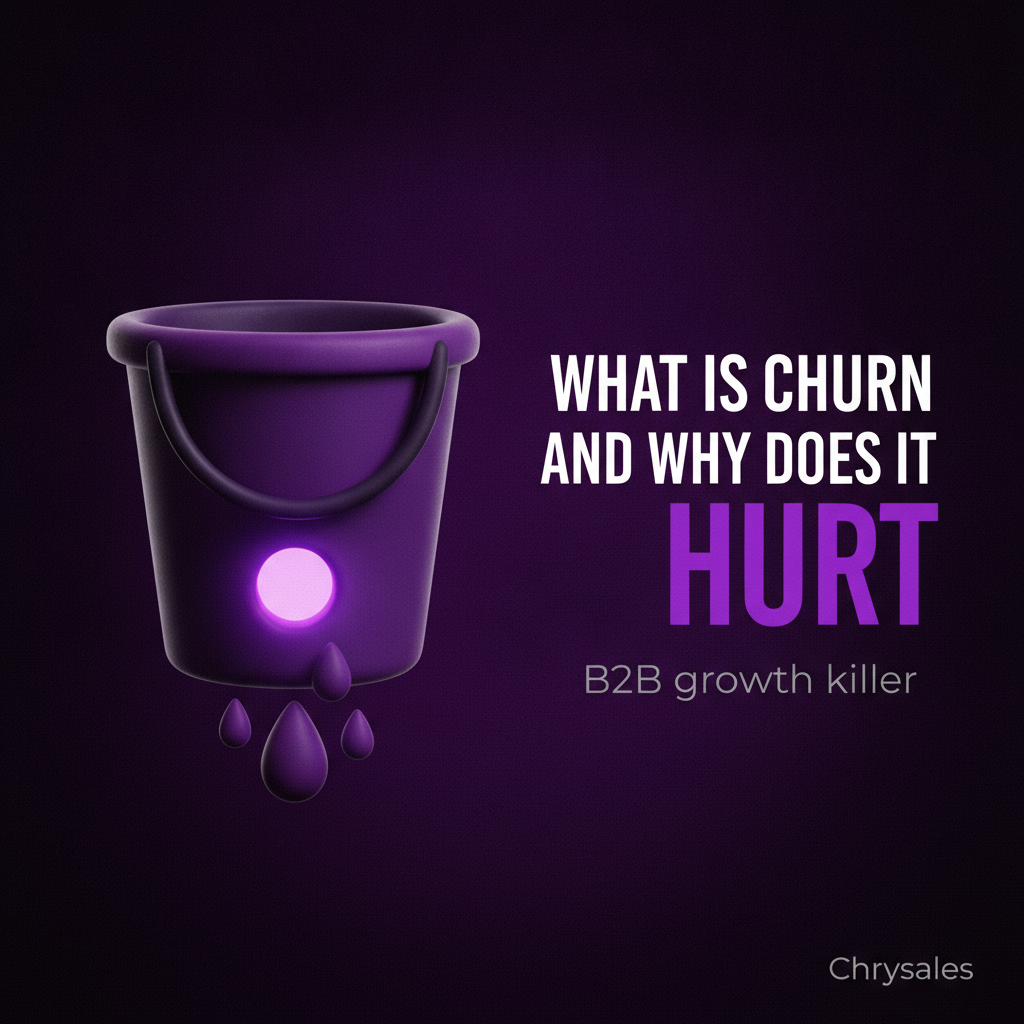
What is churn is the rate at which customers stop doing business with you, causing lost revenue and making predictable B2B growth harder to achieve. Picture this: you sign 10 new clients in January. By March, 3 of them are gone. That's churn. And if you're not tracking it, you're basically trying to fill a bucket with a hole in the bottom.
Understanding Churn: What It Actually Means for Your Business
Churn rate is the percentage of customers who leave your business over a specific time period. Think of it like your phone contact list. If you start the month with 100 contacts and 5 people block you by the end, you have a 5% monthly churn rate.
The basic formula looks like this: take the number of customers lost during a period, divide by the total customers at the start of that period, multiply by 100. So if you had 200 clients on January 1st and lost 10 by January 31st, your monthly churn rate is 5%.
But here's where it gets interesting. Not all churn is created equal.
Customer Churn vs Revenue Churn
Customer churn counts the number of people who leave. Revenue churn measures the money that walks out the door with them. These two numbers tell very different stories.
A 30-person consulting firm might lose 2 clients in a month, one paying $500/month and another paying $5,000/month. That's the same customer churn (2 clients), but wildly different revenue churn ($500 vs $5,000). The second one hurts a lot more.
Watch out: A lot of teams celebrate low customer churn rates while ignoring that their highest-paying clients are the ones leaving. Always track both numbers.
Why Churn Matters More Than You Think
Let's say you're growing at 10% per month but churning at 8%. Your real growth is only 2%. You're working twice as hard to fill a leaking bucket.
Most cold outreach campaigns and lead generation efforts completely ignore this reality. They assume every new client is pure growth, but if half of them leave within six months, you're stuck on a treadmill.
Studies show that reducing churn by just 5% can increase profits by 25% to 95%. Why? Because keeping an existing client costs way less than finding a new one. The math is simple: fix the leak before you pour more water in.
The Two Types of Churn That Kill B2B Growth

Most people think churn is just "people leaving." But there are actually two flavors that matter for subscription businesses, agencies, and service companies.
Logo Churn: The Headcount Problem
Logo churn is the pure headcount version. How many actual customers stopped paying you? If you run a sales training program with 50 companies enrolled and 5 cancel this quarter, your logo churn is 10%.
This metric matters most when your pricing is fairly consistent across clients. A marketing agency charging $3,000 to $5,000 per month to most clients should watch logo churn closely. It tells you if your service is working or if people are quietly unhappy.
Net Revenue Churn: The Money Problem
Net revenue churn is trickier but more important. It accounts for customers leaving, customers downgrading, and customers upgrading or expanding.
A 200-person tech company might lose 3 clients worth $15,000 total but upsell 5 others for an extra $20,000. The logo churn looks bad (3 clients left), but net revenue churn is actually negative (you made more money than you lost).
Negative revenue churn is the dream. It means your existing clients are spending more over time, even if a few drop off. Companies with strong customer success systems and upsell motions can hit this. Most don't.
Common mistake: Tracking only one type of churn. You need both. Logo churn tells you if people are happy. Revenue churn tells you if your business model works.
Where Churn Actually Starts (Hint: It's Not Where You Think)
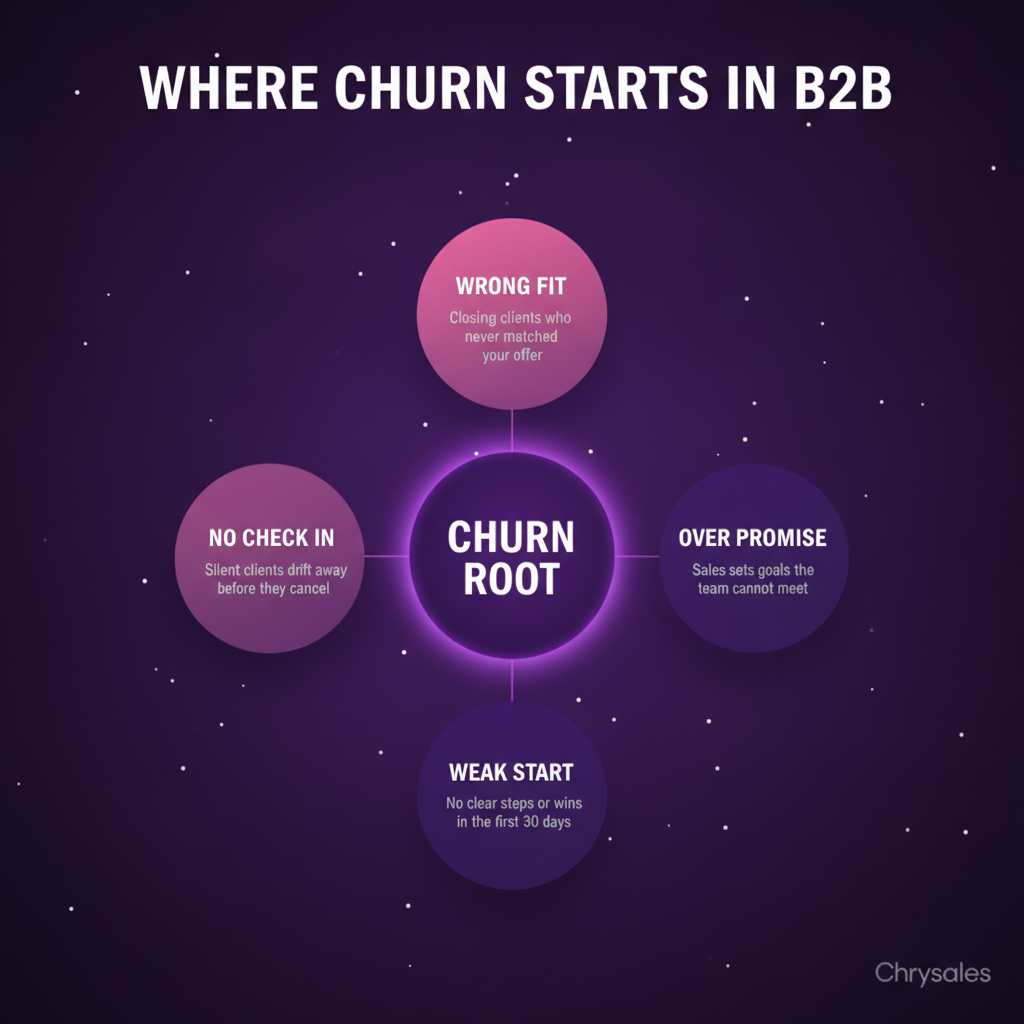
Here's what most teams miss: churn doesn't start when a client cancels. It starts way earlier, usually during the sales process.
The Wrong Client Problem
If you close someone who isn't a good fit, they're going to leave. A B2B lead generation agency that signs a client with no budget, no time, and unrealistic expectations just locked in future churn. The deal felt good in the moment. The result is a headache three months later and a cancellation six months later.
We see this all the time with new clients. They're so hungry for revenue that they say yes to everyone. Then they wonder why half their customers don't stick around. The fix isn't better onboarding. It's better sales qualification.
The Overpromise Trap
Another churn multiplier: setting the wrong expectations during closing. If your sales call promises results in 30 days but your actual process takes 90, you just created a disappointed client. Disappointed clients don't renew.
Think of your offer like a menu at a restaurant. If the picture shows a massive burger and you bring out a slider, the customer feels cheated. It doesn't matter if the slider tastes amazing. They expected something different.
Pro Tip: Record your sales calls. Listen to what your team promises. Compare it to what you actually deliver. If there's a gap, fix the promises, not just the delivery.
Onboarding Gaps and Early Ghosting
Most churn happens in the first 90 days. A client signs up, gets handed off to your team, and then... crickets. No clear next steps. No quick wins. No regular check-ins. They start wondering if they made the right choice.
One marketing agency we worked with had a 35% churn rate in the first quarter. After building a structured onboarding system with weekly calls, clear milestones, and a 30-day quick win, their early churn dropped to 12%. Same service, better system.
How to Calculate Your Churn Rate (The Right Way)
Let's make this super practical. Grab your numbers and follow along.
Basic Customer Churn Rate Formula
Here's the simplest version:
Churn Rate = (Customers Lost During Period / Customers at Start of Period) x 100
Example: You start March with 80 clients. By March 31st, 4 have canceled. Your churn rate is (4 / 80) x 100 = 5%.
Do this monthly. Track the trend. If your churn is rising, something is breaking. If it's falling, you're doing something right.
Revenue Churn Calculation
Revenue churn works the same way but swaps customers for dollars.
Revenue Churn Rate = (MRR Lost During Period / MRR at Start of Period) x 100
MRR is Monthly Recurring Revenue, the predictable income you expect each month. If you started March with $50,000 in MRR and lost $3,000 by the end, your revenue churn is (3,000 / 50,000) x 100 = 6%.
Net Revenue Churn (The Advanced Move)
Net revenue churn includes upgrades and downgrades:
Net Revenue Churn = [(MRR Lost - MRR from Upgrades) / MRR at Start] x 100
Say you lost $3,000 in MRR but upsold existing clients for an extra $2,500. Your net revenue churn is [(3,000 - 2,500) / 50,000] x 100 = 1%. Much better than 6%.
If your upgrades exceed your losses, you get negative churn. That's when the magic happens. You can grow without signing a single new client.
Watch out: Don't confuse gross churn (all losses) with net churn (losses minus gains). Gross churn is always higher. Net churn is the number that matters for real growth.
What's a "Good" Churn Rate? (It Depends)
Quick question: is 5% monthly churn good or bad? Honestly, it depends on your business.
SaaS and Subscription Benchmarks
For B2B SaaS companies, a monthly churn rate under 5% is solid. Under 3% is great. Under 2% means you've built something sticky.
Annual churn (which compounds monthly churn) should ideally stay under 20% for healthy B2B businesses. Consumer SaaS can handle higher churn because client acquisition is cheaper. But B2B companies with long sales cycles and high customer acquisition costs can't afford to lose 10% of clients every month. The math breaks.
Service Business and Agency Churn
For agencies and service businesses, churn works a little differently. You might have fewer clients but higher contract values. Losing one $10,000/month client is the same revenue hit as losing ten $1,000/month clients.
A 30-person consulting firm with 20 active clients can't afford to lose 2 clients per quarter (10% quarterly churn). That's scrambling to replace half your book every year. Aim for under 5% quarterly churn if you're in services.
Pro Tip: If your churn rate is above 10% per month, stop focusing on lead generation. Fix your product, your onboarding, or your client selection first. Adding more clients to a broken system just speeds up the leak.
How to Reduce Customer Churn (What Actually Works)
Most churn reduction advice is fluffy ("delight your customers!"). Let's talk about what actually moves the number.
Fix the Sales Process First
Go back to who you're closing and how you're closing them. Tighten your ICP (ideal customer profile). If a prospect doesn't fit your best customer pattern, don't close them. It feels like leaving money on the table. It's actually avoiding future pain.
Build a simple ICP scoring system for lead qualification: budget, timeline, fit, decision-making power. Anything scoring below 70 gets disqualified or nurtured longer. One tech company we worked with cut their churn in half just by saying no to bad-fit prospects.
Build a Real Onboarding System
Onboarding isn't "send a welcome email and hope for the best." It's a structured process that gets clients to a quick win fast.
Map out the first 30, 60, 90 days:
- Day 1: Welcome call, set expectations, assign a point person
- Week 1: First small deliverable or action item completed
- Week 2-4: Regular check-ins, progress updates, address early questions
- Day 30: Quick win delivered, client feels momentum
- Day 60-90: Deeper results, expand scope if it makes sense
A 15-person consulting firm that just wings it will lose clients. A 15-person consulting firm with a repeatable onboarding checklist keeps them.
Catch Problems Early with Check-Ins
Churn doesn't happen overnight. Clients get quiet. They stop replying as fast. They skip calls. These are warning signs.
Set up regular check-ins, not just when there's a problem. Monthly calls. Quarterly reviews. Ask one simple question: "On a scale of 1 to 10, how likely are you to keep working with us in 6 months?" Anyone who says 7 or below needs immediate attention.
Common mistake: Waiting until the client says "we're canceling" to ask what's wrong. By then, it's too late. Catch the drift early.
Use AI to Spot At-Risk Clients
Here's a newer move: use AI tools to track engagement signals. Are they opening your emails? Logging into your platform? Attending calls? Responding to messages?
Feed those signals into a simple scoring model. Clients with dropping engagement scores go on a watch list. Reach out proactively. Most teams don't even realize a client is unhappy until the cancellation email lands.
We've built Gemini-based sales workflows that flag at-risk accounts automatically. The system watches behavior, scores engagement, and alerts the team. It's like having a second brain watching your book of business.
Churn Prevention vs Client Acquisition: The Real Strategy
Most B2B sales strategies are lopsided. Tons of energy goes into cold outreach, lead generation, booking calls, and closing deals. Almost nothing goes into keeping the clients you just worked so hard to get.
Here's a reality check: if your customer acquisition cost is $5,000 and your average client lifetime value is only $8,000 because half of them churn in six months, you're barely profitable. But if you cut churn in half and double the lifetime value to $16,000, the same acquisition work becomes twice as valuable.
The best growth strategy isn't just filling the top of the funnel. It's plugging the holes in the bottom. A small sales team with low churn beats a big sales team with high churn every single time.
Think of it this way: a 200-person company with a leaky retention system is like a car with a hole in the gas tank. You can keep refilling it, but you're never getting anywhere fast. Fix the tank first, then hit the gas.
You can also watch how to build a sales system that brings clients to you for a deeper walkthrough on creating predictable, scalable growth without constantly scrambling for new leads.
Pro Tip: Before you hire another salesperson or invest in more lead generation, run the numbers. What would happen to your revenue if you reduced churn by 20%? Often, that single move unlocks more growth than doubling your outbound volume.
Frequently Asked Questions
Q: What's the difference between churn rate and retention rate?
Churn rate measures the percentage of customers you lose. Retention rate measures the percentage you keep. They're two sides of the same coin. If your churn rate is 5%, your retention rate is 95%. Most teams track retention because it sounds better, but both numbers tell the same story. Focus on the one that helps you spot problems faster.
Q: Is churn always a bad thing?
Not always. Sometimes losing low-value or high-maintenance clients is good for your business. If a client pays $300/month but takes 10 hours of support time, they're actually costing you money. Healthy churn means shedding bad-fit clients so you can focus on great-fit ones. The goal isn't zero churn. It's low churn among the clients who matter.
Q: How often should I calculate my churn rate?
Monthly is the sweet spot for most B2B businesses. It's frequent enough to catch trends early but not so frequent that normal fluctuations freak you out. If you're a SaaS company or subscription business, track it monthly. If you're an agency with fewer, larger clients, quarterly works too. Just pick a rhythm and stick to it.
Q: Can you have negative churn?
Yes, and it's amazing when it happens. Negative churn means your existing customers are spending more money over time (through upgrades, add-ons, expansions) than you're losing from cancellations. So even if a few clients leave, your total revenue from the remaining base still grows. This is the dream scenario for any recurring revenue business.
Q: What causes high churn in B2B companies?
Usually one of three things: closing the wrong clients, overpromising during sales, or weak onboarding. Sometimes it's a product or service issue, but more often it's a system problem. Clients leave when expectations don't match reality, when they don't see quick wins, or when they feel ignored after signing. Understanding the silent mistake that kills sales before it even starts can help you prevent these misalignment issues early in your sales process. Fix those three and your churn drops fast.
What is churn is the rate at which customers stop doing business with you, causing lost revenue and making predictable B2B growth harder to achieve. Picture this: you sign 10 new clients in January. By March, 3 of them are gone. That's churn. And if you're not tracking it, you're basically trying to fill a bucket with a hole in the bottom.
Understanding Churn: What It Actually Means for Your Business
Churn rate is the percentage of customers who leave your business over a specific time period. Think of it like your phone contact list. If you start the month with 100 contacts and 5 people block you by the end, you have a 5% monthly churn rate.
The basic formula looks like this: take the number of customers lost during a period, divide by the total customers at the start of that period, multiply by 100. So if you had 200 clients on January 1st and lost 10 by January 31st, your monthly churn rate is 5%.
But here's where it gets interesting. Not all churn is created equal.
Customer Churn vs Revenue Churn
Customer churn counts the number of people who leave. Revenue churn measures the money that walks out the door with them. These two numbers tell very different stories.
A 30-person consulting firm might lose 2 clients in a month, one paying $500/month and another paying $5,000/month. That's the same customer churn (2 clients), but wildly different revenue churn ($500 vs $5,000). The second one hurts a lot more.
Watch out: A lot of teams celebrate low customer churn rates while ignoring that their highest-paying clients are the ones leaving. Always track both numbers.
Why Churn Matters More Than You Think
Let's say you're growing at 10% per month but churning at 8%. Your real growth is only 2%. You're working twice as hard to fill a leaking bucket.
Most cold outreach campaigns and lead generation efforts completely ignore this reality. They assume every new client is pure growth, but if half of them leave within six months, you're stuck on a treadmill.
Studies show that reducing churn by just 5% can increase profits by 25% to 95%. Why? Because keeping an existing client costs way less than finding a new one. The math is simple: fix the leak before you pour more water in.
The Two Types of Churn That Kill B2B Growth
Most people think churn is just "people leaving." But there are actually two flavors that matter for subscription businesses, agencies, and service companies.
Logo Churn: The Headcount Problem
Logo churn is the pure headcount version. How many actual customers stopped paying you? If you run a sales training program with 50 companies enrolled and 5 cancel this quarter, your logo churn is 10%.
This metric matters most when your pricing is fairly consistent across clients. A marketing agency charging $3,000 to $5,000 per month to most clients should watch logo churn closely. It tells you if your service is working or if people are quietly unhappy.
Net Revenue Churn: The Money Problem
Net revenue churn is trickier but more important. It accounts for customers leaving, customers downgrading, and customers upgrading or expanding.
A 200-person tech company might lose 3 clients worth $15,000 total but upsell 5 others for an extra $20,000. The logo churn looks bad (3 clients left), but net revenue churn is actually negative (you made more money than you lost).
Negative revenue churn is the dream. It means your existing clients are spending more over time, even if a few drop off. Companies with strong customer success systems and upsell motions can hit this. Most don't.
Common mistake: Tracking only one type of churn. You need both. Logo churn tells you if people are happy. Revenue churn tells you if your business model works.
Where Churn Actually Starts (Hint: It's Not Where You Think)
Here's what most teams miss: churn doesn't start when a client cancels. It starts way earlier, usually during the sales process.
The Wrong Client Problem
If you close someone who isn't a good fit, they're going to leave. A B2B lead generation agency that signs a client with no budget, no time, and unrealistic expectations just locked in future churn. The deal felt good in the moment. The result is a headache three months later and a cancellation six months later.
We see this all the time with new clients. They're so hungry for revenue that they say yes to everyone. Then they wonder why half their customers don't stick around. The fix isn't better onboarding. It's better sales qualification.
The Overpromise Trap
Another churn multiplier: setting the wrong expectations during closing. If your sales call promises results in 30 days but your actual process takes 90, you just created a disappointed client. Disappointed clients don't renew.
Think of your offer like a menu at a restaurant. If the picture shows a massive burger and you bring out a slider, the customer feels cheated. It doesn't matter if the slider tastes amazing. They expected something different.
Pro Tip: Record your sales calls. Listen to what your team promises. Compare it to what you actually deliver. If there's a gap, fix the promises, not just the delivery.
Onboarding Gaps and Early Ghosting
Most churn happens in the first 90 days. A client signs up, gets handed off to your team, and then... crickets. No clear next steps. No quick wins. No regular check-ins. They start wondering if they made the right choice.
One marketing agency we worked with had a 35% churn rate in the first quarter. After building a structured onboarding system with weekly calls, clear milestones, and a 30-day quick win, their early churn dropped to 12%. Same service, better system.
How to Calculate Your Churn Rate (The Right Way)
Let's make this super practical. Grab your numbers and follow along.
Basic Customer Churn Rate Formula
Here's the simplest version:
Churn Rate = (Customers Lost During Period / Customers at Start of Period) x 100
Example: You start March with 80 clients. By March 31st, 4 have canceled. Your churn rate is (4 / 80) x 100 = 5%.
Do this monthly. Track the trend. If your churn is rising, something is breaking. If it's falling, you're doing something right.
Revenue Churn Calculation
Revenue churn works the same way but swaps customers for dollars.
Revenue Churn Rate = (MRR Lost During Period / MRR at Start of Period) x 100
MRR is Monthly Recurring Revenue, the predictable income you expect each month. If you started March with $50,000 in MRR and lost $3,000 by the end, your revenue churn is (3,000 / 50,000) x 100 = 6%.
Net Revenue Churn (The Advanced Move)
Net revenue churn includes upgrades and downgrades:
Net Revenue Churn = [(MRR Lost - MRR from Upgrades) / MRR at Start] x 100
Say you lost $3,000 in MRR but upsold existing clients for an extra $2,500. Your net revenue churn is [(3,000 - 2,500) / 50,000] x 100 = 1%. Much better than 6%.
If your upgrades exceed your losses, you get negative churn. That's when the magic happens. You can grow without signing a single new client.
Watch out: Don't confuse gross churn (all losses) with net churn (losses minus gains). Gross churn is always higher. Net churn is the number that matters for real growth.
What's a "Good" Churn Rate? (It Depends)
Quick question: is 5% monthly churn good or bad? Honestly, it depends on your business.
SaaS and Subscription Benchmarks
For B2B SaaS companies, a monthly churn rate under 5% is solid. Under 3% is great. Under 2% means you've built something sticky.
Annual churn (which compounds monthly churn) should ideally stay under 20% for healthy B2B businesses. Consumer SaaS can handle higher churn because client acquisition is cheaper. But B2B companies with long sales cycles and high customer acquisition costs can't afford to lose 10% of clients every month. The math breaks.
Service Business and Agency Churn
For agencies and service businesses, churn works a little differently. You might have fewer clients but higher contract values. Losing one $10,000/month client is the same revenue hit as losing ten $1,000/month clients.
A 30-person consulting firm with 20 active clients can't afford to lose 2 clients per quarter (10% quarterly churn). That's scrambling to replace half your book every year. Aim for under 5% quarterly churn if you're in services.
Pro Tip: If your churn rate is above 10% per month, stop focusing on lead generation. Fix your product, your onboarding, or your client selection first. Adding more clients to a broken system just speeds up the leak.
How to Reduce Customer Churn (What Actually Works)
Most churn reduction advice is fluffy ("delight your customers!"). Let's talk about what actually moves the number.
Fix the Sales Process First
Go back to who you're closing and how you're closing them. Tighten your ICP (ideal customer profile). If a prospect doesn't fit your best customer pattern, don't close them. It feels like leaving money on the table. It's actually avoiding future pain.
Build a simple ICP scoring system for lead qualification: budget, timeline, fit, decision-making power. Anything scoring below 70 gets disqualified or nurtured longer. One tech company we worked with cut their churn in half just by saying no to bad-fit prospects.
Build a Real Onboarding System
Onboarding isn't "send a welcome email and hope for the best." It's a structured process that gets clients to a quick win fast.
Map out the first 30, 60, 90 days:
- Day 1: Welcome call, set expectations, assign a point person
- Week 1: First small deliverable or action item completed
- Week 2-4: Regular check-ins, progress updates, address early questions
- Day 30: Quick win delivered, client feels momentum
- Day 60-90: Deeper results, expand scope if it makes sense
A 15-person consulting firm that just wings it will lose clients. A 15-person consulting firm with a repeatable onboarding checklist keeps them.
Catch Problems Early with Check-Ins
Churn doesn't happen overnight. Clients get quiet. They stop replying as fast. They skip calls. These are warning signs.
Set up regular check-ins, not just when there's a problem. Monthly calls. Quarterly reviews. Ask one simple question: "On a scale of 1 to 10, how likely are you to keep working with us in 6 months?" Anyone who says 7 or below needs immediate attention.
Common mistake: Waiting until the client says "we're canceling" to ask what's wrong. By then, it's too late. Catch the drift early.
Use AI to Spot At-Risk Clients
Here's a newer move: use AI tools to track engagement signals. Are they opening your emails? Logging into your platform? Attending calls? Responding to messages?
Feed those signals into a simple scoring model. Clients with dropping engagement scores go on a watch list. Reach out proactively. Most teams don't even realize a client is unhappy until the cancellation email lands.
We've built Gemini-based sales workflows that flag at-risk accounts automatically. The system watches behavior, scores engagement, and alerts the team. It's like having a second brain watching your book of business.
Churn Prevention vs Client Acquisition: The Real Strategy
Most B2B sales strategies are lopsided. Tons of energy goes into cold outreach, lead generation, booking calls, and closing deals. Almost nothing goes into keeping the clients you just worked so hard to get.
Here's a reality check: if your customer acquisition cost is $5,000 and your average client lifetime value is only $8,000 because half of them churn in six months, you're barely profitable. But if you cut churn in half and double the lifetime value to $16,000, the same acquisition work becomes twice as valuable.
The best growth strategy isn't just filling the top of the funnel. It's plugging the holes in the bottom. A small sales team with low churn beats a big sales team with high churn every single time.
Think of it this way: a 200-person company with a leaky retention system is like a car with a hole in the gas tank. You can keep refilling it, but you're never getting anywhere fast. Fix the tank first, then hit the gas.
You can also watch how to build a sales system that brings clients to you for a deeper walkthrough on creating predictable, scalable growth without constantly scrambling for new leads.
Pro Tip: Before you hire another salesperson or invest in more lead generation, run the numbers. What would happen to your revenue if you reduced churn by 20%? Often, that single move unlocks more growth than doubling your outbound volume.
Frequently Asked Questions
Q: What's the difference between churn rate and retention rate?
Churn rate measures the percentage of customers you lose. Retention rate measures the percentage you keep. They're two sides of the same coin. If your churn rate is 5%, your retention rate is 95%. Most teams track retention because it sounds better, but both numbers tell the same story. Focus on the one that helps you spot problems faster.
Q: Is churn always a bad thing?
Not always. Sometimes losing low-value or high-maintenance clients is good for your business. If a client pays $300/month but takes 10 hours of support time, they're actually costing you money. Healthy churn means shedding bad-fit clients so you can focus on great-fit ones. The goal isn't zero churn. It's low churn among the clients who matter.
Q: How often should I calculate my churn rate?
Monthly is the sweet spot for most B2B businesses. It's frequent enough to catch trends early but not so frequent that normal fluctuations freak you out. If you're a SaaS company or subscription business, track it monthly. If you're an agency with fewer, larger clients, quarterly works too. Just pick a rhythm and stick to it.
Q: Can you have negative churn?
Yes, and it's amazing when it happens. Negative churn means your existing customers are spending more money over time (through upgrades, add-ons, expansions) than you're losing from cancellations. So even if a few clients leave, your total revenue from the remaining base still grows. This is the dream scenario for any recurring revenue business.
Q: What causes high churn in B2B companies?
Usually one of three things: closing the wrong clients, overpromising during sales, or weak onboarding. Sometimes it's a product or service issue, but more often it's a system problem. Clients leave when expectations don't match reality, when they don't see quick wins, or when they feel ignored after signing. Understanding the silent mistake that kills sales before it even starts can help you prevent these misalignment issues early in your sales process. Fix those three and your churn drops fast.
Scaling Is Not Hard If You Have The Right Systems
If you’re serious about leveling up your scaling game, you need the right system, the right training, and the right team behind you. We're here to give you the exact tools and strategies top entrepreneurs use to dominate.

Discover the latest tips
View All.avif)
Chrysales was formed from the words "chrysalis" the stage where a caterpillar transforms into a butterfly and "sales".
It stands for one thing: sales transformation.Because scaling doesn’t happen by doing more of the same. Scaling only happens when you go through real transformation in your systems, your offer, team and the way you sell.
.avif)


