.avif)
What Does a BDR Do in B2B Sales?

A BDR role handles prospecting, lead generation, and meeting booking at the top of the funnel in b2b sales. It focuses on finding potential customers and handing qualified leads to the sales team. If you've ever wondered who's responsible for filling the sales pipeline before deals start closing, the answer is usually a BDR.
The BDR role is all about finding potential customers, reaching out to them, and booking meetings for the sales team to close. Think of it like a chef who preps all the ingredients before the main cook starts making the dish. Without the prep, nothing gets cooked. Without the BDR, nothing gets sold.
But here's the thing: not every company needs to hire a full-time BDR. Sometimes you just need a sales system that works like one.
What Is a Business Development Representative?
A business development representative is the person who handles the top of the sales funnel. Their job is to find leads, reach out, qualify them, and hand them off to the sales team when they're ready to buy. They don't close deals. They don't manage accounts after the sale. They focus on one thing: getting meetings booked with qualified prospects.
The BDR role became popular as B2B sales got more complex. Companies realized they needed someone focused only on outbound prospecting so closers could focus on closing. The separation made sense. But it also made sales teams expensive.
Outbound vs. Inbound BDRs
Some BDRs focus on outbound sales, meaning they go out and find leads through cold emails, LinkedIn messages, and cold calls. Others work inbound, handling leads that already came in through the website or marketing campaigns. Both types do lead qualification, but outbound BDRs usually have a harder job because they're starting conversations from scratch.
Most small sales teams start with outbound because they can't wait around for inbound leads to show up. Outbound BDRs build the pipeline from zero.
BDR vs. SDR: What's the Difference?
You'll also hear the term SDR, or sales development representative. The terms are used interchangeably most of the time. Technically, some companies say BDRs focus more on outbound and new business, while SDRs handle inbound leads and existing accounts. But in practice, most teams use BDR and SDR to mean the same thing.
Pro Tip: If you're hiring, don't get stuck on the title. Focus on whether the person can do cold outreach and book meetings. The label doesn't matter as much as the skills.
What Does a BDR Actually Do Every Day?
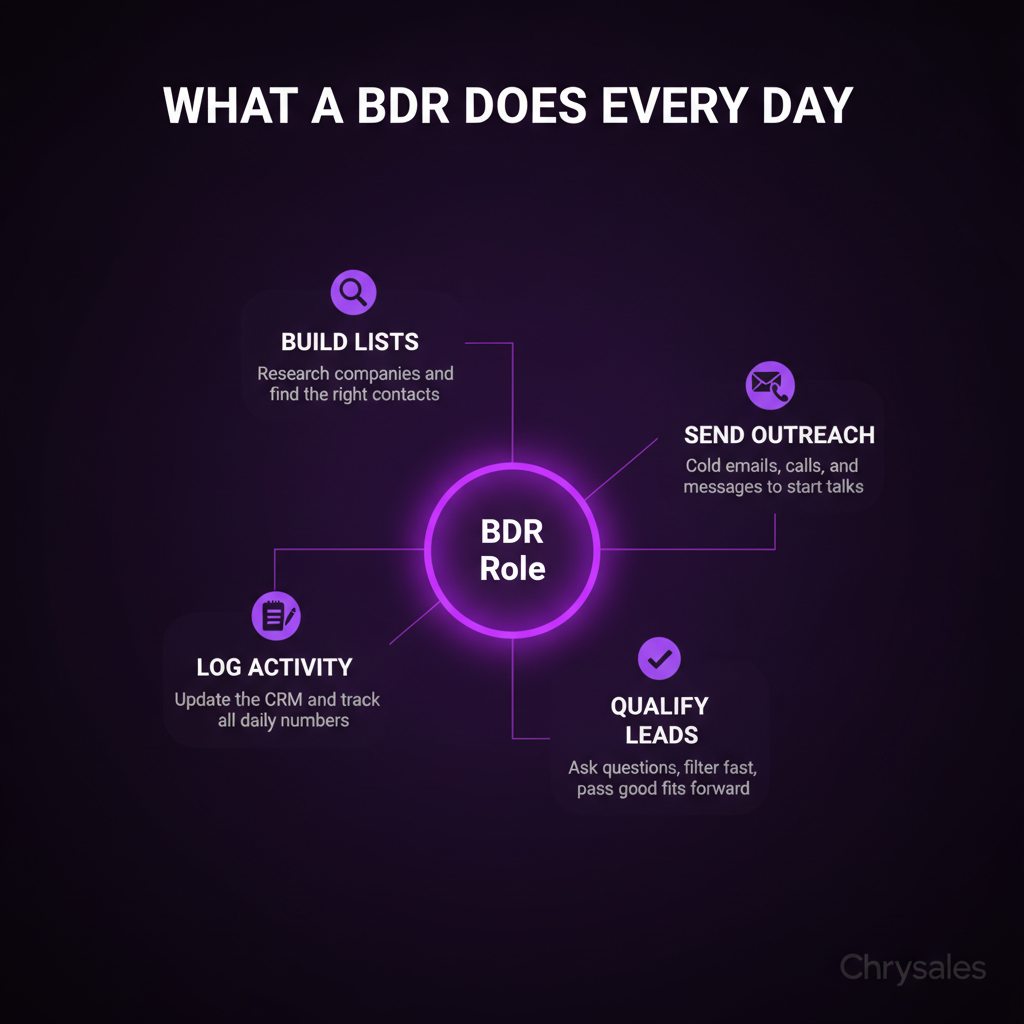
The day-to-day work of a BDR is repetitive by design. They follow a process, hit daily targets, and focus on volume. Here's what a typical day looks like:
Morning: Research and List Building
Good BDRs start the day by building or reviewing their list. They look for companies that fit the ideal customer profile, find the right contacts, and gather enough information to personalize outreach. A bad list kills everything downstream.
Picture this: you spend two weeks writing perfect emails, but your list is full of people who aren't even buyers. That's the trap.
Midday: Cold Outreach
This is where the bulk of the work happens. BDRs send cold emails, LinkedIn connection requests, and make cold calls. They follow up with people who didn't respond the first time. They test subject lines, tweak scripts, and keep track of what's working.
It's a numbers game, but it's also a skill game. Sending 100 bad emails won't book meetings. Sending 50 smart, personalized ones will.
Afternoon: Lead Qualification and Meeting Handoffs
When someone replies, the BDR jumps into qualification mode. They ask discovery questions to figure out if the lead is a good fit. If they are, the BDR books a meeting and hands the lead off to the closer. If not, they move on.
A good BDR knows how to disqualify fast so they're not wasting time on leads that won't close.
End of Day: CRM Updates and Metrics
BDRs live in the CRM. Every call, email, and response gets logged. They track their numbers: emails sent, calls made, meetings booked, and pipeline generated. Most BDR teams have daily or weekly quotas. Hit the numbers, keep the job. Miss the numbers, get coaching or get cut.
Common mistake: Skipping CRM updates. When data isn't logged, managers can't see what's working. The whole sales system breaks down.
Key Responsibilities of a BDR
Let's break down the core tasks every BDR handles, whether they're on a big sales team or working solo at a growing B2B company.
Cold Outreach and Prospecting
This is the main job. BDRs reach out to people who've never heard of the company. They use email sequences, LinkedIn messages, and cold calls to start conversations. The goal is to get a reply, not close a deal.
A 15-person consulting firm might have one BDR sending 80 emails a day and making 30 calls. A bigger team might have five BDRs each hitting similar numbers. You can also watch four proven ways to find clients through outbound prospecting for a deeper walkthrough of effective lead generation tactics.
Lead Qualification
Not every reply is a good lead. BDRs ask questions to figure out if the person has budget, authority, need, and timeline. This is called BANT in some sales systems. If the lead checks the boxes, they move forward. If not, the BDR either nurtures them for later or moves on.
Set a simple rule: anything scoring above a certain threshold goes to the top of your call list. If a lead doesn't fit, don't waste time trying to force it.
CRM Management and Data Hygiene
BDRs keep the CRM clean. They update contact info, log activity, and make sure nothing falls through the cracks. This sounds boring, but it's critical. If the CRM is a mess, the sales team can't follow up properly and deals get lost.
Collaboration with Sales and Marketing
BDRs sit between marketing and sales. They tell marketing which leads are good and which aren't. They tell sales what objections keep coming up. Good BDRs act like a feedback loop, making the whole pipeline generation process smarter over time.
Skills Every BDR Needs to Succeed
The BDR role isn't easy. It's high-pressure, repetitive, and rejection-heavy. But it's also one of the best ways to learn B2B sales from the ground up. Here are the skills that separate good BDRs from the ones who burn out in three months.
Communication and Writing
Cold emails need to be short, clear, and personalized. Cold calls need to sound confident without being pushy. If a BDR can't write a good email or hold a conversation without reading from a script, they won't last.
Research and Targeting
Outbound sales only works when you're reaching out to the right people. A good BDR spends time researching companies, understanding pain points, and finding the decision makers.
A 200-person company that just did layoffs is not a hot lead. It's a bad fit, full stop.
Resilience and Consistency
Most cold emails get ignored. Most cold calls go to voicemail. BDRs face rejection every single day. The ones who succeed don't take it personally. They treat it like a game: send more, test more, learn more.
Time Management
BDRs juggle multiple tasks at once. They need to block time for calls, emails, research, and CRM updates. The best ones use templates, tools, and routines to stay on top of everything without burning out.
Watch out: Trying to do everything manually. Most teams build a 40-step workflow when 12 steps would do the job. Keep it simple.
Do You Actually Need a BDR, or Do You Need a BDR System?
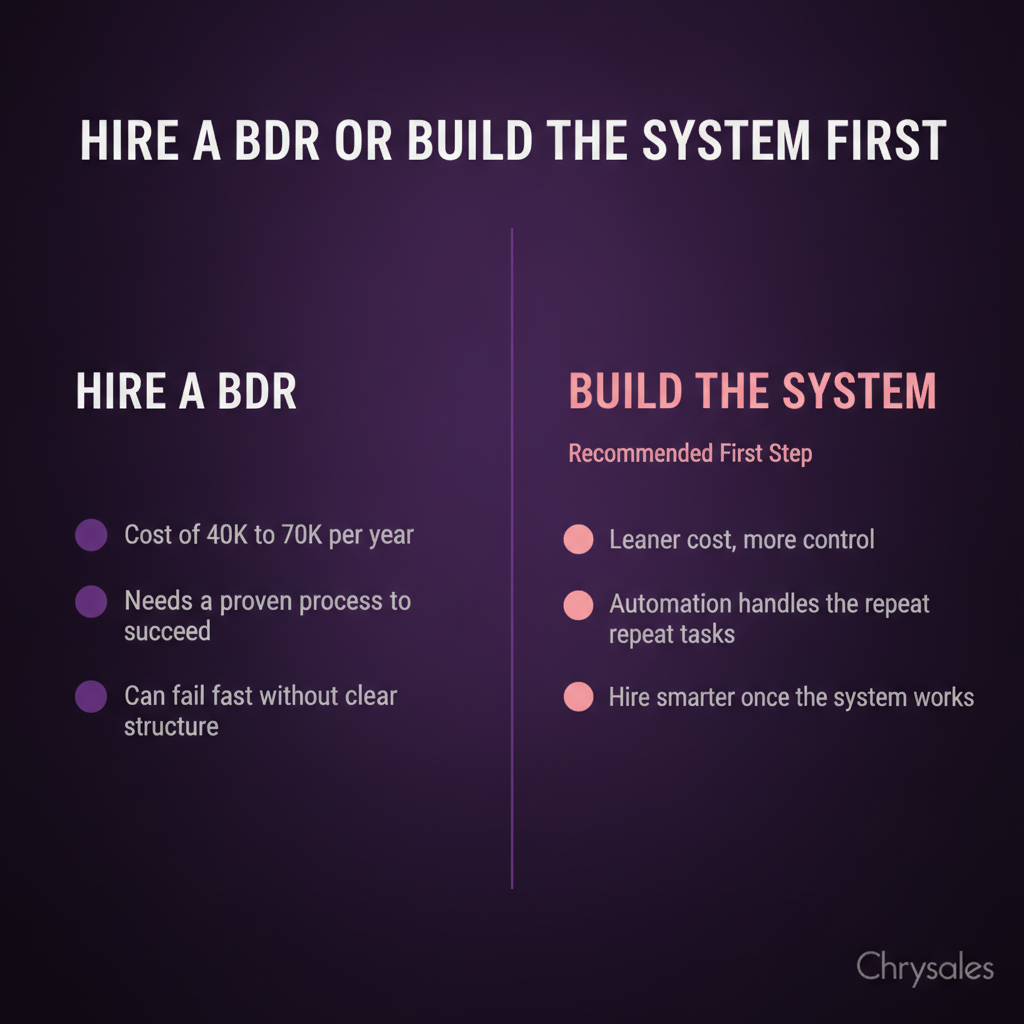
Here's where most growing B2B companies get stuck. They think the only way to generate pipeline is to hire a full-time BDR. But hiring too early can backfire. If the sales process isn't clear, if the offer isn't dialed in, if there's no training system in place, the BDR will struggle. And then you're paying someone $50K to $70K a year to figure it out.
The Real Question: System First, Hire Second
Before you hire, ask: do we have a repeatable process for client acquisition? Do we know exactly who we're targeting, what we're saying, and how we're following up? If the answer is no, hiring a BDR won't fix it. You need a sales system first.
A marketing agency we worked with tried hiring three BDRs in six months. Two quit within 60 days. The problem wasn't the people. It was the lack of structure. Once they built a clear outbound process, automated parts of the workflow, and trained the next hire properly, everything clicked.
When Hiring a BDR Makes Sense
Hire a BDR when:
- You have a clear ideal customer profile
- You have a proven offer that converts
- You have a repeatable sales process
- You have someone to train and manage the BDR
If those four things are in place, a good BDR can scale your pipeline fast. If they're not, you're throwing money away.
The Alternative: Build the BDR System Yourself
Small sales teams don't always need a full-time hire. Sometimes you can build a BDR system using automation, templates, and part-time help. Use AI tools for lead scoring, automate email sequences, and hire a setter on commission to book meetings. It's leaner, cheaper, and gives you more control.
If you want to learn how to build a sales system that actually scales without hiring immediately, you'll need a clear framework that handles prospecting, qualification, and follow-up automatically.
How BDRs Fit Into the Sales Funnel
The sales funnel has a few stages: awareness, interest, decision, and close. BDRs own the top two stages. They make people aware of your company and get them interested enough to take a meeting. After that, the closer takes over.
Pipeline Generation and Handoffs
BDRs don't close deals, but they're responsible for pipeline generation. If the BDR books 20 meetings a month and 5 turn into deals, that's a 25% close rate. The BDR's job is to make sure those 20 meetings are high-quality. Handoffs need to be smooth. The closer should know everything the BDR learned during qualification.
Understanding how to build sales pipeline systematically helps BDRs focus their efforts on high-value activities that actually convert into revenue opportunities.
Metrics That Matter
BDRs get measured on:
- Emails sent per day
- Calls made per day
- Meetings booked per week
- Pipeline generated per month
- Conversion rate from contact to meeting
Most BDR teams aim for 8 to 12 meetings booked per month per rep. Some industries are higher, some lower. The key is consistency.
One 30-person consulting firm we trained went from 3 meetings a month to 14 just by fixing their list and tightening their messaging.
AI, Automation, and the Future of the BDR Role
A lot of people are asking if AI is going to replace BDRs. The short answer: not fully, but it's changing the role fast. AI tools can now handle lead scoring, email personalization, and even first-touch outreach. That means BDRs need to focus more on the human part: research, relationship building, and handling complex objections.
What AI Can Do
AI can score leads based on behavior, write first-draft emails, and suggest the best time to follow up. Tools like Gemini based sales workflows can automate a ton of the repetitive stuff. That's a good thing. It frees up BDRs to focus on the leads that actually need a human touch.
Looking at the best AI SDR tools for 2025 can help you identify which platforms handle lead scoring, email sequencing, and outbound workflows most effectively.
What AI Can't Do
AI can't read between the lines on a discovery call. It can't handle a tricky objection or pivot the conversation when a lead brings up something unexpected. It can't build real trust. The best BDR teams use AI to handle the grunt work and humans to handle the nuance.
You can also see how an AI sales system generates record revenue by taking on repetitive BDR tasks like lead scoring and email sequencing while keeping the human touch where it matters most.
Pro Tip: If you're building a sales system from scratch, start with automation for the easy stuff: email sequences, lead scoring, CRM updates. Save the human hours for the high-value tasks like calls and personalized follow-ups.
How Chrysales Builds BDR Systems Without the Hire
Most small sales teams don't need a full-time BDR right away. They need a system that works like one. That's where Chrysales comes in. We build custom sales systems that handle lead generation, outbound prospecting, and appointment booking without the overhead of a new hire.
We've trained over 1,000 business owners and 500+ sales teams. Our clients generate over €10M in revenue using the systems we build. We don't sell a course or a tool. We work 1-on-1 to build a repeatable, predictable process that fits your business.
That includes AI driven lead scoring, email sequences that convert, and the scripts your team needs to book meetings consistently. If you're stuck between hiring a BDR and figuring it out yourself, we can show you the third option: a system that does the heavy lifting so you can hire smarter later.
Modern teams also benefit from following outbound email marketing best practices to ensure their cold outreach campaigns book meetings and generate pipeline at scale.
Frequently Asked Questions
Q: What is the main difference between a BDR and an Account Executive?
A BDR focuses on the top of the funnel. They find leads, reach out, qualify, and book meetings. An Account Executive (AE) takes those meetings and closes the deals. BDRs don't negotiate contracts or manage accounts after the sale. AEs do. The split lets each person focus on what they're best at. In smaller companies, one person might do both, but as you scale, separating the roles makes the sales process faster and more predictable.
Q: How much does a BDR typically get paid?
Most BDRs earn between $40K and $70K a year, depending on location and experience. That usually includes a base salary plus commission or bonuses tied to meetings booked or pipeline generated. In expensive cities or high-growth tech companies, the numbers can go higher. Entry-level BDRs start around $40K. After a year or two, they either move up to closer roles or take on senior BDR positions with higher quotas and better pay.
Q: Can a BDR role be done remotely?
Yes. The BDR role is one of the easiest sales jobs to do remotely. All you need is a laptop, a CRM, a phone, and a good internet connection. A lot of B2B sales teams went fully remote during 2020 and never went back. Remote BDRs can be just as productive as in-office ones, as long as they have clear targets, good tools, and regular check-ins with their manager. Some companies even hire BDRs in different time zones to cover more hours.
Q: What's a realistic number of meetings for a BDR to book per month?
Most BDRs aim for 8 to 12 qualified meetings per month. Some industries or sales systems hit higher numbers, especially if they have strong inbound support or really dialed-in targeting. If a BDR is booking fewer than 6 meetings a month consistently, something is off. Could be the list, the messaging, the offer, or the training. The fix is usually in the system, not the person.
Q: Is the BDR role a good entry point into sales?
Absolutely. The BDR role is one of the best ways to break into B2B sales with no experience. You learn how to prospect, communicate, handle rejection, and understand the full sales cycle. Most people who start as BDRs move up to closer roles within 12 to 24 months. The skills you build as a BDR translate to almost every other sales job. It's hard work, but if you treat it like a learning phase and not a dead end, it pays off.
A BDR role handles prospecting, lead generation, and meeting booking at the top of the funnel in b2b sales. It focuses on finding potential customers and handing qualified leads to the sales team. If you've ever wondered who's responsible for filling the sales pipeline before deals start closing, the answer is usually a BDR.
The BDR role is all about finding potential customers, reaching out to them, and booking meetings for the sales team to close. Think of it like a chef who preps all the ingredients before the main cook starts making the dish. Without the prep, nothing gets cooked. Without the BDR, nothing gets sold.
But here's the thing: not every company needs to hire a full-time BDR. Sometimes you just need a sales system that works like one.
What Is a Business Development Representative?
A business development representative is the person who handles the top of the sales funnel. Their job is to find leads, reach out, qualify them, and hand them off to the sales team when they're ready to buy. They don't close deals. They don't manage accounts after the sale. They focus on one thing: getting meetings booked with qualified prospects.
The BDR role became popular as B2B sales got more complex. Companies realized they needed someone focused only on outbound prospecting so closers could focus on closing. The separation made sense. But it also made sales teams expensive.
Outbound vs. Inbound BDRs
Some BDRs focus on outbound sales, meaning they go out and find leads through cold emails, LinkedIn messages, and cold calls. Others work inbound, handling leads that already came in through the website or marketing campaigns. Both types do lead qualification, but outbound BDRs usually have a harder job because they're starting conversations from scratch.
Most small sales teams start with outbound because they can't wait around for inbound leads to show up. Outbound BDRs build the pipeline from zero.
BDR vs. SDR: What's the Difference?
You'll also hear the term SDR, or sales development representative. The terms are used interchangeably most of the time. Technically, some companies say BDRs focus more on outbound and new business, while SDRs handle inbound leads and existing accounts. But in practice, most teams use BDR and SDR to mean the same thing.
Pro Tip: If you're hiring, don't get stuck on the title. Focus on whether the person can do cold outreach and book meetings. The label doesn't matter as much as the skills.
What Does a BDR Actually Do Every Day?
The day-to-day work of a BDR is repetitive by design. They follow a process, hit daily targets, and focus on volume. Here's what a typical day looks like:
Morning: Research and List Building
Good BDRs start the day by building or reviewing their list. They look for companies that fit the ideal customer profile, find the right contacts, and gather enough information to personalize outreach. A bad list kills everything downstream.
Picture this: you spend two weeks writing perfect emails, but your list is full of people who aren't even buyers. That's the trap.
Midday: Cold Outreach
This is where the bulk of the work happens. BDRs send cold emails, LinkedIn connection requests, and make cold calls. They follow up with people who didn't respond the first time. They test subject lines, tweak scripts, and keep track of what's working.
It's a numbers game, but it's also a skill game. Sending 100 bad emails won't book meetings. Sending 50 smart, personalized ones will.
Afternoon: Lead Qualification and Meeting Handoffs
When someone replies, the BDR jumps into qualification mode. They ask discovery questions to figure out if the lead is a good fit. If they are, the BDR books a meeting and hands the lead off to the closer. If not, they move on.
A good BDR knows how to disqualify fast so they're not wasting time on leads that won't close.
End of Day: CRM Updates and Metrics
BDRs live in the CRM. Every call, email, and response gets logged. They track their numbers: emails sent, calls made, meetings booked, and pipeline generated. Most BDR teams have daily or weekly quotas. Hit the numbers, keep the job. Miss the numbers, get coaching or get cut.
Common mistake: Skipping CRM updates. When data isn't logged, managers can't see what's working. The whole sales system breaks down.
Key Responsibilities of a BDR
Let's break down the core tasks every BDR handles, whether they're on a big sales team or working solo at a growing B2B company.
Cold Outreach and Prospecting
This is the main job. BDRs reach out to people who've never heard of the company. They use email sequences, LinkedIn messages, and cold calls to start conversations. The goal is to get a reply, not close a deal.
A 15-person consulting firm might have one BDR sending 80 emails a day and making 30 calls. A bigger team might have five BDRs each hitting similar numbers. You can also watch four proven ways to find clients through outbound prospecting for a deeper walkthrough of effective lead generation tactics.
Lead Qualification
Not every reply is a good lead. BDRs ask questions to figure out if the person has budget, authority, need, and timeline. This is called BANT in some sales systems. If the lead checks the boxes, they move forward. If not, the BDR either nurtures them for later or moves on.
Set a simple rule: anything scoring above a certain threshold goes to the top of your call list. If a lead doesn't fit, don't waste time trying to force it.
CRM Management and Data Hygiene
BDRs keep the CRM clean. They update contact info, log activity, and make sure nothing falls through the cracks. This sounds boring, but it's critical. If the CRM is a mess, the sales team can't follow up properly and deals get lost.
Collaboration with Sales and Marketing
BDRs sit between marketing and sales. They tell marketing which leads are good and which aren't. They tell sales what objections keep coming up. Good BDRs act like a feedback loop, making the whole pipeline generation process smarter over time.
Skills Every BDR Needs to Succeed
The BDR role isn't easy. It's high-pressure, repetitive, and rejection-heavy. But it's also one of the best ways to learn B2B sales from the ground up. Here are the skills that separate good BDRs from the ones who burn out in three months.
Communication and Writing
Cold emails need to be short, clear, and personalized. Cold calls need to sound confident without being pushy. If a BDR can't write a good email or hold a conversation without reading from a script, they won't last.
Research and Targeting
Outbound sales only works when you're reaching out to the right people. A good BDR spends time researching companies, understanding pain points, and finding the decision makers.
A 200-person company that just did layoffs is not a hot lead. It's a bad fit, full stop.
Resilience and Consistency
Most cold emails get ignored. Most cold calls go to voicemail. BDRs face rejection every single day. The ones who succeed don't take it personally. They treat it like a game: send more, test more, learn more.
Time Management
BDRs juggle multiple tasks at once. They need to block time for calls, emails, research, and CRM updates. The best ones use templates, tools, and routines to stay on top of everything without burning out.
Watch out: Trying to do everything manually. Most teams build a 40-step workflow when 12 steps would do the job. Keep it simple.
Do You Actually Need a BDR, or Do You Need a BDR System?
Here's where most growing B2B companies get stuck. They think the only way to generate pipeline is to hire a full-time BDR. But hiring too early can backfire. If the sales process isn't clear, if the offer isn't dialed in, if there's no training system in place, the BDR will struggle. And then you're paying someone $50K to $70K a year to figure it out.
The Real Question: System First, Hire Second
Before you hire, ask: do we have a repeatable process for client acquisition? Do we know exactly who we're targeting, what we're saying, and how we're following up? If the answer is no, hiring a BDR won't fix it. You need a sales system first.
A marketing agency we worked with tried hiring three BDRs in six months. Two quit within 60 days. The problem wasn't the people. It was the lack of structure. Once they built a clear outbound process, automated parts of the workflow, and trained the next hire properly, everything clicked.
When Hiring a BDR Makes Sense
Hire a BDR when:
- You have a clear ideal customer profile
- You have a proven offer that converts
- You have a repeatable sales process
- You have someone to train and manage the BDR
If those four things are in place, a good BDR can scale your pipeline fast. If they're not, you're throwing money away.
The Alternative: Build the BDR System Yourself
Small sales teams don't always need a full-time hire. Sometimes you can build a BDR system using automation, templates, and part-time help. Use AI tools for lead scoring, automate email sequences, and hire a setter on commission to book meetings. It's leaner, cheaper, and gives you more control.
If you want to learn how to build a sales system that actually scales without hiring immediately, you'll need a clear framework that handles prospecting, qualification, and follow-up automatically.
How BDRs Fit Into the Sales Funnel
The sales funnel has a few stages: awareness, interest, decision, and close. BDRs own the top two stages. They make people aware of your company and get them interested enough to take a meeting. After that, the closer takes over.
Pipeline Generation and Handoffs
BDRs don't close deals, but they're responsible for pipeline generation. If the BDR books 20 meetings a month and 5 turn into deals, that's a 25% close rate. The BDR's job is to make sure those 20 meetings are high-quality. Handoffs need to be smooth. The closer should know everything the BDR learned during qualification.
Understanding how to build sales pipeline systematically helps BDRs focus their efforts on high-value activities that actually convert into revenue opportunities.
Metrics That Matter
BDRs get measured on:
- Emails sent per day
- Calls made per day
- Meetings booked per week
- Pipeline generated per month
- Conversion rate from contact to meeting
Most BDR teams aim for 8 to 12 meetings booked per month per rep. Some industries are higher, some lower. The key is consistency.
One 30-person consulting firm we trained went from 3 meetings a month to 14 just by fixing their list and tightening their messaging.
AI, Automation, and the Future of the BDR Role
A lot of people are asking if AI is going to replace BDRs. The short answer: not fully, but it's changing the role fast. AI tools can now handle lead scoring, email personalization, and even first-touch outreach. That means BDRs need to focus more on the human part: research, relationship building, and handling complex objections.
What AI Can Do
AI can score leads based on behavior, write first-draft emails, and suggest the best time to follow up. Tools like Gemini based sales workflows can automate a ton of the repetitive stuff. That's a good thing. It frees up BDRs to focus on the leads that actually need a human touch.
Looking at the best AI SDR tools for 2025 can help you identify which platforms handle lead scoring, email sequencing, and outbound workflows most effectively.
What AI Can't Do
AI can't read between the lines on a discovery call. It can't handle a tricky objection or pivot the conversation when a lead brings up something unexpected. It can't build real trust. The best BDR teams use AI to handle the grunt work and humans to handle the nuance.
You can also see how an AI sales system generates record revenue by taking on repetitive BDR tasks like lead scoring and email sequencing while keeping the human touch where it matters most.
Pro Tip: If you're building a sales system from scratch, start with automation for the easy stuff: email sequences, lead scoring, CRM updates. Save the human hours for the high-value tasks like calls and personalized follow-ups.
How Chrysales Builds BDR Systems Without the Hire
Most small sales teams don't need a full-time BDR right away. They need a system that works like one. That's where Chrysales comes in. We build custom sales systems that handle lead generation, outbound prospecting, and appointment booking without the overhead of a new hire.
We've trained over 1,000 business owners and 500+ sales teams. Our clients generate over €10M in revenue using the systems we build. We don't sell a course or a tool. We work 1-on-1 to build a repeatable, predictable process that fits your business.
That includes AI driven lead scoring, email sequences that convert, and the scripts your team needs to book meetings consistently. If you're stuck between hiring a BDR and figuring it out yourself, we can show you the third option: a system that does the heavy lifting so you can hire smarter later.
Modern teams also benefit from following outbound email marketing best practices to ensure their cold outreach campaigns book meetings and generate pipeline at scale.
Frequently Asked Questions
Q: What is the main difference between a BDR and an Account Executive?
A BDR focuses on the top of the funnel. They find leads, reach out, qualify, and book meetings. An Account Executive (AE) takes those meetings and closes the deals. BDRs don't negotiate contracts or manage accounts after the sale. AEs do. The split lets each person focus on what they're best at. In smaller companies, one person might do both, but as you scale, separating the roles makes the sales process faster and more predictable.
Q: How much does a BDR typically get paid?
Most BDRs earn between $40K and $70K a year, depending on location and experience. That usually includes a base salary plus commission or bonuses tied to meetings booked or pipeline generated. In expensive cities or high-growth tech companies, the numbers can go higher. Entry-level BDRs start around $40K. After a year or two, they either move up to closer roles or take on senior BDR positions with higher quotas and better pay.
Q: Can a BDR role be done remotely?
Yes. The BDR role is one of the easiest sales jobs to do remotely. All you need is a laptop, a CRM, a phone, and a good internet connection. A lot of B2B sales teams went fully remote during 2020 and never went back. Remote BDRs can be just as productive as in-office ones, as long as they have clear targets, good tools, and regular check-ins with their manager. Some companies even hire BDRs in different time zones to cover more hours.
Q: What's a realistic number of meetings for a BDR to book per month?
Most BDRs aim for 8 to 12 qualified meetings per month. Some industries or sales systems hit higher numbers, especially if they have strong inbound support or really dialed-in targeting. If a BDR is booking fewer than 6 meetings a month consistently, something is off. Could be the list, the messaging, the offer, or the training. The fix is usually in the system, not the person.
Q: Is the BDR role a good entry point into sales?
Absolutely. The BDR role is one of the best ways to break into B2B sales with no experience. You learn how to prospect, communicate, handle rejection, and understand the full sales cycle. Most people who start as BDRs move up to closer roles within 12 to 24 months. The skills you build as a BDR translate to almost every other sales job. It's hard work, but if you treat it like a learning phase and not a dead end, it pays off.
Scaling Is Not Hard If You Have The Right Systems
If you’re serious about leveling up your scaling game, you need the right system, the right training, and the right team behind you. We're here to give you the exact tools and strategies top entrepreneurs use to dominate.

Discover the latest tips
View All.avif)
Chrysales was formed from the words "chrysalis" the stage where a caterpillar transforms into a butterfly and "sales".
It stands for one thing: sales transformation.Because scaling doesn’t happen by doing more of the same. Scaling only happens when you go through real transformation in your systems, your offer, team and the way you sell.
.avif)


