
What to say when a prospect says they already have a vendor
When a prospect raises the "we already have a vendor" objection, treat it as information about their setup and keep the tone calm. Agree with them, ask one or two questions about how the current setup works, and listen for a gap. If there is one, offer a small step next to the vendor they have; if there isn't, ask when they next review it and come back then.
This guide gives you the questions, full replies for a cold call, an email, a LinkedIn message and a first meeting, and a simple rule for when to stop.
What does "we already have a vendor" really mean?
"We already have a vendor" can mean three different things: the buyer is happy, the buyer is unhappy but too tired to change, or the buyer is locked in by politics or a contract. Sometimes it's just a reflex to end a call they didn't plan for. Your job in the first minute is to find out which one you are hearing, because each needs a different next move.
The three meanings come from the buyer side. InsideProcurement, a newsletter written by a procurement manager, splits "we're happy with our current supplier" into "We actually are happy", "We're not happy, but we're tired" and "We're politically locked in". That is a more useful map than a script, because it tells you what to listen for.
There are good reasons the default answer is "we're fine". Samuelson and Zeckhauser's 1988 study of decision making found that "individuals disproportionately stick with the status quo", in lab experiments and in real choices of health plans and retirement programs. In B2B, a study by Blut and colleagues in Industrial Marketing Management (2016) found "relational switching costs to be most important for securing B2B buyer-seller relationships". In plain words, the person on the phone may simply like the people they work with now.
Timing plays a part too. LinkedIn's B2B Institute, with the Ehrenberg-Bass Institute, puts it as "95% of your potential buyers aren't ready to buy today". That figure comes from a planning model built on purchase cycles, so read it as a reminder that at any given moment, most of your list isn't looking.
| What you hear | What it probably means | Your next move |
|---|---|---|
| "We're all set, thanks" before you've said what you do | A reflex to end an unplanned call | Agree, then ask one short question about how it runs today |
| "We're happy with them" plus a specific reason | Real satisfaction | Ask when they last compared, log the vendor, come back at the review |
| "They're fine" with a sigh, or "it's a pain to change" | Unhappy but tired | Ask what they would change and what switching would involve |
| "The CEO picked them" or "we signed for another term" | Locked in by politics or a contract | Ask when the term ends and who decides, offer something small that doesn't touch the contract |
In our write-up of what we learned cold calling CEOs, "We're all set" is treated the same way: "It's a soft no. Ask one more question before you hang up." The table above is that one question, matched to what you hear.
What should you say first?
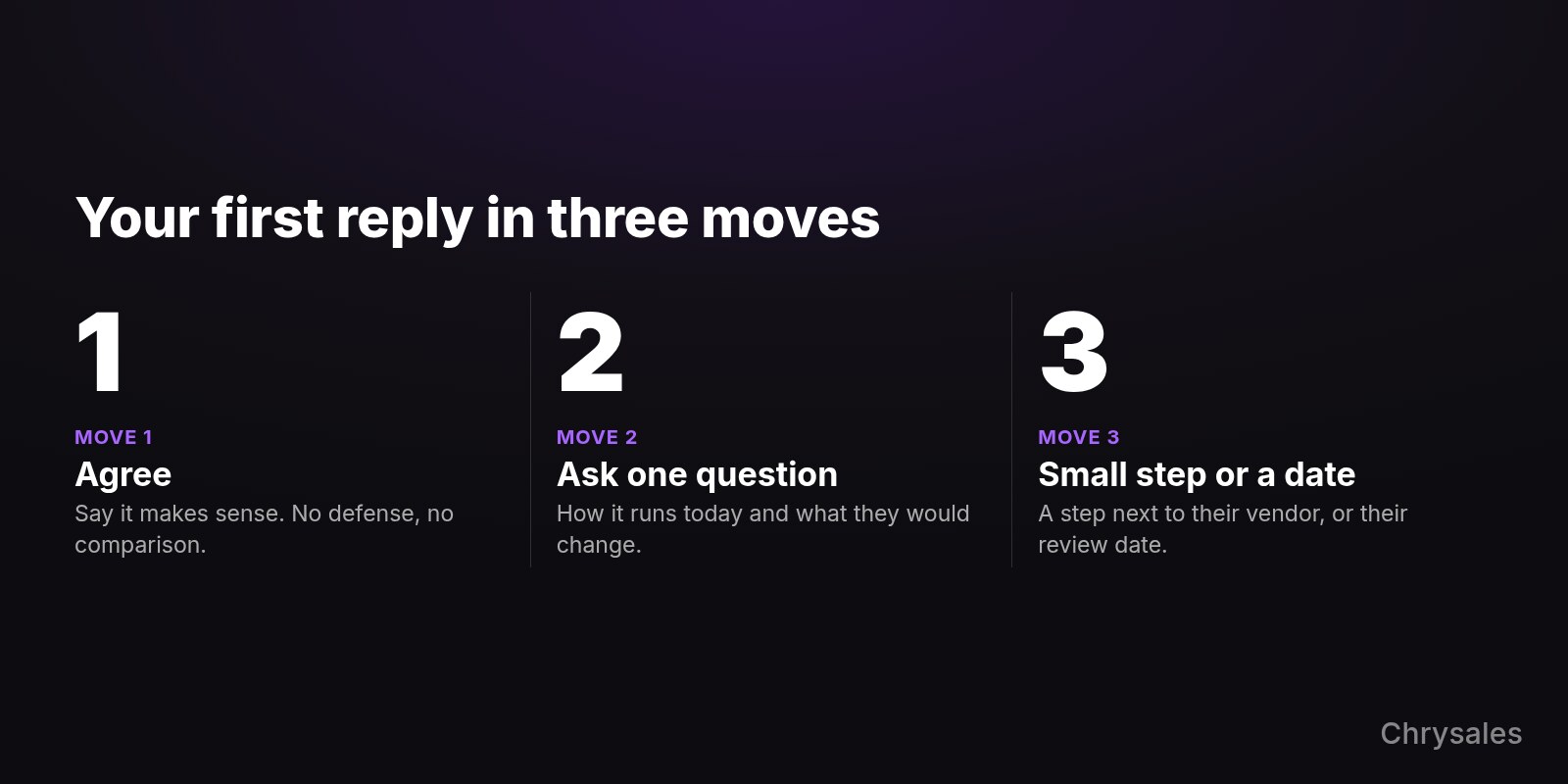
Say something that agrees with them, then ask one question. Don't defend your offer, don't compare, and don't say anything about the current vendor. Your first sentence has one job, which is to lower the tension so the prospect is willing to answer a question. The pitch can wait until you know there is a gap worth talking about.
The sales writers quoted here agree on the first move. Anthony Iannarino puts the risk plainly: "A direct assault on your competitor creates resistance, not dissatisfaction." He also names the upside. "By speaking well of your competitor, you eliminate the need for your dream client to defend them." Writing on Gong's blog, Armand Farrokh describes the usual mistake: "Reps make the mistake of criticizing and throwing mud at a prospect's current solution".
Two public openers show the tone. Keith Weightman's reply to "we're happy with our current provider" is short. "That makes sense, otherwise you'd probably be calling me." Jeb Blount at Sales Gravy answers "We already do billing" with "That's perfect, because none of my customers do outsourcing. They all have internal billing departments."
Our own view is simple. The first objection is rarely the real one; it tests whether you go away easily. Stay calm, agree, and ask one question.
A first reply you can use as written:
That makes sense. I'd expect a company your size to have someone for this already.
Can I ask one thing before I let you go? If you could change one part of how it runs today, what would it be?
If you want more on the first seconds of a call, our guide on how to open a cold call covers openers and the other early brush-offs. For objections later in a conversation, the objection handling patterns post shows how to treat each one as a question.
Which questions show whether there is a gap?
Ask about how the current setup runs, not about your offer. Good questions ask how long they have worked with the vendor, what they would change, what happens when something goes wrong, when they last compared options and when the agreement comes up for review. Two or three of these are enough in one conversation. The answers tell you whether there is a gap now, later, or not at all.
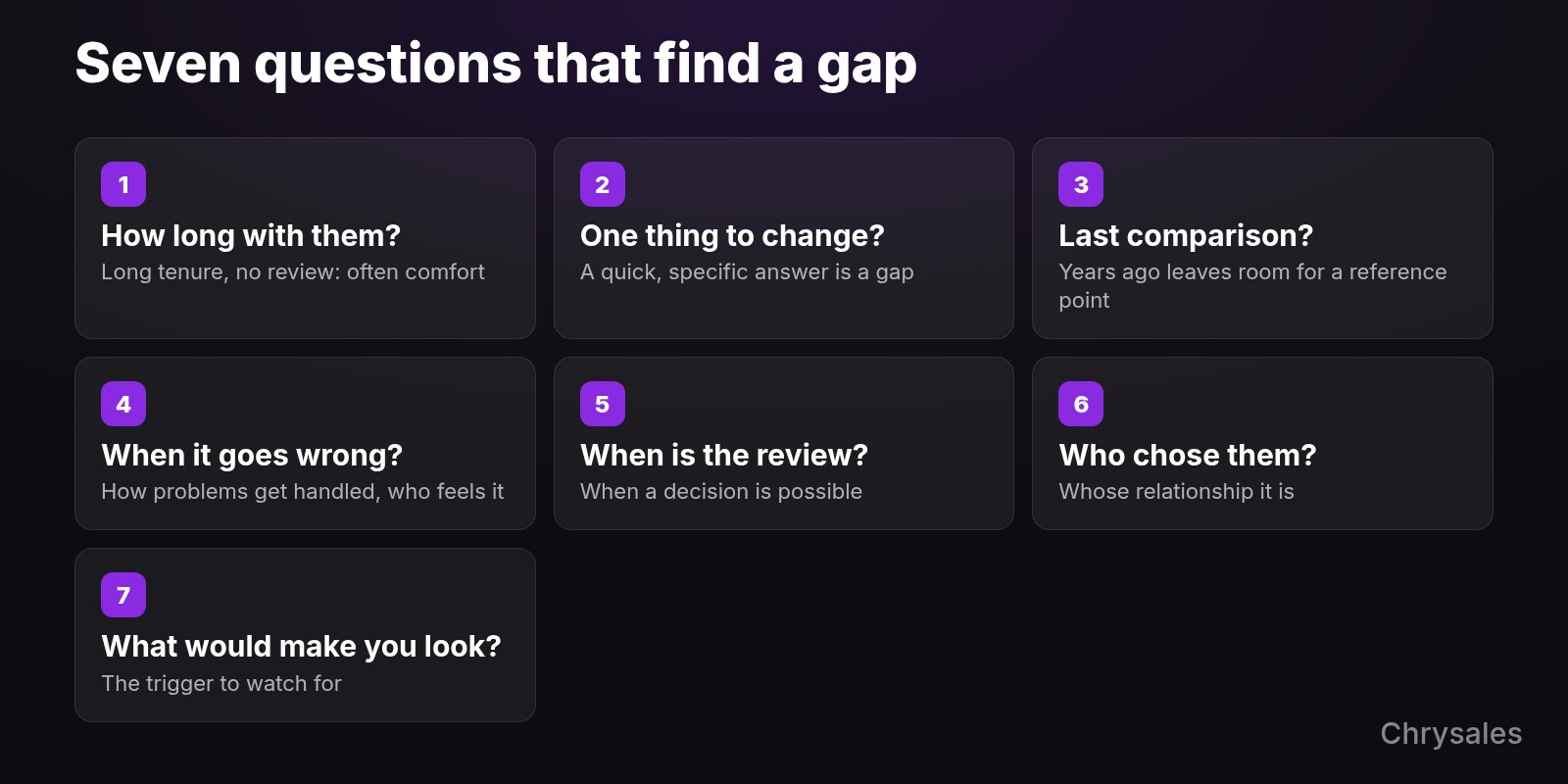
Pick the two or three that fit the moment. Each one is listed with what the answer tells you.
- "How long have you worked with them?" Keith Weightman asks it as "Remind me, how long have you been with them?" A long tenure with no review in between can mean comfort rather than a fresh choice.
- "If you could change one thing about how it runs, big or small, what would it be?" This is close to the question Jeff Borovitz of Sandler suggests. A quick, specific answer usually points to a gap. "Nothing really" probably means they're content.
- "When did you last compare them with anyone else?" InsideProcurement's version is "Out of curiosity, when was the last time you did a serious benchmark or alternatives review in this category?" If the honest answer is "years ago", you can offer a second opinion.
- "What happens when something goes wrong?" You learn how the vendor handles problems and who on their side feels the pain. Service problems are also why buyers switch: in an IDC survey of about 2,600 organizations, line-of-business respondents ranked better service quality first among their reasons for switching service providers.
- "When does the agreement come up for review?" Business contracts often need notice before the term ends, sometimes 30, 60 or 90 days before, or they renew on their own, according to a general UK guide from Sprintlaw. You aren't giving legal advice here, only learning when a decision is possible.
- "Who chose them, and who would be involved if you looked again?" In B2B, the relationship with the current supplier is a big part of what holds a buyer in place, so find out whose relationship it is.
- "What would need to happen for you to look at other options?" This is a version of Weightman's "what would need to happen to even cause you to look at other options?", and the answer gives you the trigger to watch for.
Don't fire all seven in a row; that turns a conversation into an audit. Ask one, listen, and let the answer pick the next. When you hear a real gap, move to a proper discovery call with its own time slot instead of pitching on the spot.
Word-for-word replies for calls, email, LinkedIn and meetings
Each channel needs a different length and tone, but the same three moves: agree, ask one question, and offer either a small next step or a later date. The replies below are complete, with no blanks to fill. They use a made-up seller, Daniel, who runs a fictional 30-person B2B company called Northfield. Each reply also covers the second pushback, when the prospect says no again.
On a cold call
Prospect: Thanks, but we already have someone for that.

Daniel: That makes sense, I'd expect you to. I'm not calling to replace anyone today.
Can I ask one thing? If you could change one part of how it works now, what would it be?

Prospect: Honestly, nothing. We're happy with them.

Daniel: Good to hear, and I won't argue with that. When do you normally review it, so I know
whether it's worth checking in at all?

Prospect: Probably next fall.

Daniel: Then I'll leave you alone until late summer and send one short note before your
review, so you have something to compare against. Is this the right number for that,
or is someone else involved?
Replying to an email
The prospect answered your cold email with "Thanks, but we already have a provider for this."
Subject: Re: your current setup

Thanks for the reply, that helps.

I won't try to talk you out of a provider you're happy with. One question so I know whether
to stay in touch at all: when did you last compare them with anyone else?

If it was recent and they won, I'll leave it there. If it's been a while, I can send a one-page
outline of how we handle the same work, so you have a reference point at your next review.

Either way, thanks for answering.
Daniel
If they reply "no need", answer with one line ("Understood, thanks for letting me know") and log the vendor and the review month. Don't send a second pitch.
Replying on LinkedIn
Thanks for telling me, and good that it's covered. Out of curiosity, is there one thing you'd
change about how it runs today? If not, no problem at all. I'll just check in once before
your next review, if that's OK with you.
LinkedIn messages read like a chat, so keep it to a few lines and one question. If the answer is "we're fine, really", reply "Got it, thanks" and stop there.
In a first meeting
Here the line usually comes up halfway through: "We already use a provider for part of this."
Daniel: Good to know. Which part do they cover, and which part sits with your own team?

Prospect: They do the main work. The reporting and the follow-up are on us.

Daniel: How is that going for your team?

Prospect: It takes more time than it should.

Daniel: Then I'd rather fit around what works than replace it. Would it make sense to look
only at the part your team carries, and keep your provider for the rest?
If they push back again ("we'd rather keep it all with one provider"), accept it, ask when they next review the setup, and agree on a date to talk. That is a clear outcome, and it goes into your log.
Rules for unsolicited calls and emails differ by country, and Germany is strict under UWG §7. Check what applies to your market with a lawyer before you build follow-ups into a routine.
To see objections handled live, watch the video below. In it, Sabir cold calls with real clients and goes through real objections and responses as they come up.
How do you get in when they won't switch?
If the prospect won't replace their vendor, offer something that sits next to it. That can be a place on their supplier list, one piece of work the current vendor doesn't cover, or a reference point for their next review. A small step asks for less trust than a full switch. If nothing fits, watch for a trigger event, such as a new decision maker or a bad incident, that makes them look again.
The smallest step is to be the name they call next time. Mike Brooks (Mr. Inside Sales) answers "we're all set" with "That's great, and I'd just like to see if we could get on your vendor list for the next time you're in the market." It asks for very little and gives you a reason to keep their details up to date.
A bigger step is to start next to the current vendor. Stage 2 Capital describes how buyers handle this in subscription deals: "many contracts allow for tier downgrades rather than outright cancellations". A buyer can take less from the current vendor and add a new one alongside. The same idea works for services: take one part of the work, run it well, and let the first results show whether it works.
How you frame it matters as much as what you offer. Stage 2 Capital's advice is "Frame the switch as conditions changing, not a bad choice." Joe Fairleigh, quoted there, is shorter: "Don't bad mouth incumbent." The person who chose the current vendor needs a way to say yes without admitting a mistake.
Sometimes there is no opening today, and the job is to notice when one appears. Craig Elias, author of SHiFT!, says "A trigger event tends to create what I call a window of dissatisfaction." In a Selling Power interview he describes how he worked large accounts: "I would find out who my biggest competitor was in each account." Then he waited for "either that salesperson to leave the account or that salesperson's primary contact" to leave.
Elias groups trigger events into three kinds that you can watch for:
- A bad experience with a product or service, with people, or with the provider.
- A change in people, places or priorities, such as a new manager or a move.
- A new reason to change for legal, risk or economic reasons.
When should you let it go, and how do you follow up?
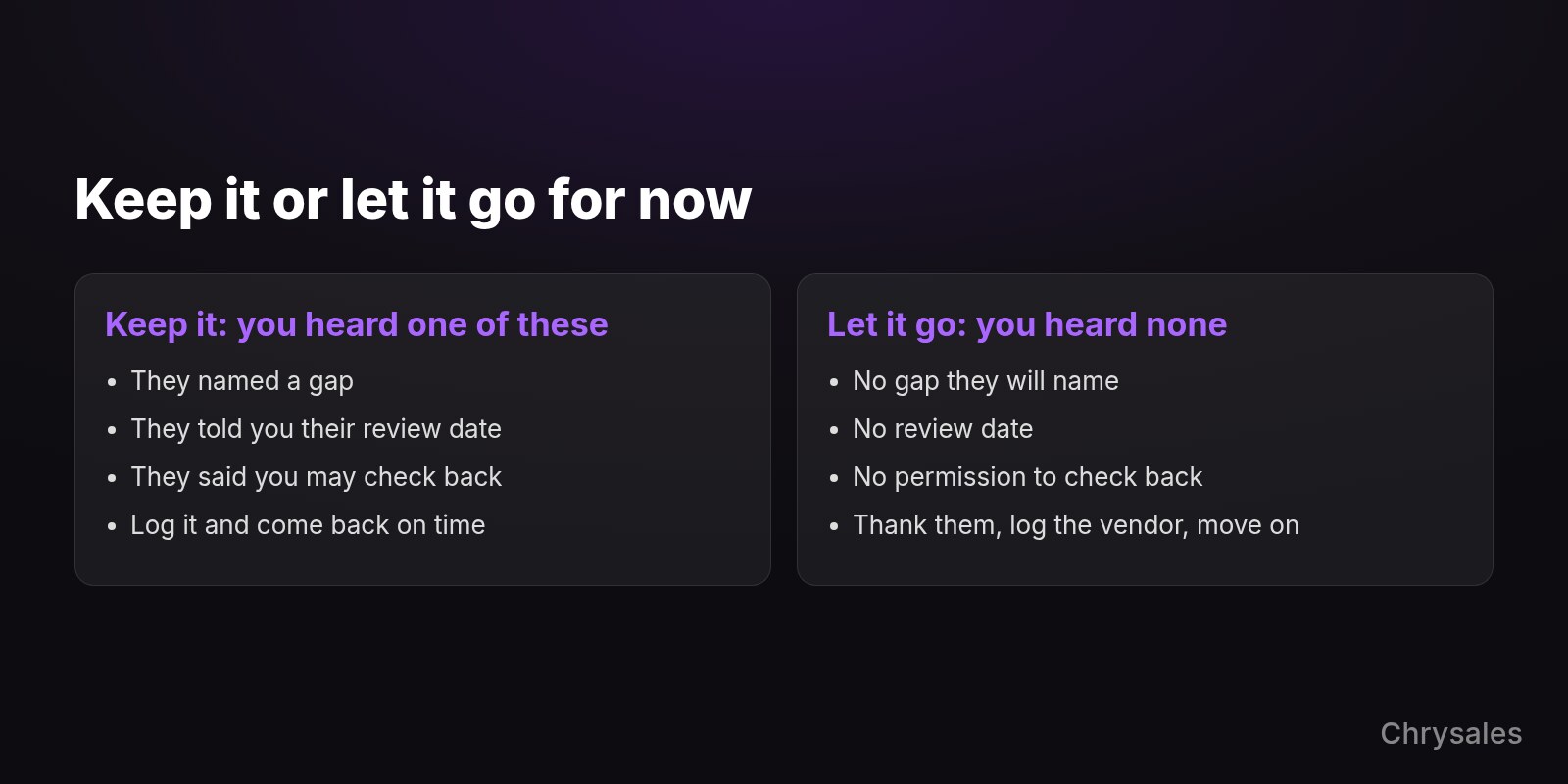
Let it go for now when three things are missing: no gap they will name, no date when they review the vendor, and no permission to check back. When all three are missing, more calls only annoy them. When you have at least a date or a permission, log it and come back at that time with one short, useful message instead of a weekly chase.
A simple rule for each prospect:
- Did they name a gap? Book a proper conversation about that gap.
- No gap, but they told you when they review the vendor? Log the date and set a reminder before it.
- No gap and no date, but they said you may check back? Log it and set one check-in, months out.
- None of the three? Thank them, log the vendor, and move on to the next prospect.
The log can be a spreadsheet or a few fields in your CRM. Copy these columns:
| Company | Current vendor | What they said | Review or renewal month | Trigger to watch | Next touch |
|---|---|---|---|---|---|
| Fictional Co A | Named on the call | "Happy, signed last spring" | March | New head of operations | Mid-January, one email |
| Fictional Co B | Not shared | "We'd change the reporting" | Not known | None yet | Discovery call booked |
| Fictional Co C | Named in email | "We're fine" | Not known | Contact leaves | Check in once in six months |
Fewer, better-timed touches beat a steady drip. Spiceworks surveyed 535 IT buyers in the US and UK (published in 2018). 85% of them said too many sales calls and emails from tech brands make them less likely to buy from a vendor they're loyal to. That survey is about IT buyers and is several years old, but it fits the advice above.
A vague "maybe later" after a full pitch is a different situation. Our guide to handling "I need to think about it" covers that one, including when to stop.
Common mistakes with "we already have a vendor"
Six mistakes are worth avoiding: attacking the current vendor, pitching harder, offering a discount, arguing, hanging up without writing anything down, and chasing every week. Each one either makes the prospect defend their choice or throws away the date when they might change it.
- Criticizing the current vendor. It makes the prospect defend the vendor they picked. Ask what they would change instead, and let them say it.
- Asking for a demo straight away. InsideProcurement lists "Can I at least show you a quick demo?" among the worst responses. Earn the meeting with a gap first.
- Cutting your price to win the switch. A discount tells them the main difference is cost. Our post on selling without discounts shows what to offer instead.
- Arguing with "we're happy". You won't win that argument on a first call. Accept it, and ask when they last compared.
- Hanging up with "OK, thanks". The vendor name and review month are the most useful things you learned. Log them before the next call.
- Following up every week. Weekly chasing without a reason annoys people. Come back at the review date or after a trigger event.
FAQ
Is "we already have a vendor" just a brush-off?
Sometimes. If you hear it before you've said what you do, it is often a reflex to end the call. If they add a specific reason, such as a recent contract or a person they trust, it is more likely real. One calm question tells you which.
Should I ask who their vendor is?
Yes, if you ask lightly and only once. Our cold call guide suggests a version like "Got it. Can I ask who you're working with now, just so I know?" Knowing the name helps you log it and spot changes later, but don't comment on the vendor once you hear it.
What if they are under contract?
Ask when the term ends and when a decision about renewal gets made, because contracts often need notice well before the end date. Then offer something that doesn't touch the contract, such as a place on their supplier list or one piece the current vendor doesn't cover. For anything about the contract itself, they should talk to their own lawyer.
How often should I follow up with a prospect who has a vendor?
Follow up when there is a reason: shortly before their review date, after a trigger event, or when you have something useful to send. A few timed touches a year are better than a weekly check-in. If they asked you not to follow up, respect it and remove them from the sequence.
Sources
- Samuelson and Zeckhauser - Status Quo Bias in Decision Making (Journal of Risk and Uncertainty, 1988)
- Blut et al. - Securing business-to-business relationships: The impact of switching costs (Industrial Marketing Management, 2016)
- LinkedIn B2B Institute - The 95-5 rule
- IDC - Navigating the top drivers of service provider switching (2024)
- Spiceworks - Study examines the drivers and destroyers of brand loyalty among IT buyers (2018)
- Gong - We found the top objections across 300M cold calls
- Anthony Iannarino - Directly attacking your competitor creates resistance
- Keith Weightman - How to respond to "We're happy with our current provider"
- InsideProcurement - We're happy with our current supplier
- Jeff Borovitz, Sandler - Handle sales prospecting objections with confidence
- Jeb Blount, Sales Gravy - Use the Ledge Technique for overcoming objections
- Mike Brooks - How to handle the objection "We're all set"
- Stage 2 Capital - Buying out contracts: how to displace an incumbent
- Selling Power - Craig Elias on trigger event strategies
- CustomerThink - Craig Elias on the window of dissatisfaction
- Sprintlaw - Auto-renewal clauses in UK business contracts
Do the prospects who already have a vendor end up as a dead list in your CRM? On a free strategy call, Chrysales can go through how you log them, when you come back, and the outreach around it. Plan your follow-up for taken prospects on a free call
When a prospect raises the "we already have a vendor" objection, treat it as information about their setup and keep the tone calm. Agree with them, ask one or two questions about how the current setup works, and listen for a gap. If there is one, offer a small step next to the vendor they have; if there isn't, ask when they next review it and come back then.
This guide gives you the questions, full replies for a cold call, an email, a LinkedIn message and a first meeting, and a simple rule for when to stop.
What does "we already have a vendor" really mean?
"We already have a vendor" can mean three different things: the buyer is happy, the buyer is unhappy but too tired to change, or the buyer is locked in by politics or a contract. Sometimes it's just a reflex to end a call they didn't plan for. Your job in the first minute is to find out which one you are hearing, because each needs a different next move.
The three meanings come from the buyer side. InsideProcurement, a newsletter written by a procurement manager, splits "we're happy with our current supplier" into "We actually are happy", "We're not happy, but we're tired" and "We're politically locked in". That is a more useful map than a script, because it tells you what to listen for.
There are good reasons the default answer is "we're fine". Samuelson and Zeckhauser's 1988 study of decision making found that "individuals disproportionately stick with the status quo", in lab experiments and in real choices of health plans and retirement programs. In B2B, a study by Blut and colleagues in Industrial Marketing Management (2016) found "relational switching costs to be most important for securing B2B buyer-seller relationships". In plain words, the person on the phone may simply like the people they work with now.
Timing plays a part too. LinkedIn's B2B Institute, with the Ehrenberg-Bass Institute, puts it as "95% of your potential buyers aren't ready to buy today". That figure comes from a planning model built on purchase cycles, so read it as a reminder that at any given moment, most of your list isn't looking.
| What you hear | What it probably means | Your next move |
|---|---|---|
| "We're all set, thanks" before you've said what you do | A reflex to end an unplanned call | Agree, then ask one short question about how it runs today |
| "We're happy with them" plus a specific reason | Real satisfaction | Ask when they last compared, log the vendor, come back at the review |
| "They're fine" with a sigh, or "it's a pain to change" | Unhappy but tired | Ask what they would change and what switching would involve |
| "The CEO picked them" or "we signed for another term" | Locked in by politics or a contract | Ask when the term ends and who decides, offer something small that doesn't touch the contract |
In our write-up of what we learned cold calling CEOs, "We're all set" is treated the same way: "It's a soft no. Ask one more question before you hang up." The table above is that one question, matched to what you hear.
What should you say first?
Say something that agrees with them, then ask one question. Don't defend your offer, don't compare, and don't say anything about the current vendor. Your first sentence has one job, which is to lower the tension so the prospect is willing to answer a question. The pitch can wait until you know there is a gap worth talking about.
The sales writers quoted here agree on the first move. Anthony Iannarino puts the risk plainly: "A direct assault on your competitor creates resistance, not dissatisfaction." He also names the upside. "By speaking well of your competitor, you eliminate the need for your dream client to defend them." Writing on Gong's blog, Armand Farrokh describes the usual mistake: "Reps make the mistake of criticizing and throwing mud at a prospect's current solution".
Two public openers show the tone. Keith Weightman's reply to "we're happy with our current provider" is short. "That makes sense, otherwise you'd probably be calling me." Jeb Blount at Sales Gravy answers "We already do billing" with "That's perfect, because none of my customers do outsourcing. They all have internal billing departments."
Our own view is simple. The first objection is rarely the real one; it tests whether you go away easily. Stay calm, agree, and ask one question.
A first reply you can use as written:
That makes sense. I'd expect a company your size to have someone for this already.
Can I ask one thing before I let you go? If you could change one part of how it runs today, what would it be?
If you want more on the first seconds of a call, our guide on how to open a cold call covers openers and the other early brush-offs. For objections later in a conversation, the objection handling patterns post shows how to treat each one as a question.
Which questions show whether there is a gap?
Ask about how the current setup runs, not about your offer. Good questions ask how long they have worked with the vendor, what they would change, what happens when something goes wrong, when they last compared options and when the agreement comes up for review. Two or three of these are enough in one conversation. The answers tell you whether there is a gap now, later, or not at all.
Pick the two or three that fit the moment. Each one is listed with what the answer tells you.
- "How long have you worked with them?" Keith Weightman asks it as "Remind me, how long have you been with them?" A long tenure with no review in between can mean comfort rather than a fresh choice.
- "If you could change one thing about how it runs, big or small, what would it be?" This is close to the question Jeff Borovitz of Sandler suggests. A quick, specific answer usually points to a gap. "Nothing really" probably means they're content.
- "When did you last compare them with anyone else?" InsideProcurement's version is "Out of curiosity, when was the last time you did a serious benchmark or alternatives review in this category?" If the honest answer is "years ago", you can offer a second opinion.
- "What happens when something goes wrong?" You learn how the vendor handles problems and who on their side feels the pain. Service problems are also why buyers switch: in an IDC survey of about 2,600 organizations, line-of-business respondents ranked better service quality first among their reasons for switching service providers.
- "When does the agreement come up for review?" Business contracts often need notice before the term ends, sometimes 30, 60 or 90 days before, or they renew on their own, according to a general UK guide from Sprintlaw. You aren't giving legal advice here, only learning when a decision is possible.
- "Who chose them, and who would be involved if you looked again?" In B2B, the relationship with the current supplier is a big part of what holds a buyer in place, so find out whose relationship it is.
- "What would need to happen for you to look at other options?" This is a version of Weightman's "what would need to happen to even cause you to look at other options?", and the answer gives you the trigger to watch for.
Don't fire all seven in a row; that turns a conversation into an audit. Ask one, listen, and let the answer pick the next. When you hear a real gap, move to a proper discovery call with its own time slot instead of pitching on the spot.
Word-for-word replies for calls, email, LinkedIn and meetings
Each channel needs a different length and tone, but the same three moves: agree, ask one question, and offer either a small next step or a later date. The replies below are complete, with no blanks to fill. They use a made-up seller, Daniel, who runs a fictional 30-person B2B company called Northfield. Each reply also covers the second pushback, when the prospect says no again.
On a cold call
Prospect: Thanks, but we already have someone for that.

Daniel: That makes sense, I'd expect you to. I'm not calling to replace anyone today.
Can I ask one thing? If you could change one part of how it works now, what would it be?

Prospect: Honestly, nothing. We're happy with them.

Daniel: Good to hear, and I won't argue with that. When do you normally review it, so I know
whether it's worth checking in at all?

Prospect: Probably next fall.

Daniel: Then I'll leave you alone until late summer and send one short note before your
review, so you have something to compare against. Is this the right number for that,
or is someone else involved?
Replying to an email
The prospect answered your cold email with "Thanks, but we already have a provider for this."
Subject: Re: your current setup

Thanks for the reply, that helps.

I won't try to talk you out of a provider you're happy with. One question so I know whether
to stay in touch at all: when did you last compare them with anyone else?

If it was recent and they won, I'll leave it there. If it's been a while, I can send a one-page
outline of how we handle the same work, so you have a reference point at your next review.

Either way, thanks for answering.
Daniel
If they reply "no need", answer with one line ("Understood, thanks for letting me know") and log the vendor and the review month. Don't send a second pitch.
Replying on LinkedIn
Thanks for telling me, and good that it's covered. Out of curiosity, is there one thing you'd
change about how it runs today? If not, no problem at all. I'll just check in once before
your next review, if that's OK with you.
LinkedIn messages read like a chat, so keep it to a few lines and one question. If the answer is "we're fine, really", reply "Got it, thanks" and stop there.
In a first meeting
Here the line usually comes up halfway through: "We already use a provider for part of this."
Daniel: Good to know. Which part do they cover, and which part sits with your own team?

Prospect: They do the main work. The reporting and the follow-up are on us.

Daniel: How is that going for your team?

Prospect: It takes more time than it should.

Daniel: Then I'd rather fit around what works than replace it. Would it make sense to look
only at the part your team carries, and keep your provider for the rest?
If they push back again ("we'd rather keep it all with one provider"), accept it, ask when they next review the setup, and agree on a date to talk. That is a clear outcome, and it goes into your log.
Rules for unsolicited calls and emails differ by country, and Germany is strict under UWG §7. Check what applies to your market with a lawyer before you build follow-ups into a routine.
To see objections handled live, watch the video below. In it, Sabir cold calls with real clients and goes through real objections and responses as they come up.
How do you get in when they won't switch?
If the prospect won't replace their vendor, offer something that sits next to it. That can be a place on their supplier list, one piece of work the current vendor doesn't cover, or a reference point for their next review. A small step asks for less trust than a full switch. If nothing fits, watch for a trigger event, such as a new decision maker or a bad incident, that makes them look again.
The smallest step is to be the name they call next time. Mike Brooks (Mr. Inside Sales) answers "we're all set" with "That's great, and I'd just like to see if we could get on your vendor list for the next time you're in the market." It asks for very little and gives you a reason to keep their details up to date.
A bigger step is to start next to the current vendor. Stage 2 Capital describes how buyers handle this in subscription deals: "many contracts allow for tier downgrades rather than outright cancellations". A buyer can take less from the current vendor and add a new one alongside. The same idea works for services: take one part of the work, run it well, and let the first results show whether it works.
How you frame it matters as much as what you offer. Stage 2 Capital's advice is "Frame the switch as conditions changing, not a bad choice." Joe Fairleigh, quoted there, is shorter: "Don't bad mouth incumbent." The person who chose the current vendor needs a way to say yes without admitting a mistake.
Sometimes there is no opening today, and the job is to notice when one appears. Craig Elias, author of SHiFT!, says "A trigger event tends to create what I call a window of dissatisfaction." In a Selling Power interview he describes how he worked large accounts: "I would find out who my biggest competitor was in each account." Then he waited for "either that salesperson to leave the account or that salesperson's primary contact" to leave.
Elias groups trigger events into three kinds that you can watch for:
- A bad experience with a product or service, with people, or with the provider.
- A change in people, places or priorities, such as a new manager or a move.
- A new reason to change for legal, risk or economic reasons.
When should you let it go, and how do you follow up?
Let it go for now when three things are missing: no gap they will name, no date when they review the vendor, and no permission to check back. When all three are missing, more calls only annoy them. When you have at least a date or a permission, log it and come back at that time with one short, useful message instead of a weekly chase.
A simple rule for each prospect:
- Did they name a gap? Book a proper conversation about that gap.
- No gap, but they told you when they review the vendor? Log the date and set a reminder before it.
- No gap and no date, but they said you may check back? Log it and set one check-in, months out.
- None of the three? Thank them, log the vendor, and move on to the next prospect.
The log can be a spreadsheet or a few fields in your CRM. Copy these columns:
| Company | Current vendor | What they said | Review or renewal month | Trigger to watch | Next touch |
|---|---|---|---|---|---|
| Fictional Co A | Named on the call | "Happy, signed last spring" | March | New head of operations | Mid-January, one email |
| Fictional Co B | Not shared | "We'd change the reporting" | Not known | None yet | Discovery call booked |
| Fictional Co C | Named in email | "We're fine" | Not known | Contact leaves | Check in once in six months |
Fewer, better-timed touches beat a steady drip. Spiceworks surveyed 535 IT buyers in the US and UK (published in 2018). 85% of them said too many sales calls and emails from tech brands make them less likely to buy from a vendor they're loyal to. That survey is about IT buyers and is several years old, but it fits the advice above.
A vague "maybe later" after a full pitch is a different situation. Our guide to handling "I need to think about it" covers that one, including when to stop.
Common mistakes with "we already have a vendor"
Six mistakes are worth avoiding: attacking the current vendor, pitching harder, offering a discount, arguing, hanging up without writing anything down, and chasing every week. Each one either makes the prospect defend their choice or throws away the date when they might change it.
- Criticizing the current vendor. It makes the prospect defend the vendor they picked. Ask what they would change instead, and let them say it.
- Asking for a demo straight away. InsideProcurement lists "Can I at least show you a quick demo?" among the worst responses. Earn the meeting with a gap first.
- Cutting your price to win the switch. A discount tells them the main difference is cost. Our post on selling without discounts shows what to offer instead.
- Arguing with "we're happy". You won't win that argument on a first call. Accept it, and ask when they last compared.
- Hanging up with "OK, thanks". The vendor name and review month are the most useful things you learned. Log them before the next call.
- Following up every week. Weekly chasing without a reason annoys people. Come back at the review date or after a trigger event.
FAQ
Is "we already have a vendor" just a brush-off?
Sometimes. If you hear it before you've said what you do, it is often a reflex to end the call. If they add a specific reason, such as a recent contract or a person they trust, it is more likely real. One calm question tells you which.
Should I ask who their vendor is?
Yes, if you ask lightly and only once. Our cold call guide suggests a version like "Got it. Can I ask who you're working with now, just so I know?" Knowing the name helps you log it and spot changes later, but don't comment on the vendor once you hear it.
What if they are under contract?
Ask when the term ends and when a decision about renewal gets made, because contracts often need notice well before the end date. Then offer something that doesn't touch the contract, such as a place on their supplier list or one piece the current vendor doesn't cover. For anything about the contract itself, they should talk to their own lawyer.
How often should I follow up with a prospect who has a vendor?
Follow up when there is a reason: shortly before their review date, after a trigger event, or when you have something useful to send. A few timed touches a year are better than a weekly check-in. If they asked you not to follow up, respect it and remove them from the sequence.
Sources
- Samuelson and Zeckhauser - Status Quo Bias in Decision Making (Journal of Risk and Uncertainty, 1988)
- Blut et al. - Securing business-to-business relationships: The impact of switching costs (Industrial Marketing Management, 2016)
- LinkedIn B2B Institute - The 95-5 rule
- IDC - Navigating the top drivers of service provider switching (2024)
- Spiceworks - Study examines the drivers and destroyers of brand loyalty among IT buyers (2018)
- Gong - We found the top objections across 300M cold calls
- Anthony Iannarino - Directly attacking your competitor creates resistance
- Keith Weightman - How to respond to "We're happy with our current provider"
- InsideProcurement - We're happy with our current supplier
- Jeff Borovitz, Sandler - Handle sales prospecting objections with confidence
- Jeb Blount, Sales Gravy - Use the Ledge Technique for overcoming objections
- Mike Brooks - How to handle the objection "We're all set"
- Stage 2 Capital - Buying out contracts: how to displace an incumbent
- Selling Power - Craig Elias on trigger event strategies
- CustomerThink - Craig Elias on the window of dissatisfaction
- Sprintlaw - Auto-renewal clauses in UK business contracts
Do the prospects who already have a vendor end up as a dead list in your CRM? On a free strategy call, Chrysales can go through how you log them, when you come back, and the outreach around it. Plan your follow-up for taken prospects on a free call
Scaling Is Not Hard If You Have The Right Systems
If you’re serious about leveling up your scaling game, you need the right system, the right training, and the right team behind you. We're here to give you the exact tools and strategies top entrepreneurs use to dominate.

Discover the latest tips
View All
Chrysales was formed from the words "chrysalis" the stage where a caterpillar transforms into a butterfly and "sales".
It stands for one thing: sales transformation.Because scaling doesn’t happen by doing more of the same. Scaling only happens when you go through real transformation in your systems, your offer, team and the way you sell.


