.avif)
Top 10 Outsourced SDR Companies to Watch in 2026
An outsourced SDR team handles early sales outreach, list building, and meeting setting for B2B companies that want more lead generation and client acquisition. Here's a stat that doesn't get enough attention: only about 7% of companies actually make outsourced SDR services work. The rest? They burn thousands of dollars, get a few bad meetings, and go back to doing it themselves.
What Outsourced SDRs Actually Do (And What They Don't)
An outsourced SDR company handles the early stages of your sales process. They build lists, send cold emails, make calls, book meetings, and sometimes even qualify leads before handing them off to your closers. Think of them as your external prospecting team.
The Core Services Most SDR Companies Offer
Most B2B sales development representative outsourcing firms provide similar services:
- List building and research: They find companies and contacts that match your ideal customer profile
- Multi-channel outreach: Cold emails, LinkedIn messages, and phone calls to book appointments
- Meeting setting: They get prospects on your calendar so your team can close
- Lead qualification: Some filter leads before passing them over, others just book anyone who says yes
Watch out: If your offer isn't clear or your positioning is weak, even the best outsourced prospecting team will struggle. They can't fix a broken sales message.
What They Don't Do (But People Expect Them To)
Here's where expectations go wrong. Most outsourced SDR services don't:
- Build your sales system from scratch
- Figure out your ideal customer profile for you
- Write your positioning or offer
- Close deals (they book meetings, not contracts)
- Train your internal team on how to convert the appointments they set
Picture this: you hire an SDR firm expecting them to "figure it out," but they need you to tell them exactly who to target and what to say. Without that, they're guessing. And guessing doesn't book meetings.
The Top 10 Outsourced SDR Companies Worth Watching in 2026
These companies have track records, client rosters, and enough reviews to make the shortlist. No fluff, just what they do and who they're best for.
1. Belkins
Belkins focuses on appointment setting services for B2B companies, especially in tech and consulting. They handle email outreach, LinkedIn, and some cold calling. Their process includes list building, copywriting, and a dedicated account manager.
Best for: small sales teams that need 5 to 15 meetings per month without building an in-house SDR function.
2. Callbox
Callbox is one of the older names in B2B outbound sales. They do multi-channel campaigns (email, phone, social) and work across industries. They've been around long enough to have systems in place, but some reviews mention turnover in their SDR teams.
Best for: companies that want a proven vendor with global reach and don't mind a slightly corporate process.
3. SalesFocus
SalesFocus positions itself as an outsourced SDR agency for mid-market and enterprise B2B companies. They focus on complex sales cycles and longer-term campaigns. Their model includes monthly retainers and performance tracking.
Best for: growing B2B companies with average deal sizes above $20K and longer sales cycles.
4. Martal Group
Martal Group hires experienced SDRs (not entry-level) and assigns them to clients. They work on a project basis and focus on tech, SaaS, and professional services. They claim higher meeting quality because they hire senior reps.
Best for: SaaS and tech companies that need more than just volume, they want reps who understand technical products.
Pro Tip: Ask any SDR firm how long their reps stay on your account. High turnover means you're constantly retraining new people on your product.
5. EBQ
EBQ offers both outsourced SDR services and inside sales support. They work with B2B tech companies and position themselves as a "sales acceleration" partner. They integrate with your CRM and reporting tools.
Best for: companies that already have a sales process and want to scale outbound fast without hiring.
6. Cience
Cience combines human SDRs with some AI driven lead scoring and data tools. They focus on multi-touch campaigns and claim to handle millions of outreach touches per year. Their tech stack is more advanced than most traditional cold outreach agencies.
Best for: tech forward teams that want a blend of human outreach and AI support.
7. EngageTech (formerly LeadJen)
EngageTech focuses on B2B lead generation outsourcing for enterprise and mid-market companies. They assign dedicated teams and work on longer contracts (usually 6 to 12 months). They handle list creation, messaging, and appointment setting.
Best for: companies ready to commit to a longer term outsourced SDR partnership, not one off campaigns.
8. SalesBread
SalesBread is a smaller, boutique style cold email agency. They write custom email sequences and run LinkedIn outreach. They don't do cold calling, just email and social. Known for personalized messaging and high reply rates when the targeting is tight.
Best for: teams that want high touch, custom email campaigns and don't need phone based prospecting.
9. memoryBlue
memoryBlue offers SDR outsourcing with a focus on training and enablement. They claim to train their reps on your product before launching campaigns. They work mostly with B2B SaaS and consulting firms.
Best for: companies that need reps who can speak intelligently about complex products on day one.
10. RevBoss
RevBoss is a cold email focused SDR firm. They build campaigns, write copy, and manage lists. They don't do calls or LinkedIn, just email. Pricing is transparent (unusual in this space), and they target smaller B2B companies.
Best for: small teams with limited budgets that want to test cold email without hiring an SDR.
Common mistake: Picking an SDR company based on their website or case studies alone. Most of those case studies involved clients who already had a working sales system. If you don't, your results will look very different.
For a deeper comparison of firms offering similar services, check out our guide to b2b appointment setting companies compared to see how different providers stack up across pricing, process, and specialization.
What Needs to Be in Place Before You Outsource SDR Work
Most content on outsourced SDR companies skips this part. But this is where the 7% success rate comes from. If these things aren't in place, the SDR firm will struggle no matter how good they are.
You Need a Proven Offer and Positioning
Your offer is the reason someone takes a meeting. If your positioning is vague or your service sounds like everyone else's, no amount of cold outreach will fix it. The SDR can't invent your value proposition.
A 15 person consulting firm tried outsourcing their outbound before they had a clear offer. The SDR company booked 20 meetings in two months. Only one turned into a deal. The issue wasn't the meetings, it was what they were pitching.
You Need a Defined Ideal Customer Profile (ICP)
Most SDR outsourcing firms will ask you, "Who do you want us to target?" If your answer is "mid market tech companies" or "anyone in consulting," that's too broad. You need specifics:
- Company size (employee count, revenue range)
- Industry and sub industry
- Tech stack or tools they use
- Geography
- Buying triggers (recent funding, new hires, product launches)
Pro Tip: A tight ICP is the difference between a 1% and a 5% reply rate. The tighter the better. If you're still defining who to reach, watch this breakdown on how to find clients who need your services right now to sharpen your targeting before launching outbound.
You Need Someone Who Can Close the Meetings They Book
Outsourced SDRs book appointments. Your team has to close them. If your internal closer can't convert a discovery call into a next step, more meetings won't help. Fix the closing process first, then scale the top of the funnel.
One marketing agency hired an outsourced SDR firm and got 30 meetings in a month. They closed zero. The agency blamed the SDR company, but the real issue was their pitch. The meetings were with the right people, the offer just didn't land.
When Outsourced SDRs Actually Make Sense (And When They Don't)
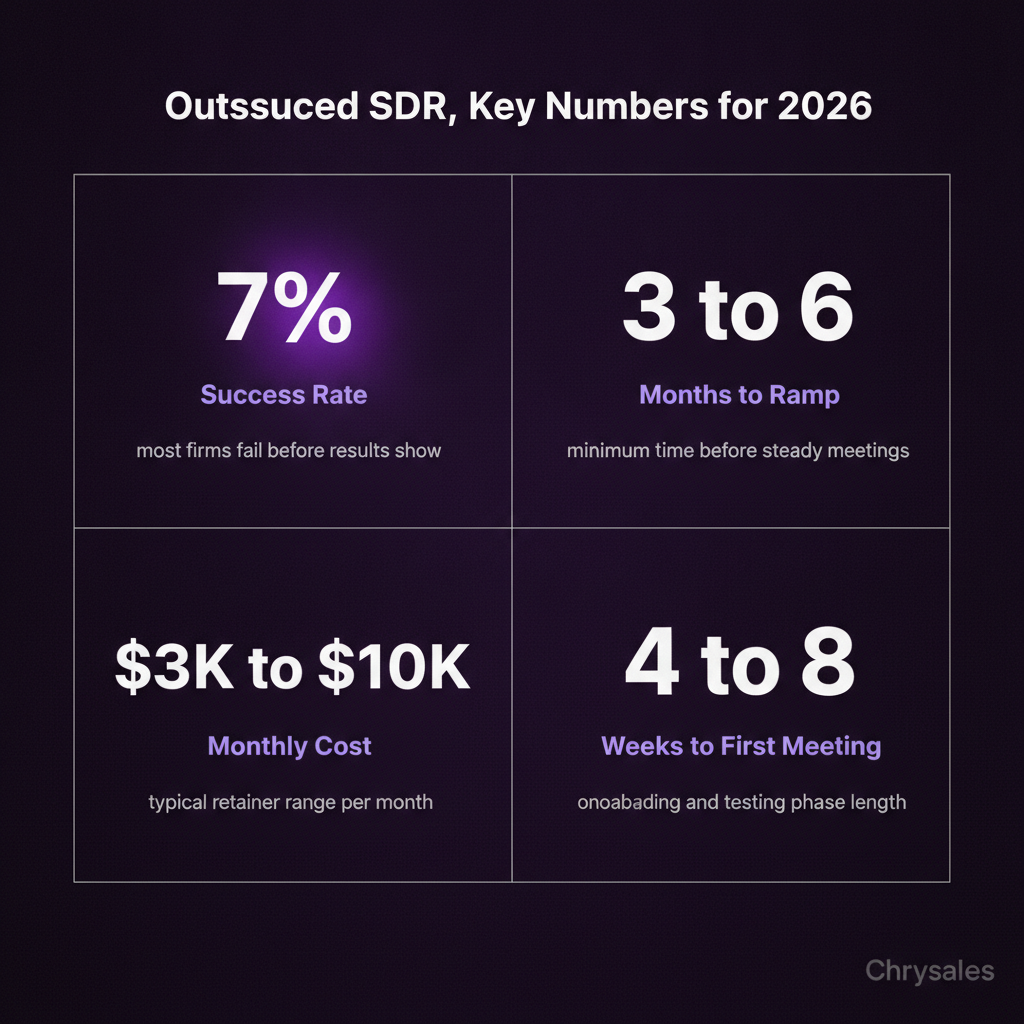
Not every company should outsource sales development representative work. Here's the breakdown.
When It Makes Sense
Outsourced SDR solutions work best when:
- You already have a repeatable sales process that converts meetings into revenue
- Your ICP is tight and documented
- You need to scale outbound fast without hiring and training internal reps
- You have someone internally who can manage the SDR relationship and give feedback
- You're testing a new market or segment and don't want to commit to a full hire yet
When It Doesn't Make Sense
Skip outsourcing if:
- You don't know who your best customers are yet
- Your offer or positioning is still being tested
- You can't close the meetings you're already getting
- You don't have budget to commit for at least 3 to 6 months (most campaigns need time to ramp)
- You expect the SDR firm to "figure out" your sales message for you
Watch out: If you're outsourcing because hiring is hard, that's not a good enough reason. Outsourcing adds complexity. You're managing a vendor instead of managing a person, and the vendor's incentives aren't always aligned with yours.
How to Evaluate an Outsourced SDR Firm (What Actually Matters)
Most people evaluate SDR companies based on the wrong things. Here's what to look for.
Ask About Rep Tenure and Turnover
High turnover means the reps working your account change every few months. That kills consistency. Ask how long the average SDR stays with the company and how long they typically stay on client accounts.
Check Their Onboarding Process
How much time do they spend learning your product, your ICP, and your messaging? If the answer is "we'll figure it out in the first week," that's a red flag. Good firms take 2 to 4 weeks to onboard before launching outreach.
Look at Their Reporting and Metrics
What do they track? Emails sent? Meetings booked? Meeting to opportunity conversion? The best firms track the full funnel, not just top of funnel vanity metrics. If they only report on emails sent and meetings set, they're not focused on what actually drives revenue.
Understand Their Pricing Model
Most outsourced SDR firms charge one of three ways:
- Monthly retainer: flat fee per month, usually includes a set number of hours or activities
- Per meeting pricing: you pay per qualified meeting booked
- Hybrid: retainer plus performance bonus for meetings or pipeline generated
Per meeting pricing sounds safe, but it can incentivize quantity over quality. Retainers align better if you want strategic partnership, not just meeting volume. For more detail on how different pricing models work across appointment setting providers, see how appointment setting costs and pricing models compare.
Building Your Own Sales System vs. Outsourcing SDR Work
Here's the thing: outsourced SDRs are a tactic, not a strategy. They can fill your calendar, but they can't build the system that turns those meetings into predictable client acquisition.
What a Custom Sales System Looks Like
A real B2B sales system includes:
- A documented ideal customer profile and buying triggers
- A no brainer offer and clear positioning
- Outbound workflows (email sequences, call scripts, LinkedIn messaging)
- A discovery call structure with the right questions to qualify and move deals forward
- Objection handling scripts for the most common pushback
- A repeatable process for onboarding and training new sales hires
This is what Chrysales builds for clients. We've trained over 500 sales teams and generated more than €10M in client revenue by building these systems first. Once the system is in place, you can hire SDRs, use automation, or bring in an outsourced team to scale. But without the system, you're just guessing.
When Outsourcing Fits Into the System
Outsourced SDRs work best as a temporary or supplementary tool. Use them to:
- Test a new market before hiring internally
- Scale fast during a growth phase
- Fill gaps while you're hiring and training your own team
- Handle overflow when your internal SDRs are maxed out
But don't use them as a replacement for building your own repeatable, internal sales process. That's the foundation. Outsourcing is the accelerator.
Pro Tip: If you're choosing between building a sales system and hiring an outsourced SDR firm, build the system first. Then layer on the SDR support. That order matters. To see exactly how to build a sales system that actually scales, read our complete guide or watch our walkthrough on building a sales system so powerful clients come to you.
How AI Is Changing Outsourced SDR Services in 2026
AI is showing up in B2B outbound sales in two big ways: lead scoring and personalization at scale.
AI-Powered Lead Scoring
Some SDR firms now use AI to score leads before reaching out. The system looks at signals like recent funding, job postings, tech stack changes, and website activity. Anything scoring above a certain threshold goes to the top of the outreach list.
This isn't magic, but it helps focus effort on accounts that are more likely to respond. If you're working with an outsourced SDR company that uses AI scoring, ask them how the scoring model is trained and whether it's customized to your ICP.
AI-Generated Personalization
AI tools can now pull data from LinkedIn, company websites, and news sources to write personalized email openers. One marketing agency saw reply rates jump from 2% to 6% after their SDR firm started using AI assisted personalization.
Watch out: AI personalization works only if the underlying list and offer are strong. A personalized email to the wrong person is still a bad email. Research shows that B2B cold email reply rates jump 2-3x when AI personalization replaces templates, but only when targeting and messaging fundamentals are already dialed in.
Chrysales integrates AI into custom sales workflows using Gemini based systems. We build lead scoring models, automate research, and create outreach sequences that feel human but scale like software. That's the next level beyond basic outsourced SDR work. For a full breakdown of tools and workflows, see our guide to the best AI SDR tools in 2025.
What Happens After the SDR Books the Meeting (The Part Most People Ignore)
Outsourced prospecting gets you the meeting. What happens next is on you.
The Discovery Call Is Where Most Deals Die
If your discovery call process is weak, you'll burn through meetings without closing. Most teams skip the hard questions and jump straight to pitching. That's why conversion rates stay low.
Good discovery calls follow a structure:
- Set the agenda and get permission to ask questions
- Ask about current state, pain points, and what they've tried
- Qualify budget, timeline, and decision making process
- Present a tailored next step (demo, proposal, scoping call)
You Need Scripts, Not Just "Good Salespeople"
Most teams think hiring a "good salesperson" will solve the problem. But even good salespeople perform better with scripts. Scripts for discovery, objection handling, pricing conversations, and follow up. Without them, every call is different, and nothing improves.
One 30 person consulting firm had three closers, each running discovery calls their own way. Conversion rates ranged from 10% to 40% depending on who took the meeting. After we built a standard call structure and objection scripts, all three closers hit 35% to 45% consistently. That's what a system does. It takes what works and makes it repeatable. For specific frameworks and techniques, explore our guide on discovery call closing techniques to turn more meetings into pipeline.
Frequently Asked Questions
Q: How much do outsourced SDR companies typically cost?
Most outsourced SDR services charge between $3,000 and $10,000 per month depending on the scope, number of touches, and whether they include list building and copywriting. Per meeting pricing usually ranges from $200 to $500 per qualified appointment. Expect to commit for at least 3 to 6 months since most campaigns need time to ramp up before you see consistent results.
Q: Can I use an outsourced SDR firm if I don't have a sales team yet?
You can, but it's risky. If you don't have someone who can close the meetings the SDR books, you'll waste the appointments. A better approach is to get at least one person who can handle discovery and close deals, prove the offer works, then bring in an outsourced SDR firm to scale the top of the funnel. Without that, you're paying for meetings that go nowhere.
Q: What's the difference between an SDR and a BDR?
In most companies, SDR (sales development representative) and BDR (business development representative) mean the same thing: the person who does outbound prospecting and books meetings. Some companies use BDR for outbound and SDR for inbound, but there's no universal standard. When evaluating outsourced BDR companies or SDR firms, just ask what their reps actually do (outbound, inbound, or both).
Q: How long does it take to see results from an outsourced SDR company?
Plan for 4 to 8 weeks before you see consistent meetings. The first few weeks are onboarding, list building, and testing messaging. Month two is when campaigns start to ramp. If you're not seeing any traction by month three, either the targeting is off, the offer isn't landing, or the SDR firm isn't executing. Don't expect instant results in week one.
Q: Should I hire an in-house SDR or use an outsourced SDR firm?
If you have a repeatable sales process, a clear ICP, and budget to hire, an in-house SDR usually performs better long term because they're fully dedicated to your product and learn faster. But hiring takes time and comes with risk. Outsourcing makes sense if you need speed, want to test a market, or don't have the bandwidth to manage a new hire. Think of outsourcing as short term scale, in house as long term investment.
An outsourced SDR team handles early sales outreach, list building, and meeting setting for B2B companies that want more lead generation and client acquisition. Here's a stat that doesn't get enough attention: only about 7% of companies actually make outsourced SDR services work. The rest? They burn thousands of dollars, get a few bad meetings, and go back to doing it themselves.
What Outsourced SDRs Actually Do (And What They Don't)
An outsourced SDR company handles the early stages of your sales process. They build lists, send cold emails, make calls, book meetings, and sometimes even qualify leads before handing them off to your closers. Think of them as your external prospecting team.
The Core Services Most SDR Companies Offer
Most B2B sales development representative outsourcing firms provide similar services:
- List building and research: They find companies and contacts that match your ideal customer profile
- Multi-channel outreach: Cold emails, LinkedIn messages, and phone calls to book appointments
- Meeting setting: They get prospects on your calendar so your team can close
- Lead qualification: Some filter leads before passing them over, others just book anyone who says yes
Watch out: If your offer isn't clear or your positioning is weak, even the best outsourced prospecting team will struggle. They can't fix a broken sales message.
What They Don't Do (But People Expect Them To)
Here's where expectations go wrong. Most outsourced SDR services don't:
- Build your sales system from scratch
- Figure out your ideal customer profile for you
- Write your positioning or offer
- Close deals (they book meetings, not contracts)
- Train your internal team on how to convert the appointments they set
Picture this: you hire an SDR firm expecting them to "figure it out," but they need you to tell them exactly who to target and what to say. Without that, they're guessing. And guessing doesn't book meetings.
The Top 10 Outsourced SDR Companies Worth Watching in 2026
These companies have track records, client rosters, and enough reviews to make the shortlist. No fluff, just what they do and who they're best for.
1. Belkins
Belkins focuses on appointment setting services for B2B companies, especially in tech and consulting. They handle email outreach, LinkedIn, and some cold calling. Their process includes list building, copywriting, and a dedicated account manager.
Best for: small sales teams that need 5 to 15 meetings per month without building an in-house SDR function.
2. Callbox
Callbox is one of the older names in B2B outbound sales. They do multi-channel campaigns (email, phone, social) and work across industries. They've been around long enough to have systems in place, but some reviews mention turnover in their SDR teams.
Best for: companies that want a proven vendor with global reach and don't mind a slightly corporate process.
3. SalesFocus
SalesFocus positions itself as an outsourced SDR agency for mid-market and enterprise B2B companies. They focus on complex sales cycles and longer-term campaigns. Their model includes monthly retainers and performance tracking.
Best for: growing B2B companies with average deal sizes above $20K and longer sales cycles.
4. Martal Group
Martal Group hires experienced SDRs (not entry-level) and assigns them to clients. They work on a project basis and focus on tech, SaaS, and professional services. They claim higher meeting quality because they hire senior reps.
Best for: SaaS and tech companies that need more than just volume, they want reps who understand technical products.
Pro Tip: Ask any SDR firm how long their reps stay on your account. High turnover means you're constantly retraining new people on your product.
5. EBQ
EBQ offers both outsourced SDR services and inside sales support. They work with B2B tech companies and position themselves as a "sales acceleration" partner. They integrate with your CRM and reporting tools.
Best for: companies that already have a sales process and want to scale outbound fast without hiring.
6. Cience
Cience combines human SDRs with some AI driven lead scoring and data tools. They focus on multi-touch campaigns and claim to handle millions of outreach touches per year. Their tech stack is more advanced than most traditional cold outreach agencies.
Best for: tech forward teams that want a blend of human outreach and AI support.
7. EngageTech (formerly LeadJen)
EngageTech focuses on B2B lead generation outsourcing for enterprise and mid-market companies. They assign dedicated teams and work on longer contracts (usually 6 to 12 months). They handle list creation, messaging, and appointment setting.
Best for: companies ready to commit to a longer term outsourced SDR partnership, not one off campaigns.
8. SalesBread
SalesBread is a smaller, boutique style cold email agency. They write custom email sequences and run LinkedIn outreach. They don't do cold calling, just email and social. Known for personalized messaging and high reply rates when the targeting is tight.
Best for: teams that want high touch, custom email campaigns and don't need phone based prospecting.
9. memoryBlue
memoryBlue offers SDR outsourcing with a focus on training and enablement. They claim to train their reps on your product before launching campaigns. They work mostly with B2B SaaS and consulting firms.
Best for: companies that need reps who can speak intelligently about complex products on day one.
10. RevBoss
RevBoss is a cold email focused SDR firm. They build campaigns, write copy, and manage lists. They don't do calls or LinkedIn, just email. Pricing is transparent (unusual in this space), and they target smaller B2B companies.
Best for: small teams with limited budgets that want to test cold email without hiring an SDR.
Common mistake: Picking an SDR company based on their website or case studies alone. Most of those case studies involved clients who already had a working sales system. If you don't, your results will look very different.
For a deeper comparison of firms offering similar services, check out our guide to b2b appointment setting companies compared to see how different providers stack up across pricing, process, and specialization.
What Needs to Be in Place Before You Outsource SDR Work
Most content on outsourced SDR companies skips this part. But this is where the 7% success rate comes from. If these things aren't in place, the SDR firm will struggle no matter how good they are.
You Need a Proven Offer and Positioning
Your offer is the reason someone takes a meeting. If your positioning is vague or your service sounds like everyone else's, no amount of cold outreach will fix it. The SDR can't invent your value proposition.
A 15 person consulting firm tried outsourcing their outbound before they had a clear offer. The SDR company booked 20 meetings in two months. Only one turned into a deal. The issue wasn't the meetings, it was what they were pitching.
You Need a Defined Ideal Customer Profile (ICP)
Most SDR outsourcing firms will ask you, "Who do you want us to target?" If your answer is "mid market tech companies" or "anyone in consulting," that's too broad. You need specifics:
- Company size (employee count, revenue range)
- Industry and sub industry
- Tech stack or tools they use
- Geography
- Buying triggers (recent funding, new hires, product launches)
Pro Tip: A tight ICP is the difference between a 1% and a 5% reply rate. The tighter the better. If you're still defining who to reach, watch this breakdown on how to find clients who need your services right now to sharpen your targeting before launching outbound.
You Need Someone Who Can Close the Meetings They Book
Outsourced SDRs book appointments. Your team has to close them. If your internal closer can't convert a discovery call into a next step, more meetings won't help. Fix the closing process first, then scale the top of the funnel.
One marketing agency hired an outsourced SDR firm and got 30 meetings in a month. They closed zero. The agency blamed the SDR company, but the real issue was their pitch. The meetings were with the right people, the offer just didn't land.
When Outsourced SDRs Actually Make Sense (And When They Don't)
Not every company should outsource sales development representative work. Here's the breakdown.
When It Makes Sense
Outsourced SDR solutions work best when:
- You already have a repeatable sales process that converts meetings into revenue
- Your ICP is tight and documented
- You need to scale outbound fast without hiring and training internal reps
- You have someone internally who can manage the SDR relationship and give feedback
- You're testing a new market or segment and don't want to commit to a full hire yet
When It Doesn't Make Sense
Skip outsourcing if:
- You don't know who your best customers are yet
- Your offer or positioning is still being tested
- You can't close the meetings you're already getting
- You don't have budget to commit for at least 3 to 6 months (most campaigns need time to ramp)
- You expect the SDR firm to "figure out" your sales message for you
Watch out: If you're outsourcing because hiring is hard, that's not a good enough reason. Outsourcing adds complexity. You're managing a vendor instead of managing a person, and the vendor's incentives aren't always aligned with yours.
How to Evaluate an Outsourced SDR Firm (What Actually Matters)
Most people evaluate SDR companies based on the wrong things. Here's what to look for.
Ask About Rep Tenure and Turnover
High turnover means the reps working your account change every few months. That kills consistency. Ask how long the average SDR stays with the company and how long they typically stay on client accounts.
Check Their Onboarding Process
How much time do they spend learning your product, your ICP, and your messaging? If the answer is "we'll figure it out in the first week," that's a red flag. Good firms take 2 to 4 weeks to onboard before launching outreach.
Look at Their Reporting and Metrics
What do they track? Emails sent? Meetings booked? Meeting to opportunity conversion? The best firms track the full funnel, not just top of funnel vanity metrics. If they only report on emails sent and meetings set, they're not focused on what actually drives revenue.
Understand Their Pricing Model
Most outsourced SDR firms charge one of three ways:
- Monthly retainer: flat fee per month, usually includes a set number of hours or activities
- Per meeting pricing: you pay per qualified meeting booked
- Hybrid: retainer plus performance bonus for meetings or pipeline generated
Per meeting pricing sounds safe, but it can incentivize quantity over quality. Retainers align better if you want strategic partnership, not just meeting volume. For more detail on how different pricing models work across appointment setting providers, see how appointment setting costs and pricing models compare.
Building Your Own Sales System vs. Outsourcing SDR Work
Here's the thing: outsourced SDRs are a tactic, not a strategy. They can fill your calendar, but they can't build the system that turns those meetings into predictable client acquisition.
What a Custom Sales System Looks Like
A real B2B sales system includes:
- A documented ideal customer profile and buying triggers
- A no brainer offer and clear positioning
- Outbound workflows (email sequences, call scripts, LinkedIn messaging)
- A discovery call structure with the right questions to qualify and move deals forward
- Objection handling scripts for the most common pushback
- A repeatable process for onboarding and training new sales hires
This is what Chrysales builds for clients. We've trained over 500 sales teams and generated more than €10M in client revenue by building these systems first. Once the system is in place, you can hire SDRs, use automation, or bring in an outsourced team to scale. But without the system, you're just guessing.
When Outsourcing Fits Into the System
Outsourced SDRs work best as a temporary or supplementary tool. Use them to:
- Test a new market before hiring internally
- Scale fast during a growth phase
- Fill gaps while you're hiring and training your own team
- Handle overflow when your internal SDRs are maxed out
But don't use them as a replacement for building your own repeatable, internal sales process. That's the foundation. Outsourcing is the accelerator.
Pro Tip: If you're choosing between building a sales system and hiring an outsourced SDR firm, build the system first. Then layer on the SDR support. That order matters. To see exactly how to build a sales system that actually scales, read our complete guide or watch our walkthrough on building a sales system so powerful clients come to you.
How AI Is Changing Outsourced SDR Services in 2026
AI is showing up in B2B outbound sales in two big ways: lead scoring and personalization at scale.
AI-Powered Lead Scoring
Some SDR firms now use AI to score leads before reaching out. The system looks at signals like recent funding, job postings, tech stack changes, and website activity. Anything scoring above a certain threshold goes to the top of the outreach list.
This isn't magic, but it helps focus effort on accounts that are more likely to respond. If you're working with an outsourced SDR company that uses AI scoring, ask them how the scoring model is trained and whether it's customized to your ICP.
AI-Generated Personalization
AI tools can now pull data from LinkedIn, company websites, and news sources to write personalized email openers. One marketing agency saw reply rates jump from 2% to 6% after their SDR firm started using AI assisted personalization.
Watch out: AI personalization works only if the underlying list and offer are strong. A personalized email to the wrong person is still a bad email. Research shows that B2B cold email reply rates jump 2-3x when AI personalization replaces templates, but only when targeting and messaging fundamentals are already dialed in.
Chrysales integrates AI into custom sales workflows using Gemini based systems. We build lead scoring models, automate research, and create outreach sequences that feel human but scale like software. That's the next level beyond basic outsourced SDR work. For a full breakdown of tools and workflows, see our guide to the best AI SDR tools in 2025.
What Happens After the SDR Books the Meeting (The Part Most People Ignore)
Outsourced prospecting gets you the meeting. What happens next is on you.
The Discovery Call Is Where Most Deals Die
If your discovery call process is weak, you'll burn through meetings without closing. Most teams skip the hard questions and jump straight to pitching. That's why conversion rates stay low.
Good discovery calls follow a structure:
- Set the agenda and get permission to ask questions
- Ask about current state, pain points, and what they've tried
- Qualify budget, timeline, and decision making process
- Present a tailored next step (demo, proposal, scoping call)
You Need Scripts, Not Just "Good Salespeople"
Most teams think hiring a "good salesperson" will solve the problem. But even good salespeople perform better with scripts. Scripts for discovery, objection handling, pricing conversations, and follow up. Without them, every call is different, and nothing improves.
One 30 person consulting firm had three closers, each running discovery calls their own way. Conversion rates ranged from 10% to 40% depending on who took the meeting. After we built a standard call structure and objection scripts, all three closers hit 35% to 45% consistently. That's what a system does. It takes what works and makes it repeatable. For specific frameworks and techniques, explore our guide on discovery call closing techniques to turn more meetings into pipeline.
Frequently Asked Questions
Q: How much do outsourced SDR companies typically cost?
Most outsourced SDR services charge between $3,000 and $10,000 per month depending on the scope, number of touches, and whether they include list building and copywriting. Per meeting pricing usually ranges from $200 to $500 per qualified appointment. Expect to commit for at least 3 to 6 months since most campaigns need time to ramp up before you see consistent results.
Q: Can I use an outsourced SDR firm if I don't have a sales team yet?
You can, but it's risky. If you don't have someone who can close the meetings the SDR books, you'll waste the appointments. A better approach is to get at least one person who can handle discovery and close deals, prove the offer works, then bring in an outsourced SDR firm to scale the top of the funnel. Without that, you're paying for meetings that go nowhere.
Q: What's the difference between an SDR and a BDR?
In most companies, SDR (sales development representative) and BDR (business development representative) mean the same thing: the person who does outbound prospecting and books meetings. Some companies use BDR for outbound and SDR for inbound, but there's no universal standard. When evaluating outsourced BDR companies or SDR firms, just ask what their reps actually do (outbound, inbound, or both).
Q: How long does it take to see results from an outsourced SDR company?
Plan for 4 to 8 weeks before you see consistent meetings. The first few weeks are onboarding, list building, and testing messaging. Month two is when campaigns start to ramp. If you're not seeing any traction by month three, either the targeting is off, the offer isn't landing, or the SDR firm isn't executing. Don't expect instant results in week one.
Q: Should I hire an in-house SDR or use an outsourced SDR firm?
If you have a repeatable sales process, a clear ICP, and budget to hire, an in-house SDR usually performs better long term because they're fully dedicated to your product and learn faster. But hiring takes time and comes with risk. Outsourcing makes sense if you need speed, want to test a market, or don't have the bandwidth to manage a new hire. Think of outsourcing as short term scale, in house as long term investment.
Scaling Is Not Hard If You Have The Right Systems
If you’re serious about leveling up your scaling game, you need the right system, the right training, and the right team behind you. We're here to give you the exact tools and strategies top entrepreneurs use to dominate.

Discover the latest tips
View All.avif)
Chrysales was formed from the words "chrysalis" the stage where a caterpillar transforms into a butterfly and "sales".
It stands for one thing: sales transformation.Because scaling doesn’t happen by doing more of the same. Scaling only happens when you go through real transformation in your systems, your offer, team and the way you sell.
.avif)


