
How to shorten a B2B sales cycle without discounting
To shorten a B2B sales cycle, start by measuring how many days your deals spend in each stage, from the first meeting to the signature. Then remove the waiting you add yourself: deals that were never a fit, talks with people who can't sign, calls without a booked next step, and proposals that reopen the discussion. Some time belongs to the buyer (budget approval, procurement, legal), and you plan around it rather than cut it. Discounts and fake deadlines are the wrong tools, because buyers learn to wait for them.
This is for you if you still sit in most of your company's deals and those deals drag on for months. You'll leave with a way to measure your cycle by stage and find the waits worth fixing first, plus scripts and a plan template to copy.
How do you measure your sales cycle before you shorten it?
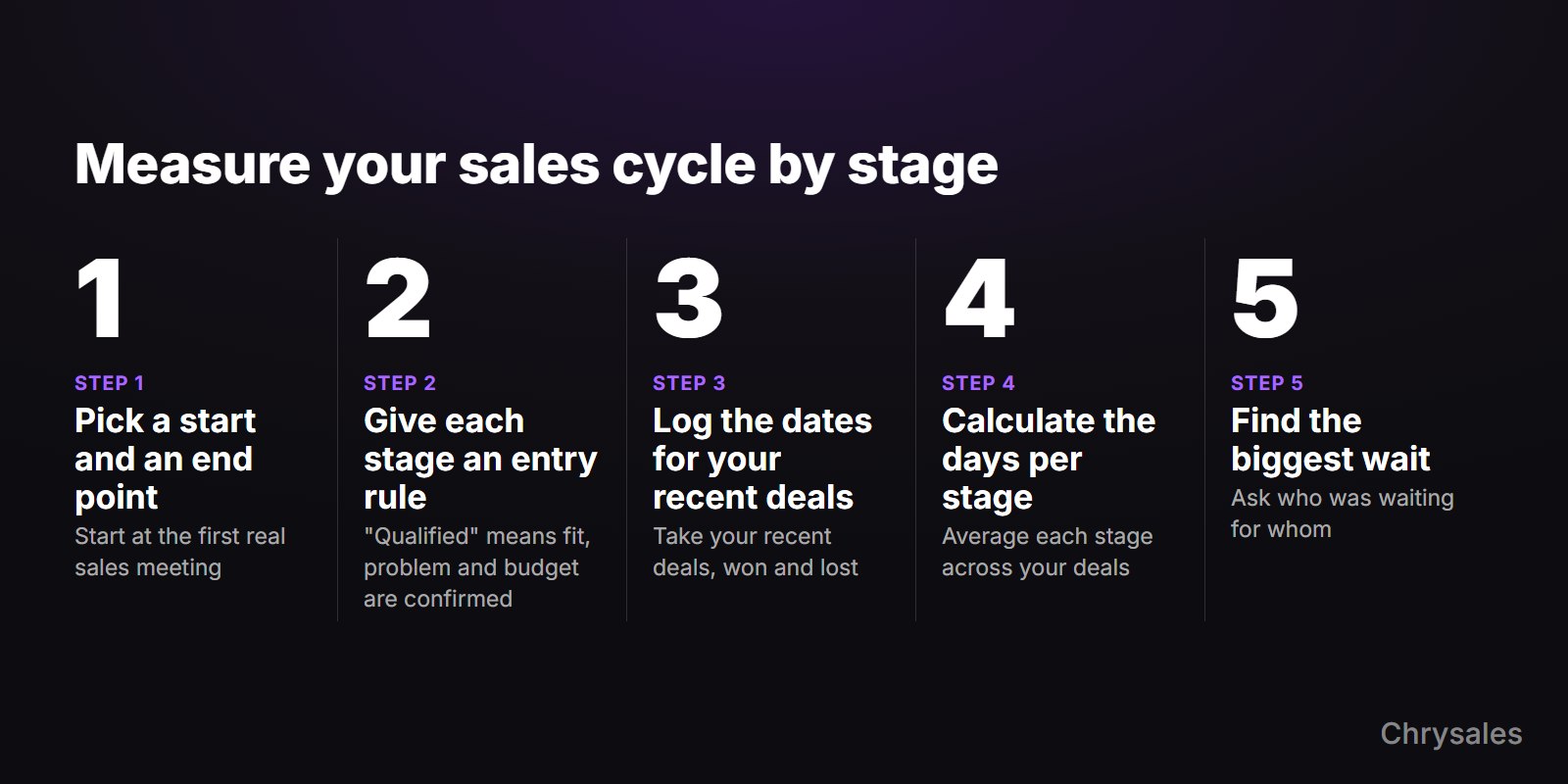
Your sales cycle is the time from the first sales meeting to a signed contract. Salesforce defines the average sales cycle length as the total number of days your deals took to close, divided by the number of closed deals. That one average hides where the time goes, so also log the date each deal enters every stage, for won and lost deals, and compare the days per stage.
The average only counts closed deals. Deals that stalled for months and then died never show up in it, and those are often the ones that cost you the most time. That's why the stage view matters more than the headline number.
- Pick a start and an end point. Start at the first real sales meeting and end at the signature, and use the same points for every deal.
- Give each stage an entry rule. "Qualified" means fit, problem and budget are confirmed, and "proposal sent" means the buyer has the document. If your stages are vague, define clear pipeline stages before you measure.
- Log the dates for your recent deals. Take your recent deals, won and lost, and write down the date each one entered each stage. Your CRM may already have this, and a spreadsheet works too.
- Calculate the days per stage. Subtract the entry dates, then average each stage across your deals.
- Find the biggest wait. Mark the stage with the most days and ask who was waiting for whom: you, the buyer, or a third person nobody had met.
Here is an example with made-up numbers. A fictional 20-person B2B company averages its last deals by stage:
| Stage | Entry rule | Average days (example) | Who was waiting |
|---|---|---|---|
| First meeting to qualified | fit, problem and budget confirmed | 6 | the seller, for answers |
| Qualified to proposal sent | buyer has the proposal | 19 | the buyer, for the founder's next free slot |
| Proposal sent to verbal yes | decision maker says yes | 27 | the seller, while the buyer "reviews internally" |
| Verbal yes to signed | contract signed | 15 | both sides, for procurement and legal |
| Total | 67 |
In this made-up example, the longest stage is the proposal, and the second longest is the founder's own calendar. Both are on the seller's side to fix.
Industry averages won't help you much here. Published figures disagree and mostly come from vendors. The best documented one, 6sense's 2025 buyer experience report, found a buying cycle of about 10.1 months, but for large purchases where the median deal was $200,000 to $300,000. If you sell smaller deals, that number says nothing about yours, and your own stage times do.
Why do B2B deals take so long?
B2B deals take long for two sets of reasons. On the buyer's side, many people are involved, they disagree, budgets get frozen, and many deals end with no decision at all. On the seller's side, time is lost on deals that were never a fit, on contacts who can't sign, on calls without a next step, and on the founder's full calendar. You control the second list.
The buyer's side is well researched:
- Forrester's State of Business Buying 2024 found that 13 people in the buying organization are involved on average, and 86% of B2B purchases stall.
- In Forrester's 2023 survey of more than 18,000 buyers, 89% said they had a purchase stall, "often due to budget limitations".
- A Gartner survey of 632 B2B buyers found that 74% of buyer teams show unhealthy conflict during the decision.
- In an interview, Matt Dixon, co-author of The JOLT Effect, put a number on deals that end with no decision. "Our research shows that anywhere between 40 and 60% of all deals are actually lost to the customer doing nothing." That research is based on about 2.5 million recorded sales calls.
Dixon also says that most of those losses come from indecision, the fear of making the wrong choice, more than from a buyer who prefers things as they are. Calling more often doesn't remove that fear.
The seller's side is where you start, because these waits are yours to remove:
| Where the time goes | Whose wait | What fixes it |
|---|---|---|
| Deal was never a fit but stays in the pipeline | yours | qualify in the first call |
| You only talk to someone who can't sign | yours | ask early who decides and meet them |
| The call ends with "I'll get back to you" | yours | book the next step during the call |
| The proposal reopens the discussion | yours | write it as a confirmation of what was agreed |
| The founder has no free slot for two weeks | yours | hand parts of the process to someone else |
| Budget cycle, procurement, legal review | the buyer's | ask about them early and start them in parallel |
| People in the buying group disagree | shared | reach each of them before the proposal |
How do you qualify deals earlier?
Qualify in the first call, before you put time into demos or proposals. Find out four things: the problem and what it costs them, who has the final say, whether there is budget and a reason to move soon, and how the company buys (approvals, procurement, contract). If you can't get those answers, the deal isn't ready yet, and your pipeline should show it that way.
Two terms from the MEDDICC sales method help here.
The economic buyer is "the person with the overall authority in the buying decision". The paper process is "the series of steps that follow the Decision Process in how you will go from Decision to signature". In practice that means things like the purchase order, legal review, supplier registration and the signature itself. If nobody asks about the paper process before the decision, a verbal yes can wait for weeks before it becomes a signature.
You can ask all of this in plain words:
1. What happens if this isn't fixed in the next six months?
2. Besides you, who will be part of this decision, and who signs in the end?
3. Is there a budget for this already, or would it need to be approved?
4. Once you decide, what has to happen before a contract can be signed?
   Procurement, legal, a security review, a supplier form?
5. Is there a date that matters to you, like a launch, a new quarter or a new hire?
If the answers show a poor fit, close the deal as lost and tell the prospect so politely. A dead deal in the pipeline still costs you follow-ups and makes your forecast wrong. "If someone isn't a good fit, we don't message them at all," is how Sabir applies the same rule one step earlier, in outreach.
To decide fit before the first call, score leads against your ideal client profile. In a 6-minute tutorial, Sabir shows how to set a strict ideal client profile and filter prospects by four criteria and by geography, so you spend time only on prospects who fit.
How do you reach everyone who has to say yes?
Ask your main contact early who else is involved, then meet those people yourself or give your contact what they need to win them over. Most B2B decisions are made by a group, and the deal can't close until the last person who has to agree is on board. You want each person's concerns on the table before the proposal, while you can still answer them.
Your main contact is often a champion, which MEDDICC describes as "a person who has power, influence, and credibility within the customer's organization." A champion helps, but can't make the others agree. In the Gartner survey on buying-group conflict, groups that reach consensus were 2.5 times more likely to report that their deal was high-quality. That is a correlation, not proof, but it shows why you should reach every member of the buying group before the proposal.
"If you also sell to them, the deal progresses faster," writes Jason Lemkin, founder of SaaStr, about the other people involved in a deal.
- Ask the mapping question in the first or second call.
- Write down each role next to a name: who signs, who will use it, who checks the money, who checks the risk.
- Offer a short call with the people you haven't met, or a one-page summary your contact can forward.
- Ask what each person worries about, and answer it in their terms.
"Besides you, who else will want a say in this, and who signs in the end?"
"Last time your company bought something like this, who joined late and slowed it down?"
"Would it help if I joined a short call with [name], so you don't have to explain it all twice?"
Keep those extra touchpoints few and useful. In a Gartner survey of 632 buyers, published in 2025, 61% of B2B buyers said they prefer a rep-free buying experience, and 73% actively avoid suppliers who send irrelevant outreach. The same release says buyers still want a seller's input on specific questions, such as whether a product fits their company. So a call with the finance owner about the numbers is a better use of their time than another generic check-in.
What should happen at the end of every sales call?
Every sales call should end with a next step that has a date, a time and named people, booked while you are both still on the call. A vague ending like "I'll get back to you next week" leaves the next step without a date. For deals with several steps, add a short mutual action plan: a shared list of what both sides will do, by whom and by when, up to the signature.
Sandler calls agreements like this upfront contracts: "mutual agreements between buyers and sellers", made out loud, about the agenda of a meeting up to the next steps. You set it at the start of the call ("by the end, let's decide whether a next step makes sense") and close it at the end.
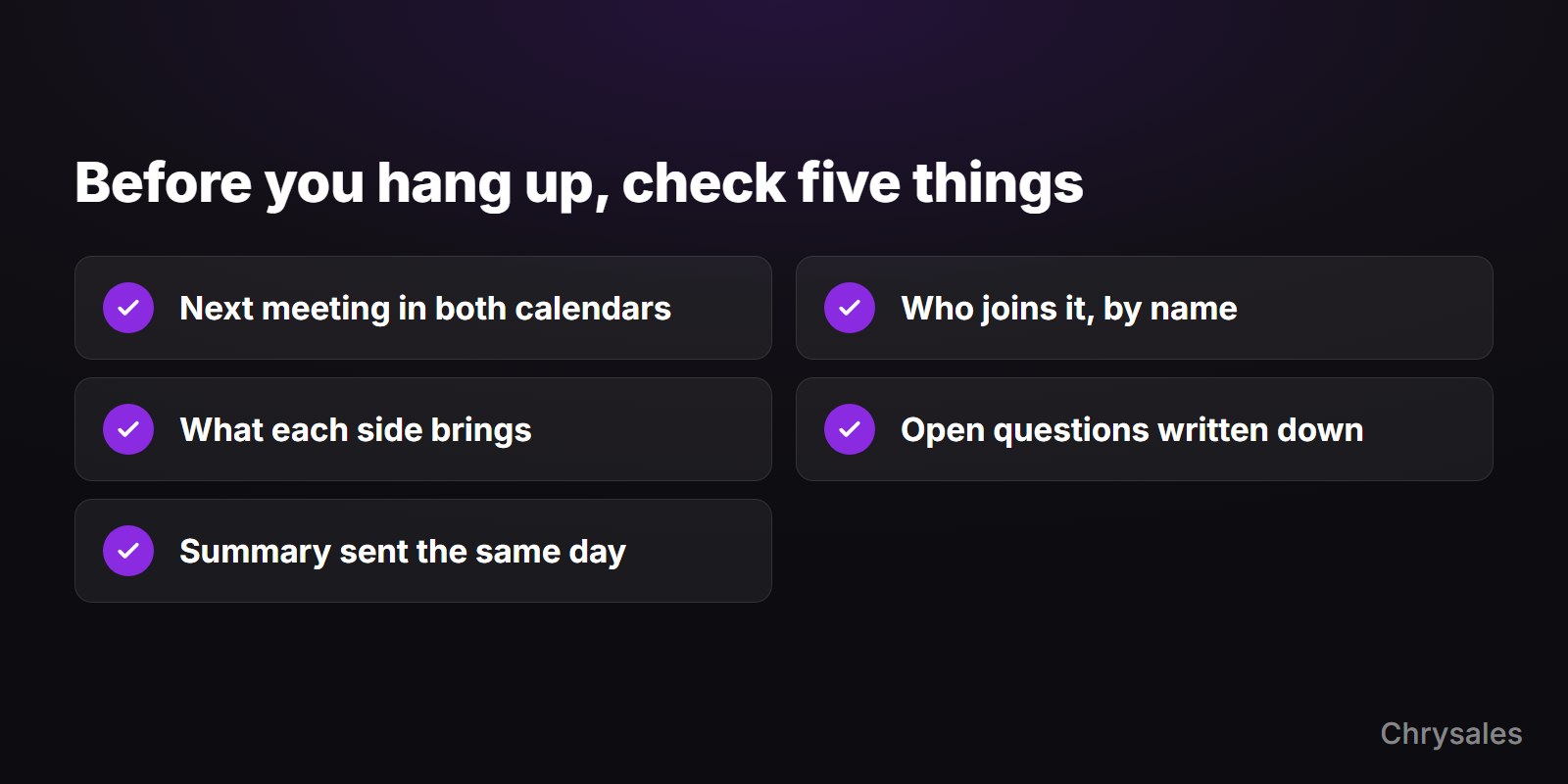
Before you hang up, check five things:
- Next meeting in both calendars
- Who joins it, by name
- What each side brings
- Open questions written down
- Summary sent the same day
A script for the last two minutes:
"Before we hang up, let's put the next step in the calendar.
You said you want to show this to [name] from finance.
Does Thursday at 10 or Friday at 2 work for a 30-minute call with both of you?
I'll send the invite now, with a short summary of what we agreed today."
If the buyer won't commit to any date, that tells you something too. Often the deal has an open concern you haven't heard yet; here is how to handle "I need to think about it" when it comes up.
A mutual action plan is the same idea for the whole deal. No independent study we know of proves that it shortens cycles, so treat it as a practical checklist that both sides can see. Keep it to one page:
Mutual action plan: [Client company] and [Your company]
Goal: [result the client wants] by [date]

Step                                      Owner                 Due
1. Problem and goals agreed               [Client] + [You]      [date]
2. Call with the budget owner             [Client contact]      [date]
3. Proposal walk-through, live            [You]                 [date]
4. Legal and procurement review           [Client legal]        [date]
5. Signature                              [Economic buyer]      [date]
6. Kick-off                               [You] + [Client]      [date]

Open questions: [list]
Next check-in: [date, time]
How do you write a proposal that doesn't stall the deal?
Write the proposal only after the buyer has agreed on the problem, the scope, the rough budget and who signs, so the document confirms what was already said. Then walk through it live with the decision maker instead of emailing it and waiting. A proposal sent before that agreement becomes the start of a new negotiation, and the deal waits while it is "reviewed internally".
Consultant and author Alan Weiss puts it in two lines: "A proposal is a SUMMATION, not an EXPLORATION." and "The sale occurs before the proposal is ever written."
- Check that you're ready. The prospect can explain your solution back in their own words, has given a budget range, and has introduced you to the others involved. More on when to send a proposal and what to agree first.
- Book the walk-through before you send anything. Send the document a few minutes before the call or share your screen.
- Keep it short. Their problem in their words, the outcome, the scope, the price, the start date and how signing works.
- Limit the options. Two or three at most, because every extra option is one more thing for the group to compare.
- Write the paper process into it. Who signs, in which tool, which documents procurement needs, and the target date.
The point about options comes from The JOLT Effect by Matt Dixon and Ted McKenna, which recommends "limiting purchase exploration" because indecisive buyers get stuck comparing options. A proposal with five packages and a menu of add-ons gives a nervous buyer more to compare.
How do you follow up without pushing?
Follow up on the dates you agreed with the buyer, and make each message useful: a summary, an answer to an open question, or something their colleagues need. When a deal stops answering, send two or three short messages over a few weeks, then close it as lost and say so politely. A clean pipeline shows you your real cycle times.
| When | What to send |
|---|---|
| Same day as the call | summary, what was agreed, the booked next step |
| The day before each agreed date | a short reminder with the agenda |
| The day after a missed date | one line with one question |
| About a week later | something useful: an answer, a document their finance team asked for |
| About two weeks later | a closing message that leaves the door open |
Hi [name], I haven't heard back since our call on [date], so I'm guessing
[project] has moved down the list. I'll close it on my side for now.
If it comes back up, reply here and we'll pick it up from the plan we made.
The closing message saves you from chasing, and it gives the buyer an easy way to say "not now". If you want to time your messages by what the buyer does, such as a visit to your pricing page or a new person in the thread, read how to follow up on buying signals.
Does a discount shorten the sales cycle?
A discount can close one deal faster, but as a habit it slows your deals down. Buyers who learn that you discount at month-end or quarter-end start waiting for it. Many stalls come from indecision, budget and disagreement inside the buyer's company, and a discount fixes none of those.
Jason Lemkin described the pattern to CFO Dive. Buyers who know the cadence "may just wait until the end of the month or quarter, ask for the biggest discount, and sign then," he said. Discount levels for the same deal also "typically vary immensely from one sales representative to the next", according to the pricing consultancy Simon-Kucher. Once you have salespeople, unplanned discounts turn into a habit of the team, and buyers notice.
When a buyer hesitates over price, check whether the concern is really risk or timing before you touch the price. Change the deal shape and keep the price:
| Instead of a discount | Offer this | Why it helps |
|---|---|---|
| Lower price | a smaller first phase with clear success criteria | less risk for the buyer, same price per unit of work |
| Lower price to sign this month | a later start date | the buyer signs now, starts when they are ready |
| Lower price for a tight budget | payments split over the project | fits the budget without cutting value |
| Lower price for "too much" | a reduced scope | they pay for what they need now |
| Lower price because they're nervous | an agreed review point after the first phase | the decision feels reversible |
The JOLT Effect names "Taking risk off the table" as one of the remedies for indecision. Each option in that table does that without teaching buyers to wait.
When can't you shorten the sales cycle?
You can't shorten the parts of the cycle that belong to the buyer's company: annual budget cycles, required pilots, procurement, legal and security reviews, and the time a large group needs to agree. What you can do is find out about them in the first calls, start them early and run them in parallel, so they don't begin only after a verbal yes.
Plan around these waits. As Jason Lemkin of SaaStr puts it: "You can't change budgeting cycles, the need to do pilots, etc."
- Ask about the paper process in the first or second call, with the questions from the qualification section.
- Ask for the supplier forms, security questions and contract template while the buyer is still deciding.
- If a pilot is required, agree on its success criteria and end date before it starts.
- If the budget is set once a year, ask when, and whether this could go into the next one.
- Put all of it in the mutual action plan with owners and dates.
One wait looks like the buyer's but is often yours: the founder's calendar. If every second meeting slips a week because you're delivering projects, the cycle grows no matter how good the buyer is. That's the point where the founder becomes the bottleneck and parts of the process need to move to someone else.
Common mistakes when trying to close faster
Most attempts to speed up deals fail in the same few ways. Each one feels like progress and adds weeks, so check your last few deals against this list.
- Fake urgency. Deadlines that aren't real ("this price ends Friday") teach buyers that your dates move, so use real ones: their launch, their quarter, your team's start capacity.
- Sending the proposal before the buyer agrees on scope and budget, which turns it into a negotiation.
- One contact only. If your contact can't convince the others, the deal stalls where you can't see it, so ask who else decides in the first calls.
- Chasing without a reason. Every follow-up needs a date you agreed on or something useful, and "just checking in" has neither.
- Overpromising to win. Canada's business development bank BDC calls overpromising "in order to get a deal" one of the biggest B2B sales mistakes. A promise the buyer doubts gives them one more reason to hesitate before signing.
- Not measuring. Without days per stage you fix the wrong thing. Log the dates for your recent deals before changing your process.
FAQ
What is a normal B2B sales cycle length?
There is no reliable single number for small and mid-sized B2B companies. Published averages disagree and mostly come from vendors. 6sense's 2025 report found about 10.1 months, but in a survey of large purchases where the median was $200,000 to $300,000. Measure your own cycle by stage instead.
Does a shorter sales cycle mean more revenue?
It can, even at the same price. VC Tomasz Tunguz calculates sales velocity by multiplying the deals in progress by the win rate and the average deal size, then dividing by the sales cycle length. A shorter cycle raises that number, as long as the win rate and deal size hold.
Can automation or AI shorten the sales cycle?
Automation helps with the mechanical parts: reminders, summaries, scheduling and keeping the pipeline up to date. Deals stall on decisions, and Sabir's view is that a deal is won in moments a tool can't handle, such as hearing hesitation and finding the real objection behind "let me think about it". Use tools to remove admin delays, and keep the conversations human.
How long should you keep following up on a stalled deal?
Follow up on the dates you agreed, and when the buyer stops answering, send two or three useful messages over a few weeks. Then close the deal as lost with a polite message that leaves the door open. A deal that stays "open" for months makes your cycle numbers and your forecast wrong.
Sources
- Salesforce - Sales cycle length: how it's calculated and why it's important
- Tomasz Tunguz - Sales velocity
- Gartner via MarketScreener - Gartner sales survey finds 61% of B2B buyers prefer a rep-free buying experience
- Gartner via Communications Today - Buying group conflict and consensus
- Forrester - The State of Business Buying 2024
- Forrester - 2023 B2B buyers survey press release
- Forrester - What It Means podcast: the state of B2B buying (2023 survey)
- CustomerThink - The problem of customer indecision, interview with Matt Dixon
- 6sense - 2025 B2B Buyer Experience Report
- MEDDICC - MEDDPICC sales methodology and process
- Sandler - Upfront contracts
- Alan Weiss - How to write a short, effective proposal
- SaaStr - Tips for shortening enterprise sales cycles
- CFO Dive - Model discounts into pricing, SaaS specialist says
- Simon-Kucher via The Pricing Advisor - Successful customer discounting in B2B
- BDC - 5 B2B sales mistakes your business must avoid
Want this built for your business? Chrysales sets up the outreach, pipeline and closing system with you and your team. Book a free strategy call
To shorten a B2B sales cycle, start by measuring how many days your deals spend in each stage, from the first meeting to the signature. Then remove the waiting you add yourself: deals that were never a fit, talks with people who can't sign, calls without a booked next step, and proposals that reopen the discussion. Some time belongs to the buyer (budget approval, procurement, legal), and you plan around it rather than cut it. Discounts and fake deadlines are the wrong tools, because buyers learn to wait for them.
This is for you if you still sit in most of your company's deals and those deals drag on for months. You'll leave with a way to measure your cycle by stage and find the waits worth fixing first, plus scripts and a plan template to copy.
How do you measure your sales cycle before you shorten it?
Your sales cycle is the time from the first sales meeting to a signed contract. Salesforce defines the average sales cycle length as the total number of days your deals took to close, divided by the number of closed deals. That one average hides where the time goes, so also log the date each deal enters every stage, for won and lost deals, and compare the days per stage.
The average only counts closed deals. Deals that stalled for months and then died never show up in it, and those are often the ones that cost you the most time. That's why the stage view matters more than the headline number.
- Pick a start and an end point. Start at the first real sales meeting and end at the signature, and use the same points for every deal.
- Give each stage an entry rule. "Qualified" means fit, problem and budget are confirmed, and "proposal sent" means the buyer has the document. If your stages are vague, define clear pipeline stages before you measure.
- Log the dates for your recent deals. Take your recent deals, won and lost, and write down the date each one entered each stage. Your CRM may already have this, and a spreadsheet works too.
- Calculate the days per stage. Subtract the entry dates, then average each stage across your deals.
- Find the biggest wait. Mark the stage with the most days and ask who was waiting for whom: you, the buyer, or a third person nobody had met.
Here is an example with made-up numbers. A fictional 20-person B2B company averages its last deals by stage:
| Stage | Entry rule | Average days (example) | Who was waiting |
|---|---|---|---|
| First meeting to qualified | fit, problem and budget confirmed | 6 | the seller, for answers |
| Qualified to proposal sent | buyer has the proposal | 19 | the buyer, for the founder's next free slot |
| Proposal sent to verbal yes | decision maker says yes | 27 | the seller, while the buyer "reviews internally" |
| Verbal yes to signed | contract signed | 15 | both sides, for procurement and legal |
| Total | 67 |
In this made-up example, the longest stage is the proposal, and the second longest is the founder's own calendar. Both are on the seller's side to fix.
Industry averages won't help you much here. Published figures disagree and mostly come from vendors. The best documented one, 6sense's 2025 buyer experience report, found a buying cycle of about 10.1 months, but for large purchases where the median deal was $200,000 to $300,000. If you sell smaller deals, that number says nothing about yours, and your own stage times do.
Why do B2B deals take so long?
B2B deals take long for two sets of reasons. On the buyer's side, many people are involved, they disagree, budgets get frozen, and many deals end with no decision at all. On the seller's side, time is lost on deals that were never a fit, on contacts who can't sign, on calls without a next step, and on the founder's full calendar. You control the second list.
The buyer's side is well researched:
- Forrester's State of Business Buying 2024 found that 13 people in the buying organization are involved on average, and 86% of B2B purchases stall.
- In Forrester's 2023 survey of more than 18,000 buyers, 89% said they had a purchase stall, "often due to budget limitations".
- A Gartner survey of 632 B2B buyers found that 74% of buyer teams show unhealthy conflict during the decision.
- In an interview, Matt Dixon, co-author of The JOLT Effect, put a number on deals that end with no decision. "Our research shows that anywhere between 40 and 60% of all deals are actually lost to the customer doing nothing." That research is based on about 2.5 million recorded sales calls.
Dixon also says that most of those losses come from indecision, the fear of making the wrong choice, more than from a buyer who prefers things as they are. Calling more often doesn't remove that fear.
The seller's side is where you start, because these waits are yours to remove:
| Where the time goes | Whose wait | What fixes it |
|---|---|---|
| Deal was never a fit but stays in the pipeline | yours | qualify in the first call |
| You only talk to someone who can't sign | yours | ask early who decides and meet them |
| The call ends with "I'll get back to you" | yours | book the next step during the call |
| The proposal reopens the discussion | yours | write it as a confirmation of what was agreed |
| The founder has no free slot for two weeks | yours | hand parts of the process to someone else |
| Budget cycle, procurement, legal review | the buyer's | ask about them early and start them in parallel |
| People in the buying group disagree | shared | reach each of them before the proposal |
How do you qualify deals earlier?
Qualify in the first call, before you put time into demos or proposals. Find out four things: the problem and what it costs them, who has the final say, whether there is budget and a reason to move soon, and how the company buys (approvals, procurement, contract). If you can't get those answers, the deal isn't ready yet, and your pipeline should show it that way.
Two terms from the MEDDICC sales method help here.
The economic buyer is "the person with the overall authority in the buying decision". The paper process is "the series of steps that follow the Decision Process in how you will go from Decision to signature". In practice that means things like the purchase order, legal review, supplier registration and the signature itself. If nobody asks about the paper process before the decision, a verbal yes can wait for weeks before it becomes a signature.
You can ask all of this in plain words:
1. What happens if this isn't fixed in the next six months?
2. Besides you, who will be part of this decision, and who signs in the end?
3. Is there a budget for this already, or would it need to be approved?
4. Once you decide, what has to happen before a contract can be signed?
   Procurement, legal, a security review, a supplier form?
5. Is there a date that matters to you, like a launch, a new quarter or a new hire?
If the answers show a poor fit, close the deal as lost and tell the prospect so politely. A dead deal in the pipeline still costs you follow-ups and makes your forecast wrong. "If someone isn't a good fit, we don't message them at all," is how Sabir applies the same rule one step earlier, in outreach.
To decide fit before the first call, score leads against your ideal client profile. In a 6-minute tutorial, Sabir shows how to set a strict ideal client profile and filter prospects by four criteria and by geography, so you spend time only on prospects who fit.
How do you reach everyone who has to say yes?
Ask your main contact early who else is involved, then meet those people yourself or give your contact what they need to win them over. Most B2B decisions are made by a group, and the deal can't close until the last person who has to agree is on board. You want each person's concerns on the table before the proposal, while you can still answer them.
Your main contact is often a champion, which MEDDICC describes as "a person who has power, influence, and credibility within the customer's organization." A champion helps, but can't make the others agree. In the Gartner survey on buying-group conflict, groups that reach consensus were 2.5 times more likely to report that their deal was high-quality. That is a correlation, not proof, but it shows why you should reach every member of the buying group before the proposal.
"If you also sell to them, the deal progresses faster," writes Jason Lemkin, founder of SaaStr, about the other people involved in a deal.
- Ask the mapping question in the first or second call.
- Write down each role next to a name: who signs, who will use it, who checks the money, who checks the risk.
- Offer a short call with the people you haven't met, or a one-page summary your contact can forward.
- Ask what each person worries about, and answer it in their terms.
"Besides you, who else will want a say in this, and who signs in the end?"
"Last time your company bought something like this, who joined late and slowed it down?"
"Would it help if I joined a short call with [name], so you don't have to explain it all twice?"
Keep those extra touchpoints few and useful. In a Gartner survey of 632 buyers, published in 2025, 61% of B2B buyers said they prefer a rep-free buying experience, and 73% actively avoid suppliers who send irrelevant outreach. The same release says buyers still want a seller's input on specific questions, such as whether a product fits their company. So a call with the finance owner about the numbers is a better use of their time than another generic check-in.
What should happen at the end of every sales call?
Every sales call should end with a next step that has a date, a time and named people, booked while you are both still on the call. A vague ending like "I'll get back to you next week" leaves the next step without a date. For deals with several steps, add a short mutual action plan: a shared list of what both sides will do, by whom and by when, up to the signature.
Sandler calls agreements like this upfront contracts: "mutual agreements between buyers and sellers", made out loud, about the agenda of a meeting up to the next steps. You set it at the start of the call ("by the end, let's decide whether a next step makes sense") and close it at the end.
Before you hang up, check five things:
- Next meeting in both calendars
- Who joins it, by name
- What each side brings
- Open questions written down
- Summary sent the same day
A script for the last two minutes:
"Before we hang up, let's put the next step in the calendar.
You said you want to show this to [name] from finance.
Does Thursday at 10 or Friday at 2 work for a 30-minute call with both of you?
I'll send the invite now, with a short summary of what we agreed today."
If the buyer won't commit to any date, that tells you something too. Often the deal has an open concern you haven't heard yet; here is how to handle "I need to think about it" when it comes up.
A mutual action plan is the same idea for the whole deal. No independent study we know of proves that it shortens cycles, so treat it as a practical checklist that both sides can see. Keep it to one page:
Mutual action plan: [Client company] and [Your company]
Goal: [result the client wants] by [date]

Step                                      Owner                 Due
1. Problem and goals agreed               [Client] + [You]      [date]
2. Call with the budget owner             [Client contact]      [date]
3. Proposal walk-through, live            [You]                 [date]
4. Legal and procurement review           [Client legal]        [date]
5. Signature                              [Economic buyer]      [date]
6. Kick-off                               [You] + [Client]      [date]

Open questions: [list]
Next check-in: [date, time]
How do you write a proposal that doesn't stall the deal?
Write the proposal only after the buyer has agreed on the problem, the scope, the rough budget and who signs, so the document confirms what was already said. Then walk through it live with the decision maker instead of emailing it and waiting. A proposal sent before that agreement becomes the start of a new negotiation, and the deal waits while it is "reviewed internally".
Consultant and author Alan Weiss puts it in two lines: "A proposal is a SUMMATION, not an EXPLORATION." and "The sale occurs before the proposal is ever written."
- Check that you're ready. The prospect can explain your solution back in their own words, has given a budget range, and has introduced you to the others involved. More on when to send a proposal and what to agree first.
- Book the walk-through before you send anything. Send the document a few minutes before the call or share your screen.
- Keep it short. Their problem in their words, the outcome, the scope, the price, the start date and how signing works.
- Limit the options. Two or three at most, because every extra option is one more thing for the group to compare.
- Write the paper process into it. Who signs, in which tool, which documents procurement needs, and the target date.
The point about options comes from The JOLT Effect by Matt Dixon and Ted McKenna, which recommends "limiting purchase exploration" because indecisive buyers get stuck comparing options. A proposal with five packages and a menu of add-ons gives a nervous buyer more to compare.
How do you follow up without pushing?
Follow up on the dates you agreed with the buyer, and make each message useful: a summary, an answer to an open question, or something their colleagues need. When a deal stops answering, send two or three short messages over a few weeks, then close it as lost and say so politely. A clean pipeline shows you your real cycle times.
| When | What to send |
|---|---|
| Same day as the call | summary, what was agreed, the booked next step |
| The day before each agreed date | a short reminder with the agenda |
| The day after a missed date | one line with one question |
| About a week later | something useful: an answer, a document their finance team asked for |
| About two weeks later | a closing message that leaves the door open |
Hi [name], I haven't heard back since our call on [date], so I'm guessing
[project] has moved down the list. I'll close it on my side for now.
If it comes back up, reply here and we'll pick it up from the plan we made.
The closing message saves you from chasing, and it gives the buyer an easy way to say "not now". If you want to time your messages by what the buyer does, such as a visit to your pricing page or a new person in the thread, read how to follow up on buying signals.
Does a discount shorten the sales cycle?
A discount can close one deal faster, but as a habit it slows your deals down. Buyers who learn that you discount at month-end or quarter-end start waiting for it. Many stalls come from indecision, budget and disagreement inside the buyer's company, and a discount fixes none of those.
Jason Lemkin described the pattern to CFO Dive. Buyers who know the cadence "may just wait until the end of the month or quarter, ask for the biggest discount, and sign then," he said. Discount levels for the same deal also "typically vary immensely from one sales representative to the next", according to the pricing consultancy Simon-Kucher. Once you have salespeople, unplanned discounts turn into a habit of the team, and buyers notice.
When a buyer hesitates over price, check whether the concern is really risk or timing before you touch the price. Change the deal shape and keep the price:
| Instead of a discount | Offer this | Why it helps |
|---|---|---|
| Lower price | a smaller first phase with clear success criteria | less risk for the buyer, same price per unit of work |
| Lower price to sign this month | a later start date | the buyer signs now, starts when they are ready |
| Lower price for a tight budget | payments split over the project | fits the budget without cutting value |
| Lower price for "too much" | a reduced scope | they pay for what they need now |
| Lower price because they're nervous | an agreed review point after the first phase | the decision feels reversible |
The JOLT Effect names "Taking risk off the table" as one of the remedies for indecision. Each option in that table does that without teaching buyers to wait.
When can't you shorten the sales cycle?
You can't shorten the parts of the cycle that belong to the buyer's company: annual budget cycles, required pilots, procurement, legal and security reviews, and the time a large group needs to agree. What you can do is find out about them in the first calls, start them early and run them in parallel, so they don't begin only after a verbal yes.
Plan around these waits. As Jason Lemkin of SaaStr puts it: "You can't change budgeting cycles, the need to do pilots, etc."
- Ask about the paper process in the first or second call, with the questions from the qualification section.
- Ask for the supplier forms, security questions and contract template while the buyer is still deciding.
- If a pilot is required, agree on its success criteria and end date before it starts.
- If the budget is set once a year, ask when, and whether this could go into the next one.
- Put all of it in the mutual action plan with owners and dates.
One wait looks like the buyer's but is often yours: the founder's calendar. If every second meeting slips a week because you're delivering projects, the cycle grows no matter how good the buyer is. That's the point where the founder becomes the bottleneck and parts of the process need to move to someone else.
Common mistakes when trying to close faster
Most attempts to speed up deals fail in the same few ways. Each one feels like progress and adds weeks, so check your last few deals against this list.
- Fake urgency. Deadlines that aren't real ("this price ends Friday") teach buyers that your dates move, so use real ones: their launch, their quarter, your team's start capacity.
- Sending the proposal before the buyer agrees on scope and budget, which turns it into a negotiation.
- One contact only. If your contact can't convince the others, the deal stalls where you can't see it, so ask who else decides in the first calls.
- Chasing without a reason. Every follow-up needs a date you agreed on or something useful, and "just checking in" has neither.
- Overpromising to win. Canada's business development bank BDC calls overpromising "in order to get a deal" one of the biggest B2B sales mistakes. A promise the buyer doubts gives them one more reason to hesitate before signing.
- Not measuring. Without days per stage you fix the wrong thing. Log the dates for your recent deals before changing your process.
FAQ
What is a normal B2B sales cycle length?
There is no reliable single number for small and mid-sized B2B companies. Published averages disagree and mostly come from vendors. 6sense's 2025 report found about 10.1 months, but in a survey of large purchases where the median was $200,000 to $300,000. Measure your own cycle by stage instead.
Does a shorter sales cycle mean more revenue?
It can, even at the same price. VC Tomasz Tunguz calculates sales velocity by multiplying the deals in progress by the win rate and the average deal size, then dividing by the sales cycle length. A shorter cycle raises that number, as long as the win rate and deal size hold.
Can automation or AI shorten the sales cycle?
Automation helps with the mechanical parts: reminders, summaries, scheduling and keeping the pipeline up to date. Deals stall on decisions, and Sabir's view is that a deal is won in moments a tool can't handle, such as hearing hesitation and finding the real objection behind "let me think about it". Use tools to remove admin delays, and keep the conversations human.
How long should you keep following up on a stalled deal?
Follow up on the dates you agreed, and when the buyer stops answering, send two or three useful messages over a few weeks. Then close the deal as lost with a polite message that leaves the door open. A deal that stays "open" for months makes your cycle numbers and your forecast wrong.
Sources
- Salesforce - Sales cycle length: how it's calculated and why it's important
- Tomasz Tunguz - Sales velocity
- Gartner via MarketScreener - Gartner sales survey finds 61% of B2B buyers prefer a rep-free buying experience
- Gartner via Communications Today - Buying group conflict and consensus
- Forrester - The State of Business Buying 2024
- Forrester - 2023 B2B buyers survey press release
- Forrester - What It Means podcast: the state of B2B buying (2023 survey)
- CustomerThink - The problem of customer indecision, interview with Matt Dixon
- 6sense - 2025 B2B Buyer Experience Report
- MEDDICC - MEDDPICC sales methodology and process
- Sandler - Upfront contracts
- Alan Weiss - How to write a short, effective proposal
- SaaStr - Tips for shortening enterprise sales cycles
- CFO Dive - Model discounts into pricing, SaaS specialist says
- Simon-Kucher via The Pricing Advisor - Successful customer discounting in B2B
- BDC - 5 B2B sales mistakes your business must avoid
Want this built for your business? Chrysales sets up the outreach, pipeline and closing system with you and your team. Book a free strategy call
Scaling Is Not Hard If You Have The Right Systems
If you’re serious about leveling up your scaling game, you need the right system, the right training, and the right team behind you. We're here to give you the exact tools and strategies top entrepreneurs use to dominate.

Discover the latest tips
View All
Chrysales was formed from the words "chrysalis" the stage where a caterpillar transforms into a butterfly and "sales".
It stands for one thing: sales transformation.Because scaling doesn’t happen by doing more of the same. Scaling only happens when you go through real transformation in your systems, your offer, team and the way you sell.


