.avif)
How to Make Short Form Video That Converts Leads
How to make short form video that converts means using a strong opening that gets attention, keeps people watching, and leads them to take action. It works best when the hook, proof, and next step are clear.
Here's the thing: most short form videos get scrolled past in 0.8 seconds. Not because they're badly made. Because the first line doesn't grab.
The best cold email in the world won't get read if the subject line doesn't land. Same goes for how to make short form video that converts. The hook is everything.
In this post, we'll break down the exact formula that makes someone stop mid-scroll, watch the whole thing, and actually take action.
Why Most Short Form Videos Fail Before They Even Start
Most teams spend hours editing a 60-second video and three seconds on the opening line. That's backwards.
Think of your hook like the first bite of food at a restaurant. If it's bland, you're not ordering a second dish. If it slaps, you're telling your friends about it.
The data backs this up. Studies show that 65% of viewers who watch the first three seconds will watch at least 10 seconds. But if you lose them in the first second, they're gone. No second chance.
The Three-Second Rule for B2B Sales Content
You have three seconds. That's it.
In that window, your hook needs to do one thing: make the viewer think "wait, this is for me" or "I need to hear this."
Most B2B videos open with a logo. Or a slow pan of an office. Or "Hi, I'm John from XYZ company." None of that works. The scroll wins every time.
A better opening: "We just booked 47 sales calls in 30 days using one cold email tweak." Now you've got attention.
Pro Tip: Record your hook five different ways. Test them. The one that feels a little uncomfortable to say is usually the one that performs best.
The Three Hook Types That Actually Convert Viewers
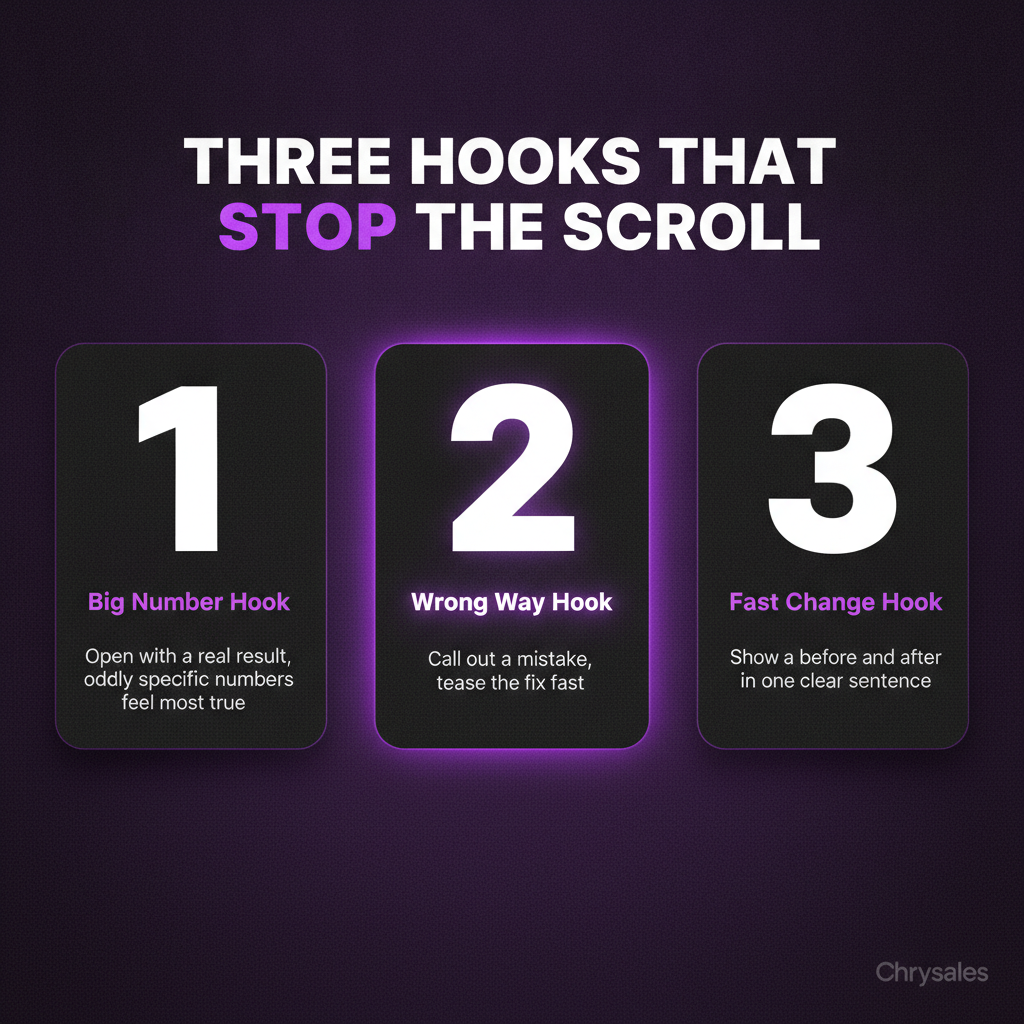
Not all hooks are built the same. Some get clicks. Some get engagement. Some drive lead generation.
Here are the three that work best for B2B lead generation and sales training content.
1. The Big Number Hook
Open with a specific result. A number that makes someone stop.
Examples:
- "This one email template got us a 22% reply rate"
- "We turned down 14 leads last month because our pipeline was full"
- "A 12-person team closed €180K in 60 days with this sales system"
The number has to be real. Round numbers work. But oddly specific ones (like 22% instead of 20%) feel more believable.
This hook type works great for B2B video content lead generation because it signals proof right away. You're not asking for trust. You're showing results upfront.
2. The "You're Doing It Wrong" Hook
People love finding out they've been screwing something up. It's why "common mistakes" content performs so well.
Examples:
- "Most cold emails fail because of this one thing you're not checking"
- "Your sales calls are tanking because you're asking discovery questions too late"
- "If your CRM looks like this, you're losing deals"
This works for client acquisition content because it creates a gap. You're implying the viewer has a problem they didn't know about. Now they want the fix.
Watch out: Don't just call out the mistake. Tease the solution in the first five seconds or they'll scroll anyway.
3. The Fast Transformation Hook
Show before and after, condensed into one sentence.
Examples:
- "We went from 2% close rate to 34% in six weeks"
- "This sales team couldn't hire. Now they're scaling faster than they can onboard."
- "From zero outbound system to 15 booked calls a week"
This is the short form video for B2B version of a case study. People want to see the gap closed fast. The hook sets up the story.
One marketing agency we worked with tested this hook style against a "tips and tricks" opener. The transformation hook got 4x more video completions and double the profile visits.
How to Structure the First Five Seconds After the Hook
The hook grabs them. The next five seconds keep them.
Here's what needs to happen in that window.
Validate the Hook Immediately
If your hook is "This one tweak got us 47 calls in 30 days," your next sentence better explain what the tweak was. Don't stall. Don't build suspense. Give value fast.
Bad follow-up: "Let me tell you a story about how we figured this out..."
Good follow-up: "The tweak? We stopped targeting job titles and started targeting companies that just raised funding."
See the difference? One keeps the promise. One delays it.
Use Visual Proof in the First Frame
If you're talking about results, show them. A screenshot of the calendar. The inbox with replies. A dashboard with the number.
Viewers trust what they see more than what they hear. If your hook mentions a big number, flash it on screen in the first three seconds.
A 30-person consulting firm tried this. They opened a video with "12 discovery calls booked this week" and showed their actual Calendly screenshot in the first frame. Completion rate jumped from 18% to 41%.
Common mistake: Putting the proof at the end of the video. By then, most people are gone.
The Script Formula That Holds Attention All the Way Through
Hook and opening are sorted. Now you need the middle to not suck.
Most videos lose people around the 15-second mark because the script gets boring.
The Three-Beat Structure
Every good short form video that converts follows this pattern:
- Hook (0-3 seconds): the big promise or number
- Proof or explanation (3-20 seconds): why it works or how you did it
- One clear action (20-30 seconds): what they should do next
That's it. Three beats. Don't add more. Don't make it complicated.
Example breakdown:
- Hook: "We booked 22 sales calls in two weeks with zero ad spend"
- Proof: "Here's what we did. We scraped 500 companies from LinkedIn, filtered for two hiring signals, and sent one personalized video to each decision maker. Reply rate was 11%."
- Action: "Start with 50 companies. Find one signal that matters. Send personal videos. Link in bio for the full breakdown."
30 seconds. Three beats. Done.
Cut Every Extra Word
Read your script out loud. If a word doesn't move the story forward, delete it.
"So basically what we did was we kind of tested a bunch of different strategies" becomes "We tested five strategies."
Tight scripts hold attention. Loose ones lose it.
Pro Tip: Aim for 140-160 words per minute when you read your script. That's the sweet spot for B2B video marketing. Faster feels rushed. Slower feels like a lecture.
Where Most Teams Screw Up the Call to Action
You nailed the hook. The video kept attention. Now you need them to do something.
This is where content sales funnel for B2B leads strategy matters most.
The CTA Has to Match the Platform
If you're posting on LinkedIn, "link in bio" doesn't work. LinkedIn doesn't surface bios. The CTA should be "comment the word SYSTEM and I'll send you the guide."
If you're on Instagram or TikTok, "link in bio" works fine. Just make sure the link actually goes somewhere useful, not your homepage.
If you're using short form video for sales outreach, the CTA might be "reply to this email with your biggest objection and I'll send you a custom breakdown." That's personal. That's useful.
One CTA Only
Don't ask people to like, comment, follow, and click the link. Pick one. The more options you give, the less action you get.
We see this all the time with new clients. They'll end a video with "Follow for more tips, check the link for our free guide, and drop a comment if you have questions." That's three asks. Most people do zero.
Better: "Comment the word LEADS and I'll send you the exact email template." One action. Clear. Easy.
A 15-person consulting firm tested this. Single CTA videos got 6x more comments than multi-CTA videos.
How to Repurpose Long Form Video to Short Clips Without Losing Impact
Most teams already have long form content. Sales calls. Webinars. Podcasts. Internal training videos.
You don't need to start from scratch.
Find the Standalone Moments
Go through your long form video and find the 30-60 second chunks that make sense on their own.
Look for:
- A clear question and answer
- A single tip or insight
- A quick story with a punchline
- A stat with context
Don't just chop random clips. Each clip needs to work as its own piece.
One tech company had a 40-minute webinar on sales automation. They pulled eight clips. Each one answered a different question: "What's the first automation to set up?" "How do you score leads?" "What tools do you actually need?"
Each clip drove traffic back to the full webinar. Conversion from clip viewers to webinar watchers was 28%.
Add Captions and Cut Dead Air
Most people watch short form video with the sound off. Captions aren't optional.
Also, cut every pause. Every "um." Every breath longer than half a second.
Long form can breathe. Short form can't.
Editing tight is what separates content that converts from content that gets skipped.
Watch out: Don't over-edit to the point where it feels robotic. A natural pause after a big point is fine. Five seconds of silence while you think is not.
Why Short Form Video Works Better with a Sales System Behind It
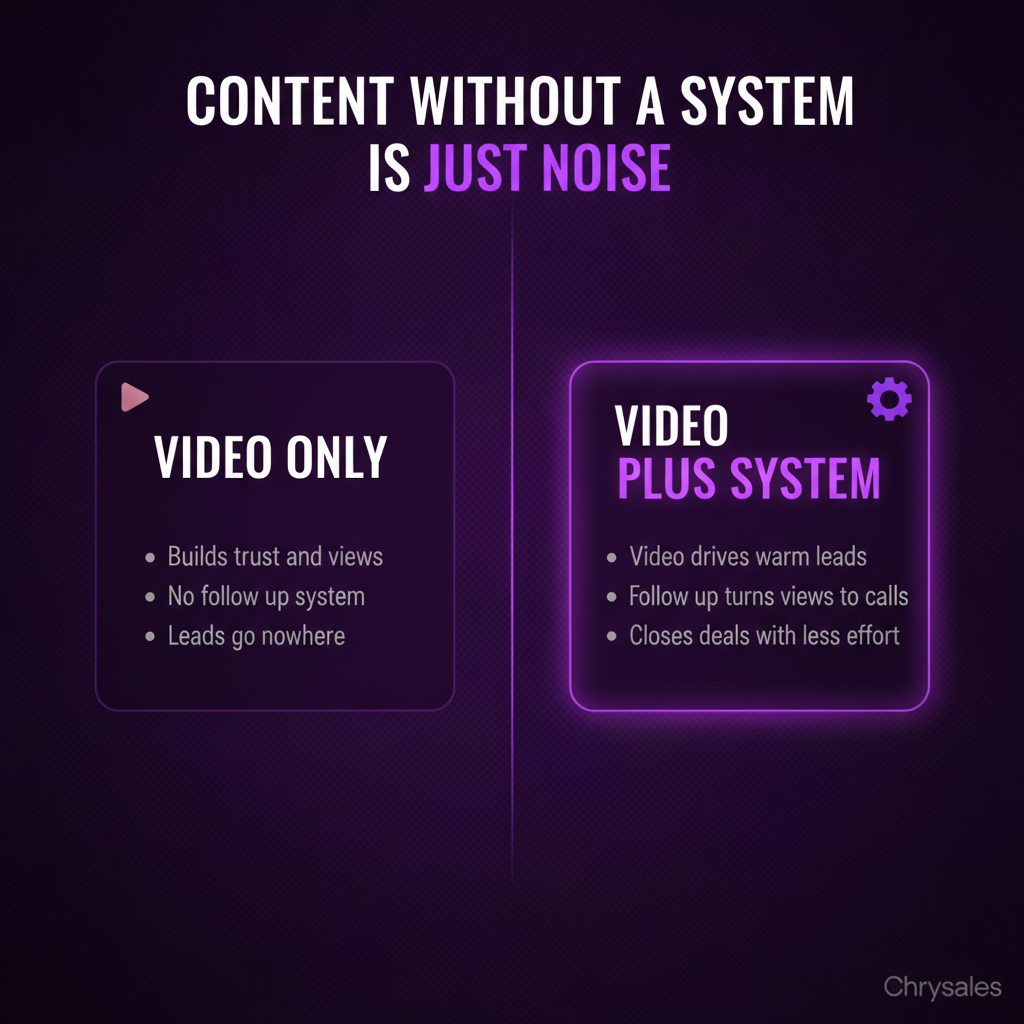
Here's the truth nobody tells you: short form video alone won't get you clients. It builds awareness. It builds trust. But without a system to convert that attention into client acquisition, it's just content.
Short Form Video as a Trust Builder
Think of video as the top of your sales funnel. Someone sees your clip. They check your profile. They see more clips. Now they trust you a little.
When you reach out in a cold email or a DM, you're not a stranger anymore. You're the person from the video. Reply rates go up. Objection handling gets easier. The close happens faster.
We worked with a marketing agency that posted three short videos a week for two months. They didn't go viral. Average views were around 800. But when they sent cold outreach, 40% of recipients said "I've seen your videos." Close rate doubled.
The Follow-Up System Matters More Than the Video
Here's what a real system looks like:
- Post short form video with one clear CTA
- Capture leads (email, comment, DM, whatever)
- Send immediate follow-up with next step (book a call, download guide, watch longer video)
- Nurture with email or retargeting if they don't convert right away
Most teams stop at step one. They post the video and hope. That's not a sales system. That's content marketing without a plan.
If you're spending time making how to make short form video that converts, spend equal time building the system that turns views into conversations and conversations into closed deals. You can watch how to build a sales system so powerful clients come to you for a deeper walkthrough of this approach.
Pro Tip: Track where your leads come from. If 30% of your booked calls saw a video first, double down on video. If it's 2%, your time might be better spent elsewhere. Let the data decide.
Frequently Asked Questions
Q: How long should a short form video be for B2B sales content?
Aim for 30-60 seconds. Anything under 20 seconds feels too rushed to deliver real value. Anything over 90 seconds loses attention unless the content is incredibly tight. The sweet spot for how to make short form video that converts in B2B is around 45 seconds. That's enough time for a hook, proof, and a clear CTA without dragging. Test different lengths and watch your completion rates. If people drop off at 40 seconds, your videos are too long.
Q: Do I need expensive equipment to make short form video work?
No. A phone camera and decent lighting are enough. Most successful B2B video content is shot on an iPhone in a quiet room with a window for natural light. What matters more than gear is the script and the hook. A perfectly lit video with a weak opening still gets scrolled past. A phone video with a strong hook and clear value keeps attention. If you want to level up, invest in a cheap lapel mic. Audio quality matters more than video quality for B2B lead generation content.
Q: Should I show my face or can I use screen recordings and text overlays?
Both work, but face-to-camera builds trust faster. People buy from people, especially in B2B sales. Seeing your face makes you real. That said, screen recordings with voiceover work great for tutorial-style content or case study breakdowns. A mix of both is ideal. Use face-to-camera for thought leadership and trust-building. Use screen shares for step-by-step how-tos and data walkthroughs. Don't hide behind text-only videos. They feel generic and don't build the same connection.
Q: How often should I post short form video to see results?
Three to five times a week is the minimum to build momentum. Posting once a week won't cut through the noise. Daily is better if you can maintain quality, but don't sacrifice the script just to hit a posting schedule. Consistency matters more than frequency. If you commit to three videos a week and actually do it for 90 days, you'll see traction. One viral video won't change your business. A steady flow of solid content that supports your sales system will. Track what works and do more of that.
Q: Can short form video actually replace cold outreach for client acquisition?
No, but it makes outreach way more effective. Short form video is not a replacement for a sales system. It's a support layer. When someone's already seen your content, your cold email or DM doesn't feel cold anymore. They recognize you. Trust is higher. Reply rates improve. We've seen teams combine short-form video to get clients with cold outreach and double their response rates compared to outreach alone. Use video to build authority and warm up your list. Then reach out with a clear offer. That combo is how you turn content into actual closed deals.
How to make short form video that converts means using a strong opening that gets attention, keeps people watching, and leads them to take action. It works best when the hook, proof, and next step are clear.
Here's the thing: most short form videos get scrolled past in 0.8 seconds. Not because they're badly made. Because the first line doesn't grab.
The best cold email in the world won't get read if the subject line doesn't land. Same goes for how to make short form video that converts. The hook is everything.
In this post, we'll break down the exact formula that makes someone stop mid-scroll, watch the whole thing, and actually take action.
Why Most Short Form Videos Fail Before They Even Start
Most teams spend hours editing a 60-second video and three seconds on the opening line. That's backwards.
Think of your hook like the first bite of food at a restaurant. If it's bland, you're not ordering a second dish. If it slaps, you're telling your friends about it.
The data backs this up. Studies show that 65% of viewers who watch the first three seconds will watch at least 10 seconds. But if you lose them in the first second, they're gone. No second chance.
The Three-Second Rule for B2B Sales Content
You have three seconds. That's it.
In that window, your hook needs to do one thing: make the viewer think "wait, this is for me" or "I need to hear this."
Most B2B videos open with a logo. Or a slow pan of an office. Or "Hi, I'm John from XYZ company." None of that works. The scroll wins every time.
A better opening: "We just booked 47 sales calls in 30 days using one cold email tweak." Now you've got attention.
Pro Tip: Record your hook five different ways. Test them. The one that feels a little uncomfortable to say is usually the one that performs best.
The Three Hook Types That Actually Convert Viewers
Not all hooks are built the same. Some get clicks. Some get engagement. Some drive lead generation.
Here are the three that work best for B2B lead generation and sales training content.
1. The Big Number Hook
Open with a specific result. A number that makes someone stop.
Examples:
- "This one email template got us a 22% reply rate"
- "We turned down 14 leads last month because our pipeline was full"
- "A 12-person team closed €180K in 60 days with this sales system"
The number has to be real. Round numbers work. But oddly specific ones (like 22% instead of 20%) feel more believable.
This hook type works great for B2B video content lead generation because it signals proof right away. You're not asking for trust. You're showing results upfront.
2. The "You're Doing It Wrong" Hook
People love finding out they've been screwing something up. It's why "common mistakes" content performs so well.
Examples:
- "Most cold emails fail because of this one thing you're not checking"
- "Your sales calls are tanking because you're asking discovery questions too late"
- "If your CRM looks like this, you're losing deals"
This works for client acquisition content because it creates a gap. You're implying the viewer has a problem they didn't know about. Now they want the fix.
Watch out: Don't just call out the mistake. Tease the solution in the first five seconds or they'll scroll anyway.
3. The Fast Transformation Hook
Show before and after, condensed into one sentence.
Examples:
- "We went from 2% close rate to 34% in six weeks"
- "This sales team couldn't hire. Now they're scaling faster than they can onboard."
- "From zero outbound system to 15 booked calls a week"
This is the short form video for B2B version of a case study. People want to see the gap closed fast. The hook sets up the story.
One marketing agency we worked with tested this hook style against a "tips and tricks" opener. The transformation hook got 4x more video completions and double the profile visits.
How to Structure the First Five Seconds After the Hook
The hook grabs them. The next five seconds keep them.
Here's what needs to happen in that window.
Validate the Hook Immediately
If your hook is "This one tweak got us 47 calls in 30 days," your next sentence better explain what the tweak was. Don't stall. Don't build suspense. Give value fast.
Bad follow-up: "Let me tell you a story about how we figured this out..."
Good follow-up: "The tweak? We stopped targeting job titles and started targeting companies that just raised funding."
See the difference? One keeps the promise. One delays it.
Use Visual Proof in the First Frame
If you're talking about results, show them. A screenshot of the calendar. The inbox with replies. A dashboard with the number.
Viewers trust what they see more than what they hear. If your hook mentions a big number, flash it on screen in the first three seconds.
A 30-person consulting firm tried this. They opened a video with "12 discovery calls booked this week" and showed their actual Calendly screenshot in the first frame. Completion rate jumped from 18% to 41%.
Common mistake: Putting the proof at the end of the video. By then, most people are gone.
The Script Formula That Holds Attention All the Way Through
Hook and opening are sorted. Now you need the middle to not suck.
Most videos lose people around the 15-second mark because the script gets boring.
The Three-Beat Structure
Every good short form video that converts follows this pattern:
- Hook (0-3 seconds): the big promise or number
- Proof or explanation (3-20 seconds): why it works or how you did it
- One clear action (20-30 seconds): what they should do next
That's it. Three beats. Don't add more. Don't make it complicated.
Example breakdown:
- Hook: "We booked 22 sales calls in two weeks with zero ad spend"
- Proof: "Here's what we did. We scraped 500 companies from LinkedIn, filtered for two hiring signals, and sent one personalized video to each decision maker. Reply rate was 11%."
- Action: "Start with 50 companies. Find one signal that matters. Send personal videos. Link in bio for the full breakdown."
30 seconds. Three beats. Done.
Cut Every Extra Word
Read your script out loud. If a word doesn't move the story forward, delete it.
"So basically what we did was we kind of tested a bunch of different strategies" becomes "We tested five strategies."
Tight scripts hold attention. Loose ones lose it.
Pro Tip: Aim for 140-160 words per minute when you read your script. That's the sweet spot for B2B video marketing. Faster feels rushed. Slower feels like a lecture.
Where Most Teams Screw Up the Call to Action
You nailed the hook. The video kept attention. Now you need them to do something.
This is where content sales funnel for B2B leads strategy matters most.
The CTA Has to Match the Platform
If you're posting on LinkedIn, "link in bio" doesn't work. LinkedIn doesn't surface bios. The CTA should be "comment the word SYSTEM and I'll send you the guide."
If you're on Instagram or TikTok, "link in bio" works fine. Just make sure the link actually goes somewhere useful, not your homepage.
If you're using short form video for sales outreach, the CTA might be "reply to this email with your biggest objection and I'll send you a custom breakdown." That's personal. That's useful.
One CTA Only
Don't ask people to like, comment, follow, and click the link. Pick one. The more options you give, the less action you get.
We see this all the time with new clients. They'll end a video with "Follow for more tips, check the link for our free guide, and drop a comment if you have questions." That's three asks. Most people do zero.
Better: "Comment the word LEADS and I'll send you the exact email template." One action. Clear. Easy.
A 15-person consulting firm tested this. Single CTA videos got 6x more comments than multi-CTA videos.
How to Repurpose Long Form Video to Short Clips Without Losing Impact
Most teams already have long form content. Sales calls. Webinars. Podcasts. Internal training videos.
You don't need to start from scratch.
Find the Standalone Moments
Go through your long form video and find the 30-60 second chunks that make sense on their own.
Look for:
- A clear question and answer
- A single tip or insight
- A quick story with a punchline
- A stat with context
Don't just chop random clips. Each clip needs to work as its own piece.
One tech company had a 40-minute webinar on sales automation. They pulled eight clips. Each one answered a different question: "What's the first automation to set up?" "How do you score leads?" "What tools do you actually need?"
Each clip drove traffic back to the full webinar. Conversion from clip viewers to webinar watchers was 28%.
Add Captions and Cut Dead Air
Most people watch short form video with the sound off. Captions aren't optional.
Also, cut every pause. Every "um." Every breath longer than half a second.
Long form can breathe. Short form can't.
Editing tight is what separates content that converts from content that gets skipped.
Watch out: Don't over-edit to the point where it feels robotic. A natural pause after a big point is fine. Five seconds of silence while you think is not.
Why Short Form Video Works Better with a Sales System Behind It
Here's the truth nobody tells you: short form video alone won't get you clients. It builds awareness. It builds trust. But without a system to convert that attention into client acquisition, it's just content.
Short Form Video as a Trust Builder
Think of video as the top of your sales funnel. Someone sees your clip. They check your profile. They see more clips. Now they trust you a little.
When you reach out in a cold email or a DM, you're not a stranger anymore. You're the person from the video. Reply rates go up. Objection handling gets easier. The close happens faster.
We worked with a marketing agency that posted three short videos a week for two months. They didn't go viral. Average views were around 800. But when they sent cold outreach, 40% of recipients said "I've seen your videos." Close rate doubled.
The Follow-Up System Matters More Than the Video
Here's what a real system looks like:
- Post short form video with one clear CTA
- Capture leads (email, comment, DM, whatever)
- Send immediate follow-up with next step (book a call, download guide, watch longer video)
- Nurture with email or retargeting if they don't convert right away
Most teams stop at step one. They post the video and hope. That's not a sales system. That's content marketing without a plan.
If you're spending time making how to make short form video that converts, spend equal time building the system that turns views into conversations and conversations into closed deals. You can watch how to build a sales system so powerful clients come to you for a deeper walkthrough of this approach.
Pro Tip: Track where your leads come from. If 30% of your booked calls saw a video first, double down on video. If it's 2%, your time might be better spent elsewhere. Let the data decide.
Frequently Asked Questions
Q: How long should a short form video be for B2B sales content?
Aim for 30-60 seconds. Anything under 20 seconds feels too rushed to deliver real value. Anything over 90 seconds loses attention unless the content is incredibly tight. The sweet spot for how to make short form video that converts in B2B is around 45 seconds. That's enough time for a hook, proof, and a clear CTA without dragging. Test different lengths and watch your completion rates. If people drop off at 40 seconds, your videos are too long.
Q: Do I need expensive equipment to make short form video work?
No. A phone camera and decent lighting are enough. Most successful B2B video content is shot on an iPhone in a quiet room with a window for natural light. What matters more than gear is the script and the hook. A perfectly lit video with a weak opening still gets scrolled past. A phone video with a strong hook and clear value keeps attention. If you want to level up, invest in a cheap lapel mic. Audio quality matters more than video quality for B2B lead generation content.
Q: Should I show my face or can I use screen recordings and text overlays?
Both work, but face-to-camera builds trust faster. People buy from people, especially in B2B sales. Seeing your face makes you real. That said, screen recordings with voiceover work great for tutorial-style content or case study breakdowns. A mix of both is ideal. Use face-to-camera for thought leadership and trust-building. Use screen shares for step-by-step how-tos and data walkthroughs. Don't hide behind text-only videos. They feel generic and don't build the same connection.
Q: How often should I post short form video to see results?
Three to five times a week is the minimum to build momentum. Posting once a week won't cut through the noise. Daily is better if you can maintain quality, but don't sacrifice the script just to hit a posting schedule. Consistency matters more than frequency. If you commit to three videos a week and actually do it for 90 days, you'll see traction. One viral video won't change your business. A steady flow of solid content that supports your sales system will. Track what works and do more of that.
Q: Can short form video actually replace cold outreach for client acquisition?
No, but it makes outreach way more effective. Short form video is not a replacement for a sales system. It's a support layer. When someone's already seen your content, your cold email or DM doesn't feel cold anymore. They recognize you. Trust is higher. Reply rates improve. We've seen teams combine short-form video to get clients with cold outreach and double their response rates compared to outreach alone. Use video to build authority and warm up your list. Then reach out with a clear offer. That combo is how you turn content into actual closed deals.
Scaling Is Not Hard If You Have The Right Systems
If you’re serious about leveling up your scaling game, you need the right system, the right training, and the right team behind you. We're here to give you the exact tools and strategies top entrepreneurs use to dominate.

Discover the latest tips
View All.avif)
Chrysales was formed from the words "chrysalis" the stage where a caterpillar transforms into a butterfly and "sales".
It stands for one thing: sales transformation.Because scaling doesn’t happen by doing more of the same. Scaling only happens when you go through real transformation in your systems, your offer, team and the way you sell.
.avif)


