.avif)
Sales Process vs Sales System: What B2B Teams Miss
A sales system is the full setup behind b2b sales that keeps lead generation, client acquisition, and follow-up working without constant hand-holding. Here's the thing: most B2B companies think they have a sales system. They have a CRM. They have a pitch deck. Maybe they track pipeline stages. But when someone on the team goes on vacation, deals stall. When they hire a new salesperson, it takes four months before they close anything. That's not a system. That's a sales process held together with duct tape and hope.
What a Sales Process Actually Is
A sales process is the sequence of steps a deal moves through from first contact to closed won. It's linear. It looks clean in a flowchart. Prospect → Discovery → Demo → Proposal → Close. You've seen this before. It tells you what happens and in what order. But it doesn't tell you how to make it happen consistently, who does each step, what to say when someone ghosts you, or how to hire the person who runs step three when you're ready to scale.
Why Processes Feel Like Progress
When you first map out your sales process, it feels like a breakthrough. You finally see the stages. You label your CRM columns. You know what "qualified" means for your team. That clarity matters. But a process is just a starting point. It's the skeleton. Without the muscles, nervous system, and organs, it doesn't move on its own.
Common mistake: Teams spend weeks building the perfect process doc, then never look at it again. The doc lives in a Google Drive folder while everyone sells differently.
What a Sales System Really Means
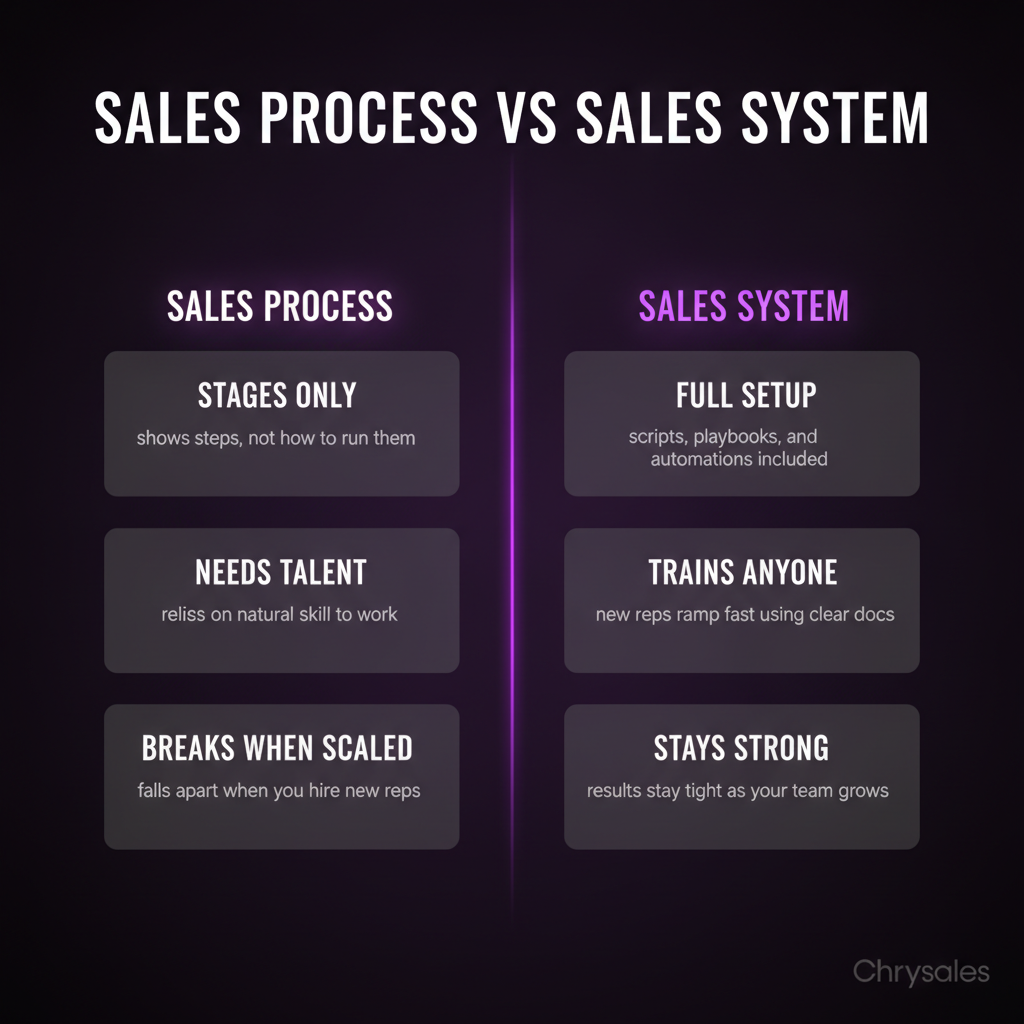
A sales system is the full infrastructure that makes your process work without you babysitting every step. It's the playbooks, the scripts, the automations, the hiring plan, the training docs, the data tracking, the follow-up sequences, and the accountability structure. Picture this: you hire a closer on Monday. By Friday, they've watched your onboarding videos, shadowed three calls, practiced your pitch with feedback, and they know exactly how to handle the five most common objections. That's a sales system.
The Three Layers of a Real Sales System
A complete sales system has three layers. Most teams only build the first one.
Layer 1: The Process Map
The stages and definitions. What qualifies as a lead. What moves someone from discovery to demo. This is table stakes.
Layer 2: The Execution Infrastructure
The how. Your cold email templates. Your discovery call script. Your objection handling doc. The Loom video showing new hires how to log deals in the CRM. The weekly pipeline review meeting structure. This is where most of the work lives.
Layer 3: The Growth Engine
The hiring rubric for your next salesperson. The AI lead scoring model that ranks your pipeline by close probability. The 12 step onboarding checklist that cuts ramp time in half. The feedback loop that updates your playbook every quarter based on what's actually working.
Pro Tip: If you can't hand your sales process to a stranger and have them run a decent call by next week, you don't have a system yet.
Why Most B2B Teams Only Have a Process
Building a process takes a afternoon. Building a sales system takes weeks. Most teams stop after the process because it feels done. You have stages. You have a CRM. You're "organized." But here's what happens next. Your best salesperson closes 60% of qualified leads. Your newest hire closes 18%. Same process. Wildly different results. That gap is the system you haven't built yet.
The Personality Problem
A sales process relies on personality. If your top performer is naturally great at reading the room, handling objections on the fly, and knowing when to push for the close, they'll crush it. The process gives them a loose structure, but they're doing the real work. When you hire someone who doesn't have that natural feel, the process doesn't save them. They follow the stages, but they don't know what to say in step two. They don't know how to recover when a prospect goes quiet. They flounder.
A sales system removes personality as the variable. It gives everyone the script for step two. It tells them exactly when to send the follow up and what to write. It trains them on the recovery move when someone ghosts.
Watch out: If your sales results depend on one or two people, you're one resignation away from a revenue drop. That's a process problem, not a people problem.
The Repeatable Revenue Test
Here's how to know if you have a system or just a process. Ask yourself: can you predict how many deals you'll close next month within a 15% margin of error? If the answer is no, you're missing the system layer. Predictable revenue comes from repeatable actions. Repeatable actions come from documented, trained, and measured systems.
What Repeatability Actually Looks Like
A 20 person consulting firm books 40 discovery calls a month. They convert 30% to demos. They close 50% of demos. Every month, those numbers stay within a tight range. That's repeatability. They know their numbers because their system tracks activity at every stage, as demonstrated in B2B sales metrics benchmarks. They know why the numbers stay consistent because their system trains every rep the same way. They know what breaks when the numbers dip because their system has built in diagnostics.
One marketing agency we worked with had a 0.8% reply rate on cold outreach. After building a system around lead scoring, list hygiene, and message sequencing, they hit 4.2%. The process didn't change. The system around the process did.
The Five Components Every Sales System Needs
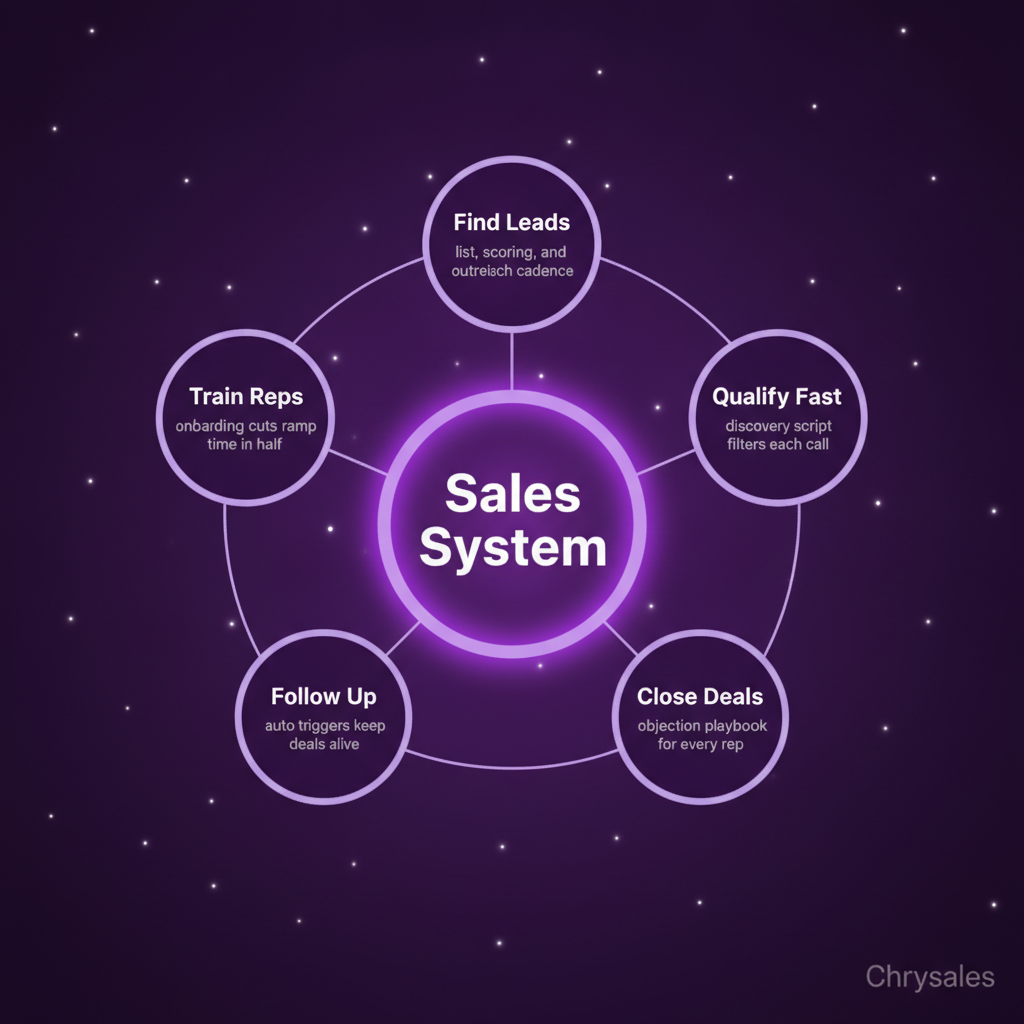
If you're ready to go from process to system, here's what you're building. Think of these as the five organs that keep the machine alive.
1. Lead Generation System
Not just "we do cold email." A system means: where the list comes from, how you score leads, what triggers outreach, the exact messages at each stage, who owns follow up, and how you measure which sources actually convert. Most teams treat lead generation like a side task. Generate some names, send some emails, hope for replies. A system treats it like the engine. If the engine sputters, nothing else matters.
2. Qualification and Discovery Framework
What questions do you ask on every discovery call? In what order? What answers disqualify someone immediately? What moves them to the next stage? If you can't hand a new hire a two page discovery script that works, this piece is missing. Your discovery call is not a friendly chat. It's a diagnostic. You're figuring out if they have the problem you solve, if they know they have it, if they're motivated to fix it, and if they can afford your solution. Your system should script that diagnostic so every rep runs it the same way.
Pro Tip: Record your best discovery calls. Transcribe them. Pull out the exact questions that get prospects talking. That's your script.
3. Closing and Objection Playbook
What are the eight objections you hear every week? What's the exact response for each one? When someone says "I need to think about it," what do you say next? A 30 person tech company we worked with had no objection playbook. Every rep winged it. Close rates ranged from 12% to 53% depending on who ran the call. We documented responses for the ten most common objections. Three months later, the whole team was closing above 40%. Same leads. Same offer. Better system.
4. Pipeline Management and Follow-Up Automation
Deals die in the follow up. A system automates the follow up so nothing slips. If a prospect doesn't reply to your proposal in three days, the system triggers a reminder. If they don't book the next call, the system sends a nudge. This isn't about being pushy. It's about not losing deals because you forgot to check in. Most lost deals aren't a hard no. They're a slow fade because no one followed up at the right time, a pattern confirmed by recent B2B sales statistics.
Common mistake: Teams set up a CRM and think that's pipeline management. A CRM is a tool. A system is the rules, triggers, and cadences that make the tool useful.
5. Hiring and Training Infrastructure
When you hire your next salesperson, how long until they're fully ramped? If the answer is "depends on the person," your system is incomplete. A real system includes the job description, the interview scorecard, the first week onboarding plan, the shadowing checklist, the role play scenarios, and the 30 60 90 day benchmarks. Hire someone on Monday. By day five, they should be able to run a passable discovery call. By day thirty, they should close their first deal.
We've trained over 500 sales teams. The ones that ramp new hires in under 45 days all have the same thing: a documented onboarding system that removes guesswork.
How to Build Your First Sales System in Four Steps
You don't need six months and a consultant to build this. You need four focused weeks and a willingness to document what's already working. If you want a deeper walkthrough, you can watch how to build a sales system so powerful clients come to you.
Step 1: Record Everything for Two Weeks
Record your sales calls. Save your email templates. Track what moves deals forward and what stalls them. You're gathering the raw material. Most of your system already exists in your head and in your top performer's habits. You just haven't written it down yet.
Step 2: Build the Minimum Viable Playbook
Pick the three highest impact pieces: your discovery script, your top five objection responses, and your cold outreach sequence. Document those first. Don't try to write the 100 page sales bible. Start with the 10 page playbook that covers 80% of situations. You can expand it later.
Step 3: Test It With a New Hire or Junior Rep
Hand the playbook to someone who doesn't know your process cold. Have them run a call using only what's documented. Where do they get stuck? That's where your system has gaps. A sales system for agencies only works if someone without your experience can follow it. If it only works when you're in the room explaining every step, it's not a system yet.
Step 4: Automate the Repeatable Parts
Anything that happens the same way every time should be automated or templated. Follow up emails. Meeting reminders. Lead scoring. CRM updates. Your reps should spend their time on the high value stuff: actual conversations, custom outreach to hot leads, and closing calls. The system should handle the repetitive tasks that don't need a human decision.
Pro Tip: Start with one automation. Get it working. Then add the next one. Trying to automate everything at once is how good systems turn into broken messes.
When to Move From Process to System
Here's the moment most teams realize they need a real system: they try to hire. They bring in a new salesperson, hand them the process doc, and six weeks later the person is lost. Or worse, they're doing their own thing because the process didn't give them enough direction. If you're still founder led sales and closing everything yourself, a process might be enough for now. But the second you want someone else to carry the load, you need a sales system.
The Warning Signs You're Running on Process Alone
Your close rate swings wildly month to month. One rep is killing it, another is struggling, and you can't figure out why. New hires take four to six months to ramp. You're spending half your week answering questions that should be documented somewhere. If any of those sound familiar, you're not under resourced. You're under systematized.
Watch out: Hiring more salespeople before you have a system just multiplies the chaos. You'll have three people doing three different things, none of them scalable. Fix the system first, then scale the team. To understand why most founders are stuck at $10k/month and how to fix it today, explore the structural issues that keep revenue capped without a full system in place.
Why Chrysales Builds Systems, Not Just Processes
Most sales training teaches you the process. Stages, pipeline math, call structure. That's useful, but it's not enough. At Chrysales, we build the full system: the playbooks, the automations, the hiring rubric, the onboarding plan, and the AI tools that make it all predictable. We've worked with over 500 B2B sales teams. The ones that hit predictable revenue all have the same thing: a custom sales system that works without the founder in every call.
We don't sell you a course and wish you luck. We build it with you, 1 on 1, so it fits your offer, your market, and your team. That's the difference. A process is generic. A sales system is built for you. Learn more about how to build a sales system that actually scales for your B2B team.
Frequently Asked Questions
Q: How long does it take to build a full sales system from scratch?
Most teams can build a working sales system in four to six weeks if they focus. That's enough time to document your core playbooks, set up basic automations, and train your first hire. You don't need a perfect system to start seeing results. You need a minimum viable system that covers discovery, objection handling, and follow up. You can refine and expand it over time as you learn what works. The key is to start documenting now rather than waiting until you have time to do it perfectly.
Q: Can a small team with one or two salespeople benefit from a sales system, or is it only for bigger teams?
Small teams benefit the most. When you're small, you can't afford to lose deals because of inconsistency or because your one closer is on vacation. A system protects you from single points of failure. It also makes hiring your next salesperson way easier because you have a playbook ready. Think of it like this: a system is how you go from two salespeople to five without everything breaking. If you wait until you're bigger to build it, scaling gets messy fast. For guidance on building scalable sales processes for B2B teams, start with the fundamentals that make expansion smooth.
Q: What's the difference between a CRM and a sales system?
A CRM is a tool. A sales system is the strategy, process, and content that makes the tool useful. Your CRM tracks deals and stores contact info. Your sales system tells you what to say on discovery calls, how to handle objections, when to follow up, and what makes someone qualified. Most teams buy a CRM, set up pipeline stages, and think they're done. But a CRM without playbooks, training, and clear ownership is just an empty spreadsheet with better UI.
Q: How do I know if my system is actually working or if I just got lucky with a few good months?
Track your key metrics over at least three months. If your close rate, reply rate, and pipeline velocity stay consistent within a 15% range, your system is working. If the numbers bounce all over, you're still relying on effort or luck instead of repeatability. A working system also shows up in new hire performance. If new reps ramp in under 60 days and hit similar numbers to your veterans, that's proof your system transfers knowledge. If every new hire is a gamble, the system isn't strong enough yet. Reference current B2B sales benchmarks to compare your results against industry standards.
Q: Should I build the system myself or hire someone to do it?
If you have the time and you know what good looks like, you can build it yourself using your best calls and emails as the foundation. But most teams don't know what they don't know. They document the wrong things or skip the pieces that matter most. Working with someone who's built hundreds of systems helps you avoid the expensive mistakes and get to predictable revenue faster. At Chrysales, we build it with you so you own the system and can run it without us. That's different from hiring someone to do it for you and walking away. To remove yourself from sales with a repeatable system, start by documenting what already works and then layer in the execution infrastructure that makes it transferable.
A sales system is the full setup behind b2b sales that keeps lead generation, client acquisition, and follow-up working without constant hand-holding. Here's the thing: most B2B companies think they have a sales system. They have a CRM. They have a pitch deck. Maybe they track pipeline stages. But when someone on the team goes on vacation, deals stall. When they hire a new salesperson, it takes four months before they close anything. That's not a system. That's a sales process held together with duct tape and hope.
What a Sales Process Actually Is
A sales process is the sequence of steps a deal moves through from first contact to closed won. It's linear. It looks clean in a flowchart. Prospect → Discovery → Demo → Proposal → Close. You've seen this before. It tells you what happens and in what order. But it doesn't tell you how to make it happen consistently, who does each step, what to say when someone ghosts you, or how to hire the person who runs step three when you're ready to scale.
Why Processes Feel Like Progress
When you first map out your sales process, it feels like a breakthrough. You finally see the stages. You label your CRM columns. You know what "qualified" means for your team. That clarity matters. But a process is just a starting point. It's the skeleton. Without the muscles, nervous system, and organs, it doesn't move on its own.
Common mistake: Teams spend weeks building the perfect process doc, then never look at it again. The doc lives in a Google Drive folder while everyone sells differently.
What a Sales System Really Means
A sales system is the full infrastructure that makes your process work without you babysitting every step. It's the playbooks, the scripts, the automations, the hiring plan, the training docs, the data tracking, the follow-up sequences, and the accountability structure. Picture this: you hire a closer on Monday. By Friday, they've watched your onboarding videos, shadowed three calls, practiced your pitch with feedback, and they know exactly how to handle the five most common objections. That's a sales system.
The Three Layers of a Real Sales System
A complete sales system has three layers. Most teams only build the first one.
Layer 1: The Process Map
The stages and definitions. What qualifies as a lead. What moves someone from discovery to demo. This is table stakes.
Layer 2: The Execution Infrastructure
The how. Your cold email templates. Your discovery call script. Your objection handling doc. The Loom video showing new hires how to log deals in the CRM. The weekly pipeline review meeting structure. This is where most of the work lives.
Layer 3: The Growth Engine
The hiring rubric for your next salesperson. The AI lead scoring model that ranks your pipeline by close probability. The 12 step onboarding checklist that cuts ramp time in half. The feedback loop that updates your playbook every quarter based on what's actually working.
Pro Tip: If you can't hand your sales process to a stranger and have them run a decent call by next week, you don't have a system yet.
Why Most B2B Teams Only Have a Process
Building a process takes a afternoon. Building a sales system takes weeks. Most teams stop after the process because it feels done. You have stages. You have a CRM. You're "organized." But here's what happens next. Your best salesperson closes 60% of qualified leads. Your newest hire closes 18%. Same process. Wildly different results. That gap is the system you haven't built yet.
The Personality Problem
A sales process relies on personality. If your top performer is naturally great at reading the room, handling objections on the fly, and knowing when to push for the close, they'll crush it. The process gives them a loose structure, but they're doing the real work. When you hire someone who doesn't have that natural feel, the process doesn't save them. They follow the stages, but they don't know what to say in step two. They don't know how to recover when a prospect goes quiet. They flounder.
A sales system removes personality as the variable. It gives everyone the script for step two. It tells them exactly when to send the follow up and what to write. It trains them on the recovery move when someone ghosts.
Watch out: If your sales results depend on one or two people, you're one resignation away from a revenue drop. That's a process problem, not a people problem.
The Repeatable Revenue Test
Here's how to know if you have a system or just a process. Ask yourself: can you predict how many deals you'll close next month within a 15% margin of error? If the answer is no, you're missing the system layer. Predictable revenue comes from repeatable actions. Repeatable actions come from documented, trained, and measured systems.
What Repeatability Actually Looks Like
A 20 person consulting firm books 40 discovery calls a month. They convert 30% to demos. They close 50% of demos. Every month, those numbers stay within a tight range. That's repeatability. They know their numbers because their system tracks activity at every stage, as demonstrated in B2B sales metrics benchmarks. They know why the numbers stay consistent because their system trains every rep the same way. They know what breaks when the numbers dip because their system has built in diagnostics.
One marketing agency we worked with had a 0.8% reply rate on cold outreach. After building a system around lead scoring, list hygiene, and message sequencing, they hit 4.2%. The process didn't change. The system around the process did.
The Five Components Every Sales System Needs
If you're ready to go from process to system, here's what you're building. Think of these as the five organs that keep the machine alive.
1. Lead Generation System
Not just "we do cold email." A system means: where the list comes from, how you score leads, what triggers outreach, the exact messages at each stage, who owns follow up, and how you measure which sources actually convert. Most teams treat lead generation like a side task. Generate some names, send some emails, hope for replies. A system treats it like the engine. If the engine sputters, nothing else matters.
2. Qualification and Discovery Framework
What questions do you ask on every discovery call? In what order? What answers disqualify someone immediately? What moves them to the next stage? If you can't hand a new hire a two page discovery script that works, this piece is missing. Your discovery call is not a friendly chat. It's a diagnostic. You're figuring out if they have the problem you solve, if they know they have it, if they're motivated to fix it, and if they can afford your solution. Your system should script that diagnostic so every rep runs it the same way.
Pro Tip: Record your best discovery calls. Transcribe them. Pull out the exact questions that get prospects talking. That's your script.
3. Closing and Objection Playbook
What are the eight objections you hear every week? What's the exact response for each one? When someone says "I need to think about it," what do you say next? A 30 person tech company we worked with had no objection playbook. Every rep winged it. Close rates ranged from 12% to 53% depending on who ran the call. We documented responses for the ten most common objections. Three months later, the whole team was closing above 40%. Same leads. Same offer. Better system.
4. Pipeline Management and Follow-Up Automation
Deals die in the follow up. A system automates the follow up so nothing slips. If a prospect doesn't reply to your proposal in three days, the system triggers a reminder. If they don't book the next call, the system sends a nudge. This isn't about being pushy. It's about not losing deals because you forgot to check in. Most lost deals aren't a hard no. They're a slow fade because no one followed up at the right time, a pattern confirmed by recent B2B sales statistics.
Common mistake: Teams set up a CRM and think that's pipeline management. A CRM is a tool. A system is the rules, triggers, and cadences that make the tool useful.
5. Hiring and Training Infrastructure
When you hire your next salesperson, how long until they're fully ramped? If the answer is "depends on the person," your system is incomplete. A real system includes the job description, the interview scorecard, the first week onboarding plan, the shadowing checklist, the role play scenarios, and the 30 60 90 day benchmarks. Hire someone on Monday. By day five, they should be able to run a passable discovery call. By day thirty, they should close their first deal.
We've trained over 500 sales teams. The ones that ramp new hires in under 45 days all have the same thing: a documented onboarding system that removes guesswork.
How to Build Your First Sales System in Four Steps
You don't need six months and a consultant to build this. You need four focused weeks and a willingness to document what's already working. If you want a deeper walkthrough, you can watch how to build a sales system so powerful clients come to you.
Step 1: Record Everything for Two Weeks
Record your sales calls. Save your email templates. Track what moves deals forward and what stalls them. You're gathering the raw material. Most of your system already exists in your head and in your top performer's habits. You just haven't written it down yet.
Step 2: Build the Minimum Viable Playbook
Pick the three highest impact pieces: your discovery script, your top five objection responses, and your cold outreach sequence. Document those first. Don't try to write the 100 page sales bible. Start with the 10 page playbook that covers 80% of situations. You can expand it later.
Step 3: Test It With a New Hire or Junior Rep
Hand the playbook to someone who doesn't know your process cold. Have them run a call using only what's documented. Where do they get stuck? That's where your system has gaps. A sales system for agencies only works if someone without your experience can follow it. If it only works when you're in the room explaining every step, it's not a system yet.
Step 4: Automate the Repeatable Parts
Anything that happens the same way every time should be automated or templated. Follow up emails. Meeting reminders. Lead scoring. CRM updates. Your reps should spend their time on the high value stuff: actual conversations, custom outreach to hot leads, and closing calls. The system should handle the repetitive tasks that don't need a human decision.
Pro Tip: Start with one automation. Get it working. Then add the next one. Trying to automate everything at once is how good systems turn into broken messes.
When to Move From Process to System
Here's the moment most teams realize they need a real system: they try to hire. They bring in a new salesperson, hand them the process doc, and six weeks later the person is lost. Or worse, they're doing their own thing because the process didn't give them enough direction. If you're still founder led sales and closing everything yourself, a process might be enough for now. But the second you want someone else to carry the load, you need a sales system.
The Warning Signs You're Running on Process Alone
Your close rate swings wildly month to month. One rep is killing it, another is struggling, and you can't figure out why. New hires take four to six months to ramp. You're spending half your week answering questions that should be documented somewhere. If any of those sound familiar, you're not under resourced. You're under systematized.
Watch out: Hiring more salespeople before you have a system just multiplies the chaos. You'll have three people doing three different things, none of them scalable. Fix the system first, then scale the team. To understand why most founders are stuck at $10k/month and how to fix it today, explore the structural issues that keep revenue capped without a full system in place.
Why Chrysales Builds Systems, Not Just Processes
Most sales training teaches you the process. Stages, pipeline math, call structure. That's useful, but it's not enough. At Chrysales, we build the full system: the playbooks, the automations, the hiring rubric, the onboarding plan, and the AI tools that make it all predictable. We've worked with over 500 B2B sales teams. The ones that hit predictable revenue all have the same thing: a custom sales system that works without the founder in every call.
We don't sell you a course and wish you luck. We build it with you, 1 on 1, so it fits your offer, your market, and your team. That's the difference. A process is generic. A sales system is built for you. Learn more about how to build a sales system that actually scales for your B2B team.
Frequently Asked Questions
Q: How long does it take to build a full sales system from scratch?
Most teams can build a working sales system in four to six weeks if they focus. That's enough time to document your core playbooks, set up basic automations, and train your first hire. You don't need a perfect system to start seeing results. You need a minimum viable system that covers discovery, objection handling, and follow up. You can refine and expand it over time as you learn what works. The key is to start documenting now rather than waiting until you have time to do it perfectly.
Q: Can a small team with one or two salespeople benefit from a sales system, or is it only for bigger teams?
Small teams benefit the most. When you're small, you can't afford to lose deals because of inconsistency or because your one closer is on vacation. A system protects you from single points of failure. It also makes hiring your next salesperson way easier because you have a playbook ready. Think of it like this: a system is how you go from two salespeople to five without everything breaking. If you wait until you're bigger to build it, scaling gets messy fast. For guidance on building scalable sales processes for B2B teams, start with the fundamentals that make expansion smooth.
Q: What's the difference between a CRM and a sales system?
A CRM is a tool. A sales system is the strategy, process, and content that makes the tool useful. Your CRM tracks deals and stores contact info. Your sales system tells you what to say on discovery calls, how to handle objections, when to follow up, and what makes someone qualified. Most teams buy a CRM, set up pipeline stages, and think they're done. But a CRM without playbooks, training, and clear ownership is just an empty spreadsheet with better UI.
Q: How do I know if my system is actually working or if I just got lucky with a few good months?
Track your key metrics over at least three months. If your close rate, reply rate, and pipeline velocity stay consistent within a 15% range, your system is working. If the numbers bounce all over, you're still relying on effort or luck instead of repeatability. A working system also shows up in new hire performance. If new reps ramp in under 60 days and hit similar numbers to your veterans, that's proof your system transfers knowledge. If every new hire is a gamble, the system isn't strong enough yet. Reference current B2B sales benchmarks to compare your results against industry standards.
Q: Should I build the system myself or hire someone to do it?
If you have the time and you know what good looks like, you can build it yourself using your best calls and emails as the foundation. But most teams don't know what they don't know. They document the wrong things or skip the pieces that matter most. Working with someone who's built hundreds of systems helps you avoid the expensive mistakes and get to predictable revenue faster. At Chrysales, we build it with you so you own the system and can run it without us. That's different from hiring someone to do it for you and walking away. To remove yourself from sales with a repeatable system, start by documenting what already works and then layer in the execution infrastructure that makes it transferable.
Scaling Is Not Hard If You Have The Right Systems
If you’re serious about leveling up your scaling game, you need the right system, the right training, and the right team behind you. We're here to give you the exact tools and strategies top entrepreneurs use to dominate.

Discover the latest tips
View All.avif)
Chrysales was formed from the words "chrysalis" the stage where a caterpillar transforms into a butterfly and "sales".
It stands for one thing: sales transformation.Because scaling doesn’t happen by doing more of the same. Scaling only happens when you go through real transformation in your systems, your offer, team and the way you sell.
.avif)


