
Sales role play: how to rehearse calls before buyers hear them
Sales role play means practicing a sales conversation with a colleague who plays the buyer. We suggest rehearsing one moment of a call at a time, such as the opener or the objection you hear most. An objection is a reason the buyer gives for not going ahead. Keep sessions to about 15 minutes and use a short scenario card built from real calls.
Give one point of feedback, then replay the same moment right away.
Do it every week, not once a quarter. That way your reps make their mistakes in practice, not on the good leads you worked hard to get.
Why sales role play feels fake
Role plays often feel fake for three reasons. The whole team watches, the round covers a whole call, and it ends with a long list of criticism. Each has a simple fix.
The first problem is the audience. Sue Barrett, a sales coach, names it clearly. "Many people feel self-conscious and don't want to look 'bad' in front of their peers."
A rep acting in front of the whole team is thinking about their image, not the buyer. So start one-to-one.
The second problem is size. Sales trainer Troy Harrison warns managers against role-playing entire sales calls. He suggests picking out one part of the call instead.
The third problem comes at the end. Simon Hazeldine describes a bad session where the seller gets twelve things to improve and no chance to try any of them again.
Hazeldine suggests "one or two improvements" instead, then replaying the same moment straight away.
Pick one moment to practice
Each session practices one moment taken from your real calls. Jennifer Bullock, an analyst at Forrester, agrees. In her words, "Role-plays should focus on one or two objectives."
To start, pick one of these three moments. Each is short enough to practice in one round.
- The opener. The first lines of a call, where the buyer decides whether to keep listening.
- One discovery question, a question that helps you learn what the buyer needs. Pick a single question from your discovery call questions and practice asking it, then following up on the answer.
- The objection you hear most. For many teams that's "we already have a vendor", meaning they already buy from someone else. It's a good first drill.
Build the moment from what buyers really said to your team. Research on workplace training backs this up.
A review of 117 training studies found that people used a skill on the job more when they practiced with situations they brought themselves. It also helped when their bosses were trained too.
That research covers workplace training in general, not sales alone.
Write a one-page scenario card
A scenario card is a short note each side reads before the round, so nobody has to make things up on the spot. The buyer gets their side, the seller gets theirs.
GitLab does something similar in its public handbook. Several of its customer success role plays give the customer and the customer success manager each their own info sheet. Some end with a review after the scenario.
Here is a made-up example card you can copy and change:
SCENARIO CARD (made-up example)

BUYER SIDE
Who you are: Head of Operations at a 40-person B2B company.
Situation: You agreed to a short call because a colleague asked you to.
What you want: to end the call politely, unless you hear something new.
Your first line: "We already have a vendor."
How to play it: If the seller asks a good question, answer it honestly.
If the seller starts pitching, repeat your line.

SELLER SIDE
Goal of this round: keep the conversation open, not win the deal.
A good answer: accepts that they have a vendor and asks one question,
such as "What would make you switch?"
Listen for: does the seller ask a question before they pitch?
Write the buyer's first line word for word from a real call. If you can't remember one, listen to a recent recording first.
Run a 15-minute session
A session takes about 15 minutes for one moment and one rep. Below is a simple routine we suggest.
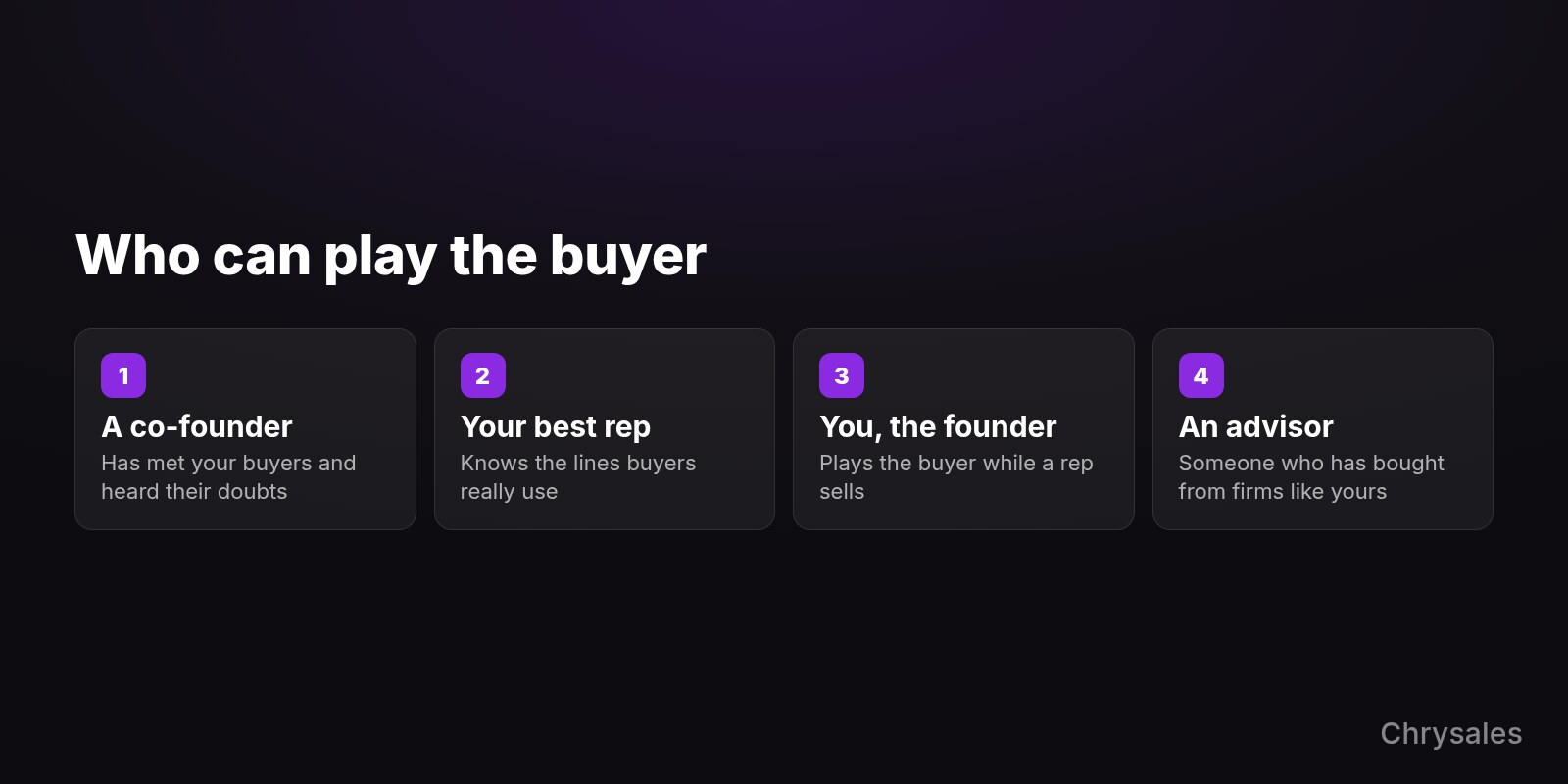
Pick someone who knows your real buyers and can play them realistically. The image below shows a few people who can take the role.
Harrison reminds managers that their job isn't to be the toughest prospect the rep will ever meet. He suggests getting tougher only when the rep goes off course.
- Set the scene (about 2 minutes). Both people read their side of the card.
- Run one round on the chosen moment (two to three minutes).
- Ask the rep what they would change first (1 minute).
- Give one point of feedback about what the rep said or did (2 minutes).
- Replay the same moment right away, two or three more times (about 6 minutes).
- Write down the line that worked best, so the team can reuse it.
Talk about what the rep said, not about who the rep is. A large review of feedback research by Kluger and DeNisi found that feedback helped on average. But over a third of feedback made performance worse, and it worked worse when it pointed at the person instead of the task.
For how often, look at GitLab's objection practice page. It suggests about 5 minutes to handle one objection, then about 10 minutes of team review, weekly or every two weeks.
Bullock adds that role play shouldn't stop after onboarding, the first weeks of a new rep. Build it into your 90-day onboarding plan and keep it going after that.
Practicing alone or with AI
You can practice alone too. Say your opener out loud, record it on your phone, and listen back before your next call.
AI role-play tools let a rep talk to an AI "buyer" and get feedback.
Hyperbound is one such tool. Its website says: "Train with realistic roleplays and instant feedback." The appeal is more practice without an audience.
The limit is the buyer. An AI buyer may only know what you tell it about your market.
If you have no call recordings or written sales process yet, a person who knows your buyers will play them better.
A general chatbot can also act as a practice buyer if you give it your scenario card. Treat that as an option to try, not a proven method.
Conclusion: Run one session this week
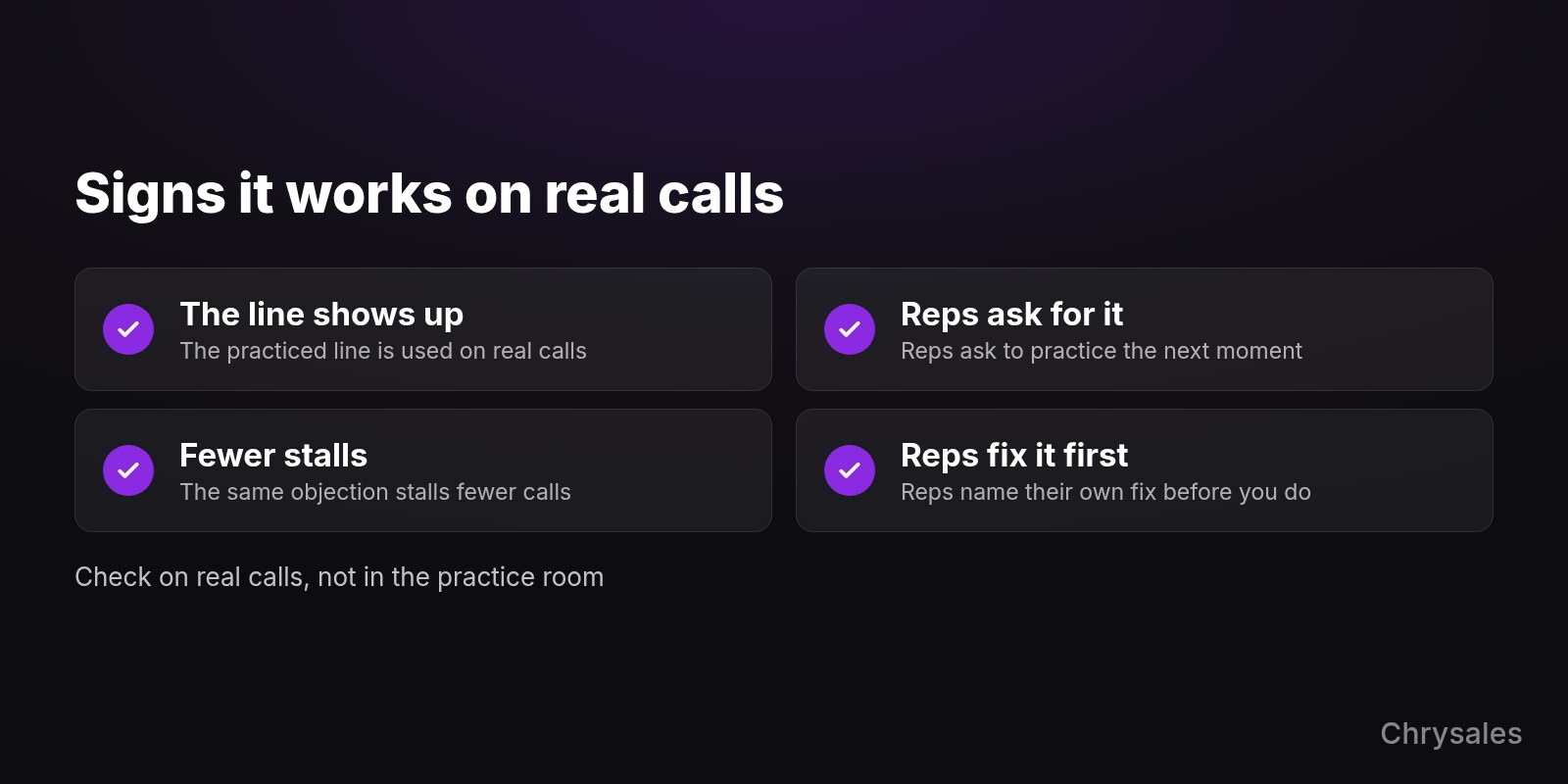
Start small, then check the result on real calls. For the card above, listen for whether the rep asks a question before pitching. The image below shows other signs.
We found no solid study of sales role play on its own. The training review above also found bigger effects on learning than on job behavior. So the test is what changes on your next sales calls.
What to do first:
- Pick the one moment that costs you the most deals right now.
- Write one scenario card, using a line a real buyer said.
- Run one 15-minute session with one rep this week.
- A week later, review your recorded calls and listen for the same moment. Did the rep do what worked in practice?
Want help building the sales process behind your team's calls? Chrysales builds the sales system and team with founders, starting with a free strategy call. Book a free strategy call with Chrysales

Sales role play means practicing a sales conversation with a colleague who plays the buyer. We suggest rehearsing one moment of a call at a time, such as the opener or the objection you hear most. An objection is a reason the buyer gives for not going ahead. Keep sessions to about 15 minutes and use a short scenario card built from real calls.
Give one point of feedback, then replay the same moment right away.
Do it every week, not once a quarter. That way your reps make their mistakes in practice, not on the good leads you worked hard to get.
Why sales role play feels fake
Role plays often feel fake for three reasons. The whole team watches, the round covers a whole call, and it ends with a long list of criticism. Each has a simple fix.
The first problem is the audience. Sue Barrett, a sales coach, names it clearly. "Many people feel self-conscious and don't want to look 'bad' in front of their peers."
A rep acting in front of the whole team is thinking about their image, not the buyer. So start one-to-one.
The second problem is size. Sales trainer Troy Harrison warns managers against role-playing entire sales calls. He suggests picking out one part of the call instead.
The third problem comes at the end. Simon Hazeldine describes a bad session where the seller gets twelve things to improve and no chance to try any of them again.
Hazeldine suggests "one or two improvements" instead, then replaying the same moment straight away.
Pick one moment to practice
Each session practices one moment taken from your real calls. Jennifer Bullock, an analyst at Forrester, agrees. In her words, "Role-plays should focus on one or two objectives."
To start, pick one of these three moments. Each is short enough to practice in one round.
- The opener. The first lines of a call, where the buyer decides whether to keep listening.
- One discovery question, a question that helps you learn what the buyer needs. Pick a single question from your discovery call questions and practice asking it, then following up on the answer.
- The objection you hear most. For many teams that's "we already have a vendor", meaning they already buy from someone else. It's a good first drill.
Build the moment from what buyers really said to your team. Research on workplace training backs this up.
A review of 117 training studies found that people used a skill on the job more when they practiced with situations they brought themselves. It also helped when their bosses were trained too.
That research covers workplace training in general, not sales alone.
Write a one-page scenario card
A scenario card is a short note each side reads before the round, so nobody has to make things up on the spot. The buyer gets their side, the seller gets theirs.
GitLab does something similar in its public handbook. Several of its customer success role plays give the customer and the customer success manager each their own info sheet. Some end with a review after the scenario.
Here is a made-up example card you can copy and change:
SCENARIO CARD (made-up example)

BUYER SIDE
Who you are: Head of Operations at a 40-person B2B company.
Situation: You agreed to a short call because a colleague asked you to.
What you want: to end the call politely, unless you hear something new.
Your first line: "We already have a vendor."
How to play it: If the seller asks a good question, answer it honestly.
If the seller starts pitching, repeat your line.

SELLER SIDE
Goal of this round: keep the conversation open, not win the deal.
A good answer: accepts that they have a vendor and asks one question,
such as "What would make you switch?"
Listen for: does the seller ask a question before they pitch?
Write the buyer's first line word for word from a real call. If you can't remember one, listen to a recent recording first.
Run a 15-minute session
A session takes about 15 minutes for one moment and one rep. Below is a simple routine we suggest.
Pick someone who knows your real buyers and can play them realistically. The image below shows a few people who can take the role.
Harrison reminds managers that their job isn't to be the toughest prospect the rep will ever meet. He suggests getting tougher only when the rep goes off course.
- Set the scene (about 2 minutes). Both people read their side of the card.
- Run one round on the chosen moment (two to three minutes).
- Ask the rep what they would change first (1 minute).
- Give one point of feedback about what the rep said or did (2 minutes).
- Replay the same moment right away, two or three more times (about 6 minutes).
- Write down the line that worked best, so the team can reuse it.
Talk about what the rep said, not about who the rep is. A large review of feedback research by Kluger and DeNisi found that feedback helped on average. But over a third of feedback made performance worse, and it worked worse when it pointed at the person instead of the task.
For how often, look at GitLab's objection practice page. It suggests about 5 minutes to handle one objection, then about 10 minutes of team review, weekly or every two weeks.
Bullock adds that role play shouldn't stop after onboarding, the first weeks of a new rep. Build it into your 90-day onboarding plan and keep it going after that.
Practicing alone or with AI
You can practice alone too. Say your opener out loud, record it on your phone, and listen back before your next call.
AI role-play tools let a rep talk to an AI "buyer" and get feedback.
Hyperbound is one such tool. Its website says: "Train with realistic roleplays and instant feedback." The appeal is more practice without an audience.
The limit is the buyer. An AI buyer may only know what you tell it about your market.
If you have no call recordings or written sales process yet, a person who knows your buyers will play them better.
A general chatbot can also act as a practice buyer if you give it your scenario card. Treat that as an option to try, not a proven method.
Conclusion: Run one session this week
Start small, then check the result on real calls. For the card above, listen for whether the rep asks a question before pitching. The image below shows other signs.
We found no solid study of sales role play on its own. The training review above also found bigger effects on learning than on job behavior. So the test is what changes on your next sales calls.
What to do first:
- Pick the one moment that costs you the most deals right now.
- Write one scenario card, using a line a real buyer said.
- Run one 15-minute session with one rep this week.
- A week later, review your recorded calls and listen for the same moment. Did the rep do what worked in practice?
Want help building the sales process behind your team's calls? Chrysales builds the sales system and team with founders, starting with a free strategy call. Book a free strategy call with Chrysales
Scaling Is Not Hard If You Have The Right Systems
If you’re serious about leveling up your scaling game, you need the right system, the right training, and the right team behind you. We're here to give you the exact tools and strategies top entrepreneurs use to dominate.

Discover the latest tips
View All
Chrysales was formed from the words "chrysalis" the stage where a caterpillar transforms into a butterfly and "sales".
It stands for one thing: sales transformation.Because scaling doesn’t happen by doing more of the same. Scaling only happens when you go through real transformation in your systems, your offer, team and the way you sell.


