.avif)
How to Take Sales Conversation Control From Minute One

Sales conversation control is the skill of guiding a sales call from the start, so you ask better questions, stay on track, and move toward a clear next step. Most sales calls spiral out of control in the first five minutes. The prospect starts asking about price before you've even explained the offer. Or they derail into a 20 minute tangent about their current setup. Or they go quiet and you're stuck doing all the talking. Here's the thing: none of that happens by accident. It happens because one person decided to lead the conversation, and it wasn't you. The fix isn't smoother talking or better objection scripts. It's simpler than that. It starts with one question you ask at the very beginning that changes who's steering the call. That question gives you sales conversation control without feeling pushy or weird.
Why Most Sales Calls Go Off the Rails
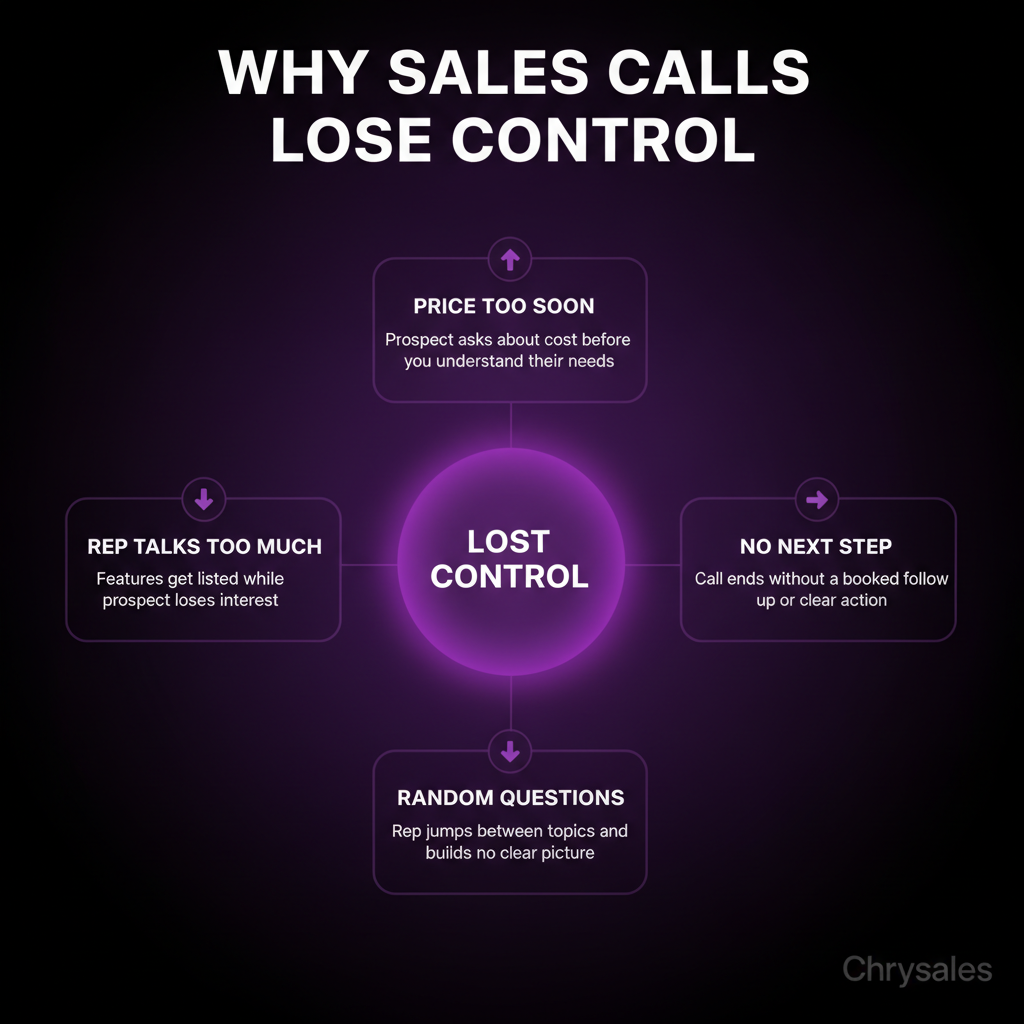
Picture this: you book a discovery call with a company that fits your ideal client profile. You're prepared. You've got your pitch ready. But 10 minutes in, the prospect is talking about their org chart, their budget cycle from two years ago, and a vendor they fired in 2019. You're nodding along, taking notes, but you have no idea how to get back on track. By the end of the call, you've learned a ton of random stuff but nothing that helps you close the deal. This happens because the prospect took control. Not on purpose, usually. They're just nervous or curious or trying to feel out whether you're wasting their time. But the result is the same: you lose the ability to guide the conversation toward a decision.
Here's the stat that matters: Sales teams that follow a structured sales discovery call framework close deals 30% faster than teams that wing it. That's not because they're better talkers. It's because they control the flow of the conversation from the start.
The Real Cost of Losing Control
When you lose control of a sales call, a few things happen:
- You don't get the information you need to make a good offer
- The prospect forms opinions about your solution based on incomplete info
- You end the call without a clear next step
- The deal stalls in your pipeline for weeks or months
A 50 person tech company we worked with had this exact problem. Their sales team was booking 15 calls a week but only closing 2 deals a month. When we listened to their calls, the pattern was obvious. The prospects were asking all the questions. The sales reps were answering. No one was leading. The reps thought they were being helpful. Really, they were giving away all their power.
Who Controls the Call Controls the Outcome
Sales conversation control isn't about dominating the other person. It's about making sure the call has structure. Think of it like this: if you invite someone to dinner at your house, you decide the menu, the seating, and when to serve dessert. Your guest doesn't walk into your kitchen and start rearranging things. That would be weird. A sales call works the same way. You're the host. You set the agenda. You guide the flow. Most people mix up control with being pushy. They're not the same. Being pushy is ignoring what the other person wants. Having control is making sure the conversation serves both of you. When you lead the call, the prospect actually feels more comfortable because they're not guessing what happens next.
The Single Question That Changes Everything
So what's the question?
"Does it make sense if I ask you a few questions first to understand your situation, and then I'll explain how we can help?"
That's it. One sentence. You ask it in the first two minutes of the call, right after the small talk. It sounds simple because it is. But it does three things at once:
- It sets you up as the person leading the conversation
- It gives the prospect permission to relax and answer questions instead of feeling like they need to grill you
- It creates a structure: questions first, pitch second, decision third
Pro Tip: Most sales reps skip this and dive straight into discovery questions. The prospect feels ambushed. This one sentence eliminates that awkwardness.
Why This Question Works So Well
When you ask this question, you're establishing an upfront contract in the sales process. That's sales training language for "an agreement about how the call is going to go." You're not demanding anything. You're proposing a plan. The prospect almost always says yes because the plan sounds fair. They get to talk about their challenges, and then you get to explain your solution. Everyone knows what's coming. Here's what happens when you don't ask it: the prospect assumes the call is a pitch. They're on defense from the start. They interrupt with objections before you've even finished explaining what you do. Or they sit quietly and wait for you to finish so they can say "send me some info." Neither of those scenarios leads to deals.
A 15 person consulting firm we worked with tested this exact approach. Their lead generation process was solid. They were booking calls with qualified prospects. But their close rate was under 10%. We had them start every call with this question. Within a month, their close rate jumped to 22%. Same leads. Same offer. Different structure.
How to Ask It Without Sounding Scripted
The exact wording matters less than the tone. You're not reading from a card. You're casually proposing a plan. Here's how it sounds in real life:
"Hey, thanks for hopping on. Before we dive in, does it make sense if I ask you a few questions about your current setup and what you're looking to improve? That way I can explain how we help in a way that actually fits your situation."
Notice the conversational flow. You're talking like a normal person. You're explaining why you're asking questions, which makes the prospect more likely to open up.
Watch out: If you ask this question but then immediately start pitching, you lose all credibility. The prospect agreed to a plan, and you broke it. Stick to the structure you proposed.
Building a Sales Call Structure That Works Every Time
Once you've asked the opening question and the prospect agrees, you're in control. Now you need a structure to follow. This is where most teams fall apart. They ask random questions, jump around between topics, and never build a clear picture of what the prospect actually needs. Here's a simple structure that works for B2B sales across most industries:
Step 1: Understand Their Current Situation
Ask 3 to 5 questions about where they are right now. Not where they want to be. Not what's broken. Just the facts.
- "Walk me through how you're handling [process] right now."
- "How many people are involved in that?"
- "What's working well with your current setup?"
These questions feel easy for the prospect to answer. You're not challenging them. You're just gathering info. This is also where you build trust. If you skip this step and jump straight to "what are your biggest problems," the prospect clams up.
Step 2: Identify the Gap
Now you shift to what's not working. This is where you find the pain. But you're not digging for pain to manipulate them. You're trying to understand what's worth solving.
- "What's the biggest challenge with that process?"
- "How is that affecting your team or your numbers?"
- "If you could change one thing, what would it be?"
Common mistake: Sales reps ask these questions but don't pause long enough for the prospect to answer. Silence is your friend here. Let them think. Let them talk. The best insights come when you shut up and listen.
Step 3: Clarify the Impact
This is the part most people skip. You've identified the problem. Now you need to understand why it matters. What happens if they don't fix it?
- "If this stays the same for the next six months, what does that cost you?"
- "How does this impact the rest of the business?"
- "What have you tried so far to fix it?"
This step does two things. It helps you understand urgency, and it helps the prospect realize the problem is bigger than they thought. You're not creating urgency out of thin air. You're just making the real urgency visible.
Step 4: Transition to the Solution
Now you've earned the right to pitch. You've asked questions. You've listened. You understand their situation. The transition is smooth because you already agreed to this structure at the start of the call.
"Got it. Based on what you've told me, here's how we'd approach this..."
You're not launching into a generic pitch. You're explaining your solution in the context of everything they just told you. That's what makes it feel personal instead of scripted. To see how these common B2B sales call patterns play out in real conversations, our research shows the exact talk tracks and discovery flows that lead to higher close rates.
Taking Control Without Being Pushy
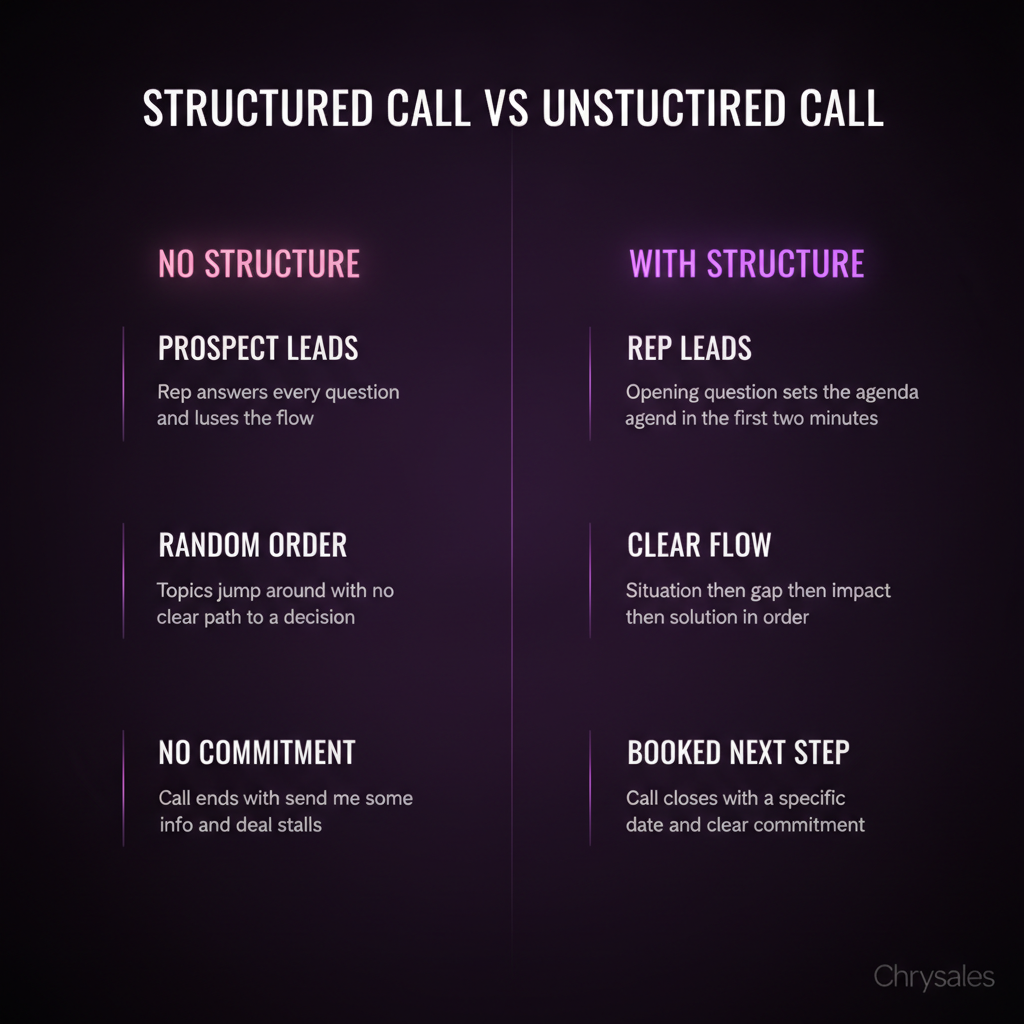
Here's where people get nervous. They think taking control of the sales conversation means talking over the prospect or ignoring their questions. That's not it. Real control is about staying on track while still being flexible.
Redirecting Without Shutting Them Down
Sometimes the prospect will jump ahead. They'll ask about pricing in minute three. Or they'll say "just tell me what you do" before you've asked any questions. Here's how you handle it:
"Totally fair question. I'll definitely cover that. Before I do, can I ask you two quick things so I can give you the right answer?"
You're not saying no. You're saying "yes, and let me make sure I do it right." Most prospects are fine with that as long as you acknowledge their question.
Pro Tip: Write down their question if they ask it early. Then come back to it later in the call. This shows you were listening and builds trust.
Handling the Prospect Who Wants to Lead
Some prospects are used to running calls. They're senior people. They're used to being in charge. They'll try to take over. That's fine. You don't need to fight them. You just need to guide them back to the structure.
"I love that you're thinking ahead. Let me make sure I understand the full picture first, and then we can dig into that."
You're validating their question without letting the call derail. You're staying in control of the flow without being combative. A marketing agency we worked with had a client who dominated every call. The sales rep felt like they couldn't get a word in. We coached them to use this exact line. The next call, the client actually thanked them for keeping things on track. Turns out, even dominant prospects appreciate structure. It makes the call feel productive instead of chaotic.
Common Traps That Kill Sales Conversation Leadership
Even if you start the call strong, there are a few traps that will make you lose control halfway through. Here are the big ones and how to avoid them.
Trap 1: Answering Every Question Immediately
The prospect asks a question. You answer it. They ask another. You answer that too. Before you know it, the call is a Q&A session and you're not learning anything about them.
The fix: Acknowledge the question, then redirect. "Good question. I'll cover that in a second. First, let me ask you this..."
Trap 2: Talking Too Much
You're excited about your offer. You start explaining every feature. The prospect zones out. You've lost them.
The fix: Keep your answers short. Two to three sentences max. Then ask a follow up question to pull them back in.
Trap 3: Skipping the Next Step
The call ends. You both say "great, let's stay in touch." No one books a follow up. The deal dies.
The fix: Before you hang up, propose a specific next step. "Does it make sense to book a follow up call for [specific date] to walk through the proposal?" Get them to commit before you end the call. For practical examples of how to secure commitment during discovery calls, our guide includes scripts and frameworks to close with a clear next step every time.
Watch out: If the prospect says "send me some info and I'll get back to you," that's a polite rejection. Don't just say okay. Ask what specifically they need to see to make a decision. That question will either surface the real objection or force them to commit to a next step.
How This Fits Into a Bigger Sales System
Controlling one sales call is great. But it doesn't matter much if your lead generation is broken or your offer is unclear. Sales conversation control is one piece of a bigger system. Here's how it fits.
Lead Generation Sets You Up to Win
If your leads are bad, no amount of conversation control will save you. A 200 person company that just did layoffs is not a hot lead. It's a bad fit, full stop. Your lead generation process should be filtering for people who actually need what you sell and can afford it. We see this all the time with new clients. They're booking calls, but the prospects are tire kickers or window shoppers. The sales conversations feel hard because they are. You're trying to sell to people who shouldn't be on the call in the first place.
Pro Tip: If more than 30% of your discovery calls end with "not right now," your lead qualification is broken. Fix that before you worry about call structure. Research shows that proven lead qualification strategies used by top B2B brands focus on filtering for decision makers and real pain before booking any call.
Your Offer Has to Make Sense
Even with perfect sales conversation control, you'll lose deals if your offer is confusing or weak. Think of it like this: the offer is the menu. The sales call is the waiter. If the menu is confusing, the waiter has no chance. Your offer should answer three questions in under 30 seconds:
- Who is this for?
- What problem does it solve?
- Why is this better than doing nothing or going somewhere else?
If you can't answer those clearly, the prospect won't either. And a confused prospect always says no.
Client Acquisition Is About Repetition
One good sales call doesn't build a business. You need a system that lets you run 10, 20, 50 good calls in a row. That's where sales training and automation come in. You train your team to use the same structure. You automate the follow ups. You track what's working and fix what's not. A tech company we worked with had one great closer. That person handled every sales call. When they went on vacation, revenue dropped to zero. That's not a system. That's a dependency. We helped them document the process, train two more people, and build a repeatable motion. Now they can scale without relying on one person. You can watch how to build a sales system so powerful clients come to you to see the full framework for designing repeatable client acquisition that doesn't depend on one star performer.
If you want to turn this single-call structure into a repeatable, team-wide motion instead of relying on one closer, our guide on how to build a sales system that actually scales walks through documentation, training, and automation so your entire team can replicate these results.
Putting This Into Action This Week
You don't need to overhaul your entire sales process to start using this. You can test it today. Pick your next three sales calls. In the first two minutes of each call, ask the question:
"Does it make sense if I ask you a few questions first to understand your situation, and then I'll explain how we can help?"
Then follow the structure:
- Understand their current situation
- Identify the gap
- Clarify the impact
- Transition to the solution
Write down what happens. How did the prospect respond? Did you stay in control? Did you get better information than usual? Did the call end with a clear next step? Most teams see a difference immediately. The calls feel smoother. The prospects are more engaged. The close rate starts to climb.
Common mistake: Teams try this once, it feels awkward, and they quit. Of course it feels awkward the first time. You're learning a new habit. Do it five times. By the fifth call, it'll feel natural.
Frequently Asked Questions
Q: What if the prospect says no when I ask to lead with questions?
It almost never happens, but if it does, respect it. Say "no problem, what would be most helpful for you?" and adjust. But in practice, prospects say yes 95% of the time because the request sounds reasonable. If someone pushes back hard, it's usually a sign they're not a good fit or they're not actually interested. Better to find that out in minute two than minute 30.
Q: How do I control the call without sounding like a robot reading a script?
Use the structure as a guide, not a script. You're not reciting lines. You're following a flow. Think of it like driving to a new place. You follow the GPS directions, but you still sound like yourself when you talk to the passenger. Same thing here. The structure keeps you on track. Your personality keeps it human. You can also learn the seven levels of sales from struggling to closing effortlessly to understand how conversation control fits into broader sales mastery and development.
Q: Can I use this approach for cold calls or only booked meetings?
It works for both, but you need to adjust the opening. On a cold call, you don't have permission yet, so you earn it fast. "Hey, I know I'm catching you out of the blue. I work with companies like yours on [problem]. Do you have two minutes for me to ask a quick question to see if this is even relevant for you?" If they say yes, you're in. Then you can use the same structure.
Q: What if I ask all the right questions but the prospect still doesn't buy?
Sales conversation control improves your close rate, but it's not magic. Some prospects won't buy no matter how good the call is. Maybe the timing is wrong. Maybe they can't afford it. Maybe they just got burned by a competitor and need time. The goal isn't to close every deal. The goal is to run a clean process that gives you the best shot and makes it easy to see why deals are lost.
Q: How does this fit with AI tools and sales automation?
AI can help you prep for the call by scoring leads, pulling research, and suggesting questions based on the prospect's industry. But the call itself is still human. You're the one building trust and reading the room. Think of AI as the assistant that hands you the right tools before the call starts. You're still the one doing the work. Sales automation handles follow ups and reminders after the call so deals don't slip through the cracks.
Sales conversation control is the skill of guiding a sales call from the start, so you ask better questions, stay on track, and move toward a clear next step. Most sales calls spiral out of control in the first five minutes. The prospect starts asking about price before you've even explained the offer. Or they derail into a 20 minute tangent about their current setup. Or they go quiet and you're stuck doing all the talking. Here's the thing: none of that happens by accident. It happens because one person decided to lead the conversation, and it wasn't you. The fix isn't smoother talking or better objection scripts. It's simpler than that. It starts with one question you ask at the very beginning that changes who's steering the call. That question gives you sales conversation control without feeling pushy or weird.
Why Most Sales Calls Go Off the Rails
Picture this: you book a discovery call with a company that fits your ideal client profile. You're prepared. You've got your pitch ready. But 10 minutes in, the prospect is talking about their org chart, their budget cycle from two years ago, and a vendor they fired in 2019. You're nodding along, taking notes, but you have no idea how to get back on track. By the end of the call, you've learned a ton of random stuff but nothing that helps you close the deal. This happens because the prospect took control. Not on purpose, usually. They're just nervous or curious or trying to feel out whether you're wasting their time. But the result is the same: you lose the ability to guide the conversation toward a decision.
Here's the stat that matters: Sales teams that follow a structured sales discovery call framework close deals 30% faster than teams that wing it. That's not because they're better talkers. It's because they control the flow of the conversation from the start.
The Real Cost of Losing Control
When you lose control of a sales call, a few things happen:
- You don't get the information you need to make a good offer
- The prospect forms opinions about your solution based on incomplete info
- You end the call without a clear next step
- The deal stalls in your pipeline for weeks or months
A 50 person tech company we worked with had this exact problem. Their sales team was booking 15 calls a week but only closing 2 deals a month. When we listened to their calls, the pattern was obvious. The prospects were asking all the questions. The sales reps were answering. No one was leading. The reps thought they were being helpful. Really, they were giving away all their power.
Who Controls the Call Controls the Outcome
Sales conversation control isn't about dominating the other person. It's about making sure the call has structure. Think of it like this: if you invite someone to dinner at your house, you decide the menu, the seating, and when to serve dessert. Your guest doesn't walk into your kitchen and start rearranging things. That would be weird. A sales call works the same way. You're the host. You set the agenda. You guide the flow. Most people mix up control with being pushy. They're not the same. Being pushy is ignoring what the other person wants. Having control is making sure the conversation serves both of you. When you lead the call, the prospect actually feels more comfortable because they're not guessing what happens next.
The Single Question That Changes Everything
So what's the question?
"Does it make sense if I ask you a few questions first to understand your situation, and then I'll explain how we can help?"
That's it. One sentence. You ask it in the first two minutes of the call, right after the small talk. It sounds simple because it is. But it does three things at once:
- It sets you up as the person leading the conversation
- It gives the prospect permission to relax and answer questions instead of feeling like they need to grill you
- It creates a structure: questions first, pitch second, decision third
Pro Tip: Most sales reps skip this and dive straight into discovery questions. The prospect feels ambushed. This one sentence eliminates that awkwardness.
Why This Question Works So Well
When you ask this question, you're establishing an upfront contract in the sales process. That's sales training language for "an agreement about how the call is going to go." You're not demanding anything. You're proposing a plan. The prospect almost always says yes because the plan sounds fair. They get to talk about their challenges, and then you get to explain your solution. Everyone knows what's coming. Here's what happens when you don't ask it: the prospect assumes the call is a pitch. They're on defense from the start. They interrupt with objections before you've even finished explaining what you do. Or they sit quietly and wait for you to finish so they can say "send me some info." Neither of those scenarios leads to deals.
A 15 person consulting firm we worked with tested this exact approach. Their lead generation process was solid. They were booking calls with qualified prospects. But their close rate was under 10%. We had them start every call with this question. Within a month, their close rate jumped to 22%. Same leads. Same offer. Different structure.
How to Ask It Without Sounding Scripted
The exact wording matters less than the tone. You're not reading from a card. You're casually proposing a plan. Here's how it sounds in real life:
"Hey, thanks for hopping on. Before we dive in, does it make sense if I ask you a few questions about your current setup and what you're looking to improve? That way I can explain how we help in a way that actually fits your situation."
Notice the conversational flow. You're talking like a normal person. You're explaining why you're asking questions, which makes the prospect more likely to open up.
Watch out: If you ask this question but then immediately start pitching, you lose all credibility. The prospect agreed to a plan, and you broke it. Stick to the structure you proposed.
Building a Sales Call Structure That Works Every Time
Once you've asked the opening question and the prospect agrees, you're in control. Now you need a structure to follow. This is where most teams fall apart. They ask random questions, jump around between topics, and never build a clear picture of what the prospect actually needs. Here's a simple structure that works for B2B sales across most industries:
Step 1: Understand Their Current Situation
Ask 3 to 5 questions about where they are right now. Not where they want to be. Not what's broken. Just the facts.
- "Walk me through how you're handling [process] right now."
- "How many people are involved in that?"
- "What's working well with your current setup?"
These questions feel easy for the prospect to answer. You're not challenging them. You're just gathering info. This is also where you build trust. If you skip this step and jump straight to "what are your biggest problems," the prospect clams up.
Step 2: Identify the Gap
Now you shift to what's not working. This is where you find the pain. But you're not digging for pain to manipulate them. You're trying to understand what's worth solving.
- "What's the biggest challenge with that process?"
- "How is that affecting your team or your numbers?"
- "If you could change one thing, what would it be?"
Common mistake: Sales reps ask these questions but don't pause long enough for the prospect to answer. Silence is your friend here. Let them think. Let them talk. The best insights come when you shut up and listen.
Step 3: Clarify the Impact
This is the part most people skip. You've identified the problem. Now you need to understand why it matters. What happens if they don't fix it?
- "If this stays the same for the next six months, what does that cost you?"
- "How does this impact the rest of the business?"
- "What have you tried so far to fix it?"
This step does two things. It helps you understand urgency, and it helps the prospect realize the problem is bigger than they thought. You're not creating urgency out of thin air. You're just making the real urgency visible.
Step 4: Transition to the Solution
Now you've earned the right to pitch. You've asked questions. You've listened. You understand their situation. The transition is smooth because you already agreed to this structure at the start of the call.
"Got it. Based on what you've told me, here's how we'd approach this..."
You're not launching into a generic pitch. You're explaining your solution in the context of everything they just told you. That's what makes it feel personal instead of scripted. To see how these common B2B sales call patterns play out in real conversations, our research shows the exact talk tracks and discovery flows that lead to higher close rates.
Taking Control Without Being Pushy
Here's where people get nervous. They think taking control of the sales conversation means talking over the prospect or ignoring their questions. That's not it. Real control is about staying on track while still being flexible.
Redirecting Without Shutting Them Down
Sometimes the prospect will jump ahead. They'll ask about pricing in minute three. Or they'll say "just tell me what you do" before you've asked any questions. Here's how you handle it:
"Totally fair question. I'll definitely cover that. Before I do, can I ask you two quick things so I can give you the right answer?"
You're not saying no. You're saying "yes, and let me make sure I do it right." Most prospects are fine with that as long as you acknowledge their question.
Pro Tip: Write down their question if they ask it early. Then come back to it later in the call. This shows you were listening and builds trust.
Handling the Prospect Who Wants to Lead
Some prospects are used to running calls. They're senior people. They're used to being in charge. They'll try to take over. That's fine. You don't need to fight them. You just need to guide them back to the structure.
"I love that you're thinking ahead. Let me make sure I understand the full picture first, and then we can dig into that."
You're validating their question without letting the call derail. You're staying in control of the flow without being combative. A marketing agency we worked with had a client who dominated every call. The sales rep felt like they couldn't get a word in. We coached them to use this exact line. The next call, the client actually thanked them for keeping things on track. Turns out, even dominant prospects appreciate structure. It makes the call feel productive instead of chaotic.
Common Traps That Kill Sales Conversation Leadership
Even if you start the call strong, there are a few traps that will make you lose control halfway through. Here are the big ones and how to avoid them.
Trap 1: Answering Every Question Immediately
The prospect asks a question. You answer it. They ask another. You answer that too. Before you know it, the call is a Q&A session and you're not learning anything about them.
The fix: Acknowledge the question, then redirect. "Good question. I'll cover that in a second. First, let me ask you this..."
Trap 2: Talking Too Much
You're excited about your offer. You start explaining every feature. The prospect zones out. You've lost them.
The fix: Keep your answers short. Two to three sentences max. Then ask a follow up question to pull them back in.
Trap 3: Skipping the Next Step
The call ends. You both say "great, let's stay in touch." No one books a follow up. The deal dies.
The fix: Before you hang up, propose a specific next step. "Does it make sense to book a follow up call for [specific date] to walk through the proposal?" Get them to commit before you end the call. For practical examples of how to secure commitment during discovery calls, our guide includes scripts and frameworks to close with a clear next step every time.
Watch out: If the prospect says "send me some info and I'll get back to you," that's a polite rejection. Don't just say okay. Ask what specifically they need to see to make a decision. That question will either surface the real objection or force them to commit to a next step.
How This Fits Into a Bigger Sales System
Controlling one sales call is great. But it doesn't matter much if your lead generation is broken or your offer is unclear. Sales conversation control is one piece of a bigger system. Here's how it fits.
Lead Generation Sets You Up to Win
If your leads are bad, no amount of conversation control will save you. A 200 person company that just did layoffs is not a hot lead. It's a bad fit, full stop. Your lead generation process should be filtering for people who actually need what you sell and can afford it. We see this all the time with new clients. They're booking calls, but the prospects are tire kickers or window shoppers. The sales conversations feel hard because they are. You're trying to sell to people who shouldn't be on the call in the first place.
Pro Tip: If more than 30% of your discovery calls end with "not right now," your lead qualification is broken. Fix that before you worry about call structure. Research shows that proven lead qualification strategies used by top B2B brands focus on filtering for decision makers and real pain before booking any call.
Your Offer Has to Make Sense
Even with perfect sales conversation control, you'll lose deals if your offer is confusing or weak. Think of it like this: the offer is the menu. The sales call is the waiter. If the menu is confusing, the waiter has no chance. Your offer should answer three questions in under 30 seconds:
- Who is this for?
- What problem does it solve?
- Why is this better than doing nothing or going somewhere else?
If you can't answer those clearly, the prospect won't either. And a confused prospect always says no.
Client Acquisition Is About Repetition
One good sales call doesn't build a business. You need a system that lets you run 10, 20, 50 good calls in a row. That's where sales training and automation come in. You train your team to use the same structure. You automate the follow ups. You track what's working and fix what's not. A tech company we worked with had one great closer. That person handled every sales call. When they went on vacation, revenue dropped to zero. That's not a system. That's a dependency. We helped them document the process, train two more people, and build a repeatable motion. Now they can scale without relying on one person. You can watch how to build a sales system so powerful clients come to you to see the full framework for designing repeatable client acquisition that doesn't depend on one star performer.
If you want to turn this single-call structure into a repeatable, team-wide motion instead of relying on one closer, our guide on how to build a sales system that actually scales walks through documentation, training, and automation so your entire team can replicate these results.
Putting This Into Action This Week
You don't need to overhaul your entire sales process to start using this. You can test it today. Pick your next three sales calls. In the first two minutes of each call, ask the question:
"Does it make sense if I ask you a few questions first to understand your situation, and then I'll explain how we can help?"
Then follow the structure:
- Understand their current situation
- Identify the gap
- Clarify the impact
- Transition to the solution
Write down what happens. How did the prospect respond? Did you stay in control? Did you get better information than usual? Did the call end with a clear next step? Most teams see a difference immediately. The calls feel smoother. The prospects are more engaged. The close rate starts to climb.
Common mistake: Teams try this once, it feels awkward, and they quit. Of course it feels awkward the first time. You're learning a new habit. Do it five times. By the fifth call, it'll feel natural.
Frequently Asked Questions
Q: What if the prospect says no when I ask to lead with questions?
It almost never happens, but if it does, respect it. Say "no problem, what would be most helpful for you?" and adjust. But in practice, prospects say yes 95% of the time because the request sounds reasonable. If someone pushes back hard, it's usually a sign they're not a good fit or they're not actually interested. Better to find that out in minute two than minute 30.
Q: How do I control the call without sounding like a robot reading a script?
Use the structure as a guide, not a script. You're not reciting lines. You're following a flow. Think of it like driving to a new place. You follow the GPS directions, but you still sound like yourself when you talk to the passenger. Same thing here. The structure keeps you on track. Your personality keeps it human. You can also learn the seven levels of sales from struggling to closing effortlessly to understand how conversation control fits into broader sales mastery and development.
Q: Can I use this approach for cold calls or only booked meetings?
It works for both, but you need to adjust the opening. On a cold call, you don't have permission yet, so you earn it fast. "Hey, I know I'm catching you out of the blue. I work with companies like yours on [problem]. Do you have two minutes for me to ask a quick question to see if this is even relevant for you?" If they say yes, you're in. Then you can use the same structure.
Q: What if I ask all the right questions but the prospect still doesn't buy?
Sales conversation control improves your close rate, but it's not magic. Some prospects won't buy no matter how good the call is. Maybe the timing is wrong. Maybe they can't afford it. Maybe they just got burned by a competitor and need time. The goal isn't to close every deal. The goal is to run a clean process that gives you the best shot and makes it easy to see why deals are lost.
Q: How does this fit with AI tools and sales automation?
AI can help you prep for the call by scoring leads, pulling research, and suggesting questions based on the prospect's industry. But the call itself is still human. You're the one building trust and reading the room. Think of AI as the assistant that hands you the right tools before the call starts. You're still the one doing the work. Sales automation handles follow ups and reminders after the call so deals don't slip through the cracks.
Scaling Is Not Hard If You Have The Right Systems
If you’re serious about leveling up your scaling game, you need the right system, the right training, and the right team behind you. We're here to give you the exact tools and strategies top entrepreneurs use to dominate.

Discover the latest tips
View All.avif)
Chrysales was formed from the words "chrysalis" the stage where a caterpillar transforms into a butterfly and "sales".
It stands for one thing: sales transformation.Because scaling doesn’t happen by doing more of the same. Scaling only happens when you go through real transformation in your systems, your offer, team and the way you sell.
.avif)


