
Sales call review: a 20-minute scorecard for B2B founders
A simple sales call review can take about 20 minutes per rep (the person on your team who sells) each week.
Pick one type of sales meeting and listen to a recording. Check it against five or six yes/no lines you can hear, and note the time for each.
Then choose a single thing to fix. A plain recording from your video tool is enough, and it works for your own meetings too.
Without this, you judge each meeting by what the rep tells you afterward. Steli Efti of Close says managers who don't listen treat the conversation "like a black box", something they never see inside. You hear the rep's story, never the words of the prospect, the possible client.
Which calls should you review?
Start with one kind of meeting: the discovery call. That is the first real conversation with a new prospect, where the rep learns their problem before any pitch. Every rep runs it, so recordings are easy to compare.
For volume, Gong's help center suggests starting with one call per rep each week. That is a software company's suggestion. We found no study that tested the right number, but one recording a week is a common start.
Mix deals the rep won and lost. If you only listen when numbers drop, reviews feel like punishment.
Mark Roberge, former CRO (head of sales and revenue) at HubSpot, gives a simple example in a SaaStr talk. A rep's plan for the month could be to record two discovery calls and listen to them together.
No reps yet? Review your own recordings the same way. Good ones later help with the onboarding plan for a new sales rep.
For the meeting itself, see how to run a discovery call.
What goes on a sales call scorecard
A scorecard is a short list of things you check on every recording. Keep it to five or six lines you can hear on the recording, each answered yes or no, with a timestamp. A timestamp is the minute and second where it happened, so you can play it back for the rep.
Skip 1-10 scores for things like confidence. Two people can score the same meeting differently, and the rep hears a verdict on themselves.
Close's free call review checklist mixes yes/no questions with 1-10 scores for things like likability. It ends by asking you to choose one thing for the rep to improve. Keep that last step, and keep your own lines to things you can point to on the recording.
Copy this scorecard into any doc.
SALES CALL REVIEW - first discovery call
Rep:              Date:              Call with:

Yes/No   Time    What you can hear
[ ]      __:__   1. Agreed the goal of the call at the start
[ ]      __:__   2. Asked about the problem before pitching
[ ]      __:__   3. The prospect talked more than the rep
[ ]      __:__   4. Asked who else decides
[ ]      __:__   5. Met the main worry with a question, no discount
[ ]      __:__   6. Ended with a booked next step and a date

One fix for next week:
For what strong versions of these moments sound like, see what good B2B sales calls sound like.
A 20-minute sales call review routine
Use a fixed order, so you never sit through a whole recording. You don't need call software like Gong. A transcript, the written text of the conversation, makes the first step faster.
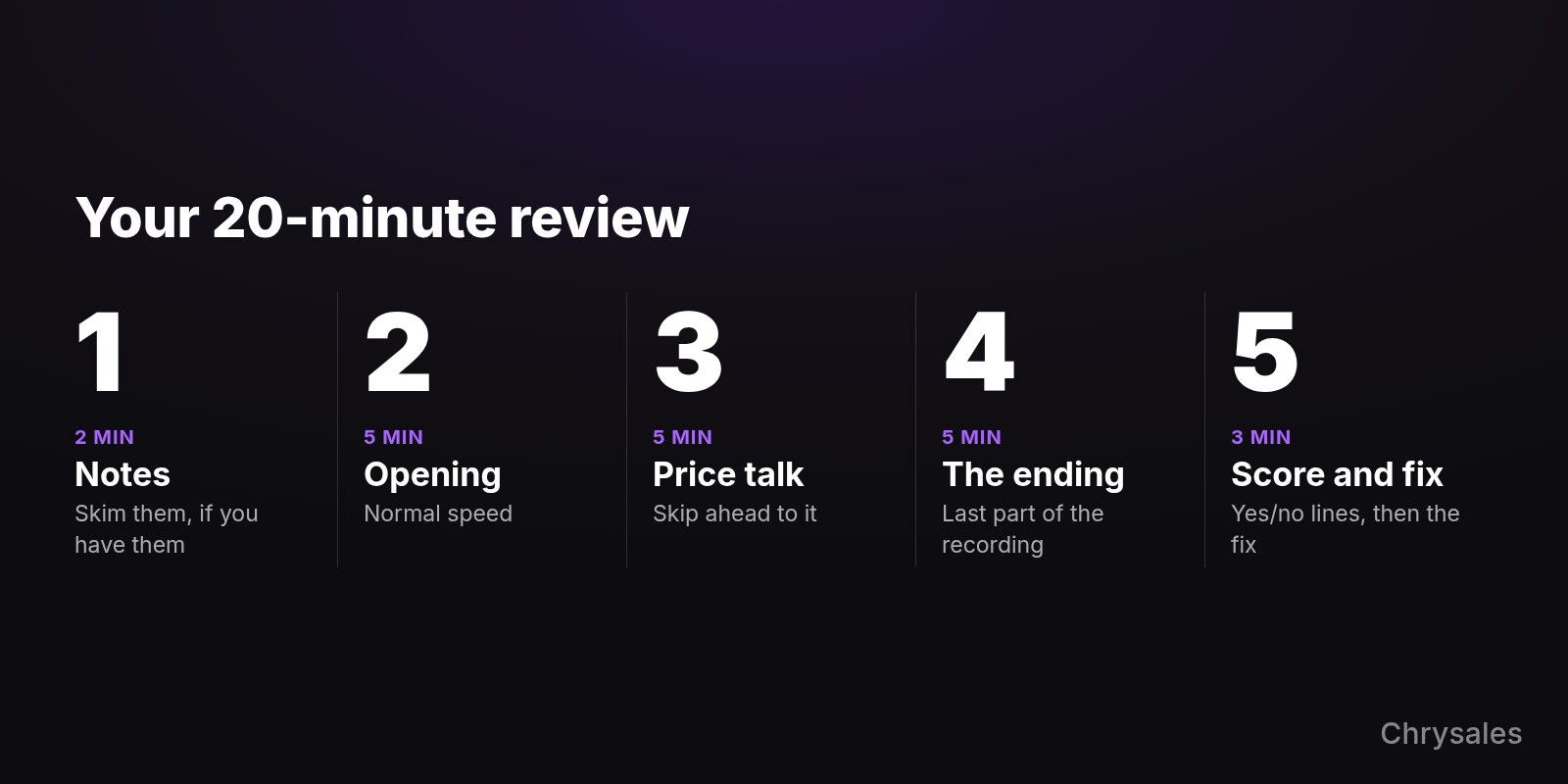
The image shows a suggested time for each part. This list says what to listen for.
- Read the notes or transcript quickly and find where price or the main worry comes up.
- Play the opening at normal speed. Did the rep agree on a goal for the meeting?
- Jump to the price or worry part. Did the rep ask a question before offering a discount?
- Play the end. Is there a next step with a date, and did anyone ask who else decides?
- Mark each line yes or no, with the time you heard it.
- Pick the "no" that matters most for the next meeting.
Speed up playback where nothing important happens. Gong's guide for reps also says to raise the playback speed to save time.
To practice, watch this session from Sabir's channel. Note the time each objection, a reason the buyer gives to say no, comes up. He sits down with real clients and makes cold calls live, going through real objections and responses.
Feedback that changes one thing
Name a behavior, give its timestamp, and suggest a thing to try next time. Roberge says good managers spot many problems, then narrow them down to "the one or two that will make the biggest difference".
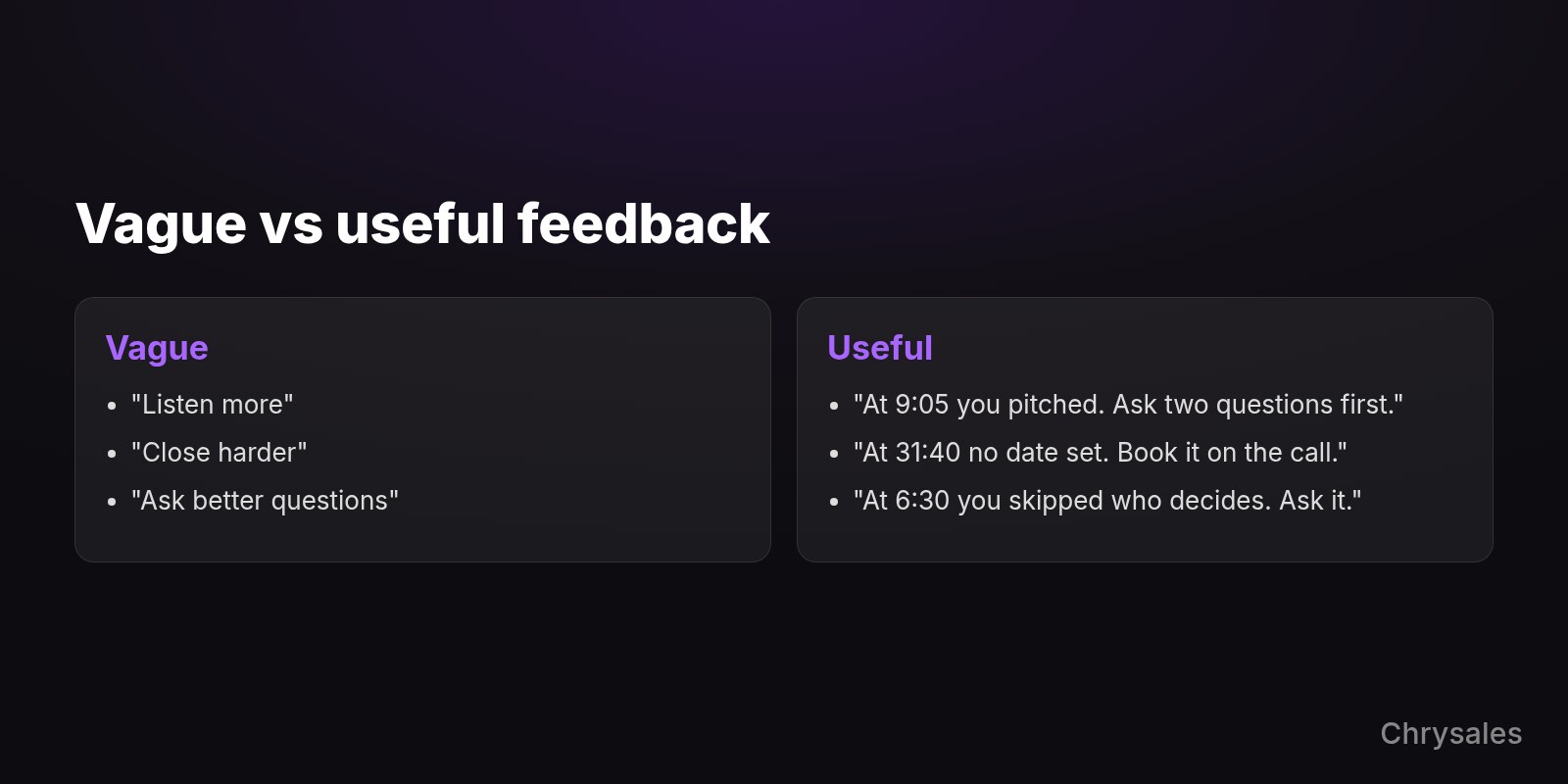
The image puts made-up vague lines next to useful ones. Vague feedback like "be more confident" gives the rep nothing specific to try, while one named behavior with a timestamp does.
How you say it matters too.
A large review of research on feedback in general, by Kluger and DeNisi, found feedback helps on average. But in over a third of cases it made performance worse. It worked less when it pointed at the person instead of the task.
So talk about what the rep did, not who they are. Sales Gravy puts it as address actions, not traits.
Give it in a one-on-one, a private meeting with just you and the rep. Keep it out of the team meeting, which has a different job, as the weekly sales meeting agenda explains.
Play the moment, ask the rep what they heard, then agree on the fix.
Record calls the right way
Tell everyone in the meeting that you record, every time. The rules differ by country, and this is not legal advice, so check with a lawyer for your markets.
In the US, federal law sets a minimum: one person in the conversation agrees. State laws can be stricter. Some states, for example California, Florida and Pennsylvania, require everyone in the conversation to agree.
A call across state lines can fall under the stricter rule, so asking everyone is the safer habit.
In the EU, GDPR, the EU's data protection law, requires you to tell people why you use their data and on what legal basis. Recordings of people are generally treated as their personal data. National rules can add more.
In Germany, recording a private conversation without permission can be a criminal offence. Switzerland and the UK have their own rules.
Conclusion: Review a recording this week
You don't need a big coaching program. This week:
- Copy the scorecard into a doc.
- Pick a recent discovery call per rep, or a recording of your own.
- Score it in 20 minutes and give a single fix in a one-on-one.
Next week, check the same line on a new recording. A good sign is the same "no" turning into a "yes" over a few weeks.
Want help with how your team runs and reviews sales calls? On a free strategy call, Chrysales can look at your sales process and help you build it, and the team to run it. Talk through your call reviews on a free call
A simple sales call review can take about 20 minutes per rep (the person on your team who sells) each week.
Pick one type of sales meeting and listen to a recording. Check it against five or six yes/no lines you can hear, and note the time for each.
Then choose a single thing to fix. A plain recording from your video tool is enough, and it works for your own meetings too.
Without this, you judge each meeting by what the rep tells you afterward. Steli Efti of Close says managers who don't listen treat the conversation "like a black box", something they never see inside. You hear the rep's story, never the words of the prospect, the possible client.
Which calls should you review?
Start with one kind of meeting: the discovery call. That is the first real conversation with a new prospect, where the rep learns their problem before any pitch. Every rep runs it, so recordings are easy to compare.
For volume, Gong's help center suggests starting with one call per rep each week. That is a software company's suggestion. We found no study that tested the right number, but one recording a week is a common start.
Mix deals the rep won and lost. If you only listen when numbers drop, reviews feel like punishment.
Mark Roberge, former CRO (head of sales and revenue) at HubSpot, gives a simple example in a SaaStr talk. A rep's plan for the month could be to record two discovery calls and listen to them together.
No reps yet? Review your own recordings the same way. Good ones later help with the onboarding plan for a new sales rep.
For the meeting itself, see how to run a discovery call.
What goes on a sales call scorecard
A scorecard is a short list of things you check on every recording. Keep it to five or six lines you can hear on the recording, each answered yes or no, with a timestamp. A timestamp is the minute and second where it happened, so you can play it back for the rep.
Skip 1-10 scores for things like confidence. Two people can score the same meeting differently, and the rep hears a verdict on themselves.
Close's free call review checklist mixes yes/no questions with 1-10 scores for things like likability. It ends by asking you to choose one thing for the rep to improve. Keep that last step, and keep your own lines to things you can point to on the recording.
Copy this scorecard into any doc.
SALES CALL REVIEW - first discovery call
Rep:              Date:              Call with:

Yes/No   Time    What you can hear
[ ]      __:__   1. Agreed the goal of the call at the start
[ ]      __:__   2. Asked about the problem before pitching
[ ]      __:__   3. The prospect talked more than the rep
[ ]      __:__   4. Asked who else decides
[ ]      __:__   5. Met the main worry with a question, no discount
[ ]      __:__   6. Ended with a booked next step and a date

One fix for next week:
For what strong versions of these moments sound like, see what good B2B sales calls sound like.
A 20-minute sales call review routine
Use a fixed order, so you never sit through a whole recording. You don't need call software like Gong. A transcript, the written text of the conversation, makes the first step faster.
The image shows a suggested time for each part. This list says what to listen for.
- Read the notes or transcript quickly and find where price or the main worry comes up.
- Play the opening at normal speed. Did the rep agree on a goal for the meeting?
- Jump to the price or worry part. Did the rep ask a question before offering a discount?
- Play the end. Is there a next step with a date, and did anyone ask who else decides?
- Mark each line yes or no, with the time you heard it.
- Pick the "no" that matters most for the next meeting.
Speed up playback where nothing important happens. Gong's guide for reps also says to raise the playback speed to save time.
To practice, watch this session from Sabir's channel. Note the time each objection, a reason the buyer gives to say no, comes up. He sits down with real clients and makes cold calls live, going through real objections and responses.
Feedback that changes one thing
Name a behavior, give its timestamp, and suggest a thing to try next time. Roberge says good managers spot many problems, then narrow them down to "the one or two that will make the biggest difference".
The image puts made-up vague lines next to useful ones. Vague feedback like "be more confident" gives the rep nothing specific to try, while one named behavior with a timestamp does.
How you say it matters too.
A large review of research on feedback in general, by Kluger and DeNisi, found feedback helps on average. But in over a third of cases it made performance worse. It worked less when it pointed at the person instead of the task.
So talk about what the rep did, not who they are. Sales Gravy puts it as address actions, not traits.
Give it in a one-on-one, a private meeting with just you and the rep. Keep it out of the team meeting, which has a different job, as the weekly sales meeting agenda explains.
Play the moment, ask the rep what they heard, then agree on the fix.
Record calls the right way
Tell everyone in the meeting that you record, every time. The rules differ by country, and this is not legal advice, so check with a lawyer for your markets.
In the US, federal law sets a minimum: one person in the conversation agrees. State laws can be stricter. Some states, for example California, Florida and Pennsylvania, require everyone in the conversation to agree.
A call across state lines can fall under the stricter rule, so asking everyone is the safer habit.
In the EU, GDPR, the EU's data protection law, requires you to tell people why you use their data and on what legal basis. Recordings of people are generally treated as their personal data. National rules can add more.
In Germany, recording a private conversation without permission can be a criminal offence. Switzerland and the UK have their own rules.
Conclusion: Review a recording this week
You don't need a big coaching program. This week:
- Copy the scorecard into a doc.
- Pick a recent discovery call per rep, or a recording of your own.
- Score it in 20 minutes and give a single fix in a one-on-one.
Next week, check the same line on a new recording. A good sign is the same "no" turning into a "yes" over a few weeks.
Want help with how your team runs and reviews sales calls? On a free strategy call, Chrysales can look at your sales process and help you build it, and the team to run it. Talk through your call reviews on a free call
Scaling Is Not Hard If You Have The Right Systems
If you’re serious about leveling up your scaling game, you need the right system, the right training, and the right team behind you. We're here to give you the exact tools and strategies top entrepreneurs use to dominate.

Discover the latest tips
View All
Chrysales was formed from the words "chrysalis" the stage where a caterpillar transforms into a butterfly and "sales".
It stands for one thing: sales transformation.Because scaling doesn’t happen by doing more of the same. Scaling only happens when you go through real transformation in your systems, your offer, team and the way you sell.


