.avif)
Why AI Sales Automation Is Replacing the SDR Role
Sales automation for agencies is a way to handle lead generation, outreach, follow ups, and booking meetings with software so humans can focus on selling. Sales Development Reps used to be the backbone of B2B sales. Cold calling, list building, booking meetings. Now? That playbook is breaking. AI sales automation is eating tasks that took SDRs hours. Tools score leads instantly, write personalized emails at scale, and book meetings while you sleep. But here's the thing: automation alone doesn't replace an SDR. It replaces the bad parts of the job. What comes next is smarter, faster, and way more effective.
Why the Old SDR Model Stopped Working
The traditional SDR setup looked the same everywhere. Hire someone right out of college. Give them a list, a script, and a phone. Tell them to make 100 calls a day. Most quit within six months. The ones who stayed burned out or got promoted. The problem wasn't the people. It was the system. Manual prospecting takes forever. SDRs spent 70% of their time on admin work: updating CRMs, cleaning lists, chasing dead leads. Only 30% went to actual selling. That ratio made no sense.
The Real Cost of Manual Prospecting
A full-time SDR costs around €50,000 to €70,000 per year when you factor in salary, tools, and training. If they're spending most of their day on tasks a tool can do in minutes, you're paying someone to be a human spreadsheet.
Common mistake: Companies hire more SDRs to fix a broken process. Three struggling SDRs don't outperform one well-supported person with the right sales automation for agencies setup.
Why Cold Calling Alone Doesn't Scale
Cold calls still work, but only when the list is perfect and the timing is right. Most SDRs dialed leads who weren't ready, weren't interested, or weren't even the right person. No amount of charisma fixes a bad list. Picture this: you spend two weeks perfecting your pitch, but your list is full of people who aren't decision makers. That's the trap. The traditional SDR model put all the weight on the person, not the system.
What AI Sales Automation Actually Does
AI sales automation isn't one tool. It's a full stack of software working together to handle the repetitive parts of B2B lead generation. Think of it like a smart assistant that never takes a break. AI scores leads based on behavior. It finds contact info. It writes personalized emails. It follows up on time, every time. Some systems even book meetings directly into your calendar. This isn't sci-fi stuff. Companies are using this right now.
Lead Scoring That Actually Works
Old-school lead scoring was a mess. Someone downloaded a white paper three months ago, so they're "warm." That's not how buying works. AI sales agents analyze real signals: job changes, funding rounds, website visits, email opens, reply tone. A 200-person company that just did layoffs is not a hot lead. It's a bad fit, full stop. AI catches that. Humans often miss it.
Pro Tip: Set a simple rule. Anything scoring above 70 goes to the top of your call list. Below 40? Automate the nurture sequence and move on.
Automated Lead Generation That Builds Your List
Manual list building used to take days. You'd search LinkedIn, copy names into a spreadsheet, hunt for emails, verify them one by one. Now? Automated lead generation tools pull company data, enrich it with contact info, and filter by your exact criteria in minutes. We worked with a tech company last year. Their SDR spent 15 hours a week building lists. After setting up sales workflow automation, that dropped to two hours. The lists were cleaner, too.
Personalization at Scale
Here's where people get confused. They think automation means robotic, generic emails. Not anymore. AI personalization outreach pulls data from LinkedIn profiles, company news, recent funding, job postings, even podcast appearances. It drops those details into emails that feel hand-written. A 30-person consulting firm tried this last quarter. They booked 12 new calls in three weeks. The secret? Their emails mentioned real details, like a recent blog post or a new hire. Prospects replied because it felt human.
Watch out: Don't over-personalize. Mentioning someone's college roommate's dog is creepy. Stick to professional signals.
The Hybrid Model: AI Plus Smart Humans
So if AI does the grunt work, what happens to the people? They get better jobs. The new model isn't "replace SDRs with bots." It's "let AI handle the boring stuff so humans can focus on sales training, relationship building, and closing." Industry research shows that the right balance of AI and human SDRs dramatically improves team performance and morale.
What Humans Still Do Better
AI can't read a room on a Zoom call. It can't pivot mid-conversation when someone raises a new objection. It can't build trust the way a real person can. Think of your sales pipeline like a phone contact list. If half the numbers don't work, no message gets through. AI cleans the list. Humans make the call that matters.
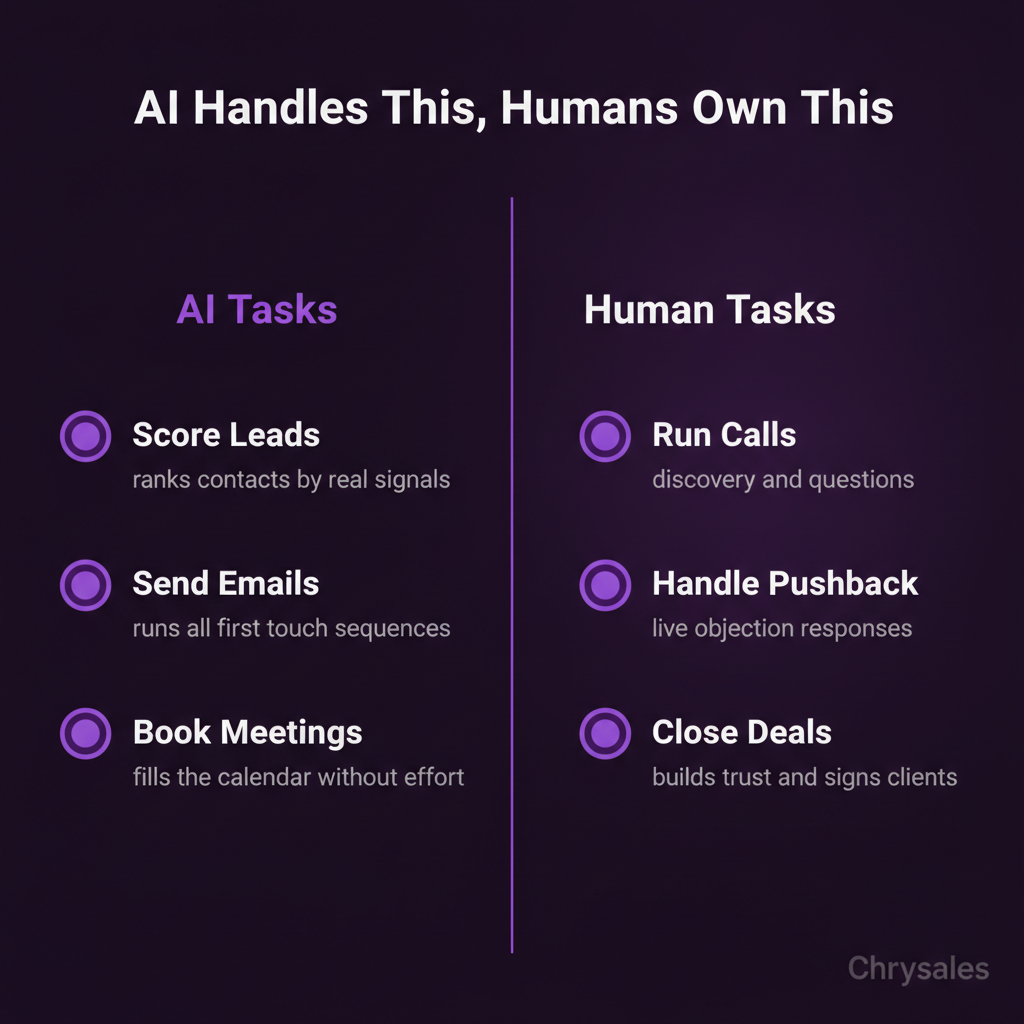
The best B2B sales teams now run a hybrid model. AI handles:
- Lead research and scoring
- First outreach emails
- Follow-up sequences
- Meeting scheduling
- CRM updates
Humans own:
- Discovery calls
- Objection handling
- Custom pitches
- Relationship building
- Deal closing
One marketing agency split their team this way. Their "SDRs" became "Client Acquisition Specialists." Same people, different focus. Instead of 100 dials a day, they took 8 to 10 high-quality calls. Conversion rates tripled.
Building a Sales System Around AI
Here's the thing nobody tells you: the list does most of the heavy lifting. A great email sent to the wrong person flops. An okay email sent to the perfect person at the perfect time books a meeting. Your sales system for B2B has to start with clean data. AI tools like Instantly email automation, Apollo, and Clay build lists fast, but they're only as good as your filters. Narrow your target. Pick one industry, one company size, one problem you solve. Feed that to your AI. Then automate the first three touches.
Email one introduces your offer. Email two shares a quick case study or stat. Email three asks for 15 minutes. If they don't reply, the AI nurtures them over 90 days. If they do reply, a human takes over.
Pro Tip: Most teams build a 40-step workflow when 12 steps would do the job. Start simple. Add complexity only if data shows it works.
What This Means for Client Acquisition
Predictable revenue for agencies used to feel impossible. You'd have a great month, then nothing for six weeks. The new model fixes that. When AI handles the top of your funnel, you get consistent volume. Every week, 20 new leads enter the system. Every week, 5 to 8 book calls. Every week, 1 to 2 close. That predictability changes everything.
The Math That Makes It Work
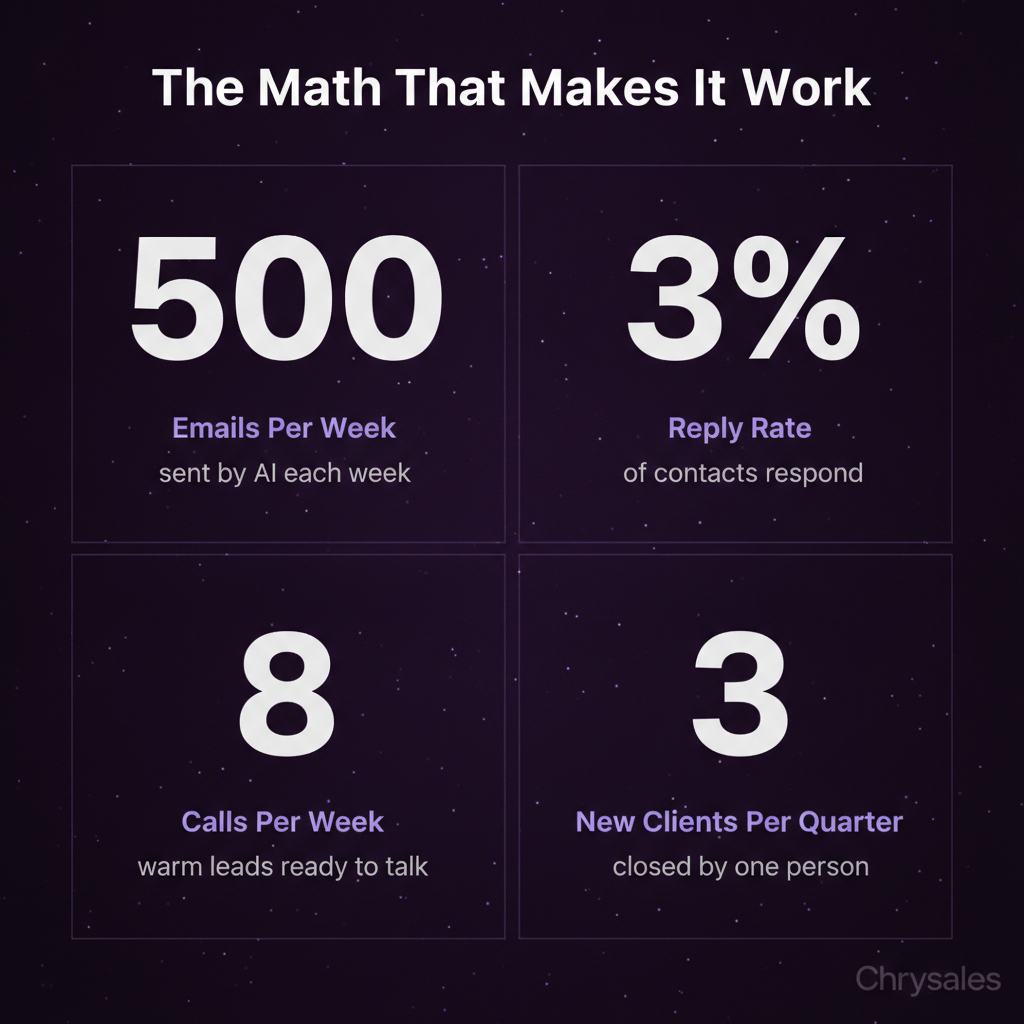
Let's say your agency sales process needs 50 qualified conversations per quarter to hit revenue goals. The old way: hire two SDRs, hope they hit quota, pray they don't quit. The new way: AI sends 500 personalized emails per week. 3% reply. That's 15 replies. Half book calls. That's 7 to 8 calls per week, 30+ per month. One person can handle that volume if the leads are pre-qualified.
A 15-person consulting firm we worked with went from 4 new clients a year to 3 per quarter using this model. Their secret? They stopped hiring more SDRs and started building a real sales system that actually scales.
How to Measure What Actually Matters
Old SDR metrics were a mess. Calls made. Emails sent. Activity theater. New metrics focus on outcomes:
- Reply rate (aim for 3% to 5%)
- Meeting show rate (should be above 70%)
- Meeting-to-opportunity conversion (above 25% is solid)
- Cost per booked meeting (under €100 is the sweet spot)
If your AI sales automation drives those numbers up and your cost per meeting down, it's working. If not, tweak the list or the message. Cold email success statistics show that consistent testing and refinement can double your results within 90 days.
Watch out: Don't obsess over open rates. Inbox providers fake them now. Replies and meetings are the only metrics that matter.
The Tools That Power the New Model
You don't need a dozen tools. You need the right stack. Here's what actually works for B2B client acquisition in 2025.
Lead Generation and Enrichment
Tools like Apollo, Clay, and ZoomInfo pull company and contact data. They enrich your list with job titles, company size, tech stack, recent news. Feed them your ideal customer profile and they return a list of leads that match. One tech company used Clay to find SaaS companies with 20 to 100 employees that recently raised a Series A. That filter alone cut their list size by 80% and boosted reply rates by 4x.
Email Automation and Sequencing
Instantly, Lemlist, and Smartlead send personalized emails at scale. They rotate domains to protect your sender reputation. They A/B test subject lines. They track replies and hand warm leads to humans automatically. Following cold email best practices ensures your sequences convert without damaging deliverability.
Common mistake: Sending from your main domain. One spam complaint can wreck your deliverability. Use separate domains for cold outreach.
AI Sales Agents and Assistants
Newer tools like 11x, Artisan, and custom Gemini based sales workflows act like full time assistants. They monitor your pipeline, suggest next actions, draft follow up emails, and even analyze call transcripts for objection patterns. We've built custom AI outreach personalization workflows for clients using Gemini. The AI reads a prospect's recent LinkedIn posts, pulls a relevant insight, and drafts an email. A human reviews it, tweaks if needed, and sends. Takes 90 seconds per email instead of 10 minutes. You can watch how this AI sales system delivers record revenue to see the full workflow in action.
CRM and Pipeline Management
HubSpot, Pipedrive, and Close keep everything organized. AI tools push data into your CRM automatically. No more manual updates. Your pipeline stays clean without anyone lifting a finger.
How to Build This System Without Burning Cash
You don't need a €50,000 tool budget. Start small. Pick one part of your sales process and automate it. Once that works, add the next piece.
Step One: Fix Your List
Before you automate anything, get your targeting right. Write down exactly who you sell to. Industry, company size, role, location, problem they have. Be specific. Use a free trial of Apollo or Clay. Build a list of 500 people who match. Export it. Review it manually. If half the names don't feel right, tighten your filters. A bad list automated is still a bad list. Fix this first.
Step Two: Write Three Emails
Don't write a 12 email sequence yet. Write three. Email one: "Hi [name], noticed [specific thing about their company]. We help [type of company] with [specific problem]. Worth a quick call?" Email two: "Quick follow up. We helped [similar company] [specific result]. Could do the same for you. Free to chat?" Email three: "Last one from me. If [problem] ever becomes a priority, happy to share what worked for [industry]." Test these manually. Send 50 by hand. If 2 to 3 people reply, you have a winner. If nobody replies, your message or list needs work.
Step Three: Automate the First Touch
Once your emails work manually, plug them into an automation tool. Start with 50 leads per week. Track reply rate, meeting rate, and quality of leads who book. If reply rate drops below 2%, something broke. Either the list got worse or the emails sound too robotic. Tweak and test.
Step Four: Add a Human Layer
When leads reply, a human takes over. This is where sales training matters. Your team needs to know how to run a discovery call, handle objections, and pitch your offer clearly. Hiring and scaling doesn't mean hiring 10 people. It means hiring one great person and giving them the tools to do the work of three.
Pro Tip: Record every sales call. Review them monthly. Look for patterns in objections and questions. Update your pitch and FAQ based on what you hear.
The Future of B2B Sales Teams
Five years from now, a "sales team" will look completely different. You won't have 10 SDRs dialing all day. You'll have 2 to 3 Client Acquisition Specialists running discovery calls, backed by AI handling everything else. The companies winning in B2B lead generation today are already building this model. They're training their people on strategy, not admin work. They're investing in sales systems, not just headcount. Research on the economics of AI SDRs versus human setters reveals how this shift is reshaping the entire industry.
This isn't about replacing humans. It's about giving them better tools so they can focus on what actually moves the needle: building relationships, understanding customer problems, and closing deals. If you're still running the old SDR playbook, you're competing with teams that have 10x the efficiency and half the cost. That gap only gets wider.
Frequently Asked Questions
Q: Does AI sales automation work for small teams or just big companies?
It works even better for small teams. A three person agency can't afford two full time SDRs. But they can afford a €200 per month tool stack that does the same work. Small teams benefit most because automation gives them the leverage big companies already have through sheer headcount. Start with one tool, get it working, then add more.
Q: How long does it take to set up an automated sales system?
Two to four weeks if you know what you're doing. Week one: build and test your lead list. Week two: write and test your first emails manually. Week three: plug everything into automation and run a small test batch. Week four: review data, fix what's broken, and scale up. Don't try to automate everything at once. Start with the top of your funnel. Working with AI sales automation consultants can speed up this timeline significantly.
Q: What happens to SDRs when AI takes over their tasks?
The good ones get promoted. The best SDRs already hated cold calling and list building. They liked the human part: conversations, problem solving, relationship building. Those skills matter more now, not less. Companies train former SDRs to become Client Acquisition Specialists or Account Executives. The role evolves, it doesn't disappear.
Q: Can AI write personalized emails that actually sound human?
Yes, but only if you feed it the right data. Generic AI emails still sound robotic. The trick is pulling specific details: a recent funding round, a new hire, a blog post, a podcast appearance. Tools like Clay and custom Gemini workflows do this well. A human should still review emails before they send, especially early on. Over time, the AI learns your voice.
Q: How much does it cost to replace an SDR with automation?
A solid sales automation for agencies stack costs €200 to €500 per month. That includes lead enrichment, email automation, CRM, and AI tools. Compare that to a full time SDR at €50,000+ per year. You save money and often get better results because AI doesn't have bad days, doesn't quit, and never forgets to follow up. The ROI usually hits within 90 days.
Sales automation for agencies is a way to handle lead generation, outreach, follow ups, and booking meetings with software so humans can focus on selling. Sales Development Reps used to be the backbone of B2B sales. Cold calling, list building, booking meetings. Now? That playbook is breaking. AI sales automation is eating tasks that took SDRs hours. Tools score leads instantly, write personalized emails at scale, and book meetings while you sleep. But here's the thing: automation alone doesn't replace an SDR. It replaces the bad parts of the job. What comes next is smarter, faster, and way more effective.
Why the Old SDR Model Stopped Working
The traditional SDR setup looked the same everywhere. Hire someone right out of college. Give them a list, a script, and a phone. Tell them to make 100 calls a day. Most quit within six months. The ones who stayed burned out or got promoted. The problem wasn't the people. It was the system. Manual prospecting takes forever. SDRs spent 70% of their time on admin work: updating CRMs, cleaning lists, chasing dead leads. Only 30% went to actual selling. That ratio made no sense.
The Real Cost of Manual Prospecting
A full-time SDR costs around €50,000 to €70,000 per year when you factor in salary, tools, and training. If they're spending most of their day on tasks a tool can do in minutes, you're paying someone to be a human spreadsheet.
Common mistake: Companies hire more SDRs to fix a broken process. Three struggling SDRs don't outperform one well-supported person with the right sales automation for agencies setup.
Why Cold Calling Alone Doesn't Scale
Cold calls still work, but only when the list is perfect and the timing is right. Most SDRs dialed leads who weren't ready, weren't interested, or weren't even the right person. No amount of charisma fixes a bad list. Picture this: you spend two weeks perfecting your pitch, but your list is full of people who aren't decision makers. That's the trap. The traditional SDR model put all the weight on the person, not the system.
What AI Sales Automation Actually Does
AI sales automation isn't one tool. It's a full stack of software working together to handle the repetitive parts of B2B lead generation. Think of it like a smart assistant that never takes a break. AI scores leads based on behavior. It finds contact info. It writes personalized emails. It follows up on time, every time. Some systems even book meetings directly into your calendar. This isn't sci-fi stuff. Companies are using this right now.
Lead Scoring That Actually Works
Old-school lead scoring was a mess. Someone downloaded a white paper three months ago, so they're "warm." That's not how buying works. AI sales agents analyze real signals: job changes, funding rounds, website visits, email opens, reply tone. A 200-person company that just did layoffs is not a hot lead. It's a bad fit, full stop. AI catches that. Humans often miss it.
Pro Tip: Set a simple rule. Anything scoring above 70 goes to the top of your call list. Below 40? Automate the nurture sequence and move on.
Automated Lead Generation That Builds Your List
Manual list building used to take days. You'd search LinkedIn, copy names into a spreadsheet, hunt for emails, verify them one by one. Now? Automated lead generation tools pull company data, enrich it with contact info, and filter by your exact criteria in minutes. We worked with a tech company last year. Their SDR spent 15 hours a week building lists. After setting up sales workflow automation, that dropped to two hours. The lists were cleaner, too.
Personalization at Scale
Here's where people get confused. They think automation means robotic, generic emails. Not anymore. AI personalization outreach pulls data from LinkedIn profiles, company news, recent funding, job postings, even podcast appearances. It drops those details into emails that feel hand-written. A 30-person consulting firm tried this last quarter. They booked 12 new calls in three weeks. The secret? Their emails mentioned real details, like a recent blog post or a new hire. Prospects replied because it felt human.
Watch out: Don't over-personalize. Mentioning someone's college roommate's dog is creepy. Stick to professional signals.
The Hybrid Model: AI Plus Smart Humans
So if AI does the grunt work, what happens to the people? They get better jobs. The new model isn't "replace SDRs with bots." It's "let AI handle the boring stuff so humans can focus on sales training, relationship building, and closing." Industry research shows that the right balance of AI and human SDRs dramatically improves team performance and morale.
What Humans Still Do Better
AI can't read a room on a Zoom call. It can't pivot mid-conversation when someone raises a new objection. It can't build trust the way a real person can. Think of your sales pipeline like a phone contact list. If half the numbers don't work, no message gets through. AI cleans the list. Humans make the call that matters.
The best B2B sales teams now run a hybrid model. AI handles:
- Lead research and scoring
- First outreach emails
- Follow-up sequences
- Meeting scheduling
- CRM updates
Humans own:
- Discovery calls
- Objection handling
- Custom pitches
- Relationship building
- Deal closing
One marketing agency split their team this way. Their "SDRs" became "Client Acquisition Specialists." Same people, different focus. Instead of 100 dials a day, they took 8 to 10 high-quality calls. Conversion rates tripled.
Building a Sales System Around AI
Here's the thing nobody tells you: the list does most of the heavy lifting. A great email sent to the wrong person flops. An okay email sent to the perfect person at the perfect time books a meeting. Your sales system for B2B has to start with clean data. AI tools like Instantly email automation, Apollo, and Clay build lists fast, but they're only as good as your filters. Narrow your target. Pick one industry, one company size, one problem you solve. Feed that to your AI. Then automate the first three touches.
Email one introduces your offer. Email two shares a quick case study or stat. Email three asks for 15 minutes. If they don't reply, the AI nurtures them over 90 days. If they do reply, a human takes over.
Pro Tip: Most teams build a 40-step workflow when 12 steps would do the job. Start simple. Add complexity only if data shows it works.
What This Means for Client Acquisition
Predictable revenue for agencies used to feel impossible. You'd have a great month, then nothing for six weeks. The new model fixes that. When AI handles the top of your funnel, you get consistent volume. Every week, 20 new leads enter the system. Every week, 5 to 8 book calls. Every week, 1 to 2 close. That predictability changes everything.
The Math That Makes It Work
Let's say your agency sales process needs 50 qualified conversations per quarter to hit revenue goals. The old way: hire two SDRs, hope they hit quota, pray they don't quit. The new way: AI sends 500 personalized emails per week. 3% reply. That's 15 replies. Half book calls. That's 7 to 8 calls per week, 30+ per month. One person can handle that volume if the leads are pre-qualified.
A 15-person consulting firm we worked with went from 4 new clients a year to 3 per quarter using this model. Their secret? They stopped hiring more SDRs and started building a real sales system that actually scales.
How to Measure What Actually Matters
Old SDR metrics were a mess. Calls made. Emails sent. Activity theater. New metrics focus on outcomes:
- Reply rate (aim for 3% to 5%)
- Meeting show rate (should be above 70%)
- Meeting-to-opportunity conversion (above 25% is solid)
- Cost per booked meeting (under €100 is the sweet spot)
If your AI sales automation drives those numbers up and your cost per meeting down, it's working. If not, tweak the list or the message. Cold email success statistics show that consistent testing and refinement can double your results within 90 days.
Watch out: Don't obsess over open rates. Inbox providers fake them now. Replies and meetings are the only metrics that matter.
The Tools That Power the New Model
You don't need a dozen tools. You need the right stack. Here's what actually works for B2B client acquisition in 2025.
Lead Generation and Enrichment
Tools like Apollo, Clay, and ZoomInfo pull company and contact data. They enrich your list with job titles, company size, tech stack, recent news. Feed them your ideal customer profile and they return a list of leads that match. One tech company used Clay to find SaaS companies with 20 to 100 employees that recently raised a Series A. That filter alone cut their list size by 80% and boosted reply rates by 4x.
Email Automation and Sequencing
Instantly, Lemlist, and Smartlead send personalized emails at scale. They rotate domains to protect your sender reputation. They A/B test subject lines. They track replies and hand warm leads to humans automatically. Following cold email best practices ensures your sequences convert without damaging deliverability.
Common mistake: Sending from your main domain. One spam complaint can wreck your deliverability. Use separate domains for cold outreach.
AI Sales Agents and Assistants
Newer tools like 11x, Artisan, and custom Gemini based sales workflows act like full time assistants. They monitor your pipeline, suggest next actions, draft follow up emails, and even analyze call transcripts for objection patterns. We've built custom AI outreach personalization workflows for clients using Gemini. The AI reads a prospect's recent LinkedIn posts, pulls a relevant insight, and drafts an email. A human reviews it, tweaks if needed, and sends. Takes 90 seconds per email instead of 10 minutes. You can watch how this AI sales system delivers record revenue to see the full workflow in action.
CRM and Pipeline Management
HubSpot, Pipedrive, and Close keep everything organized. AI tools push data into your CRM automatically. No more manual updates. Your pipeline stays clean without anyone lifting a finger.
How to Build This System Without Burning Cash
You don't need a €50,000 tool budget. Start small. Pick one part of your sales process and automate it. Once that works, add the next piece.
Step One: Fix Your List
Before you automate anything, get your targeting right. Write down exactly who you sell to. Industry, company size, role, location, problem they have. Be specific. Use a free trial of Apollo or Clay. Build a list of 500 people who match. Export it. Review it manually. If half the names don't feel right, tighten your filters. A bad list automated is still a bad list. Fix this first.
Step Two: Write Three Emails
Don't write a 12 email sequence yet. Write three. Email one: "Hi [name], noticed [specific thing about their company]. We help [type of company] with [specific problem]. Worth a quick call?" Email two: "Quick follow up. We helped [similar company] [specific result]. Could do the same for you. Free to chat?" Email three: "Last one from me. If [problem] ever becomes a priority, happy to share what worked for [industry]." Test these manually. Send 50 by hand. If 2 to 3 people reply, you have a winner. If nobody replies, your message or list needs work.
Step Three: Automate the First Touch
Once your emails work manually, plug them into an automation tool. Start with 50 leads per week. Track reply rate, meeting rate, and quality of leads who book. If reply rate drops below 2%, something broke. Either the list got worse or the emails sound too robotic. Tweak and test.
Step Four: Add a Human Layer
When leads reply, a human takes over. This is where sales training matters. Your team needs to know how to run a discovery call, handle objections, and pitch your offer clearly. Hiring and scaling doesn't mean hiring 10 people. It means hiring one great person and giving them the tools to do the work of three.
Pro Tip: Record every sales call. Review them monthly. Look for patterns in objections and questions. Update your pitch and FAQ based on what you hear.
The Future of B2B Sales Teams
Five years from now, a "sales team" will look completely different. You won't have 10 SDRs dialing all day. You'll have 2 to 3 Client Acquisition Specialists running discovery calls, backed by AI handling everything else. The companies winning in B2B lead generation today are already building this model. They're training their people on strategy, not admin work. They're investing in sales systems, not just headcount. Research on the economics of AI SDRs versus human setters reveals how this shift is reshaping the entire industry.
This isn't about replacing humans. It's about giving them better tools so they can focus on what actually moves the needle: building relationships, understanding customer problems, and closing deals. If you're still running the old SDR playbook, you're competing with teams that have 10x the efficiency and half the cost. That gap only gets wider.
Frequently Asked Questions
Q: Does AI sales automation work for small teams or just big companies?
It works even better for small teams. A three person agency can't afford two full time SDRs. But they can afford a €200 per month tool stack that does the same work. Small teams benefit most because automation gives them the leverage big companies already have through sheer headcount. Start with one tool, get it working, then add more.
Q: How long does it take to set up an automated sales system?
Two to four weeks if you know what you're doing. Week one: build and test your lead list. Week two: write and test your first emails manually. Week three: plug everything into automation and run a small test batch. Week four: review data, fix what's broken, and scale up. Don't try to automate everything at once. Start with the top of your funnel. Working with AI sales automation consultants can speed up this timeline significantly.
Q: What happens to SDRs when AI takes over their tasks?
The good ones get promoted. The best SDRs already hated cold calling and list building. They liked the human part: conversations, problem solving, relationship building. Those skills matter more now, not less. Companies train former SDRs to become Client Acquisition Specialists or Account Executives. The role evolves, it doesn't disappear.
Q: Can AI write personalized emails that actually sound human?
Yes, but only if you feed it the right data. Generic AI emails still sound robotic. The trick is pulling specific details: a recent funding round, a new hire, a blog post, a podcast appearance. Tools like Clay and custom Gemini workflows do this well. A human should still review emails before they send, especially early on. Over time, the AI learns your voice.
Q: How much does it cost to replace an SDR with automation?
A solid sales automation for agencies stack costs €200 to €500 per month. That includes lead enrichment, email automation, CRM, and AI tools. Compare that to a full time SDR at €50,000+ per year. You save money and often get better results because AI doesn't have bad days, doesn't quit, and never forgets to follow up. The ROI usually hits within 90 days.
Scaling Is Not Hard If You Have The Right Systems
If you’re serious about leveling up your scaling game, you need the right system, the right training, and the right team behind you. We're here to give you the exact tools and strategies top entrepreneurs use to dominate.

Discover the latest tips
View All.avif)
Chrysales was formed from the words "chrysalis" the stage where a caterpillar transforms into a butterfly and "sales".
It stands for one thing: sales transformation.Because scaling doesn’t happen by doing more of the same. Scaling only happens when you go through real transformation in your systems, your offer, team and the way you sell.
.avif)


