
How to run a discovery call: qualify first, pitch last
How to run a discovery call comes down to a simple order: qualify first, pitch last. Set the agenda right away, then spend most of the time on the problem, its cost, who decides and when. Keep your pitch for the end, and give it only if the prospect qualifies. Finish with a dated next step or a clear no.
This is for you if you run first sales conversations yourself, talk more than you'd like, and hear "let me think about it" too often. You get a 30-minute structure, a question list, five pass/fail gates, and notes and a recap email to copy.
What is a discovery call, and what should it decide?
A discovery call is your first real sales conversation with a prospect, where you find out whether they have a problem you can solve and whether they can buy. It should decide one of three things: a dated next step, a clear no, or a real need that has to wait until an agreed date.
The third outcome keeps "maybe" out of your pipeline. A real need without budget gets a check-back date, and polite vagueness gets a no.
Three kinds of early conversation get mixed up:
| Type | Main purpose | Who talks most | Result |
|---|---|---|---|
| Qualification | A quick check of basic fit | Either side | Whether a longer talk is worth booking |
| Discovery | Understand problem, cost, decision, timing and money | They do | A booked follow-up or a clear no |
| Demo | Show how your offer solves the problems you found | You | A view on whether your offer fits |
On a small purchase you may cover all three together. Keep them in that order anyway.
What should you prepare before a discovery call?
Check that the prospect fits, then spend about 10 minutes on research and write down a guess about their problem. Then decide who should attend on both sides, so you don't spend half an hour with someone who can't answer what matters most.
- Check the fit. Company size, market and role should match your ideal client profile. If too many poor fits reach you, score leads before they get on your calendar.
- Research for 10 minutes. Read the booking form and any referral note, then look at their website, the person's role and recent company news. Keep only what changes your questions.
- Write a hypothesis. For a made-up 30-person B2B company, that might be "I think they lose weeks because every lead waits for the founder." You test that sentence, and you never present it.
- Decide who attends. Pick a single lead on your side. In the invite, check whether anyone else on their side should join.
- Know your limits. Write down your smallest sensible deal and what you don't do, so you can spot a poor fit while you're talking.
How do you run a 30-minute discovery call?
Run a 30-minute discovery call in five blocks: open, then problem and cost, then decision, timing and money, then a short answer and the next step. You talk most during the opening and the answer, and the prospect talks most from minute 2 until about minute 20.
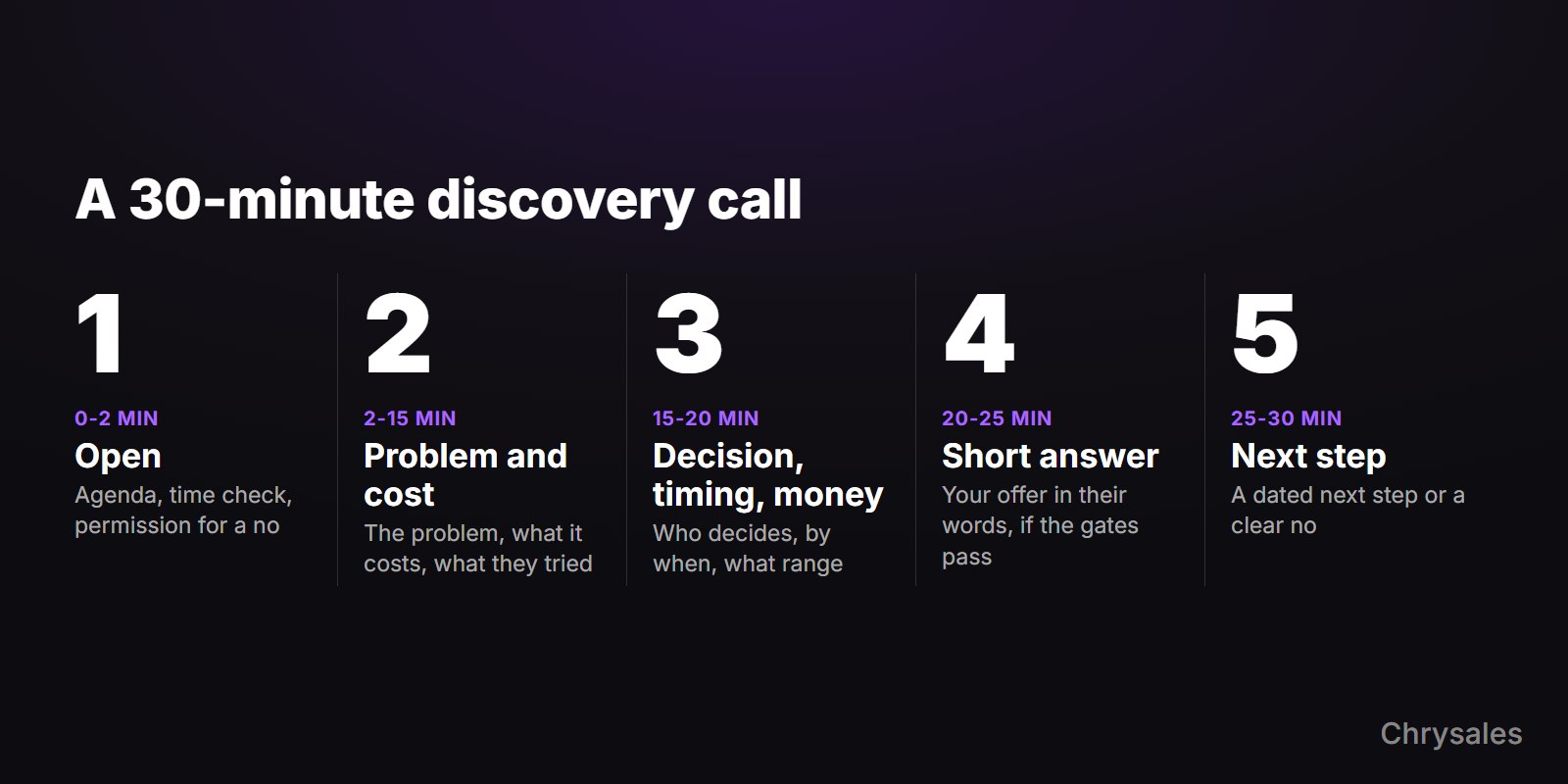
| Minutes | Block | Goal | Who talks most |
|---|---|---|---|
| 0-2 | Open | Agenda, time check, permission for a no | You |
| 2-15 | Problem and cost | The problem, what it costs, what they tried | They do |
| 15-20 | Decision, timing, money | Who decides, by when, what range | They do |
| 20-25 | Short answer | Your offer in their words, if the gates pass | You |
| 25-30 | Next step | A dated next step or a clear no | Both |
The time blocks, the gates and the scripts without a named author are this post's suggestions, not measured results. Adjust them to how your buyers buy.
The hard part for you is the stretch up to minute 20. You know your offer better than anyone, and every problem you hear will tempt you to explain the fix. Write the idea down and keep going.
If you reach minute 25 with gates still open, skip the answer block and book a second meeting. That costs you far less than a pitch to someone you haven't qualified.
Prefer watching to reading? This short video from the Sales Feed YouTube channel covers a framework for qualifying leads and building trust. It isn't ours, so treat it as a second opinion.
How do you open a discovery call?
Open by confirming the time and the agenda, and tell the prospect that a no is a fine result. That takes about two minutes, and after it, asking about money and decisions later won't feel sudden.
"Thanks for making the time. We planned 30 minutes, does that still work?
I'd like to start with what's going on at your end, then how a decision
like this gets made. If I can help, I'll tell you how in a few minutes,
and we'll look at what comes next. If we're not a match, either of us
can say so and we both get our time back. Anything you'd add?"
The line about saying no gives the prospect permission to be honest. Chris Orlob's script on Gong's blog uses a version of it: by the end, you're "either interested and we plan the next logical step, or you're not interested, you tell me that candidly, and we avoid wasting each other's time."
Some prospects will jump ahead and ask for your price in minute three. Note the question, promise to come back to it, and read how to keep control of the conversation for that moment.
Which discovery call questions should you ask?
Ask about six things in this order: the problem, its cost, what they already tried, how the decision gets made, the timing and the money. Stay on a topic until you understand the answer, and treat about a dozen questions as a guide, since a good follow-up can beat a new question.
Here are 12 to start from. Reword them and skip anything the prospect already answered.
Problem
1. What made you book this call now, and not six months ago?
2. Tell me about the last time this came up. What happened?
3. Which part of that bothers you most?

Cost
4. What does this cost you per quarter, roughly, in money or hours?
5. Who else in the company feels it?

Past attempts
6. What did you try before, and why did it stop working?

Decision
7. When you bought something like this before, how did that decision get made?
8. Whose signature does this need?

Timing
9. Is there a date this has to be solved by? What's behind that date?
10. What else is competing for attention this quarter?

Money
11. Do you have a range in mind, or has nobody looked at that yet?
12. If this came to [your range], would that work, or would it need approval?
Gong, which sells recording software, gives a rough guide to the number. Its analysis of 519,000 recorded discovery calls, published in 2017, found that "asking between 11-14 discovery call questions during the course of the call correlates with the greatest success". It adds that the most effective calls "uncover between three and four business problems".
A later Gong analysis, published in 2025, covered sales conversations of at least 10 minutes, not only discovery: winners asked "15 to 16 questions" and losers "about 20 per call". Both are vendor data showing correlation, and neither page states when the data was collected. Use them as a range, and don't expect extra questions to help by themselves.
Before you change topic, dig a little deeper, then try "What else?" to reach the second and third problem. With made-up answers, that sounds like this:
| They say | Your follow-up |
|---|---|
| "Our leads have been slow." | "Slow compared to when, and what changed?" |
| "It's costing us." | "Roughly how much in a normal quarter?" |
| "We'd need to discuss it internally." | "Who is in that discussion, and what will they ask?" |
How much of the time should you talk?
Listen more than you talk, above all before minute 20, and don't chase an exact percentage. Gong's data shows only a small gap between won and lost deals across every kind of conversation, so treat talk time as a warning sign and keep your attention on the questions.
Gong's 2025 look at 326K calls of at least 10 minutes found that reps talked 57% of the time on won deals and 62% on lost deals. Gong itself says "that difference isn't massive". These figures cover more than discovery, and the page gives no data period. Talking less may simply go along with winning rather than cause it.
A simpler rule works in the moment: until you give your short answer around minute 20, end every turn with a question. If you catch yourself explaining your offer, stop and try "Sorry, I jumped ahead. What were you saying about that?"
Check your notes afterward. If you can't write down the problem and its cost in the prospect's own words, you probably did too much of the talking.
How do you qualify a prospect with pass/fail gates?
Check five gates before you pitch: need, cost, decision, timing and money. Each gets a pass or a fail based on what the prospect actually said, and a fail tells you what to do next: ask again, change the follow-up, set a check-back date or end the conversation politely.
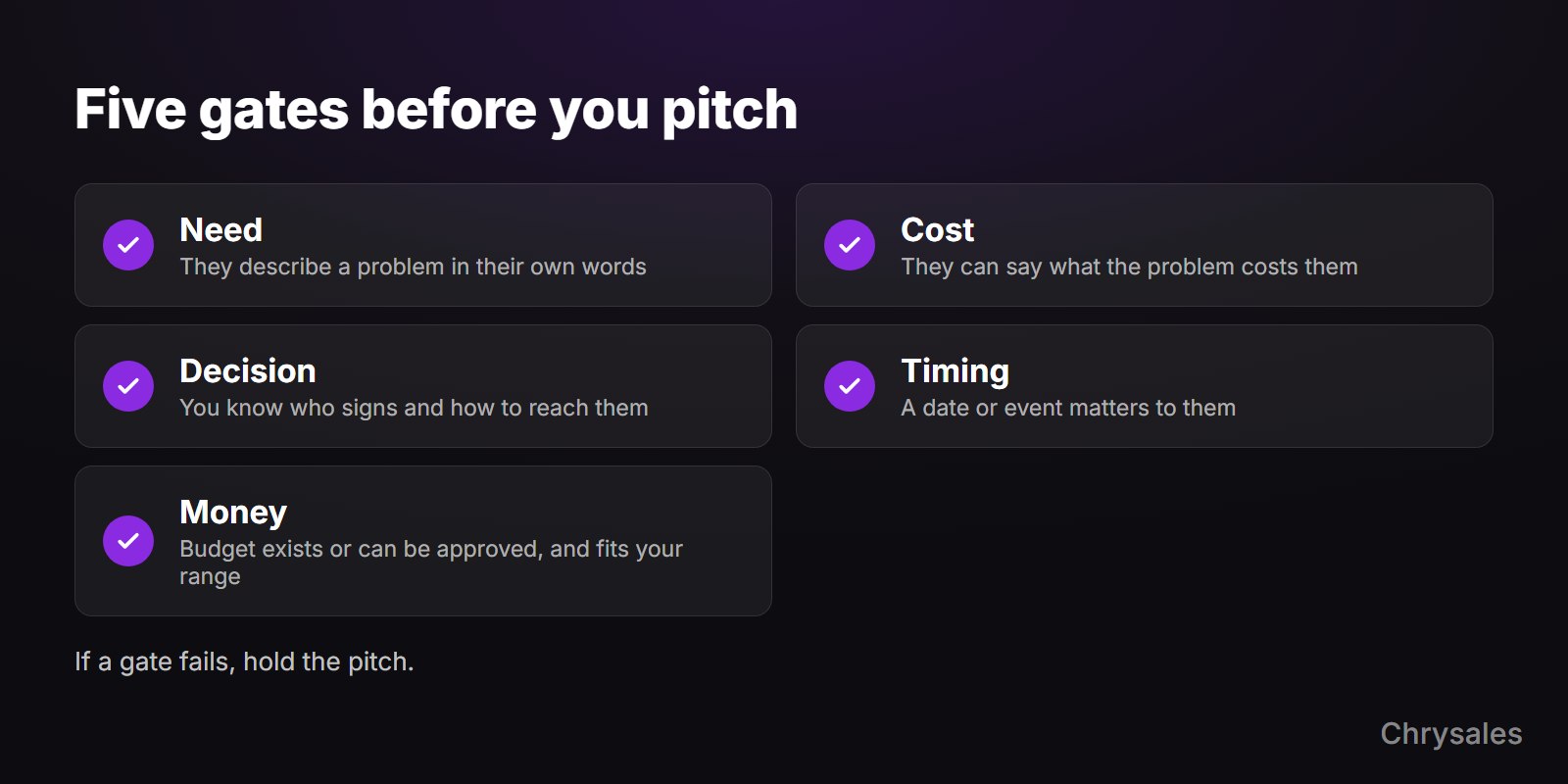
| Gate | Pass | Fail | Your move on a fail |
|---|---|---|---|
| Need | They describe a problem in their own words and want it fixed | Curiosity, or no problem they care about | Ask what made them book. If nothing comes up, end politely |
| Cost | They can say what the problem costs them, in money, time or lost business | It's annoying, but nothing depends on it | Ask what happens if it stays as it is. If the answer is "not much", treat it as not now |
| Decision | You know who signs and how to reach them | They can't say who signs, or won't let you reach that person | Make that person the focus of your follow-up meeting |
| Timing | A date or event matters to them | "Someday", with no date and no trigger | Agree on a month to check back and take it out of your active deals |
| Money | Budget exists or can be approved, and fits your range | No budget and no route to it, or far below your range | State your range once. Offer a smaller scope if you can, otherwise end politely |
Count a vague answer as a fail, because "we'll figure out the budget later" tells you nothing yet. If a gate fails, hold the pitch. Need and cost failures usually end the discussion, while decision and timing failures only change what happens after it.
The decision gate deserves extra care. Forrester's January 2026 release says "The typical buying decision now includes 13 internal stakeholders and nine external influencers". The release gives no sample, and in our view a founder-led deal at a small company will usually involve fewer people. Find out who else has a say anyway.
You'll hear about BANT, MEDDIC and CHAMP. They cover similar ground:
- BANT is widely credited to IBM, and its date of origin is disputed. An IBM partner form from June 2012 spells it out as "Budget, Authority, Need and Timeframe".
- MEDDIC was created at PTC in 1996, according to the training company MEDDICC. The letters stand for Metrics, Economic Buyer, Decision Criteria, Decision Process, Identify Pain and Champion.
- CHAMP stands for "Challenges, Authority, Money, and Prioritization", according to Revenue.io. It starts with the problem, which is also the order of the five gates here.
When do you pitch, and what about "just send me a proposal"?
Pitch late, only after the gates pass, and keep it short and tied to the words the prospect used. If they say "just send me a proposal," find out what they'll do with it and who will read it, then send it only if they qualify.
Start by repeating what you heard, so they can correct you before you offer anything.
"You said [problem in their words], and that it costs you [their number].
You want it solved by [their date], and [name] signs off.
Here's what I'd do about that: [two or three sentences, no feature list].
Does that match what you need, or did I miss something?"
A proposal request can be a real step forward or a polite exit, and two questions tell you which.
"Happy to. So it's useful and not a guess, can I ask two things first?
What will you do with the proposal once you have it?
Who needs to read it, and what will they look for?"| What you hear | What it tells you | Your move |
|---|---|---|
| Clear answers, gates pass | It's a real step forward | Agree to write it and book a live walk-through before you hang up |
| Clear answers, gates still open | They're interested, you're missing facts | Book a second meeting with the person who decides |
| Vague answers, or "just send it" again | Probably a polite no | Send a short summary with no price, and offer to talk if things change |
If proposals keep stalling, this post on why founders lose winnable deals covers when to send one.
How do you end a discovery call with a real next step?
End with a dated action both sides agree on: a meeting in the calendar with named people, and what each side will bring. If you can't get that, ask what's in the way, and if it turns out nothing comes after this conversation, say so and record a no.
Neil Rackham's SPIN research covers "more than 35,000 sales calls". Huthwaite International, the training company behind SPIN, sorts endings into four types. Watch out for a Continuation, "where the customer continues the sales process, but things aren't progressing".
| Ending | Example (made up) | Your move |
|---|---|---|
| Advance | "Let's go through this with finance on Thursday at 11." | Send the invite before you hang up |
| Order | "Send the contract and we'll sign." | Send it the same day |
| Continuation | "Send me something and I'll get back to you." | Ask for a date, or ask what's in the way |
| No Sale | "This isn't for us." | Thank them and mark it as lost |
To get an Advance, go for the biggest step the prospect can really take. Huthwaite says successful sellers propose the highest commitment the customer can realistically give.
Give this part its full five minutes. In a Gong study of 28,833 closed deals, published in 2018, sellers in the fastest deals spent "53% more time discussing 'next steps' during the first meeting" than in deals with a slow sales cycle. The same post says that in 26% of introductory meetings, next steps weren't touched at all. Like the other Gong figures here, these come from the vendor and show correlation only.
As Sandler trainer Jeff Borovitz puts it, "you're locking in the future or agreeing that there isn't one."
When the gates pass
"From what you've told me, the follow-up is 30 minutes with [name]
to go through [topic]. Would Wednesday at 11 or Thursday at 4 suit you both?
I'll send the invite while we're on the line."

When they say "let me think about it"
"Of course. What would you need to know to say a clear yes or no?
Let's put 15 minutes on [date] for your answer. A no is completely fine."
In a short video about AI agents, Chrysales founder Sabir Naghiyev says a deal is won in moments AI can't handle, such as finding the real objection behind "let me think about it". So listen to the answer before you book anything. If the hesitation stays, use this guide to handle "I need to think about it".
If the gates passed and the purchase is simple enough to finish right there, use this closing script.
What do you say to a prospect who isn't a fit?
Say it directly, with the reason, and point the prospect to a better option if you can. A polite no protects your calendar, and it spares them from reading a proposal that was never going to help them.
Open deals that lead nowhere are expensive. "Our research shows that anywhere between 40 and 60% of all deals are actually lost to the customer doing nothing," Matt Dixon, co-author of The JOLT Effect, said in a 2022 interview. His research draws on about 2.5 million recorded conversations. You can't spot all of those deals early, but you can stop feeding those that fail a gate.
In another short video, Sabir puts his outreach rule this way: "If someone isn't a good fit, we don't message them at all." This is where you apply that rule, before you spend days on a proposal.
Poor fit
"From what you've told me, I don't think we're the right choice for this,
because [reason]. I'd rather say that now than send a proposal that won't
help you. For this, I'd look at [option, if you know one]."

Real need, wrong time
"This sounds important, but not before [date]. Shall I check back in [month]?
If something changes sooner, you know where to find me."
Log the result the same day:
- The gate that failed
- The reason, in the prospect's words
- A check-back date, if you agreed on it
- Whether this lead source keeps sending the same kind of prospect
What should you send afterward?
Send a short recap the same day: what you heard, what you agreed and the booked follow-up. Fill in your notes first, while you still remember the exact words they used, because the recap and everything after it build on them.
Copy these notes into your CRM or a document:
Company / contact / date:
Recording: [agreed / not recorded]

Problems (their words):
1.
2.
3.
Cost (their number):
Tried before:
Who decides, who signs:
Date that matters:
Budget range:

Gates: Need [pass/fail]  Cost [pass/fail]  Decision [pass/fail]
       Timing [pass/fail]  Money [pass/fail]
Ending: [Advance / Order / Continuation / No Sale]
Follow-up: [date, time, people]
I owe them:
They owe me:
Then send the recap:
Subject: Our talk on [date]: summary and next step

Hi [name],

Thanks for your time today. Here's what I heard, so please correct
anything I got wrong.

Your situation: [problem in their words]
What it costs: [their number or description]
What matters by when: [date or event]
Who is involved: [names and roles]

Agreed follow-up: [meeting, date, time, people]
I'll bring: [what you owe them]
You'll bring: [what they owe you]

Best,
[your name]
Rules on recording calls differ by country and state, so check what applies to you first. If you do record, ask at the start and write the answer in your notes:
"Is it okay if I record this so my notes are accurate?
If you'd rather I didn't, I'll just take notes."
For a deal with several people and steps, write the next step into a mutual action plan that both sides can see. Before your next call, copy the five time blocks and the five gates (need, cost, decision, timing, money) onto a single page, and fill in the notes straight after you hang up. Sabir's check is a good place to start: "look at your last 10 sales calls. How many turned into clients?"
FAQ
How long should a discovery call be?
Thirty minutes is a sensible default. A Gong analysis of 30,000 first calls, published in 2017, found "no statistically significant correlation" between first-call length and getting a second meeting. It also says you're "12% more likely to get a prospect to show up" with a 30-minute slot than a 60-minute one.
Should discovery or a demo come first?
Discovery usually comes first, because you can't choose what to show until you know the problem. Chris Orlob, CEO of Caliber (formerly Pclub.io), said in a podcast, "we never show the product on the first call, but that's because that's not how our buyers buy." He was describing his own company, so if your buyers expect to see something, ask your key questions first and show only the part that fits.
What if the decision maker isn't there?
Carry on and treat the decision gate as open. Find out who decides and what that person will want to know, then book a meeting with them. Hold your full pitch until they join, so your contact doesn't have to repeat it secondhand.
Can a founder do this without sales experience?
Yes, though expect it to feel awkward at the start. Pete Kazanjy's book for founders, Founding Sales, calls discovery "the thing that first-time salespeople bungle the worst." A written structure helps, because you know what comes next and don't need to improvise.
Sources
- Gong - Question count study (2017)
- Gong - Talk-to-listen ratio analysis (2025)
- Gong - Next steps and cycle speed study (2018)
- Gong - Meeting length study (2017)
- CustomerThink - Interview with Matt Dixon on customer indecision (2022)
- Forrester - The State of Business Buying 2026 press release
- IBM - BANT criteria template (June 2012)
- MEDDICC - Who created MEDDIC
- Revenue.io - What is CHAMP
- Routledge - SPIN Selling by Neil Rackham
- Huthwaite International - The science behind SPIN Selling
- Holloway - Founding Sales by Pete Kazanjy
- Sandler - Jeff Borovitz on upfront contracts
- Reditus podcast - Chris Orlob on winning customers
Want help fitting this structure into how you sell? Chrysales builds the whole acquisition system with you and your team. Talk it through with Chrysales
How to run a discovery call comes down to a simple order: qualify first, pitch last. Set the agenda right away, then spend most of the time on the problem, its cost, who decides and when. Keep your pitch for the end, and give it only if the prospect qualifies. Finish with a dated next step or a clear no.
This is for you if you run first sales conversations yourself, talk more than you'd like, and hear "let me think about it" too often. You get a 30-minute structure, a question list, five pass/fail gates, and notes and a recap email to copy.
What is a discovery call, and what should it decide?
A discovery call is your first real sales conversation with a prospect, where you find out whether they have a problem you can solve and whether they can buy. It should decide one of three things: a dated next step, a clear no, or a real need that has to wait until an agreed date.
The third outcome keeps "maybe" out of your pipeline. A real need without budget gets a check-back date, and polite vagueness gets a no.
Three kinds of early conversation get mixed up:
| Type | Main purpose | Who talks most | Result |
|---|---|---|---|
| Qualification | A quick check of basic fit | Either side | Whether a longer talk is worth booking |
| Discovery | Understand problem, cost, decision, timing and money | They do | A booked follow-up or a clear no |
| Demo | Show how your offer solves the problems you found | You | A view on whether your offer fits |
On a small purchase you may cover all three together. Keep them in that order anyway.
What should you prepare before a discovery call?
Check that the prospect fits, then spend about 10 minutes on research and write down a guess about their problem. Then decide who should attend on both sides, so you don't spend half an hour with someone who can't answer what matters most.
- Check the fit. Company size, market and role should match your ideal client profile. If too many poor fits reach you, score leads before they get on your calendar.
- Research for 10 minutes. Read the booking form and any referral note, then look at their website, the person's role and recent company news. Keep only what changes your questions.
- Write a hypothesis. For a made-up 30-person B2B company, that might be "I think they lose weeks because every lead waits for the founder." You test that sentence, and you never present it.
- Decide who attends. Pick a single lead on your side. In the invite, check whether anyone else on their side should join.
- Know your limits. Write down your smallest sensible deal and what you don't do, so you can spot a poor fit while you're talking.
How do you run a 30-minute discovery call?
Run a 30-minute discovery call in five blocks: open, then problem and cost, then decision, timing and money, then a short answer and the next step. You talk most during the opening and the answer, and the prospect talks most from minute 2 until about minute 20.
| Minutes | Block | Goal | Who talks most |
|---|---|---|---|
| 0-2 | Open | Agenda, time check, permission for a no | You |
| 2-15 | Problem and cost | The problem, what it costs, what they tried | They do |
| 15-20 | Decision, timing, money | Who decides, by when, what range | They do |
| 20-25 | Short answer | Your offer in their words, if the gates pass | You |
| 25-30 | Next step | A dated next step or a clear no | Both |
The time blocks, the gates and the scripts without a named author are this post's suggestions, not measured results. Adjust them to how your buyers buy.
The hard part for you is the stretch up to minute 20. You know your offer better than anyone, and every problem you hear will tempt you to explain the fix. Write the idea down and keep going.
If you reach minute 25 with gates still open, skip the answer block and book a second meeting. That costs you far less than a pitch to someone you haven't qualified.
Prefer watching to reading? This short video from the Sales Feed YouTube channel covers a framework for qualifying leads and building trust. It isn't ours, so treat it as a second opinion.
How do you open a discovery call?
Open by confirming the time and the agenda, and tell the prospect that a no is a fine result. That takes about two minutes, and after it, asking about money and decisions later won't feel sudden.
"Thanks for making the time. We planned 30 minutes, does that still work?
I'd like to start with what's going on at your end, then how a decision
like this gets made. If I can help, I'll tell you how in a few minutes,
and we'll look at what comes next. If we're not a match, either of us
can say so and we both get our time back. Anything you'd add?"
The line about saying no gives the prospect permission to be honest. Chris Orlob's script on Gong's blog uses a version of it: by the end, you're "either interested and we plan the next logical step, or you're not interested, you tell me that candidly, and we avoid wasting each other's time."
Some prospects will jump ahead and ask for your price in minute three. Note the question, promise to come back to it, and read how to keep control of the conversation for that moment.
Which discovery call questions should you ask?
Ask about six things in this order: the problem, its cost, what they already tried, how the decision gets made, the timing and the money. Stay on a topic until you understand the answer, and treat about a dozen questions as a guide, since a good follow-up can beat a new question.
Here are 12 to start from. Reword them and skip anything the prospect already answered.
Problem
1. What made you book this call now, and not six months ago?
2. Tell me about the last time this came up. What happened?
3. Which part of that bothers you most?

Cost
4. What does this cost you per quarter, roughly, in money or hours?
5. Who else in the company feels it?

Past attempts
6. What did you try before, and why did it stop working?

Decision
7. When you bought something like this before, how did that decision get made?
8. Whose signature does this need?

Timing
9. Is there a date this has to be solved by? What's behind that date?
10. What else is competing for attention this quarter?

Money
11. Do you have a range in mind, or has nobody looked at that yet?
12. If this came to [your range], would that work, or would it need approval?
Gong, which sells recording software, gives a rough guide to the number. Its analysis of 519,000 recorded discovery calls, published in 2017, found that "asking between 11-14 discovery call questions during the course of the call correlates with the greatest success". It adds that the most effective calls "uncover between three and four business problems".
A later Gong analysis, published in 2025, covered sales conversations of at least 10 minutes, not only discovery: winners asked "15 to 16 questions" and losers "about 20 per call". Both are vendor data showing correlation, and neither page states when the data was collected. Use them as a range, and don't expect extra questions to help by themselves.
Before you change topic, dig a little deeper, then try "What else?" to reach the second and third problem. With made-up answers, that sounds like this:
| They say | Your follow-up |
|---|---|
| "Our leads have been slow." | "Slow compared to when, and what changed?" |
| "It's costing us." | "Roughly how much in a normal quarter?" |
| "We'd need to discuss it internally." | "Who is in that discussion, and what will they ask?" |
How much of the time should you talk?
Listen more than you talk, above all before minute 20, and don't chase an exact percentage. Gong's data shows only a small gap between won and lost deals across every kind of conversation, so treat talk time as a warning sign and keep your attention on the questions.
Gong's 2025 look at 326K calls of at least 10 minutes found that reps talked 57% of the time on won deals and 62% on lost deals. Gong itself says "that difference isn't massive". These figures cover more than discovery, and the page gives no data period. Talking less may simply go along with winning rather than cause it.
A simpler rule works in the moment: until you give your short answer around minute 20, end every turn with a question. If you catch yourself explaining your offer, stop and try "Sorry, I jumped ahead. What were you saying about that?"
Check your notes afterward. If you can't write down the problem and its cost in the prospect's own words, you probably did too much of the talking.
How do you qualify a prospect with pass/fail gates?
Check five gates before you pitch: need, cost, decision, timing and money. Each gets a pass or a fail based on what the prospect actually said, and a fail tells you what to do next: ask again, change the follow-up, set a check-back date or end the conversation politely.
| Gate | Pass | Fail | Your move on a fail |
|---|---|---|---|
| Need | They describe a problem in their own words and want it fixed | Curiosity, or no problem they care about | Ask what made them book. If nothing comes up, end politely |
| Cost | They can say what the problem costs them, in money, time or lost business | It's annoying, but nothing depends on it | Ask what happens if it stays as it is. If the answer is "not much", treat it as not now |
| Decision | You know who signs and how to reach them | They can't say who signs, or won't let you reach that person | Make that person the focus of your follow-up meeting |
| Timing | A date or event matters to them | "Someday", with no date and no trigger | Agree on a month to check back and take it out of your active deals |
| Money | Budget exists or can be approved, and fits your range | No budget and no route to it, or far below your range | State your range once. Offer a smaller scope if you can, otherwise end politely |
Count a vague answer as a fail, because "we'll figure out the budget later" tells you nothing yet. If a gate fails, hold the pitch. Need and cost failures usually end the discussion, while decision and timing failures only change what happens after it.
The decision gate deserves extra care. Forrester's January 2026 release says "The typical buying decision now includes 13 internal stakeholders and nine external influencers". The release gives no sample, and in our view a founder-led deal at a small company will usually involve fewer people. Find out who else has a say anyway.
You'll hear about BANT, MEDDIC and CHAMP. They cover similar ground:
- BANT is widely credited to IBM, and its date of origin is disputed. An IBM partner form from June 2012 spells it out as "Budget, Authority, Need and Timeframe".
- MEDDIC was created at PTC in 1996, according to the training company MEDDICC. The letters stand for Metrics, Economic Buyer, Decision Criteria, Decision Process, Identify Pain and Champion.
- CHAMP stands for "Challenges, Authority, Money, and Prioritization", according to Revenue.io. It starts with the problem, which is also the order of the five gates here.
When do you pitch, and what about "just send me a proposal"?
Pitch late, only after the gates pass, and keep it short and tied to the words the prospect used. If they say "just send me a proposal," find out what they'll do with it and who will read it, then send it only if they qualify.
Start by repeating what you heard, so they can correct you before you offer anything.
"You said [problem in their words], and that it costs you [their number].
You want it solved by [their date], and [name] signs off.
Here's what I'd do about that: [two or three sentences, no feature list].
Does that match what you need, or did I miss something?"
A proposal request can be a real step forward or a polite exit, and two questions tell you which.
"Happy to. So it's useful and not a guess, can I ask two things first?
What will you do with the proposal once you have it?
Who needs to read it, and what will they look for?"| What you hear | What it tells you | Your move |
|---|---|---|
| Clear answers, gates pass | It's a real step forward | Agree to write it and book a live walk-through before you hang up |
| Clear answers, gates still open | They're interested, you're missing facts | Book a second meeting with the person who decides |
| Vague answers, or "just send it" again | Probably a polite no | Send a short summary with no price, and offer to talk if things change |
If proposals keep stalling, this post on why founders lose winnable deals covers when to send one.
How do you end a discovery call with a real next step?
End with a dated action both sides agree on: a meeting in the calendar with named people, and what each side will bring. If you can't get that, ask what's in the way, and if it turns out nothing comes after this conversation, say so and record a no.
Neil Rackham's SPIN research covers "more than 35,000 sales calls". Huthwaite International, the training company behind SPIN, sorts endings into four types. Watch out for a Continuation, "where the customer continues the sales process, but things aren't progressing".
| Ending | Example (made up) | Your move |
|---|---|---|
| Advance | "Let's go through this with finance on Thursday at 11." | Send the invite before you hang up |
| Order | "Send the contract and we'll sign." | Send it the same day |
| Continuation | "Send me something and I'll get back to you." | Ask for a date, or ask what's in the way |
| No Sale | "This isn't for us." | Thank them and mark it as lost |
To get an Advance, go for the biggest step the prospect can really take. Huthwaite says successful sellers propose the highest commitment the customer can realistically give.
Give this part its full five minutes. In a Gong study of 28,833 closed deals, published in 2018, sellers in the fastest deals spent "53% more time discussing 'next steps' during the first meeting" than in deals with a slow sales cycle. The same post says that in 26% of introductory meetings, next steps weren't touched at all. Like the other Gong figures here, these come from the vendor and show correlation only.
As Sandler trainer Jeff Borovitz puts it, "you're locking in the future or agreeing that there isn't one."
When the gates pass
"From what you've told me, the follow-up is 30 minutes with [name]
to go through [topic]. Would Wednesday at 11 or Thursday at 4 suit you both?
I'll send the invite while we're on the line."

When they say "let me think about it"
"Of course. What would you need to know to say a clear yes or no?
Let's put 15 minutes on [date] for your answer. A no is completely fine."
In a short video about AI agents, Chrysales founder Sabir Naghiyev says a deal is won in moments AI can't handle, such as finding the real objection behind "let me think about it". So listen to the answer before you book anything. If the hesitation stays, use this guide to handle "I need to think about it".
If the gates passed and the purchase is simple enough to finish right there, use this closing script.
What do you say to a prospect who isn't a fit?
Say it directly, with the reason, and point the prospect to a better option if you can. A polite no protects your calendar, and it spares them from reading a proposal that was never going to help them.
Open deals that lead nowhere are expensive. "Our research shows that anywhere between 40 and 60% of all deals are actually lost to the customer doing nothing," Matt Dixon, co-author of The JOLT Effect, said in a 2022 interview. His research draws on about 2.5 million recorded conversations. You can't spot all of those deals early, but you can stop feeding those that fail a gate.
In another short video, Sabir puts his outreach rule this way: "If someone isn't a good fit, we don't message them at all." This is where you apply that rule, before you spend days on a proposal.
Poor fit
"From what you've told me, I don't think we're the right choice for this,
because [reason]. I'd rather say that now than send a proposal that won't
help you. For this, I'd look at [option, if you know one]."

Real need, wrong time
"This sounds important, but not before [date]. Shall I check back in [month]?
If something changes sooner, you know where to find me."
Log the result the same day:
- The gate that failed
- The reason, in the prospect's words
- A check-back date, if you agreed on it
- Whether this lead source keeps sending the same kind of prospect
What should you send afterward?
Send a short recap the same day: what you heard, what you agreed and the booked follow-up. Fill in your notes first, while you still remember the exact words they used, because the recap and everything after it build on them.
Copy these notes into your CRM or a document:
Company / contact / date:
Recording: [agreed / not recorded]

Problems (their words):
1.
2.
3.
Cost (their number):
Tried before:
Who decides, who signs:
Date that matters:
Budget range:

Gates: Need [pass/fail]  Cost [pass/fail]  Decision [pass/fail]
       Timing [pass/fail]  Money [pass/fail]
Ending: [Advance / Order / Continuation / No Sale]
Follow-up: [date, time, people]
I owe them:
They owe me:
Then send the recap:
Subject: Our talk on [date]: summary and next step

Hi [name],

Thanks for your time today. Here's what I heard, so please correct
anything I got wrong.

Your situation: [problem in their words]
What it costs: [their number or description]
What matters by when: [date or event]
Who is involved: [names and roles]

Agreed follow-up: [meeting, date, time, people]
I'll bring: [what you owe them]
You'll bring: [what they owe you]

Best,
[your name]
Rules on recording calls differ by country and state, so check what applies to you first. If you do record, ask at the start and write the answer in your notes:
"Is it okay if I record this so my notes are accurate?
If you'd rather I didn't, I'll just take notes."
For a deal with several people and steps, write the next step into a mutual action plan that both sides can see. Before your next call, copy the five time blocks and the five gates (need, cost, decision, timing, money) onto a single page, and fill in the notes straight after you hang up. Sabir's check is a good place to start: "look at your last 10 sales calls. How many turned into clients?"
FAQ
How long should a discovery call be?
Thirty minutes is a sensible default. A Gong analysis of 30,000 first calls, published in 2017, found "no statistically significant correlation" between first-call length and getting a second meeting. It also says you're "12% more likely to get a prospect to show up" with a 30-minute slot than a 60-minute one.
Should discovery or a demo come first?
Discovery usually comes first, because you can't choose what to show until you know the problem. Chris Orlob, CEO of Caliber (formerly Pclub.io), said in a podcast, "we never show the product on the first call, but that's because that's not how our buyers buy." He was describing his own company, so if your buyers expect to see something, ask your key questions first and show only the part that fits.
What if the decision maker isn't there?
Carry on and treat the decision gate as open. Find out who decides and what that person will want to know, then book a meeting with them. Hold your full pitch until they join, so your contact doesn't have to repeat it secondhand.
Can a founder do this without sales experience?
Yes, though expect it to feel awkward at the start. Pete Kazanjy's book for founders, Founding Sales, calls discovery "the thing that first-time salespeople bungle the worst." A written structure helps, because you know what comes next and don't need to improvise.
Sources
- Gong - Question count study (2017)
- Gong - Talk-to-listen ratio analysis (2025)
- Gong - Next steps and cycle speed study (2018)
- Gong - Meeting length study (2017)
- CustomerThink - Interview with Matt Dixon on customer indecision (2022)
- Forrester - The State of Business Buying 2026 press release
- IBM - BANT criteria template (June 2012)
- MEDDICC - Who created MEDDIC
- Revenue.io - What is CHAMP
- Routledge - SPIN Selling by Neil Rackham
- Huthwaite International - The science behind SPIN Selling
- Holloway - Founding Sales by Pete Kazanjy
- Sandler - Jeff Borovitz on upfront contracts
- Reditus podcast - Chris Orlob on winning customers
Want help fitting this structure into how you sell? Chrysales builds the whole acquisition system with you and your team. Talk it through with Chrysales
Scaling Is Not Hard If You Have The Right Systems
If you’re serious about leveling up your scaling game, you need the right system, the right training, and the right team behind you. We're here to give you the exact tools and strategies top entrepreneurs use to dominate.

Discover the latest tips
View All
Chrysales was formed from the words "chrysalis" the stage where a caterpillar transforms into a butterfly and "sales".
It stands for one thing: sales transformation.Because scaling doesn’t happen by doing more of the same. Scaling only happens when you go through real transformation in your systems, your offer, team and the way you sell.


