
One call or two: when to close a B2B deal on the first call
A one call close means you get a clear yes on the first sales call. The buyer agrees to buy, and you agree on a start. Aim for it only when three things are true. The person on the call can approve the spend alone, your offer is standard, and they came informed. If not, split the sale into two calls and book the second before the first one ends.
Getting this wrong costs you either way. Push someone who can't say yes, and the deal stalls inside their company. Add a call nobody needed, and a ready buyer cools off.
When a one call close works
A one call close works when one person can say yes and the buyer has already done most of the homework. Many buyers arrive that way.
6sense surveyed nearly 4,000 B2B buyers. On average, they had finished 61% of their buying process before they first spoke to a vendor. 6sense sells data tools, so read it as a vendor's survey.
Pete Kazanjy, author of Founding Sales, makes a related point about the proposal. When the buyer clearly has only one way to buy, Kazanjy writes, "it's better to just skip to the contract".
That holds only if the buyer is qualified and has said they want to buy. Qualified means a real fit, with the need and the budget.
Deb Calvert of People First Productivity Solutions used to advocate the two-call model. Calvert has since changed course and now prefers one call whenever you can, because the wait between calls slows the deal.
When you do ask, these closing lines for the call help you say it without pressure.
A cold prospect, someone who doesn't know you yet, is a different case. In this video, Sabir explains why closing a completely cold prospect in one call is nearly impossible, and how a warm-up before the call helps.
When you need a second call
You need a second call when someone else must agree before the company buys. These people are the buying group, for example a manager, someone from finance or the people who will use what you sell.
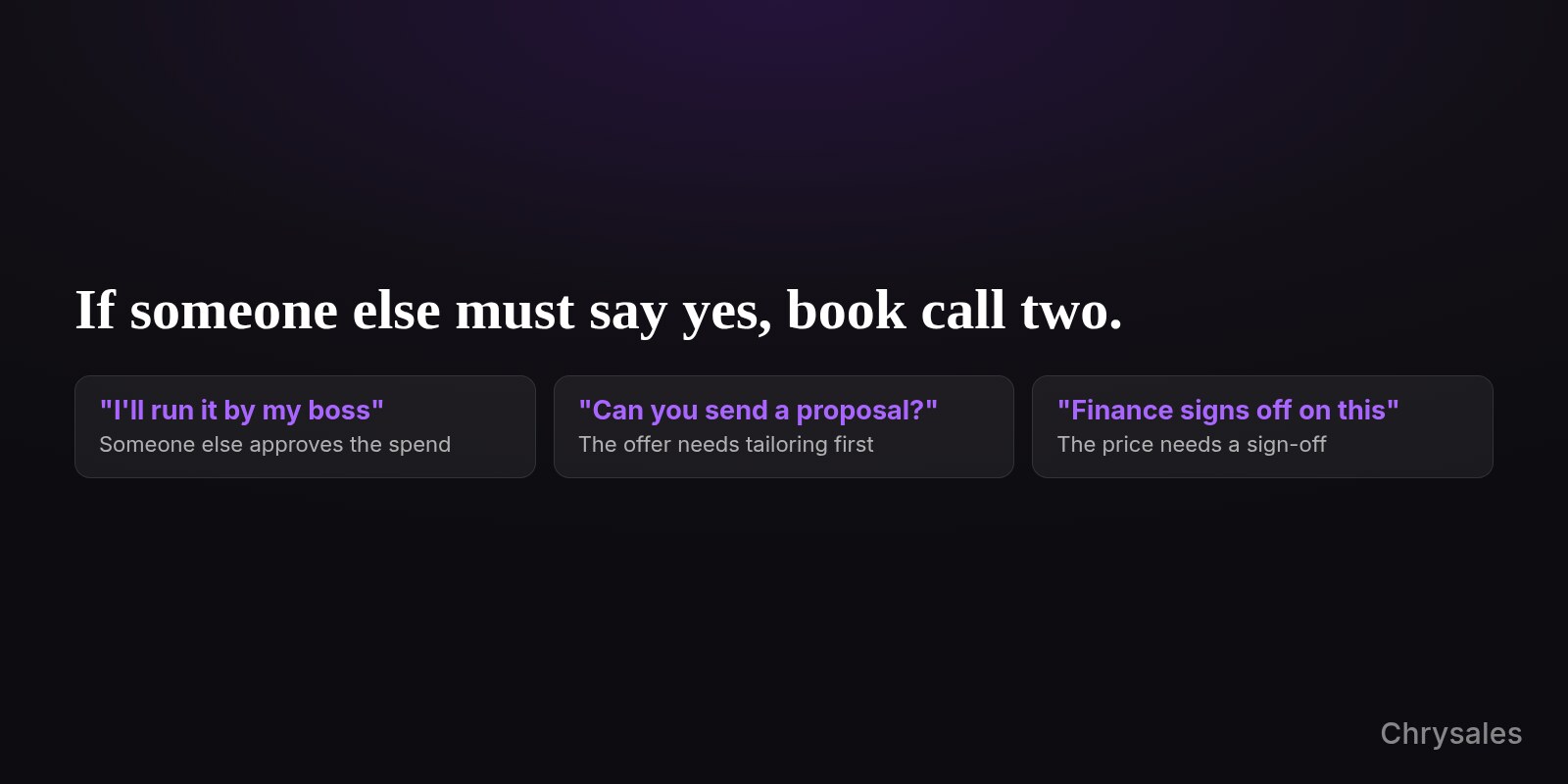
The image shows three things a buyer may say near the end of call one. Each one means the yes is not theirs alone to give.
Forrester's 2024 buyer study found that on average, 13 people within an organization are involved in the buying decision.
Calvert makes the same exception: "Sales that are more complex and those that require input/approvals from others need a second call". In Kazanjy's example, the buyer says a colleague, Jeff, must agree. Then you book a meeting with Jeff too.
Gong, a company that records sales calls, looked at more than 52,000 sales opportunities from its customers. In won deals, the number of people from the buyer's side in the second meeting almost triples. That is Gong's own data, and good deals may simply attract more people.
Pick your model with four questions
Answer four questions about the deal. If all four point to one call, ask for the decision on that call. If even one points to two, plan for two.
| Question | One call if... | Two calls if... |
|---|---|---|
| Who approves the spend? | The person on the call | Others must agree |
| How custom is the offer? | Standard, fixed scope | Needs a tailored proposal |
| How much do they know? | They did their homework | Still learning the problem |
| How big is the risk for them? | Small and easy to undo | Large or hard to undo |
A made-up example: Anna runs operations at a 30-person B2B company and wants your standard package. She approves that spend herself and has compared vendors, so one call fits. If her finance director signs off on anything new, plan two.
Treat the table as a rule of thumb to test. It sets no price limit, because one company's small purchase needs a board vote at another.
What to do on call one
In a two-call sale, call one is your discovery call: the first real talk, where you learn the problem and who decides. It should end with call two booked and the right people invited.
- Ask early who else will weigh in and how their company buys.
- Agree on the problem in their words, and what it costs them.
- Say what call two covers. Invite the decision maker, the person who approves the spend.
- Book call two before you hang up.
- Send a short written summary the same day.
Keep the gap short because, in Calvert's words, the chances of a sale "diminish rapidly over time".
Save the full proposal, the written offer with scope and price, for call two. Here is what goes in the proposal. The summary can be this short:
Hi [Name], thanks for today. Here is what I heard:
The problem: [in their words]
What it costs you now: [their example]
Who else decides: [names or roles]
Next: [day and time] with [names]. We go through the offer and decide together if we start.
Why book before you hang up? Jason Lemkin of SaaStr writes that a vague "I'll get back to you" almost always means No, or at best not now.
In Gong's data on 28,833 closed deals, close rates fell 71% when next steps were not discussed on the first call. It is 2018 data and shows a pattern, not proof.
For the questions, see how to run the discovery call. With several people involved, a one-page plan you both agree on keeps call two from slipping.
Check which model works for you
Your own past deals are the best test, because we found no study that compares one call with two. The gains claimed online come from vendors, coaches or agencies describing their own clients.
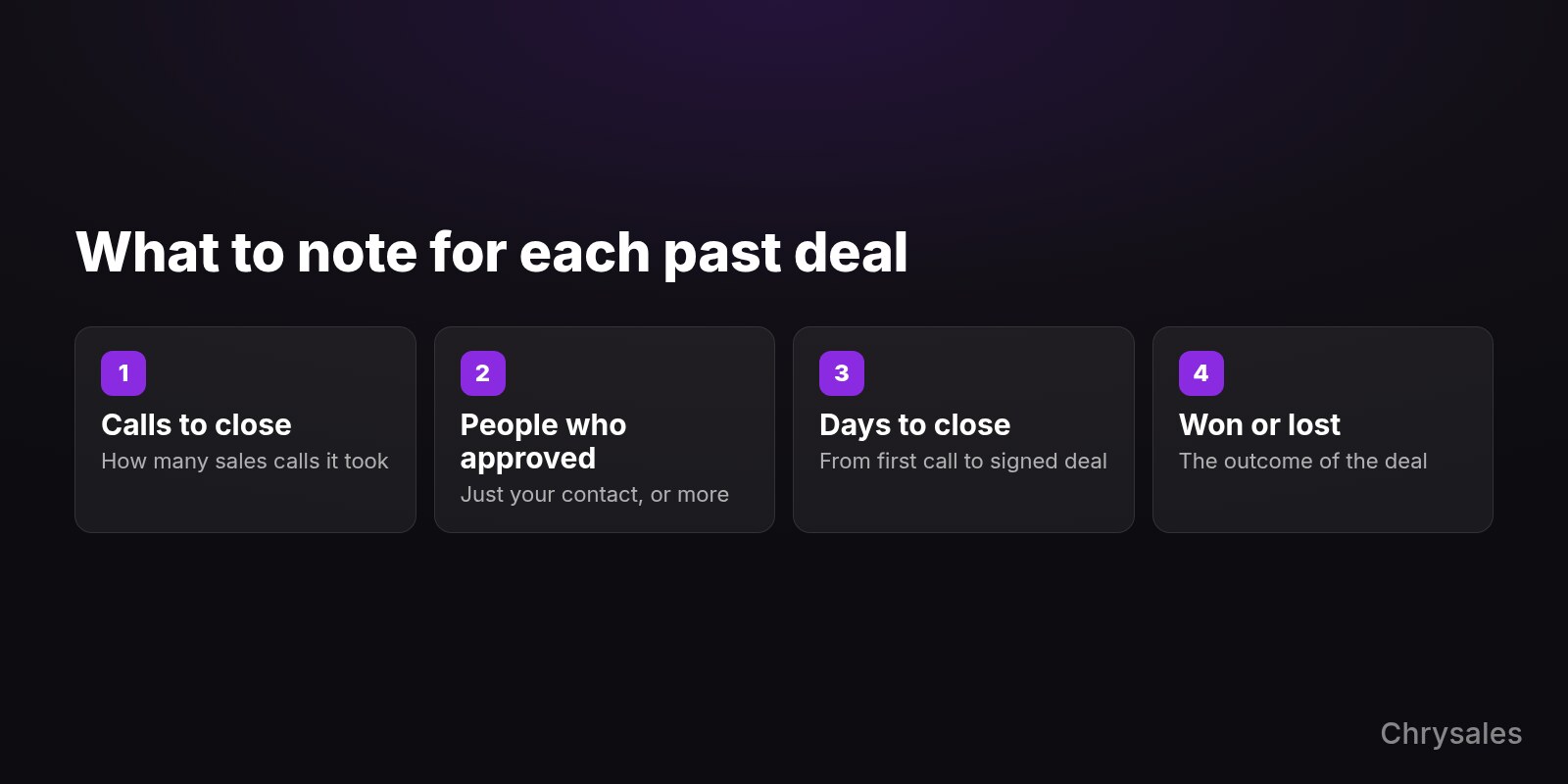
Take your last 15 to 20 deals, won and lost, and note the four things in the image for each. Then compare: do one-call deals win as often as two-call deals, and which move faster?
Jeremy Miller, author of Sticky Branding, set a similar goal at LEAPJob. The average deal took 60 to 120 days from start to signature, and the team aimed for two calls over two weeks. Miller gives no result.
With 20 deals, read the result as a hint. Keep noting the same things and look again each quarter.
Conclusion: Ask who approves first
On every first call, ask who else must agree before they buy.
Then run the deal through the four questions. If any answer points to two calls, use call one to learn who decides, and invite them to call two.
Whichever model you use, never end a call without the next step in the calendar: a day, a time and the people who decide.
Not sure where your sales calls should split for your deal size and buyers? On a free strategy call, Chrysales can map your call steps with you. Map out your sales calls on a free call
A one call close means you get a clear yes on the first sales call. The buyer agrees to buy, and you agree on a start. Aim for it only when three things are true. The person on the call can approve the spend alone, your offer is standard, and they came informed. If not, split the sale into two calls and book the second before the first one ends.
Getting this wrong costs you either way. Push someone who can't say yes, and the deal stalls inside their company. Add a call nobody needed, and a ready buyer cools off.
When a one call close works
A one call close works when one person can say yes and the buyer has already done most of the homework. Many buyers arrive that way.
6sense surveyed nearly 4,000 B2B buyers. On average, they had finished 61% of their buying process before they first spoke to a vendor. 6sense sells data tools, so read it as a vendor's survey.
Pete Kazanjy, author of Founding Sales, makes a related point about the proposal. When the buyer clearly has only one way to buy, Kazanjy writes, "it's better to just skip to the contract".
That holds only if the buyer is qualified and has said they want to buy. Qualified means a real fit, with the need and the budget.
Deb Calvert of People First Productivity Solutions used to advocate the two-call model. Calvert has since changed course and now prefers one call whenever you can, because the wait between calls slows the deal.
When you do ask, these closing lines for the call help you say it without pressure.
A cold prospect, someone who doesn't know you yet, is a different case. In this video, Sabir explains why closing a completely cold prospect in one call is nearly impossible, and how a warm-up before the call helps.
When you need a second call
You need a second call when someone else must agree before the company buys. These people are the buying group, for example a manager, someone from finance or the people who will use what you sell.
The image shows three things a buyer may say near the end of call one. Each one means the yes is not theirs alone to give.
Forrester's 2024 buyer study found that on average, 13 people within an organization are involved in the buying decision.
Calvert makes the same exception: "Sales that are more complex and those that require input/approvals from others need a second call". In Kazanjy's example, the buyer says a colleague, Jeff, must agree. Then you book a meeting with Jeff too.
Gong, a company that records sales calls, looked at more than 52,000 sales opportunities from its customers. In won deals, the number of people from the buyer's side in the second meeting almost triples. That is Gong's own data, and good deals may simply attract more people.
Pick your model with four questions
Answer four questions about the deal. If all four point to one call, ask for the decision on that call. If even one points to two, plan for two.
| Question | One call if... | Two calls if... |
|---|---|---|
| Who approves the spend? | The person on the call | Others must agree |
| How custom is the offer? | Standard, fixed scope | Needs a tailored proposal |
| How much do they know? | They did their homework | Still learning the problem |
| How big is the risk for them? | Small and easy to undo | Large or hard to undo |
A made-up example: Anna runs operations at a 30-person B2B company and wants your standard package. She approves that spend herself and has compared vendors, so one call fits. If her finance director signs off on anything new, plan two.
Treat the table as a rule of thumb to test. It sets no price limit, because one company's small purchase needs a board vote at another.
What to do on call one
In a two-call sale, call one is your discovery call: the first real talk, where you learn the problem and who decides. It should end with call two booked and the right people invited.
- Ask early who else will weigh in and how their company buys.
- Agree on the problem in their words, and what it costs them.
- Say what call two covers. Invite the decision maker, the person who approves the spend.
- Book call two before you hang up.
- Send a short written summary the same day.
Keep the gap short because, in Calvert's words, the chances of a sale "diminish rapidly over time".
Save the full proposal, the written offer with scope and price, for call two. Here is what goes in the proposal. The summary can be this short:
Hi [Name], thanks for today. Here is what I heard:
The problem: [in their words]
What it costs you now: [their example]
Who else decides: [names or roles]
Next: [day and time] with [names]. We go through the offer and decide together if we start.
Why book before you hang up? Jason Lemkin of SaaStr writes that a vague "I'll get back to you" almost always means No, or at best not now.
In Gong's data on 28,833 closed deals, close rates fell 71% when next steps were not discussed on the first call. It is 2018 data and shows a pattern, not proof.
For the questions, see how to run the discovery call. With several people involved, a one-page plan you both agree on keeps call two from slipping.
Check which model works for you
Your own past deals are the best test, because we found no study that compares one call with two. The gains claimed online come from vendors, coaches or agencies describing their own clients.
Take your last 15 to 20 deals, won and lost, and note the four things in the image for each. Then compare: do one-call deals win as often as two-call deals, and which move faster?
Jeremy Miller, author of Sticky Branding, set a similar goal at LEAPJob. The average deal took 60 to 120 days from start to signature, and the team aimed for two calls over two weeks. Miller gives no result.
With 20 deals, read the result as a hint. Keep noting the same things and look again each quarter.
Conclusion: Ask who approves first
On every first call, ask who else must agree before they buy.
Then run the deal through the four questions. If any answer points to two calls, use call one to learn who decides, and invite them to call two.
Whichever model you use, never end a call without the next step in the calendar: a day, a time and the people who decide.
Not sure where your sales calls should split for your deal size and buyers? On a free strategy call, Chrysales can map your call steps with you. Map out your sales calls on a free call
Scaling Is Not Hard If You Have The Right Systems
If you’re serious about leveling up your scaling game, you need the right system, the right training, and the right team behind you. We're here to give you the exact tools and strategies top entrepreneurs use to dominate.

Discover the latest tips
View All
Chrysales was formed from the words "chrysalis" the stage where a caterpillar transforms into a butterfly and "sales".
It stands for one thing: sales transformation.Because scaling doesn’t happen by doing more of the same. Scaling only happens when you go through real transformation in your systems, your offer, team and the way you sell.


