.avif)
How to Make Money with AI in B2B Sales

Make money with ai in B2B sales means using AI to help businesses find clients, close deals, and grow revenue through lead generation, sales training, and client acquisition. Most people chasing ways to make money with AI end up testing random tools, burning hours on tutorials, and still making zero dollars. Here's what they miss: the real money isn't in using AI to make content or passive income gimmicks. It's in using AI to make money the old-fashioned way, by helping businesses find clients, close deals, and scale revenue. That means sales.
The companies making serious cash with AI are building sales systems that run smoother, faster, and with less guesswork. If your team handles any part of client acquisition, AI can turn your sales process from a messy scramble into a repeatable money-making engine. Here's exactly how.
Why Most "Make Money With AI" Advice Misses the Point
Most articles on making money with artificial intelligence focus on passive income schemes. Write AI-generated blog posts. Sell AI art. Launch a ChatGPT course. The problem? Those tactics rarely produce consistent income. People testing them report the same story: low demand, fierce competition, and earnings that never match the hype.
The actual money sits in B2B sales. Businesses pay real budgets to solve real problems. They need clients. They need deals closed. They need sales teams that don't fall apart when the first hire quits. If you can use AI to help them get more leads, book more calls, or close more deals, you've found a revenue stream that scales. Not a side hustle that fizzles out in three months.
Watch out: Don't fall for the "AI will do all the work" trap. AI is a tool. The money comes from applying it to actual business problems, not letting it run on autopilot.
Use AI for Lead Generation and List Building

Lead generation is where most sales teams bleed time and money. They buy stale contact lists, scrape LinkedIn manually, or pay agencies thousands for leads that never convert. AI changes the game by doing the research faster and smarter, as detailed in research on how AI transforms B2B sales processes.
AI-Powered Lead Scoring
Picture this: you have 2,000 contacts in your CRM. Half are outdated. A quarter are bad fits. Maybe 200 are worth calling. Most teams waste hours sorting through the mess manually. AI lead scoring can scan that list in minutes, rank every contact based on signals like recent funding, job changes, company size, or tech stack, and spit out a prioritized list.
Set a simple rule: anything scoring above 70 goes to the top of your call list. Anything below 40 gets archived. Suddenly, your sales team spends time talking to real prospects instead of chasing ghosts. A 30-person consulting firm we worked with had 1,500 leads sitting untouched. After running an AI scoring model, they found 180 high-intent contacts they'd completely ignored. Booked 14 calls in the first week.
Automating Outreach Research
Cold outreach fails when the message feels generic. AI can pull recent news, LinkedIn activity, or company updates for every contact on your list, then personalize the first line of your email. Not "Hey, I saw your company does marketing" level personalization. Real details. "Saw you just opened a Berlin office. Curious how you're handling hiring there."
One marketing agency used this approach and jumped from a 0.8% reply rate to 4.2% in three weeks. Same offer. Same email structure. Better research.
Pro Tip: Use AI to draft the research summary, but always review it before hitting send. Sometimes it hallucinates details that aren't true.
Build AI Sales Automation Workflows That Close Deals Faster
Sales automation used to mean clunky email sequences and calendar links. Now, AI can handle objections, answer questions, and move deals forward without a human touching every step. You can watch how an AI sales system gets you record revenue to see the full workflow in action.
Automated Follow-Up Sequences That Feel Human
Most deals die in follow-up. You send a proposal. Silence. You follow up once. Maybe twice. Then you move on. AI can track every deal stage and send follow-ups that reference the last conversation, adjust tone based on responses, and escalate to a human only when the prospect is ready to talk.
We see this all the time with new clients. They send one follow-up and give up. With AI handling the first three to five touches, deals that would've gone cold suddenly book calls.
AI-Assisted Discovery and Objection Handling
Sales calls are where most teams lose deals. Not because the offer is weak. Because the rep doesn't ask the right questions or fumbles objections. AI tools can listen to live calls, suggest discovery questions in real time, and serve up objection scripts when a prospect says "it's too expensive" or "we need to think about it."
A 15-person consulting firm tested this during discovery calls. Their close rate went from 18% to 29% in two months. Same team. Same offer. Better questions.
Common mistake: Building a 40-step workflow when 12 steps would do the job. Start simple. Add complexity only when you see gaps.
Sell AI-Enabled Services to Other Businesses
If you're looking for how to use AI to make money directly, this is the fastest path. Businesses know they should be doing something with AI, but most don't know where to start. If you can package AI into a service they actually need, you've got a productized offer.
Productized AI Outreach Services
B2B lead generation is a massive market, and most companies do it badly. You can build an AI outbound automation system where you handle list building, personalization, and follow-up for clients. Price it monthly. Deliver booked calls.
The setup: AI scores leads, personalizes outreach, tracks responses, and hands warm replies to the client's sales team. You charge per month or per booked call. No guesswork. No bloated agency overhead. One tech company launched this exact service six months ago. They charge $3,000 per month per client and currently run it for eight companies. That's $24,000 monthly recurring revenue with a two-person team.
AI Sales Training and Coaching Programs
Sales training is another space where AI opens doors. Most sales reps never get real coaching after the first week. AI can analyze recorded calls, score them for discovery quality, objection handling, and pitch clarity, then generate custom coaching feedback.
You can sell this as a service to companies with sales teams, or white-label it under your own brand. Businesses pay serious money to improve close rates. AI makes coaching scalable in a way 1 on 1 sessions never could, as shown in the 2025 B2B SaaS sales AI report.
Pro Tip: Don't try to sell "AI consulting" as a vague service. Pick one specific problem, outreach, training, lead scoring, and package it cleanly.
Scale Your Own Sales Team Using AI Tools
If you already run a business, using AI to make money often starts with making your own sales process more efficient. AI won't replace your sales team, but it can make a three-person team perform like six.
Hire and Train Faster With AI-Assisted Onboarding
Hiring salespeople is expensive and slow. Most new hires take 60 to 90 days to ramp up. Some never do. AI can cut that time in half by handling onboarding: walking reps through discovery scripts, practicing objection handling via chatbots, and quizzing them on product knowledge.
We worked with a tech company who hired three salespeople in a month. Two quit within 60 days. The fix wasn't more hiring. It was the system around the hires. After building an AI-assisted onboarding program, their next two hires hit quota in 45 days.
Use AI to Create Repeatable Sales Playbooks
A good sales system is like a recipe. Follow the steps, get the same dish every time. AI can analyze your best sales calls, extract the patterns, what questions closed deals, what phrases killed them, and turn that into a playbook. This approach is covered in depth in our AI sales enablement guide.
Most teams wing it. Every rep has their own style. Some crush it. Some flop. AI lets you bottle what works and roll it out to everyone.
Watch out: Don't let AI write your entire pitch. Use it to find what already works, then train your team to repeat it.
Turn AI Into a Client Acquisition System, Not Just a Tool
Here's the thing: tools don't make you money. Systems do. AI tools like ChatGPT, Gemini, or Clay are powerful, but they're just pieces. The money comes from connecting them into the only AI sales system you need in 2026 that runs without you babysitting every step.
Map Your Sales Process First
Before you add AI anywhere, map out your current sales process. Lead comes in. Someone qualifies them. Someone books a call. Someone runs discovery. Someone sends a proposal. Someone follows up. Write every step.
Now ask: where does the process break? Where do leads fall through? Where does your team waste time on stuff a machine could handle? That's where AI goes. A 50-person marketing agency did this exercise and found that 60% of their leads never got a follow-up email because reps were too busy. One AI workflow fixed it. Leads got instant responses. Booked calls doubled in 90 days.
Build It Once, Run It Forever
The beauty of AI sales automation is that once it's built, it runs. New lead comes in. AI scores them. High score triggers personalized outreach. No response? AI follows up three times. Prospect replies? AI books the call and adds it to your calendar. You show up to talk only when someone's ready to buy.
Most companies build systems like this internally. Smart ones sell it as a service to other businesses. Either way, you're using AI to make money on repeat, not trading time for dollars.
Pro Tip: Start with one part of your sales process. Get that running smoothly. Then add the next piece. Trying to automate everything at once usually ends in a broken mess.
Track What Actually Drives Revenue, Not Vanity Metrics
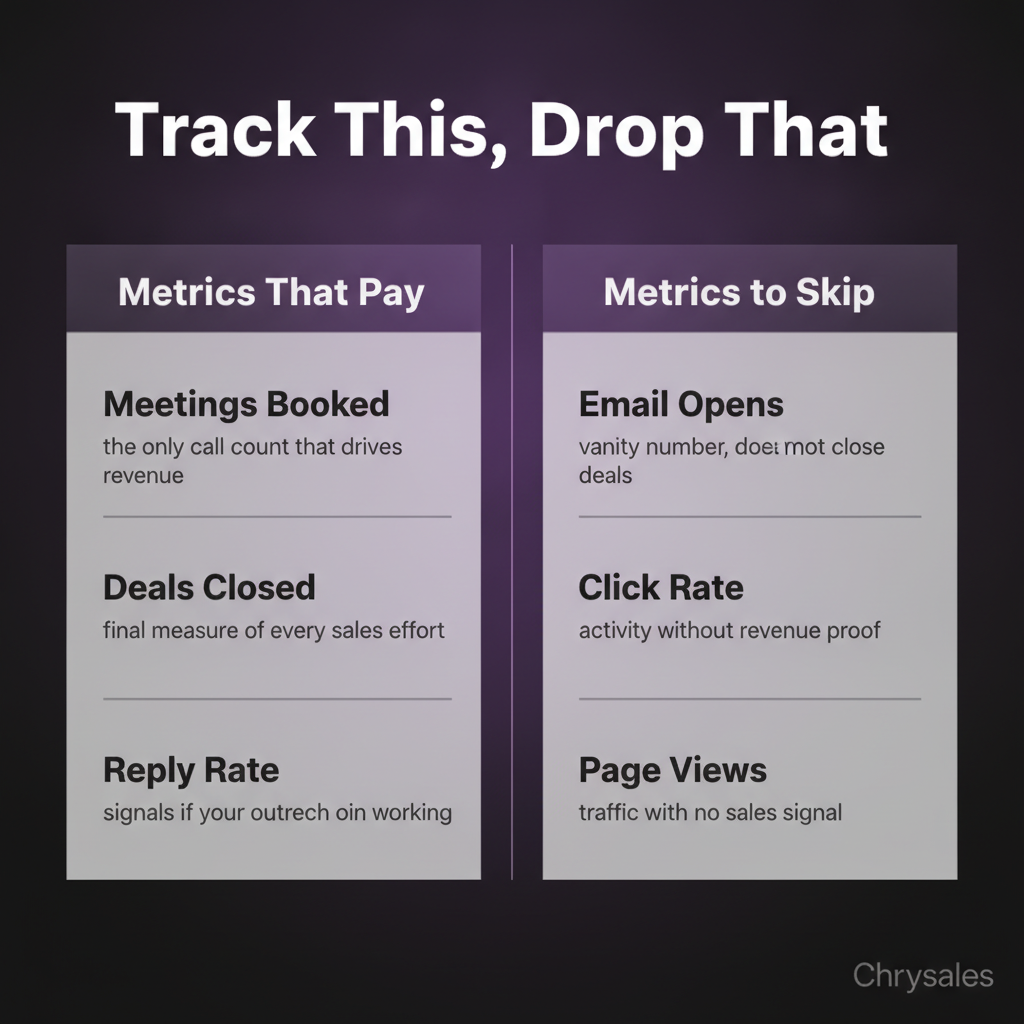
AI gives you access to more data than ever. The trap is tracking everything and acting on nothing. If you want to make money with AI in B2B sales, focus on the metrics that actually move revenue.
Focus on Meetings Booked and Deals Closed
Forget open rates. Forget clicks. The only numbers that matter are meetings booked and deals closed. AI can track these across every campaign, rep, and channel. If a campaign books 20 calls but closes zero deals, kill it. If another books five calls and closes three, double down.
Set up a simple dashboard. Leads generated. Meetings booked. Deals closed. Revenue. That's it. Review it weekly. Adjust what's not working.
Use AI to Spot Patterns in Wins and Losses
AI can analyze every closed deal and every lost deal to find patterns. Maybe deals close faster when discovery calls happen within 48 hours of the first email. Maybe prospects who mention budget in the first call close at 3x the rate. Maybe deals over $50k need a second decision-maker on the call.
Most sales teams never spot these patterns because they're buried in hundreds of calls. AI surfaces them in minutes, according to findings in the G2 AI sales insights report for 2025. One B2B sales team found that deals closed 40% faster when they sent a one-page case study in the follow-up email instead of a full proposal deck. Tiny shift. Big revenue impact.
Common mistake: Collecting data but never reviewing it. If you're not checking your dashboard weekly, the data is useless.
Frequently Asked Questions
Q: Can you really make money with AI if you're not technical?
Yes. Most people using AI to make money in B2B sales aren't coders. They're using tools like ChatGPT, Clay, Instantly, or Lemlist to automate parts of their sales process. You don't need to build the AI. You just need to know which tool solves which problem. If you can follow a YouTube tutorial, you can set up most of these workflows in a few hours.
Q: What's the fastest way to start making money with AI in sales?
Pick one part of your sales process that's broken and fix it with AI. If you're spending hours building lead lists, use AI lead generation channels for B2B to automate list building and lead scoring. If follow-ups are your weak spot, set up an AI-powered email sequence. Don't try to automate everything at once. Fix one thing, see results, then move to the next. Small wins build momentum.
Q: Do I need to invest a lot of money to use AI for B2B sales?
Not really. Most AI sales tools have free tiers or cost under $100 per month. You can start with ChatGPT for research and drafting, a free CRM, and a basic email tool. As you make money, reinvest in better tools. A consulting firm making $20k per month in new revenue from AI outreach can easily justify $500 in software costs.
Q: Is selling AI services to other businesses a good idea right now?
Absolutely. Most B2B companies know they should use AI but have no clue how. If you can package AI into a specific service like lead generation, outreach, or sales training, businesses will pay for it. The key is to solve a real problem, not sell "AI consulting" as a vague concept. Be specific. Solve one thing really well.
Q: How do I know if AI is actually improving my sales results?
Track before and after. If you're adding AI to outreach, measure reply rates and meetings booked before you start. Run the AI version for 30 days. Compare the numbers. If reply rates go up and meetings increase, it's working. If nothing changes, adjust the workflow or try a different part of the process. Always test, measure, and tweak.
Make money with ai in B2B sales means using AI to help businesses find clients, close deals, and grow revenue through lead generation, sales training, and client acquisition. Most people chasing ways to make money with AI end up testing random tools, burning hours on tutorials, and still making zero dollars. Here's what they miss: the real money isn't in using AI to make content or passive income gimmicks. It's in using AI to make money the old-fashioned way, by helping businesses find clients, close deals, and scale revenue. That means sales.
The companies making serious cash with AI are building sales systems that run smoother, faster, and with less guesswork. If your team handles any part of client acquisition, AI can turn your sales process from a messy scramble into a repeatable money-making engine. Here's exactly how.
Why Most "Make Money With AI" Advice Misses the Point
Most articles on making money with artificial intelligence focus on passive income schemes. Write AI-generated blog posts. Sell AI art. Launch a ChatGPT course. The problem? Those tactics rarely produce consistent income. People testing them report the same story: low demand, fierce competition, and earnings that never match the hype.
The actual money sits in B2B sales. Businesses pay real budgets to solve real problems. They need clients. They need deals closed. They need sales teams that don't fall apart when the first hire quits. If you can use AI to help them get more leads, book more calls, or close more deals, you've found a revenue stream that scales. Not a side hustle that fizzles out in three months.
Watch out: Don't fall for the "AI will do all the work" trap. AI is a tool. The money comes from applying it to actual business problems, not letting it run on autopilot.
Use AI for Lead Generation and List Building
Lead generation is where most sales teams bleed time and money. They buy stale contact lists, scrape LinkedIn manually, or pay agencies thousands for leads that never convert. AI changes the game by doing the research faster and smarter, as detailed in research on how AI transforms B2B sales processes.
AI-Powered Lead Scoring
Picture this: you have 2,000 contacts in your CRM. Half are outdated. A quarter are bad fits. Maybe 200 are worth calling. Most teams waste hours sorting through the mess manually. AI lead scoring can scan that list in minutes, rank every contact based on signals like recent funding, job changes, company size, or tech stack, and spit out a prioritized list.
Set a simple rule: anything scoring above 70 goes to the top of your call list. Anything below 40 gets archived. Suddenly, your sales team spends time talking to real prospects instead of chasing ghosts. A 30-person consulting firm we worked with had 1,500 leads sitting untouched. After running an AI scoring model, they found 180 high-intent contacts they'd completely ignored. Booked 14 calls in the first week.
Automating Outreach Research
Cold outreach fails when the message feels generic. AI can pull recent news, LinkedIn activity, or company updates for every contact on your list, then personalize the first line of your email. Not "Hey, I saw your company does marketing" level personalization. Real details. "Saw you just opened a Berlin office. Curious how you're handling hiring there."
One marketing agency used this approach and jumped from a 0.8% reply rate to 4.2% in three weeks. Same offer. Same email structure. Better research.
Pro Tip: Use AI to draft the research summary, but always review it before hitting send. Sometimes it hallucinates details that aren't true.
Build AI Sales Automation Workflows That Close Deals Faster
Sales automation used to mean clunky email sequences and calendar links. Now, AI can handle objections, answer questions, and move deals forward without a human touching every step. You can watch how an AI sales system gets you record revenue to see the full workflow in action.
Automated Follow-Up Sequences That Feel Human
Most deals die in follow-up. You send a proposal. Silence. You follow up once. Maybe twice. Then you move on. AI can track every deal stage and send follow-ups that reference the last conversation, adjust tone based on responses, and escalate to a human only when the prospect is ready to talk.
We see this all the time with new clients. They send one follow-up and give up. With AI handling the first three to five touches, deals that would've gone cold suddenly book calls.
AI-Assisted Discovery and Objection Handling
Sales calls are where most teams lose deals. Not because the offer is weak. Because the rep doesn't ask the right questions or fumbles objections. AI tools can listen to live calls, suggest discovery questions in real time, and serve up objection scripts when a prospect says "it's too expensive" or "we need to think about it."
A 15-person consulting firm tested this during discovery calls. Their close rate went from 18% to 29% in two months. Same team. Same offer. Better questions.
Common mistake: Building a 40-step workflow when 12 steps would do the job. Start simple. Add complexity only when you see gaps.
Sell AI-Enabled Services to Other Businesses
If you're looking for how to use AI to make money directly, this is the fastest path. Businesses know they should be doing something with AI, but most don't know where to start. If you can package AI into a service they actually need, you've got a productized offer.
Productized AI Outreach Services
B2B lead generation is a massive market, and most companies do it badly. You can build an AI outbound automation system where you handle list building, personalization, and follow-up for clients. Price it monthly. Deliver booked calls.
The setup: AI scores leads, personalizes outreach, tracks responses, and hands warm replies to the client's sales team. You charge per month or per booked call. No guesswork. No bloated agency overhead. One tech company launched this exact service six months ago. They charge $3,000 per month per client and currently run it for eight companies. That's $24,000 monthly recurring revenue with a two-person team.
AI Sales Training and Coaching Programs
Sales training is another space where AI opens doors. Most sales reps never get real coaching after the first week. AI can analyze recorded calls, score them for discovery quality, objection handling, and pitch clarity, then generate custom coaching feedback.
You can sell this as a service to companies with sales teams, or white-label it under your own brand. Businesses pay serious money to improve close rates. AI makes coaching scalable in a way 1 on 1 sessions never could, as shown in the 2025 B2B SaaS sales AI report.
Pro Tip: Don't try to sell "AI consulting" as a vague service. Pick one specific problem, outreach, training, lead scoring, and package it cleanly.
Scale Your Own Sales Team Using AI Tools
If you already run a business, using AI to make money often starts with making your own sales process more efficient. AI won't replace your sales team, but it can make a three-person team perform like six.
Hire and Train Faster With AI-Assisted Onboarding
Hiring salespeople is expensive and slow. Most new hires take 60 to 90 days to ramp up. Some never do. AI can cut that time in half by handling onboarding: walking reps through discovery scripts, practicing objection handling via chatbots, and quizzing them on product knowledge.
We worked with a tech company who hired three salespeople in a month. Two quit within 60 days. The fix wasn't more hiring. It was the system around the hires. After building an AI-assisted onboarding program, their next two hires hit quota in 45 days.
Use AI to Create Repeatable Sales Playbooks
A good sales system is like a recipe. Follow the steps, get the same dish every time. AI can analyze your best sales calls, extract the patterns, what questions closed deals, what phrases killed them, and turn that into a playbook. This approach is covered in depth in our AI sales enablement guide.
Most teams wing it. Every rep has their own style. Some crush it. Some flop. AI lets you bottle what works and roll it out to everyone.
Watch out: Don't let AI write your entire pitch. Use it to find what already works, then train your team to repeat it.
Turn AI Into a Client Acquisition System, Not Just a Tool
Here's the thing: tools don't make you money. Systems do. AI tools like ChatGPT, Gemini, or Clay are powerful, but they're just pieces. The money comes from connecting them into the only AI sales system you need in 2026 that runs without you babysitting every step.
Map Your Sales Process First
Before you add AI anywhere, map out your current sales process. Lead comes in. Someone qualifies them. Someone books a call. Someone runs discovery. Someone sends a proposal. Someone follows up. Write every step.
Now ask: where does the process break? Where do leads fall through? Where does your team waste time on stuff a machine could handle? That's where AI goes. A 50-person marketing agency did this exercise and found that 60% of their leads never got a follow-up email because reps were too busy. One AI workflow fixed it. Leads got instant responses. Booked calls doubled in 90 days.
Build It Once, Run It Forever
The beauty of AI sales automation is that once it's built, it runs. New lead comes in. AI scores them. High score triggers personalized outreach. No response? AI follows up three times. Prospect replies? AI books the call and adds it to your calendar. You show up to talk only when someone's ready to buy.
Most companies build systems like this internally. Smart ones sell it as a service to other businesses. Either way, you're using AI to make money on repeat, not trading time for dollars.
Pro Tip: Start with one part of your sales process. Get that running smoothly. Then add the next piece. Trying to automate everything at once usually ends in a broken mess.
Track What Actually Drives Revenue, Not Vanity Metrics
AI gives you access to more data than ever. The trap is tracking everything and acting on nothing. If you want to make money with AI in B2B sales, focus on the metrics that actually move revenue.
Focus on Meetings Booked and Deals Closed
Forget open rates. Forget clicks. The only numbers that matter are meetings booked and deals closed. AI can track these across every campaign, rep, and channel. If a campaign books 20 calls but closes zero deals, kill it. If another books five calls and closes three, double down.
Set up a simple dashboard. Leads generated. Meetings booked. Deals closed. Revenue. That's it. Review it weekly. Adjust what's not working.
Use AI to Spot Patterns in Wins and Losses
AI can analyze every closed deal and every lost deal to find patterns. Maybe deals close faster when discovery calls happen within 48 hours of the first email. Maybe prospects who mention budget in the first call close at 3x the rate. Maybe deals over $50k need a second decision-maker on the call.
Most sales teams never spot these patterns because they're buried in hundreds of calls. AI surfaces them in minutes, according to findings in the G2 AI sales insights report for 2025. One B2B sales team found that deals closed 40% faster when they sent a one-page case study in the follow-up email instead of a full proposal deck. Tiny shift. Big revenue impact.
Common mistake: Collecting data but never reviewing it. If you're not checking your dashboard weekly, the data is useless.
Frequently Asked Questions
Q: Can you really make money with AI if you're not technical?
Yes. Most people using AI to make money in B2B sales aren't coders. They're using tools like ChatGPT, Clay, Instantly, or Lemlist to automate parts of their sales process. You don't need to build the AI. You just need to know which tool solves which problem. If you can follow a YouTube tutorial, you can set up most of these workflows in a few hours.
Q: What's the fastest way to start making money with AI in sales?
Pick one part of your sales process that's broken and fix it with AI. If you're spending hours building lead lists, use AI lead generation channels for B2B to automate list building and lead scoring. If follow-ups are your weak spot, set up an AI-powered email sequence. Don't try to automate everything at once. Fix one thing, see results, then move to the next. Small wins build momentum.
Q: Do I need to invest a lot of money to use AI for B2B sales?
Not really. Most AI sales tools have free tiers or cost under $100 per month. You can start with ChatGPT for research and drafting, a free CRM, and a basic email tool. As you make money, reinvest in better tools. A consulting firm making $20k per month in new revenue from AI outreach can easily justify $500 in software costs.
Q: Is selling AI services to other businesses a good idea right now?
Absolutely. Most B2B companies know they should use AI but have no clue how. If you can package AI into a specific service like lead generation, outreach, or sales training, businesses will pay for it. The key is to solve a real problem, not sell "AI consulting" as a vague concept. Be specific. Solve one thing really well.
Q: How do I know if AI is actually improving my sales results?
Track before and after. If you're adding AI to outreach, measure reply rates and meetings booked before you start. Run the AI version for 30 days. Compare the numbers. If reply rates go up and meetings increase, it's working. If nothing changes, adjust the workflow or try a different part of the process. Always test, measure, and tweak.
Scaling Is Not Hard If You Have The Right Systems
If you’re serious about leveling up your scaling game, you need the right system, the right training, and the right team behind you. We're here to give you the exact tools and strategies top entrepreneurs use to dominate.

Discover the latest tips
View All.avif)
Chrysales was formed from the words "chrysalis" the stage where a caterpillar transforms into a butterfly and "sales".
It stands for one thing: sales transformation.Because scaling doesn’t happen by doing more of the same. Scaling only happens when you go through real transformation in your systems, your offer, team and the way you sell.
.avif)


