.avif)
What Is Lead Generation in Digital Marketing?
Lead generation digital marketing is the process of attracting the right people online and turning their interest into contacts you can follow up with for sales. Picture this: you launch a new B2B product, set up a website, write some LinkedIn posts, and wait. A week goes by. Maybe someone fills out a contact form. Maybe not. That's not lead generation. That's hoping.
Real lead generation in digital marketing is the process of attracting people who might want what you're selling and getting them to raise their hand and say "tell me more." It's not magic. It's a system. And if you don't have one, you're burning time and money on random tactics that feel productive but don't fill your pipeline.
This guide walks you through what lead generation digital marketing actually means, how it works in B2B sales, and how to build a process that brings in clients without crossing your fingers every month.
What Lead Generation Actually Means in Digital Marketing
Lead generation is how you turn strangers on the internet into people you can talk to about your product or service. It's the step between "no one knows who we are" and "here's a list of people who want a demo."
In digital marketing, this happens through channels like LinkedIn, Google search, email, paid ads, and content. The goal is simple: get someone to give you their contact info because they're interested in what you do.
Why Digital Channels Changed the Game
Before the internet, lead generation meant trade shows, cold calls from phone books, and newspaper ads. You had to guess who might be interested. Digital marketing flipped that. Now you can target a 50-person tech company in Berlin that just raised funding and show them an ad about your sales automation tool.
You can write a blog post that ranks on Google when someone searches "how to hire a sales team" and capture their email when they download a guide. The list is better. The targeting is sharper. The cost per lead drops.
The Difference Between a Lead and a Random Website Visitor
Not everyone who lands on your site is a lead. A lead is someone who took an action that signals interest. They filled out a form. They booked a call. They replied to an email. They downloaded something.
A random visitor clicked a link, looked around for eight seconds, and left. That's not a lead. That's traffic. Lead generation is about converting traffic into people you can actually follow up with.
Pro Tip: If your website has no clear way to capture contact info, you're just renting attention. Add a lead magnet, a booking link, or a simple "get in touch" form that actually works.
How B2B Lead Generation Works in Practice
B2B lead generation is different from selling sneakers or meal kits. You're not trying to get someone to click "buy now" on a $50 product. You're trying to get a company to commit to a $10K, $50K, or $200K deal that takes weeks or months to close.
That means lead generation in B2B is about starting conversations, not instant purchases.
The Lead Generation Funnel for B2B Companies
Think of the funnel in three stages: awareness, consideration, and decision. At the top, someone realizes they have a problem. Maybe their sales process is a mess. Maybe they need more leads. They start searching. Your content shows up. They read a blog, watch a video, see a LinkedIn post. That's awareness.
Next, they're comparing options. They download a guide, sign up for a webinar, or check out your case studies. That's consideration.
Finally, they book a call or request a proposal. That's decision. Most B2B companies focus all their energy on the bottom of the funnel and wonder why there's no one to talk to. The top and middle matter just as much.
Inbound Lead Generation vs Outbound Lead Generation
Inbound means they come to you. You publish content, rank on Google, post on LinkedIn, run ads, and people find you and raise their hand. Outbound means you go to them. You send cold emails, message people on LinkedIn, or call companies that fit your ideal customer profile.
Both work. Most fast-growing B2B companies do both. Inbound builds long-term pipeline. Outbound fills gaps fast when you need meetings this month.
Common mistake: Thinking you have to pick one. A 40-person consulting firm might get 30% of leads from SEO content and 70% from cold outreach. That's normal. Use what works for your situation.
The Core Digital Marketing Channels That Generate B2B Leads
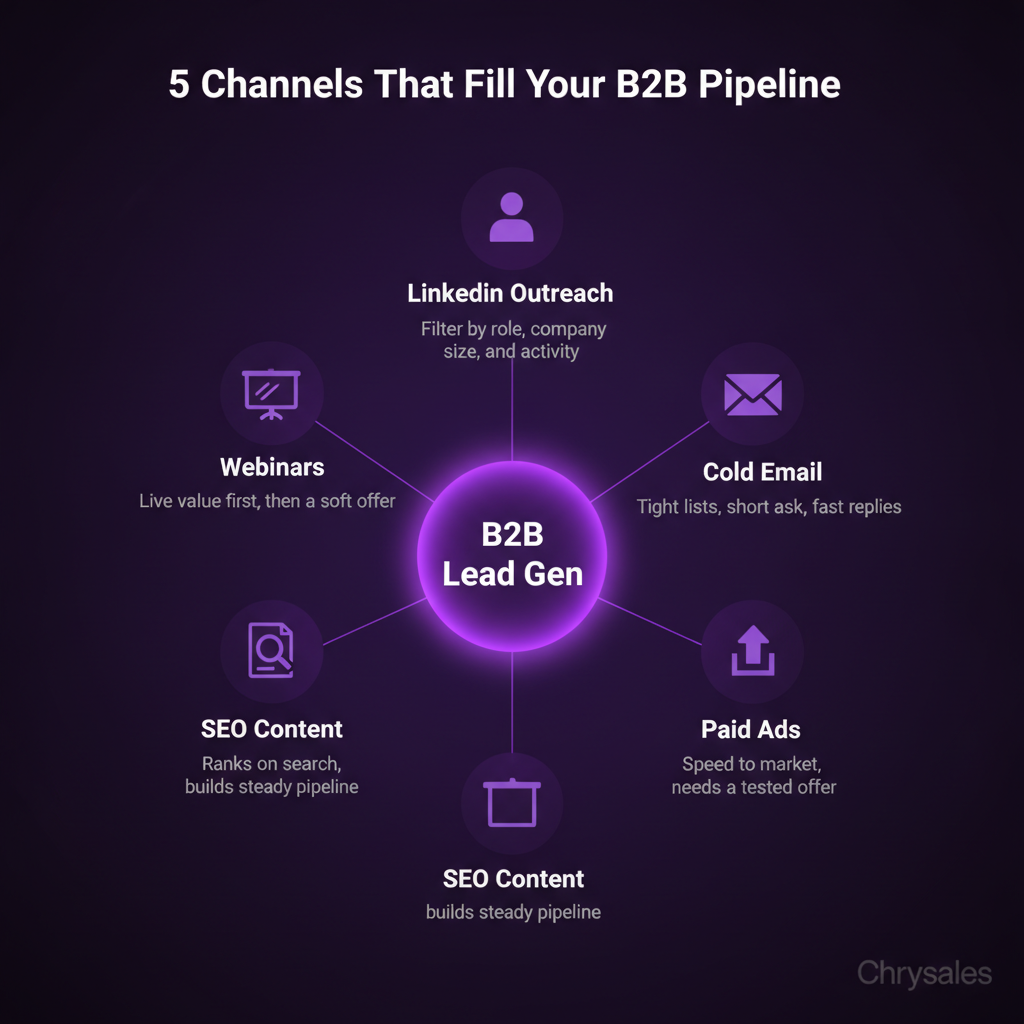
You don't need to be everywhere. You need to be where your buyers are, and you need to do it well. Here are the channels that matter most for B2B lead generation.
LinkedIn Lead Generation
LinkedIn is the best place for B2B outreach. Period. You can filter by job title, company size, industry, location, and even recent activity like job changes or funding announcements.
A marketing agency can build a list of 500 CMOs at tech companies with 20 to 100 employees and send personalized connection requests. A 15-person consulting firm can post case studies and get inbound messages from prospects. LinkedIn also has lead gen ads that let people submit their info without leaving the platform.
The key is personalization. Generic "I'd love to connect" messages get ignored. Messages that reference something specific about their company or role get replies.
Content Marketing and SEO
When someone Googles "how to build a sales team" or "B2B lead generation strategies," your blog can show up. If the content is good and there's a clear next step like "book a free consultation" or "download our hiring checklist," you just captured a lead without spending a dollar on ads.
SEO takes time. You won't rank in two weeks. But six months in, you can have a steady stream of inbound leads finding you through search. Write about the problems your buyers have. Make it easy to read. Include real examples. Add a way to capture their email. That's the loop.
Cold Email Outreach for B2B Sales
Cold email still works if you do it right. The trick is the list. Most cold emails flop because the list is bad, not the words. If you're emailing people who don't have the problem you solve, no subject line will save you.
Build a list of companies that fit your ideal customer profile. Find the right person at each company. Personalize the first line so they know it's not a mass blast. Keep it short. Make the ask small, like "worth a 15 minute call?" not "buy our thing."
A well run cold outreach campaign for a B2B company can book 10 to 20 meetings a month with a 3% to 5% reply rate, and following outbound email marketing best practices can help you hit those benchmarks consistently.
Watch out: Sending 10,000 emails to a scraped list with zero personalization will get your domain blacklisted and your reply rate under 0.5%. Quality beats volume every time.
Paid Ads (Google and LinkedIn)
Paid ads put your offer in front of people who are already searching for a solution or fit your buyer profile. Google Search ads show up when someone types "sales consulting for tech companies." LinkedIn ads can target decision makers at companies you choose.
The upside is speed. You can launch a campaign today and get leads this week. The downside is cost. B2B clicks on LinkedIn can run $8 to $15 each. If your landing page doesn't convert, you're burning money.
Use paid ads when you have an offer that's tested, a landing page that works, and a follow up process ready to go.
Webinars and Events
A live webinar where you teach something valuable can generate 50 to 200 leads in an hour. People register with their email. You deliver real value on the webinar. At the end, you make an offer for a consultation or demo.
Even if only 10% book a call, that's 5 to 20 qualified leads from one event. Small in person events work too. A 30 person sales training workshop in your city can fill your pipeline for a quarter.
The key is providing value first. A webinar that's just a sales pitch gets people to drop off in five minutes.
What Makes a Lead Actually Qualified
Not all leads are created equal. A lead who downloaded a free checklist is not the same as a lead who booked a 30 minute strategy call. You need a way to score and prioritize leads so your team knows who to follow up with first.
Lead Scoring Basics
Lead scoring is just assigning points to actions that signal buying intent. Someone who visited your pricing page three times and watched a case study video scores higher than someone who read one blog post and left.
Someone at a 100 person company in your target industry scores higher than someone at a 5 person company outside your niche. Set a simple rule: anything scoring above 70 goes to the top of your call list. Anything under 30 gets nurtured with email until they engage more.
Most CRMs can do this automatically.
The Difference Between MQLs and SQLs
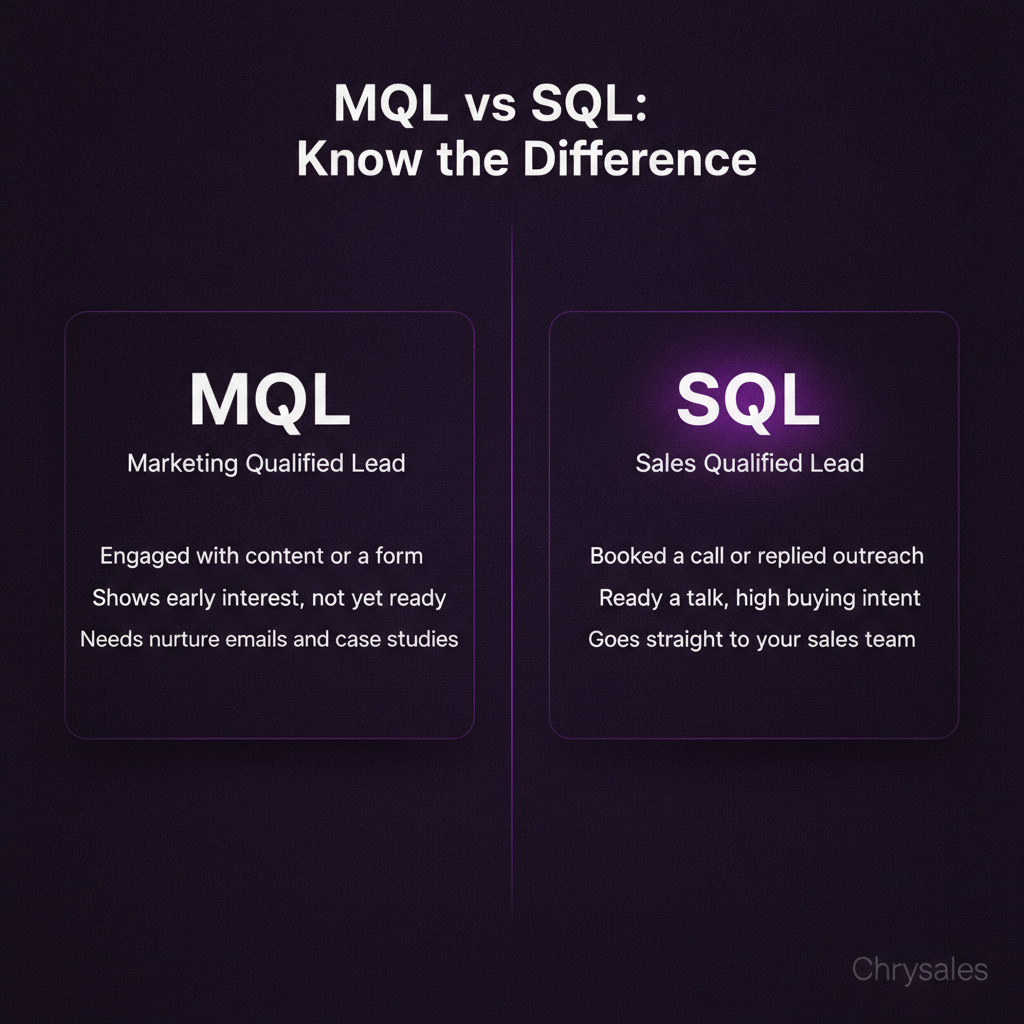
An MQL, or marketing qualified lead, is someone who engaged with your marketing and looks like a potential fit. They downloaded something, attended a webinar, or filled out a form.
An SQL, or sales qualified lead, is someone who's actually ready to talk. They booked a call. They replied to an outreach email saying "let's chat." They asked for a demo.
Your sales team should focus on SQLs. Marketing should focus on turning cold traffic into MQLs, then nurturing MQLs into SQLs. If you're handing your sales team a bunch of people who signed up for a free guide six months ago and haven't engaged since, you're wasting their time.
Pro Tip: Build a handoff process between marketing and sales. Marketing says "this lead hit 75 points and requested a call." Sales says "got it, I'll reach out in 24 hours." No handoff process means leads fall through the cracks.
Building a Lead Generation System That Doesn't Rely on Luck
Most teams treat lead generation like a campaign. They run ads for a month, send some emails, post on LinkedIn for two weeks, then stop. That's not a system. A system is something you can repeat, measure, and improve every month without reinventing the wheel.
Step 1: Define Your Ideal Customer Profile
If you don't know who you're trying to reach, you'll waste money targeting the wrong people. Sit down and write out exactly who your best customers are. Industry, company size, revenue, location, growth stage, tech stack, whatever matters for your business.
A sales coaching agency might target 20 to 200 person B2B companies in SaaS, consulting, or marketing agencies with at least $2M in revenue. That's specific. That's targetable. "Any business that needs sales help" is not.
Step 2: Pick Two or Three Channels and Commit
You don't need to be on every platform. Pick two or three channels where your buyers actually are and go deep. For most B2B companies, that's LinkedIn outreach, SEO content, and either cold email or paid LinkedIn ads. Do those well before adding more.
A small sales team running LinkedIn outreach and SEO can generate 30 to 50 leads a month. That same team trying to do LinkedIn, TikTok, Google ads, webinars, and podcasts will do all of them badly and get 10 leads.
Step 3: Create a Lead Magnet That Solves One Problem
A lead magnet is the thing you give away to get someone's email. It could be a checklist, a template, a guide, a recorded training, a calculator, or a free audit. The trick is making it solve one specific problem fast.
"The Ultimate Guide to Everything Sales" sounds big but doesn't solve anything. "The 12 Question Sales Discovery Script for B2B Consultants" solves one problem for one audience. That converts.
Step 4: Set Up Automation for Follow Up
Most leads don't convert on the first touch. You need a sequence. Someone downloads your guide. You send a follow up email the next day with a case study. Three days later, you send a link to book a call. A week later, you send a short video walking through your process.
This doesn't have to be complicated. A six email sequence over two weeks is enough. Tools like HubSpot, ActiveCampaign, or Apollo can automate this, and using proven cold email follow-up templates can dramatically increase your reply rates without writing every message from scratch.
We see clients use Gemini based workflows to personalize follow up at scale without writing every email by hand.
Common mistake: Building a 40 step workflow when 12 steps would do the job. Start simple. Add complexity only when you see what's working.
How AI Is Changing Lead Generation in 2025
AI is not replacing lead generation. It's making it faster and more precise. If you're still manually building lists and writing every email from scratch, you're working 10 times harder than you need to.
AI-Powered Lead Scoring and Enrichment
AI tools can scan thousands of companies, score them based on your ideal customer profile, and surface the top 100 companies most likely to buy. They can also enrich your list with extra data like recent funding, tech stack, employee count, and job openings.
This used to take a VA a week. Now it takes 20 minutes. At Chrysales, we use Gemini based workflows to score leads and prioritize outreach. A tech company we worked with went from manually reviewing 500 leads a month to scoring and routing them automatically, cutting their follow up time in half.
Personalization at Scale
AI can write personalized first lines for cold emails by pulling info from a prospect's LinkedIn or website. It can't write the whole email well yet, but it can handle the personalization layer.
That means you can send 200 emails a day that feel like you wrote each one by hand, without spending eight hours doing it. Just make sure a human reviews the output. AI sometimes says weird stuff.
Chatbots and Conversational Lead Capture
A chatbot on your website can qualify leads in real time. Someone lands on your pricing page. The bot asks "what size is your team?" and "what's your biggest sales challenge?" Based on the answers, it either books them a call or sends them to a resource page.
This works great for high traffic websites. If you only get 50 visitors a month, don't bother. Just put a simple contact form.
Common Lead Generation Mistakes That Kill Your Pipeline
Even experienced teams make these mistakes. Catching them early saves months of wasted effort.
Focusing on Volume Over Quality
Sending 10,000 cold emails to a bad list is worse than sending 300 to a good one. Running ads to get 500 unqualified leads is worse than getting 50 qualified ones.
A 200 person company that just did layoffs is not a hot lead. It's a bad fit, full stop. Always optimize for fit first, volume second.
No Follow Up Process
Most leads don't buy on the first touch. If someone fills out a form and you wait three days to follow up, they've already talked to two of your competitors.
Set up a process where leads get contacted within 24 hours, followed up with at least three to five times over two weeks. We see clients lose 40% of their pipeline just from slow or inconsistent follow up.
Ignoring the Data
If your cold email campaign has a 0.8% reply rate and your industry average is 3% to 5%, something's broken. If your landing page converts at 1% and similar pages convert at 8%, dig into why, and cross-check your numbers against the latest B2B sales statistics to see where you stand compared to top performers.
Most teams run campaigns, see mediocre results, and just keep going. Look at the numbers every week. Ask what's working and what's not. Fix what's broken before scaling.
Watch out: Blaming "the market" or "the economy" when your reply rates tank is almost always wrong. The issue is usually your list, your offer, or your messaging.
How Chrysales Builds Lead Generation Systems for B2B Companies
We've trained over 1,000 business owners and 500+ sales teams, and we've seen every version of broken lead generation. The issue is almost never "we need more tactics." It's "we don't have a system."
Lead generation only works when your sales system is built to receive and close those leads. That's where we come in, and if you're ready to build something repeatable and scalable, you can watch how to build a sales system so powerful clients come to you for a complete walkthrough of our methodology.
Our Approach to Client Acquisition
We don't sell you a course or a list of leads. We build you a custom lead generation system that fits your business. That starts with defining your ideal customer profile, picking the right channels, setting up your outreach infrastructure, and building the follow up process.
We also help you build a no brainer offer so when someone does raise their hand, they actually want to talk to you. A 30 person consulting firm we worked with had zero inbound leads and a 1% cold email reply rate. After rebuilding their list, rewriting their outreach, and setting up an automated follow up sequence, they booked 12 new calls in three weeks.
Combining Lead Gen with Sales Training
A great lead generation system means nothing if your team can't close. We train your team on discovery questions, objection handling, and call structure so they convert the leads you're generating.
We've helped clients at Amazon, Vodafone, and Deutsche Börse build full sales systems, not just run one off campaigns. Our methodology is simple: Learn, Build Systems, Automate, Hire Chief of Staff. Lead generation fits into the "Build Systems" phase, and it connects directly to how you hire, train, and scale your team.
Predictable Pipeline, Not Random Spikes
Our goal is to help you build a pipeline that brings in 20, 50, or 100 qualified leads every month without reinventing the process. No more hoping someone sees your LinkedIn post. No more launching a campaign, getting three leads, and wondering what to do next.
Just a system that runs, gets better over time, and fills your calendar with people who actually want to buy, and learning how to build a sales system that actually scales is the foundation of everything we teach.
Frequently Asked Questions
Q: What's the difference between lead generation and demand generation?
Demand generation is about building awareness and interest in your product or service. Lead generation is about capturing contact info from people who show that interest. Demand gen is top of funnel. Lead gen is middle to bottom. You need both, but they're not the same thing. Demand gen makes people aware. Lead gen makes them reachable.
Q: How long does it take to see results from digital lead generation?
It depends on the channel. Cold outreach and paid ads can generate leads in the first week. SEO and content marketing take three to six months before you see consistent traffic and conversions. Most B2B companies should expect to test and tweak for 30 to 60 days before a lead generation system starts producing steady results. If you're not seeing any traction after 90 days, something's broken.
Q: How many leads do I need to hit my revenue goals?
Work backward from your sales goals. If you need to close 10 new clients a quarter and your close rate is 20%, you need 50 sales qualified leads. If 30% of marketing qualified leads turn into sales qualified leads, you need about 170 MQLs. That's your target. Track your conversion rates at each stage so you know exactly how many leads you need at the top to hit your goal at the bottom, and benchmark your funnel metrics against published B2B sales statistics to see where you can improve.
Q: Can small teams do lead generation without a big budget?
Yes. A small team can run cold outreach, post on LinkedIn, and write SEO content with almost no budget. It just takes time. Cold email tools cost $50 to $100 a month. A LinkedIn Sales Navigator account is about $80. SEO is free if you write your own content. You don't need a $10K ad budget to start. You need a clear plan, consistent effort, and a willingness to test and learn.
Q: What's the best lead generation channel for B2B companies?
There's no universal best channel. It depends on your audience, your offer, and your resources. For most B2B companies, LinkedIn outreach and cold email are the fastest to start and easiest to test, and if you want to dive deeper into tactical approaches, you can watch 4 ways to find clients who need your services right now for step-by-step strategies you can implement this week.
SEO and content marketing build long term inbound pipeline. Paid ads work if you have budget and a proven offer. Start with two channels, measure what works, and double down on the winners.
Lead generation digital marketing is the process of attracting the right people online and turning their interest into contacts you can follow up with for sales. Picture this: you launch a new B2B product, set up a website, write some LinkedIn posts, and wait. A week goes by. Maybe someone fills out a contact form. Maybe not. That's not lead generation. That's hoping.
Real lead generation in digital marketing is the process of attracting people who might want what you're selling and getting them to raise their hand and say "tell me more." It's not magic. It's a system. And if you don't have one, you're burning time and money on random tactics that feel productive but don't fill your pipeline.
This guide walks you through what lead generation digital marketing actually means, how it works in B2B sales, and how to build a process that brings in clients without crossing your fingers every month.
What Lead Generation Actually Means in Digital Marketing
Lead generation is how you turn strangers on the internet into people you can talk to about your product or service. It's the step between "no one knows who we are" and "here's a list of people who want a demo."
In digital marketing, this happens through channels like LinkedIn, Google search, email, paid ads, and content. The goal is simple: get someone to give you their contact info because they're interested in what you do.
Why Digital Channels Changed the Game
Before the internet, lead generation meant trade shows, cold calls from phone books, and newspaper ads. You had to guess who might be interested. Digital marketing flipped that. Now you can target a 50-person tech company in Berlin that just raised funding and show them an ad about your sales automation tool.
You can write a blog post that ranks on Google when someone searches "how to hire a sales team" and capture their email when they download a guide. The list is better. The targeting is sharper. The cost per lead drops.
The Difference Between a Lead and a Random Website Visitor
Not everyone who lands on your site is a lead. A lead is someone who took an action that signals interest. They filled out a form. They booked a call. They replied to an email. They downloaded something.
A random visitor clicked a link, looked around for eight seconds, and left. That's not a lead. That's traffic. Lead generation is about converting traffic into people you can actually follow up with.
Pro Tip: If your website has no clear way to capture contact info, you're just renting attention. Add a lead magnet, a booking link, or a simple "get in touch" form that actually works.
How B2B Lead Generation Works in Practice
B2B lead generation is different from selling sneakers or meal kits. You're not trying to get someone to click "buy now" on a $50 product. You're trying to get a company to commit to a $10K, $50K, or $200K deal that takes weeks or months to close.
That means lead generation in B2B is about starting conversations, not instant purchases.
The Lead Generation Funnel for B2B Companies
Think of the funnel in three stages: awareness, consideration, and decision. At the top, someone realizes they have a problem. Maybe their sales process is a mess. Maybe they need more leads. They start searching. Your content shows up. They read a blog, watch a video, see a LinkedIn post. That's awareness.
Next, they're comparing options. They download a guide, sign up for a webinar, or check out your case studies. That's consideration.
Finally, they book a call or request a proposal. That's decision. Most B2B companies focus all their energy on the bottom of the funnel and wonder why there's no one to talk to. The top and middle matter just as much.
Inbound Lead Generation vs Outbound Lead Generation
Inbound means they come to you. You publish content, rank on Google, post on LinkedIn, run ads, and people find you and raise their hand. Outbound means you go to them. You send cold emails, message people on LinkedIn, or call companies that fit your ideal customer profile.
Both work. Most fast-growing B2B companies do both. Inbound builds long-term pipeline. Outbound fills gaps fast when you need meetings this month.
Common mistake: Thinking you have to pick one. A 40-person consulting firm might get 30% of leads from SEO content and 70% from cold outreach. That's normal. Use what works for your situation.
The Core Digital Marketing Channels That Generate B2B Leads
You don't need to be everywhere. You need to be where your buyers are, and you need to do it well. Here are the channels that matter most for B2B lead generation.
LinkedIn Lead Generation
LinkedIn is the best place for B2B outreach. Period. You can filter by job title, company size, industry, location, and even recent activity like job changes or funding announcements.
A marketing agency can build a list of 500 CMOs at tech companies with 20 to 100 employees and send personalized connection requests. A 15-person consulting firm can post case studies and get inbound messages from prospects. LinkedIn also has lead gen ads that let people submit their info without leaving the platform.
The key is personalization. Generic "I'd love to connect" messages get ignored. Messages that reference something specific about their company or role get replies.
Content Marketing and SEO
When someone Googles "how to build a sales team" or "B2B lead generation strategies," your blog can show up. If the content is good and there's a clear next step like "book a free consultation" or "download our hiring checklist," you just captured a lead without spending a dollar on ads.
SEO takes time. You won't rank in two weeks. But six months in, you can have a steady stream of inbound leads finding you through search. Write about the problems your buyers have. Make it easy to read. Include real examples. Add a way to capture their email. That's the loop.
Cold Email Outreach for B2B Sales
Cold email still works if you do it right. The trick is the list. Most cold emails flop because the list is bad, not the words. If you're emailing people who don't have the problem you solve, no subject line will save you.
Build a list of companies that fit your ideal customer profile. Find the right person at each company. Personalize the first line so they know it's not a mass blast. Keep it short. Make the ask small, like "worth a 15 minute call?" not "buy our thing."
A well run cold outreach campaign for a B2B company can book 10 to 20 meetings a month with a 3% to 5% reply rate, and following outbound email marketing best practices can help you hit those benchmarks consistently.
Watch out: Sending 10,000 emails to a scraped list with zero personalization will get your domain blacklisted and your reply rate under 0.5%. Quality beats volume every time.
Paid Ads (Google and LinkedIn)
Paid ads put your offer in front of people who are already searching for a solution or fit your buyer profile. Google Search ads show up when someone types "sales consulting for tech companies." LinkedIn ads can target decision makers at companies you choose.
The upside is speed. You can launch a campaign today and get leads this week. The downside is cost. B2B clicks on LinkedIn can run $8 to $15 each. If your landing page doesn't convert, you're burning money.
Use paid ads when you have an offer that's tested, a landing page that works, and a follow up process ready to go.
Webinars and Events
A live webinar where you teach something valuable can generate 50 to 200 leads in an hour. People register with their email. You deliver real value on the webinar. At the end, you make an offer for a consultation or demo.
Even if only 10% book a call, that's 5 to 20 qualified leads from one event. Small in person events work too. A 30 person sales training workshop in your city can fill your pipeline for a quarter.
The key is providing value first. A webinar that's just a sales pitch gets people to drop off in five minutes.
What Makes a Lead Actually Qualified
Not all leads are created equal. A lead who downloaded a free checklist is not the same as a lead who booked a 30 minute strategy call. You need a way to score and prioritize leads so your team knows who to follow up with first.
Lead Scoring Basics
Lead scoring is just assigning points to actions that signal buying intent. Someone who visited your pricing page three times and watched a case study video scores higher than someone who read one blog post and left.
Someone at a 100 person company in your target industry scores higher than someone at a 5 person company outside your niche. Set a simple rule: anything scoring above 70 goes to the top of your call list. Anything under 30 gets nurtured with email until they engage more.
Most CRMs can do this automatically.
The Difference Between MQLs and SQLs
An MQL, or marketing qualified lead, is someone who engaged with your marketing and looks like a potential fit. They downloaded something, attended a webinar, or filled out a form.
An SQL, or sales qualified lead, is someone who's actually ready to talk. They booked a call. They replied to an outreach email saying "let's chat." They asked for a demo.
Your sales team should focus on SQLs. Marketing should focus on turning cold traffic into MQLs, then nurturing MQLs into SQLs. If you're handing your sales team a bunch of people who signed up for a free guide six months ago and haven't engaged since, you're wasting their time.
Pro Tip: Build a handoff process between marketing and sales. Marketing says "this lead hit 75 points and requested a call." Sales says "got it, I'll reach out in 24 hours." No handoff process means leads fall through the cracks.
Building a Lead Generation System That Doesn't Rely on Luck
Most teams treat lead generation like a campaign. They run ads for a month, send some emails, post on LinkedIn for two weeks, then stop. That's not a system. A system is something you can repeat, measure, and improve every month without reinventing the wheel.
Step 1: Define Your Ideal Customer Profile
If you don't know who you're trying to reach, you'll waste money targeting the wrong people. Sit down and write out exactly who your best customers are. Industry, company size, revenue, location, growth stage, tech stack, whatever matters for your business.
A sales coaching agency might target 20 to 200 person B2B companies in SaaS, consulting, or marketing agencies with at least $2M in revenue. That's specific. That's targetable. "Any business that needs sales help" is not.
Step 2: Pick Two or Three Channels and Commit
You don't need to be on every platform. Pick two or three channels where your buyers actually are and go deep. For most B2B companies, that's LinkedIn outreach, SEO content, and either cold email or paid LinkedIn ads. Do those well before adding more.
A small sales team running LinkedIn outreach and SEO can generate 30 to 50 leads a month. That same team trying to do LinkedIn, TikTok, Google ads, webinars, and podcasts will do all of them badly and get 10 leads.
Step 3: Create a Lead Magnet That Solves One Problem
A lead magnet is the thing you give away to get someone's email. It could be a checklist, a template, a guide, a recorded training, a calculator, or a free audit. The trick is making it solve one specific problem fast.
"The Ultimate Guide to Everything Sales" sounds big but doesn't solve anything. "The 12 Question Sales Discovery Script for B2B Consultants" solves one problem for one audience. That converts.
Step 4: Set Up Automation for Follow Up
Most leads don't convert on the first touch. You need a sequence. Someone downloads your guide. You send a follow up email the next day with a case study. Three days later, you send a link to book a call. A week later, you send a short video walking through your process.
This doesn't have to be complicated. A six email sequence over two weeks is enough. Tools like HubSpot, ActiveCampaign, or Apollo can automate this, and using proven cold email follow-up templates can dramatically increase your reply rates without writing every message from scratch.
We see clients use Gemini based workflows to personalize follow up at scale without writing every email by hand.
Common mistake: Building a 40 step workflow when 12 steps would do the job. Start simple. Add complexity only when you see what's working.
How AI Is Changing Lead Generation in 2025
AI is not replacing lead generation. It's making it faster and more precise. If you're still manually building lists and writing every email from scratch, you're working 10 times harder than you need to.
AI-Powered Lead Scoring and Enrichment
AI tools can scan thousands of companies, score them based on your ideal customer profile, and surface the top 100 companies most likely to buy. They can also enrich your list with extra data like recent funding, tech stack, employee count, and job openings.
This used to take a VA a week. Now it takes 20 minutes. At Chrysales, we use Gemini based workflows to score leads and prioritize outreach. A tech company we worked with went from manually reviewing 500 leads a month to scoring and routing them automatically, cutting their follow up time in half.
Personalization at Scale
AI can write personalized first lines for cold emails by pulling info from a prospect's LinkedIn or website. It can't write the whole email well yet, but it can handle the personalization layer.
That means you can send 200 emails a day that feel like you wrote each one by hand, without spending eight hours doing it. Just make sure a human reviews the output. AI sometimes says weird stuff.
Chatbots and Conversational Lead Capture
A chatbot on your website can qualify leads in real time. Someone lands on your pricing page. The bot asks "what size is your team?" and "what's your biggest sales challenge?" Based on the answers, it either books them a call or sends them to a resource page.
This works great for high traffic websites. If you only get 50 visitors a month, don't bother. Just put a simple contact form.
Common Lead Generation Mistakes That Kill Your Pipeline
Even experienced teams make these mistakes. Catching them early saves months of wasted effort.
Focusing on Volume Over Quality
Sending 10,000 cold emails to a bad list is worse than sending 300 to a good one. Running ads to get 500 unqualified leads is worse than getting 50 qualified ones.
A 200 person company that just did layoffs is not a hot lead. It's a bad fit, full stop. Always optimize for fit first, volume second.
No Follow Up Process
Most leads don't buy on the first touch. If someone fills out a form and you wait three days to follow up, they've already talked to two of your competitors.
Set up a process where leads get contacted within 24 hours, followed up with at least three to five times over two weeks. We see clients lose 40% of their pipeline just from slow or inconsistent follow up.
Ignoring the Data
If your cold email campaign has a 0.8% reply rate and your industry average is 3% to 5%, something's broken. If your landing page converts at 1% and similar pages convert at 8%, dig into why, and cross-check your numbers against the latest B2B sales statistics to see where you stand compared to top performers.
Most teams run campaigns, see mediocre results, and just keep going. Look at the numbers every week. Ask what's working and what's not. Fix what's broken before scaling.
Watch out: Blaming "the market" or "the economy" when your reply rates tank is almost always wrong. The issue is usually your list, your offer, or your messaging.
How Chrysales Builds Lead Generation Systems for B2B Companies
We've trained over 1,000 business owners and 500+ sales teams, and we've seen every version of broken lead generation. The issue is almost never "we need more tactics." It's "we don't have a system."
Lead generation only works when your sales system is built to receive and close those leads. That's where we come in, and if you're ready to build something repeatable and scalable, you can watch how to build a sales system so powerful clients come to you for a complete walkthrough of our methodology.
Our Approach to Client Acquisition
We don't sell you a course or a list of leads. We build you a custom lead generation system that fits your business. That starts with defining your ideal customer profile, picking the right channels, setting up your outreach infrastructure, and building the follow up process.
We also help you build a no brainer offer so when someone does raise their hand, they actually want to talk to you. A 30 person consulting firm we worked with had zero inbound leads and a 1% cold email reply rate. After rebuilding their list, rewriting their outreach, and setting up an automated follow up sequence, they booked 12 new calls in three weeks.
Combining Lead Gen with Sales Training
A great lead generation system means nothing if your team can't close. We train your team on discovery questions, objection handling, and call structure so they convert the leads you're generating.
We've helped clients at Amazon, Vodafone, and Deutsche Börse build full sales systems, not just run one off campaigns. Our methodology is simple: Learn, Build Systems, Automate, Hire Chief of Staff. Lead generation fits into the "Build Systems" phase, and it connects directly to how you hire, train, and scale your team.
Predictable Pipeline, Not Random Spikes
Our goal is to help you build a pipeline that brings in 20, 50, or 100 qualified leads every month without reinventing the process. No more hoping someone sees your LinkedIn post. No more launching a campaign, getting three leads, and wondering what to do next.
Just a system that runs, gets better over time, and fills your calendar with people who actually want to buy, and learning how to build a sales system that actually scales is the foundation of everything we teach.
Frequently Asked Questions
Q: What's the difference between lead generation and demand generation?
Demand generation is about building awareness and interest in your product or service. Lead generation is about capturing contact info from people who show that interest. Demand gen is top of funnel. Lead gen is middle to bottom. You need both, but they're not the same thing. Demand gen makes people aware. Lead gen makes them reachable.
Q: How long does it take to see results from digital lead generation?
It depends on the channel. Cold outreach and paid ads can generate leads in the first week. SEO and content marketing take three to six months before you see consistent traffic and conversions. Most B2B companies should expect to test and tweak for 30 to 60 days before a lead generation system starts producing steady results. If you're not seeing any traction after 90 days, something's broken.
Q: How many leads do I need to hit my revenue goals?
Work backward from your sales goals. If you need to close 10 new clients a quarter and your close rate is 20%, you need 50 sales qualified leads. If 30% of marketing qualified leads turn into sales qualified leads, you need about 170 MQLs. That's your target. Track your conversion rates at each stage so you know exactly how many leads you need at the top to hit your goal at the bottom, and benchmark your funnel metrics against published B2B sales statistics to see where you can improve.
Q: Can small teams do lead generation without a big budget?
Yes. A small team can run cold outreach, post on LinkedIn, and write SEO content with almost no budget. It just takes time. Cold email tools cost $50 to $100 a month. A LinkedIn Sales Navigator account is about $80. SEO is free if you write your own content. You don't need a $10K ad budget to start. You need a clear plan, consistent effort, and a willingness to test and learn.
Q: What's the best lead generation channel for B2B companies?
There's no universal best channel. It depends on your audience, your offer, and your resources. For most B2B companies, LinkedIn outreach and cold email are the fastest to start and easiest to test, and if you want to dive deeper into tactical approaches, you can watch 4 ways to find clients who need your services right now for step-by-step strategies you can implement this week.
SEO and content marketing build long term inbound pipeline. Paid ads work if you have budget and a proven offer. Start with two channels, measure what works, and double down on the winners.
Scaling Is Not Hard If You Have The Right Systems
If you’re serious about leveling up your scaling game, you need the right system, the right training, and the right team behind you. We're here to give you the exact tools and strategies top entrepreneurs use to dominate.

Discover the latest tips
View All.avif)
Chrysales was formed from the words "chrysalis" the stage where a caterpillar transforms into a butterfly and "sales".
It stands for one thing: sales transformation.Because scaling doesn’t happen by doing more of the same. Scaling only happens when you go through real transformation in your systems, your offer, team and the way you sell.
.avif)


