.avif)
How to Use Instagram Stories to Pre-sell Your Offer

Instagram stories strategy is a simple way to use Stories to warm leads, build trust, and answer objections before a call gets booked. Most people treat Instagram Stories like a throwaway feature. They post random updates, share a meme, maybe drop a behind-the-scenes shot, and hope someone notices. But here's the thing: Stories can do way more than build brand awareness. When used right, they pre-sell your offer before a single call gets booked. You're warming leads, building trust, and answering objections while people are scrolling through their phone at lunch. By the time someone actually books a discovery call, they already know what you do, why it works, and whether they want it. That's the difference between cold outreach and having prospects who show up ready to buy.
Why Instagram Stories Work for B2B Lead Generation
Instagram Stories feel casual, but they're one of the best tools for client acquisition if you know how to use them. Unlike a polished LinkedIn post or a long blog, Stories are quick, personal, and easy to consume. People watch them while waiting in line or between meetings. That low-friction format makes it perfect for Instagram lead generation for B2B sales. Here's what most people miss: Stories let you build a relationship before you ask for anything. You're not pitching. You're teaching, sharing, and showing up consistently. Over time, that builds trust. When someone sees your Stories every day for two weeks, they feel like they know you. That familiarity is what turns a cold lead into a warm one.
The Psychology Behind Story-Based Selling
Think of Instagram Stories like a daily coffee chat. You're not selling every time you talk. You're sharing insights, dropping useful tips, and occasionally mentioning what you do. People buy from people they trust, and trust comes from repetition and value.
Pro Tip: Post Stories at least 4-5 times per week. Consistency matters more than perfection. A slightly blurry phone video beats no content at all.
What Pre-Selling Actually Means
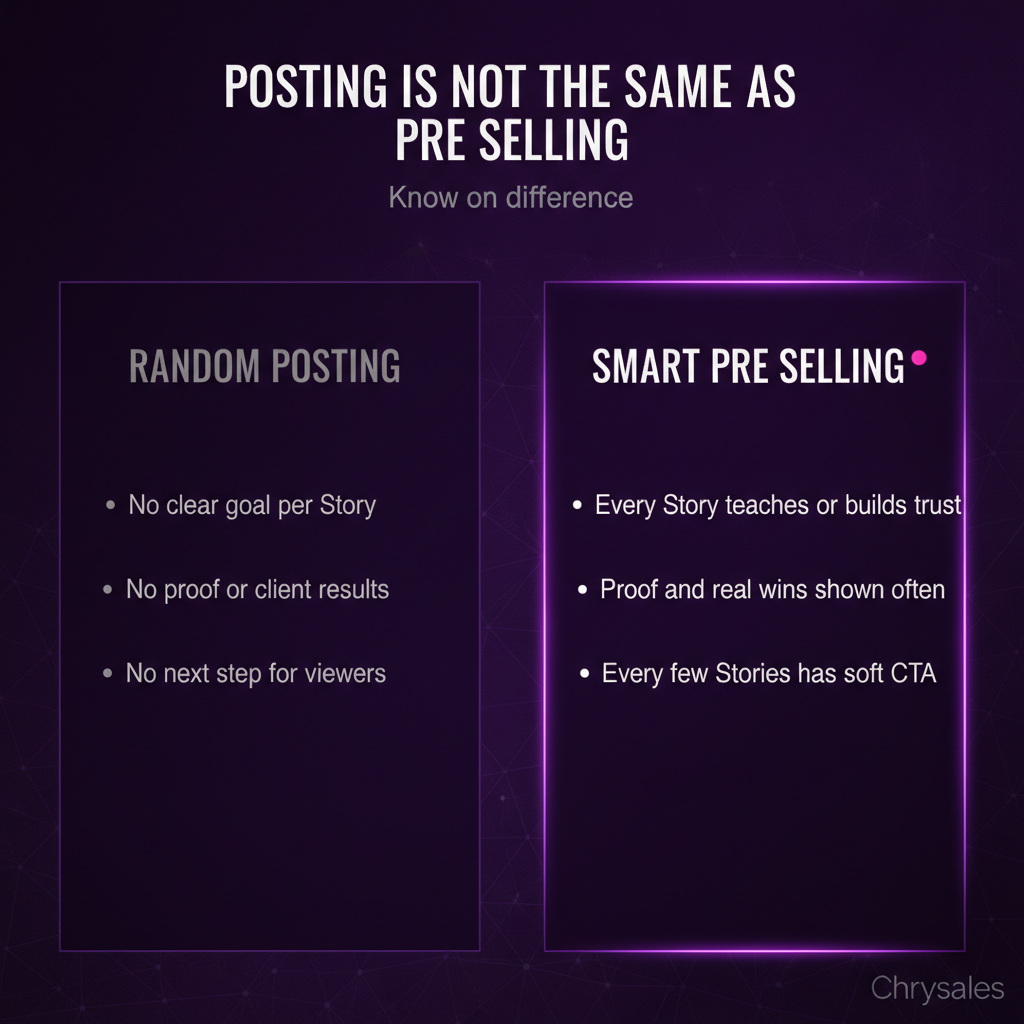
Pre-selling isn't pitching your service over and over. It's answering the questions prospects have before they even think to ask. It's showing proof that your method works. It's making your offer so clear that by the time someone books a call, they already know if they're a fit. A 30-person consulting firm tried this last quarter. They posted daily Stories breaking down their sales process, sharing client wins, and explaining common objections. They didn't push calls. They just showed up. In three weeks, they booked 12 discovery calls, and 9 of those were pre-sold. The prospects knew the price range, the timeline, and what results to expect. The calls were short and most closed.
The Difference Between Posting and Pre-Selling
Posting is random. Pre-selling is intentional. Every Story should do one of three things:
- Teach something useful
- Build trust with proof or transparency
- Move someone closer to booking a call
If your Story doesn't do one of those, it's just noise.
How to Structure Your Instagram Stories for Sales
You don't need a huge following to make this work. You need a clear Instagram Stories strategy. Start by thinking of your Stories like a mini-sales funnel. Every few days, you're guiding people through the same journey your sales call would take them on. If you're looking for a complete framework, you can watch how to build a sales system so powerful clients come to you for a deeper walkthrough of this approach.
Step 1: Hook Them with a Problem or Insight
Your first Story in a sequence should grab attention. Call out a specific problem your audience faces. Make it relatable and sharp.
Example: "Most B2B sales teams waste 60% of their outreach on leads who were never going to buy. Here's how to fix that."
That's a hook. It stops the scroll. Now people want to know more.
Step 2: Break Down the Solution
Over the next 3-5 Story frames, explain the fix. Keep each frame simple. One idea per screen. Use text overlays, not long captions. People are watching Stories on mute half the time.
Example sequence:
- Frame 1: "The problem isn't your pitch. It's your list."
- Frame 2: "If half your leads aren't decision-makers, no message lands."
- Frame 3: "We built a lead scoring system that filters out bad fits before outreach starts."
- Frame 4: "Result: 4x higher reply rate in 30 days."
Each frame builds on the last. You're teaching, not selling.
Step 3: Show Proof
This is where pre-selling happens. Show a real result. Share a client win. Post a screenshot of a Slack message or an email from a happy customer. Numbers work too.
Example: "A marketing agency used this system and booked 18 calls in their first month. Their close rate jumped from 12% to 34%."
Proof beats claims every time. People trust what they can see.
Watch out: Don't use fake or inflated numbers. Real, small wins are more believable than huge claims with no backup.
Step 4: End with a Soft CTA
After you've taught something and shown proof, invite people to take the next step. Don't hard-sell. Just make it easy to move forward.
Example: "If you want a system like this, DM me 'SALES' and I'll send you the breakdown."
That's it. Simple. Direct. Low-pressure.
Content Ideas That Pre-Sell Without Pitching
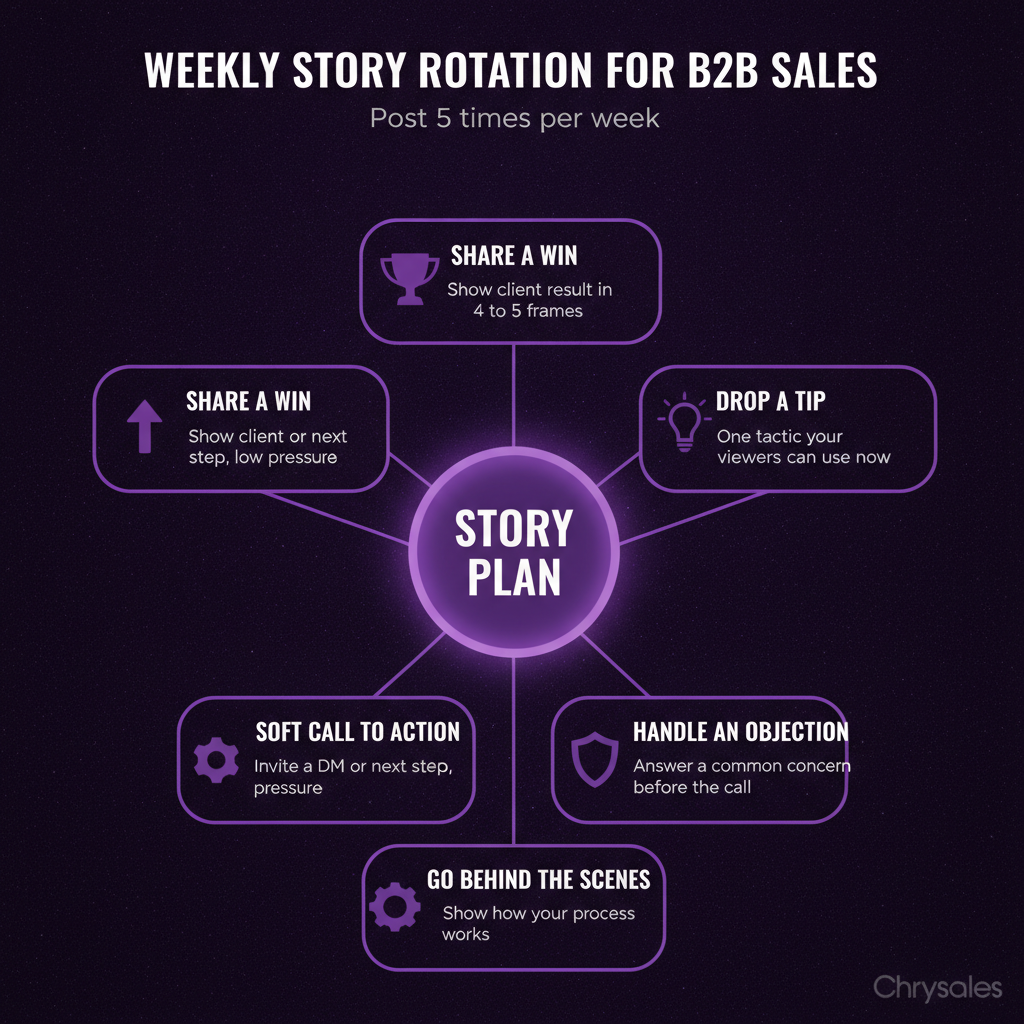
You don't need to come up with new ideas every day. Build a content rotation. Here are the types of Stories that work for B2B lead generation, and you can explore more in our guide on Instagram content that converts B2B leads.
Client Wins and Case Study Breakdowns
Share a quick case study in 4-5 Story frames. Show the before state, the problem, what you built, and the result. This is social proof in action.
Example: "A tech company had zero inbound leads. We built a cold outreach system. 40 booked calls in 60 days. Here's what we did."
Then break it down step by step. People love seeing the process.
Behind-the-Scenes of Your Sales Process
Show how you do what you do. Record a quick video explaining your discovery call structure. Walk through how you qualify leads. Show your CRM setup or your follow-up sequence.
This transparency builds trust. It also educates prospects so they show up to calls informed.
Pro Tip: Raw, unpolished Stories often perform better than highly produced ones. People want real, not perfect.
Common Objections You Hear on Calls
If prospects say the same thing over and over, turn it into content. Answer objections in your Stories before they become roadblocks.
Example objections to address:
- "We tried cold outreach and it didn't work."
- "Our sales team is too small to build a system."
- "We don't have time to train new hires."
Answer each one honestly. Show why it failed before and what's different now. This is pre-selling at its best. You're removing friction before it even shows up.
Quick Tips and How-To Clips
People love actionable advice they can use immediately. Share one tactic, one script, one template. Make it valuable enough that someone could take it and run.
Example: "Here's the cold email subject line we use. 41% open rate. Steal it."
Then show the subject line. That's useful. That's shareable. That's the kind of content people remember.
How to Use Instagram DM Sales Strategy After Stories
Stories warm people up. DMs close the deal. When someone replies to your Story, that's a hot lead. They raised their hand. Now you move them to a conversation. For a complete breakdown of converting Story replies into booked calls, read our Instagram DM strategy for B2B lead generation.
Respond Fast and Personal
When someone DMs you after a Story, reply within an hour if possible. The faster you respond, the warmer the lead stays. Don't send a canned message. Reference what they said or what Story they replied to.
Example: They reply to a Story about lead scoring. You say, "Glad that one landed! Are you dealing with the same issue on your end?"
That opens the conversation. Now you're talking, not pitching.
Qualify in the DMs
Ask a few questions before you push for a call. Find out if they're a fit. This saves everyone time and makes the call more likely to close.
Questions to ask:
- What's your biggest challenge with [topic]?
- Have you tried anything to fix it?
- What does your team look like right now?
If they answer and they sound like a fit, suggest a call. If they don't, send them a resource and stay in touch.
Common mistake: Pushing for a call too fast. If someone just started following you, they're not ready. Warm them up with a few more DM exchanges first.
How to Track What's Working
You can't improve what you don't measure. Instagram gives you basic analytics in the app. Use them.
Metrics to Watch
Track these weekly:
- Story views (are people watching?)
- Replies and DMs (are people engaging?)
- Link clicks if you add a CTA sticker (are people taking action?)
- Discovery calls booked from Instagram (are Stories turning into revenue?)
If your views drop, your content might be getting stale. If views are high but replies are low, your CTAs might be weak. Adjust based on what the numbers tell you.
Set a Benchmark and Test
Pick one Instagram Stories content plan and run it for 30 days. Post 5 times per week. Track how many DMs and calls you get. Then tweak one thing and test again.
Maybe you change the CTA. Maybe you add more proof. Small tests add up.
One marketing agency tested two different Story sequences. Sequence A focused on tips. Sequence B focused on client wins. Sequence B drove 3x more DMs. They doubled down on case studies after that.
How Chrysales Uses Instagram Stories for Client Acquisition
We don't just teach this. We use it. Our Instagram Stories show how we build custom sales systems for B2B companies. We break down real client wins, share sales training clips, and answer objections we hear on discovery calls. The goal isn't to go viral. It's to warm leads so when they book a call, they already know what we do and how we do it.
Here's what that looks like in practice. We post 5-6 Stories per week. Two are tactical tips about sales automation or cold outreach. Two are client results with numbers. One is a behind-the-scenes look at how we work. One is a soft CTA inviting people to DM or book a call. That rhythm works because it's consistent, valuable, and clear.
Pro Tip: If you're not sure where to start, record one client win story this week. Share the problem, what you did, and the result. Post it as 4-5 frames. See how people respond.
Common Mistakes That Kill Instagram Stories Engagement
Most people mess this up in predictable ways. Here's what to avoid.
Posting Once a Week and Hoping for Results
Stories disappear in 24 hours. If you post once a week, you're invisible the other six days. Consistency beats perfection. Post 4-5 times per week minimum. Research on how often to post on Instagram confirms that regular Story posting keeps you top of mind with your audience. It doesn't have to be fancy. It just has to show up.
Talking About Yourself Instead of the Reader
No one cares about your morning coffee or your office plant unless it ties to a lesson they can use. Your Stories should answer one question: "What's in it for me?"
If it doesn't teach, build trust, or entertain, cut it.
No Clear Next Step
If someone watches your Story and thinks "cool, now what?" you lost them. Every few Stories, drop a CTA. It can be soft, but it has to exist.
"DM me if you want the template." "Link in bio for the guide." "Reply with your biggest question."
Give people a way to move forward.
Watch out: Don't end every single Story with a CTA. That feels pushy. Mix value with occasional asks.
Ignoring the DMs You Get
If someone replies to your Story and you don't respond for two days, that lead is cold. DMs are where the real Instagram for B2B magic happens. Check them daily. Reply fast. Turn conversations into calls. You can also learn more ways to find clients who need your services right now by combining Story engagement with proactive outreach.
How to Build Your Instagram Stories Content Plan
You don't need to wing it every day. Build a simple rotation. Here's a weekly structure that works for most B2B sales teams.
Monday: Share a client win or case study
Tuesday: Drop a quick sales tip or tactic
Wednesday: Answer a common objection
Thursday: Behind-the-scenes of your process
Friday: Soft CTA with a next step
That's 5 Stories. Takes 20 minutes to plan for the week. Film them all in one sitting if it's easier. Schedule them if Instagram allows or just post manually.
Over time, you'll see which types get the most replies. Double down on those. Cut the ones that flop. A simple Instagram Stories content plan beats random posting every time. For more insights on building a Story-based sales funnel, check out this guide on using Instagram Stories in your sales funnel.
Frequently Asked Questions
Q: How many Stories should I post per day to see results?
You don't need to post 10 Stories a day. Aim for 1-2 Stories daily, or 5-6 per week. Consistency matters more than volume. If you post every day for a month, you'll see more engagement than posting 10 Stories one day and disappearing for a week. Quality and rhythm win.
Q: Do I need a big following for Instagram Stories to work for B2B sales?
No. A small, engaged audience beats a huge, cold one. If you have 300 followers and 50 of them are your ideal clients, that's enough. Focus on getting the right people to follow you, not just more people. Stories work when the viewers are warm or could become warm.
Q: Should I use Instagram Stories call to action stickers or just text overlays?
Both work. Stickers like polls, questions, and link stickers boost engagement because Instagram's algorithm favors them. But a simple text CTA like "DM me SALES for the breakdown" works just as well. Test both and see what your audience responds to. Don't overthink it.
Q: How do I get people to reply to my Stories instead of just watching?
Ask direct questions. Use the question sticker. Call out a specific problem and invite people to share if they've dealt with it. The more specific your ask, the more replies you'll get. "Have you tried cold email?" gets weak replies. "What's your cold email open rate right now?" gets real answers. For more tactics, explore this resource on Instagram lead generation strategies.
Q: Can Instagram Stories replace cold outreach for lead generation?
Not completely, but they're a strong addition. Cold outreach fills your pipeline with new leads. Stories warm those leads and bring in inbound interest. Use both. Outreach gets you in front of people. Stories keep you top of mind and pre-sell your offer so calls close faster.
Instagram stories strategy is a simple way to use Stories to warm leads, build trust, and answer objections before a call gets booked. Most people treat Instagram Stories like a throwaway feature. They post random updates, share a meme, maybe drop a behind-the-scenes shot, and hope someone notices. But here's the thing: Stories can do way more than build brand awareness. When used right, they pre-sell your offer before a single call gets booked. You're warming leads, building trust, and answering objections while people are scrolling through their phone at lunch. By the time someone actually books a discovery call, they already know what you do, why it works, and whether they want it. That's the difference between cold outreach and having prospects who show up ready to buy.
Why Instagram Stories Work for B2B Lead Generation
Instagram Stories feel casual, but they're one of the best tools for client acquisition if you know how to use them. Unlike a polished LinkedIn post or a long blog, Stories are quick, personal, and easy to consume. People watch them while waiting in line or between meetings. That low-friction format makes it perfect for Instagram lead generation for B2B sales. Here's what most people miss: Stories let you build a relationship before you ask for anything. You're not pitching. You're teaching, sharing, and showing up consistently. Over time, that builds trust. When someone sees your Stories every day for two weeks, they feel like they know you. That familiarity is what turns a cold lead into a warm one.
The Psychology Behind Story-Based Selling
Think of Instagram Stories like a daily coffee chat. You're not selling every time you talk. You're sharing insights, dropping useful tips, and occasionally mentioning what you do. People buy from people they trust, and trust comes from repetition and value.
Pro Tip: Post Stories at least 4-5 times per week. Consistency matters more than perfection. A slightly blurry phone video beats no content at all.
What Pre-Selling Actually Means
Pre-selling isn't pitching your service over and over. It's answering the questions prospects have before they even think to ask. It's showing proof that your method works. It's making your offer so clear that by the time someone books a call, they already know if they're a fit. A 30-person consulting firm tried this last quarter. They posted daily Stories breaking down their sales process, sharing client wins, and explaining common objections. They didn't push calls. They just showed up. In three weeks, they booked 12 discovery calls, and 9 of those were pre-sold. The prospects knew the price range, the timeline, and what results to expect. The calls were short and most closed.
The Difference Between Posting and Pre-Selling
Posting is random. Pre-selling is intentional. Every Story should do one of three things:
- Teach something useful
- Build trust with proof or transparency
- Move someone closer to booking a call
If your Story doesn't do one of those, it's just noise.
How to Structure Your Instagram Stories for Sales
You don't need a huge following to make this work. You need a clear Instagram Stories strategy. Start by thinking of your Stories like a mini-sales funnel. Every few days, you're guiding people through the same journey your sales call would take them on. If you're looking for a complete framework, you can watch how to build a sales system so powerful clients come to you for a deeper walkthrough of this approach.
Step 1: Hook Them with a Problem or Insight
Your first Story in a sequence should grab attention. Call out a specific problem your audience faces. Make it relatable and sharp.
Example: "Most B2B sales teams waste 60% of their outreach on leads who were never going to buy. Here's how to fix that."
That's a hook. It stops the scroll. Now people want to know more.
Step 2: Break Down the Solution
Over the next 3-5 Story frames, explain the fix. Keep each frame simple. One idea per screen. Use text overlays, not long captions. People are watching Stories on mute half the time.
Example sequence:
- Frame 1: "The problem isn't your pitch. It's your list."
- Frame 2: "If half your leads aren't decision-makers, no message lands."
- Frame 3: "We built a lead scoring system that filters out bad fits before outreach starts."
- Frame 4: "Result: 4x higher reply rate in 30 days."
Each frame builds on the last. You're teaching, not selling.
Step 3: Show Proof
This is where pre-selling happens. Show a real result. Share a client win. Post a screenshot of a Slack message or an email from a happy customer. Numbers work too.
Example: "A marketing agency used this system and booked 18 calls in their first month. Their close rate jumped from 12% to 34%."
Proof beats claims every time. People trust what they can see.
Watch out: Don't use fake or inflated numbers. Real, small wins are more believable than huge claims with no backup.
Step 4: End with a Soft CTA
After you've taught something and shown proof, invite people to take the next step. Don't hard-sell. Just make it easy to move forward.
Example: "If you want a system like this, DM me 'SALES' and I'll send you the breakdown."
That's it. Simple. Direct. Low-pressure.
Content Ideas That Pre-Sell Without Pitching
You don't need to come up with new ideas every day. Build a content rotation. Here are the types of Stories that work for B2B lead generation, and you can explore more in our guide on Instagram content that converts B2B leads.
Client Wins and Case Study Breakdowns
Share a quick case study in 4-5 Story frames. Show the before state, the problem, what you built, and the result. This is social proof in action.
Example: "A tech company had zero inbound leads. We built a cold outreach system. 40 booked calls in 60 days. Here's what we did."
Then break it down step by step. People love seeing the process.
Behind-the-Scenes of Your Sales Process
Show how you do what you do. Record a quick video explaining your discovery call structure. Walk through how you qualify leads. Show your CRM setup or your follow-up sequence.
This transparency builds trust. It also educates prospects so they show up to calls informed.
Pro Tip: Raw, unpolished Stories often perform better than highly produced ones. People want real, not perfect.
Common Objections You Hear on Calls
If prospects say the same thing over and over, turn it into content. Answer objections in your Stories before they become roadblocks.
Example objections to address:
- "We tried cold outreach and it didn't work."
- "Our sales team is too small to build a system."
- "We don't have time to train new hires."
Answer each one honestly. Show why it failed before and what's different now. This is pre-selling at its best. You're removing friction before it even shows up.
Quick Tips and How-To Clips
People love actionable advice they can use immediately. Share one tactic, one script, one template. Make it valuable enough that someone could take it and run.
Example: "Here's the cold email subject line we use. 41% open rate. Steal it."
Then show the subject line. That's useful. That's shareable. That's the kind of content people remember.
How to Use Instagram DM Sales Strategy After Stories
Stories warm people up. DMs close the deal. When someone replies to your Story, that's a hot lead. They raised their hand. Now you move them to a conversation. For a complete breakdown of converting Story replies into booked calls, read our Instagram DM strategy for B2B lead generation.
Respond Fast and Personal
When someone DMs you after a Story, reply within an hour if possible. The faster you respond, the warmer the lead stays. Don't send a canned message. Reference what they said or what Story they replied to.
Example: They reply to a Story about lead scoring. You say, "Glad that one landed! Are you dealing with the same issue on your end?"
That opens the conversation. Now you're talking, not pitching.
Qualify in the DMs
Ask a few questions before you push for a call. Find out if they're a fit. This saves everyone time and makes the call more likely to close.
Questions to ask:
- What's your biggest challenge with [topic]?
- Have you tried anything to fix it?
- What does your team look like right now?
If they answer and they sound like a fit, suggest a call. If they don't, send them a resource and stay in touch.
Common mistake: Pushing for a call too fast. If someone just started following you, they're not ready. Warm them up with a few more DM exchanges first.
How to Track What's Working
You can't improve what you don't measure. Instagram gives you basic analytics in the app. Use them.
Metrics to Watch
Track these weekly:
- Story views (are people watching?)
- Replies and DMs (are people engaging?)
- Link clicks if you add a CTA sticker (are people taking action?)
- Discovery calls booked from Instagram (are Stories turning into revenue?)
If your views drop, your content might be getting stale. If views are high but replies are low, your CTAs might be weak. Adjust based on what the numbers tell you.
Set a Benchmark and Test
Pick one Instagram Stories content plan and run it for 30 days. Post 5 times per week. Track how many DMs and calls you get. Then tweak one thing and test again.
Maybe you change the CTA. Maybe you add more proof. Small tests add up.
One marketing agency tested two different Story sequences. Sequence A focused on tips. Sequence B focused on client wins. Sequence B drove 3x more DMs. They doubled down on case studies after that.
How Chrysales Uses Instagram Stories for Client Acquisition
We don't just teach this. We use it. Our Instagram Stories show how we build custom sales systems for B2B companies. We break down real client wins, share sales training clips, and answer objections we hear on discovery calls. The goal isn't to go viral. It's to warm leads so when they book a call, they already know what we do and how we do it.
Here's what that looks like in practice. We post 5-6 Stories per week. Two are tactical tips about sales automation or cold outreach. Two are client results with numbers. One is a behind-the-scenes look at how we work. One is a soft CTA inviting people to DM or book a call. That rhythm works because it's consistent, valuable, and clear.
Pro Tip: If you're not sure where to start, record one client win story this week. Share the problem, what you did, and the result. Post it as 4-5 frames. See how people respond.
Common Mistakes That Kill Instagram Stories Engagement
Most people mess this up in predictable ways. Here's what to avoid.
Posting Once a Week and Hoping for Results
Stories disappear in 24 hours. If you post once a week, you're invisible the other six days. Consistency beats perfection. Post 4-5 times per week minimum. Research on how often to post on Instagram confirms that regular Story posting keeps you top of mind with your audience. It doesn't have to be fancy. It just has to show up.
Talking About Yourself Instead of the Reader
No one cares about your morning coffee or your office plant unless it ties to a lesson they can use. Your Stories should answer one question: "What's in it for me?"
If it doesn't teach, build trust, or entertain, cut it.
No Clear Next Step
If someone watches your Story and thinks "cool, now what?" you lost them. Every few Stories, drop a CTA. It can be soft, but it has to exist.
"DM me if you want the template." "Link in bio for the guide." "Reply with your biggest question."
Give people a way to move forward.
Watch out: Don't end every single Story with a CTA. That feels pushy. Mix value with occasional asks.
Ignoring the DMs You Get
If someone replies to your Story and you don't respond for two days, that lead is cold. DMs are where the real Instagram for B2B magic happens. Check them daily. Reply fast. Turn conversations into calls. You can also learn more ways to find clients who need your services right now by combining Story engagement with proactive outreach.
How to Build Your Instagram Stories Content Plan
You don't need to wing it every day. Build a simple rotation. Here's a weekly structure that works for most B2B sales teams.
Monday: Share a client win or case study
Tuesday: Drop a quick sales tip or tactic
Wednesday: Answer a common objection
Thursday: Behind-the-scenes of your process
Friday: Soft CTA with a next step
That's 5 Stories. Takes 20 minutes to plan for the week. Film them all in one sitting if it's easier. Schedule them if Instagram allows or just post manually.
Over time, you'll see which types get the most replies. Double down on those. Cut the ones that flop. A simple Instagram Stories content plan beats random posting every time. For more insights on building a Story-based sales funnel, check out this guide on using Instagram Stories in your sales funnel.
Frequently Asked Questions
Q: How many Stories should I post per day to see results?
You don't need to post 10 Stories a day. Aim for 1-2 Stories daily, or 5-6 per week. Consistency matters more than volume. If you post every day for a month, you'll see more engagement than posting 10 Stories one day and disappearing for a week. Quality and rhythm win.
Q: Do I need a big following for Instagram Stories to work for B2B sales?
No. A small, engaged audience beats a huge, cold one. If you have 300 followers and 50 of them are your ideal clients, that's enough. Focus on getting the right people to follow you, not just more people. Stories work when the viewers are warm or could become warm.
Q: Should I use Instagram Stories call to action stickers or just text overlays?
Both work. Stickers like polls, questions, and link stickers boost engagement because Instagram's algorithm favors them. But a simple text CTA like "DM me SALES for the breakdown" works just as well. Test both and see what your audience responds to. Don't overthink it.
Q: How do I get people to reply to my Stories instead of just watching?
Ask direct questions. Use the question sticker. Call out a specific problem and invite people to share if they've dealt with it. The more specific your ask, the more replies you'll get. "Have you tried cold email?" gets weak replies. "What's your cold email open rate right now?" gets real answers. For more tactics, explore this resource on Instagram lead generation strategies.
Q: Can Instagram Stories replace cold outreach for lead generation?
Not completely, but they're a strong addition. Cold outreach fills your pipeline with new leads. Stories warm those leads and bring in inbound interest. Use both. Outreach gets you in front of people. Stories keep you top of mind and pre-sell your offer so calls close faster.
Scaling Is Not Hard If You Have The Right Systems
If you’re serious about leveling up your scaling game, you need the right system, the right training, and the right team behind you. We're here to give you the exact tools and strategies top entrepreneurs use to dominate.

Discover the latest tips
View All.avif)
Chrysales was formed from the words "chrysalis" the stage where a caterpillar transforms into a butterfly and "sales".
It stands for one thing: sales transformation.Because scaling doesn’t happen by doing more of the same. Scaling only happens when you go through real transformation in your systems, your offer, team and the way you sell.
.avif)


