.avif)
How to Build an ICP Scoring System That Qualifies Leads
An ICP scoring system is a simple way to rank leads so you can focus on the best fit for lead generation, b2b sales, and client acquisition. Most cold outreach fails because teams spend weeks writing perfect emails, then send them to the wrong people. A 200 person company that just did layoffs is not a "hot lead." It's a bad fit, full stop. This is where an ICP scoring system saves you from wasting time on leads that were never going to close.
What Is an ICP Scoring System and Why It Matters More Than Your Email Copy
An ICP scoring system is a simple scoring method that ranks leads based on how well they match your best customers. You pick 5 to 8 criteria that matter most, give each one a weight, then score every lead that comes in. The higher the score, the better the fit. Here's the thing: most B2B sales teams treat every lead the same. They book 20 calls a week, and 15 of them are with people who don't have budget, don't have authority, or don't even have the problem you solve. That's exhausting and expensive. An ICP scoring rubric fixes this by putting your best fit leads at the top of the pile every single time.
The Real Cost of Bad Lead Qualification
Picture this: you spend two weeks writing cold emails, hire a VA to build a list, send 1,000 messages, and book 10 calls. But when you get on those calls, half the companies are too small, three are in the wrong industry, and one person thought you were selling something completely different. You just burned 15 hours on calls that had zero chance of closing. A 30 person consulting firm tried this last quarter. They had a 0.8% reply rate and booked 12 calls. Only one turned into a deal. After they built a B2B lead qualification framework and cleaned up their list, their reply rate jumped to 3.4% and they closed four deals in the next 8 weeks. Same email. Better list.
How ICP Scoring Connects to Predictable Client Acquisition
When you score leads before you reach out, you're building a repeatable system. You're not guessing. You're not hoping the next batch of emails works better. You know exactly who fits, who doesn't, and where to spend your time. That's predictable client acquisition. You can forecast how many leads you need to generate 10 qualified calls, and how many calls you need to close three deals. The math starts working.
Pro Tip: Start scoring leads manually in a spreadsheet before you automate anything. You'll catch edge cases and refine your criteria faster.
The 5 Core Scoring Dimensions for B2B Lead Generation
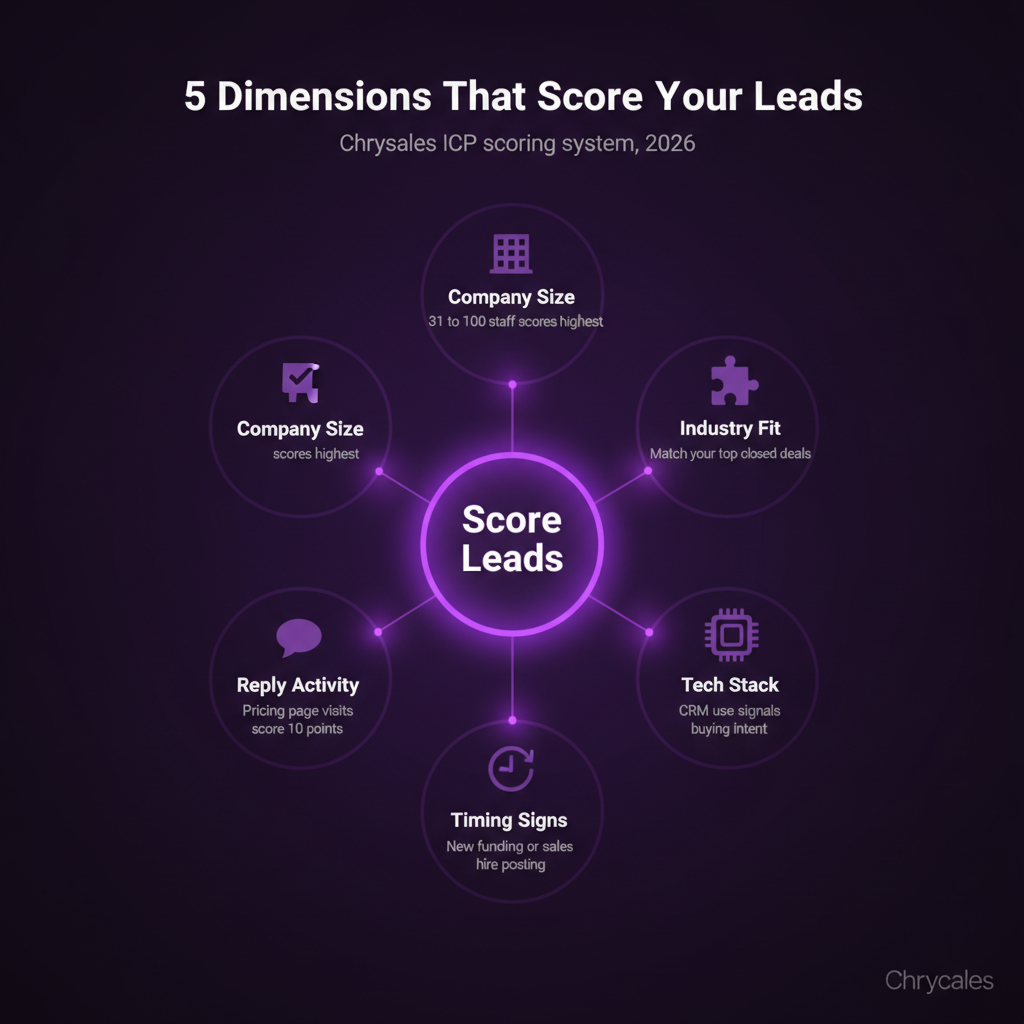
A solid ICP scoring rubric for B2B companies breaks down into five main buckets. You don't need 20 criteria. Five to eight well chosen ones will do most of the heavy lifting.
Company Size and Revenue
This is the simplest filter. If your best customers are companies with 20 to 100 employees, anyone with 5 employees or 500 employees gets a lower score. Same with revenue. If you sell to companies doing $2M to $20M a year, a startup at $300K isn't a fit yet, and a $200M enterprise probably has a procurement process that takes 9 months. Set score ranges like this:
- 10 to 30 employees: 3 points
- 31 to 100 employees: 10 points
- 101 to 300 employees: 6 points
- Over 300 employees: 2 points
The middle range gets the highest score because that's where your actual customers live.
Industry and Vertical Fit
Some industries buy faster, pay more, and have the exact problem you solve. Others don't. If 80% of your closed deals come from IT companies, consulting firms, and marketing agencies, those industries should score highest. Quick example:
- IT/Tech: 10 points
- Consulting: 10 points
- Marketing agencies: 10 points
- Manufacturing: 4 points
- Retail: 2 points
If you've never closed a retail client and your product doesn't fit their workflow, why waste time scoring them high?
Technographic Signals and Tool Stack
This one's gold for outbound lead prioritization. If your product integrates with HubSpot and you see a company using it, that's a strong signal. If they're using tools that compete with you, they might be open to switching, or they might be locked in. Score accordingly. For a sales automation tool, you might score:
- Uses HubSpot or Salesforce: 8 points
- Uses a competing CRM: 4 points
- No CRM detected: 2 points
We worked with a tech company who added this to their ICP fit score and cut their sales cycle by 18 days on average. They stopped wasting calls on companies that would need 6 months to switch systems.
Behavioral and Engagement Signals
This is where you catch intent. Did they visit your pricing page three times? Did they download a guide? Did they open five emails in a row? Behavioral signals tell you who's curious and who's just browsing. Score it like this:
- Visited pricing page or booked a demo: 10 points
- Downloaded content or opened 3+ emails: 6 points
- Opened 1 email, no other activity: 2 points
- Zero engagement: 0 points
Most B2B SaaS teams ignore this, then wonder why their cold leads never convert. Behavior beats demographics every time.
Pain Point and Timing Indicators
The best leads have a problem right now. They just hired a sales team and need training. They're scaling fast and their old system broke. They posted a job opening for a sales role. These timing signals push a lead from "maybe later" to "let's talk this week." Look for:
- Recent funding or growth announcement: 8 points
- Job postings for sales roles: 7 points
- Leadership change (new VP of Sales): 6 points
- No obvious timing signal: 0 points
One marketing agency we coached added this dimension and their close rate jumped from 14% to 22% in one quarter. They stopped calling companies that weren't ready and focused on the ones actively looking for help.
Watch out: Don't score layoffs or restructuring as positive signals. A company cutting staff is usually tightening budgets, not buying new tools.
How to Build Your First Lead Qualification Framework in 4 Steps
Building an ICP scoring rubric doesn't take weeks. You can have a working version in a few hours if you follow these steps.
Step 1: Analyze Your Best Customers
Pull a list of your top 10 to 15 customers. The ones who paid on time, closed fast, got results, and didn't ghost you after two months. Look for patterns:
- What size are they?
- What industry?
- What tools do they use?
- What problem did they need solved right away?
Write down the 5 to 8 traits that show up most often. Those become your scoring criteria.
Step 2: Assign Weights to Each Criterion
Not all criteria matter equally. If company size predicts close rate better than industry, give it more weight. A simple way to do this: assign point values out of 10 for each dimension, with your ideal match getting 10 points and poor fits getting 0 to 3 points. Here's a quick scoring rubric example:
- Company size: 0 to 10 points
- Industry fit: 0 to 10 points
- Tech stack: 0 to 8 points
- Behavioral signals: 0 to 10 points
- Timing indicators: 0 to 8 points
Total possible score: 46 points. Any lead scoring above 30 goes to the top of your list.
Step 3: Score a Sample of 50 Leads Manually
Before you automate anything, score 50 leads by hand. Use a spreadsheet. You'll catch edge cases fast. You'll see a lead that scores high but feels wrong, or a lead that scores low but you know they'd be a great fit. Adjust your weights and criteria until the scores match your gut. This step sounds boring. It is. But it's also the difference between a scoring system that works and one that sends you chasing bad leads for three months.
Step 4: Set Tier Thresholds and Next Actions
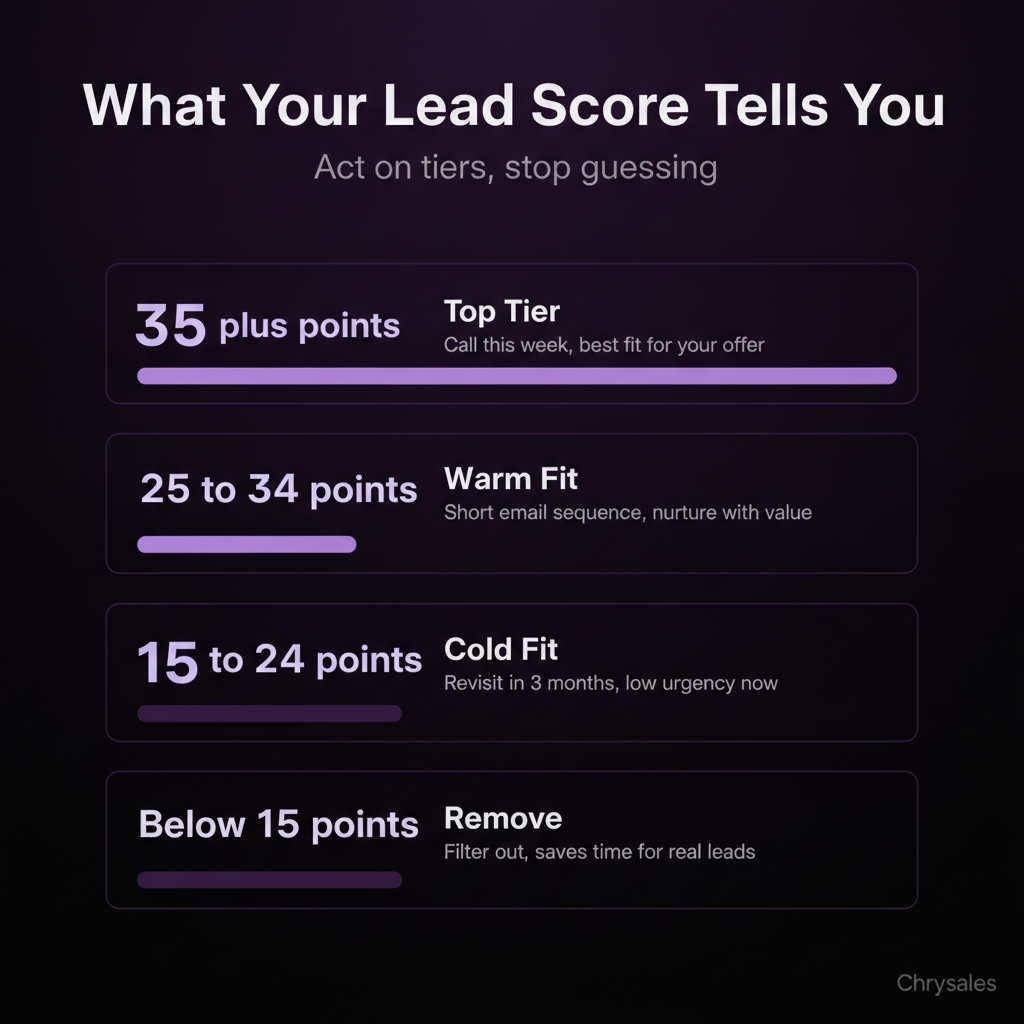
Once you have scores, create tiers:
- 35+ points: Tier 1. Call them this week.
- 25 to 34 points: Tier 2. Nurture with a short email sequence.
- 15 to 24 points: Tier 3. Long nurture or revisit in 3 months.
- Below 15 points: Ignore or remove from list.
This makes life simple for your sales team. They're not deciding who to call. The system tells them. They just pick up the phone and talk to people who actually fit.
Common mistake: Setting thresholds too high. If only 2% of your leads hit Tier 1, you don't have enough people to call. Lower the bar slightly or adjust your weights so 10 to 15% of leads make the cut.
How Chrysales Uses ICP Scoring to Build Custom Sales Systems
At Chrysales, we've trained over 500 sales teams and helped generate more than €10M in client revenue by building custom sales systems from the ground up. One of the first things we do with every client is build or fix their ICP scoring system. Most teams skip this step and go straight to cold email or hiring salespeople. That's like building a house without a foundation. Here's how we approach it differently:
We Start with Real Data, Not Guesswork
We pull your closed deals from the last 12 months and score them retroactively. We look for patterns you might have missed. A lot of times, the best customers aren't who you think they are. Maybe you assumed enterprise was your sweet spot, but the data shows mid market closes faster and stays longer. We adjust the ICP scoring rubric to reflect reality, not assumptions.
We Connect Scoring to Your Full Sales System
An ICP fit score only works if it connects to the rest of your sales process. We tie it to cold outreach sequences, discovery call scripts, and even offer creation. If a lead scores high on timing signals, they get a different message than a lead who scores high on industry fit but low on urgency. This is where AI comes in. We use Gemini based sales workflows to auto score leads, route them to the right sequences, and flag high priority prospects for your team to call first.
We Train Your Team to Actually Use It
A spreadsheet sitting in Google Drive doesn't help anyone. We train your setters and closers to check scores before every call, adjust their pitch based on fit, and update the rubric as they learn more. Over time, your team gets better at spotting patterns and your close rate goes up without changing your offer or pricing. You can also watch how to build a sales system so powerful clients come to you for a deeper walkthrough of this approach.
Pro Tip: Review your ICP scoring system every quarter. Markets shift, your product evolves, and the traits that mattered 6 months ago might not matter now.
Common ICP Scoring Mistakes That Kill Your Outbound Reply Rate
Most teams make the same mistakes when they first build a B2B ICP scoring rubric. Here are the big ones we see all the time, and how to avoid them.
Scoring Too Many Criteria
You don't need 15 data points to qualify a lead. Too many criteria make scoring slow, confusing, and inconsistent. Pick 5 to 8 criteria that actually predict closed deals. The rest is noise.
Weighing Everything Equally
If company size and industry fit both get 10 points, but industry matters twice as much in real life, your scores will be off. Look at your closed deals. Which traits show up every single time? Those get the most weight.
Ignoring Negative Signals
Some traits should subtract points, not add them. A company that just went through layoffs, or one that's using a tool that directly competes with yours and signed a 3 year contract last month. These are red flags. Score them low or filter them out completely.
Not Updating the Rubric as You Learn
Your first ICP scoring rubric will be wrong in a few places. That's fine. The point is to start scoring, see what works, and adjust. Every quarter, pull your closed deals and lost deals. Look for patterns. Update your criteria and weights. A static rubric becomes useless fast. We worked with a 25 person consulting firm who built their first sales qualification system in 2023. They updated it three times in the first 6 months as they learned which signals actually mattered. By month 9, their close rate was up 31% and their average deal size grew by 18%. Same team, same offer. Better scoring.
How to Automate ICP Scoring Without Losing the Human Touch
Once your manual scoring system works, you can start automating parts of it. But don't automate too early. If your criteria are still shifting, automation locks you into bad decisions.
Use Enrichment Tools to Pull Data Automatically
Tools like Clay, Apollo, or Clearbit can pull company size, industry, tech stack, and funding data automatically. You set the rules once, and every new lead gets scored without manual work. This is where B2B lead generation gets scalable. Set it up so leads above a certain score get added to your CRM and routed to a specific sequence. Leads below the threshold get filtered out or sent to a long term nurture list. Your sales team only sees the good ones.
Build Conditional Workflows Based on Score
Different score ranges should trigger different actions. A lead scoring 40 points should get a personal email and a same day call. A lead scoring 28 points should enter a 5 email nurture sequence. A lead scoring 12 points should get one generic email and nothing else. This is where AI in sales shines. We help clients set up Gemini based workflows that adjust messaging, timing, and follow up cadence based on score. High fit leads get aggressive follow up. Medium fit leads get education and nurturing. Low fit leads get archived.
Review Scores Before Every Sales Call
Even with automation, your closers should glance at the score before hopping on a call. It gives context. A lead who scored high on behavioral signals but low on company size needs a different approach than a lead who scored high on industry fit but low on timing. The score tells you where to lean in and where to probe.
Watch out: Don't let automation replace judgment. If a lead scores low but your gut says they're a fit, trust your gut. The system is a guide, not a law.
Real Examples: What a Strong ICP Scoring Rubric Looks Like for Different B2B Businesses
Here's how three different types of companies might build their ICP scoring system.
Example 1: Sales Training for Consulting Firms
Criteria:
- Company size (15 to 80 employees): 10 points
- Industry (consulting, professional services): 10 points
- Recent sales hire posted: 8 points
- No in house sales trainer: 6 points
- Located in Europe or North America: 4 points
Total possible: 38 points. Leads scoring 28+ go to immediate outreach.
Example 2: Marketing Automation SaaS
Criteria:
- Company revenue ($2M to $15M): 10 points
- Uses HubSpot or Salesforce: 8 points
- Visited pricing page in last 30 days: 10 points
- Marketing team size 3+: 7 points
- Industry (SaaS, agencies, B2B services): 6 points
Total possible: 41 points. Leads scoring 30+ get a demo invite within 24 hours.
Example 3: IT Consulting for Mid Market
Criteria:
- Company size (50 to 300 employees): 10 points
- Industry (fintech, healthtech, SaaS): 8 points
- Uses legacy systems (detected via tech stack): 7 points
- Recent funding or acquisition: 8 points
- Leadership change in last 6 months: 5 points
Total possible: 38 points. Leads scoring 25+ enter a 7 day outreach sequence.
Each of these examples is built around what actually predicts a closed deal for that business. They're simple, weighted toward the traits that matter most, and they make it obvious who to call first.
Frequently Asked Questions
Q: How many criteria should I include in my ICP scoring system?
Five to eight criteria is the sweet spot. Fewer than five and you're missing important signals. More than eight and scoring becomes slow and inconsistent. Pick the traits that show up in 70% or more of your best customers and focus on those. You can always add more later, but start simple so your team actually uses it.
Q: Should I build my ICP scoring rubric before or after I start cold outreach?
Before, always. Sending cold emails without a scoring system is like throwing darts blindfolded. You'll waste time on bad fit leads and burn through your list faster. Build the rubric first, score your list, then reach out to the top 20% only. Your reply rate and close rate will be higher from day one.
Q: Can I use the same ICP scoring system for inbound and outbound leads?
Yes, but you might want to adjust weights slightly. Inbound leads already showed interest, so behavioral signals matter more. Outbound leads need stronger firmographic and timing signals to be worth a cold call. Use the same core criteria, but shift the weights based on where the lead came from. Most teams run two versions of the same rubric.
Q: How often should I update my B2B lead qualification framework?
Every quarter is a good baseline. Pull your closed deals and lost deals from the last 90 days. Look for patterns. Did a new trait start showing up in wins? Did an old criterion stop mattering? Update your criteria and weights, then rescore a sample batch to make sure the changes work. Markets shift fast, so your rubric should shift with them.
Q: What's a realistic close rate improvement after implementing ICP scoring?
Most B2B sales teams see a 15 to 30% improvement in close rate within the first 6 months of using a solid scoring system. That's because they stop wasting time on bad fits and focus energy on leads that actually match their best customers. Your mileage will vary depending on how messy your list was before, but expect noticeable gains within the first quarter if you score consistently and follow the tiers.
An ICP scoring system is a simple way to rank leads so you can focus on the best fit for lead generation, b2b sales, and client acquisition. Most cold outreach fails because teams spend weeks writing perfect emails, then send them to the wrong people. A 200 person company that just did layoffs is not a "hot lead." It's a bad fit, full stop. This is where an ICP scoring system saves you from wasting time on leads that were never going to close.
What Is an ICP Scoring System and Why It Matters More Than Your Email Copy
An ICP scoring system is a simple scoring method that ranks leads based on how well they match your best customers. You pick 5 to 8 criteria that matter most, give each one a weight, then score every lead that comes in. The higher the score, the better the fit. Here's the thing: most B2B sales teams treat every lead the same. They book 20 calls a week, and 15 of them are with people who don't have budget, don't have authority, or don't even have the problem you solve. That's exhausting and expensive. An ICP scoring rubric fixes this by putting your best fit leads at the top of the pile every single time.
The Real Cost of Bad Lead Qualification
Picture this: you spend two weeks writing cold emails, hire a VA to build a list, send 1,000 messages, and book 10 calls. But when you get on those calls, half the companies are too small, three are in the wrong industry, and one person thought you were selling something completely different. You just burned 15 hours on calls that had zero chance of closing. A 30 person consulting firm tried this last quarter. They had a 0.8% reply rate and booked 12 calls. Only one turned into a deal. After they built a B2B lead qualification framework and cleaned up their list, their reply rate jumped to 3.4% and they closed four deals in the next 8 weeks. Same email. Better list.
How ICP Scoring Connects to Predictable Client Acquisition
When you score leads before you reach out, you're building a repeatable system. You're not guessing. You're not hoping the next batch of emails works better. You know exactly who fits, who doesn't, and where to spend your time. That's predictable client acquisition. You can forecast how many leads you need to generate 10 qualified calls, and how many calls you need to close three deals. The math starts working.
Pro Tip: Start scoring leads manually in a spreadsheet before you automate anything. You'll catch edge cases and refine your criteria faster.
The 5 Core Scoring Dimensions for B2B Lead Generation
A solid ICP scoring rubric for B2B companies breaks down into five main buckets. You don't need 20 criteria. Five to eight well chosen ones will do most of the heavy lifting.
Company Size and Revenue
This is the simplest filter. If your best customers are companies with 20 to 100 employees, anyone with 5 employees or 500 employees gets a lower score. Same with revenue. If you sell to companies doing $2M to $20M a year, a startup at $300K isn't a fit yet, and a $200M enterprise probably has a procurement process that takes 9 months. Set score ranges like this:
- 10 to 30 employees: 3 points
- 31 to 100 employees: 10 points
- 101 to 300 employees: 6 points
- Over 300 employees: 2 points
The middle range gets the highest score because that's where your actual customers live.
Industry and Vertical Fit
Some industries buy faster, pay more, and have the exact problem you solve. Others don't. If 80% of your closed deals come from IT companies, consulting firms, and marketing agencies, those industries should score highest. Quick example:
- IT/Tech: 10 points
- Consulting: 10 points
- Marketing agencies: 10 points
- Manufacturing: 4 points
- Retail: 2 points
If you've never closed a retail client and your product doesn't fit their workflow, why waste time scoring them high?
Technographic Signals and Tool Stack
This one's gold for outbound lead prioritization. If your product integrates with HubSpot and you see a company using it, that's a strong signal. If they're using tools that compete with you, they might be open to switching, or they might be locked in. Score accordingly. For a sales automation tool, you might score:
- Uses HubSpot or Salesforce: 8 points
- Uses a competing CRM: 4 points
- No CRM detected: 2 points
We worked with a tech company who added this to their ICP fit score and cut their sales cycle by 18 days on average. They stopped wasting calls on companies that would need 6 months to switch systems.
Behavioral and Engagement Signals
This is where you catch intent. Did they visit your pricing page three times? Did they download a guide? Did they open five emails in a row? Behavioral signals tell you who's curious and who's just browsing. Score it like this:
- Visited pricing page or booked a demo: 10 points
- Downloaded content or opened 3+ emails: 6 points
- Opened 1 email, no other activity: 2 points
- Zero engagement: 0 points
Most B2B SaaS teams ignore this, then wonder why their cold leads never convert. Behavior beats demographics every time.
Pain Point and Timing Indicators
The best leads have a problem right now. They just hired a sales team and need training. They're scaling fast and their old system broke. They posted a job opening for a sales role. These timing signals push a lead from "maybe later" to "let's talk this week." Look for:
- Recent funding or growth announcement: 8 points
- Job postings for sales roles: 7 points
- Leadership change (new VP of Sales): 6 points
- No obvious timing signal: 0 points
One marketing agency we coached added this dimension and their close rate jumped from 14% to 22% in one quarter. They stopped calling companies that weren't ready and focused on the ones actively looking for help.
Watch out: Don't score layoffs or restructuring as positive signals. A company cutting staff is usually tightening budgets, not buying new tools.
How to Build Your First Lead Qualification Framework in 4 Steps
Building an ICP scoring rubric doesn't take weeks. You can have a working version in a few hours if you follow these steps.
Step 1: Analyze Your Best Customers
Pull a list of your top 10 to 15 customers. The ones who paid on time, closed fast, got results, and didn't ghost you after two months. Look for patterns:
- What size are they?
- What industry?
- What tools do they use?
- What problem did they need solved right away?
Write down the 5 to 8 traits that show up most often. Those become your scoring criteria.
Step 2: Assign Weights to Each Criterion
Not all criteria matter equally. If company size predicts close rate better than industry, give it more weight. A simple way to do this: assign point values out of 10 for each dimension, with your ideal match getting 10 points and poor fits getting 0 to 3 points. Here's a quick scoring rubric example:
- Company size: 0 to 10 points
- Industry fit: 0 to 10 points
- Tech stack: 0 to 8 points
- Behavioral signals: 0 to 10 points
- Timing indicators: 0 to 8 points
Total possible score: 46 points. Any lead scoring above 30 goes to the top of your list.
Step 3: Score a Sample of 50 Leads Manually
Before you automate anything, score 50 leads by hand. Use a spreadsheet. You'll catch edge cases fast. You'll see a lead that scores high but feels wrong, or a lead that scores low but you know they'd be a great fit. Adjust your weights and criteria until the scores match your gut. This step sounds boring. It is. But it's also the difference between a scoring system that works and one that sends you chasing bad leads for three months.
Step 4: Set Tier Thresholds and Next Actions
Once you have scores, create tiers:
- 35+ points: Tier 1. Call them this week.
- 25 to 34 points: Tier 2. Nurture with a short email sequence.
- 15 to 24 points: Tier 3. Long nurture or revisit in 3 months.
- Below 15 points: Ignore or remove from list.
This makes life simple for your sales team. They're not deciding who to call. The system tells them. They just pick up the phone and talk to people who actually fit.
Common mistake: Setting thresholds too high. If only 2% of your leads hit Tier 1, you don't have enough people to call. Lower the bar slightly or adjust your weights so 10 to 15% of leads make the cut.
How Chrysales Uses ICP Scoring to Build Custom Sales Systems
At Chrysales, we've trained over 500 sales teams and helped generate more than €10M in client revenue by building custom sales systems from the ground up. One of the first things we do with every client is build or fix their ICP scoring system. Most teams skip this step and go straight to cold email or hiring salespeople. That's like building a house without a foundation. Here's how we approach it differently:
We Start with Real Data, Not Guesswork
We pull your closed deals from the last 12 months and score them retroactively. We look for patterns you might have missed. A lot of times, the best customers aren't who you think they are. Maybe you assumed enterprise was your sweet spot, but the data shows mid market closes faster and stays longer. We adjust the ICP scoring rubric to reflect reality, not assumptions.
We Connect Scoring to Your Full Sales System
An ICP fit score only works if it connects to the rest of your sales process. We tie it to cold outreach sequences, discovery call scripts, and even offer creation. If a lead scores high on timing signals, they get a different message than a lead who scores high on industry fit but low on urgency. This is where AI comes in. We use Gemini based sales workflows to auto score leads, route them to the right sequences, and flag high priority prospects for your team to call first.
We Train Your Team to Actually Use It
A spreadsheet sitting in Google Drive doesn't help anyone. We train your setters and closers to check scores before every call, adjust their pitch based on fit, and update the rubric as they learn more. Over time, your team gets better at spotting patterns and your close rate goes up without changing your offer or pricing. You can also watch how to build a sales system so powerful clients come to you for a deeper walkthrough of this approach.
Pro Tip: Review your ICP scoring system every quarter. Markets shift, your product evolves, and the traits that mattered 6 months ago might not matter now.
Common ICP Scoring Mistakes That Kill Your Outbound Reply Rate
Most teams make the same mistakes when they first build a B2B ICP scoring rubric. Here are the big ones we see all the time, and how to avoid them.
Scoring Too Many Criteria
You don't need 15 data points to qualify a lead. Too many criteria make scoring slow, confusing, and inconsistent. Pick 5 to 8 criteria that actually predict closed deals. The rest is noise.
Weighing Everything Equally
If company size and industry fit both get 10 points, but industry matters twice as much in real life, your scores will be off. Look at your closed deals. Which traits show up every single time? Those get the most weight.
Ignoring Negative Signals
Some traits should subtract points, not add them. A company that just went through layoffs, or one that's using a tool that directly competes with yours and signed a 3 year contract last month. These are red flags. Score them low or filter them out completely.
Not Updating the Rubric as You Learn
Your first ICP scoring rubric will be wrong in a few places. That's fine. The point is to start scoring, see what works, and adjust. Every quarter, pull your closed deals and lost deals. Look for patterns. Update your criteria and weights. A static rubric becomes useless fast. We worked with a 25 person consulting firm who built their first sales qualification system in 2023. They updated it three times in the first 6 months as they learned which signals actually mattered. By month 9, their close rate was up 31% and their average deal size grew by 18%. Same team, same offer. Better scoring.
How to Automate ICP Scoring Without Losing the Human Touch
Once your manual scoring system works, you can start automating parts of it. But don't automate too early. If your criteria are still shifting, automation locks you into bad decisions.
Use Enrichment Tools to Pull Data Automatically
Tools like Clay, Apollo, or Clearbit can pull company size, industry, tech stack, and funding data automatically. You set the rules once, and every new lead gets scored without manual work. This is where B2B lead generation gets scalable. Set it up so leads above a certain score get added to your CRM and routed to a specific sequence. Leads below the threshold get filtered out or sent to a long term nurture list. Your sales team only sees the good ones.
Build Conditional Workflows Based on Score
Different score ranges should trigger different actions. A lead scoring 40 points should get a personal email and a same day call. A lead scoring 28 points should enter a 5 email nurture sequence. A lead scoring 12 points should get one generic email and nothing else. This is where AI in sales shines. We help clients set up Gemini based workflows that adjust messaging, timing, and follow up cadence based on score. High fit leads get aggressive follow up. Medium fit leads get education and nurturing. Low fit leads get archived.
Review Scores Before Every Sales Call
Even with automation, your closers should glance at the score before hopping on a call. It gives context. A lead who scored high on behavioral signals but low on company size needs a different approach than a lead who scored high on industry fit but low on timing. The score tells you where to lean in and where to probe.
Watch out: Don't let automation replace judgment. If a lead scores low but your gut says they're a fit, trust your gut. The system is a guide, not a law.
Real Examples: What a Strong ICP Scoring Rubric Looks Like for Different B2B Businesses
Here's how three different types of companies might build their ICP scoring system.
Example 1: Sales Training for Consulting Firms
Criteria:
- Company size (15 to 80 employees): 10 points
- Industry (consulting, professional services): 10 points
- Recent sales hire posted: 8 points
- No in house sales trainer: 6 points
- Located in Europe or North America: 4 points
Total possible: 38 points. Leads scoring 28+ go to immediate outreach.
Example 2: Marketing Automation SaaS
Criteria:
- Company revenue ($2M to $15M): 10 points
- Uses HubSpot or Salesforce: 8 points
- Visited pricing page in last 30 days: 10 points
- Marketing team size 3+: 7 points
- Industry (SaaS, agencies, B2B services): 6 points
Total possible: 41 points. Leads scoring 30+ get a demo invite within 24 hours.
Example 3: IT Consulting for Mid Market
Criteria:
- Company size (50 to 300 employees): 10 points
- Industry (fintech, healthtech, SaaS): 8 points
- Uses legacy systems (detected via tech stack): 7 points
- Recent funding or acquisition: 8 points
- Leadership change in last 6 months: 5 points
Total possible: 38 points. Leads scoring 25+ enter a 7 day outreach sequence.
Each of these examples is built around what actually predicts a closed deal for that business. They're simple, weighted toward the traits that matter most, and they make it obvious who to call first.
Frequently Asked Questions
Q: How many criteria should I include in my ICP scoring system?
Five to eight criteria is the sweet spot. Fewer than five and you're missing important signals. More than eight and scoring becomes slow and inconsistent. Pick the traits that show up in 70% or more of your best customers and focus on those. You can always add more later, but start simple so your team actually uses it.
Q: Should I build my ICP scoring rubric before or after I start cold outreach?
Before, always. Sending cold emails without a scoring system is like throwing darts blindfolded. You'll waste time on bad fit leads and burn through your list faster. Build the rubric first, score your list, then reach out to the top 20% only. Your reply rate and close rate will be higher from day one.
Q: Can I use the same ICP scoring system for inbound and outbound leads?
Yes, but you might want to adjust weights slightly. Inbound leads already showed interest, so behavioral signals matter more. Outbound leads need stronger firmographic and timing signals to be worth a cold call. Use the same core criteria, but shift the weights based on where the lead came from. Most teams run two versions of the same rubric.
Q: How often should I update my B2B lead qualification framework?
Every quarter is a good baseline. Pull your closed deals and lost deals from the last 90 days. Look for patterns. Did a new trait start showing up in wins? Did an old criterion stop mattering? Update your criteria and weights, then rescore a sample batch to make sure the changes work. Markets shift fast, so your rubric should shift with them.
Q: What's a realistic close rate improvement after implementing ICP scoring?
Most B2B sales teams see a 15 to 30% improvement in close rate within the first 6 months of using a solid scoring system. That's because they stop wasting time on bad fits and focus energy on leads that actually match their best customers. Your mileage will vary depending on how messy your list was before, but expect noticeable gains within the first quarter if you score consistently and follow the tiers.
Scaling Is Not Hard If You Have The Right Systems
If you’re serious about leveling up your scaling game, you need the right system, the right training, and the right team behind you. We're here to give you the exact tools and strategies top entrepreneurs use to dominate.

Discover the latest tips
View All.avif)
Chrysales was formed from the words "chrysalis" the stage where a caterpillar transforms into a butterfly and "sales".
It stands for one thing: sales transformation.Because scaling doesn’t happen by doing more of the same. Scaling only happens when you go through real transformation in your systems, your offer, team and the way you sell.
.avif)


