.avif)
How to Hire Sales People Who Actually Perform
Hiring sales people means finding reps who can sell, follow a clear process, and close deals without wasting time, money, or momentum. Picture this: you post a job, interview 20 candidates, pick the one with the best resume, and three months later they've closed zero deals. You're back to square one, except now you're out time, money, and momentum.
Most teams hire sales people the same way they'd hire an accountant or a designer. That's the mistake. Sales hiring is different. The resume doesn't tell you who can sell. The interview doesn't show you who will show up hungry every day. And if you don't have a system for finding, vetting, and onboarding sales reps, you're basically rolling dice and hoping for wins.
This guide walks you through the exact steps to hire sales people who actually perform, starting from the moment you decide you need help.
Why Most Teams Hire Sales Reps Too Early (And How to Know You're Ready)
Here's the thing: hiring a sales rep before you're ready is one of the fastest ways to burn cash and kill confidence. A lot of teams think the first sales hire will magically fix their revenue problem. It won't. If you don't have a repeatable way to close deals yourself, you can't teach someone else to do it.
Before you hire sales people, you need to answer three questions. First: have you closed at least five to ten deals yourself? If you haven't, you don't know what works yet. You're guessing, and you're asking someone else to guess with you. Second: can you explain your sales process in writing? If you can't write down the steps from first contact to signed contract, you don't have a process to hand off. Third: do you have enough qualified leads coming in to keep a rep busy? If your pipeline is empty, your new hire will spend weeks cold calling random contacts or sitting idle while you scramble to fill the funnel.
Watch out: A common mistake is hiring a sales rep to "figure out" your sales process for you. That's not their job. They execute the system. You build it first. If you're still running founder-led sales and unsure whether your system is ready for a first hire, watch this breakdown of why most founders are stuck at $10k/month to understand the sales foundations needed to scale beyond a revenue plateau.
A 15-person consulting firm we worked with tried to hire their first sales rep six months before they were ready. The rep had no training, no script, no lead list. He lasted eight weeks. Once they built a real sales system and documented the process, their second hire closed 12 deals in the first quarter. Same market, different setup.
The Real Cost of a Bad Sales Hire
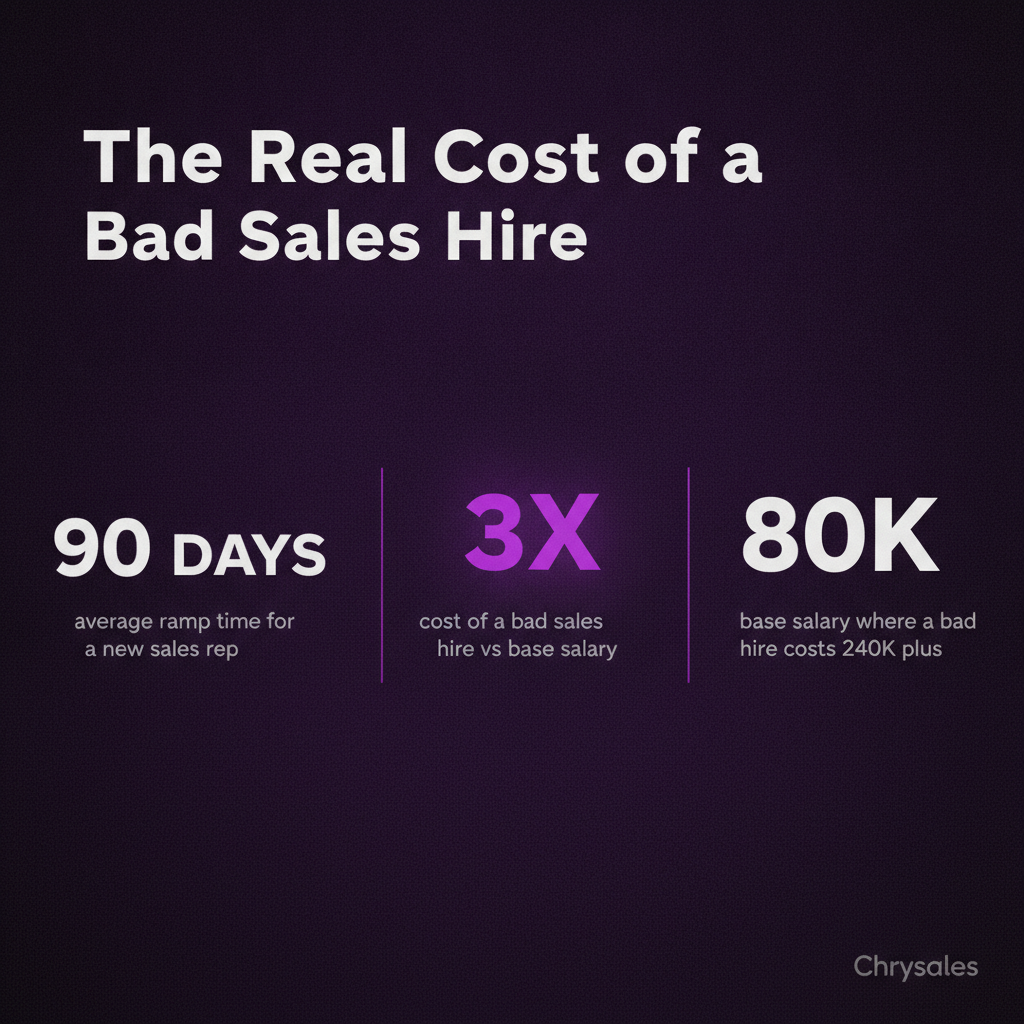
A bad sales hire costs way more than salary. You lose three to six months of ramp time. You waste hours coaching someone who won't make it. Your best leads get burned by someone who doesn't know how to close them. And if you're a small team, a failed hire can tank morale. Other people see it and start questioning whether the whole plan works.
Most studies show the cost of a bad sales hire is somewhere between 1.5x and 3x their annual salary when you factor in lost deals, training time, and recruitment costs. For a rep making $80K base, that's $120K to $240K down the drain. For B2B companies trying to hit growth targets, that's not just money. It's quarters of momentum you don't get back.
What to Look for When You Hire Sales People (Traits That Actually Matter)
Most job posts for sales roles list experience first. Five years in SaaS. Background in B2B lead generation. Proven track record. But experience is one of the least reliable predictors of sales success. A rep who crushed it at one company might flop at yours because the product, process, and market are different.
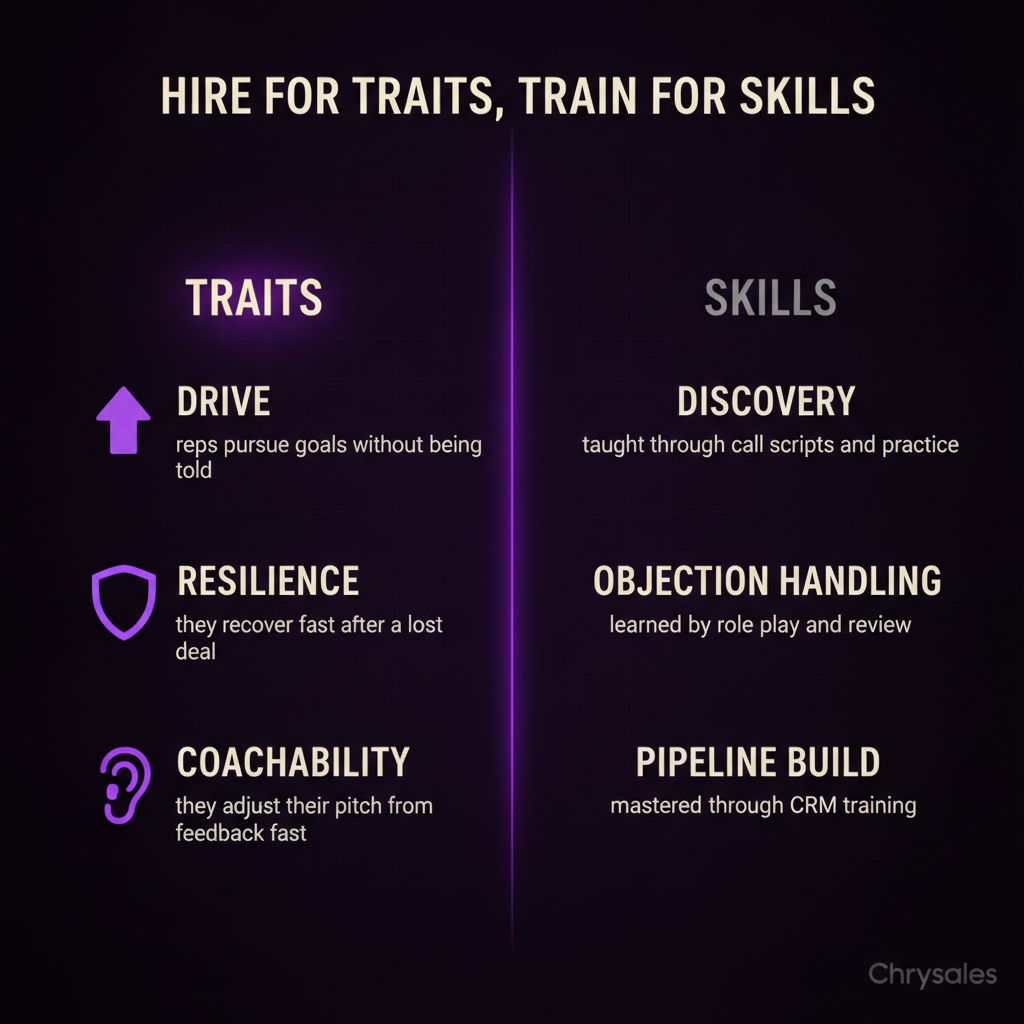
What matters more than experience? Three things: coachability, drive, and resilience.
Coachability means they listen, take feedback, and adjust fast. In B2B sales, you're constantly tweaking your pitch, your questions, your objection handling. If someone can't absorb coaching, they'll stay stuck at their current skill level forever. During interviews, ask them to describe a time they got critical feedback and what they did with it. If they can't think of an example or they blame the feedback-giver, that's a red flag.
Drive is harder to define, but you know it when you see it. It's the rep who follows up without being told. The one who asks what they can do better after a lost deal. The one who treats every no as a step closer to yes. You can't teach drive. You can only hire for it. One way to test it: ask candidates how they've hit a big goal in the past, in any area of life. If they've run a marathon, built a side business, or taught themselves a skill from scratch, they probably have the internal engine that sales requires.
Resilience is what keeps a rep going after ten no's in a row. Sales is rejection-heavy. If someone takes a lost deal personally or needs constant reassurance, they won't last. Ask them to describe a time they failed at something important and how they recovered. Listen for ownership and forward motion, not excuses.
Skills You Can Train vs. Traits You Can't
Here's a simple rule: hire for traits, train for skills. You can teach someone how to run a discovery call, how to handle objections, how to build a pipeline in your CRM. You can't teach hunger, curiosity, or the willingness to hear "no" 50 times before you hear "yes."
A lot of teams make the mistake of hiring the most polished candidate. The one who sounds smooth in the interview, who's done the job before, who doesn't need much training. But polished doesn't mean they'll perform. We've seen marketing agencies hire experienced sales reps who knew all the buzzwords but couldn't adapt to a new process. And we've seen teams hire people with zero sales experience who learned fast, followed the system, and closed deals within 30 days.
Pro Tip: During the interview, give candidates a role-play scenario. Make them pitch your product or handle a common objection on the spot. Their performance doesn't need to be perfect. Watch how they think on their feet, how they ask questions, and whether they can take a note and immediately apply it in round two.
Where to Find High-Performance Sales Reps (Beyond Job Boards)
Most teams post on LinkedIn and Indeed and wait for applications. That works for volume, but it doesn't work for quality. If you want to hire sales people who actually perform, you need to go where high performers hang out.
Start with referrals. Ask your network if they know any strong sales reps looking for a new role. Referrals come pre-vetted and consistently outperform candidates from job boards. If someone you trust vouches for a candidate, that cuts your risk in half. Offer a referral bonus to make it worth people's time to think hard and send you someone good.
Next, look in communities where sales professionals gather. Places like Reddit's r/sales, sales-focused Slack groups, and LinkedIn groups for B2B sales are full of people talking shop. You can post opportunities there or reach out directly to people who give smart answers and seem engaged. Same goes for sales training platforms and programs. People who invest in their own sales training tend to be the ones who take the job seriously.
Another option: recruit from adjacent roles. Customer success people, account managers, and business development reps often have the relationship skills and work ethic you need. They might not have "closer" on their resume, but with the right sales training and a solid sales system, they can ramp fast.
Common mistake: Only hiring people who've done the exact same role at the exact same type of company. That narrows your pool too much and misses great candidates who have the traits but not the title.
How to Screen and Interview Sales Candidates (Without Getting Fooled)
Resumes lie. Not always on purpose, but they do. Someone says they "led B2B sales" and it turns out they sent emails and attended meetings. Someone lists "client acquisition" as a skill and it means they worked on a team where other people closed deals. You can't hire sales people based on what they claim. You need to see them in action.
Your screening process should have three stages. Stage one: a short phone screen, 15 to 20 minutes. Ask them why they're in sales, what they like about it, and what their biggest sales win was. Listen for specifics. If they say "I love helping people," that's generic. If they say "I closed a six-month deal by solving a problem the client didn't even know they had," that's real.
Stage two: a longer interview, 45 to 60 minutes. This is where you ask behavioral questions and run a role-play. Behavioral questions sound like: "Tell me about a time you lost a deal you thought you'd win. What happened?" or "Describe how you've handled a prospect who went silent after three follow-ups." You're listening for how they think, how they handle adversity, and whether they take responsibility or blame externals.
The role-play is critical. Give them a realistic scenario. Pretend you're a prospect with a specific objection or a common hesitation. See how they respond in real time. After the first round, give them one piece of feedback and run it again. If they adjust immediately, that's coachability in action. If they ignore your feedback and do the same thing twice, that's a problem.
Pro Tip: Record the role-play (with permission) and watch it back. You'll catch things in the moment that your gut might miss. How do they listen? Do they ask good questions? Do they talk too much or not enough?
Stage three: a working interview or trial task. This could be a paid half-day where they sit in on calls, shadow your process, and do a mock pitch to your team. Or it could be a take-home assignment where they research your ideal customer, draft a cold outreach sequence, or map out how they'd approach the first 30 days. You're testing whether they can do the actual work, not just talk about it. For a step-by-step breakdown of sourcing and evaluating candidates, check out our guide on how to find and hire top-performing sales reps.
The Questions That Separate Good Reps from Great Ones
Here are five questions that consistently reveal who's going to perform:
- Walk me through how you'd prepare for a call with a prospect you've never spoken to before.
- Tell me about a time you had to sell something you didn't fully believe in. How did you handle it?
- What's your process for staying organized when you're managing 30+ active leads?
- How do you know when to keep pushing and when to walk away from a deal?
- Describe the best sales training or coaching you've ever received. What made it effective?
If a candidate gives vague answers or can't point to specific examples, that's a sign they either don't have much real experience or they haven't thought deeply about how they work. Great reps can tell you exactly how they operate because they've refined their process over time.
How to Structure the Offer and Comp Plan (So You Attract the Right People)
Compensation matters, but structure matters more. If you hire sales people on a comp plan that doesn't match your business model, you'll attract the wrong reps or create bad incentives.
For B2B sales, most comp plans split base salary and commission somewhere between 50/50 and 70/30. A 50/50 split works when your sales cycle is short and reps can close deals fast. A 70/30 split makes sense when deals take months and reps need stability while they ramp. Avoid commission-only unless you're hiring very experienced closers who already have a book of business. Most strong reps won't take a commission-only role because it's too risky, especially if they don't know your product or market yet.
Set clear commission triggers. Pay on closed deals, not meetings booked or proposals sent. And define "closed" precisely. Does it mean signed contract? First payment received? If there's ambiguity, you'll have arguments later. To go deeper on designing base and commission splits that attract the right reps and align incentives, read our article on commission structures that actually work for sales reps.
Watch out: If your commission structure pays the same for every deal size, reps will chase the easiest closes, not the most valuable ones. Tier your commissions so bigger deals pay better. That aligns their goals with yours.
One tech company we worked with paid flat $500 commissions per deal, whether the contract was $5K or $50K. Their reps spent all their time closing small clients because the effort was the same. When they switched to percentage-based commissions with accelerators for deals over $20K, average deal size doubled in one quarter.
Ramp Expectations and Timeline
Don't expect a new sales rep to close deals in week one. A realistic ramp timeline for most B2B sales roles is 60 to 90 days. In month one, they're learning your product, your market, your pitch. In month two, they're running calls and working deals with your support. In month three, they start closing on their own.
Set milestone goals for each phase. Month one: shadow ten calls, complete product training, send 50 outreach messages. Month two: book five demos, run three discovery calls solo, close one small deal. Month three: close three deals, build a pipeline of 20 active opportunities. Clear milestones help you see if someone's on track or struggling early, before you've invested six months. For a detailed breakdown of what these first 90 days should look like, this guide to 30-60-90 day ramp plans offers a helpful framework.
What Happens After You Hire Sales People (The Make-or-Break 90 Days)
Hiring the right person is half the battle. The other half is onboarding them into a system that actually works. If you hand someone a login and say "good luck," you're setting them up to fail.
Your onboarding process should cover three areas: product knowledge, sales process, and lead access. Product knowledge means they can explain what you sell, who it's for, and why it matters better than the client can explain their own problem. Sales process means they know every step from first contact to close, the scripts for each stage, and how to move a deal forward when it stalls. Lead access means they have a list of qualified prospects to call, email, or reach out to from day one. No rep should ever sit idle because they don't know who to contact.
Build a 30-day onboarding checklist. Include things like: complete product demo training, listen to five recorded sales calls, role-play three common objections, send your first 25 cold emails, book your first demo. Make it concrete. Vague goals like "get familiar with the product" don't help anyone.
Pro Tip: Pair your new hire with a mentor or existing rep if you have one. Shadowing someone who's already closing deals cuts ramp time in half. If you don't have another rep, you be the mentor. Block two hours a week to review calls, give feedback, and answer questions. Because successful sales hires depend on plugging reps into a proven system, this video shows how to build a sales system so powerful clients come to you and sets your new hires up for consistent success.
The Most Common Reasons New Sales Hires Fail (And How to Avoid Them)
Three things kill most new sales hires: bad leads, no coaching, and mismatched expectations.
Bad leads mean your rep is calling people who aren't buyers, don't have budget, or aren't a fit. If your lead list is weak, even a great rep will struggle. Make sure your rep has access to a qualified pipeline before they start. Use lead scoring, research, and filters to give them the best possible chances.
No coaching means they're winging it with no feedback. Sales is a skill you improve through repetition and correction. If you're not reviewing their calls, listening to their pitches, and helping them adjust, they'll plateau fast or pick up bad habits. Schedule a weekly one-on-one to go through what's working and what's not.
Mismatched expectations happen when you hire someone thinking they'll close 20 deals a month and they think the job is sending emails and booking meetings. Get aligned on goals, activity targets, and success metrics in writing before they start. If you expect 50 outreach touches a day and they think ten emails a week is plenty, you'll both be frustrated. For founders worrying about when and how to bring on their first closer, our article on why the first sales hire fails dives into these common mistakes and how to avoid them.
A marketing agency hired a rep and gave him no lead list, no CRM setup, and no training. He spent the first month building his own prospecting process from scratch. By the time he started reaching out, he was burned out and discouraged. He quit after 60 days. The fix wasn't a better hire. It was a better system.
When to Hire a Second Sales Rep (And Why Pairs Outperform Solo Hires)
Once your first sales hire is ramped and closing deals consistently, you might think it's time to hire a second. You're right. But here's a tip most teams miss: hire your first two sales reps at the same time if you can afford it.
Why? Because a single sales hire has no benchmark. If they're doing well, you don't know if it's because they're great or because your system is great. If they're struggling, you don't know if it's them or the market. When you hire two reps at once, you get instant comparison data. One might crush it while the other struggles, and that tells you the difference is skill or effort, not the leads or the process. It also creates healthy competition and accountability. People perform better when they see someone next to them hitting targets.
If you can't afford two full-time reps, consider hiring one full-time and one part-time, or two part-time reps who can each dedicate 20 hours a week. The comparison data is worth more than the extra cost.
Common mistake: Waiting until your first hire is "perfect" before adding a second. That day never comes. Once they're hitting 70% to 80% of quota consistently for two months, it's time to scale.
How Chrysales Helps Teams Hire and Scale Sales Without the Guesswork
Hiring sales people is one piece of a bigger puzzle. At Chrysales, we've trained over 500 sales teams and helped clients generate more than €10M in revenue by building custom sales systems that work before, during, and after the hire.
We don't just help you find reps. We help you build the onboarding process, the scripts, the lead pipeline, and the coaching structure that turns a good hire into a great performer. Our process starts with your sales system, not the job post. We map out your offer, your ideal customer, your discovery questions, and your close structure. Then we help you hire the right people into a system that's ready to support them. That's why our clients see new reps ramp faster and stay longer.
We've worked with companies like Amazon, Vodafone, and Cloudification, and we've built the same repeatable process for consulting firms, tech companies, and agencies with teams from five to 50 people. If you're thinking about hiring sales people but you're not sure your system is ready, or if you've already hired and it's not working, we can help. We do 1-on-1 coaching and custom builds, not courses or cookie-cutter templates. Learn more at chrysales.com.
Frequently Asked Questions
Q: Should I hire a full-time sales rep or start with a freelance closer?
Start full-time if you have enough leads and budget to keep someone busy for 30+ hours a week. A full-time rep is more invested, easier to train, and more likely to stick around once they start winning. Freelance closers make sense if your volume is low or inconsistent, but they won't build the same depth of product knowledge or customer relationships. If you're not sure, test with a part-time rep for 90 days and scale to full-time once you see momentum.
Q: How many leads does a new sales rep need per week to stay productive?
For most B2B sales teams, a rep needs 50 to 100 new qualified leads per month to stay busy, depending on your sales cycle. That breaks down to roughly 12 to 25 leads per week. If your leads are highly qualified, you can go lower. If your close rate is under 5%, you'll need more. The key is keeping their pipeline full enough that they're always working active deals, not waiting around for the next batch of contacts.
Q: What's the biggest red flag to watch for when interviewing sales candidates?
Someone who talks way more than they listen. Good sales reps ask questions, pause, and let you talk. If a candidate dominates the interview, interrupts, or doesn't ask a single question about your business, they'll do the same thing to prospects. Another red flag: blaming past failures on externals. If they say their last company's leads were bad, the product didn't work, or management didn't support them, they probably won't take ownership when things get hard at your company either.
Q: How long should I wait before deciding a new hire isn't working out?
Give them 90 days if they're showing effort and improvement. If they're hitting activity goals, asking good questions, and learning from feedback, they deserve the full ramp period. But if they're missing targets, not following your process, or showing low effort by day 45, have the hard conversation early. Waiting six months to fire someone who's clearly not a fit just burns more time and money. Set clear expectations up front and check in every two weeks during the first 90 days.
Q: Do I need a sales manager before I hire multiple sales reps?
Not right away. If you're hiring your first one or two sales reps, you can manage them yourself as long as you're willing to coach, review calls, and stay involved. Once you hit three to four reps, managing them becomes a full-time job and your time is better spent on strategy, product, or growth. That's when you either promote a top performer to a player coach role or hire a dedicated sales leader. Don't hire a manager before you have proven reps to manage. Build the team first, then layer in leadership.
Hiring sales people means finding reps who can sell, follow a clear process, and close deals without wasting time, money, or momentum. Picture this: you post a job, interview 20 candidates, pick the one with the best resume, and three months later they've closed zero deals. You're back to square one, except now you're out time, money, and momentum.
Most teams hire sales people the same way they'd hire an accountant or a designer. That's the mistake. Sales hiring is different. The resume doesn't tell you who can sell. The interview doesn't show you who will show up hungry every day. And if you don't have a system for finding, vetting, and onboarding sales reps, you're basically rolling dice and hoping for wins.
This guide walks you through the exact steps to hire sales people who actually perform, starting from the moment you decide you need help.
Why Most Teams Hire Sales Reps Too Early (And How to Know You're Ready)
Here's the thing: hiring a sales rep before you're ready is one of the fastest ways to burn cash and kill confidence. A lot of teams think the first sales hire will magically fix their revenue problem. It won't. If you don't have a repeatable way to close deals yourself, you can't teach someone else to do it.
Before you hire sales people, you need to answer three questions. First: have you closed at least five to ten deals yourself? If you haven't, you don't know what works yet. You're guessing, and you're asking someone else to guess with you. Second: can you explain your sales process in writing? If you can't write down the steps from first contact to signed contract, you don't have a process to hand off. Third: do you have enough qualified leads coming in to keep a rep busy? If your pipeline is empty, your new hire will spend weeks cold calling random contacts or sitting idle while you scramble to fill the funnel.
Watch out: A common mistake is hiring a sales rep to "figure out" your sales process for you. That's not their job. They execute the system. You build it first. If you're still running founder-led sales and unsure whether your system is ready for a first hire, watch this breakdown of why most founders are stuck at $10k/month to understand the sales foundations needed to scale beyond a revenue plateau.
A 15-person consulting firm we worked with tried to hire their first sales rep six months before they were ready. The rep had no training, no script, no lead list. He lasted eight weeks. Once they built a real sales system and documented the process, their second hire closed 12 deals in the first quarter. Same market, different setup.
The Real Cost of a Bad Sales Hire
A bad sales hire costs way more than salary. You lose three to six months of ramp time. You waste hours coaching someone who won't make it. Your best leads get burned by someone who doesn't know how to close them. And if you're a small team, a failed hire can tank morale. Other people see it and start questioning whether the whole plan works.
Most studies show the cost of a bad sales hire is somewhere between 1.5x and 3x their annual salary when you factor in lost deals, training time, and recruitment costs. For a rep making $80K base, that's $120K to $240K down the drain. For B2B companies trying to hit growth targets, that's not just money. It's quarters of momentum you don't get back.
What to Look for When You Hire Sales People (Traits That Actually Matter)
Most job posts for sales roles list experience first. Five years in SaaS. Background in B2B lead generation. Proven track record. But experience is one of the least reliable predictors of sales success. A rep who crushed it at one company might flop at yours because the product, process, and market are different.
What matters more than experience? Three things: coachability, drive, and resilience.
Coachability means they listen, take feedback, and adjust fast. In B2B sales, you're constantly tweaking your pitch, your questions, your objection handling. If someone can't absorb coaching, they'll stay stuck at their current skill level forever. During interviews, ask them to describe a time they got critical feedback and what they did with it. If they can't think of an example or they blame the feedback-giver, that's a red flag.
Drive is harder to define, but you know it when you see it. It's the rep who follows up without being told. The one who asks what they can do better after a lost deal. The one who treats every no as a step closer to yes. You can't teach drive. You can only hire for it. One way to test it: ask candidates how they've hit a big goal in the past, in any area of life. If they've run a marathon, built a side business, or taught themselves a skill from scratch, they probably have the internal engine that sales requires.
Resilience is what keeps a rep going after ten no's in a row. Sales is rejection-heavy. If someone takes a lost deal personally or needs constant reassurance, they won't last. Ask them to describe a time they failed at something important and how they recovered. Listen for ownership and forward motion, not excuses.
Skills You Can Train vs. Traits You Can't
Here's a simple rule: hire for traits, train for skills. You can teach someone how to run a discovery call, how to handle objections, how to build a pipeline in your CRM. You can't teach hunger, curiosity, or the willingness to hear "no" 50 times before you hear "yes."
A lot of teams make the mistake of hiring the most polished candidate. The one who sounds smooth in the interview, who's done the job before, who doesn't need much training. But polished doesn't mean they'll perform. We've seen marketing agencies hire experienced sales reps who knew all the buzzwords but couldn't adapt to a new process. And we've seen teams hire people with zero sales experience who learned fast, followed the system, and closed deals within 30 days.
Pro Tip: During the interview, give candidates a role-play scenario. Make them pitch your product or handle a common objection on the spot. Their performance doesn't need to be perfect. Watch how they think on their feet, how they ask questions, and whether they can take a note and immediately apply it in round two.
Where to Find High-Performance Sales Reps (Beyond Job Boards)
Most teams post on LinkedIn and Indeed and wait for applications. That works for volume, but it doesn't work for quality. If you want to hire sales people who actually perform, you need to go where high performers hang out.
Start with referrals. Ask your network if they know any strong sales reps looking for a new role. Referrals come pre-vetted and consistently outperform candidates from job boards. If someone you trust vouches for a candidate, that cuts your risk in half. Offer a referral bonus to make it worth people's time to think hard and send you someone good.
Next, look in communities where sales professionals gather. Places like Reddit's r/sales, sales-focused Slack groups, and LinkedIn groups for B2B sales are full of people talking shop. You can post opportunities there or reach out directly to people who give smart answers and seem engaged. Same goes for sales training platforms and programs. People who invest in their own sales training tend to be the ones who take the job seriously.
Another option: recruit from adjacent roles. Customer success people, account managers, and business development reps often have the relationship skills and work ethic you need. They might not have "closer" on their resume, but with the right sales training and a solid sales system, they can ramp fast.
Common mistake: Only hiring people who've done the exact same role at the exact same type of company. That narrows your pool too much and misses great candidates who have the traits but not the title.
How to Screen and Interview Sales Candidates (Without Getting Fooled)
Resumes lie. Not always on purpose, but they do. Someone says they "led B2B sales" and it turns out they sent emails and attended meetings. Someone lists "client acquisition" as a skill and it means they worked on a team where other people closed deals. You can't hire sales people based on what they claim. You need to see them in action.
Your screening process should have three stages. Stage one: a short phone screen, 15 to 20 minutes. Ask them why they're in sales, what they like about it, and what their biggest sales win was. Listen for specifics. If they say "I love helping people," that's generic. If they say "I closed a six-month deal by solving a problem the client didn't even know they had," that's real.
Stage two: a longer interview, 45 to 60 minutes. This is where you ask behavioral questions and run a role-play. Behavioral questions sound like: "Tell me about a time you lost a deal you thought you'd win. What happened?" or "Describe how you've handled a prospect who went silent after three follow-ups." You're listening for how they think, how they handle adversity, and whether they take responsibility or blame externals.
The role-play is critical. Give them a realistic scenario. Pretend you're a prospect with a specific objection or a common hesitation. See how they respond in real time. After the first round, give them one piece of feedback and run it again. If they adjust immediately, that's coachability in action. If they ignore your feedback and do the same thing twice, that's a problem.
Pro Tip: Record the role-play (with permission) and watch it back. You'll catch things in the moment that your gut might miss. How do they listen? Do they ask good questions? Do they talk too much or not enough?
Stage three: a working interview or trial task. This could be a paid half-day where they sit in on calls, shadow your process, and do a mock pitch to your team. Or it could be a take-home assignment where they research your ideal customer, draft a cold outreach sequence, or map out how they'd approach the first 30 days. You're testing whether they can do the actual work, not just talk about it. For a step-by-step breakdown of sourcing and evaluating candidates, check out our guide on how to find and hire top-performing sales reps.
The Questions That Separate Good Reps from Great Ones
Here are five questions that consistently reveal who's going to perform:
- Walk me through how you'd prepare for a call with a prospect you've never spoken to before.
- Tell me about a time you had to sell something you didn't fully believe in. How did you handle it?
- What's your process for staying organized when you're managing 30+ active leads?
- How do you know when to keep pushing and when to walk away from a deal?
- Describe the best sales training or coaching you've ever received. What made it effective?
If a candidate gives vague answers or can't point to specific examples, that's a sign they either don't have much real experience or they haven't thought deeply about how they work. Great reps can tell you exactly how they operate because they've refined their process over time.
How to Structure the Offer and Comp Plan (So You Attract the Right People)
Compensation matters, but structure matters more. If you hire sales people on a comp plan that doesn't match your business model, you'll attract the wrong reps or create bad incentives.
For B2B sales, most comp plans split base salary and commission somewhere between 50/50 and 70/30. A 50/50 split works when your sales cycle is short and reps can close deals fast. A 70/30 split makes sense when deals take months and reps need stability while they ramp. Avoid commission-only unless you're hiring very experienced closers who already have a book of business. Most strong reps won't take a commission-only role because it's too risky, especially if they don't know your product or market yet.
Set clear commission triggers. Pay on closed deals, not meetings booked or proposals sent. And define "closed" precisely. Does it mean signed contract? First payment received? If there's ambiguity, you'll have arguments later. To go deeper on designing base and commission splits that attract the right reps and align incentives, read our article on commission structures that actually work for sales reps.
Watch out: If your commission structure pays the same for every deal size, reps will chase the easiest closes, not the most valuable ones. Tier your commissions so bigger deals pay better. That aligns their goals with yours.
One tech company we worked with paid flat $500 commissions per deal, whether the contract was $5K or $50K. Their reps spent all their time closing small clients because the effort was the same. When they switched to percentage-based commissions with accelerators for deals over $20K, average deal size doubled in one quarter.
Ramp Expectations and Timeline
Don't expect a new sales rep to close deals in week one. A realistic ramp timeline for most B2B sales roles is 60 to 90 days. In month one, they're learning your product, your market, your pitch. In month two, they're running calls and working deals with your support. In month three, they start closing on their own.
Set milestone goals for each phase. Month one: shadow ten calls, complete product training, send 50 outreach messages. Month two: book five demos, run three discovery calls solo, close one small deal. Month three: close three deals, build a pipeline of 20 active opportunities. Clear milestones help you see if someone's on track or struggling early, before you've invested six months. For a detailed breakdown of what these first 90 days should look like, this guide to 30-60-90 day ramp plans offers a helpful framework.
What Happens After You Hire Sales People (The Make-or-Break 90 Days)
Hiring the right person is half the battle. The other half is onboarding them into a system that actually works. If you hand someone a login and say "good luck," you're setting them up to fail.
Your onboarding process should cover three areas: product knowledge, sales process, and lead access. Product knowledge means they can explain what you sell, who it's for, and why it matters better than the client can explain their own problem. Sales process means they know every step from first contact to close, the scripts for each stage, and how to move a deal forward when it stalls. Lead access means they have a list of qualified prospects to call, email, or reach out to from day one. No rep should ever sit idle because they don't know who to contact.
Build a 30-day onboarding checklist. Include things like: complete product demo training, listen to five recorded sales calls, role-play three common objections, send your first 25 cold emails, book your first demo. Make it concrete. Vague goals like "get familiar with the product" don't help anyone.
Pro Tip: Pair your new hire with a mentor or existing rep if you have one. Shadowing someone who's already closing deals cuts ramp time in half. If you don't have another rep, you be the mentor. Block two hours a week to review calls, give feedback, and answer questions. Because successful sales hires depend on plugging reps into a proven system, this video shows how to build a sales system so powerful clients come to you and sets your new hires up for consistent success.
The Most Common Reasons New Sales Hires Fail (And How to Avoid Them)
Three things kill most new sales hires: bad leads, no coaching, and mismatched expectations.
Bad leads mean your rep is calling people who aren't buyers, don't have budget, or aren't a fit. If your lead list is weak, even a great rep will struggle. Make sure your rep has access to a qualified pipeline before they start. Use lead scoring, research, and filters to give them the best possible chances.
No coaching means they're winging it with no feedback. Sales is a skill you improve through repetition and correction. If you're not reviewing their calls, listening to their pitches, and helping them adjust, they'll plateau fast or pick up bad habits. Schedule a weekly one-on-one to go through what's working and what's not.
Mismatched expectations happen when you hire someone thinking they'll close 20 deals a month and they think the job is sending emails and booking meetings. Get aligned on goals, activity targets, and success metrics in writing before they start. If you expect 50 outreach touches a day and they think ten emails a week is plenty, you'll both be frustrated. For founders worrying about when and how to bring on their first closer, our article on why the first sales hire fails dives into these common mistakes and how to avoid them.
A marketing agency hired a rep and gave him no lead list, no CRM setup, and no training. He spent the first month building his own prospecting process from scratch. By the time he started reaching out, he was burned out and discouraged. He quit after 60 days. The fix wasn't a better hire. It was a better system.
When to Hire a Second Sales Rep (And Why Pairs Outperform Solo Hires)
Once your first sales hire is ramped and closing deals consistently, you might think it's time to hire a second. You're right. But here's a tip most teams miss: hire your first two sales reps at the same time if you can afford it.
Why? Because a single sales hire has no benchmark. If they're doing well, you don't know if it's because they're great or because your system is great. If they're struggling, you don't know if it's them or the market. When you hire two reps at once, you get instant comparison data. One might crush it while the other struggles, and that tells you the difference is skill or effort, not the leads or the process. It also creates healthy competition and accountability. People perform better when they see someone next to them hitting targets.
If you can't afford two full-time reps, consider hiring one full-time and one part-time, or two part-time reps who can each dedicate 20 hours a week. The comparison data is worth more than the extra cost.
Common mistake: Waiting until your first hire is "perfect" before adding a second. That day never comes. Once they're hitting 70% to 80% of quota consistently for two months, it's time to scale.
How Chrysales Helps Teams Hire and Scale Sales Without the Guesswork
Hiring sales people is one piece of a bigger puzzle. At Chrysales, we've trained over 500 sales teams and helped clients generate more than €10M in revenue by building custom sales systems that work before, during, and after the hire.
We don't just help you find reps. We help you build the onboarding process, the scripts, the lead pipeline, and the coaching structure that turns a good hire into a great performer. Our process starts with your sales system, not the job post. We map out your offer, your ideal customer, your discovery questions, and your close structure. Then we help you hire the right people into a system that's ready to support them. That's why our clients see new reps ramp faster and stay longer.
We've worked with companies like Amazon, Vodafone, and Cloudification, and we've built the same repeatable process for consulting firms, tech companies, and agencies with teams from five to 50 people. If you're thinking about hiring sales people but you're not sure your system is ready, or if you've already hired and it's not working, we can help. We do 1-on-1 coaching and custom builds, not courses or cookie-cutter templates. Learn more at chrysales.com.
Frequently Asked Questions
Q: Should I hire a full-time sales rep or start with a freelance closer?
Start full-time if you have enough leads and budget to keep someone busy for 30+ hours a week. A full-time rep is more invested, easier to train, and more likely to stick around once they start winning. Freelance closers make sense if your volume is low or inconsistent, but they won't build the same depth of product knowledge or customer relationships. If you're not sure, test with a part-time rep for 90 days and scale to full-time once you see momentum.
Q: How many leads does a new sales rep need per week to stay productive?
For most B2B sales teams, a rep needs 50 to 100 new qualified leads per month to stay busy, depending on your sales cycle. That breaks down to roughly 12 to 25 leads per week. If your leads are highly qualified, you can go lower. If your close rate is under 5%, you'll need more. The key is keeping their pipeline full enough that they're always working active deals, not waiting around for the next batch of contacts.
Q: What's the biggest red flag to watch for when interviewing sales candidates?
Someone who talks way more than they listen. Good sales reps ask questions, pause, and let you talk. If a candidate dominates the interview, interrupts, or doesn't ask a single question about your business, they'll do the same thing to prospects. Another red flag: blaming past failures on externals. If they say their last company's leads were bad, the product didn't work, or management didn't support them, they probably won't take ownership when things get hard at your company either.
Q: How long should I wait before deciding a new hire isn't working out?
Give them 90 days if they're showing effort and improvement. If they're hitting activity goals, asking good questions, and learning from feedback, they deserve the full ramp period. But if they're missing targets, not following your process, or showing low effort by day 45, have the hard conversation early. Waiting six months to fire someone who's clearly not a fit just burns more time and money. Set clear expectations up front and check in every two weeks during the first 90 days.
Q: Do I need a sales manager before I hire multiple sales reps?
Not right away. If you're hiring your first one or two sales reps, you can manage them yourself as long as you're willing to coach, review calls, and stay involved. Once you hit three to four reps, managing them becomes a full-time job and your time is better spent on strategy, product, or growth. That's when you either promote a top performer to a player coach role or hire a dedicated sales leader. Don't hire a manager before you have proven reps to manage. Build the team first, then layer in leadership.
Scaling Is Not Hard If You Have The Right Systems
If you’re serious about leveling up your scaling game, you need the right system, the right training, and the right team behind you. We're here to give you the exact tools and strategies top entrepreneurs use to dominate.

Discover the latest tips
View All.avif)
Chrysales was formed from the words "chrysalis" the stage where a caterpillar transforms into a butterfly and "sales".
It stands for one thing: sales transformation.Because scaling doesn’t happen by doing more of the same. Scaling only happens when you go through real transformation in your systems, your offer, team and the way you sell.
.avif)


