
Fractional sales leader or full-time hire: which comes first?
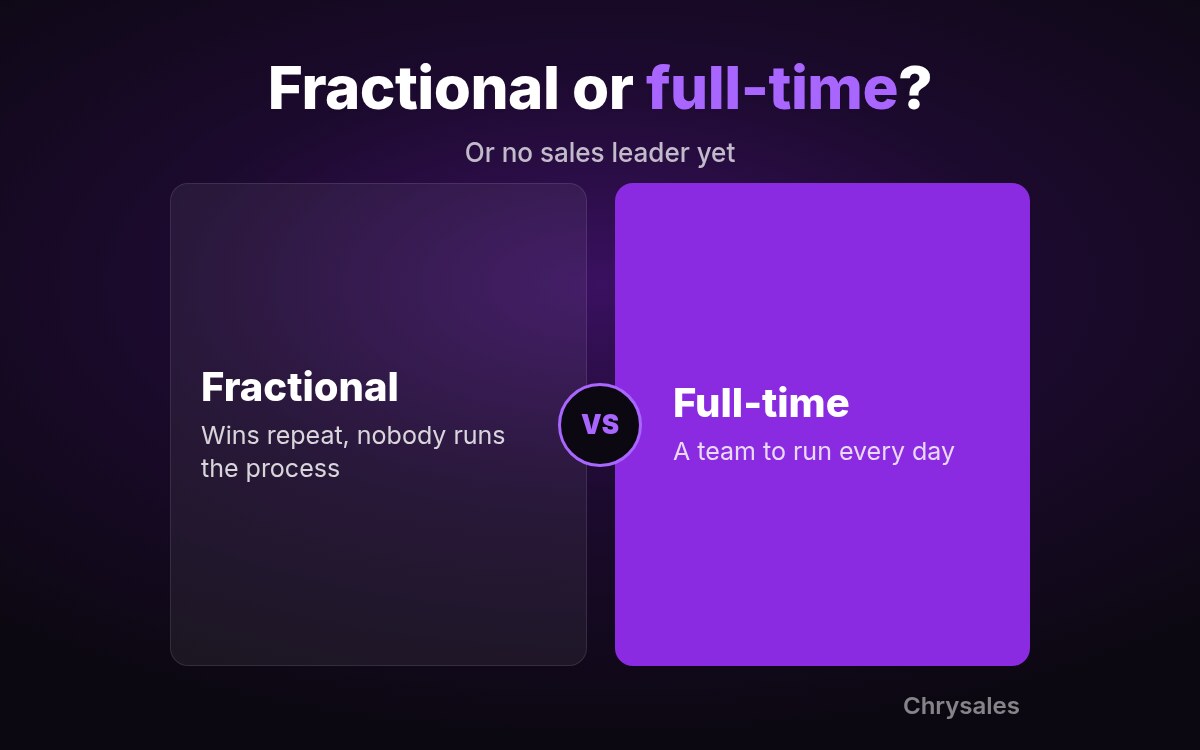
A fractional sales leader fits when your wins repeat but nobody builds the process or manages the sellers, and the work doesn't fill a full-time week. Hire full-time once there is a team to run every day and a proven way of selling to scale. If you have no repeatable wins or no lead flow, do neither yet, because neither hire fixes that.
The fear behind this choice is paying senior money for someone who doesn't move revenue, and no hiring format removes that risk. Most cost figures on this topic also come from companies that sell the service or something close to it. We tag every number below with who published it, and where we estimated, we show the math.
What does a fractional sales leader actually do?
Fractional sales leaders are senior salespeople who work part-time for your company on an ongoing basis, build the sales process and manage the sellers. Apollo, which sells sales software, says "These leaders typically work 10-20 hours per week" (vendor figure, as of November 2026). That is 25-50% of a 40-hour week.
The title changes more than the work does. You'll see fractional head of sales, fractional sales director, fractional VP of Sales and fractional CRO (chief revenue officer). Judge the arrangement by the time and the authority you get, because these three formats often get mixed up:
| Format | Time | What you're buying |
|---|---|---|
| Fractional leader | Part-time, ongoing | Someone who owns sales work and decisions for part of the week |
| Interim leader | "Full time, time boxed", as TrinityHawk, which sells fractional leadership, defines it | A full-time stand-in for a set period |
| Advisor | Occasional | Opinions, while you and your team do the work |
The work itself comes down to these jobs.
- Turning how you sell into a written process, usually starting from a playbook built from your won deals.
- Setting the pipeline stages and running a weekly review.
- Hiring and coaching the first sellers.
- Reporting to you on numbers you both agreed.
Whether the person also sells deals varies from one provider to the next, so write that into the contract.
Which do you need: fractional, full-time or neither yet?
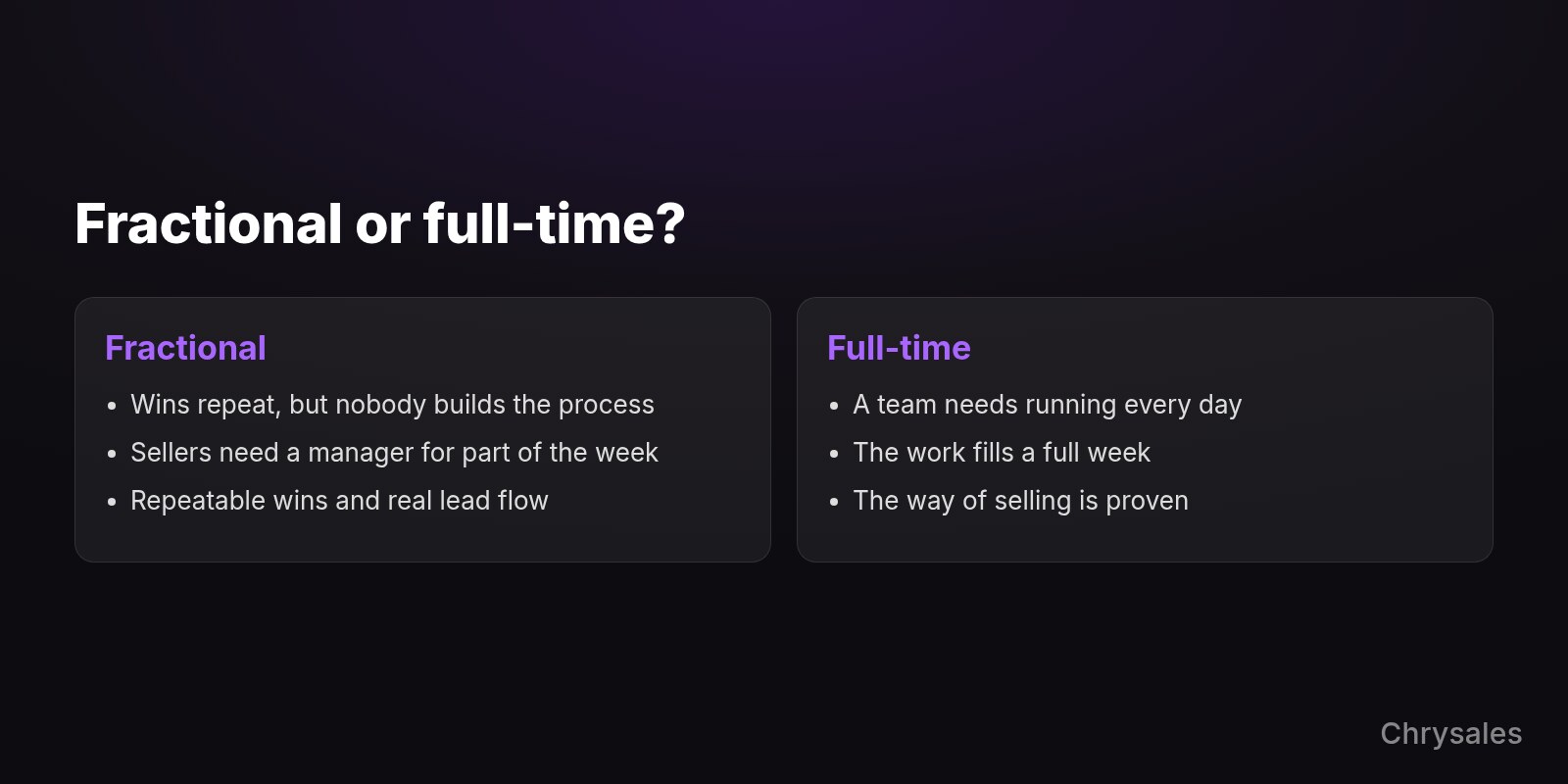
Choose by what is broken, because a job title can't tell you. If wins repeat but nobody builds the process or manages the sellers, and that work fills only part of a week, go fractional. If a team needs running every day, hire full-time. If you have no repeatable wins or no lead flow, do neither yet and fix that first.
Sources disagree on the revenue level that justifies a first sales leader, and many count annual recurring revenue (ARR), which tells you little if you sell projects or one-off deals. They agree more on proof: a repeatable process and sellers who win. So start with the problem you can see this month.
| What's broken | How it shows up | Your path |
|---|---|---|
| No repeatable wins | You can't say why your last deals closed | Neither yet |
| No lead flow | Almost every lead still comes through you | Neither yet |
| You're out of capacity, and nobody else sells | Deals close, but only when you run them | A seller before a leader, once you know why a first sales hire fails without a system |
| Nothing is written down | Sellers ask you how to handle each deal | Fractional |
| Sellers have no manager | Nobody coaches them, and the work would fill part of a week | Fractional |
| A team needs daily management | Decisions pile up between your own calls | Full-time |
Once you know the problem, compare the three paths on the same criteria:
| Criterion | Fractional | Full-time | Neither yet |
|---|---|---|---|
| Fits when | Wins repeat, but nobody builds the process | A team needs running every day | You have no repeatable wins or no lead flow |
| Workload | Sellers need a manager for part of the week | The work fills a full week | Too little to manage |
| Proof | Repeatable wins and real lead flow | The way of selling is proven | Still being built |
| Commitment | A contract with a notice period | An employee, plus a search that takes months | No new contract |
| Main risk | Divided attention, and nothing left behind | A costly hire with nothing to scale yet | You stay the bottleneck for longer |
Take a made-up example. A 30-person B2B company has three sellers who win without the founder, but nobody coaches them, and the forecast lives in the founder's head. Management would take about two days a week, so that is a fractional case. Take away the lead flow, and the same company becomes a neither-yet case.
When is it too early for any sales leader?
It is too early when you can't teach someone else how you win, or when you are still the only source of leads. A sales leader manages and scales a way of selling that already works. Without repeatable wins and lead flow, a fractional or full-time leader has no outreach, pipeline or closing system to scale, so you pay for the title and the problem is still there.
Being tired of selling doesn't count as a signal. Steve Walsh, a Techstars Mentor-in-Residence, draws the line this way: "The right time to hire your first sales leader is not when you are tired of selling. It is when you have enough pattern recognition to teach someone else how to do it." He also writes, "In many cases, founder-led sales should last one to two years." That is one mentor's opinion, with no study behind it.
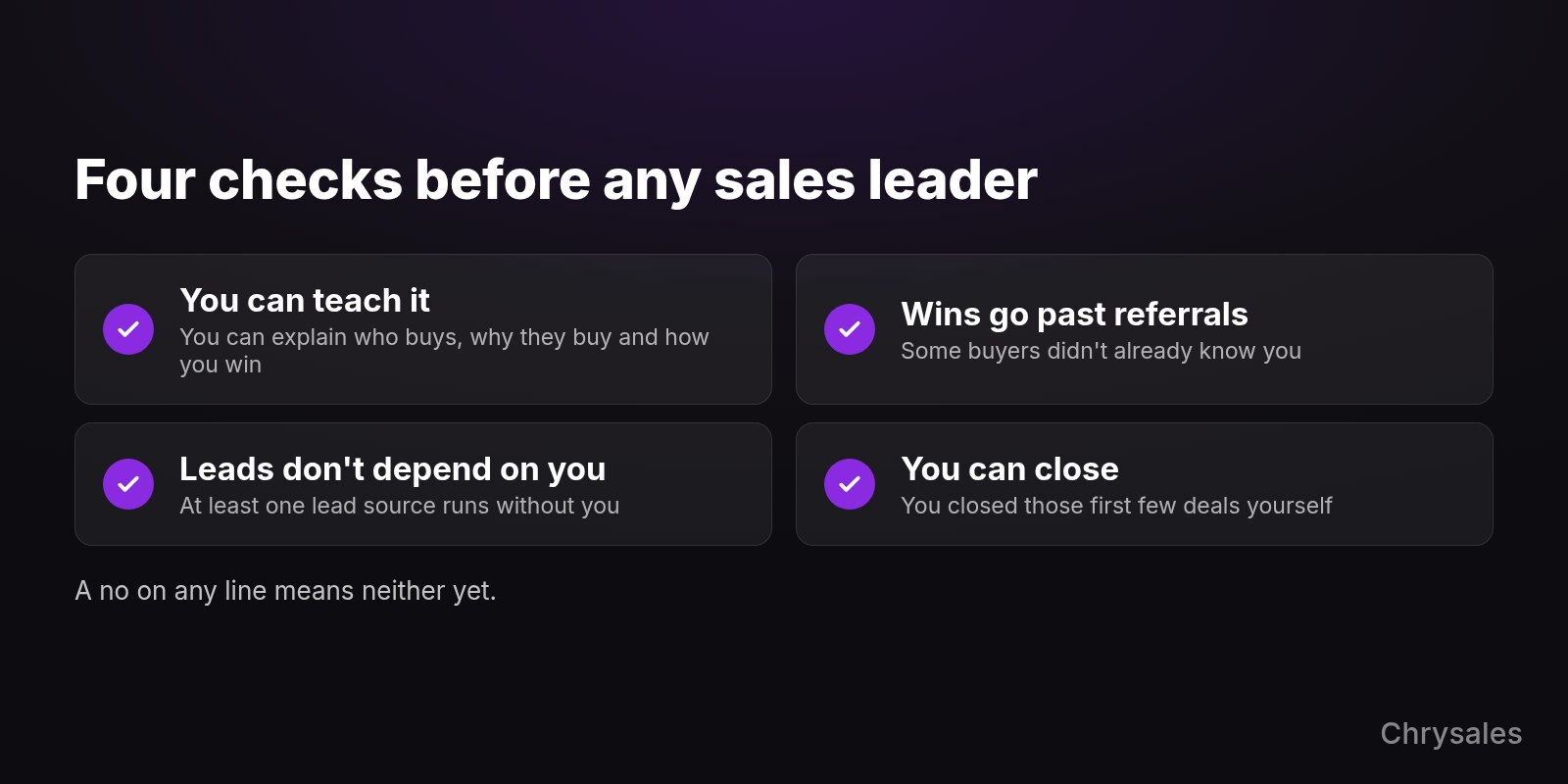
Use four checks before you pay anyone. Several of the sources here write about venture-backed software companies, so treat these as tests for your own company, not as laws.
- You can teach it. You can explain who buys, why they buy and how you win.
- Wins go past referrals. Some buyers didn't already know you.
- Leads don't depend on you. At least one lead source runs without you, and TrinityHawk, a vendor, names the wrong fit as "When you've got no lead source other than the founder."
- You can close. You closed those first few deals yourself. Unusual Ventures, summing up advice from go-to-market leader Hector Hernandez, writes: "If you can't close those first few deals, it will be difficult for a new sales hire to succeed."
A no on any line means neither yet. For a full-time VP of Sales the bar is higher. Jason Lemkin, founder of SaaStr, writes: "If you don't have a repeatable sales process or at least two performing reps, you're not ready for a VP of Sales."
The lead check catches founders treating a demand problem as a selling problem. Eyal Worthalter, writing on Venture in Security, puts it plainly: "In 2025, salespeople do not generate demand for your product. They convert that demand into revenue."
Sabir put the same point about reps this way in a YouTube description: "A sales rep should be closing deals, not searching for them."
If you land on neither yet, you still have work to do, and staying where you are has its own cost: the founder-led sales bottleneck. Chrysales' 4-step method puts the hire last: Learn, Build Systems, Automate, Hire Chief of Staff.
In this session, Sabir works with a founder whose lead flow had dropped and who had no real system. They cover why the outreach stopped working and how to build a flywheel that runs without the founder doing everything.
What does each option really cost?
Fractional can cost less per year, but the price per hour may be higher. Apollo's vendor range of $5K-15K a month comes to $60,000-$180,000 a year as of November 2026, against our rough estimate of about $212,000 for a full-time US sales manager. The UK example below, for one day a week, comes out about the same as a full-time salary, and it uses the highest day rates quoted in this post. Neither side is a quote, so swap in your own numbers.
Fractional leaders usually bill a retainer, which is a fixed monthly fee, or a day rate. Here is who published each figure:
| Figure | Who published it | Source type | Limit |
|---|---|---|---|
| $148,270 median annual wage, May 2025 | US Bureau of Labor Statistics | Independent, official | All sales managers, not VP level |
| Benefits at 30.0% of employer compensation costs, June 2026 | US Bureau of Labor Statistics | Independent, official | All private workers, not role-specific |
| About £96,400 full-time median, 2026 provisional | UK Office for National Statistics | Independent, official | Marketing, sales and advertising directors together |
| $5K-15K a month, as of November 2026 | Apollo | Vendor | Unsourced |
| Retainers of $6,000-$15,000 a month, as of November 2026 | Strategic Pete | Vendor, sells consulting | One seller's range |
| £1,500-£2,000 a day, as of November 2026 | Ahead of Sales | Vendor, sells sales direction | The page calls this typical in its summary, but ties it to specialist or urgent work in its body |
Here is the arithmetic, step by step.
- Full-time in the US: $148,270 / 0.70 = about $212,000 a year in employer cost. This is our rough estimate, and it leaves out search fees and severance.
- Fractional in the US: $5,000 x 12 = $60,000 and $15,000 x 12 = $180,000 a year, for 25-50% of a working week on Apollo's hours.
- Fractional in the UK: £1,500 x 52 = £78,000 and £2,000 x 52 = £104,000 a year, for one day a week.
- Comparison: that UK bill sits around the £96,400 full-time median, for a fifth of the time, before you add employer costs to the salary side. This is illustrative, because the source links these day rates to specialist or urgent work.
Treat the vendor numbers with care. Apollo and Strategic Pete disagree at the bottom of the range, $5K against $6,000, and Apollo gives no source for its range. Apollo sets it against "$200K+ annually plus equity", also without a source, while our $212,000 covers all sales managers, so the two aren't the same comparison.
UK figures vary even more. TrinityHawk, a vendor, says day rates are quoted at £500 to £1,000 in one place and £600 to £1,500 in another, and that "Published figures for this aren't reliable". We found no independent fractional rate data and no independent VP pay study we could open.
To run this for your company, replace step 1 with the on-target earnings (OTE, meaning base plus commission or bonus at full target) you would really offer. Replace steps 2 and 3 with real quotes. Then add search fees and severance risk to the full-time side, and judge both by what each one would have to produce.
Why do fractional sales leaders fail?
Four causes come up repeatedly in the sources on fractional engagements: too little time, too many clients, no authority, and nothing left behind. Jason Lemkin, founder of SaaStr, says of fractional sales leadership at early-stage startups: "It's almost always a waste of time, money and energy." He has experience behind that, not a study, and you can plan around most of these causes.
Too little time comes first. Lemkin's exception is narrow: "If the Fractional CRO/CMO works at least 60% time and owns the function and its core KPI for real." CRO and CMO mean chief revenue and chief marketing officer, and the core KPI is the main number the function answers for. Apollo's 10-20 hours a week is 25-50% of a 40-hour week, so that package sits below his bar.
He writes for venture-backed software companies, so you can disagree with the 60%. You should still decide what the hours can realistically carry.
The counterexample comes from a seller. Fractional Jobs, the marketplace that made the placement, describes Raven Health: "Their sales team was stuck, and leads weren't converting." The leader worked "10 hrs per week". In its case study, the marketplace reports monthly targets hit three months running and an 18-day average sales cycle. Nobody independent has checked those numbers.
Attention is the second cause. Neil Weitzman, a fractional CRO, said on CRO Spotlight that "three-ish clients is like the maximum I should kind of be taking on". Ask how many clients a candidate holds now, and who gets priority in a bad week.
Authority is the third. TrinityHawk warns that without decision rights "you're paying senior rates for suggestions".
The fourth cause is what stays behind. Strategic Pete, a vendor, lists this downside itself: "The capability leaves with them if nothing is documented and handed over". If only this person understands the pipeline, you have swapped one bottleneck for another.
Lauren McCullough is the other side of the story. Closing Time reports that founders brought her in after "the first sales leader they hired just didn't work out well". She "helped get growth going, wrote the sales playbook, hired the first Account Executive". An account executive, or AE, is a seller who closes deals.
No numbers were published, but the playbook and the AE are the kind of output that stays after the leader goes.
Vague success criteria hurt both sides. Lemkin recounts a conversation with a fractional CRO: "I asked him why his 3-month contract wasn't renewed. He said he didn't know, but just knew he did a great job."
If the engagement isn't working, act in this order:
- Name the gap against the test you agreed, using your own numbers.
- Agree one fix with a date.
- If the date passes without change, give notice under the contract.
- Collect every document, recording and login before the last day.
- Run the diagnosis again before you hire a replacement, because the real problem may be lead flow.
How do you scope a fractional engagement?
Scope a fractional engagement in writing before the first day: hours, deliverables, decision rights, reporting, notice period, documentation and a 90-day pass or fail test. Dale Shephard of the vendor TrinityHawk puts the minimum this way: "Ignore the label. Contract on three things: days per month, decision rights, and exit criteria."
Copy this template and fill in the brackets. Everything in brackets is yours to set.
FRACTIONAL SALES LEADER SCOPE

Period: 90 days, then review
Hours: [X] hours a week, on [fixed days]
Other clients: [number], and who gets priority when they clash
Reports to: [founder]

Deliverables
1. Written sales process and playbook, stored in our systems
2. Pipeline stages and a weekly review the team runs
3. [Hiring plan or coaching plan for named sellers]

Decision rights
Decides alone: [for example pipeline stages, call structure]
Needs my sign-off: [for example pricing, hiring, firing]
Sells deals personally: [yes / no / only these deals]

Reporting
Weekly: pipeline review with [founder]
Monthly: written numbers against the baseline below

Baseline today (from our own pipeline)
Qualified meetings a month: [ ]
Deals won a month: [ ]
Deals that need the founder to close: [ ]

90-day test
Pass: [agreed change against the baseline] AND
a seller runs a deal from the playbook without the founder
Fail: anything less, unless we both agree otherwise in writing

Notice
Either side: [X] days in writing

On exit
All documents, recordings and logins stay with us
Named owner for each weekly routine: [name]
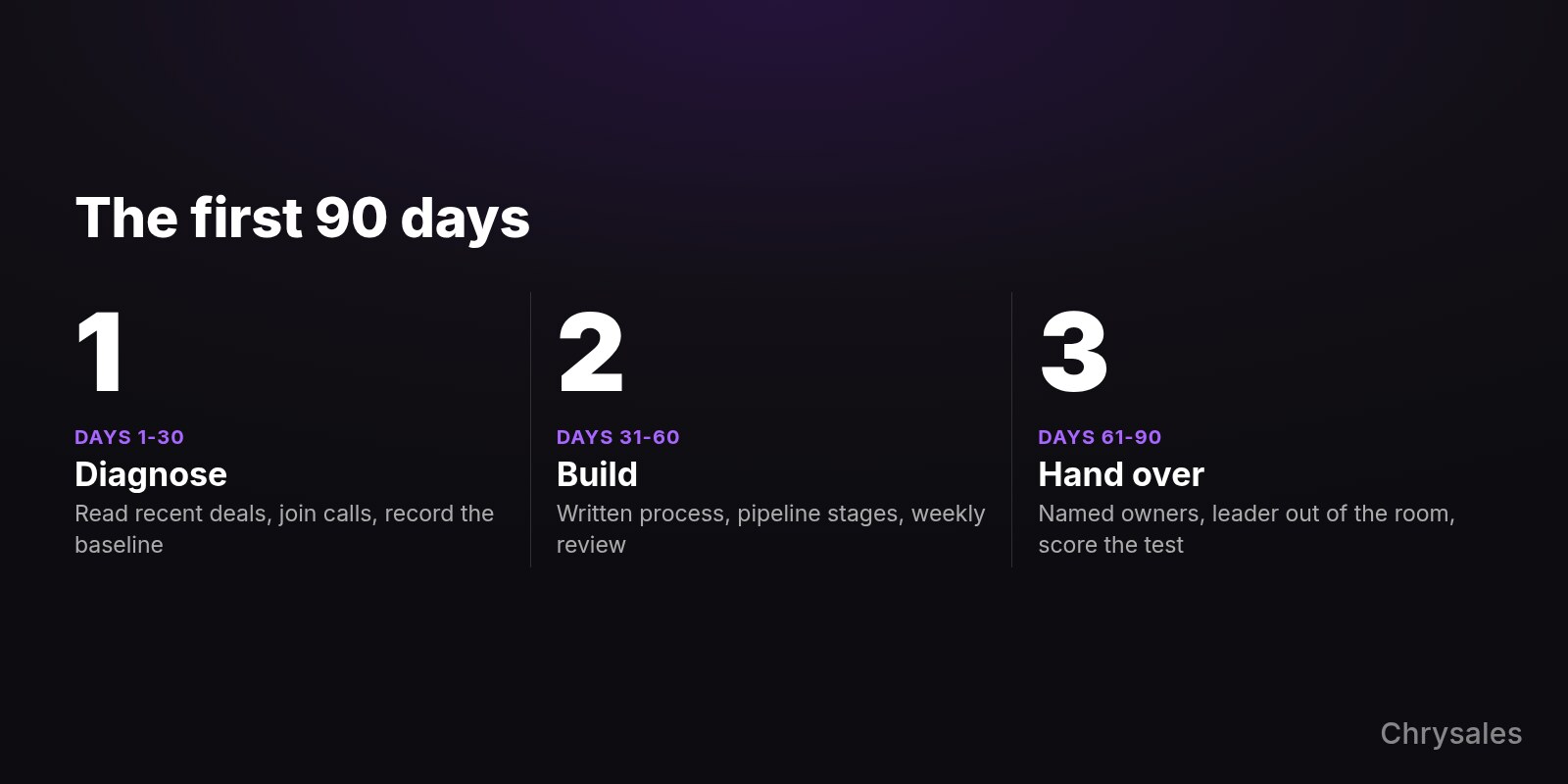
Then run the first 90 days in three blocks. Treat the split as a starting point and adjust it to your deal length.
- Days 1-30, diagnose. The leader reads recent deals, joins calls and records the baseline. You should get a written list of what is broken.
- Days 31-60, build. The written process and pipeline stages go into use, and the weekly review starts. You should see sellers working from the document.
- Days 61-90, hand over. Sellers run the routine with the leader out of the room, and each routine gets a named owner. Then you score the test.
Set the pass mark from your own pipeline data, since a benchmark from another company won't match your deals. If your deals take longer than 90 days to close, judge leading numbers such as qualified meetings.
Check contractor status before you sign, because a part-time outside leader is often engaged as a contractor. For contractors working through an intermediary such as their own limited company in the UK, GOV.UK's off-payroll guidance says "In most cases, the client will be responsible for determining the employment status of the worker." GOV.UK adds that for small clients outside the public sector, the worker's intermediary is responsible.
In Germany, the pension insurer's clearing office, the Clearingstelle of the Deutsche Rentenversicherung, decides on application whether someone is employed or self-employed: "Die Entscheidung ist rechtsverbindlich." (our translation: "The decision is legally binding."). This isn't legal advice, and rules differ by country, so ask a lawyer or tax advisor in yours.
When should you move to a full-time sales leader?
Move to a full-time sales leader when the work no longer fits inside part of a week: sellers need daily management, decisions wait for the leader's next visit, and other people win with the written process.
Jason Lemkin's test, a repeatable process or at least two performing reps, comes from venture-backed software, so treat it as a useful minimum. Add these triggers from your own company:
- The agreed hours run out before the week's management work does.
- Sellers wait days for a decision the leader could make in a meeting.
- You're ready to build a bigger team, and to scale it with a repeatable system.
- The playbook has survived someone other than you and the leader using it.
Start the search early. Talentfoot, a search firm, says of VP searches that "Eight to fourteen weeks is realistic when stakeholders stay aligned", but that is the active search only, and its internal data says to budget 3.5 to 4 months. Keep the fractional leader in place until the new hire has started.
A good fractional leader plans for this exit. Jason Lemkin of SaaStr accepts this second exception: "They come in for 3-4 months and help, yes, but they also make sure they put a full-time team in place that can scale." Neil Weitzman, a fractional CRO, tells CEOs, "But if I'm still here in six months, it means we both failed."
For the handover, write the role from what the fractional leader learned about your deals, and start the search while the fractional contract still runs. Give the new hire the playbook, the baseline numbers and the weekly review. Then pull yourself out of the routine, using a plan for stepping out of sales without losing revenue.
Your next step fits in one sitting. List your last few won and lost deals, run the four checks, find your line in the diagnosis table, and write down the one problem you would pay someone to solve.
FAQ
How much does a fractional sales leader cost?
Published figures come from sellers. As of November 2026, Apollo says $5K-15K a month, Strategic Pete says retainers of $6,000-$15,000 a month, and Ahead of Sales says £1,500-£2,000 a day in the UK, though its article also ties that range to specialist or urgent work. We found no independent rate data, so get several quotes and compare them for the same hours and decision rights.
Is a fractional sales director the same as a fractional head of sales?
Mostly, yes. Titles vary by country and by provider, and the contract matters more than the label. Compare hours, decision rights and exit terms.
Should a fractional sales leader sell deals personally?
That depends on what is broken. If you need someone to cover deals, a seller may fit better. If the leader will sell, write down which deals, because those hours come out of the process and coaching work.
How long should a fractional engagement last?
There is no standard length. Start with a 90-day term and a pass or fail test, then decide. Jason Lemkin's working example ran 3-4 months with a full-time team put in place, and Neil Weitzman, a fractional CRO, tells CEOs that six months is too long for him to still be there.
Sources
- BLS - Sales Managers, Occupational Outlook Handbook
- BLS - Compensation costs for private industry workers, June 2026
- ONS - ASHE Table 14.7a, 2026 provisional
- GOV.UK - Understanding off-payroll working (IR35)
- Deutsche Rentenversicherung - Clearingstelle
- Techstars - Founders: Your First Sales Hire Is Probably a Mistake
- SaaStr - Dear SaaStr: How Do I Hire a Great VP of Sales?
- SaaStr - A "Fractional" VP of Sales Almost Never Works
- SaaStr - Fractional CROs and CMOs: The Only Times I've Ever Seen Them Work
- Unusual Ventures - Advice from Hector Hernandez on hiring a sales leader
- Venture in Security - Why your first VP of Sales hire will fail, and what you can do instead
- Closing Time - Jonny Price on Lauren McCullough
- Fractional Jobs - Guide to hiring a fractional sales leader (marketplace)
- CRO Spotlight - Transcript with Neil Weitzman
- Fractional Jobs - Raven Health case study (marketplace)
- TrinityHawk - Guide to moving on from founder-led sales (vendor)
- Apollo - Fractional sales leadership guide (vendor)
- Strategic Pete - Article on fractional sales leadership (vendor)
- Ahead of Sales - Article on fractional sales directors (vendor)
- Talentfoot - Executive time-to-fill data (search firm)
Still unsure whether your next step is a leader or the system a leader would need? Chrysales helps you and your team build the outreach, pipeline and closing system around your sellers. Talk through your setup on a free call
A fractional sales leader fits when your wins repeat but nobody builds the process or manages the sellers, and the work doesn't fill a full-time week. Hire full-time once there is a team to run every day and a proven way of selling to scale. If you have no repeatable wins or no lead flow, do neither yet, because neither hire fixes that.
The fear behind this choice is paying senior money for someone who doesn't move revenue, and no hiring format removes that risk. Most cost figures on this topic also come from companies that sell the service or something close to it. We tag every number below with who published it, and where we estimated, we show the math.
What does a fractional sales leader actually do?
Fractional sales leaders are senior salespeople who work part-time for your company on an ongoing basis, build the sales process and manage the sellers. Apollo, which sells sales software, says "These leaders typically work 10-20 hours per week" (vendor figure, as of November 2026). That is 25-50% of a 40-hour week.
The title changes more than the work does. You'll see fractional head of sales, fractional sales director, fractional VP of Sales and fractional CRO (chief revenue officer). Judge the arrangement by the time and the authority you get, because these three formats often get mixed up:
| Format | Time | What you're buying |
|---|---|---|
| Fractional leader | Part-time, ongoing | Someone who owns sales work and decisions for part of the week |
| Interim leader | "Full time, time boxed", as TrinityHawk, which sells fractional leadership, defines it | A full-time stand-in for a set period |
| Advisor | Occasional | Opinions, while you and your team do the work |
The work itself comes down to these jobs.
- Turning how you sell into a written process, usually starting from a playbook built from your won deals.
- Setting the pipeline stages and running a weekly review.
- Hiring and coaching the first sellers.
- Reporting to you on numbers you both agreed.
Whether the person also sells deals varies from one provider to the next, so write that into the contract.
Which do you need: fractional, full-time or neither yet?
Choose by what is broken, because a job title can't tell you. If wins repeat but nobody builds the process or manages the sellers, and that work fills only part of a week, go fractional. If a team needs running every day, hire full-time. If you have no repeatable wins or no lead flow, do neither yet and fix that first.
Sources disagree on the revenue level that justifies a first sales leader, and many count annual recurring revenue (ARR), which tells you little if you sell projects or one-off deals. They agree more on proof: a repeatable process and sellers who win. So start with the problem you can see this month.
| What's broken | How it shows up | Your path |
|---|---|---|
| No repeatable wins | You can't say why your last deals closed | Neither yet |
| No lead flow | Almost every lead still comes through you | Neither yet |
| You're out of capacity, and nobody else sells | Deals close, but only when you run them | A seller before a leader, once you know why a first sales hire fails without a system |
| Nothing is written down | Sellers ask you how to handle each deal | Fractional |
| Sellers have no manager | Nobody coaches them, and the work would fill part of a week | Fractional |
| A team needs daily management | Decisions pile up between your own calls | Full-time |
Once you know the problem, compare the three paths on the same criteria:
| Criterion | Fractional | Full-time | Neither yet |
|---|---|---|---|
| Fits when | Wins repeat, but nobody builds the process | A team needs running every day | You have no repeatable wins or no lead flow |
| Workload | Sellers need a manager for part of the week | The work fills a full week | Too little to manage |
| Proof | Repeatable wins and real lead flow | The way of selling is proven | Still being built |
| Commitment | A contract with a notice period | An employee, plus a search that takes months | No new contract |
| Main risk | Divided attention, and nothing left behind | A costly hire with nothing to scale yet | You stay the bottleneck for longer |
Take a made-up example. A 30-person B2B company has three sellers who win without the founder, but nobody coaches them, and the forecast lives in the founder's head. Management would take about two days a week, so that is a fractional case. Take away the lead flow, and the same company becomes a neither-yet case.
When is it too early for any sales leader?
It is too early when you can't teach someone else how you win, or when you are still the only source of leads. A sales leader manages and scales a way of selling that already works. Without repeatable wins and lead flow, a fractional or full-time leader has no outreach, pipeline or closing system to scale, so you pay for the title and the problem is still there.
Being tired of selling doesn't count as a signal. Steve Walsh, a Techstars Mentor-in-Residence, draws the line this way: "The right time to hire your first sales leader is not when you are tired of selling. It is when you have enough pattern recognition to teach someone else how to do it." He also writes, "In many cases, founder-led sales should last one to two years." That is one mentor's opinion, with no study behind it.
Use four checks before you pay anyone. Several of the sources here write about venture-backed software companies, so treat these as tests for your own company, not as laws.
- You can teach it. You can explain who buys, why they buy and how you win.
- Wins go past referrals. Some buyers didn't already know you.
- Leads don't depend on you. At least one lead source runs without you, and TrinityHawk, a vendor, names the wrong fit as "When you've got no lead source other than the founder."
- You can close. You closed those first few deals yourself. Unusual Ventures, summing up advice from go-to-market leader Hector Hernandez, writes: "If you can't close those first few deals, it will be difficult for a new sales hire to succeed."
A no on any line means neither yet. For a full-time VP of Sales the bar is higher. Jason Lemkin, founder of SaaStr, writes: "If you don't have a repeatable sales process or at least two performing reps, you're not ready for a VP of Sales."
The lead check catches founders treating a demand problem as a selling problem. Eyal Worthalter, writing on Venture in Security, puts it plainly: "In 2025, salespeople do not generate demand for your product. They convert that demand into revenue."
Sabir put the same point about reps this way in a YouTube description: "A sales rep should be closing deals, not searching for them."
If you land on neither yet, you still have work to do, and staying where you are has its own cost: the founder-led sales bottleneck. Chrysales' 4-step method puts the hire last: Learn, Build Systems, Automate, Hire Chief of Staff.
In this session, Sabir works with a founder whose lead flow had dropped and who had no real system. They cover why the outreach stopped working and how to build a flywheel that runs without the founder doing everything.
What does each option really cost?
Fractional can cost less per year, but the price per hour may be higher. Apollo's vendor range of $5K-15K a month comes to $60,000-$180,000 a year as of November 2026, against our rough estimate of about $212,000 for a full-time US sales manager. The UK example below, for one day a week, comes out about the same as a full-time salary, and it uses the highest day rates quoted in this post. Neither side is a quote, so swap in your own numbers.
Fractional leaders usually bill a retainer, which is a fixed monthly fee, or a day rate. Here is who published each figure:
| Figure | Who published it | Source type | Limit |
|---|---|---|---|
| $148,270 median annual wage, May 2025 | US Bureau of Labor Statistics | Independent, official | All sales managers, not VP level |
| Benefits at 30.0% of employer compensation costs, June 2026 | US Bureau of Labor Statistics | Independent, official | All private workers, not role-specific |
| About £96,400 full-time median, 2026 provisional | UK Office for National Statistics | Independent, official | Marketing, sales and advertising directors together |
| $5K-15K a month, as of November 2026 | Apollo | Vendor | Unsourced |
| Retainers of $6,000-$15,000 a month, as of November 2026 | Strategic Pete | Vendor, sells consulting | One seller's range |
| £1,500-£2,000 a day, as of November 2026 | Ahead of Sales | Vendor, sells sales direction | The page calls this typical in its summary, but ties it to specialist or urgent work in its body |
Here is the arithmetic, step by step.
- Full-time in the US: $148,270 / 0.70 = about $212,000 a year in employer cost. This is our rough estimate, and it leaves out search fees and severance.
- Fractional in the US: $5,000 x 12 = $60,000 and $15,000 x 12 = $180,000 a year, for 25-50% of a working week on Apollo's hours.
- Fractional in the UK: £1,500 x 52 = £78,000 and £2,000 x 52 = £104,000 a year, for one day a week.
- Comparison: that UK bill sits around the £96,400 full-time median, for a fifth of the time, before you add employer costs to the salary side. This is illustrative, because the source links these day rates to specialist or urgent work.
Treat the vendor numbers with care. Apollo and Strategic Pete disagree at the bottom of the range, $5K against $6,000, and Apollo gives no source for its range. Apollo sets it against "$200K+ annually plus equity", also without a source, while our $212,000 covers all sales managers, so the two aren't the same comparison.
UK figures vary even more. TrinityHawk, a vendor, says day rates are quoted at £500 to £1,000 in one place and £600 to £1,500 in another, and that "Published figures for this aren't reliable". We found no independent fractional rate data and no independent VP pay study we could open.
To run this for your company, replace step 1 with the on-target earnings (OTE, meaning base plus commission or bonus at full target) you would really offer. Replace steps 2 and 3 with real quotes. Then add search fees and severance risk to the full-time side, and judge both by what each one would have to produce.
Why do fractional sales leaders fail?
Four causes come up repeatedly in the sources on fractional engagements: too little time, too many clients, no authority, and nothing left behind. Jason Lemkin, founder of SaaStr, says of fractional sales leadership at early-stage startups: "It's almost always a waste of time, money and energy." He has experience behind that, not a study, and you can plan around most of these causes.
Too little time comes first. Lemkin's exception is narrow: "If the Fractional CRO/CMO works at least 60% time and owns the function and its core KPI for real." CRO and CMO mean chief revenue and chief marketing officer, and the core KPI is the main number the function answers for. Apollo's 10-20 hours a week is 25-50% of a 40-hour week, so that package sits below his bar.
He writes for venture-backed software companies, so you can disagree with the 60%. You should still decide what the hours can realistically carry.
The counterexample comes from a seller. Fractional Jobs, the marketplace that made the placement, describes Raven Health: "Their sales team was stuck, and leads weren't converting." The leader worked "10 hrs per week". In its case study, the marketplace reports monthly targets hit three months running and an 18-day average sales cycle. Nobody independent has checked those numbers.
Attention is the second cause. Neil Weitzman, a fractional CRO, said on CRO Spotlight that "three-ish clients is like the maximum I should kind of be taking on". Ask how many clients a candidate holds now, and who gets priority in a bad week.
Authority is the third. TrinityHawk warns that without decision rights "you're paying senior rates for suggestions".
The fourth cause is what stays behind. Strategic Pete, a vendor, lists this downside itself: "The capability leaves with them if nothing is documented and handed over". If only this person understands the pipeline, you have swapped one bottleneck for another.
Lauren McCullough is the other side of the story. Closing Time reports that founders brought her in after "the first sales leader they hired just didn't work out well". She "helped get growth going, wrote the sales playbook, hired the first Account Executive". An account executive, or AE, is a seller who closes deals.
No numbers were published, but the playbook and the AE are the kind of output that stays after the leader goes.
Vague success criteria hurt both sides. Lemkin recounts a conversation with a fractional CRO: "I asked him why his 3-month contract wasn't renewed. He said he didn't know, but just knew he did a great job."
If the engagement isn't working, act in this order:
- Name the gap against the test you agreed, using your own numbers.
- Agree one fix with a date.
- If the date passes without change, give notice under the contract.
- Collect every document, recording and login before the last day.
- Run the diagnosis again before you hire a replacement, because the real problem may be lead flow.
How do you scope a fractional engagement?
Scope a fractional engagement in writing before the first day: hours, deliverables, decision rights, reporting, notice period, documentation and a 90-day pass or fail test. Dale Shephard of the vendor TrinityHawk puts the minimum this way: "Ignore the label. Contract on three things: days per month, decision rights, and exit criteria."
Copy this template and fill in the brackets. Everything in brackets is yours to set.
FRACTIONAL SALES LEADER SCOPE

Period: 90 days, then review
Hours: [X] hours a week, on [fixed days]
Other clients: [number], and who gets priority when they clash
Reports to: [founder]

Deliverables
1. Written sales process and playbook, stored in our systems
2. Pipeline stages and a weekly review the team runs
3. [Hiring plan or coaching plan for named sellers]

Decision rights
Decides alone: [for example pipeline stages, call structure]
Needs my sign-off: [for example pricing, hiring, firing]
Sells deals personally: [yes / no / only these deals]

Reporting
Weekly: pipeline review with [founder]
Monthly: written numbers against the baseline below

Baseline today (from our own pipeline)
Qualified meetings a month: [ ]
Deals won a month: [ ]
Deals that need the founder to close: [ ]

90-day test
Pass: [agreed change against the baseline] AND
a seller runs a deal from the playbook without the founder
Fail: anything less, unless we both agree otherwise in writing

Notice
Either side: [X] days in writing

On exit
All documents, recordings and logins stay with us
Named owner for each weekly routine: [name]
Then run the first 90 days in three blocks. Treat the split as a starting point and adjust it to your deal length.
- Days 1-30, diagnose. The leader reads recent deals, joins calls and records the baseline. You should get a written list of what is broken.
- Days 31-60, build. The written process and pipeline stages go into use, and the weekly review starts. You should see sellers working from the document.
- Days 61-90, hand over. Sellers run the routine with the leader out of the room, and each routine gets a named owner. Then you score the test.
Set the pass mark from your own pipeline data, since a benchmark from another company won't match your deals. If your deals take longer than 90 days to close, judge leading numbers such as qualified meetings.
Check contractor status before you sign, because a part-time outside leader is often engaged as a contractor. For contractors working through an intermediary such as their own limited company in the UK, GOV.UK's off-payroll guidance says "In most cases, the client will be responsible for determining the employment status of the worker." GOV.UK adds that for small clients outside the public sector, the worker's intermediary is responsible.
In Germany, the pension insurer's clearing office, the Clearingstelle of the Deutsche Rentenversicherung, decides on application whether someone is employed or self-employed: "Die Entscheidung ist rechtsverbindlich." (our translation: "The decision is legally binding."). This isn't legal advice, and rules differ by country, so ask a lawyer or tax advisor in yours.
When should you move to a full-time sales leader?
Move to a full-time sales leader when the work no longer fits inside part of a week: sellers need daily management, decisions wait for the leader's next visit, and other people win with the written process.
Jason Lemkin's test, a repeatable process or at least two performing reps, comes from venture-backed software, so treat it as a useful minimum. Add these triggers from your own company:
- The agreed hours run out before the week's management work does.
- Sellers wait days for a decision the leader could make in a meeting.
- You're ready to build a bigger team, and to scale it with a repeatable system.
- The playbook has survived someone other than you and the leader using it.
Start the search early. Talentfoot, a search firm, says of VP searches that "Eight to fourteen weeks is realistic when stakeholders stay aligned", but that is the active search only, and its internal data says to budget 3.5 to 4 months. Keep the fractional leader in place until the new hire has started.
A good fractional leader plans for this exit. Jason Lemkin of SaaStr accepts this second exception: "They come in for 3-4 months and help, yes, but they also make sure they put a full-time team in place that can scale." Neil Weitzman, a fractional CRO, tells CEOs, "But if I'm still here in six months, it means we both failed."
For the handover, write the role from what the fractional leader learned about your deals, and start the search while the fractional contract still runs. Give the new hire the playbook, the baseline numbers and the weekly review. Then pull yourself out of the routine, using a plan for stepping out of sales without losing revenue.
Your next step fits in one sitting. List your last few won and lost deals, run the four checks, find your line in the diagnosis table, and write down the one problem you would pay someone to solve.
FAQ
How much does a fractional sales leader cost?
Published figures come from sellers. As of November 2026, Apollo says $5K-15K a month, Strategic Pete says retainers of $6,000-$15,000 a month, and Ahead of Sales says £1,500-£2,000 a day in the UK, though its article also ties that range to specialist or urgent work. We found no independent rate data, so get several quotes and compare them for the same hours and decision rights.
Is a fractional sales director the same as a fractional head of sales?
Mostly, yes. Titles vary by country and by provider, and the contract matters more than the label. Compare hours, decision rights and exit terms.
Should a fractional sales leader sell deals personally?
That depends on what is broken. If you need someone to cover deals, a seller may fit better. If the leader will sell, write down which deals, because those hours come out of the process and coaching work.
How long should a fractional engagement last?
There is no standard length. Start with a 90-day term and a pass or fail test, then decide. Jason Lemkin's working example ran 3-4 months with a full-time team put in place, and Neil Weitzman, a fractional CRO, tells CEOs that six months is too long for him to still be there.
Sources
- BLS - Sales Managers, Occupational Outlook Handbook
- BLS - Compensation costs for private industry workers, June 2026
- ONS - ASHE Table 14.7a, 2026 provisional
- GOV.UK - Understanding off-payroll working (IR35)
- Deutsche Rentenversicherung - Clearingstelle
- Techstars - Founders: Your First Sales Hire Is Probably a Mistake
- SaaStr - Dear SaaStr: How Do I Hire a Great VP of Sales?
- SaaStr - A "Fractional" VP of Sales Almost Never Works
- SaaStr - Fractional CROs and CMOs: The Only Times I've Ever Seen Them Work
- Unusual Ventures - Advice from Hector Hernandez on hiring a sales leader
- Venture in Security - Why your first VP of Sales hire will fail, and what you can do instead
- Closing Time - Jonny Price on Lauren McCullough
- Fractional Jobs - Guide to hiring a fractional sales leader (marketplace)
- CRO Spotlight - Transcript with Neil Weitzman
- Fractional Jobs - Raven Health case study (marketplace)
- TrinityHawk - Guide to moving on from founder-led sales (vendor)
- Apollo - Fractional sales leadership guide (vendor)
- Strategic Pete - Article on fractional sales leadership (vendor)
- Ahead of Sales - Article on fractional sales directors (vendor)
- Talentfoot - Executive time-to-fill data (search firm)
Still unsure whether your next step is a leader or the system a leader would need? Chrysales helps you and your team build the outreach, pipeline and closing system around your sellers. Talk through your setup on a free call
Scaling Is Not Hard If You Have The Right Systems
If you’re serious about leveling up your scaling game, you need the right system, the right training, and the right team behind you. We're here to give you the exact tools and strategies top entrepreneurs use to dominate.

Discover the latest tips
View All
Chrysales was formed from the words "chrysalis" the stage where a caterpillar transforms into a butterfly and "sales".
It stands for one thing: sales transformation.Because scaling doesn’t happen by doing more of the same. Scaling only happens when you go through real transformation in your systems, your offer, team and the way you sell.


