
First sales hire: junior or experienced salesperson?
Should your first sales hire be junior or experienced? It depends on how much of your selling is already written down.
If you can hand over a clear process, steady leads and weekly coaching, a less experienced seller can work and costs less. If your deals are large and slow and you still work them out call by call, hire someone who has sold to buyers like yours.
Either way, you stay closely involved for months. A new seller can't follow a process that isn't there yet.
What "experienced" should really mean
For your first seller, the experience that counts is having sold something close to what you sell. Years alone tell you little.

Researchers Verbeke, Dietz and Verwaal combined 268 studies of 79,747 salespeople. Knowing the product and the customer mattered most, and their paper says that knowledge can be trained. Age and years of experience mattered much less.
Companies still ask for years. The Bridge Group's 2026 survey covered 158 B2B companies. The experience they want in new closers, the sellers who sign the deals, rose to 3.7 years from 2.7 in 2022.
Yet ramp time, the months until a new seller sells at full speed, reached 6.2 months. That is the highest in the study's history.
Deal size, meaning what one client pays you, tells you more. Fred Stevens-Smith of Rainforest QA makes this point in a 2019 Heavybit guide. A seller who did well with a $12,000-a-year product is not automatically right for $120,000 deals.
Four checks that decide it
Run these four checks and count which column wins. The sales cycle in the third row is how long it takes from first contact to a signed deal.
| Check | Points to junior | Points to experienced |
|---|---|---|
| How you sell is written down | Yes, step by step | No, still in your head |
| Deal size | Small, many clients | Large, few clients |
| Sales cycle | A few weeks | Many months |
| Your coaching time | A few hours each week | Almost none |
This is a simple rule we suggest, built on the points above. We found no study that tests it.
A long cycle means fewer wins to learn from, so a beginner gets less practice. If most answers point one way, you have your profile.
If they are mixed, look at the middle option further down. For pay and ramp costs, see what a first rep really costs.
Experts disagree on the default. Jason Lemkin of SaaStr advises: "Don't go too green or inexperienced, at least, not at first."
Nick Persico on the Close blog argues the opposite while you still lead the selling: "you want them young and hungry in this phase."
Both can be right, because each assumes a different amount of help from you.
What you still do as the founder
Neither profile frees you right away. What changes is the kind of help you give.
With a junior, you bring the leads, join or lead the closing calls, and coach every week. Let them listen in on your calls before they run their own. A 90-day onboarding plan helps you plan that start.
With an experienced seller, you share what you know about your buyers and join the big calls. You also agree on what a good month looks like before it starts.
Pete Warden, co-founder of Moonshine, writes that experienced salespeople are used to being given qualified leads and clear materials to sell with. Qualified leads are people who already fit what you sell. A small company often has neither yet.
In both cases, your seller should spend the day selling, not hunting for names. Sabir put it plainly in a short video: "A sales rep should be closing deals, not searching for them."
In the session below, Sabir works with someone who had a solid offer, but whose outreach (messages to new prospects) had stopped working. They also cover his team situation and how to build a sales system that keeps running without him doing everything himself.
The middle option between junior and senior
You don't have to choose between a beginner and a big-company senior. A third profile often fits a small B2B company better.
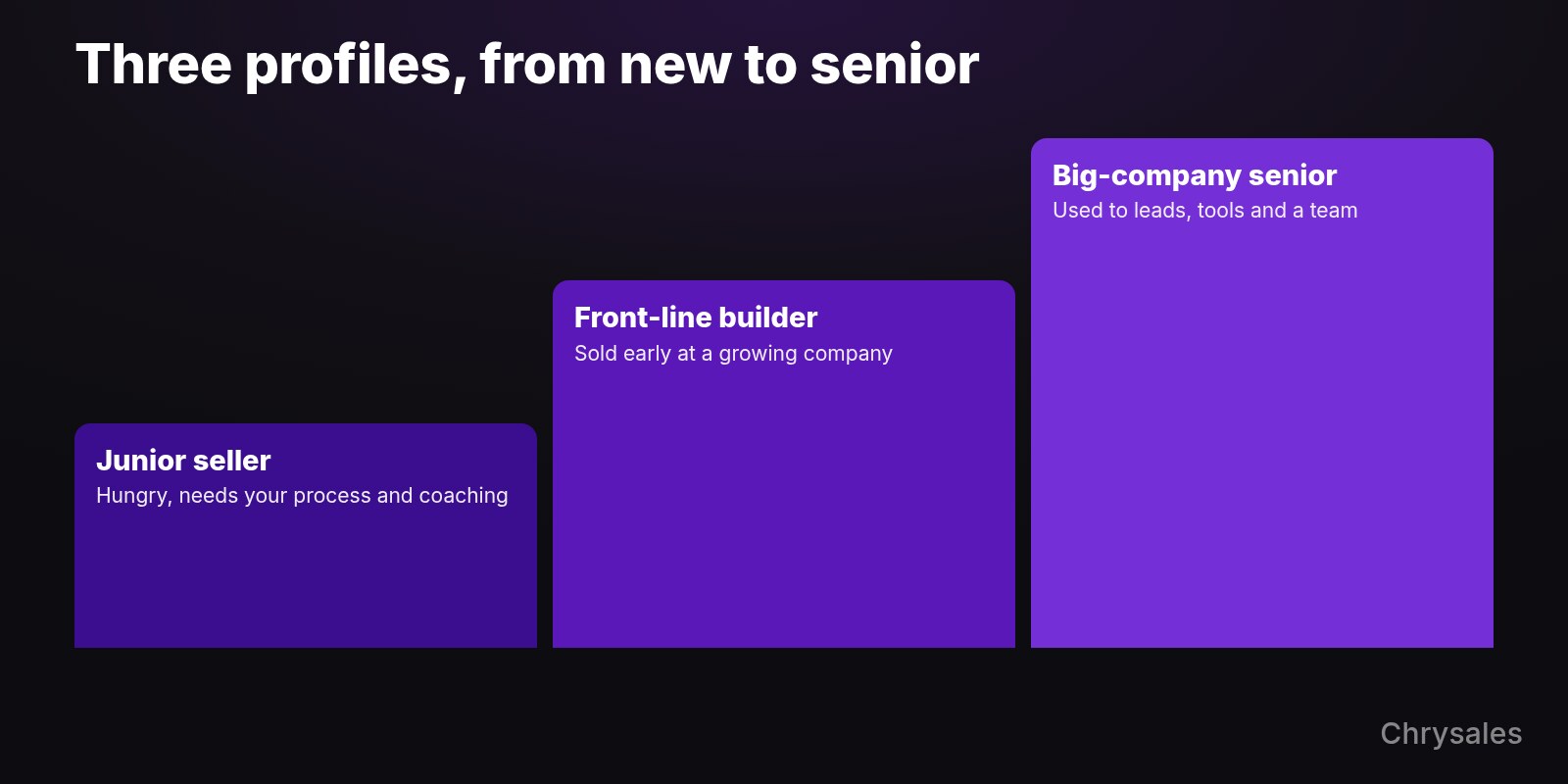
Mark Roberge, former head of sales at HubSpot, describes it in an OnStartups guest post. You need "someone who is closer to the front line and is willing to roll up their sleeves and get their hands dirty."
Roberge lists a few kinds of people who fit. One is a recently promoted sales manager at a reasonably sized business. Another is a top seller who was there in the early days of their last company's growth.
These people have sold for real and are still close to the daily work of selling.
Three hiring mistakes to avoid
A first hire can go wrong when the person doesn't fit what is in place around them. Here are three ways it happens.
- Hiring a big-company senior and expecting them to build everything alone. Warden writes: "The biggest mistake I kept making was hiring people with ten or twenty years of enterprise sales experience." Warden blames the setup he gave them, and says building a working team took three years.
- Hiring a junior with no written process and no time to coach. When results don't come, you can't tell if the person or the process failed.
- Hoping one hire will invent the system and hit targets at once. That is two jobs, and the second suffers.
Say your 30-person B2B company has six-month deals. You hire a junior, then get busy. Six months later there is no signed deal and no way to tell why.
This example is made up, but the pattern is the second mistake above.
If you see your situation here, read what to build before you hire anyone.
Conclusion: write your process down first
Start with what you can hand over. Then pick the profile.
- Write down how you won your last three deals: who you talked to, what you said, and where they nearly stalled.
- Run the four checks and see which column wins.
- Block a few hours each week in your calendar for the new seller, before you post the job.
Not sure which profile fits your deal size and the length of your deals? On a free strategy call, Chrysales can look at how you sell today and what has to be in place before your first seller starts. Check your hiring plan on a free call
Should your first sales hire be junior or experienced? It depends on how much of your selling is already written down.
If you can hand over a clear process, steady leads and weekly coaching, a less experienced seller can work and costs less. If your deals are large and slow and you still work them out call by call, hire someone who has sold to buyers like yours.
Either way, you stay closely involved for months. A new seller can't follow a process that isn't there yet.
What "experienced" should really mean
For your first seller, the experience that counts is having sold something close to what you sell. Years alone tell you little.
Researchers Verbeke, Dietz and Verwaal combined 268 studies of 79,747 salespeople. Knowing the product and the customer mattered most, and their paper says that knowledge can be trained. Age and years of experience mattered much less.
Companies still ask for years. The Bridge Group's 2026 survey covered 158 B2B companies. The experience they want in new closers, the sellers who sign the deals, rose to 3.7 years from 2.7 in 2022.
Yet ramp time, the months until a new seller sells at full speed, reached 6.2 months. That is the highest in the study's history.
Deal size, meaning what one client pays you, tells you more. Fred Stevens-Smith of Rainforest QA makes this point in a 2019 Heavybit guide. A seller who did well with a $12,000-a-year product is not automatically right for $120,000 deals.
Four checks that decide it
Run these four checks and count which column wins. The sales cycle in the third row is how long it takes from first contact to a signed deal.
| Check | Points to junior | Points to experienced |
|---|---|---|
| How you sell is written down | Yes, step by step | No, still in your head |
| Deal size | Small, many clients | Large, few clients |
| Sales cycle | A few weeks | Many months |
| Your coaching time | A few hours each week | Almost none |
This is a simple rule we suggest, built on the points above. We found no study that tests it.
A long cycle means fewer wins to learn from, so a beginner gets less practice. If most answers point one way, you have your profile.
If they are mixed, look at the middle option further down. For pay and ramp costs, see what a first rep really costs.
Experts disagree on the default. Jason Lemkin of SaaStr advises: "Don't go too green or inexperienced, at least, not at first."
Nick Persico on the Close blog argues the opposite while you still lead the selling: "you want them young and hungry in this phase."
Both can be right, because each assumes a different amount of help from you.
What you still do as the founder
Neither profile frees you right away. What changes is the kind of help you give.
With a junior, you bring the leads, join or lead the closing calls, and coach every week. Let them listen in on your calls before they run their own. A 90-day onboarding plan helps you plan that start.
With an experienced seller, you share what you know about your buyers and join the big calls. You also agree on what a good month looks like before it starts.
Pete Warden, co-founder of Moonshine, writes that experienced salespeople are used to being given qualified leads and clear materials to sell with. Qualified leads are people who already fit what you sell. A small company often has neither yet.
In both cases, your seller should spend the day selling, not hunting for names. Sabir put it plainly in a short video: "A sales rep should be closing deals, not searching for them."
In the session below, Sabir works with someone who had a solid offer, but whose outreach (messages to new prospects) had stopped working. They also cover his team situation and how to build a sales system that keeps running without him doing everything himself.
The middle option between junior and senior
You don't have to choose between a beginner and a big-company senior. A third profile often fits a small B2B company better.
Mark Roberge, former head of sales at HubSpot, describes it in an OnStartups guest post. You need "someone who is closer to the front line and is willing to roll up their sleeves and get their hands dirty."
Roberge lists a few kinds of people who fit. One is a recently promoted sales manager at a reasonably sized business. Another is a top seller who was there in the early days of their last company's growth.
These people have sold for real and are still close to the daily work of selling.
Three hiring mistakes to avoid
A first hire can go wrong when the person doesn't fit what is in place around them. Here are three ways it happens.
- Hiring a big-company senior and expecting them to build everything alone. Warden writes: "The biggest mistake I kept making was hiring people with ten or twenty years of enterprise sales experience." Warden blames the setup he gave them, and says building a working team took three years.
- Hiring a junior with no written process and no time to coach. When results don't come, you can't tell if the person or the process failed.
- Hoping one hire will invent the system and hit targets at once. That is two jobs, and the second suffers.
Say your 30-person B2B company has six-month deals. You hire a junior, then get busy. Six months later there is no signed deal and no way to tell why.
This example is made up, but the pattern is the second mistake above.
If you see your situation here, read what to build before you hire anyone.
Conclusion: write your process down first
Start with what you can hand over. Then pick the profile.
- Write down how you won your last three deals: who you talked to, what you said, and where they nearly stalled.
- Run the four checks and see which column wins.
- Block a few hours each week in your calendar for the new seller, before you post the job.
Not sure which profile fits your deal size and the length of your deals? On a free strategy call, Chrysales can look at how you sell today and what has to be in place before your first seller starts. Check your hiring plan on a free call
Scaling Is Not Hard If You Have The Right Systems
If you’re serious about leveling up your scaling game, you need the right system, the right training, and the right team behind you. We're here to give you the exact tools and strategies top entrepreneurs use to dominate.

Discover the latest tips
View All
Chrysales was formed from the words "chrysalis" the stage where a caterpillar transforms into a butterfly and "sales".
It stands for one thing: sales transformation.Because scaling doesn’t happen by doing more of the same. Scaling only happens when you go through real transformation in your systems, your offer, team and the way you sell.


