
A prospect asks for references: who to offer and how to prepare
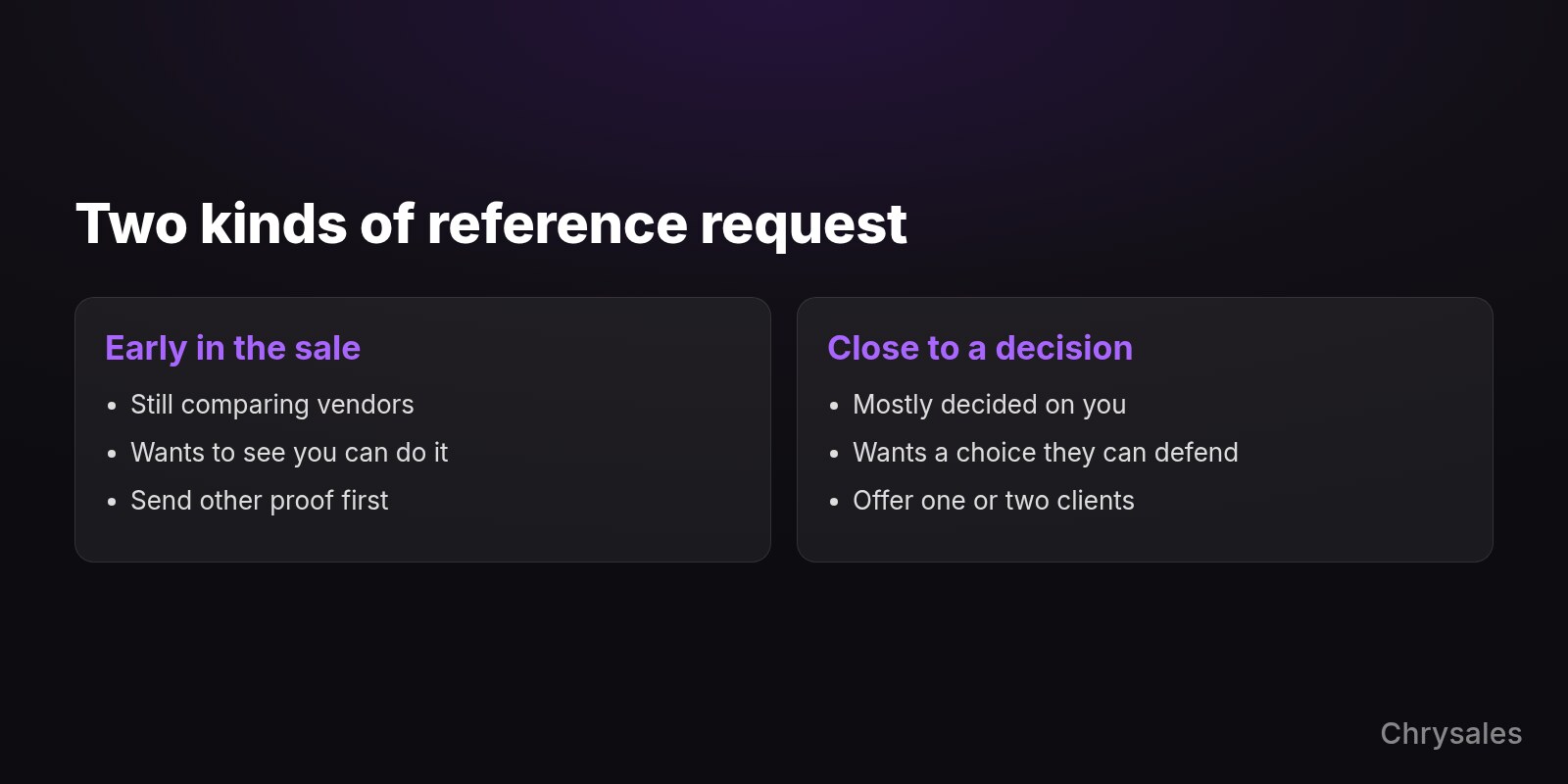
Customer reference calls tend to come late in a deal. When a prospect wants to talk to one of your customers, they are often checking a choice they have mostly made. Offer one or two customers whose situation matches theirs, get each one's yes first, and brief both sides without telling them what to say.
Done well, the call gives the buyer something to repeat to their boss. Done badly, it can cost you the deal and a good customer's patience.
When to agree to a reference call
Say yes when the buyer is close to a decision. Find out which kind of request you have before you name anyone.
A Gartner survey of 771 B2B buyers shows what buyers get from references. Reading customer references helps buyers confirm a purchase is worth it. Gartner calls this "value affirmation" in its release.
Research by LinkedIn's B2B Institute with Bain found something similar: buyers want a choice they can defend, even if it goes wrong later.
Adviser Karl Sakas gives references only at the last stage of a sale, once a prospect is already 90-95% sure. Earlier, he warns, a reference can sink the deal or waste your customers' time. It can also make you invest too much in a buyer who is only half interested.
So check one thing before you say yes. Put it to the buyer: "If the call goes well, what happens next on your side?"
A clear next step means go ahead. A vague answer means the buyer needs other proof at this stage first.
A request that comes after you send the proposal is often the late kind, and a good one to agree to.
A short video from Sabir on why buyers trust you, and why they go quiet after a sales call.
Which customer to offer
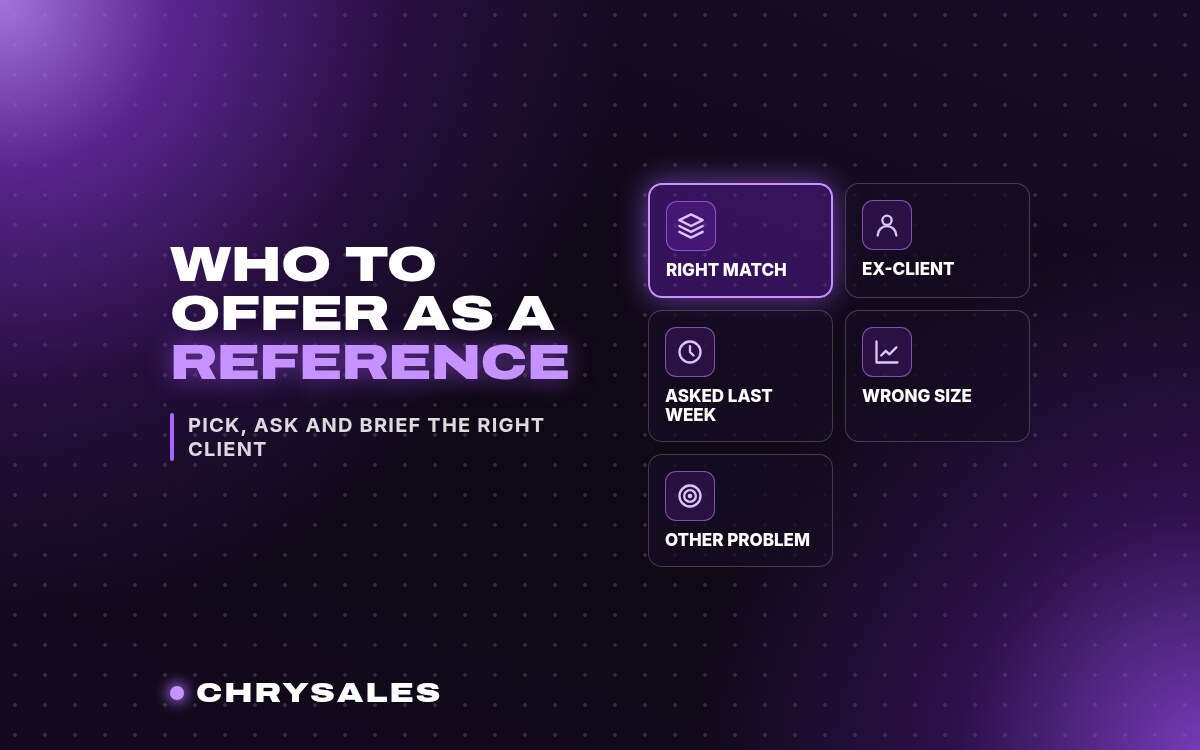
Offer the customer whose situation is closest to the prospect's. One or two names are enough.
Sales writer Anthony Iannarino suggests someone who had the exact same problem the prospect has now. We would add a few more checks:
- Same problem. They came to you with the trouble the prospect is facing today.
- Same size. Pick a company of about the same size, since a 30-person company wants to hear from someone like itself.
- Same start. If the prospect has no sales process yet, pick a customer who started there too.
- Still happy. Pick a current customer who would hire you again.
- Not asked lately. Give people a break between calls.
Steli Efti of the sales software company Close shows what skipping the "still happy" check can cost.
A salesperson offered a former customer that had moved away from his product as a reference. He did not talk to them first. Efti called the deal "almost certainly lost."
The last check protects your best customers. Asking the same few people too often leads to what Ed Gandia calls reference fatigue, and a tired customer is less keen to help.
Get your customer's yes first
Call your customer before you give anyone their name. Make it easy for them to say no, and check again each time.
Iannarino's advice is to "pick up the phone and call them" before you share a name. A yes from six months ago doesn't cover today's buyer.
There is a legal side too. Under the EU's data privacy law, the GDPR, a person's name and work email count as personal data. The simplest route is to get a clear yes before you pass on any details, then send one email that introduces both sides.
Consent can be taken back at any time. This is a plain note, not legal advice. Rules differ by country (the UK and Switzerland have their own), so check with a lawyer if you're unsure.
Here is a short message you can send or say on the phone:
Hi [Name],

A company in a similar spot to where you were a year ago is close to
working with us. They'd like a 20-30 minute call with a customer to hear
what working with us is really like.

Would you be open to that? A no is completely fine and changes
nothing between us.

If yes, I'll send one short email to you both first, saying who
they are and what they want to know.
Brief both sides, never script
Give both people context before they talk, then step back. Your customer needs to know who is calling and what worries them. The prospect needs to know what this customer can speak to.
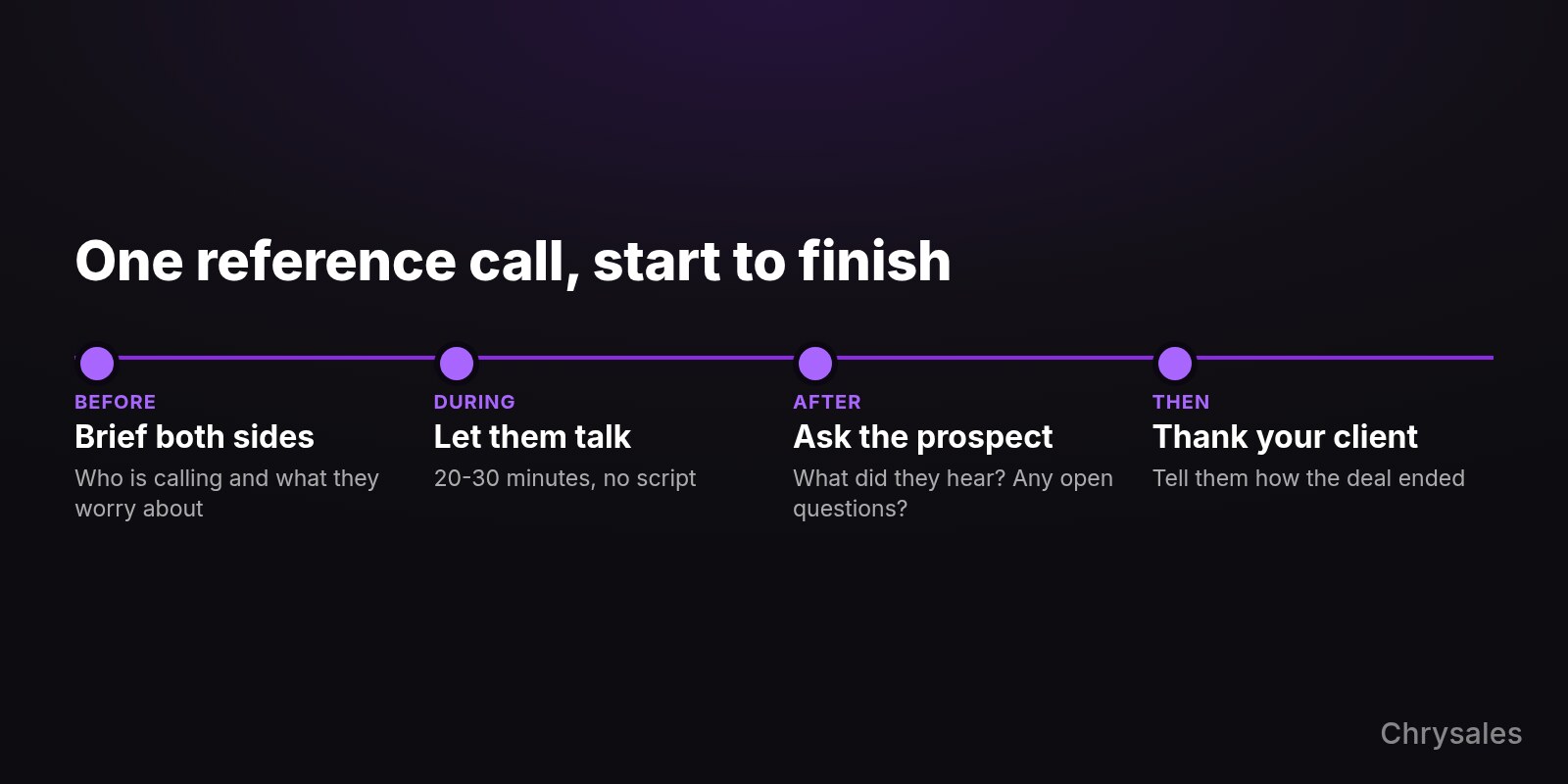
Karen Hayward of Chief Outsiders advises telling the reference what questions the prospect is trying to answer. Sharing the buyer's questions is fair context. Writing your customer's answers is coaching.
A founder once asked on Alchemist Accelerator's help center whether preparing a customer would look dishonest. One answer was to tell customers directly to say nice things, and that part is advice to skip. A coached customer can sound like an ad, and the buyer may stop trusting the call.
One intro email can brief both sides at once:
Subject: Intro: [Prospect name] and [Customer name]

Hi both,

[Customer name], [Prospect name] runs a 30-person B2B company and is
deciding whether to work with us. Their main question is
[their main worry].

[Prospect name], [Customer name] worked with us on [the same problem].
They can speak to [what they can speak to].

I'll let you two find 20-30 minutes. I'm happy to join if you'd
both like that, and just as happy to stay out of it.
Afterward, do what John D. Saunders lists as the last step of his reference process: thank the customer and check that the call took place. We'd add one more: once the deal is decided, tell them how it ended.
No references yet, or confidential clients
Say so plainly and offer the next best proof. Never promise a reference you can't deliver.
Iannarino tells of a new business owner who mentioned references to prospects that his business didn't have. A small lie like that is easy to catch when the buyer asks for a name.
You have honest options instead:
- An anonymous testimonial. When the work is confidential, Corinne McKay suggests asking the customer for a testimonial with the name removed.
- A sample of your work, with names and details taken out.
- A small paid first step, so the buyer can test you on something limited.
Tell the buyer these are weaker than a live call. If they are comparing you with a supplier they already use, this guide to the "we already have a vendor" answer helps too.
Conclusion: Build your short list this week
Don't wait for the next request to find out who would say yes. Write down three current customers who are happy and solved a clear problem with you.
Check with each one now whether they'd be open to a short call one day, and note who agreed. Then check again, with a short message, each time a real buyer comes up.
Keep this list apart from referrals. Asking clients for introductions to new leads is a different request with its own timing.
Want a second look at how proof shows up across your sales process? On a free strategy call, Chrysales can go through where reference calls and closing fit in your deals with you. Map your closing steps on a free call
Customer reference calls tend to come late in a deal. When a prospect wants to talk to one of your customers, they are often checking a choice they have mostly made. Offer one or two customers whose situation matches theirs, get each one's yes first, and brief both sides without telling them what to say.
Done well, the call gives the buyer something to repeat to their boss. Done badly, it can cost you the deal and a good customer's patience.
When to agree to a reference call
Say yes when the buyer is close to a decision. Find out which kind of request you have before you name anyone.
A Gartner survey of 771 B2B buyers shows what buyers get from references. Reading customer references helps buyers confirm a purchase is worth it. Gartner calls this "value affirmation" in its release.
Research by LinkedIn's B2B Institute with Bain found something similar: buyers want a choice they can defend, even if it goes wrong later.
Adviser Karl Sakas gives references only at the last stage of a sale, once a prospect is already 90-95% sure. Earlier, he warns, a reference can sink the deal or waste your customers' time. It can also make you invest too much in a buyer who is only half interested.
So check one thing before you say yes. Put it to the buyer: "If the call goes well, what happens next on your side?"
A clear next step means go ahead. A vague answer means the buyer needs other proof at this stage first.
A request that comes after you send the proposal is often the late kind, and a good one to agree to.
A short video from Sabir on why buyers trust you, and why they go quiet after a sales call.
Which customer to offer
Offer the customer whose situation is closest to the prospect's. One or two names are enough.
Sales writer Anthony Iannarino suggests someone who had the exact same problem the prospect has now. We would add a few more checks:
- Same problem. They came to you with the trouble the prospect is facing today.
- Same size. Pick a company of about the same size, since a 30-person company wants to hear from someone like itself.
- Same start. If the prospect has no sales process yet, pick a customer who started there too.
- Still happy. Pick a current customer who would hire you again.
- Not asked lately. Give people a break between calls.
Steli Efti of the sales software company Close shows what skipping the "still happy" check can cost.
A salesperson offered a former customer that had moved away from his product as a reference. He did not talk to them first. Efti called the deal "almost certainly lost."
The last check protects your best customers. Asking the same few people too often leads to what Ed Gandia calls reference fatigue, and a tired customer is less keen to help.
Get your customer's yes first
Call your customer before you give anyone their name. Make it easy for them to say no, and check again each time.
Iannarino's advice is to "pick up the phone and call them" before you share a name. A yes from six months ago doesn't cover today's buyer.
There is a legal side too. Under the EU's data privacy law, the GDPR, a person's name and work email count as personal data. The simplest route is to get a clear yes before you pass on any details, then send one email that introduces both sides.
Consent can be taken back at any time. This is a plain note, not legal advice. Rules differ by country (the UK and Switzerland have their own), so check with a lawyer if you're unsure.
Here is a short message you can send or say on the phone:
Hi [Name],

A company in a similar spot to where you were a year ago is close to
working with us. They'd like a 20-30 minute call with a customer to hear
what working with us is really like.

Would you be open to that? A no is completely fine and changes
nothing between us.

If yes, I'll send one short email to you both first, saying who
they are and what they want to know.
Brief both sides, never script
Give both people context before they talk, then step back. Your customer needs to know who is calling and what worries them. The prospect needs to know what this customer can speak to.
Karen Hayward of Chief Outsiders advises telling the reference what questions the prospect is trying to answer. Sharing the buyer's questions is fair context. Writing your customer's answers is coaching.
A founder once asked on Alchemist Accelerator's help center whether preparing a customer would look dishonest. One answer was to tell customers directly to say nice things, and that part is advice to skip. A coached customer can sound like an ad, and the buyer may stop trusting the call.
One intro email can brief both sides at once:
Subject: Intro: [Prospect name] and [Customer name]

Hi both,

[Customer name], [Prospect name] runs a 30-person B2B company and is
deciding whether to work with us. Their main question is
[their main worry].

[Prospect name], [Customer name] worked with us on [the same problem].
They can speak to [what they can speak to].

I'll let you two find 20-30 minutes. I'm happy to join if you'd
both like that, and just as happy to stay out of it.
Afterward, do what John D. Saunders lists as the last step of his reference process: thank the customer and check that the call took place. We'd add one more: once the deal is decided, tell them how it ended.
No references yet, or confidential clients
Say so plainly and offer the next best proof. Never promise a reference you can't deliver.
Iannarino tells of a new business owner who mentioned references to prospects that his business didn't have. A small lie like that is easy to catch when the buyer asks for a name.
You have honest options instead:
- An anonymous testimonial. When the work is confidential, Corinne McKay suggests asking the customer for a testimonial with the name removed.
- A sample of your work, with names and details taken out.
- A small paid first step, so the buyer can test you on something limited.
Tell the buyer these are weaker than a live call. If they are comparing you with a supplier they already use, this guide to the "we already have a vendor" answer helps too.
Conclusion: Build your short list this week
Don't wait for the next request to find out who would say yes. Write down three current customers who are happy and solved a clear problem with you.
Check with each one now whether they'd be open to a short call one day, and note who agreed. Then check again, with a short message, each time a real buyer comes up.
Keep this list apart from referrals. Asking clients for introductions to new leads is a different request with its own timing.
Want a second look at how proof shows up across your sales process? On a free strategy call, Chrysales can go through where reference calls and closing fit in your deals with you. Map your closing steps on a free call
Scaling Is Not Hard If You Have The Right Systems
If you’re serious about leveling up your scaling game, you need the right system, the right training, and the right team behind you. We're here to give you the exact tools and strategies top entrepreneurs use to dominate.

Discover the latest tips
View All
Chrysales was formed from the words "chrysalis" the stage where a caterpillar transforms into a butterfly and "sales".
It stands for one thing: sales transformation.Because scaling doesn’t happen by doing more of the same. Scaling only happens when you go through real transformation in your systems, your offer, team and the way you sell.


