.avif)
How to Build a Content Sales Funnel That Warms Leads
A content sales funnel is a system that uses targeted content to teach, qualify, and warm up prospects before they ever book a sales call. It moves people from unawareness to readiness so your team only talks to buyers who understand the product and pricing.
Most sales teams spend hours on calls with people who aren't ready to buy. They answer the same questions over and over. They explain pricing to tire kickers. They pitch to people who don't even understand what the product does.
Here's the thing: a good content sales funnel fixes this before you ever pick up the phone. It teaches, qualifies, and warms up prospects so that by the time they book a call, they already know what you do, why it matters, and how much it costs. The people who show up are actually ready to talk business.
Why Most Content Funnels Don't Generate Sales
Most companies think content marketing means posting blog articles and hoping someone buys. They write about industry trends, share tips on LinkedIn, and maybe send a monthly newsletter. But none of it connects to actual revenue.
The problem is simple: they're building a content funnel for awareness, not for client acquisition. A content sales funnel is different. It's built with one goal: move people from "I don't know you" to "I'm ready to buy" in a predictable way.
Every piece of content has a job. Top of funnel content introduces the problem. Middle of funnel content positions your solution. Bottom of funnel content handles objections and closes the gap between interest and action.
The Traffic vs. Revenue Trap
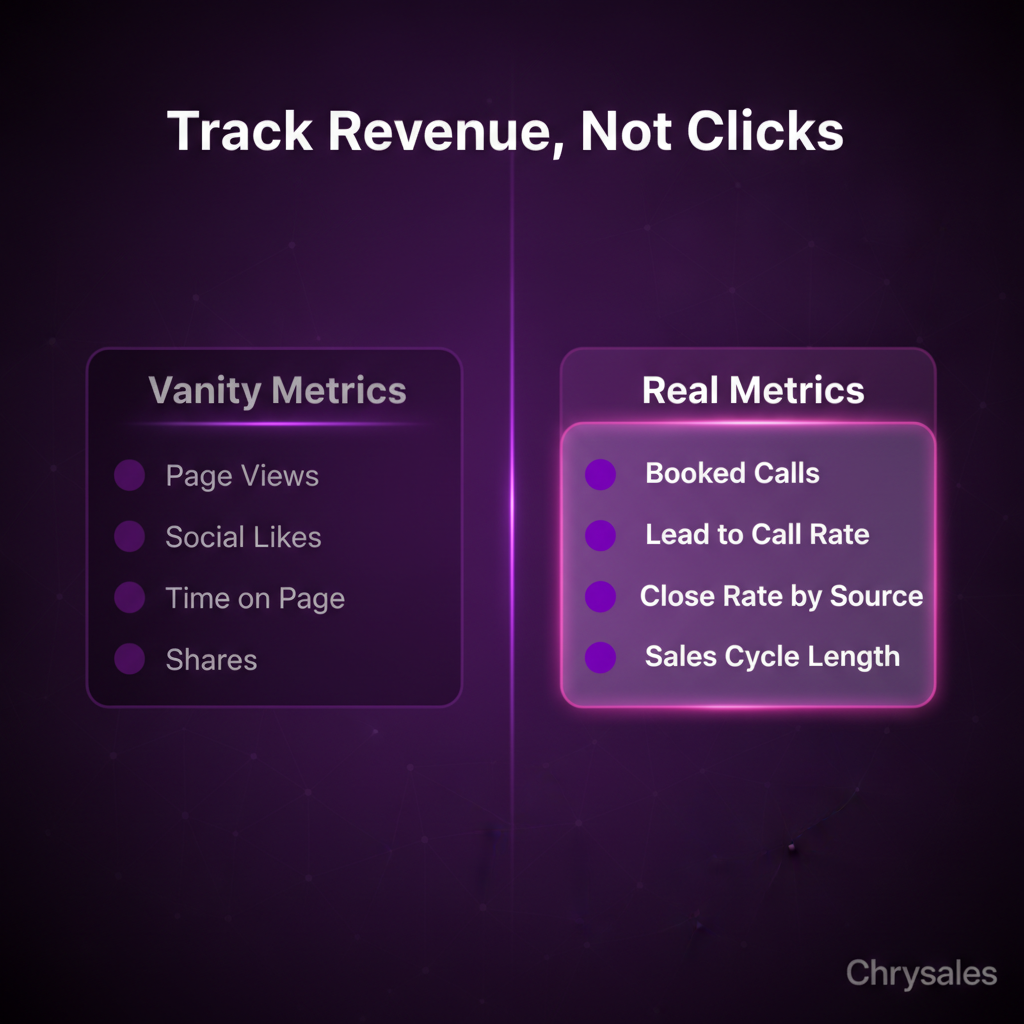
Here's where most teams get stuck. They measure success by page views, likes, and shares. Those numbers feel good, but they don't pay the bills. A content sales funnel for B2B lead generation measures different things: qualified leads, booked calls, and closed deals. If your content gets 10,000 views but zero meetings, it's not working.
Watch out: Content that educates without qualifying is just noise. Your funnel should push people toward a decision, not just keep them reading forever.
How a Content Sales Funnel Actually Works

Think of your content sales funnel like a filter. At the top, you pour in a wide audience. As they move down, the filter catches people who aren't a fit and pushes qualified buyers toward your sales team. The content at each stage does the heavy lifting so your salespeople don't have to.
Top of Funnel: Awareness and Problem Recognition
This is where people first hear about you. They have a problem but don't know the solution yet. Your job here is to name the problem in a way that makes them go, "Wait, that's exactly what I'm dealing with."
Top of funnel content for lead generation includes:
- Blog posts that explain common pain points
- LinkedIn posts with quick wins or observations
- Short videos breaking down industry challenges
- Guides that reframe how people think about their problem
A 30-person consulting firm might write a post called "Why your proposals get ghosted after the first meeting." The reader sees the headline, recognizes the pain, and clicks. They're not ready to buy yet, but they're in the funnel.
Pro Tip: Use real language your prospects use. If they say "our pipeline is a mess," don't write about "optimizing sales operations." Say "your pipeline is a mess."
Middle of Funnel: Solution Education and Positioning
Now they know the problem. Middle of funnel content shows them what good looks like. This is where you position your approach without hard selling. You're teaching them how to evaluate solutions, and in the process, you're making your method the obvious choice.
Middle funnel content types:
- Case studies with real numbers
- Email sequences that walk through your process
- Webinars or recorded demos
- Comparison guides (your approach vs. the old way)
Picture this: someone read your blog post about ghosted proposals. Now they're on your email list. You send them a case study about a tech company that went from 15% close rate to 40% by fixing their discovery process. The reader sees the result, understands the method, and starts thinking, "Maybe we need help with this."
Bottom of Funnel: Objection Handling and Conversion
Bottom of funnel content is where the sale happens. These people are close. They're interested. But they have questions: Does this work for companies like ours? How much does it cost? What's the timeline? How do we know it'll work?
Your content answers these questions before the sales call. Bottom of funnel content for client acquisition includes:
- Detailed service or product pages with pricing
- Testimonials and client results
- FAQ pages that handle common objections
- Free tools or assessments that show your expertise
One marketing agency we worked with had prospects asking the same three questions on every call: "Do you work with agencies our size?", "What if we've tried this before?", and "How fast can we see results?" They built a simple FAQ page and a 2-minute video answering those exact questions. Calls got shorter, and close rates went up because people showed up pre-sold.
Common mistake: Hiding pricing or avoiding tough questions. If someone wants to know, they'll ask on the call anyway. Answer it in your content and filter out people who aren't a fit.
Building Your Content Sales Funnel in Three Steps
Here's how to build a B2B content funnel strategy that actually generates pipeline. This isn't theory. It's what works when you need clients, not just clicks.
Step 1: Map Your Buyer Journey from Problem to Purchase
Most people skip this. They just start writing content. But if you don't know the path your buyer takes, you can't build content that moves them along it.
Sit down and write out the stages your prospects go through:
- They have a problem but don't know it's fixable
- They realize the problem is costing them money or time
- They start looking for solutions
- They compare different approaches
- They evaluate specific providers
- They make a decision
Now map content to each stage. At stage 1, you need awareness content. At stage 4, you need comparison content. At stage 6, you need testimonials and case studies.
A 15-person consulting firm that helps companies fix their sales hiring might have this funnel:
- Stage 1: Blog post: "Why your new sales hires quit in 90 days"
- Stage 2: LinkedIn post: "Bad hires cost $80K each. Here's why it keeps happening."
- Stage 3: Email series: "The 4-step hiring system that cuts turnover in half"
- Stage 4: Comparison guide: "In-house training vs. hiring a sales coach"
- Stage 5: Case study: "How a tech company hired 5 closers in 60 days"
- Stage 6: Pricing page and calendar link
Step 2: Create Content That Qualifies and Disqualifies
Good content attracts the right people. Great content also pushes away the wrong people. This is a feature, not a bug. If your content is too broad, you'll fill your calendar with tire kickers.
Write content that makes your ideal buyer say "this is exactly for me" and makes bad fits say "this isn't what I need." Be specific about who you help, what problems you solve, and who you don't work with.
For example, if you only work with B2B sales teams above $500K in revenue, say that. If your process takes 90 days, say that. If you don't do cheap quick fixes, say that. The right people will stay. The wrong people will leave. You just saved yourself hours of wasted calls.
Pro Tip: Add a qualifying question to your contact form or calendar link. Something like "What's your current monthly revenue?" or "How many salespeople do you have?" filters out people who aren't a fit before they ever book.
Step 3: Connect Content to Your Sales Process
Content isn't separate from sales. It's part of the sales system. Every piece of content should move someone closer to a decision or give your sales team better information.
Here's what this looks like in practice:
- Blog posts include a call to action: download a guide, book a call, take an assessment
- Email sequences end with a calendar link or a question that starts a conversation
- Case studies include a "Want results like this?" button
- Your FAQ page links directly to your booking page
When someone books a call, your team should know what content they've seen. If they read your pricing page, the closer knows they're price-aware. If they downloaded your hiring guide, the closer knows hiring is the pain point. This context shortens the call and increases close rate.
We've trained over 1,000 business owners and 500+ sales teams. The ones who learn how to build a sales system that actually scales and connect their content funnel to their sales process see booked call rates jump 30% to 60% in the first 60 days.
The TOFU MOFU BOFU Content Strategy That Actually Closes Deals
You've probably heard these terms before: top of funnel (TOFU), middle of funnel (MOFU), and bottom of funnel (BOFU). Most content about this is written for marketers who care about traffic. But if you're trying to close B2B sales, you need a different angle.
TOFU: Stop Trying to Sell, Start Naming Problems
Top of funnel content is not the place to pitch. Your job here is to get attention by naming a problem better than anyone else. The best TOFU content makes someone stop scrolling and say, "Wait, someone finally gets it."
Write blog posts, LinkedIn content, or short videos that call out specific frustrations. Use the exact words your prospects use. If they say "our sales team is winging it," don't write about "lack of structured methodologies." Say "your team is winging it and it's costing you deals."
A tech company might write: "Why your demos don't convert (and it's not the product)." That's a TOFU MOFU BOFU content strategy in action. It names the problem (demos don't convert), hints at the real issue (it's not the product), and pulls people in.
MOFU: Educate Them Into Your Way of Thinking
Middle of funnel is where you teach your process without giving away the service. You're showing them what good looks like. You're explaining why most people fail and what the right approach actually is. By the end, they should believe your method is the answer, even if they don't know all the details yet.
Use case studies, how-to guides, email courses, or webinars. Walk through real examples. Show before and after. Give them enough to understand the transformation, but not enough to do it alone (unless they're willing to spend 6 months figuring it out).
One of our clients, a marketing agency, built a 5-email sequence called "The offer that books itself." Each email taught one part of their offer creation process. By email 5, readers understood the method and booked calls asking, "Can you build this for us?"
BOFU: Handle Objections Before the Call
Bottom of funnel content does the work your sales team used to do in the first 10 minutes of a call. It answers the most common objections: pricing, timeline, proof, fit.
Build a strong FAQ page. Record a short "What to expect" video. Add testimonials with real results. Link to detailed case studies. Make your pricing visible (or at least give ranges). The goal is that when someone books a call, they already know you're legit, you're in their budget, and you've done this before.
Chrysales has helped generate over €10M in client revenue for companies using this exact funnel content for lead generation approach. The common thread: prospects show up to calls pre-sold because the content already did the hard work.
How to Use AI and Automation Inside Your Content Funnel
Here's where things get interesting. You don't need a 10-person marketing team to run a content sales funnel. You need a smart system. AI tools and simple automation can handle most of the heavy lifting.
AI-Assisted Content Creation
You can use AI to draft blog outlines, write email sequences, or generate social posts. But don't just hit "generate" and publish. Use AI to get 70% of the way there, then edit it into your voice. The best B2B content funnel strategy mixes speed with personality.
For example, you might use AI to create 10 blog headlines, pick the best 3, and then write the posts yourself. Or use it to draft a case study structure, then fill in the real client details and results.
Lead Scoring Based on Content Engagement
Not everyone who reads your blog is ready to buy. But someone who reads your pricing page, downloads your guide, and watches your demo video? That's a hot lead.
Set up simple tracking so you know what content each lead has consumed. If someone hits three or more bottom of funnel pages, they should get flagged for your sales team to reach out. If they've only read one blog post, they stay in the nurture sequence.
We help clients build AI lead scoring systems using Gemini-based workflows. The system watches what people do, scores them, and either books them for a call or moves them to the next stage of the funnel. This is part of our 4-step method: Learn, Build Systems, Automate, Hire Chief of Staff. You can watch AI sales system get you record revenue with unlimited demand for a deeper walkthrough of how automation and AI fit into the full client acquisition process.
Automated Follow-Up Sequences
When someone downloads a guide or signs up for your email list, they should get a sequence that moves them through the funnel. Start with a welcome email. Follow up with education. End with a pitch or calendar link.
Most teams write one email and wonder why nobody buys. The truth is, people need multiple touches. A good sequence might be:
- Email 1: Deliver the thing they signed up for
- Email 2: Share a quick win or insight (MOFU content)
- Email 3: Case study or proof (MOFU/BOFU)
- Email 4: Handle a common objection (BOFU)
- Email 5: Calendar link and direct ask
This runs on autopilot. You write it once, and it works for every new lead.
Watch out: Don't automate personality out of your emails. The sequence should sound like you, not a robot. Keep it conversational.
Common Content Funnel Mistakes That Kill Conversions
We've worked with companies from Amazon to Vodafone to small agencies just getting started. We see the same mistakes over and over. Here are the big ones.
Mistake 1: No Clear Next Step
You write a great blog post. Someone reads it, nods along, and then... leaves. No call to action. No link. No next step. They're gone.
Every piece of content needs a next step. For TOFU, it might be "Download the full guide." For MOFU, "Watch this case study." For BOFU, "Book a call." Make it obvious. Put it at the top and the bottom.
Mistake 2: Talking About You Instead of Them
Your content should be about your prospect's problems, not your company's features. Nobody cares that you've been in business for 12 years or that you use "proprietary methods." They care if you can fix their pipeline, close more deals, or hire better salespeople.
Flip your content. Instead of "We offer a 4-step sales system," say "Here's how to build a sales system that books 20 calls a month without spending on ads."
Mistake 3: Building Content Without a Sales System Behind It
Content alone doesn't close deals. You need a full system: content that qualifies, a way to book calls, a sales process that converts, and follow-up that keeps people moving. If your content is great but your sales process is broken, you'll get traffic and no revenue.
Chrysales builds full client acquisition systems. We don't just help with content. We build your offer, your outreach, your call structure, your objection scripts, and your hiring process. That's how our clients hit a 99.4% satisfaction rate and generate predictable results. You can also see how to build a sales system so powerful clients come to you to understand the full framework.
Measuring What Actually Matters in Your Content Sales Funnel
Most people track the wrong things. They look at traffic, time on page, and social shares. Those numbers are fine for a content marketing team. But if you're running a content funnel for agency owners or B2B companies trying to book clients, you need different metrics.
The Real KPIs for a Content Sales Funnel
Track these instead:
- Lead magnet conversion rate: How many visitors download your guide or sign up for your list?
- Email open and click rates: Are people engaging with your MOFU sequences?
- Content-to-call conversion rate: How many people who consume your content actually book a sales call?
- Close rate by content source: Do leads from your blog close better than leads from LinkedIn? From email?
- Sales cycle length: Does content consumption shorten the time from first touch to close?
If 1,000 people read your blog but only 5 book calls, your funnel has a leak. If 50 people book calls but only 2 close, your sales process or offer needs work. The numbers tell you exactly where to fix things.
Pro Tip: Ask every new lead, "How did you hear about us?" and "What content did you read before booking this call?" Their answers show you what's working. If you need a structured approach to measurement, learn how to track content impact on your sales funnel with the right KPIs and tracking systems.
Using Feedback to Improve Your Funnel
The best content funnels get better over time. After every sales call, ask your team: What questions did the prospect ask? What objections came up? What did they already know?
If five prospects in a row ask the same question, write a blog post or FAQ answering it. If objections keep coming up, add BOFU content that handles them. Your content should get smarter every month based on real sales conversations.
We've helped over 500 sales teams build and improve their funnels. The ones that win are the ones that treat content as part of the sales process, not a separate marketing thing. They measure revenue, not clicks. And they keep adjusting based on what's actually closing deals.
Frequently Asked Questions
Q: How long does it take to build a content sales funnel that actually generates leads?
Most teams can get a basic funnel running in 4 to 6 weeks if they focus. You don't need 50 pieces of content. Start with one strong TOFU post, one MOFU case study or guide, and one solid BOFU page (pricing or FAQ). Publish those, drive traffic, and see what happens. Then add more content based on what your prospects need. The key is to start simple and improve based on real feedback, not to build everything before you launch. If you want to plan your content systematically, a content calendar for B2B lead generation can help you organize your TOFU, MOFU, and BOFU assets over time.
Q: Can a content funnel work if we don't have a big audience yet?
Yes. A small, targeted audience beats a big, random one every time. If you have 200 people on your email list and 50 of them are perfect fits, that's better than 10,000 followers who will never buy. Focus on creating content that speaks directly to your ideal buyer. Promote it through cold outreach, LinkedIn, partnerships, or even paid ads if the numbers work. Traffic will grow as you publish consistently and share your content in the right places.
Q: What's the difference between a content marketing funnel and a content sales funnel?
A content marketing funnel focuses on awareness, traffic, and brand building. A content sales funnel focuses on qualified leads and closed deals. Marketing funnels measure page views and engagement. Sales funnels measure booked calls and revenue. The content types might look similar (blog posts, case studies, emails), but the intent, messaging, and calls to action are different. A sales funnel is built to move people toward buying, not just reading. For concrete examples, check out these 4 funnel strategies that deliver results when mapped to the buyer journey.
Q: How much content do we actually need at each stage of the funnel?
You don't need 100 blog posts to start. A working B2B sales funnel can run on 5 to 10 pieces of content if they're the right pieces. Aim for 2 to 3 strong TOFU posts that attract your ideal buyer, 2 to 3 MOFU pieces like case studies or guides that explain your approach, and 2 BOFU assets like a detailed FAQ and a testimonial page. Once that's live, add more content based on what questions prospects keep asking and where you see drop-off in your funnel. Research shows that matching the best B2B content to each funnel stage improves conversion more than publishing high volumes of generic content.
Q: Do we need a huge marketing team to run a content sales funnel?
No. Most small B2B companies run effective content funnels with one person and some simple tools. You need someone who can write, a way to publish (a blog or LinkedIn), and basic email automation. AI tools can speed up content creation. Simple CRM tracking shows what content people engage with. If you're clear on your buyer journey and your offer, you can build and run a content sales funnel without a full marketing department. Focus on systems, not headcount. According to research on optimizing your sales funnel for better lead conversion, even lean teams can achieve strong results when they focus on the right stages and metrics.
A content sales funnel is a system that uses targeted content to teach, qualify, and warm up prospects before they ever book a sales call. It moves people from unawareness to readiness so your team only talks to buyers who understand the product and pricing.
Most sales teams spend hours on calls with people who aren't ready to buy. They answer the same questions over and over. They explain pricing to tire kickers. They pitch to people who don't even understand what the product does.
Here's the thing: a good content sales funnel fixes this before you ever pick up the phone. It teaches, qualifies, and warms up prospects so that by the time they book a call, they already know what you do, why it matters, and how much it costs. The people who show up are actually ready to talk business.
Why Most Content Funnels Don't Generate Sales
Most companies think content marketing means posting blog articles and hoping someone buys. They write about industry trends, share tips on LinkedIn, and maybe send a monthly newsletter. But none of it connects to actual revenue.
The problem is simple: they're building a content funnel for awareness, not for client acquisition. A content sales funnel is different. It's built with one goal: move people from "I don't know you" to "I'm ready to buy" in a predictable way.
Every piece of content has a job. Top of funnel content introduces the problem. Middle of funnel content positions your solution. Bottom of funnel content handles objections and closes the gap between interest and action.
The Traffic vs. Revenue Trap
Here's where most teams get stuck. They measure success by page views, likes, and shares. Those numbers feel good, but they don't pay the bills. A content sales funnel for B2B lead generation measures different things: qualified leads, booked calls, and closed deals. If your content gets 10,000 views but zero meetings, it's not working.
Watch out: Content that educates without qualifying is just noise. Your funnel should push people toward a decision, not just keep them reading forever.
How a Content Sales Funnel Actually Works
Think of your content sales funnel like a filter. At the top, you pour in a wide audience. As they move down, the filter catches people who aren't a fit and pushes qualified buyers toward your sales team. The content at each stage does the heavy lifting so your salespeople don't have to.
Top of Funnel: Awareness and Problem Recognition
This is where people first hear about you. They have a problem but don't know the solution yet. Your job here is to name the problem in a way that makes them go, "Wait, that's exactly what I'm dealing with."
Top of funnel content for lead generation includes:
- Blog posts that explain common pain points
- LinkedIn posts with quick wins or observations
- Short videos breaking down industry challenges
- Guides that reframe how people think about their problem
A 30-person consulting firm might write a post called "Why your proposals get ghosted after the first meeting." The reader sees the headline, recognizes the pain, and clicks. They're not ready to buy yet, but they're in the funnel.
Pro Tip: Use real language your prospects use. If they say "our pipeline is a mess," don't write about "optimizing sales operations." Say "your pipeline is a mess."
Middle of Funnel: Solution Education and Positioning
Now they know the problem. Middle of funnel content shows them what good looks like. This is where you position your approach without hard selling. You're teaching them how to evaluate solutions, and in the process, you're making your method the obvious choice.
Middle funnel content types:
- Case studies with real numbers
- Email sequences that walk through your process
- Webinars or recorded demos
- Comparison guides (your approach vs. the old way)
Picture this: someone read your blog post about ghosted proposals. Now they're on your email list. You send them a case study about a tech company that went from 15% close rate to 40% by fixing their discovery process. The reader sees the result, understands the method, and starts thinking, "Maybe we need help with this."
Bottom of Funnel: Objection Handling and Conversion
Bottom of funnel content is where the sale happens. These people are close. They're interested. But they have questions: Does this work for companies like ours? How much does it cost? What's the timeline? How do we know it'll work?
Your content answers these questions before the sales call. Bottom of funnel content for client acquisition includes:
- Detailed service or product pages with pricing
- Testimonials and client results
- FAQ pages that handle common objections
- Free tools or assessments that show your expertise
One marketing agency we worked with had prospects asking the same three questions on every call: "Do you work with agencies our size?", "What if we've tried this before?", and "How fast can we see results?" They built a simple FAQ page and a 2-minute video answering those exact questions. Calls got shorter, and close rates went up because people showed up pre-sold.
Common mistake: Hiding pricing or avoiding tough questions. If someone wants to know, they'll ask on the call anyway. Answer it in your content and filter out people who aren't a fit.
Building Your Content Sales Funnel in Three Steps
Here's how to build a B2B content funnel strategy that actually generates pipeline. This isn't theory. It's what works when you need clients, not just clicks.
Step 1: Map Your Buyer Journey from Problem to Purchase
Most people skip this. They just start writing content. But if you don't know the path your buyer takes, you can't build content that moves them along it.
Sit down and write out the stages your prospects go through:
- They have a problem but don't know it's fixable
- They realize the problem is costing them money or time
- They start looking for solutions
- They compare different approaches
- They evaluate specific providers
- They make a decision
Now map content to each stage. At stage 1, you need awareness content. At stage 4, you need comparison content. At stage 6, you need testimonials and case studies.
A 15-person consulting firm that helps companies fix their sales hiring might have this funnel:
- Stage 1: Blog post: "Why your new sales hires quit in 90 days"
- Stage 2: LinkedIn post: "Bad hires cost $80K each. Here's why it keeps happening."
- Stage 3: Email series: "The 4-step hiring system that cuts turnover in half"
- Stage 4: Comparison guide: "In-house training vs. hiring a sales coach"
- Stage 5: Case study: "How a tech company hired 5 closers in 60 days"
- Stage 6: Pricing page and calendar link
Step 2: Create Content That Qualifies and Disqualifies
Good content attracts the right people. Great content also pushes away the wrong people. This is a feature, not a bug. If your content is too broad, you'll fill your calendar with tire kickers.
Write content that makes your ideal buyer say "this is exactly for me" and makes bad fits say "this isn't what I need." Be specific about who you help, what problems you solve, and who you don't work with.
For example, if you only work with B2B sales teams above $500K in revenue, say that. If your process takes 90 days, say that. If you don't do cheap quick fixes, say that. The right people will stay. The wrong people will leave. You just saved yourself hours of wasted calls.
Pro Tip: Add a qualifying question to your contact form or calendar link. Something like "What's your current monthly revenue?" or "How many salespeople do you have?" filters out people who aren't a fit before they ever book.
Step 3: Connect Content to Your Sales Process
Content isn't separate from sales. It's part of the sales system. Every piece of content should move someone closer to a decision or give your sales team better information.
Here's what this looks like in practice:
- Blog posts include a call to action: download a guide, book a call, take an assessment
- Email sequences end with a calendar link or a question that starts a conversation
- Case studies include a "Want results like this?" button
- Your FAQ page links directly to your booking page
When someone books a call, your team should know what content they've seen. If they read your pricing page, the closer knows they're price-aware. If they downloaded your hiring guide, the closer knows hiring is the pain point. This context shortens the call and increases close rate.
We've trained over 1,000 business owners and 500+ sales teams. The ones who learn how to build a sales system that actually scales and connect their content funnel to their sales process see booked call rates jump 30% to 60% in the first 60 days.
The TOFU MOFU BOFU Content Strategy That Actually Closes Deals
You've probably heard these terms before: top of funnel (TOFU), middle of funnel (MOFU), and bottom of funnel (BOFU). Most content about this is written for marketers who care about traffic. But if you're trying to close B2B sales, you need a different angle.
TOFU: Stop Trying to Sell, Start Naming Problems
Top of funnel content is not the place to pitch. Your job here is to get attention by naming a problem better than anyone else. The best TOFU content makes someone stop scrolling and say, "Wait, someone finally gets it."
Write blog posts, LinkedIn content, or short videos that call out specific frustrations. Use the exact words your prospects use. If they say "our sales team is winging it," don't write about "lack of structured methodologies." Say "your team is winging it and it's costing you deals."
A tech company might write: "Why your demos don't convert (and it's not the product)." That's a TOFU MOFU BOFU content strategy in action. It names the problem (demos don't convert), hints at the real issue (it's not the product), and pulls people in.
MOFU: Educate Them Into Your Way of Thinking
Middle of funnel is where you teach your process without giving away the service. You're showing them what good looks like. You're explaining why most people fail and what the right approach actually is. By the end, they should believe your method is the answer, even if they don't know all the details yet.
Use case studies, how-to guides, email courses, or webinars. Walk through real examples. Show before and after. Give them enough to understand the transformation, but not enough to do it alone (unless they're willing to spend 6 months figuring it out).
One of our clients, a marketing agency, built a 5-email sequence called "The offer that books itself." Each email taught one part of their offer creation process. By email 5, readers understood the method and booked calls asking, "Can you build this for us?"
BOFU: Handle Objections Before the Call
Bottom of funnel content does the work your sales team used to do in the first 10 minutes of a call. It answers the most common objections: pricing, timeline, proof, fit.
Build a strong FAQ page. Record a short "What to expect" video. Add testimonials with real results. Link to detailed case studies. Make your pricing visible (or at least give ranges). The goal is that when someone books a call, they already know you're legit, you're in their budget, and you've done this before.
Chrysales has helped generate over €10M in client revenue for companies using this exact funnel content for lead generation approach. The common thread: prospects show up to calls pre-sold because the content already did the hard work.
How to Use AI and Automation Inside Your Content Funnel
Here's where things get interesting. You don't need a 10-person marketing team to run a content sales funnel. You need a smart system. AI tools and simple automation can handle most of the heavy lifting.
AI-Assisted Content Creation
You can use AI to draft blog outlines, write email sequences, or generate social posts. But don't just hit "generate" and publish. Use AI to get 70% of the way there, then edit it into your voice. The best B2B content funnel strategy mixes speed with personality.
For example, you might use AI to create 10 blog headlines, pick the best 3, and then write the posts yourself. Or use it to draft a case study structure, then fill in the real client details and results.
Lead Scoring Based on Content Engagement
Not everyone who reads your blog is ready to buy. But someone who reads your pricing page, downloads your guide, and watches your demo video? That's a hot lead.
Set up simple tracking so you know what content each lead has consumed. If someone hits three or more bottom of funnel pages, they should get flagged for your sales team to reach out. If they've only read one blog post, they stay in the nurture sequence.
We help clients build AI lead scoring systems using Gemini-based workflows. The system watches what people do, scores them, and either books them for a call or moves them to the next stage of the funnel. This is part of our 4-step method: Learn, Build Systems, Automate, Hire Chief of Staff. You can watch AI sales system get you record revenue with unlimited demand for a deeper walkthrough of how automation and AI fit into the full client acquisition process.
Automated Follow-Up Sequences
When someone downloads a guide or signs up for your email list, they should get a sequence that moves them through the funnel. Start with a welcome email. Follow up with education. End with a pitch or calendar link.
Most teams write one email and wonder why nobody buys. The truth is, people need multiple touches. A good sequence might be:
- Email 1: Deliver the thing they signed up for
- Email 2: Share a quick win or insight (MOFU content)
- Email 3: Case study or proof (MOFU/BOFU)
- Email 4: Handle a common objection (BOFU)
- Email 5: Calendar link and direct ask
This runs on autopilot. You write it once, and it works for every new lead.
Watch out: Don't automate personality out of your emails. The sequence should sound like you, not a robot. Keep it conversational.
Common Content Funnel Mistakes That Kill Conversions
We've worked with companies from Amazon to Vodafone to small agencies just getting started. We see the same mistakes over and over. Here are the big ones.
Mistake 1: No Clear Next Step
You write a great blog post. Someone reads it, nods along, and then... leaves. No call to action. No link. No next step. They're gone.
Every piece of content needs a next step. For TOFU, it might be "Download the full guide." For MOFU, "Watch this case study." For BOFU, "Book a call." Make it obvious. Put it at the top and the bottom.
Mistake 2: Talking About You Instead of Them
Your content should be about your prospect's problems, not your company's features. Nobody cares that you've been in business for 12 years or that you use "proprietary methods." They care if you can fix their pipeline, close more deals, or hire better salespeople.
Flip your content. Instead of "We offer a 4-step sales system," say "Here's how to build a sales system that books 20 calls a month without spending on ads."
Mistake 3: Building Content Without a Sales System Behind It
Content alone doesn't close deals. You need a full system: content that qualifies, a way to book calls, a sales process that converts, and follow-up that keeps people moving. If your content is great but your sales process is broken, you'll get traffic and no revenue.
Chrysales builds full client acquisition systems. We don't just help with content. We build your offer, your outreach, your call structure, your objection scripts, and your hiring process. That's how our clients hit a 99.4% satisfaction rate and generate predictable results. You can also see how to build a sales system so powerful clients come to you to understand the full framework.
Measuring What Actually Matters in Your Content Sales Funnel
Most people track the wrong things. They look at traffic, time on page, and social shares. Those numbers are fine for a content marketing team. But if you're running a content funnel for agency owners or B2B companies trying to book clients, you need different metrics.
The Real KPIs for a Content Sales Funnel
Track these instead:
- Lead magnet conversion rate: How many visitors download your guide or sign up for your list?
- Email open and click rates: Are people engaging with your MOFU sequences?
- Content-to-call conversion rate: How many people who consume your content actually book a sales call?
- Close rate by content source: Do leads from your blog close better than leads from LinkedIn? From email?
- Sales cycle length: Does content consumption shorten the time from first touch to close?
If 1,000 people read your blog but only 5 book calls, your funnel has a leak. If 50 people book calls but only 2 close, your sales process or offer needs work. The numbers tell you exactly where to fix things.
Pro Tip: Ask every new lead, "How did you hear about us?" and "What content did you read before booking this call?" Their answers show you what's working. If you need a structured approach to measurement, learn how to track content impact on your sales funnel with the right KPIs and tracking systems.
Using Feedback to Improve Your Funnel
The best content funnels get better over time. After every sales call, ask your team: What questions did the prospect ask? What objections came up? What did they already know?
If five prospects in a row ask the same question, write a blog post or FAQ answering it. If objections keep coming up, add BOFU content that handles them. Your content should get smarter every month based on real sales conversations.
We've helped over 500 sales teams build and improve their funnels. The ones that win are the ones that treat content as part of the sales process, not a separate marketing thing. They measure revenue, not clicks. And they keep adjusting based on what's actually closing deals.
Frequently Asked Questions
Q: How long does it take to build a content sales funnel that actually generates leads?
Most teams can get a basic funnel running in 4 to 6 weeks if they focus. You don't need 50 pieces of content. Start with one strong TOFU post, one MOFU case study or guide, and one solid BOFU page (pricing or FAQ). Publish those, drive traffic, and see what happens. Then add more content based on what your prospects need. The key is to start simple and improve based on real feedback, not to build everything before you launch. If you want to plan your content systematically, a content calendar for B2B lead generation can help you organize your TOFU, MOFU, and BOFU assets over time.
Q: Can a content funnel work if we don't have a big audience yet?
Yes. A small, targeted audience beats a big, random one every time. If you have 200 people on your email list and 50 of them are perfect fits, that's better than 10,000 followers who will never buy. Focus on creating content that speaks directly to your ideal buyer. Promote it through cold outreach, LinkedIn, partnerships, or even paid ads if the numbers work. Traffic will grow as you publish consistently and share your content in the right places.
Q: What's the difference between a content marketing funnel and a content sales funnel?
A content marketing funnel focuses on awareness, traffic, and brand building. A content sales funnel focuses on qualified leads and closed deals. Marketing funnels measure page views and engagement. Sales funnels measure booked calls and revenue. The content types might look similar (blog posts, case studies, emails), but the intent, messaging, and calls to action are different. A sales funnel is built to move people toward buying, not just reading. For concrete examples, check out these 4 funnel strategies that deliver results when mapped to the buyer journey.
Q: How much content do we actually need at each stage of the funnel?
You don't need 100 blog posts to start. A working B2B sales funnel can run on 5 to 10 pieces of content if they're the right pieces. Aim for 2 to 3 strong TOFU posts that attract your ideal buyer, 2 to 3 MOFU pieces like case studies or guides that explain your approach, and 2 BOFU assets like a detailed FAQ and a testimonial page. Once that's live, add more content based on what questions prospects keep asking and where you see drop-off in your funnel. Research shows that matching the best B2B content to each funnel stage improves conversion more than publishing high volumes of generic content.
Q: Do we need a huge marketing team to run a content sales funnel?
No. Most small B2B companies run effective content funnels with one person and some simple tools. You need someone who can write, a way to publish (a blog or LinkedIn), and basic email automation. AI tools can speed up content creation. Simple CRM tracking shows what content people engage with. If you're clear on your buyer journey and your offer, you can build and run a content sales funnel without a full marketing department. Focus on systems, not headcount. According to research on optimizing your sales funnel for better lead conversion, even lean teams can achieve strong results when they focus on the right stages and metrics.
Scaling Is Not Hard If You Have The Right Systems
If you’re serious about leveling up your scaling game, you need the right system, the right training, and the right team behind you. We're here to give you the exact tools and strategies top entrepreneurs use to dominate.

Discover the latest tips
View All.avif)
Chrysales was formed from the words "chrysalis" the stage where a caterpillar transforms into a butterfly and "sales".
It stands for one thing: sales transformation.Because scaling doesn’t happen by doing more of the same. Scaling only happens when you go through real transformation in your systems, your offer, team and the way you sell.
.avif)


