.avif)
Clay Buyer Scoring Attributes and Implementation: A B2B Guide

Clay buyer scoring attributes and implementation assigns numerical values to prospects based on firmographic, technographic, behavioral, and negative attributes to prioritize B2B lead generation workflows. Teams achieve higher pipeline quality by integrating Clay scoring with GTM strategies, where structured B2B sales processes filter leads before outreach. Companies using validated models report reply rates of 8-15% versus 1-3% for untargeted efforts.
Why Clay buyer scoring attributes and implementation decide your pipeline quality
Clay buyer scoring attributes and implementation determines pipeline quality by prioritizing accounts that match closed-deal patterns. Clay pulls data from over 100 providers, but raw data does not close deals. Companies running structured Clay lead generation workflows see reply rates increase by factors reported in 2024 B2B sales benchmarks and statistics, compared to flat list outreach. Scoring filters noise before a single email goes out.
The cost of poor scoring
When buyer scoring attributes in Clay lack structure, sales reps waste hours on accounts that will never buy. Cold outreach burns sender reputation on irrelevant inboxes. Pipeline forecasting becomes guesswork.
The shift from list building to system building
Clay lead gen supports B2B sales when scoring functions as a system decision. Every attribute maps to a revenue hypothesis, and every score threshold triggers a defined action.
Core buyer scoring attributes that actually predict revenue
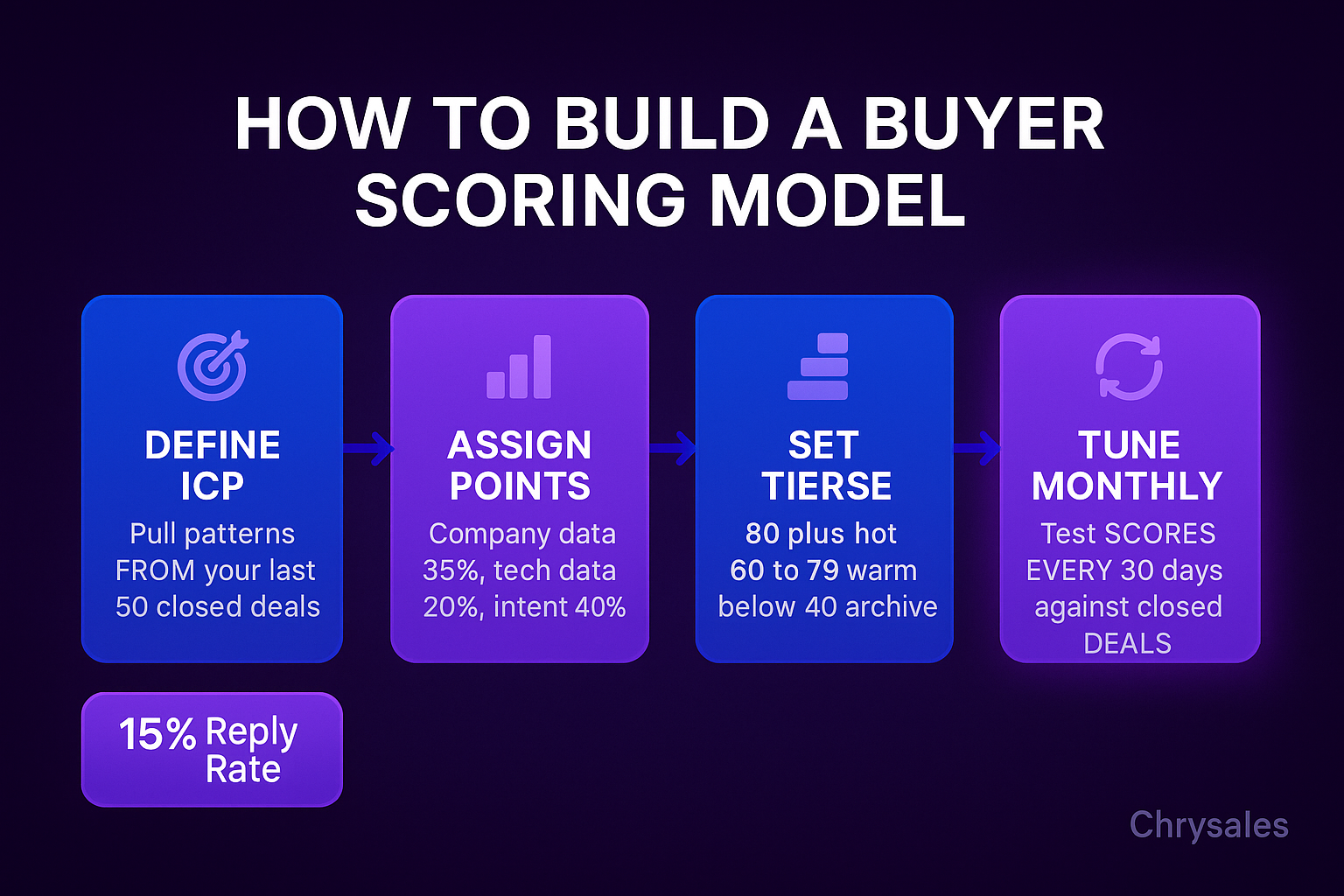
Core buyer scoring attributes predict revenue when they correlate with closed deals in B2B lead generation. Attributes earn inclusion based on conversion data, not account fit alone.
Firmographic attributes
Firmographic attributes provide baseline ICP alignment.
Technographic attributes
Technographic attributes indicate buying readiness through tech stack data. Clay integrations pull this data at scale for B2B sales teams.
Behavioral and intent attributes
Behavioral and intent attributes outperform firmographics by tracking job changes in revenue roles, hiring spikes for sales positions, recent product launches, and pricing page visits. Clay intent data plus website analytics enable these signals in one workflow.
Negative attributes
Negative attributes subtract points for red flags like layoff cycles, churn from competitors, or restricted industries.
Building the scoring model: A practical implementation walkthrough
Building the scoring model structures Clay buyer scoring attributes and implementation to reflect buying probability through weighted formulas. Weights derive from deal data. Teams that pair this with a broader sales transformation framework tend to see scoring stick across the entire revenue motion rather than dying inside a single workflow.
Step 1: Define your ICP in revenue terms
Closed deals from the last 20 to 50 provide shared traits for ICP definition. Patterns like 15 to 50 person consulting firms in DACH form the model base.
Step 2: Assign weights based on deal data
Step 3: Set score thresholds for action
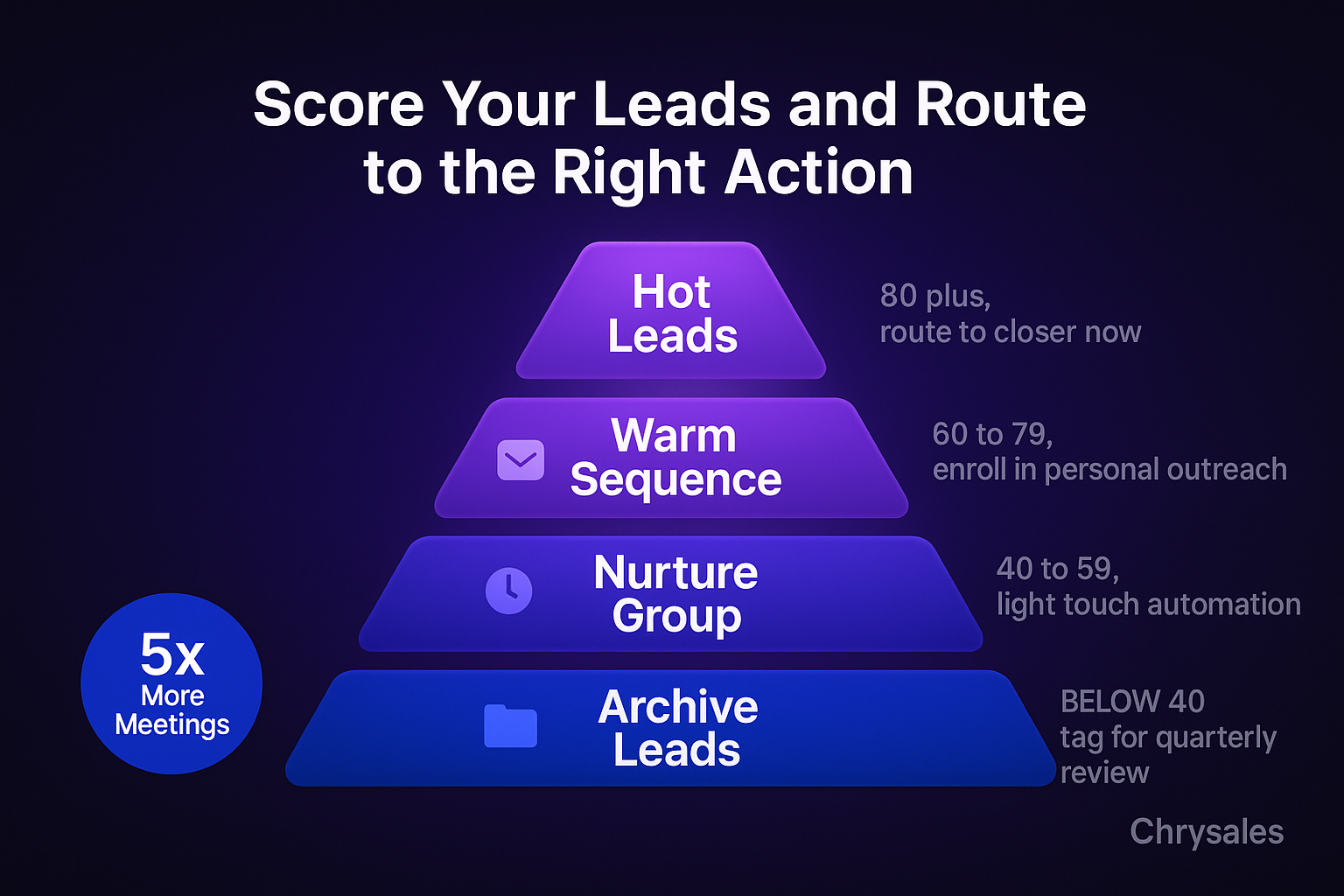
Score thresholds trigger actions in this tiering:
Step 4: Validate against closed deals
High-scoring accounts convert at higher rates than low-scoring ones after 30 days. Adjust weights if validation fails, then re-run.
Waterfall enrichment: The backbone of reliable scoring
Waterfall enrichment ensures complete input data for scoring models in Clay workflows. Match rates increase from 40% on single providers to 85% with stacked sources.
How to structure a waterfall
Common enrichment fields to waterfall
Each extra provider adds credits per row. Implementation triggers next sources only on null returns.
AI-powered personalization inside the scoring workflow
AI personalization generates outreach content based on scored attributes in Clay workflows. Clay AI columns produce first lines, pain hypotheses, and offer angles before sequencing.
Where AI columns add the most value
A simple AI prompt structure that works
AI columns use prospect role, company signal, and offer promise to connect inputs in one sentence. Teams combining Clay scoring with AI personalization achieve reply rates that align with benchmarks for high-performing outbound teams, often landing in the 8-15% range.
Routing, triggers, and closing the loop with your CRM
Routing connects scoring thresholds to workflows in sales stacks for client acquisition. Clay CRM integration turns scored lists into meetings and revenue, and the long-term payoff comes from building a sales system that scales around scoring rather than treating routing as an afterthought.
Routing logic that drives client acquisition
Closing the feedback loop
Closed deals sync back to Clay for monthly weight recalibration. Static lists differ from learning systems this way. For a deeper walkthrough on the methodology behind this, watch this breakdown on building a sales system for predictable client acquisition and how scoring fits inside it.
Why most teams skip this step
Routing requires engineering time, where sales training addresses gaps in lean teams. Chrysales builds this infrastructure for B2B companies generating €10M+ in tracked client revenue, combining Clay scoring with outreach systems and trained closers.
Common implementation mistakes that kill ROI
Common mistakes stall Clay deployments in GTM efforts. Addressing them upfront preserves credits.
Over-engineering the model on day one
Start with 8 to 10 attributes. Add after 30 days of data; 40+ attributes fail without validation.
Ignoring offer-market fit
Scoring cannot fix weak offers in B2B sales. Reply rates under 2% on high scores indicate positioning issues.
Treating Clay as a standalone solution
Clay functions as a layer in sales systems with ICP, offer, closer training, and CRM. Winning teams integrate it into a larger GTM motion, which is exactly what an efficient sales system for 2026 is designed to deliver. The closer training piece is critical too, and this overview of sales progression and closing techniques shows what high-converting reps do once a hot lead lands in their inbox.
Skipping validation cycles
Test weights every 30 to 60 days against closed-won data. Models decay without updates.
Frequently asked questions
Q1: What are the most important Clay buyer scoring attributes to start with?
Firmographics like headcount, industry, and region form the start, followed by two or three behavioral signals such as recent hiring or funding. Limit to under 10 attributes for quick validation, then add technographics based on closed deals.
Q2: How long does Clay buyer scoring attributes and implementation take to set up?
Basic models take 5 to 10 days for ICP, attributes, enrichment, and routing. Full optimization requires 60 to 90 days with conversion data.
Q3: Can Clay replace an enterprise ABM platform like 6Sense?
Clay suits SMB and mid-market B2B sales teams under 50 employees with customizability and lower cost. Enterprises need large-scale intent data budgets.
Q4: How does scoring connect to actual revenue outcomes?
Scoring allocates human attention by threshold, shortening sales cycles 2-3x for high scores matching prior wins. Validation against closed data confirms links.
Q5: Do I need a developer to implement Clay scoring workflows?
Clay requires no code; sales operators build workflows. Strategy for ICP, weights, and offers demands focus.
Q6: What ROI should a properly scored Clay system produce?
Validated systems yield 8-15% reply rates and 3-5x meeting bookings versus flat outbound. Pipeline covers costs within 90 days if offer and closers align.
Clay buyer scoring attributes and implementation assigns numerical values to prospects based on firmographic, technographic, behavioral, and negative attributes to prioritize B2B lead generation workflows. Teams achieve higher pipeline quality by integrating Clay scoring with GTM strategies, where structured B2B sales processes filter leads before outreach. Companies using validated models report reply rates of 8-15% versus 1-3% for untargeted efforts.
Why Clay buyer scoring attributes and implementation decide your pipeline quality
Clay buyer scoring attributes and implementation determines pipeline quality by prioritizing accounts that match closed-deal patterns. Clay pulls data from over 100 providers, but raw data does not close deals. Companies running structured Clay lead generation workflows see reply rates increase by factors reported in 2024 B2B sales benchmarks and statistics, compared to flat list outreach. Scoring filters noise before a single email goes out.
The cost of poor scoring
When buyer scoring attributes in Clay lack structure, sales reps waste hours on accounts that will never buy. Cold outreach burns sender reputation on irrelevant inboxes. Pipeline forecasting becomes guesswork.
The shift from list building to system building
Clay lead gen supports B2B sales when scoring functions as a system decision. Every attribute maps to a revenue hypothesis, and every score threshold triggers a defined action.
Core buyer scoring attributes that actually predict revenue
Core buyer scoring attributes predict revenue when they correlate with closed deals in B2B lead generation. Attributes earn inclusion based on conversion data, not account fit alone.
Firmographic attributes
Firmographic attributes provide baseline ICP alignment.
- Headcount and headcount growth over the last 12 months
- Funding stage and recent funding rounds
- Industry vertical and sub-vertical
- Geographic region and revenue band
Technographic attributes
Technographic attributes indicate buying readiness through tech stack data. Clay integrations pull this data at scale for B2B sales teams.
Behavioral and intent attributes
Behavioral and intent attributes outperform firmographics by tracking job changes in revenue roles, hiring spikes for sales positions, recent product launches, and pricing page visits. Clay intent data plus website analytics enable these signals in one workflow.
Negative attributes
Negative attributes subtract points for red flags like layoff cycles, churn from competitors, or restricted industries.
Building the scoring model: A practical implementation walkthrough
Building the scoring model structures Clay buyer scoring attributes and implementation to reflect buying probability through weighted formulas. Weights derive from deal data. Teams that pair this with a broader sales transformation framework tend to see scoring stick across the entire revenue motion rather than dying inside a single workflow.
Step 1: Define your ICP in revenue terms
Closed deals from the last 20 to 50 provide shared traits for ICP definition. Patterns like 15 to 50 person consulting firms in DACH form the model base.
Step 2: Assign weights based on deal data
- Firmographics: 30 to 40% of total score
- Technographics: 15 to 25%
- Behavioral and intent: 35 to 45%
- Negative attributes: subtract up to 30 points
Step 3: Set score thresholds for action
Score thresholds trigger actions in this tiering:
- 80 to 100: hot, route to a closer immediately
- 60 to 79: warm, enroll in a personalized sequence
- 40 to 59: nurture with light-touch automation
- Below 40: archive or recycle next quarter
Step 4: Validate against closed deals
High-scoring accounts convert at higher rates than low-scoring ones after 30 days. Adjust weights if validation fails, then re-run.
Waterfall enrichment: The backbone of reliable scoring
Waterfall enrichment ensures complete input data for scoring models in Clay workflows. Match rates increase from 40% on single providers to 85% with stacked sources.
How to structure a waterfall
- Primary source: highest accuracy provider for geography
- Secondary source: broader coverage backup
- Tertiary source: niche provider for technographic or intent gaps
- AI fallback: prompt-based column for missing fields
Common enrichment fields to waterfall
- Work email
- Direct phone number
- LinkedIn URL and recent activity
- Tech stack
- Recent hiring signals
Each extra provider adds credits per row. Implementation triggers next sources only on null returns.
AI-powered personalization inside the scoring workflow
AI personalization generates outreach content based on scored attributes in Clay workflows. Clay AI columns produce first lines, pain hypotheses, and offer angles before sequencing.
Where AI columns add the most value
- One-line opener from recent company event
- Prospect pain hypothesis
- Case study recommendation by industry
- Message-market fit score
A simple AI prompt structure that works
AI columns use prospect role, company signal, and offer promise to connect inputs in one sentence. Teams combining Clay scoring with AI personalization achieve reply rates that align with benchmarks for high-performing outbound teams, often landing in the 8-15% range.
Routing, triggers, and closing the loop with your CRM
Routing connects scoring thresholds to workflows in sales stacks for client acquisition. Clay CRM integration turns scored lists into meetings and revenue, and the long-term payoff comes from building a sales system that scales around scoring rather than treating routing as an afterthought.
Routing logic that drives client acquisition
- Score 80+: push to CRM as priority, notify rep in Slack
- Score 60 to 79: enroll in sequence with variables
- Score 40 to 59: add to LinkedIn engagement
- Score below 40: tag for quarterly review
Closing the feedback loop
Closed deals sync back to Clay for monthly weight recalibration. Static lists differ from learning systems this way. For a deeper walkthrough on the methodology behind this, watch this breakdown on building a sales system for predictable client acquisition and how scoring fits inside it.
Why most teams skip this step
Routing requires engineering time, where sales training addresses gaps in lean teams. Chrysales builds this infrastructure for B2B companies generating €10M+ in tracked client revenue, combining Clay scoring with outreach systems and trained closers.
Common implementation mistakes that kill ROI
Common mistakes stall Clay deployments in GTM efforts. Addressing them upfront preserves credits.
Over-engineering the model on day one
Start with 8 to 10 attributes. Add after 30 days of data; 40+ attributes fail without validation.
Ignoring offer-market fit
Scoring cannot fix weak offers in B2B sales. Reply rates under 2% on high scores indicate positioning issues.
Treating Clay as a standalone solution
Clay functions as a layer in sales systems with ICP, offer, closer training, and CRM. Winning teams integrate it into a larger GTM motion, which is exactly what an efficient sales system for 2026 is designed to deliver. The closer training piece is critical too, and this overview of sales progression and closing techniques shows what high-converting reps do once a hot lead lands in their inbox.
Skipping validation cycles
Test weights every 30 to 60 days against closed-won data. Models decay without updates.
Frequently asked questions
Q1: What are the most important Clay buyer scoring attributes to start with?
Firmographics like headcount, industry, and region form the start, followed by two or three behavioral signals such as recent hiring or funding. Limit to under 10 attributes for quick validation, then add technographics based on closed deals.
Q2: How long does Clay buyer scoring attributes and implementation take to set up?
Basic models take 5 to 10 days for ICP, attributes, enrichment, and routing. Full optimization requires 60 to 90 days with conversion data.
Q3: Can Clay replace an enterprise ABM platform like 6Sense?
Clay suits SMB and mid-market B2B sales teams under 50 employees with customizability and lower cost. Enterprises need large-scale intent data budgets.
Q4: How does scoring connect to actual revenue outcomes?
Scoring allocates human attention by threshold, shortening sales cycles 2-3x for high scores matching prior wins. Validation against closed data confirms links.
Q5: Do I need a developer to implement Clay scoring workflows?
Clay requires no code; sales operators build workflows. Strategy for ICP, weights, and offers demands focus.
Q6: What ROI should a properly scored Clay system produce?
Validated systems yield 8-15% reply rates and 3-5x meeting bookings versus flat outbound. Pipeline covers costs within 90 days if offer and closers align.
Discover the latest tips
View All.avif)
Chrysales was formed from the words "chrysalis" the stage where a caterpillar transforms into a butterfly and "sales".
It stands for one thing: sales transformation.Because scaling doesn’t happen by doing more of the same. Scaling only happens when you go through real transformation in your systems, your offer, team and the way you sell.
.avif)


